







Abstract
Two decades after the end of the Soviet Union, the global capitalist economy narrowly escaped total collapse in the ‘Great Recession’ of 2008–2009. The world in the twenty-first century has entered into a new era of crisis, which is economic, political and environmental. What will happen between now and the mid-twenty-first century that may shape and largely determine the future of humanity for centuries to come. On the occasion of the centennial anniversary of the October Revolution, this article re-evaluates the trajectory of the twentieth century socialism and identifies its legacies. It also considers the unique character of contemporary contradictions and argues that the formation of new industrial working classes may fatally undermine the system’s political legitimacy and raise again the ‘spectre of communism’ that Marx and Engels predicted, this time not only in Europe but also in the entire globe.
Introduction
One hundred years ago, the European countries were involved in a massive massacre against each other that left 17 million dead and 20 million wounded. It was in this historical context that Rosa Luxemburg uttered the slogan that humanity faced the historical choice between the ‘transition to socialism’ and ‘regression to barbarism’ (Angus, 2014).
As the imperialist war machine began to crumble at its ‘weakest link’, the Tsarist Empire collapsed in March 1917. Eight months later, the Bolsheviks came to power with the support of the workers’ and soldiers’ soviets in Petrograd and Moscow—known as the ‘October Revolution’ because the Petrograd workers’ uprising took place on 25 October 1917, by the Orthodox calendar. Strangled by starvation and industrial collapse and surrounded by domestic counter-revolutionary forces as well as hostile foreign powers, the Bolshevik-led Soviet power might not have survived. Against all odds, the Soviet Republic emerged victoriously from 3 years of bloody civil war.
In December 1922, the Union of the Soviet Socialist Republics (USSR) was created. From 1928 to 1937, the Soviet Union achieved the most rapid industrialization the world had known by then under the first and second 5-year plans. After the defeat of Nazi Germany, the Soviet Union became the world’s second strongest military power and the leader of the ‘socialist bloc’, which extended from Elbe to Yalu and, at its peak, included one-third of the world’s population and two-fifths of total land area.
By the 1980s, the Soviet Union entered into a period of economic and political crisis. The Soviet ruling elites responded to the crisis by accelerating the transition to capitalism (Kotz, 1997). The Fall of the Berlin Wall in 1989 and the dissolution of the Soviet Union in December 1991 were celebrated by the ideologists of the capitalist world system as the ‘end of history’ that marked the final victory of ‘liberal capitalism’ against all of its ideological opponents (Fukushima, 1989). Barely two decades after the so-called ‘end of history’, the global capitalist economy narrowly escaped total collapse during the ‘Great Recession’ of 2008–2009. The world has entered into a new era of economic, political and environmental crisis. History is back!
At the centennial anniversary of the October Revolution, it is time to re-evaluate the historical records of the twentieth century socialism, reflect upon its historical roots and identify its legacies. What happened in 1917 shaped and largely determined the course of world history in the twentieth century. What will happen between now (2017) and the mid-twenty-first century may shape and largely determine the future of humanity for centuries to come.
1917: Socialism in One Country
According to V.I. Lenin, socialism should be the ‘first’ or ‘lower phase’ of communism, as Karl Marx explained in the Critique of the Gotha Programme. In this ‘lower phase’, although the means of production are socialized, ‘bourgeois law’ is not yet fully abolished and certain economic inequalities (safeguarded by the state) will continue to exist. This ‘lower phase’ will then create the necessary conditions for the ‘higher phase’ of communism by bringing about ‘an enormous development of the productive forces’ and ‘doing away with the antithesis between mental and physical labor’ (Lenin, 1964 [1918]).
The Bolsheviks understood that Russia, being a ‘backward’ country in comparison with the Western industrial capitalist countries, did not have the necessary material conditions required for the transition to communism. The hope at the time was that the Russian Revolution would lead to a general European Proletarian Revolution. The European working classes would then build socialism together and provide leadership for the global transition from capitalism to communism.
By the early 1920s, it became clear that the envisioned European Revolution would be permanently postponed. After intense internal debate and power struggle, the Bolshevik Party settled for ‘socialism in one country’. Over the following decades, the Soviet Union made enormous economic and social achievements. However, rather than gradually abolishing the ‘bourgeois law’ and creating conditions for the ‘higher phase’ of communism, bureaucratic privileges and economic inequalities were widened rather than reduced, the division of mental labour and physical labour were reinforced and solidified rather than abolished, the state became not only repressive but also increasingly alienated from the labouring masses.
In the above sense, the Soviet Union and the other ‘socialist states’ in the twentieth century could not be considered the ‘first phase’ of communism that should have paved the way for the higher, more advanced phase of a classless society. However, such a comparison between the theoretical conception of communism and the historical reality of the twentieth century socialism, by itself, does not help us to understand the historical roots of the Russian Revolutions and several major revolutions that were inspired and made possible by the Russian Revolution, such as the Chinese, the Cuban and the Vietnamese. Nor does it provide the only criterion against which the twentieth century socialism should be evaluated. The historical rationality of the twentieth century socialism has to be judged in its world-historical context.
By the late nineteenth century, the capitalist world system had become dominant throughout the world and became the first global system in human history. There are three structural layers in the capitalist world system: the core, the periphery and the semi-periphery. While the world wealth is concentrated in the core, the periphery provides the system with cheap labour and natural resources. The semi-periphery, being the intermediate layer, historically has been the geographical zone characterized by intense economic and political instabilities.
In the late-nineteenth and early-twentieth centuries, Russia was a highly unstable semi-peripheral country that struggled to survive in the face of rapidly escalating interstate conflicts and growing social demands from competing social classes. After its defeat at the Russo-Japanese War in 1904–1905, the Russian Empire was threatened by not only internal instability and the possibility of revolution but also a permanent decline from the semi-periphery into the periphery. The Russian Revolution, by overthrowing the old ruling classes and completely restructuring the state, succeeded in mobilizing economic resources for accelerated industrialization. By the mid-twentieth century, the Soviet Union not only had succeeded in consolidating the status of being a strong semi-peripheral state but also appeared to be on the way to claim a position in the core in due time (Wallerstein, 1974a).
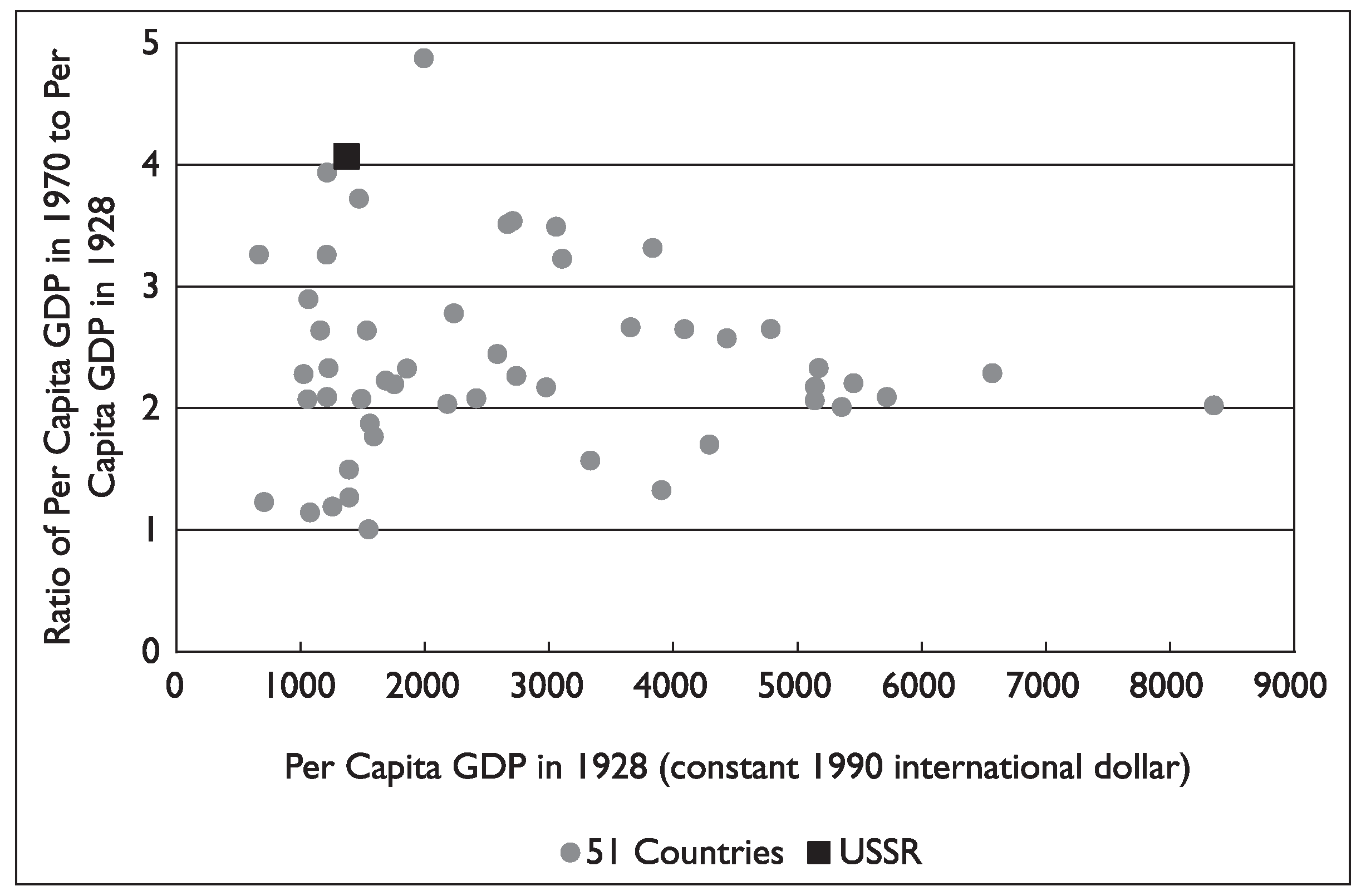
Contrary to the post-1989 neoliberal consensus that often portrays the economic performance of the Soviet socialism as a complete failure, for about half a century, the Soviet Union was one of the world’s most rapidly growing economies. Figure 1 compares the long-term growth of per capita gross domestic product (GDP) for 51 countries for which data are available for the period 1928–1970.
The horizontal axis shows a country’s initial per capita GDP (in constant 1990 international dollar) in 1928. The vertical axis shows the magnitude of a country’s total economic growth measured by the ratio of the country’s per capita GDP in 1970 to that in 1928.
For the period 1928–1970, the Soviet growth performance was extremely impressive. During 1928–1970, Soviet per capita GDP quadrupled, making the Soviet Union the second-fastest growing economy in this period (slower only to Japan). The Soviet Union was the fastest growing economy among a number of countries that had similar income levels in 1928, which include Brazil, Bulgaria, Colombia, Costa Rica, Ecuador, Guatemala, Honduras, Indonesia, Malaysia, Nicaragua, Philippines, Portugal, Romania, El Salvador, Taiwan, Turkey and Yugoslavia (with a per capita GDP ranging from USD1,000 to USD1,700 in 1928). The Soviet Union accomplished this great performance despite the massive destruction it suffered during the Second World War. If the comparison is extended to 1928–1980, the Soviet Union would still rank among the top 10 fastest growing economies.
The Soviet achievements were not limited to economic growth. The Soviet Union virtually eliminated illiteracy among the adult population and provided free health care and education to all citizens. It matched the Western capitalist countries in many areas of science and culture. The Soviet workers enjoyed full employment, job security and pensions (Mottas, 2016).
Despite these economic and social achievements, the Soviet Union remained as a part of the capitalist world system and compelled to operate according to certain laws of motion of the system. In the 1930s, the Soviet Union was among the main beneficiaries of global capital relocation. Large-scale importation of up-to-date Western capital goods made a crucial contribution to Soviet industrialization (Sutton, 1971). By the 1970s, the Soviet Union began to fall behind the leading capitalist countries in the pace of technological progress. Being a semi-peripheral country, the Soviet Union was unable to match the core capitalist countries in terms of financial resources spent on scientific and technological research. Moreover, a large part of Soviet resources used for science and technology had to be committed to military purposes in order to maintain a certain degree of strategic equilibrium against the USA.
On the other hand, by the 1970s, partly because of the success of urbanization and industrialization, the Soviet Union had to accommo-date growing economic and social demands from the working class and the urban middle-class. This compelled the Soviet Union to spend a larger proportion of the national income for mass consumption. Thus, the Soviet Union was squeezed between its inability to compete with the Western capitalist economies on technology frontier and the growing social pressure from the largely urbanized population. In this respect, the Soviet Union found itself in a dilemma that was not unlike what confronted other semi-peripheral countries, in Eastern Europe, Southern Europe and Latin America.
1848: The Grave-diggers
In April 1917, Lenin proposed that the Bolsheviks should rename their political party as the ‘Communist Party’, to distinguish them from the revisionist social democrats who had betrayed the cause of socialism, and emphasize the Party’s Marxist foundation that was first elaborated by Marx and Engels in 1848 (Lenin, 1964 [1917], pp. 84–88).
In The Communist Manifesto, Marx and Engels argued that while capitalism (or bourgeois society) had brought about unprecedented development of material productive forces, these productive forces came increasingly into conflict with the bourgeois relations of production, such that capitalism ‘fetters’ prevented further development of productive forces. Marx and Engels advanced two hypotheses. First, the conflict between the modern productive forces and the capitalist relations of production would lead to increasingly more destructive economic crises (the revolt of modern productive forces against modern conditions of production). Second, capitalist development had brought about major social transformations and a new social class, the wage workers or ‘proletariat’, would soon become the majority in the population. As the proletarianized working class grew in number and became organized in labour unions and political parties, it would begin to undermine the foundation of capitalist accumulation which rested upon the exploitation of wage labour. It was for this reason that Marx and Engels proclaimed that ‘[w]hat the bourgeoisie … produces, above all, is its own grave-diggers’ (Marx & Engels, 1978 [1848]).
By the late-nineteenth century, labour unions and working class political parties expanded rapidly in Western Europe and North America. In continental Europe, Marxism became the official programme of socialist or social democratic parties that formed the Second International. Soon after its founding, a major debate erupted between the right-wing social democrats (who became known as the ‘revisionists’) represented by Eduard Bernstein and revolutionary Marxists represented by Rosa Luxemburg and Lenin. Bernstein argued that many of Marx’s arguments were no longer suitable to the changing capitalist realities. According to Bernstein, capitalist economic crisis had been moderated; the middle classes did not disappear but expanded; the working class living standards had improved. Bernstein argued for social reform within capitalism, which would eventually evolve into socialism (Bernstein, 1993 [1899]).
Bernstein’s revisionism provided theoretical justification for the practice of the German Social Democratic Party, which had become the largest party in the German Reichstag (the imperial parliament) before the First World War. When the war broke out, the German Social Democratic Party and other major European socialist parties betrayed the official anti-war declarations of the Second International and decided to support their respective national governments in the imperialist war. In his pamphlet on Imperialism, the Highest Stage of Capitalism, Lenin tried to understand the historical conditions of the revisionism of the Second International. According to Lenin, through exploitation of colonies and semi-colonies, the Western imperialist countries were able to accumulate an enormous amount of wealth, which they could use to ‘buy off’ a section of the proletariat. In effect, the ‘labour aristocracies’ or a section of the proletariat in the Western imperialist countries were able to share a portion of the surplus value exploited from the rest of the world, and this constituted the material basis for the revisionism of the Second International (Lenin, 1963 [1916], pp. 276–284).
Lenin’s theory on imperialism helped to inspire the development of the world system theory after the 1960s.
Capitalism as a Historical System
The capitalist world system first emerged in Western Europe in the sixteenth century. By the nineteenth century, the system had become the first global system in human history. As a social system that existed under certain historical conditions and during a certain historical period, the capitalist world system (or capitalism) has certain unique features and tendencies.
Since the beginning of agriculture about 10,000 years ago, most human societies have had significant amounts of surplus product (defined as the part of a society’s total material production that is over and above replacement of material inputs and what is needed to meet the population’s subsistence needs). How the surplus product is appropriated and how it is used has largely determined a society’s basic characteristics.
In pre-capitalist societies, surplus product was almost entirely used for elites’ luxury consumption and various non-productive purposes (e.g., military campaigns, religious activities and grand imperial buildings). By contrast, under capitalism, a large portion of the surplus product is typically used for ‘expanded reproduction’, or capital accumulation.
In global and national capitalist markets, individual capitalists engage in constant and intense competition against one another. Those who succeed become wealthier and more powerful. Those who fail become bankrupt and cease to be capitalists. To prevail in competition, each capitalist is compelled to use a large portion of the surplus value (the commodity or monetary form of surplus product) to expand his or her business or invest in new technologies that may help to lower costs of production. At the system level, competition between nation-states imposes strong pressure on states to promote or directly undertake capital accumulation. Those states that fail to promote capital accumulation effectively are threatened to become ‘failed states’ that are unable to maintain political cohesion and may be destroyed either internally or externally. These mechanisms together have generated a powerful tendency towards accumulation of capital on increasingly larger scales. Thus, Immanuel Wallerstein defines capitalism as the historical system driven by the ‘endless accumulation of capital’ (Wallerstein, 2004, p. 24).
The capitalists accumulate capital in order to make profits (surplus value or the difference between revenue and costs). Historically, capitalist economic dynamics had failed to prevail in various historical systems because of many obstacles that prevented capitalists from receiving sufficiently high profit rates (rates of return on capital, or amount of profit per unit of capital invested). For capitalism to spread and establish itself as the dominant economic dynamic, various costs and risks have to be lowered so that high profit rates can provide sufficient motivation for capitalists to undertake capital accumulation as a self-sustained process.
In the history of the capitalist world system, this has been made possible by the concentration of world surplus value in the core countries that have included a small fraction of the world population. The transfer of the surplus value from the periphery to the core has taken place through direct conquest and plunder as well as unequal exchange (the peripheral countries export commodities that embody comparatively more labour in exchange for commodities from the core that embody comparatively less labour).
The concentration of world surplus value in the core allows the capitalists in the core countries to make large, monopolistic profits. Motivated by high profit rates, the core countries have functioned as the centres of global capital accumulation, up to the late-twentieth century. Moreover, the surplus value transferred from the rest of the world allows the core countries to share some of the surplus value with the domestic working classes and urban middle-classes (highly skilled professional and technical workers). Higher wages and social spending help to maintain a certain level of social compromise and ensure the political loyalty of several sectors of workers (such as highly skilled workers, scientific researchers, ideologists, bureaucrats, soldiers and military officers) that are crucial for the system’s operations.
Over the course of capitalist history, capital accumulation in the core countries tended to drive up the internal costs of labour and material inputs after several decades of rapid economic expansion. Higher labour and material costs led to falling profit rates and accumulation crisis, which in turn led to economic and political instabilities. To overcome the crisis, the core countries need to find new sources of large, monopolistic profits by transferring their capital from the old, declining industries to the new, ‘leading’ industries. In addition, the core countries needed to relocate the old industries to places where costs were sufficiently low and other conditions required for capital accumulation (such as political institutions and physical infrastructure) were more or less prepared. Historically, the semi-peripheral countries were the primary recipients of industries relocated from the core (Wallerstein, 1974b). Both the Soviet Union and several large Latin American countries were the main beneficiaries of global industrial relocation in the 1930s.
By 1945, the Red Army was in Berlin and the Soviet sphere of influence extended across the Eurasian continent. Marxist-Leninist parties became the ruling parties in about two-fifths of the world’s land area where one-third of the world population lived. Marx’s original hypothesis that the proletariat would become the grave-diggers of capitalism appeared to be well on its way to be fully confirmed.
On the other hand, a careful reading of Marx’s original hypothesis suggests that the ‘socialist revolutions’ did not take place in the predicted or intended places. With the exception of Eastern Germany (and perhaps Czechoslovakia), where ‘socialism’ was imposed by the Red Army, most ‘socialist revolutions’ took place in countries that had not yet completed industrialization and the peasants accounted for the overwhelming majority of the population. While the Russian Revolution was arguably a working class revolution in a country where the proletarianized working class was a minority, the Chinese, Vietnamese and Cuban revolutions were clearly peasant-based revolutions. Most of the world’s proletarianized wage workers were in the core zone of the capitalist world system.
The Second World War ended with the consolidation of the American hegemonic power. The US-led global capitalist restructuring created the necessary conditions for unprecedented global economic boom over the following quarter of a century. In the core capitalist countries, welfare state institutions were established and expanded. Collective bargaining between big corporations and ‘big’ labour unions allowed workers in the Western capitalist countries to share a portion of the productivity gains and enjoy steadily rising living standards. Through these arrangements, the economic and social demands of the Western working classes were accommodated by the post-war global capitalist structure and the ‘spectre of communism’ that Marx and Engels raised in the opening page of The Communist Manifesto seemed to have been successfully expelled, at least from the land of the ‘developed world’.
1968: The Speeding-up of Social History
Up to the mid-twentieth century, industrialization and therefore ‘proletarianization’ of the labour force, was limited to the core capitalist countries and a few semi-peripheral countries. The combined population of the core and the semi-periphery was about one-third of the world population around 1950 (Li, 2015, p. 68). There was still a sizeable rural population in both the semi-periphery and some core countries. If one-third of the total core and semi-peripheral labour force consisted of proletarianized wage workers, then the core and semi-peripheral proletarianized working classes combined probably accounted for about 10 per cent of the world labour force. Proletarianized wage workers in the periphery were insignificant before the mid-twentieth century.
During the post-war global economic boom, there was massive expansion of the proletarianized working class in both the core and the semi-periphery. By the 1960s, the remaining rural surplus labour force in the core and some semi-peripheral countries was largely depleted. In the core countries, the workers’ bargaining power was further strengthened by the welfare-state institutions and labour unions. By the second half of the 1960s, working class militancy and revolutionary surges threatened to destroy the existing social order throughout the three layers (core, semi-periphery and periphery) of the capitalist world system. The worldwide anti-systemic rebellions and protests climaxed in the year 1968, named by Wallerstein as a year of ‘world revolution’ (Wallerstein, 2004, pp. 84–85).
In previous major capitalist crises, intensification of social conflicts was preceded by the system-wide economic and political crises. By contrast, in the late-twentieth century, growth of working class militancy and intensification of social conflicts preceded and largely shaped the following economic and political crises. Silver and Slater referred to this historical phenomenon as the ‘speeding-up of social history’ (Silver & Slater, 1999).
In response to the global crisis, the ruling classes took action to slow down and roll back the progress of ‘social history’. In Chile, the ‘Chicago Boys’ (young Chilean economists who were students of Milton Friedman) conducted the world’s first monetarist experiment under the Pinochet fascist government (‘monetarism’ was a key neoliberal macroeconomic policy designed to undermine the workers’ bargaining power by creating high levels of unemployment). In China, the ‘capitalist roaders’ in the Communist Party took over power after Mao’s death in 1976 and arrested the radical Maoist leaders. In Britain and the USA, the rise of Thatcher and Reagan marked the triumph of neoliberalism and the capitalist abandonment of the post-war social compromise.
The Soviet Union and its Eastern European allies were also pressured by the growing economic and social demands of working classes and urban middle classes. Soviet economic growth was undermined by the depletion of domestic natural resources (Allen, 2003, pp. 203–205). Higher labour and resource costs undermined Soviet capacity to export domestic goods in exchange for Western technologies.
In the 1970s, oil price shocks led to surges in US dollar deposits in Western banks by the Middle East oil exporters. Interest rates were driven down and borrowings from Western banks appeared to be attractive to semi-peripheral countries that were in desperate need to sustain rapid economic growth, as well as to meet the population’s rising consumption expectations. Foreign debts held by the Soviet Union, Eastern Europe, Latin America and a number of ‘developing countries’ surged. In 1979, the US Federal Reserve raised the interest rate to the highest level in the history of modern central banking. Debt crisis broke out throughout the periphery and semi-periphery.
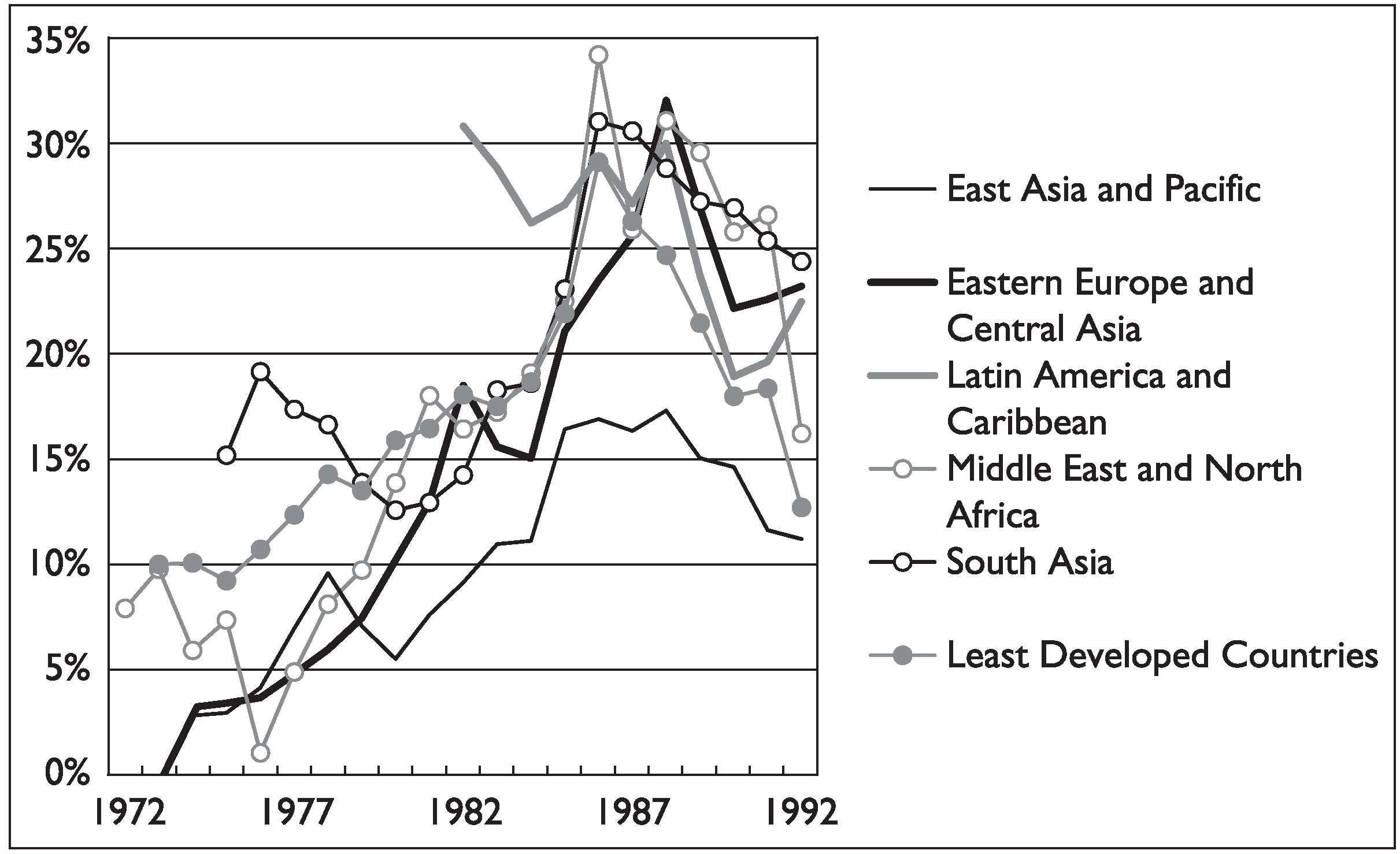
Figure 2 illustrates the debt crisis in the periphery and semi-periphery from the 1970s to the 1980s.
Before 1973, the Soviet Union and Eastern Europe (represented by ‘Eastern Europe and Central Asia’ in Figure 2) had virtually no foreign debt. By 1980, their debt service (payment of principals and interests) rose to about 10 per cent of their total export revenue. In that year, the Polish government’s attempt to shift the economic adjustment burden to the working class was met with massive strikes and protests. By 1988, the average debt service burden of the Soviet Union and Eastern Europe peaked at 32 per cent of their export revenue. In the following year, the socialist states in Eastern Europe collapsed one after another.
The fall of the Berlin War was not followed by freedom and prosperity. Instead, ‘shock therapies’ threw tens of millions into unemployment and poverty. In the Russian Federation, the total population’s life expectancy at birth fell from 69.2 years in 1989 to 64.4 years in 1994, a loss of nearly 5 years, or an average shortening of 7 per cent, over a 5-year period. During the same period, the male population’s life expectancy at birth fell from 64.2 years to 57.6 years. This represented a total loss of 6.6 years, or an average shortening of 10 per cent. Russian life expectancy did not begin to recover until 2006 (The World Bank, 2017).
The neoliberal economic policies (monetarism, privatization and liberalization) amounted to a strategy by the global ruling elites to redistribute income from the workers to the capitalists and from the periphery to the core in order to raise the global profit rate and restore favourable conditions for capital accumulation. For the global profit rate to recover, the capitalist world system needed to get rid of the ‘high cost’ industrial production in the Eastern European and Latin American semi-periphery. This was accomplished through ‘structural adjustments’ or ‘shock therapies’ enforced by the International Monetary Fund and the World Bank, with the cooperation of Eastern European and Latin American ruling elites.
For the neoliberal global restructuring to be successful, it could not simply be based on the destruction of the semi-peripheral industries. Instead, it was necessary for global capitalism to find a new, large geographical area that could provide a sufficiently large cheap labour force as well as abundant natural resources. China emerged as the ideal new platform of world manufacturing exports.
The economic rise of China has provided the global capitalist economy with a new engine of growth. But China’s economic rise has brought about fundamental changes both to China itself and to the rest of the world. In particular, China’s industrialization has led to the formation of the world’s largest industrial working class and greatly accelerated the worldwide process of proletarianization.
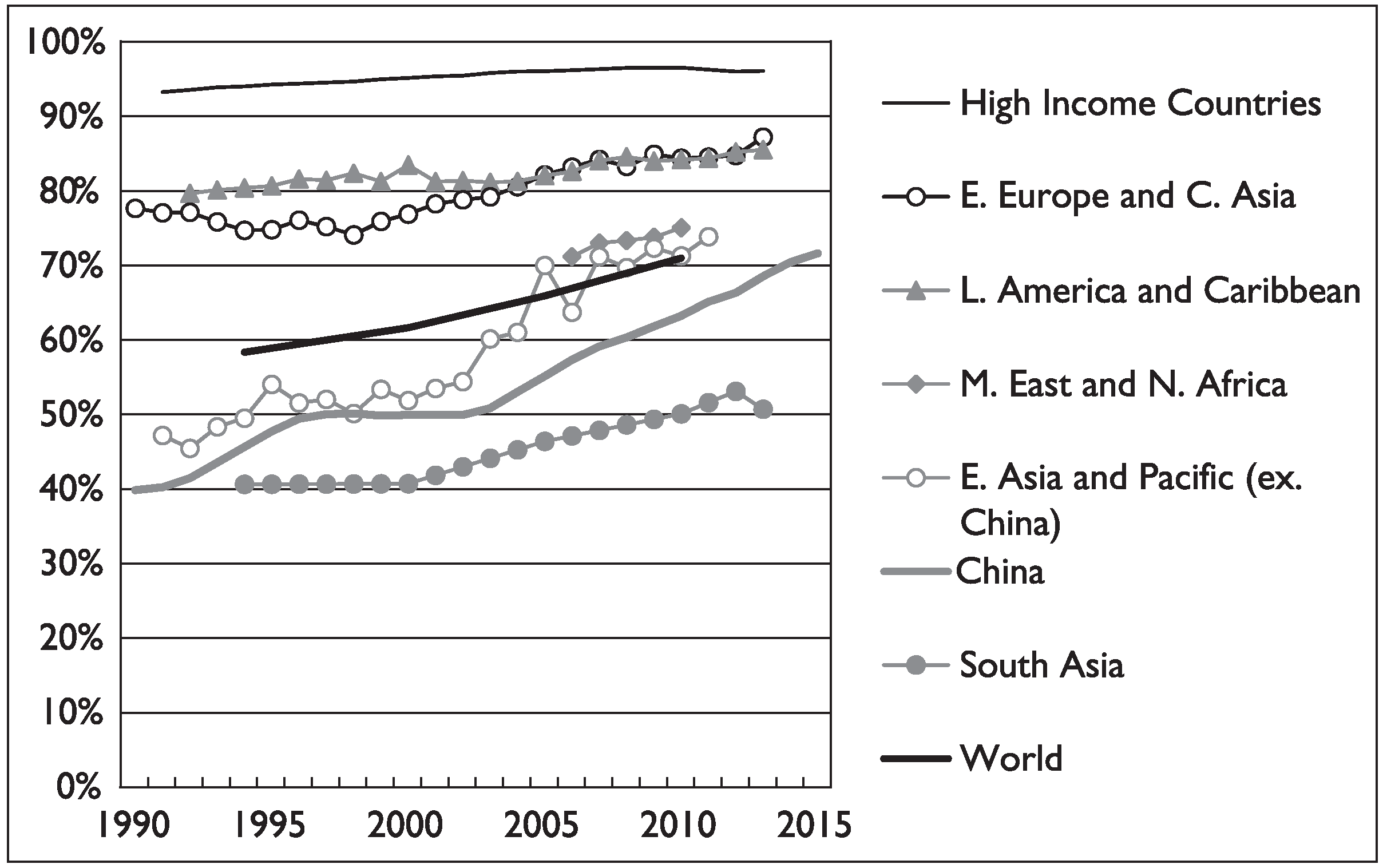
Figure 3 shows the growth of the non-agricultural employment as percentage of total employment in the world’s major regions.
Historically, the expansion of the capitalist world system has relied upon drawing upon cheap labour force from a large reserve of underemployed workers in the rural areas. In the neoliberal era, as a large part of the historical periphery (China and India) has been mobilized to participate actively in global capital accumulation, the global reserve of rural surplus labour force has been rapidly depleted. China’s non-agricultural employment as share of the total employment rose from 40 per cent in 1990, to 50 per cent in 2000, to 63 per cent in 2010 and 72 per cent in 2015. In South Asia, the share of non-agricultural employment exceeded 50 per cent in recent years. The non-agricultural employment share continued to grow in Eastern Europe, Latin America, the Middle East and East Asia (excluding China). The world average non-agricultural share of the total employment increased from 58 per cent in 1994, to 62 per cent in 2000 and 71 per cent in 2010. At this rate, the world average non-agricultural employment share could exceed 80 per cent by 2020.
Most non-agricultural employed persons are likely to be wage workers and live in the urban areas. They have better access to transportation, communication and educational resources and are more likely to get organized to demand economic and political rights. Historically, when the non-agricultural share of total employment exceeded 70 per cent in a number of semi-peripheral countries, these countries entered into a period of economic and political instability, as their existing economic regime failed to reconcile the growing demands from domestic working classes and urban middle classes, on the one hand, and the requirements of capital accumulation, on the other (Li, 2015, pp. 38–40).
According to Eric Wright (1997, pp. 97–108), in the USA (where nearly the entire labour force is employed in non-agricultural sectors), about one-half of the labour force consisted of fully proletarianized wage workers and all forms of wage workers accounted for about 90 per cent of the labour force in the 1980s.
Assuming that about one-half of the world’s non-agricultural labour force is composed of proletarianized wage workers, then currently the proletarianized working class accounts for about 35 per cent of the world labour force. The share of the proletarianized working class is likely to rise to about 40 per cent by 2020. This represents a quadrupling of the level of proletarianization compared to that in the mid-twentieth century and possibly a doubling relative to that in the 1960s and 1970s.
Historically, the proletarianization of the labour force was mainly limited to the Western part of the capitalist world system. In the 1960s, worldwide proletarianization (the share of the proletarianized working class in the total labour force) was probably around 15–20 per cent. However, the combined demands of the working classes and urban middle classes in the core and the semi-periphery already exceeded the accommodative capacity of the system. The capitalist world system was unable to meet the rising social demands from the Western world while maintaining the desired profit rate required for global capital accumulation.
The neoliberal restructuring attempted to restore the global profit rate by destroying the ‘high cost’ semi-peripheral industries and mobilizing the remaining geographic areas with cheap labour force and natural resources. But the neoliberal ‘success’ has greatly accelerated industrialization in much of the non-Western world, turning much of the non-Western labour force into proletarianized wage workers as well as high-skill professional and technical workers. In the coming decades, the newly proletarianized wage workers and newly urbanized middle classes in the non-Western world (especially in China and India) are likely to demand higher material living standards, as well as a wide range of political and social rights. This is likely to dramatically increase the global labour cost.
If global capitalism was unable to accommodate the economic and political demands from several hundreds of millions of Western workers without seriously undermining global capital accumulation, can it accommodate the combined demands from several billion workers from both the Western and the non-Western world, while maintaining the dynamic of global capital accumulation and averting the global ecological crisis?
2017: Climate Change
In Socialism: Utopian and Scientific, Engels argued that the basic contradiction of capitalism had to do with the antagonisms between the ‘socialization of production’ and the ‘capitalistic system of private appropriation’. Engels argued that this contradiction would lead to increasingly more destructive economic crises, forcing capitalism to adopt progressively more ‘socialized’ forms of economic organization. Only social ownership of the means of production and society-wide rational economic planning could bring the capitalist ‘anarchy of production’ to an end and provide the best institutional form for the development of modern productive forces (Engels, 1978 [1892]).
In the post-war years, expansion of the government sector and the regular application of Keynesian macroeconomic policies helped to stabilize the core capitalist economies and prevented the happening of Great-Depression-style violent economic crisis. In the neoliberal era, financial liberalization has led to frequent financial crises and much of the world in the periphery and semi-periphery suffered from depression-like economic destruction. Nevertheless, up to now, capitalism has survived various economic crises and it is unlikely that crisis of overproduction in its simple form will destroy capitalism in the foreseeable future.
What Marx and Engel did not anticipate is the unprecedented conflict between an economic system based on the endless accumulation of capital and the basic requirements of ecological sustainability upon which all forms of human civilization have depended.
The massive expansion of global capitalism has rested upon the exponential growth of material production and consumption, which has been made possible by the massive consumption of fossil fuels that began with the Industrial Revolution. The consumption of fossil fuels has resulted in emissions of carbon dioxide and other greenhouse gases that have led to global warming, threatening to bring about global climate catastrophes in the coming centuries.
The year 2016 was the hottest year since the modern records of global surface temperature began. According to the Goddard Institute of the US National Aeronautics and Space Administration, in 2016, the global average surface temperature was 1.25 degrees Celsius higher than the average of 1880–1920 (used as a proxy for the pre-industrial global temperature). The 10 year average from 2007 to 2016 was 0.97 degrees Celsius higher than the average of 1880–1920 (National Aeronautics and Space Administration [NASA], 2017).
According to James Hansen, one of the world’s leading climate scientists, if global warming exceeds 2 degrees Celsius (relative to the pre-industrial time), the sea level will rise by five to nine meters in the next 50 to 200 years, largely because of the collapse of the West Antarctica ice sheets. ‘It is unlikely that coastal cities or low-lying areas such as Bangladesh, European lowlands, and large portions of the United States eastern coast and northeast China plains could be protected against such large sea level rise’ (Hansen, Sato, Hearty, & Ruedy, 2016). If global warming rises above 3 degrees Celsius, sea level is likely to rise by 25 meters, the Amazon rainforest may collapse, water flows into Asia’s great rivers (the Indus, Ganges, Brahmaputra, Mekong, Yangzi and Yellow rivers) will fall by up to 90 per cent, drought and famine may turn large terrestrial areas uninhabitable, billions of environmental refugees may be forced to move from the sub-tropics to the mid-latitudes (Spratt & Sutton, 2008).
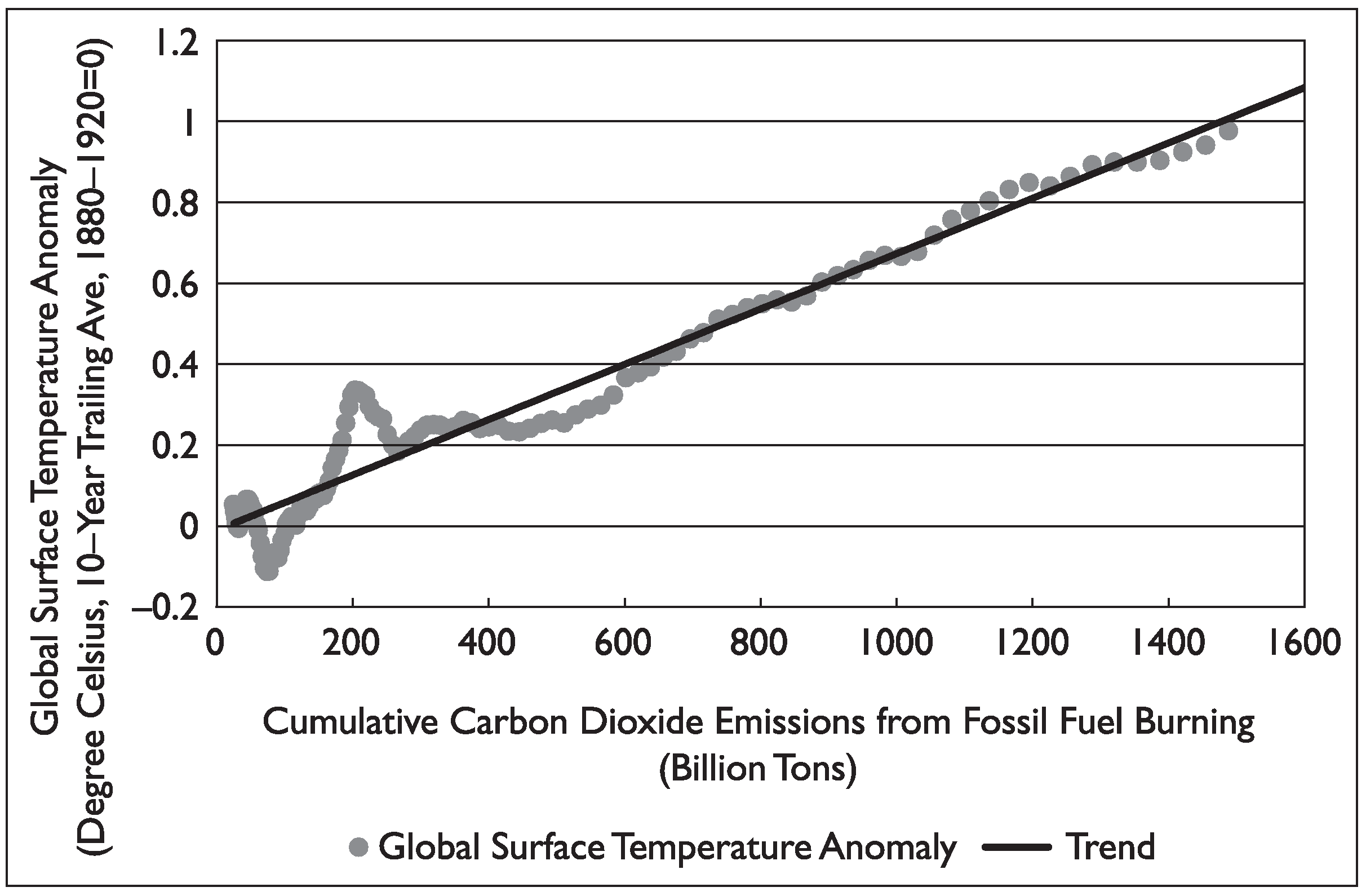
According to the Intergovernmental Panel on Climate Change’s Fifth Assessment Report, cumulative carbon dioxide emissions will largely determine the global mean surface warming by the late-twenty-first century and beyond (Intergovernmental Panel on Climate Change [IPCC], 2013, pp. 27–29). Figure 4 shows the historical relationship between the cumulative carbon dioxide emissions from fossil fuels burning (not including emissions from cement production and gas flaring) and the global surface temperature anomaly. Global surface temperature anomaly is measured as the difference between the global average surface temperature and the average global surface temperature in 1880–1920. The latter is used as a proxy for the pre-industrial global temperature (Hansen & Sato, 2016). Global surface temperature anomalies are shown in 10-year trailing averages to smooth out effects from short-term El Nino and solar irradiance cycles. The linear relationship between historical cumulative carbon dioxide emissions and the 10-year average global surface temperature anomalies indicate that for an increase of cumulative carbon dioxide emissions by 1 trillion tons, global surface temperature will rise by 0.68 degrees Celsius.
By 2020, the global cumulative carbon dioxide emissions from fossil fuels burning will have reached about 1.6 trillion tons and global average surface temperature will likely to be about 1.1 degrees Celsius warmer than the pre-industrial time. Thus, to prevent global warming from rising above 2 degrees Celsius by the end of the twenty-first century, further global warming from 2020 to 2100 should not exceed 0.9 degrees Celsius and the cumulative carbon dioxide emissions from 2020 to 2100 should not exceed 1.3 trillion tons based on the historical relationship between cumulative carbon dioxide emissions and the global surface temperature (0.9/0.68 = 1.32). This implies that the average annual global carbon dioxide emissions between 2020 and 2100 should be no more than 16.5 billion tons (1320/80 = 16.5). By comparison, the global economy currently emits about 33.5 billion tons of carbon dioxide each year.
According to United Nations projection, the world population will rise to about 9.7 billion by 2050 (United Nations [UN], 2015). Thus, to keep the global carbon dioxide emission within the cumulative budget over the last 80 years of the century, world per capita carbon dioxide emissions need to fall to 1.7 tons by 2050 (16.5/9.7 = 1.7). By comparison, world per capita carbon dioxide emissions (from fossil fuels burning only) in 2015 was about 4.6 tons. To stay within the global emissions budget, world per capita carbon dioxide emissions will have to fall by 63 per cent from 2015 to 2050, or by an average annual decline rate of 2.8 per cent. By contrast, from 2000 to 2015, world per capita carbon dioxide emissions increased at an average annual rate of 1 per cent.
Figure 5 shows the contribution of OECD countries (Organisation for Economic Co-operation and Development, the club of ‘developed’ capitalist countries that include all core capitalist countries and a few high-income semi-peripheral countries), the former Soviet Union, China, and the rest of the world to the global carbon dioxide emissions from 1980 to 2015.
In the 1970s, the OECD countries accounted for about two-thirds of the world total carbon dioxide emissions. The Soviet Union was the world’s second largest emitter, after the United States, and accounted for about one-sixth of the world total carbon dioxide emissions. The Soviet total emissions peaked in 1988 at 3.6 billion tons, or 17 per cent of world emissions. By 2000, total emissions in the former Soviet Union fell to 2.2 billion tons, or 9 per cent of the world emissions. The neoliberal restructuring removed about 1.4 billion tons of carbon dioxide emissions by destroying the former Soviet industries (at the cost of impoverishment of tens of millions). But this environmental ‘saving’ was more than offset by the massive increase in energy consumption in China and India as a consequence of the global industrial relocation.
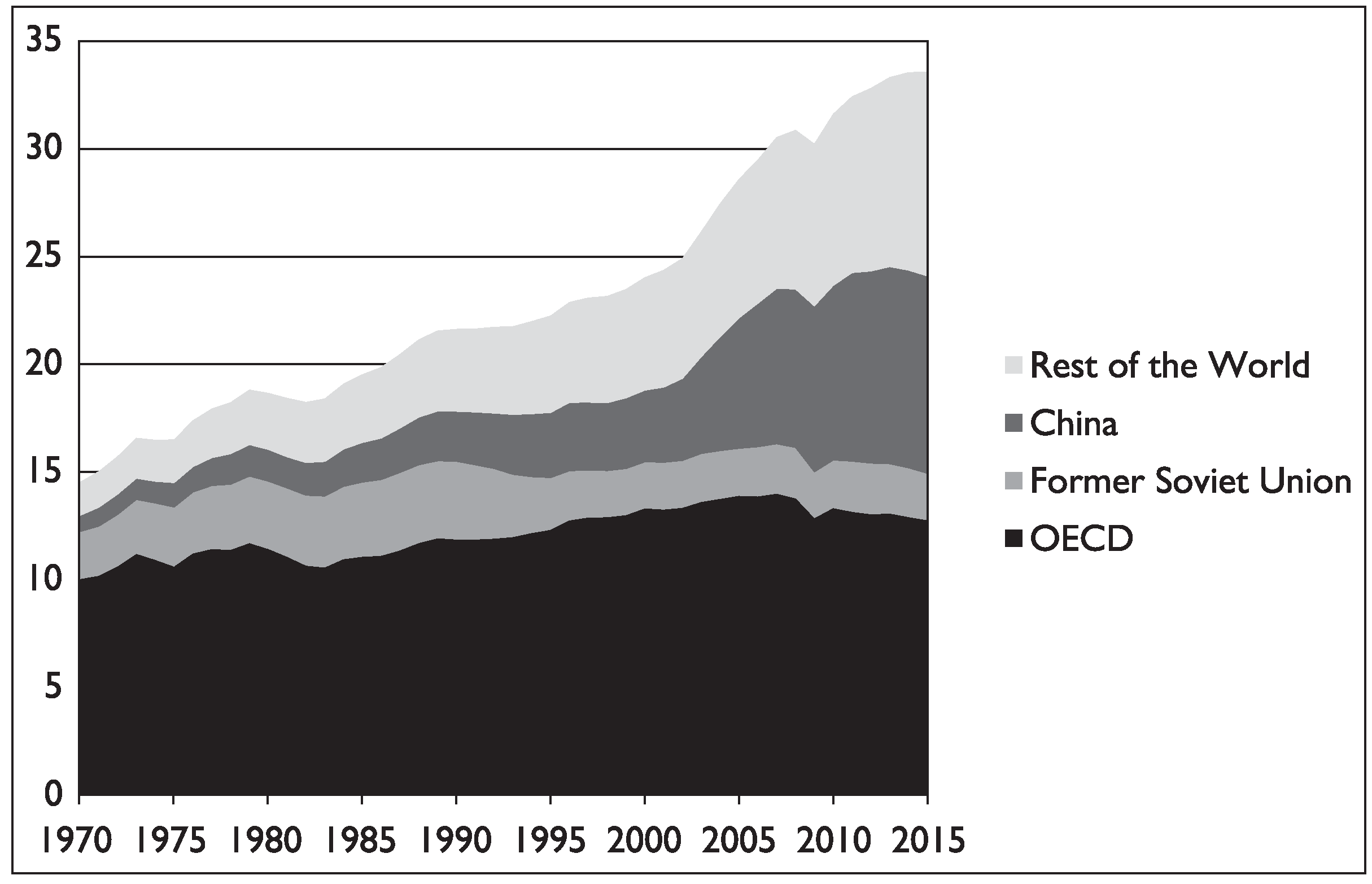
Figure 6 compares the per capita carbon dioxide emissions of the OECD countries, the former Soviet Union, China, the rest of the world and the world average.
The Western capitalist countries were responsible for most of the historical carbon dioxide emissions. In the 1970s, an average person of the OECD countries emitted about 11–12 tons of carbon dioxide each year. From 2007 to 2015, the OECD per capita emissions declined from 11.4 tons to 9.9 tons, with an average annual decline rate of 1.8 per cent. Most of the decline took place during the Great Recession of 2008–2009. If the OECD per capita emissions keep declining at the decline rate from 2007 to 2015, their per capita emissions in 2050 would still be 5.2 tons, about three times as high as the world average per capita emissions in 2050 required by climate stabilization (1.7 tons).
The carbon dioxide emissions per capita in the former Soviet Union rose rapidly in the 1970s and continued to grow during most of the 1980s. From 1990 to 1998, per capita emissions in the former Soviet Union fell sharply from 12.6 tons to 7.5 tons, with an average annual decline rate of 6.3 per cent. Such a large decline of emissions was achieved only because of the collapse of industrial production and living standards.
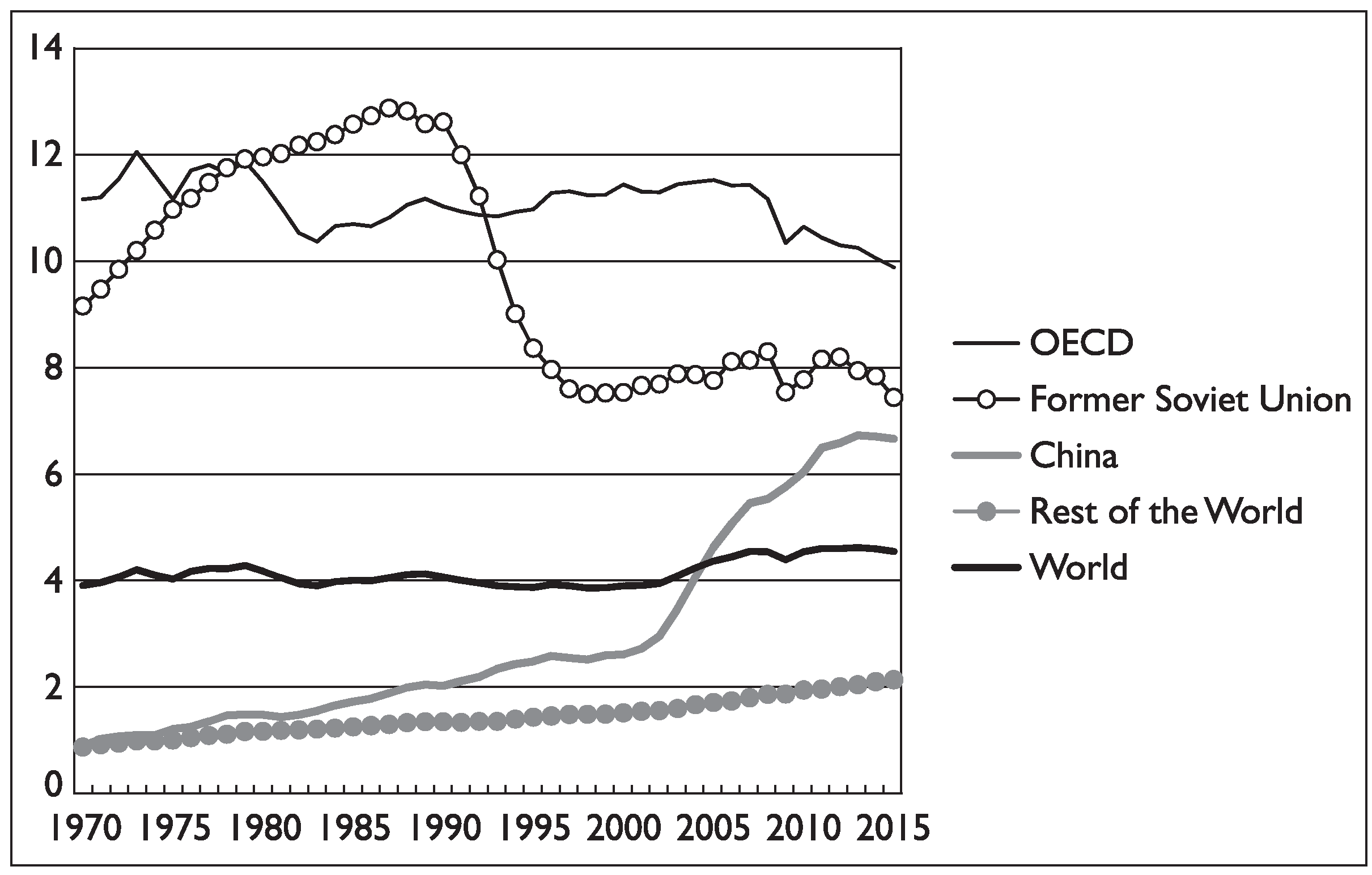
In the 1970s, China’s per capita carbon dioxide emissions were similar to that in other peripheral countries. After a temporary stabilization in the mid-1990s, China’s per capita emissions surged from 2.5 tons in 1998 to 6.7 tons in 2013. Since then, China’s per capita carbon dioxide emissions seem to have stabilized. For China’s per capita emissions to converge towards 1.7 tons by 2050, it would require an average annual decline rate of 3.8 per cent from 2015 to 2050. Such a rapid decline of carbon dioxide emissions over such a long period time has never happened in China’s economic history and rarely happened in other countries’ economic history, except for the post-Soviet economic collapse.
In the rest of the world (the world excluding OECD, former Soviet Union and China), per capita carbon dioxide emissions have grown steadily since the 1970s. From 2010 to 2015, the rest of the world’s per capita emissions grew at an average annual rate of 1.9 per cent. In 2015, the rest of the world’s per capita emissions reached near 2.2 tons. If their per capita emissions keep growing at 2 per cent a year from 2015 to 2050, their per capita emissions in 2050 will be 4.4 tons, about two and a half times the level required for climate stabilization.
Despite their low levels of per capita emissions, billions of people in the non-OECD, non-China world are struggling to meet subsistence needs. About 1 billion people currently suffer from chronic hunger, 9 million people are estimated to starve to death each year, and between 2 and 5 billion people suffer from some forms of malnutrition (Shade & Pimentel, 2010). This basic reality makes it obvious that, under capitalist conditions, it is simply impossible to achieve ecological sustainability while meeting the basic needs for the poorest several billions in the world.
2050: Barbarism or Socialism?
In The Communist Manifesto, Marx and Engels predicted that the proletariat or the working class would one day become the grave-diggers of capitalism. However, up to the mid-twentieth century, the process of proletarianization was limited to perhaps no more than one-tenth of the world labour force.
While the Russian Revolution was considered a proletarian revolution at the time, it took place in a country where the peasants accounted for the overwhelming majority of the population. Surrounded by the capitalist world system, the Bolshevik Party engaged in a programme of indu-strialization that proved to be highly successful for about half a century. However, by the 1980s, the Soviet Union could no longer reconcile the requirements of capital accumulation and the rising demands from the domestic working class and urban middle class. The Soviet ruling elites responded to the crisis by embracing the neoliberal shock therapies.
The Soviet crisis was a part of the general crisis of the semi-periphery in the capitalist world system. In response to the crisis, the global capitalist elites attempted to restore the global profit rate by destroying the ‘high cost’ industrial production in the semi-periphery and relocating much of the industrial production to new geographical areas with cheap labour force and natural resources. This has led to the economic mobilization of China and India.
However, the mobilization of a large part of the historical periphery has led to the formation of new industrial working classes. As a result, about two-fifth of the world labour force have become proletarianized. In the coming decades, global capitalism will have to struggle to accom-modate the combined economic and political demands from both the Western and the non-Western working classes. Failing to meet their demands may fatally undermine the system’s political legitimacy and raise again the ‘spectre of communism’ that Marx and Engels predicted in The Communist Manifesto, this time not only in Europe but in the entire globe.
To meet the rising demands of the global working classes without undermining global capital accumulation may require dramatically increasing the global levels of material consumption. However, after several centuries of relentless capitalist expansion, the remaining environmental space has become all but exhausted. Further expansion of global material consumption, accompanied by increase in global carbon dioxide emissions or keeping emissions at their current high levels, would guarantee global climate catastrophes by the second half of this century. In that event, the world will have to again confront the condition of barbaric destruction, not necessarily caused by imperialist war, although this possibility cannot be ruled out, but by climate change that will destroy the material foundation of human civilization.
Marx and Engels argued for socialization of the means of production and society-wide democratic planning to prevent destruction of productive forces by the capitalist ‘anarchy of production’. In the twentieth century, the Soviet Union and other socialist states used planning to achieve rapid industrialization.
Today, global capitalism threatened to destroy not only its own productive forces but also the material foundation of human civilization. To save the humanity from barbarism, it requires nothing short of a social revolution that will replace capitalism by a new social system that can use the society’s surplus product based on people’s democratic decisions, using it not for endless accumulation but for ecological sustainability and providing every member of society with the basic material conditions required for his or her free development. In this sense, socialism—social control over the surplus product—represents the only viable alternative to barbarism in the twenty-first century!