






Abstract
Developing a corporate social responsibility (CSR) strategy can help companies remain competitive, grow market share, and enhance customer loyalty. As CSR has recently become part of corporate strategy, many corporations are confronted with an employee talent shortfall. This shortfall is attributed to factors from the simple fact that there are not enough people, like Generation X not being able to replace the retiring Baby Boomers to the more complex concept of a talent mismatch.
This research investigates this intersection of CSR and talent and examines the impact of CSR on employee attraction and retention, with a special focus on Generation Y. Interviews included 36 qualitative, semi-structured interviews. Results suggest that potential employees are not as much attracted by the CSR programme, but by the values of the company. Results suggest that employees do not necessarily stay at companies because of the CSR programme. From the findings, a practitioners’ guide was created. This guide outlines the drivers of attraction and retention that focus on iValue, iDevelop and iRetain.
Introduction and Objective
Corporate social responsibility (CSR) and talent management are at pivotal points in their development. There has been research that suggests ‘CSR can lead to a competitive advantage, but only through integration of CSR with all aspects of the organization’s operations’ (Stephenson, 2009, p. 251). For talent management, it is necessary for the corporation’s top executives to understand the importance of talent, as well as having programmes that support the attraction and development of the talent. There is also concern, worry and heartache that managers and executives have, regarding attracting the right talent (Collings & Mellahi, 2009). Another layer of complexity to understanding CSR and talent is how different generations view these ideas.
One component of talent management is creating a strong employer brand in order to attract the best talent to the organization. CSR has the potential to help with that brand and also help retain employees. One method in which employers can regain trust (after an erosion, such as Enron) and have an enhanced relationship with their employees is to increase business ethics and show employees that they do ‘the right thing’ (Karnes, 2009).
This research 1 explores the intersections of the ideas that corporations are facing a talent crisis, CSR is increasingly becoming integrated into corporate strategy and Generation Y employees desire companies that promote CSR. The question is: Does CSR have an impact on attracting and retaining employees with a special focus on Generation Y?
Review of Literature
The capitalist system is under siege. In recent years, business has been increasingly viewed as a major cause of social, environmental and economic problems. Companies are widely perceived to be prospering at the expense of the broader community. Even worse, the more business has begun to embrace corporate responsibility, the more it has been blamed for society’s failures. The legitimacy of business has fallen to levels not seen in recent history (Porter & Kramer, 2011, p. 67).
This powerful quote illustrates the shift in how society views corporations and the impact these corporations can potentially have on the world, employees, governments and culture. One way in which this change has manifested is with the evolution of CSR. McWilliams and Siegel (2001, p. 117) define CSR as ‘actions that appear to further some social good, beyond the interests of the firm and that which is required by law. CSR means going beyond obeying the law’. This is a shift from the Milton Friedman classic ideology that corporations exist to maximize profits for shareholders to corporations as global problem solvers: ‘neither governments nor communities, nor NGO’s, nor business, can solve these problems alone’ (Maak & Pless 2009, p. 537).
As CSR has become part of corporate strategy, another idea that is at the forefront among leaders is the talent crisis (Wall, 2007; Woolf, 2007). This talent crisis is attributed to many factors from the simple fact that there are not enough people (as Generation X is not able to replace the retiring baby boomers) to the more complex concept of a talent mismatch, as described by Manpower (2011, p. 6): ‘exact talent is becoming increasingly difficult to find, creating a mismatch between the talent that is available and that needed by employers. This is why the apparent paradox of high levels of unemployment and job vacancies can coexist.’
Due to this talent crisis, corporations are placing greater emphasis on employee attraction and retention; in particular, how to recruit and retain Generation Y (born between 1980 and 1994), as Generation Y is the newest generation to enter the workforce (Foster, 2008; Woolf, 2007). Even in an economy that has high unemployment and many applicants for one open position, corporations are struggling to find the ‘right’ talent, as evident by Manpower’s survey of more than 35,000 employers in 36 countries. This survey found that ‘more than 30 percent [of employers] are struggling to fill jobs they desperately need in order to succeed’ (Manpower, 2011, p. 7).
There is research on the ethical fit of the employee and the employer in the attraction phase and retention. The stronger the fit of values the better the retention of the employee and the better chance the employer has to attract the employee (Coldwell, Billsberry, Marsh & van Meurs, 2008). Zunker (1994) identified almost 20 years ago that individuals select an organization on the values and vision of the organization and if the organizational culture fits with the employee’s values. The corporation’s CSR programmes often highlight ethics and values. These can be clearly articulated to employees during the attraction and the retention phases of employment. The importance of ethics and values illustrates a potential intersection between CSR and attraction and retention. For example, Generation Y employees tend to desire companies that promote CSR (PriceWaterhouseCoopers, 2008).
The research of Greening and Turban (2000) is one of the initial studies completed on employee attraction and the relationship with CSR, and found CSR can influence attraction for employees. CSR is critical and executives believed that CSR programmes help them hire and retain employees (Pinkess, 2008). CSR is important as part of the employer brand on how to attract employees to companies (Fox, 2007).
The majority of the attraction, retention and CSR research consist of quantitative studies (Aiman-Smith, Bauer & Cable, 2001; Glavas & Piderit, 2009; Greening & Turban, 2000; Peterson, 2004). Aiman-Smith et al. (2001) found CSR to be important in attracting talent as the company image attracts potential employees. Glavas and Piderit (2009, p. 66) suggest that there is ‘strong evidence that corporate citizenship can positively influence employee behaviours’. Peterson (2004, p. 313) finds that a ‘company’s reputation on social issues influences workers’ attitudes’. Peterson also proposes that employees who believe strongly in CSR will be impacted, and those who do not care about CSR will not be impacted by their company’s lack of CSR. Backhaus, Stone and Heiner (2002) found that potential employees do review the CSR reputation of the employer.
These studies are important in helping to answer the question about CSR and attraction and retention. However, this study will add to the CSR and talent research by examining the potential relationship from a qualitative perspective and investigate the depth of the potential relationship in a way that the quantitative studies cannot. Additionally, an aspect of talent management is examining the talent by segments, for example, generational talent (Collings & Mellahi, 2009; Iles, Preece & Xin, 2010). This research will do this by focusing on Generation Y, while not ignoring other talent in the baby boomer generation and Generation X. It is important to focus on Generation Y, while looking for themes across all generations on attraction and retention.
Research Method
Interviews were conducted interviews with Generation Y, Generation X and baby boomer talent in corporations. The research was completed over the telephone in 2010 with a total of 36 interviews. The data collection instrument used was a self-developed, approximately 15-item qualitative questionnaire. The survey was designed to examine the various factors that influence attraction and retention of employees and understand if CSR impacts or influences those factors, and if yes, to what degree. The interview questions were in four main sections:
General questions to understand their history and background. General questions as to their careers. General questions about their drivers for attraction and retention. Questions about connections with CSR.
Thematic analysis was used to understand the data. It is a foundational method for qualitative research and is ‘a flexible and useful research tool, which can potentially provide a rich and detailed, yet complex, account of data’ (Braun & Clarke, 2006, p. 78). Thematic analysis is a method that looks to ‘unravel the surface of “reality”’ (Braun & Clarke, 2006, p. 81). As the name implies, thematic analysis is a review and interpretation of themes that occur in text, interviews, focus groups, etc. In a thematic analysis, it is critical to determine the method of data analysis: top-down or bottom-up. A bottom-up or inductive analysis was used for this study. An inductive analysis is ‘a process of coding the data without trying to fit it into a pre-existing coding frame, or the researcher’s analytic preconceptions’ (Braun & Clarke, 2006, p. 83).
Analysis and Findings
The Economy
Before outlining the findings of this research, it is necessary to understand the backdrop of the recession and economy during the interviews. Many interviewees discussed fear as the main theme about how the economy has impacted employees. Even though the economy did increase fear and concern over current positions and future careers, it did not appear that the main reasons for being attracted or being retained at a company changed dramatically during the recession. Many people have accepted jobs or stayed with them because of fear, but the questions posed were concerning what attracts them and retains them in general. Their desires were clear, but they may not have been able to act on them due to the recession. While the economy is improving, the findings and the recommendations remain relevant. The findings were not based on the fear of the economy.
Interview Themes
Three main themes emerged throughout the interviews. The themes are (a) attraction drivers: values, career development and flexibility; (b) retention drivers: flexibility and career development; and (c) generational differences (see Table 1).
Research Themes
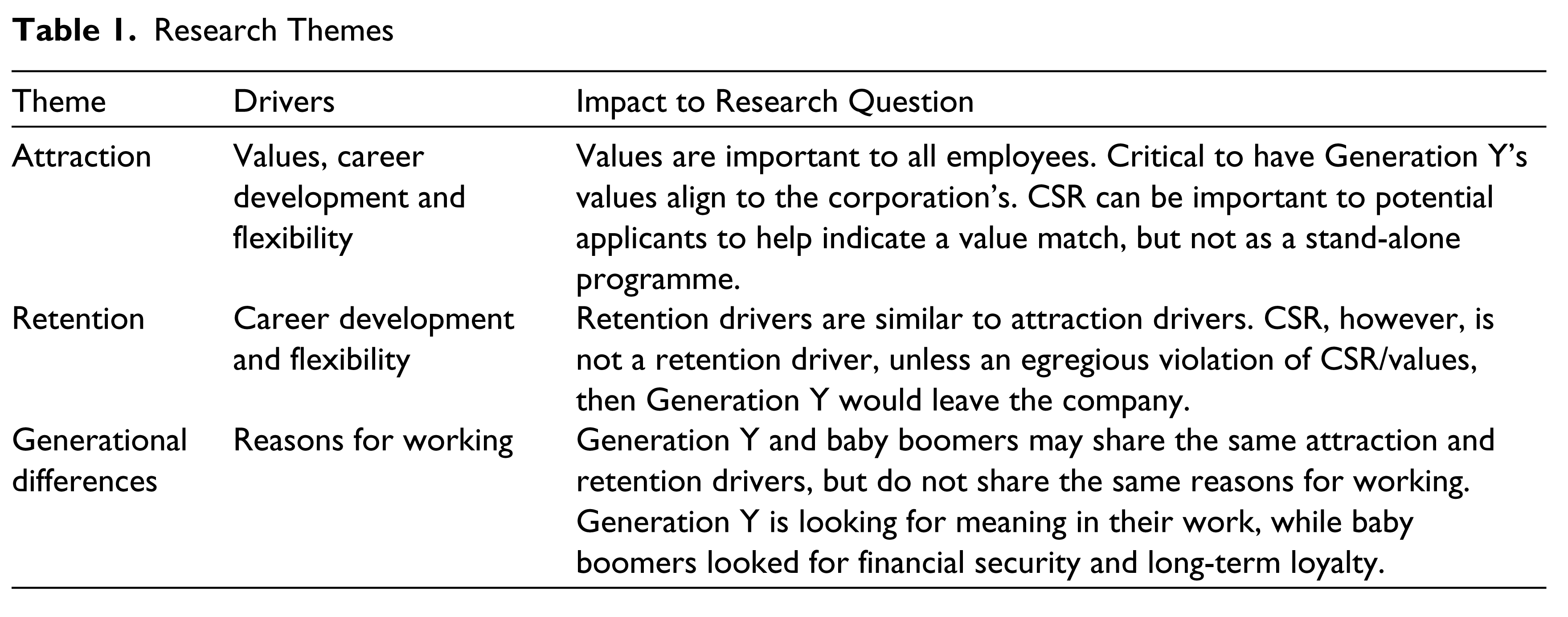
Theme #1: Attraction Drivers
The first theme that emerged surrounds attraction drivers, which are values, career development and flexibility. Additionally, Generation X and baby boomers were interested in the same attraction drivers. ‘I focus on the company and not the actual position; you never know the day to day, but if you at least know the company then you know the values…I have left places because there were no opportunities’ (Generation Y, participant—Tamara).
In terms of values, interviewees discussed the importance of values and of the alignment of their values and the company’s values. There are strong values across Generation Y members, and they are also important for Generation X and baby boomers. Generation Y, however, does not have any issues with demanding that values align. They are a vocal generation in terms of transparency of a corporation’s value set.
Additionally, Generation Y employees did not define CSR in terms of the values of corporation. When asked what is important for attraction, interviewees did not immediately respond with ‘CSR’; they did, however, discuss the values of the corporation. Interviewees discussed the need for values to be a match when looking at a new company, for example, ‘How could you go to work everyday and not believe in the company that you work for?’ (Generation Y, participant—Jessica). There was no ‘one size fits all’ in terms of values. There was no universal value that the interviewees said was important to them.
Again, like the importance of values, Generation Y is focused on career development and flexibility, but baby boomers and Generation X deem these critical drivers of development. ‘I came back to [company] ‘cause I got a promotion and growth opportunity and saw that I could have a future with the company’ (Generation X, non-CSR corporation—Nicole) and ‘Flexibility that I knew I would have’ (Generation Y, participant—Laura).
The importance of CSR as an attraction driver was not evident by the interviewees’ responses. The overwhelming driver was having a value match, which previous research has found (Coldwell, Billsberry, van Meurs & Marsh, 2008). The way in which CSR could manifest itself as an attraction driver is that CSR can illustrate the values of the company. Overall, in the interviews, CSR was not a primary driver for attraction. However, CSR could be used by companies to highlight and communicate their values to potential applicants. Having a CSR programme alone does not appear to drive employees to want to work for a particular company. It is the values of the company that attract employees, regardless of a CSR programme.
Theme #2: Retention Drivers: Flexibility and Career Development
The second theme that emerged from the research is retention. Interviewees discussed what retains them, with the majority stating that retention is focused on work/life balance or flexibility and the ability to develop one’s career at the corporation. Throughout the interviews and analysis, there was not a strong connection for CSR programmes being a critical part of retaining employees. CSR is related only if corporation ‘flies in the face’ of its stated ethics/values. For example, ‘It is all the other factors; if you hate your day-to-day job, it doesn’t matter if they have CSR’ (Generation Y, participant—Lynn).
What keeps employees at their current company is flexibility and career opportunities. Flexibility and career development were important to Generation Y and important to the other generations as well. However, how each interviewee defined career development or flexibility is different. It is critical for managers to understand how each employee defines these concepts to be better able to retain and develop employees.
Theme #3: Generational Differences
Not surprisingly, all interviewees said there are generational differences to viewing work. Generation Y and baby boomers agreed that both generations hold an opposite viewpoint of work. Generation Y employees are looking for meaning in their work and flexibility to blend work and life. Baby boomers were traditionally tied to a rigid work schedule and life events were after work, and not during. Many Generation Y interviewees replied that their parents did their job but were not passionate about it, and that they wanted to find passion in their work. However, as much as each generation said they view work differently, the responses to attraction and retention drivers did not wildly contrast each other. While the reasons behind working may be different, the need for career development and flexibility is shared. Additionally, Generation Y appears to be more forceful and bold in requesting this development and flexibility. And, if they do not receive it, they do not have the loyalty to the corporation to stay. This is unlike previous generations who tended to stay through ‘bad’ times of the company.
Summary and Recommendations
The research question was twofold: Does CSR impact attraction and retention of employees with a focus on Generation Y? The second part of that question was answered with a resounding no. When asked about retention, interviewees replied that CSR was not something that would keep them at a company. They would leave if the company had an egregious violation against their stated ethics or policy, but a CSR programme was not enough to keep the employees at the company. However, in terms of retention, a company must maintain its values and the environment that employees expect. While a specific CSR programme may not keep employees, a culture that does not match the employee’s expectations will make them leave. It is critical for corporations to operate in accordance with their values, like CSR principles, and act in an ethical manner. Employees are increasingly savvy and astute observers of corporate executive behaviour, and employees will quickly observe conflicting corporate stated behaviour and actual corporate behaviour. In the absence of authenticity, employees could become disengaged at work and may leave or become less productive.
When asked about attraction, the interviewees did not specifically articulate that CSR attracted them to the company. Interviewees were attracted to the environment and values of a corporation. A CSR programme could be important to attracting talent, as a way in which to communicate about values of the company during this attraction phase. These values are important messages in attracting Generation Y, as Cone (2006) found 79 per cent of Generation Y wanted to work for a company that cares about society. This caring may manifest itself in CSR programmes. However, the value match is the most important in the attraction phase.
However, most crucial to attraction was flexibility, in terms of work/life balance and career development. Interviewees from all generations discussed the desire for career development and wanting to work in an environment that matched their values. Flexibility, or work/life balance, was key for Generation X and Y. This was defined as working from home, having flexibility during the day to do personal errands and having varied start and end times to their day.
Throughout this research, even though interviewees might have agreed on the importance of development, values and flexibility, what each represents to each individual is different. Values, career development and flexibility cut across generational lines and company lines. While previous research supports the values-match, this researcher proposes that we are now in the time of personalization of attraction and retention of employees. Each person has different needs and wants in each category, which reflects where we are in our society. Currently, the focus is on individual choice, such as iPhone, iSleep and iRelax. We can find anything that meets our specific needs; we can find specialized groups that match our interests, such as jelly from Michigan, Spanish speakers who live in Cedar Rapids, IA, or German Shepherd dog owners who live in Chicago. Marketers have learned not to treat everyone who buys their products in the same manner. Corporations will need to learn this lesson for their employees. Employees cannot be treated as if they are all the same.
Personalized Employee Plan
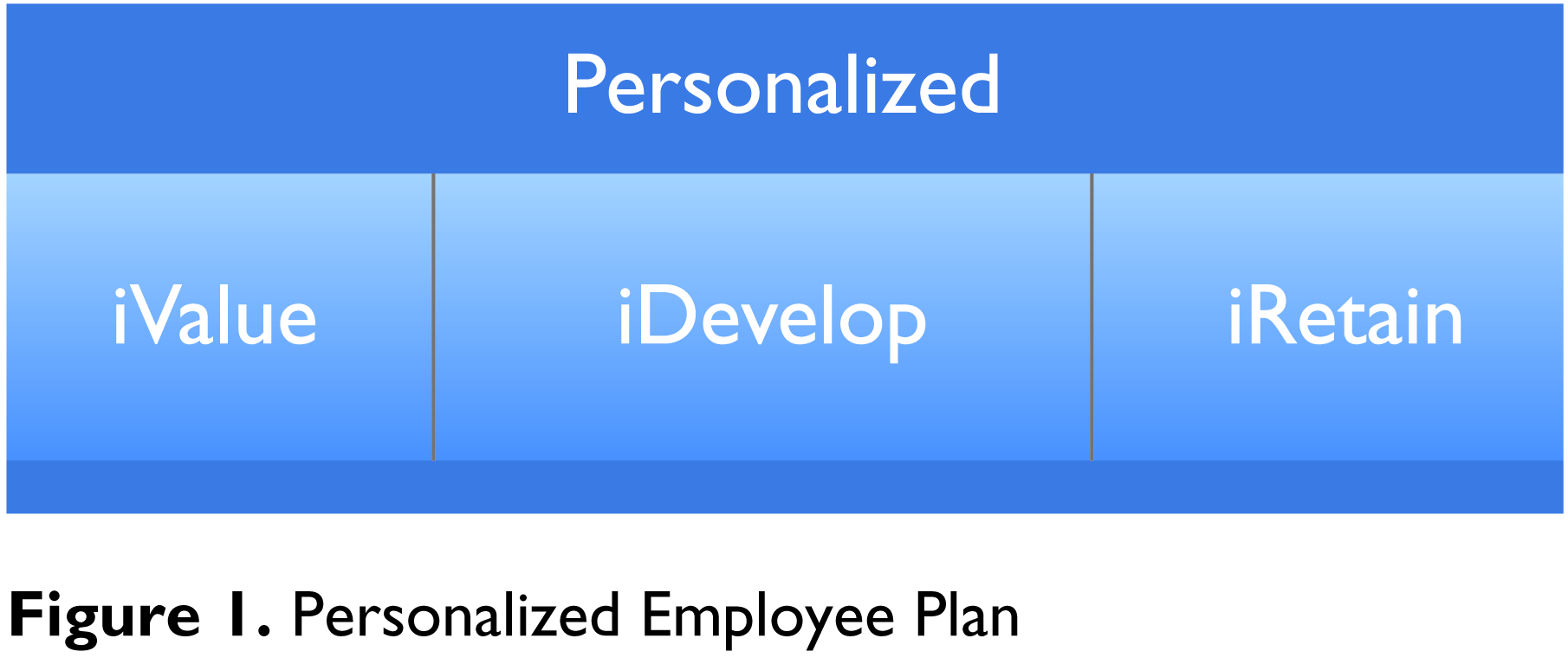
Based on principles of self-awareness, the importance of dialogue and the themes from the research, the model below was developed for managers on how to understand and engage employees in three critical areas (Figure 1):
iValue iDevelop iRetain
The first category is named iValue instead of iAttract because the attraction stage is about matching values. Does the company represent the values that I have articulated as important to me? Does the company project the image that I am proud to be associated with? A company must find the most talented employee whose values are aligned with the company’s values. Value is a word that illustrates this shift from broad-based attraction of talent, to a deeper articulation for both the company and the employees in terms of values.
For iDevelop and iRetain, employees across the generations, but specifically in Generation Y, shared in their desire for flexibility, career development, and an environmental fit. However, what that flexibility and development represents to the employee varies. For one employee, flexibility signifies working from home two days per week; for another, it may represent a 40-hour week spread over four days instead of the typical five. Career development could translate to tuition reimbursement and a supportive school environment, but for another employee, it may signify upward promotion only.
Recommendations for Human Resources Professionals
Although the categories are the standard ones for human resources (HR) professionals, the manner in which HR professionals need to develop supporting programmes is new and complex. This personalized approach demands more from HR, as they need to customize programmes and not treat all employees equally in terms of how they are attracted, how they are developed or how they are retained. HR needs to design programmes that show value to each potential employee. In fact, these types of personalized programmes demand dialogue and self-awareness from both employees and their managers. In order to understand what an employee values, or why an employee stays with a company, the manager must have an open dialogue with his or her employees to understand these topics. And, employees must be self-aware to be able to articulate what motivates them and retains them.
HR professionals can utilize the following questions by using it as a simple framework for their development of their talent management processes. It is a framework that emphasizes the personal choice and it is a different from current programmes, which are typically developed for all employees. An HR professional can use the goals that are listed below to begin the process of creating the programme and thinking differently. The goals for these recommendations are to:
Start the conversation and the thinking for HR and corporations as to how they approach values, development and retention. Provide foundational questions and goals that can help HR create programmes.
In the iValue stage, an HR professional and the company need to:
Be able to clearly articulate the vision and value of the company. Understand CSR policy and if it integrates with the vision/values. Understand the target audiences that the company is recruiting. Create messaging for each audience regarding why each should work at the company. Messaging should include career development, flexibility and environment. Training recruiters and hiring managers to ask questions to understand the values of the potential employee. Create measurements to track new hires and the success of the value match.
In the iDevelop stage, an HR professional and the company need to:
Be able to clearly articulate development philosophy of the company. The philosophy must include transparent career development and flexibility. Create a development resource centre that includes development plans, self-awareness tools and manager training on having development conversations. Create an environment that encourages employees to become self-aware and be able to articulate their development, in order to create their individual development plans. Create an environment that encourages managers and executives to have development conversations and that creates development assignments. Create measurements in order to track development.
In the iRetain stage, an HR professional needs to:
Understand the company’s retention numbers and improvements that need to be made. Create a retention philosophy for the company, specific to the audience (high potential talent, critical talent, entry-level, executives, etc.). Train managers on how to understand and ask questions to employees on what specifically retains each employee. Determine to what extent the company values impact each employee’s retention. Have managers, in partnership with employees, create individual retention plans. Create measurements in order to track retention.
Limitations and Future Research
This research has limitations that are acknowledged:
This research was conducted in the United States and cannot be generalized to other countries. The interviewees were volunteers and interested in the research topic, and no comparison group of those who were not interested in the research topic were conducted. Therefore, the findings cannot be generalized for all employees in for-profit companies or all Generation Y employees. The sample size is small and findings cannot be generalized for all employees in for-profit companies or all Generation Y employees. The interviewees have agency in their careers and can choose to leave one company for another.
Conclusion
This research study found:
Values are critical in terms of attraction. CSR programmes can demonstrate these values, but the CSR programme is a communication tool for these values. Employees want to find a corporation that matches their value set. This could translate to a company with CSR or a company without CSR, depending on the employee’s value set. CSR is a key programme in communicating a company’s values and helpful in assisting employees make the correct value match. CSR is not critical to retention, unless the executives violate the values of the CSR programmes. Work/life balance and career development are reasons why employees stay with their employers. Across all generations these were important, but especially to Generation Y, who expects them. It is crucial to understand the unique aspects of what attracts or retains employees, or the level of ‘i’ personalization that is necessary for the future of talent management.
Overall, if done well, CSR and talent management are of strategic importance to a corporation. However, it is a difficult navigation, as talent management is becoming more personalized, meaning each individual employee has his or her own demands for attraction and retention. An employer needs to understand these preferences in order to have outstanding talent in the corporation. Corporations will need to look at talent differently and as individuals. Corporations will also need to examine their CSR strategies, and not only how CSR can help increase market share and revenue but also how can it can help match the right talent to the corporation.