







Abstract
The purpose of this case study is to identify the conditions for a company developing a B2B trade show’s communication to move into an efficient Omni-channel communication approach. The case study method is used to describe the issues facing Plastic Omnium Environnement Company in deploying an Omni-channel communication approach. This company provides services to local authorities and private sector companies to dispose of their waste. Its Director of communication, Pierre Mereau, is faced with the fact that 160 French communes changed hands from one political party to another in the last local elections. This led to stagnation in terms of turnover—the time required for decision-makers to once again invest in waste management. At the same time, his General Directorate is asking him to make cuts and savings. Pierre Mereau evaluates its performance in the two last most important trade shows and set his mind to develop an Omni-channel communication approach. This case study provides an insight in an organization that is optimizing its communication strategy in a specific market. It should help companies to develop synergies between the trade show and social media.
Introduction
Plastic Omnium is a global equipment supplier that has not been adversely affected by the economic slowdown in Europe. With over 100 factories across the world, the Group, which is increasing its market share, and which is amongst the most profitable companies in its sector, has attained a position of central importance in the market place. One of its biggest divisions (Automotive Division) manufactures bumpers, grids, tailboards, wings, fuel tanks and plastic logos for leading automotive brands. The concept behind these pieces is to make vehicles, which are increasingly electronically sophisticated, more light-weight than they otherwise could be. Within the Group, Plastic Omnium’s Environment Division, provides waste management services to local authorities and private companies, accounts for 8 per cent of the Group’s turnover (some 500 million euros annually) and is totally debt-free. The Group’s management demands the same operating margins in the Environment Division as they do in the Automotive Division. The company has one of the largest private Research & Development centre in the sector, employing 300 people, 20 of whom work exclusively for the Environment Division, which therefore benefits from technological expertise in the field of plastics. The company has strong family roots. In fact, the Burelle family is still the majority shareholder. Laurent Burelle, Plastic Omnium’s Managing Director, explains: ‘Personally, I go to the office not just to work but also to develop and also, more than anything else, to hand down to the younger generation the values of a company in which we have a majority shareholding’. 2
Whilst the company places a good deal of emphasis on manufacturing, and has numerous factories abroad, the key aspect of its capability is through providing complementary services. The company is closely involved in environmental activities, a field in which it works hand-in-hand with local authorities. In the 13 Parisian arrondissements for which it holds contracts, Plastic Omnium Environnement provides services such as electronically tagged wheelie bins, repairs, replacement of lids and wheels, changing volumes, adapting products to new uses, washing services, electronic monitoring. These paid-for services are vital to Plastic Omnium Environment (POE’s) turnover.
According to Pierre Mereau, Director of Communication at Plastic Omnium Environnement,
[I]n regard to local authorities (town halls, communities of communes, etc.), you have to identify the person who makes the decisions. The city’s Mayors receive a good deal of attention. But it’s obvious that the person to get in touch with is the General Director of Technical Services (GDTS), because he’s the one who wields decision-making powers concerning the environment and waste management. After studying the results of a call for tender, the GDTS suggests a choice of service provider. Our principal target is technical directors and engineers who are responsible for environmental issues. We adapt our communication media approach to that target. And when we opt for the trade show medium, we encourage our visitors to see and touch our products. The trade show medium continues to play an important role, but we have to deal with budgetary choices and a reappraisal of routines, with participating on a long-term basis in well-organized events, with approaches that, nevertheless, continue to be popular amongst clients and personnel. But we are currently exploring the best method of approaching local politicians.
The Waste Disposal Container Market
It was Pierre Burelle, President of the Plastic Omnium Group, who, in 1947, invented wheelie bins, and who was, in the 1970s, the first person to test, in the 15th arrondissement in Paris, the waste disposal container market. These are various forms of receptacle capable of receiving waste: standing columns; buried containers, which are increasingly popular; bins with 2 or 4 wheels; wastepaper baskets: in fact everything that can contribute simultaneously to hygiene and the management of household and associated waste.
Pierre Mereau explains,
Now, Spanish firms and companies from Eastern Europe provide competition, especially in terms of the voluntary waste drop off receptacles (a drop-off point in the city where local people can get rid of their waste products). The use of waste drop-off receptacles is very widespread in these countries, more so than door-to-door waste collection using individual wheelie bins.
Plastic Omnium Environnement Division
Mr Mereau explains,
We have buried and traditional container offers adapted to downtown areas—at the foot of residential blocks and individual houses—as well as more global and personal solutions. For example, we helped the Louvre Museum, which manages enormous amounts of waste, to reappraise its approach to collecting and laying out waste receptacles.
Even so the ‘local elections effect’ has an impact on the Environment Division’s revenues, which dropped by 7 per cent last year. According to the current MD, Laurent Burelle, ‘every six years, the activity stops for six months after the elections, the time it takes for the new teams to place their orders’.
‘Luckily’, says Mereau
our products are embedded in a highly normative system adapted to each town. The competitors who, on the other hand, focus on prices enjoy less success. A bin is a mundane product, but our sales force displays its intelligence by adding value to it. We don’t use trade shows to attract clients with original products and then take orders for them; instead, we place an emphasis on developing long-term relationships. In order to propose a suitable container service, commercial engineers work for long periods of time upstream creating links and getting to know the issues faced by individual towns. When a call for tenders is launched, we have to be prepared and have a good knowledge of the local environment.
Plastic Omnium Environnement’s Environmental Commitment
In 1995, the Division started to manufacture containers mixed with virgin polyethylene. Eighty per cent of the grey tanks of bins purchased by local authorities today are made of recycled plastic. In France and Germany, the Group produces ground up material from stocks of damaged bins. Management recently signed a contract with the Brazilian company, Braskem, which developed a non-edible sugar cane molecule that, in terms of the production of polyethylene, provides an alternative to oil.
The wheel hubs of the bins are made out of recycled materials, while the tyres are reconstituted from old tyres. The bins run more smoothly. Waste receptacles are subject to highly demanding French and European norms governing the protection of the environment. Buried containers help to reduce urban pollution levels. Plastic Omnium Environnement proposes innovative, made-to-measure designs for local authorities and private companies. The three types of container buried at the foot of residential blocks—one for household waste, one for paper products and one for glass—are all equipped with electronic chips. In order to reduce their volume, household waste containers can be subject to an opening tax. In regard to buried containers, which are larger, collections are less frequent than for bins, which make things cheaper for local authorities.
PESTEL Analysis
In semi-urban and rural zones, the Group is introducing voluntary waste drop off receptacles. Thinking of children and persons of reduced mobility, the managers created a second opening at the bottom of the container. The containers are equipped with embedded weighing systems to calculate invoicing based on volume and regulate collection schedules.
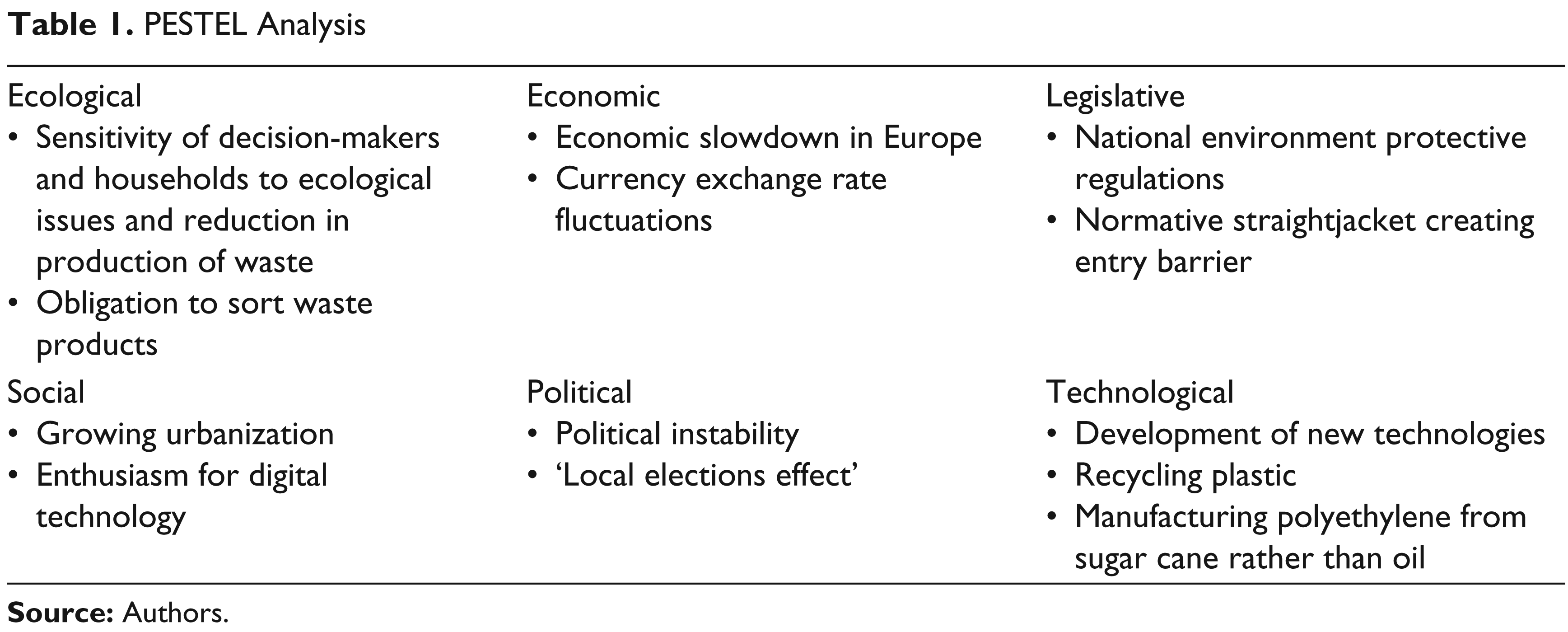
The key issues are summarized below in the form of a PESTEL analysis (see Table 1).
Plastic Omnium Environnement’s Communication Strategy
‘Let me start by saying this’ pronounces Mereau,
I believe that the Environment Division is not sufficiently recognized within the Group. There is not much about the Environment Division on the Plastic Omnium website; for example the project we worked on with the Louvre. I think that we should have our own website, but current budgets don’t allow this. Outside the Division, in order to optimize costs and remain coherent, we are developing closer synergies with our subsidiaries. We need to build on our successes, for example in Munich (Germany), we had a stand with a mezzanine, which attracted a good deal of attention. We attempt to re-use elements from one trade show in another, in a different country which reduces costs. But this is only possible if there is a real ‘osmosis’ between subsidiaries in different countries. In our current situation, we are unfortunately, very much closed off from one another.
Mereau relates:
In 2007 in Germany, we purchased the family firm, Sulo, a leader in the manufacture of bins, which became a subsidiary of the Group. Which is why, we had a stand at the IFAT trade show in Munich, (water, sewage, waste and raw materials management) to promote our products, to present a certain number of innovations, and to improve contacts with visitors from different countries. This was useful as the reputation of German quality attracts visitors, notably from the Middle East, who are increasingly interested in waste management. We get more visitors at IFAT than at the Pollutec trade show (environment and energy sectors) held in Lyon (France).
As an example of how Mereau’s team is obliged to operate, he explains
We set up a dedicated website to promote our presence at the IFAT trade show, a move that I now regret. The special Internet site wasn’t launched at the right time or in the right place. It wasn’t structured well enough and we didn’t have enough resources to support it. The graphic designer based in Germany, whose work was good on paper, bought software developed for Internet Explorer 10, spending 69 euros on it, which, all in all, seemed a reasonable thing to do. Except for the fact that, in France, we use Internet Explorer 8. So, I wasn’t able to download the pages created for Internet Explorer 10. I then had to spend 300 euros on a developer. Also there weren’t enough of us to fill the web pages. We were exhausted. In the end we had 28 visits, 21 of which were from company employees. We (had) wanted to let our regular clients and prospects know about launches and new products. It was a poor purchase, a waste of time, we had to go back to an older system, and we lost motivation. The graphic designer didn’t grasp all the complexities involved. There weren’t enough of us, and we gave up on the project. With insufficient skills within the company, we weren’t able to develop and update a website. Internet communications are vital, but if Plastic Omnium Environment doesn’t have the human resources to regularly update the content, it becomes counter-productive. I think that a website that isn’t updated can quickly become boring.
‘So, faced with these budgetary choices’ he continues,
I’m working to ensure that the IFAT stand is re-used in France (Pollutec) and, potentially, in other European countries (Spain, the UK, etc.). For every trade show I organize, I’m an internal service provider. I mostly work on the image of the company, but I also have to respond to other demands made by the sales force teams. Insofar as the trade show stand is concerned, I’m there to organize everything, but on the morning the show opens, I symbolically give them the keys. I present them with a beautiful, innovative and expensive work tool, which has taken me six months to design, and of which I want them to be proud. I position myself as a ‘back-up’ organizer, but it’s up to them to attract the clients. The sales people must qualify contacts and follow them up. We wrote a leaflet for the IFAT trade show in German and English explaining the layout, new concepts and intelligent solutions for the environment, the products on display, and relevant contacts. This is for German sales people and subsidiary managers from Belgium, Holland, and France, who come to the show with a delegation of clients; so they are prepared, they can get to know and run the stand as quickly as possible. (Mereau)
Plastic Omnium Environnement at the Pollutec Trade Show
The important aspect of exhibiting at the trade show is to meet new and existing clients. Typically a sales person will spend 20 minutes with each prospect, and is able to use a meeting room on the stand if he or she wants to discuss business further. Mereau reports
However, an interesting aspect of trade shows, is that a lot of students learn about us there, especially at the Pollutec stand. Students often ask us for an annual report or an HR contact so that they can send us a CV. They are impressed by the coherent way in which products are presented, and by our capacity for innovation. ‘I love this stand; I want to apply for a job’. But I fight with our HR department, trying to persuade them to come up with a package (website, contact list, etc.) that I could give to interested students.
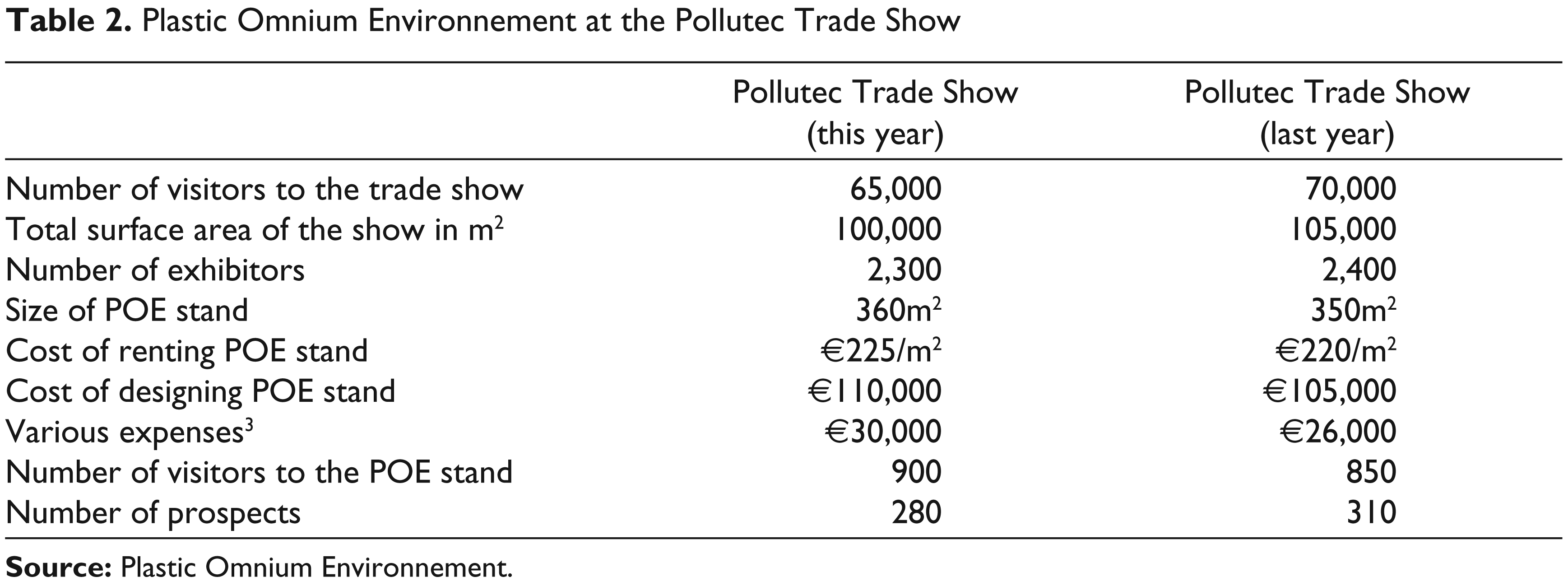
The organizers of the Pollutec trade show, held at the Lyon Expo over a period of four days, are keen that Omnium Environnement should take part. ‘But every time we need a service it costs us a considerable amount of money (see Table 2)—an Internet connection is invoiced at 125 euros (6 × 125 euros for 6 screens), and the electricity supply between 800 and 1,000 euros, for example. I have outgoings of between 12,000 and 14,000 euros, to which can be added 1,000 euros to register for a programme of conferences. When I want a visitor badge reader to measure the number of contacts and the return my on investment, it costs me 500 euros for the deposit, and 400 euros to rent the machine’, says Mr Mereau.
Plastic Omnium Environnement at the Pollutec Trade Show
According to Elodie Velten, who works with Mr Mereau as a communication assistant,
visitors to the POE stand expressed their satisfaction personally. Seventy per cent of them said that they liked the look of the stand (60% for last year’s stand); they particularly appreciated the IT equipment (tablets and tactile screens). They were impressed by the stand’s look and layout. They were also keen on the bar, which was supplied with sweet and savoury foods depending on the time of day. And the more people came to the stand, the more visitors we attracted. We achieved a 95% satisfaction rate at the last show, and 90% at the one before last; we achieved the same results in terms of the quality of answers to questions and of using the stand to promote Plastic Omnium Environment’s image. The stand at the trade show reflects the company’s image. Its graphic identity also plays an important role. Visitors to the stand are effectively coming into the company. The experience is not the same as visiting a website or leafing through a catalogue. Visitors find themselves face to face with the firm’s representatives. A certain degree of symbiosis occurs. However, it has become vital to ensure that the trade show and the website are complementary. We want to create a launch website for the next Pollutec trade show. But we aren’t webmasters (creating websites), or stand technicians (setting up stands for trade shows). Our external suppliers have to talk to each other. The website must be an event, it must make clients and prospects want to go to the trade show. The aim of the website is not to provide answers to all the prospects’ questions, but to encourage them to visit the stand. We have to make sure that the two media communicate with one another. We have to find the best ways to communicate, which is not easy. The most difficult thing has been identifying the correct criteria on which to base a good, event-based website. Stand technicians work with freelance webmasters. Webmasters are rarely company employees. (Velten)
Different Strategic Visions between a Multi-channel Strategy and a Trans-channel Strategy
Complementary Activity between the Trade Show and Social Media
A professional trade show is a commercial event involving exhibitors operating in the same field of activity, according to Mayaux, Shaw and Tissier-Desbordes (2006). The trade show medium is increasingly used as a platform for meeting people and exchanging ideas and information. As reported by Dekimpe, François, Gopalakrishna, Lilien and Van Den Bulte (1997), it is efficient in terms of attractiveness—percentage of the target visiting the stand; contacts—percentage of preceding individuals who talk to a sales person on the stand; and conversion rates—percentage of the preceding people who place an order.
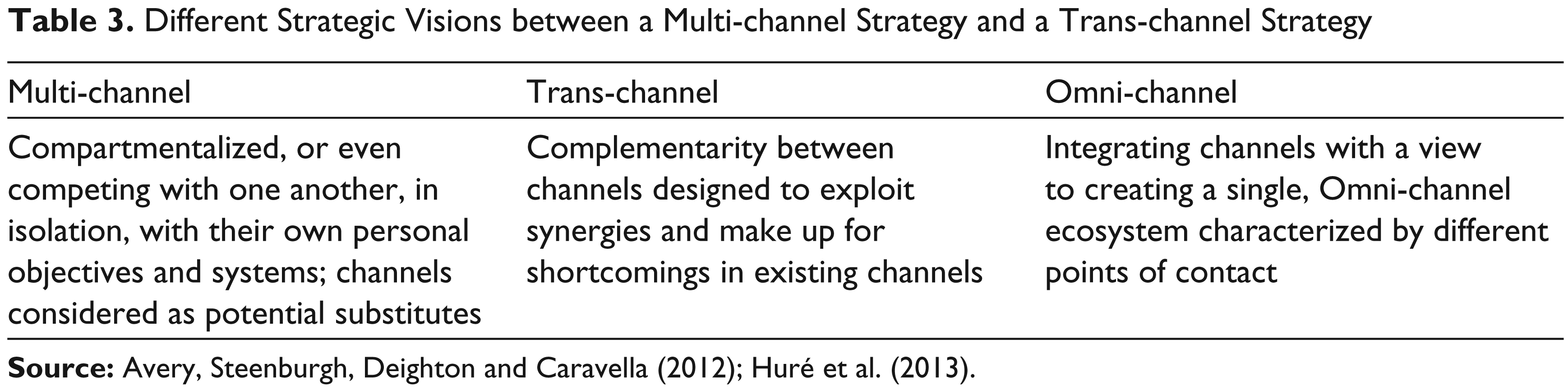
Peppers and Rogers (1993) reported that the internet strengthens client relations, developing ‘one-to-one’ marketing. However, an increasing number of clients start the buying process on the internet before physically meeting the brand’s salesperson (Belvaux, 2005). This evolution drastically changes the relationship between the client and the salesperson. Clients approach salespeople for reassurance about the result of the decisions they may already have taken. In this wake many companies move from a multi-channel to an Omni-channel strategy (see Table 3), integrating channels with a view to creating a single ecosystem characterized by different points of contact (Huré, Troiville & Picot-Coupey, 2013).
A majority of companies are implementing a Omni-channel structure (Colla & Lapoule, 2014).
Methodology
This research aims to develop better understanding of the conditions that contribute to the success of moving to an Omni-channel strategy, in the context of integrating trade show communications into an Omni-channel communication strategy; and to stimulate comments improvements may be achieved. A qualitative research approach was adopted, using the case study methodology, as its strong link between education and research is widely recognized (Lamy & Lapoule, 2012; Latusek & Vlaar, 2014). This supports the increasing encouragement of combining teaching and research in management teaching and research institutions (Gill, 2011).
A group made up of 27 management MBA students analysed the teaching version of the case—that included the literature review on complementary between the trade show and website media—during a B2B Marketing session. Of these 27, 13 were female and 14 were male. Most of them were university graduates in the 18–35 years age group and had a professional experience at trade shows. A lecturer/researcher chaired the session and an observer took notes and recorded the debriefing that we later carefully transcribed and reviewed to ensure a comprehensive understanding of the results.
The students were first asked to highlight main threats and opportunities of the waste disposal container market, strengths and weaknesses of the Environment Division of Plastic Omnium, and to identify areas for development (SWOT Analysis; Andrew, 1987). These results of this first phase of the study are presented in the SWOT Matrix (Table 4).
Plastic Omnium Environnement’s SWOT Matrix
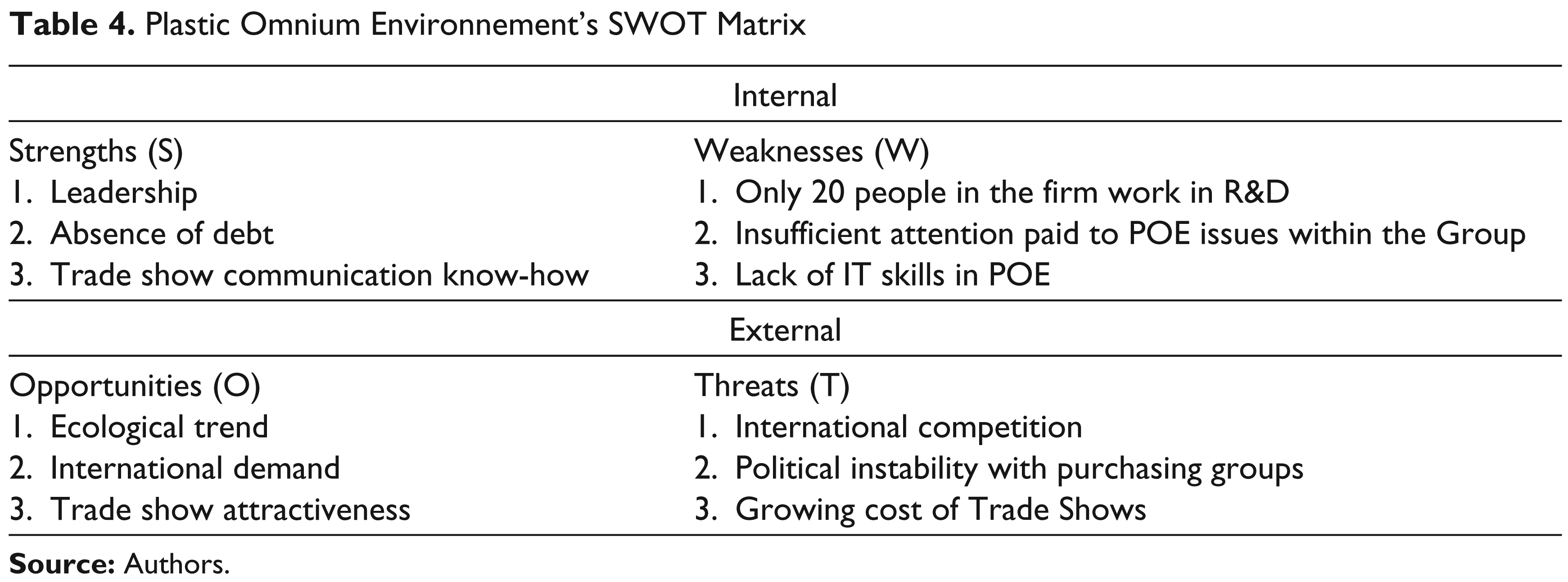
Considering the results of this SWOT analysis, the most pressing issue appears to addressing the lack of IT skills. As this is fundamental to their objectives for developing an Omni-channel communication strategy, it is particularly important. Strengthening this capability should help Plastic Omnium Environnement take advantage of Trade Show’s attractiveness and to avoid the growing cost of professional trade shows and the International competition. Clearly having this capability is one of the pre-requisites for ongoing application of an Omni-channel communication strategy.
Recommendations for Developing an Omni-channel Communication Strategy
In the second phase of the case study, the MBA students with professional experience at trade shows reviewed the outcomes of the SWOT analysis and used their understanding of this area of marketing communication from their literature review to propose a framework for future development. These suggestions encompassed both defining objectives and implementation actions, to succeed in the transition from a trade show communication strategy to an Omni-channel approach (see Table 5).
Reported Conditions for Moving from a Trade Shows Communication Strategy to an Omni-channel Approach
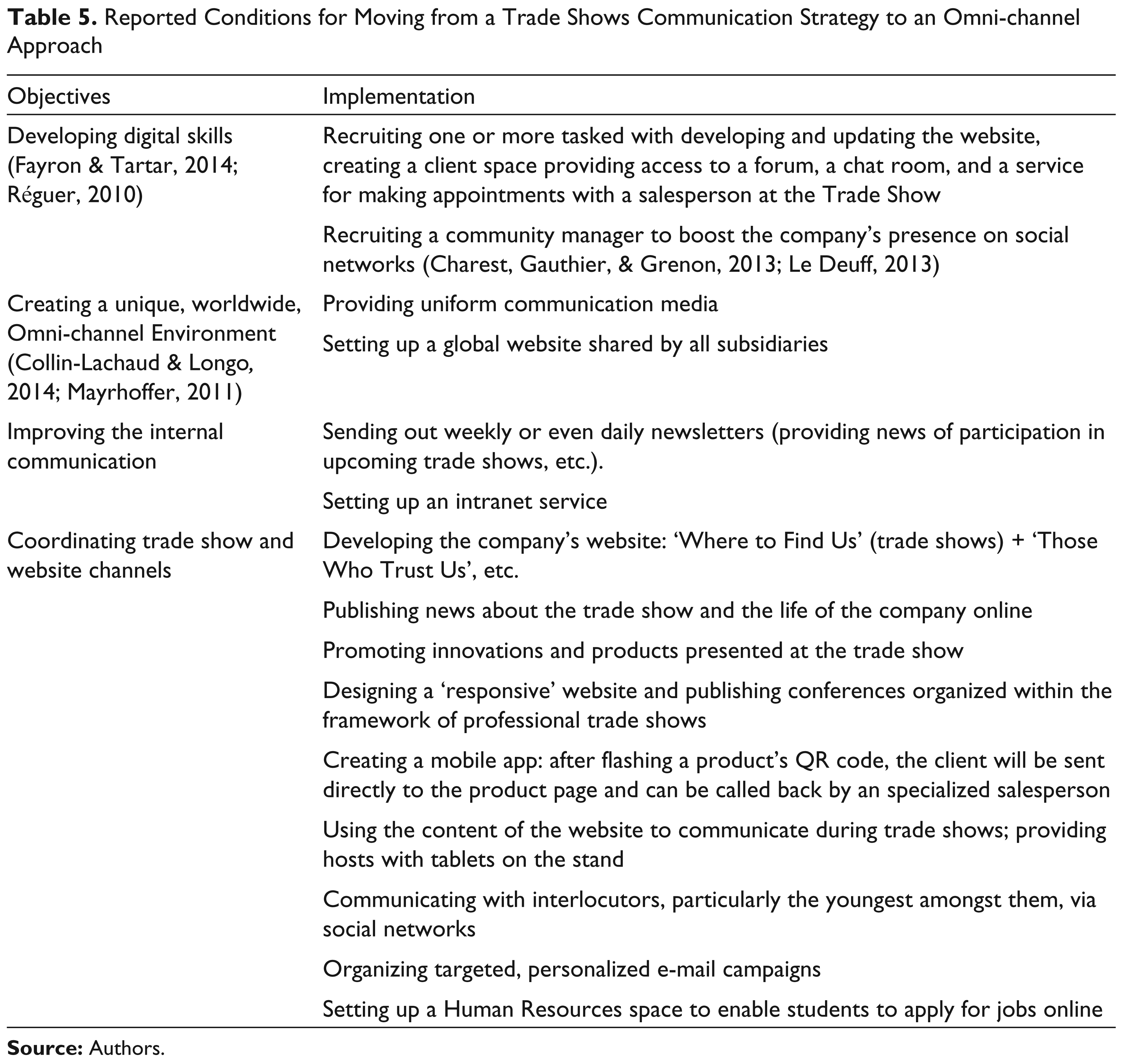
The development of digital skills and of an ergonomic website, with good coordination of both channels, should facilitate the transition from the single channel to an external Omni-channel communication strategy. In the case of an internationalized enterprise, this policy should be deployed by all subsidiaries to integrate them, which additionally will enable improvements of the internal communication across the POE subsidiaries using the Omni-channel environment.
Conclusion
Developed with the objective of bridging the gap between education and research in the field of management (Geschwind & Broström, 2015) this approach has required active participation and a multi-steps reviewing on the part of students with professional experience at trade shows. To take advantage of trade show’s attractiveness and to avoid the growing cost of professional trade shows and the International competition, Plastic Omnium Environnement is faced with the imperative to deploy an Omni-channel communications strategy. The results of the case study should provide scope for further research and contribute to build theory (Carlile & Christensen, 2004) on validating methodologies that would enable more developed understanding of how companies may move from a single-channel (trade show) communication strategy to an Omni-channel approach in B2B.
Further, it would be interesting to check these results by studying the experiences of companies operating in other markets. Other studies have been conducted with firms whose sales forces also face this transition to an Omni-channel strategy (Colla & Lapoule, 2014). It would also be interesting to compare the impact of the different cross-channel transitions, and in different industry sectors.