







Abstract
This case presents the innovative approach adopted by a for-profit social enterprise through utilization of technology, changed processes and improved business models to deliver the desired social impact. It also highlights the various challenges that the social entrepreneur faced and how the bottom of the pyramid was uplifted through success of this new social entrepreneurial venture. The case study is based on an interview conducted with the founder and managing director of SMV Wheels Pvt. Ltd. An exploratory schedule was prepared, and the researchers tried to develop an understanding of the business model deployed, challenges faced, competencies needed and strategic decisions made by the social entrepreneur that helped it in becoming sustainable.
The challenges highlighted in the case study were lack of trust of beneficiaries, stakeholder scepticism, funding the business, testing the business model, need to retain self-motivation, handling family opposition and building a team. Moreover, with the use of technology, the traditional rickshaw was converted into a lightweight, technologically superior and cost-effective model; the health hazards were minimized; and the product became accessible with small weekly payments.
Dilemma
How to alleviate the daily struggle of the rickshaw pullers who perform labour-intensive work with meagre income? Their children lacked access to schools, no nutritious food was available, many rickshaw pullers consumed alcohol on a regular basis, domestic violence was prevalent, they were unable to afford good healthcare and suffered from diseases such as tuberculosis. What could be done for them?
Options
Redesign the rickshaw as a lightweight vehicle requiring less effort to pull. Strengthen supply side and easy access to bank financing, revenue sharing from advertisements.
Discussions and Case Questions
How to further optimize economic and social value creation? What steps can reduce the cost of a rickshaw while making it robust but lightweight? Perhaps a community of networks of rickshaw pullers in different towns can give critical mass to better negotiate with the vendors. What can be done for the welfare of the dependents of the rickshaw pullers?
Introduction
Naveen Krishna, a final-year Master of Social Work student, went out to have a cup of tea on a cold winter night in December 2005. He had barely reached the tea stall when he heard a man’s shriek, who was being assaulted by a group of young men. He was dismayed to learn this was simply because the man, a rickshaw puller, had been asking for a mere ₹2 (US$0.0451), which was more than the student was disposed to pay. Naveen had to intervene; he rescued the poor rickshaw puller, helped him clean and offered him a cup of tea. The rickshaw puller was obliged at this kind act while Naveen experienced a shift in his perspective. He could sense his calling and tried to talk to the rickshaw pullers in Varanasi whenever he had time. During these small talk sessions, he realized that even after doing such arduous labour, posing risk to their health, the rickshaw pullers are not able to fulfil their basic needs. Currently, there are 8 million rickshaw pullers in India, and 95 per cent of them still do not own their rickshaws due to lack of funds (Poirier, 2009). He dreamt that he would do something for these miserable people one day. But as time passed, his Master’s programme came to an end, and he soon got a government job at the Department of Rural Development. His father always wanted him to be in a financially stable role, and he was very proud of his son having a government job.
During his tenure with the Ministry of Rural Development, he was appointed coordinator of the Rickshaw Bank project. He helped expand the rickshaw bank venture in Gujarat, Tripura and Tamil Nadu. He found the conception of placing rickshaws on the market through a non-governmental organization (NGO) model infelicitous and saw a social entrepreneurial opportunity in this sector. He could clearly see the flaws of the subsisting system that could not bring dignity to rickshaw pullers’ lives, as it worked merely as a handout. Its dependency on government funds makes it non-sustainable. He also did not want to push more people into this work because it has serious health risks and is not rewarding. He could see an opportunity in this social problem that would not only abstract the imperfections of the subsisting NGO system but in addition bring dignity to the lives of the rickshaw pullers as they would pay for their rickshaws. From the core of his heart, he still wanted to work for uplifting the community of rickshaw pullers, so he decided to quit his job. This was a very tough decision for him, as he had no idea how to proceed after this.
The next few days were even more arduous for him, as he had to face his family. With so much doubt in the future, his family was shocked by his decision. As with most northern Indian middle-class families, government job in the ministry seems to be the most lucrative and gratifying. He had forsaken what was desired by many. However, his father, who gave him the best education in hopes of an effulgent future for him, did not appreciate the idea of his son working with rickshaw pullers. There were major concerns about the social stigma that the Indian society still faces. He was apprehensive that his son would harm his social reputation through this act.
The Entrepreneurial Journey
Naveen soon began to visit the slums where these rickshaw pullers lived. Naveen started engaging frequently with rickshaw pullers. He met over 100 rickshaw pullers and began brainstorming. The rickshaw pullers were reluctant to talk to him because they were unable to understand why a well-educated man from a respectable family would ever want any interaction with them. Naveen began to spend his days in the slums, empathized with them, broke the ice gradually and they started to connect with him. He saw their daily struggle; children lacked schooling; no nutritious food was available; many rickshaw pullers consumed alcohol on a regular basis; domestic violence was prevalent; and they were unable to afford good healthcare and suffered from diseases such as tuberculosis.
The Plight of Rickshaw Pullers
He analysed that a rickshaw puller’s average earning in a day was ₹300 (US$6.81), out of which they had to pay the rent for an average of ₹60 (US$1.34) per day basis and ₹20 (US$0.449) maintenance cost. The plight of Indian rickshaw pullers raises strong questions for the government and authorities. It is a vicious circle of poverty and drudgery. These rickshaw pullers are seasonal migrants from the nearby villages and hence do not get any social identity in the urban areas (PT, 2013). Most of them have no government document, such as a ration card or a voter identity card. The lack of proper proof of identity deprives them of any financial loans or funding agency assistance. The conventional rickshaws were heavy and demanded hard work. In addition, the prices of fully assembled rickshaws were high and those poor people were unable to pay for the rickshaws. The majority of the rickshaw pullers suffer from diseases, such as joints and back pain, chest pain, asthma and tuberculosis, caused due to the nature of work (Khan, Hasan, & Shamshad, 2010). He realized that the biggest dream that a rickshaw puller has is the dream of owning his own rickshaw ‘Apna Rickshaw’.
Now Naveen could clearly understand the key deliverables that he needed to offer, so that the rickshaw puller community could benefit from it. There was need to innovate in terms of affordability, availability, acceptability and awareness of the product (Anderson & Billou, 2007). The need of the hour was a product that could be easily affordable to the rickshaw pullers, without creating an extra financial burden, or that could at least lessen the existing burden. Since they do not have a steady income, it was necessary to structure the payment plan so that they could make payments easily. This would not only help the community but also improve the repayment rate of the company and hence guarantee sustainability in the long term. It was also important that the rickshaw puller community was aware of and able to develop an understanding of the benefits of the product and accept it as a solution to their endearing problem.
Great Idea but No Resources
He could now clearly envision how a lightweight rickshaw with ownership and identity offered with a deferred payment plan was the answer to all the concerns of this community. Naveen had an idea and a clear mission in his mind but no resources. He had the conviction to implement his idea.
Researchers like Dees (2003) have also emphasized that ‘any form of social entrepreneurship that is worth promoting should be about establishing new and better ways of improving the world’. Innovation in terms of technology products, processes and business models is an essential part of running any social enterprise. This idea led to the creation of SMV Wheels Pvt. Ltd.
SMV Wheels: The Beginning
SMV Wheels, a for-profit venture aiming to bring respect in lives and livelihood of these poor rickshaw pullers, began its operation in the year 2010. Naveen believed that the for-profit model had the capability of attracting impact investments. He began operations in Varanasi, the place where he had witnessed the situation during his college days. Varanasi had a large number of rickshaws. Rickshaw is a major transport plying through the narrow traffic-jammed streets of Varanasi. SMV wheels began offering the cycle rickshaw pullers, interest-free loans with weekly payment for the duration of 12–15 months, and by the end of the payment period, the rickshaw puller gets ownership of the rickshaw. The manufacturing cost of the rickshaw is ₹11,000 (US$247.19), but it is sold at a meagre profit of ₹2,000 (US$44.94).
SMV wheels not only sells cycle rickshaws or pushcarts on a deferred payment plan but also develops a relationship that benefits the rickshaw pullers by infusing confidence and gives them dignity and respect. The company generates its profits by marking up the rickshaw prices slightly above the manufacturing costs.
Overcoming the Challenges
Naveen knew that offering rickshaws to the poor is not a new concept and would not help in making the business sustainable. Hence, he incorporated several innovations in the process and technology to make the business model sound and make the product attractive, affordable, and accessible and generate awareness about the product. While targeting the bottom of pyramid (BOP), resources need to be deployed differently for achieving maximum results. Prahalad (2004) described 12 principles needed to be employed in an organization to target the BOP market. Many of the competencies developed by Naveen can be seen as a reflection of these principles.
Innovating in Terms of Product and Processes
The social enterprises deal with the BOP segment as their consumers need to be made aware of continuous product, process, and business model innovations (Anderson & Markides, 2007).
When dealing with the BOP, the organizations need to rethink about what they are trying to deliver, how to deliver and what impact are they trying to create, as the needs and requirements of the beneficiaries are different from those of any other consumer group. The innovations at the BOP are more about addressing the issues of product acceptance, affordability of the product, and awareness about the product availability (Anderson & Markides, 2007).
Product Innovation
Since the conventional rickshaws were very heavy, pedalling it demanded a lot of energy. This arduous work has also given rickshaw pullers many health problems, such as back and joint pain, tuberculosis, etc. Naveen improvised the rickshaws to overcome this problem by making them technologically advanced, lighter in weight and adding new components that reduced the energy needed to pedal the wheels.
Process Innovation
Fully assembled rickshaws were too expensive and did not meet the rickshaw pullers’ requirements. So Naveen set up a manufacturing unit where rickshaw parts were imported and assembled from various manufacturers to produce a cost-effective lightweight version. Moreover, the deferred payment plan is designed keeping in mind the affordability factor and to make it easy and attractive for the rickshaw pullers.
Apart from the affordable payment plan, he also improved the benefits offered on joining the SMV Wheels network. On joining the SMV Wheels network, the rickshaw puller also benefits in terms of license, uniform, accident insurance, access to banking services and 20 per cent share in the advertising revenues generated from the advertisement displayed at the back of the rickshaw during the repayment period. The advertising share increases to 60 per cent once the loan has been fully paid.
Innovation, in the case of social enterprises, should be related to the mission of the social venture, as the mission influences the adaptation of innovation, and such organizations tend to be more successful in delivering a desired social impact (McDonald, 2007). The product and process innovation are integral to creation of better lives for the rickshaw pullers.
Getting Access to Funds
The social enterprise sector faces lack of funding, and hence, requires innovation and bricoleurism (people that organize their online lives, tinker with stuff, take an interest in fixing stuff, etc.) to fulfil its mission. Moreover, due to increasing competition, social enterprises are relying heavily on innovations for achieving sustainability (Weerawardena & Mort, 2006).
Naveen had no money; he approached the funding agencies, but they were cautious about the idea, so he realized that it was necessary to prove the scalability of the business model before any external funding could be achieved. So, his first funds came from his own bank savings of ₹50,000 (US$1123). Being located in the small town of Varanasi, it was very hard to access the impact investors, as they were mostly located in metropolitan cities like Delhi and Mumbai.
It took at least 1000 elevator pitches, more than 500 powerpoint presentations in Mumbai and Delhi and a year-and-half to raise the commercial capital
—Naveen Krishna
In the year 2011, SMV wheels won the Sankalp Award and the first light village capital award. The venture became a finalist in Unreasonable Institute Contest, leading to securing a fund of US$300,000 in the form of convertible debenture funding. Through his persistent efforts, Naveen and his team managed to get funds from several venture capital firms.
Optimum Value Creation
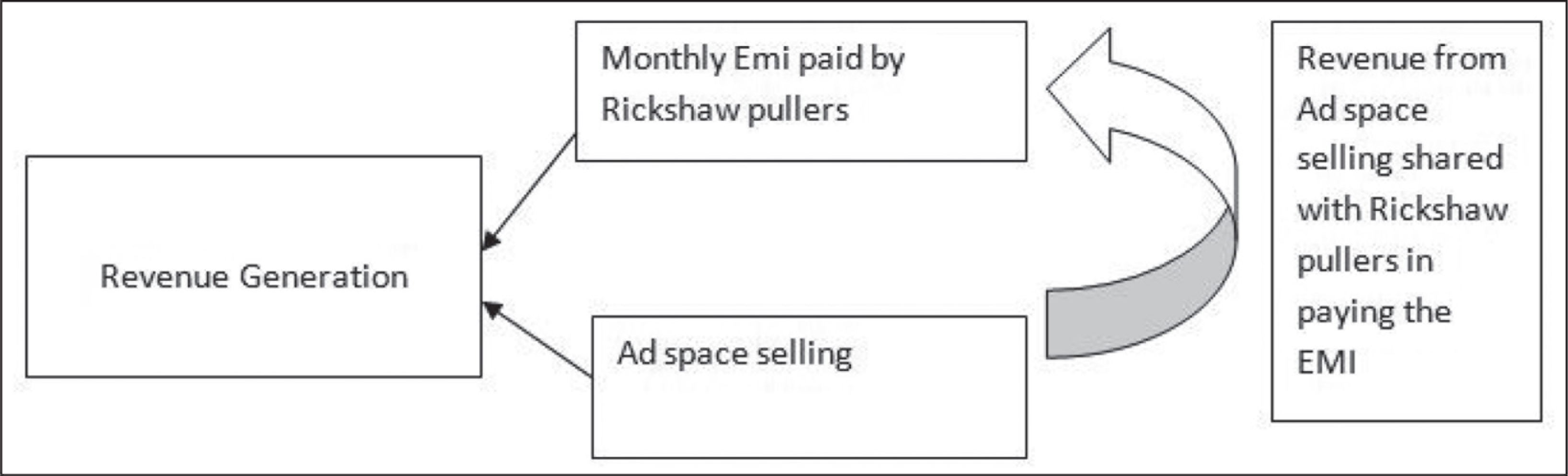
The organization identified the need to generate revenue via optimum value creation for an affordable price and identification of multifunctionality. A for-profit social enterprise must have a sustainable revenue model for optimum product quality at the said price. In the case of SMV Wheels, Naveen decided to target multiple customer segments to generate revenue. He identified two streams of revenue: the weekly EMI from rickshaw pullers and advertising revenue by renting the space on the back of a rickshaw. But as the rickshaws are sold at a very small markup, the EMI could not be the sole source. So, they decided to use the backspace of the rickshaw as an advertising space, targeting the companies who could pay them a good amount. The amount was shared with the rickshaw puller. It helped in generating revenues and also helped the rickshaw puller in augmenting his weekly payment (Figure 1).
Team Management
Naveen also needed an efficient team for SMV Wheels. But the nature of the business was not very lucrative and was socially challenging. Moreover, he did not have a regular cash flow to pay for experienced people. Few of his friends showed interest to work with him but were in doubt about the prospects. Naveen was in dilemma from where to start and how to build a team. He discussed the idea with his friends, and two of his friends, Praveen and Sumit, found it interesting and decided to take a chance. There was no money to pay them, so they decided that if nothing works out in 6 months, they would get back to their old jobs. Those 6 months changed the way they saw their future. At present, the organization has 15 employees managing its operations. The process of manufacturing the product to delivering has been streamlined and simplified, so that they can deliver their best quality.
Networking
SMV Wheels has successfully partnered with several partners such as municipal corporations, insurance companies, banks and government. His venture has received support from the UP Tourism department. The network that he has been able to create helps him by ensuring that the operations are carried out smoothly. Fully assembled rickshaws from the manufacturers with similar features as offered by SMV Wheels were expensive, hence Naveen decided to buy the parts from the wholesale suppliers and assemble them in their assembly units. He had a negotiation with vendors (rickshaw parts supplier) to give 30 per cent advance of supplied parts and the next instalment could be paid within 3 months. The assembled rickshaws had better performance and had less cost.
Stakeholder Engagement
The major stakeholders in the case of SMV Wheels are the buyers and the investors. The impact investors are not only getting good returns on their investment but also the satisfaction of financing solutions for sustainable development. Buyers, on the other hand, are the beneficiaries who are not only getting ownership of a rickshaw but opening doors to a better future and life. By getting access to this solution, a whole family’s life is boosted.
Designing a Simplified Approach of Value Deliverance
Most of the rickshaw pullers are illiterate and have no access to means of marketing communication commonly used in the industry. Naveen and his team designed a customized reach-out programme that helped these rickshaw pullers get information about this initiative. The local language is used as a means of communication and the employees of SMV approach them personally. The major issue with the rickshaw pullers is that they lack valid documentation, so it is hard to ascertain whether they are earnest towards the services offered by SMV wheels. They decided that the rickshaw pullers should register first and provide them some valid documentation, which will bind them to the cause. It is also made sure that the person applying for rickshaw has been driving a rickshaw for not less than 3 years as SMV wheels do not want to promote new people in this profession.
Perfect Balance
The unique characteristic of for-profit social enterprises is its ability to perfectly balance double bottom lines or triple bottom lines. The basic premise of for-profit social enterprise is the achievement of financial success through the creation of social impact. The increase in the financial well-being of the beneficiaries makes them better buyers, eventually leading to a growth in the business of the social enterprise (Rangan et al., 2011). The impact created by the for-profit social enterprise can be summarized in terms of the economic impact, social impact and ecological impact that they can generate through their activities.
Economic Impact
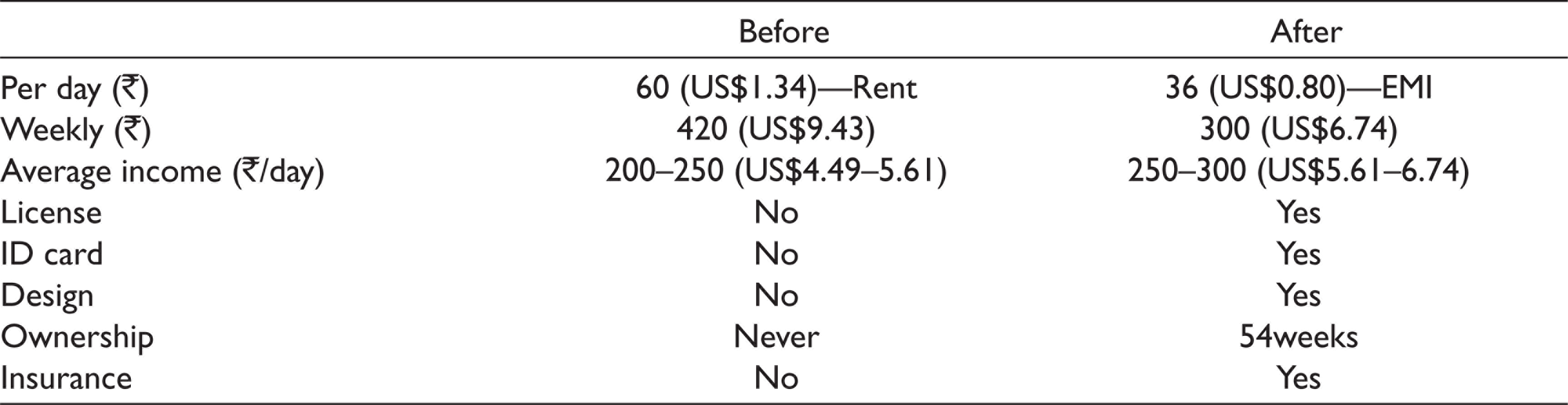
The average per day rent for a rickshaw is ₹60 (US$1.34), which is to be paid just for driving the rickshaw. So, for an entire week, the rickshaw pullers must pay ₹420 (US$9.44) as rent only. SMV wheel’s payment plan requires them to make a weekly payment of ₹300 (US$6.74). That not only spares them ₹120 (US$2.69) weekly but also guarantees ownership by the end of the process. Once the ownership is transferred, they are free to use all the money that they earn at their discretion. The surplus that they save during the payment process can also be used for improving their lives as a means to their children’s education, nutrition or medication. The company also came up with the idea of using the space behind rickshaws for advertising. The revenue generated through this process is partly used to balance some of the instalments to be paid by the rickshaw puller. SMV wheels also provide assistance in the number plate and license provision, which helps the rickshaw puller get professional recognition. Rickshaw pullers can also get insurance which they never had before. As the new rickshaw is less taxable, the rickshaw pullers can go longer distances or make more round trips, in turn, increasing their earnings.
SMV Wheels has seen a gradual increase in its reach, with more than 3,000 rickshaw pullers availing its services across Varanasi, Ranchi and Jaunpur. More than 1,500 have already earned the ownership of their rickshaws (Table 1).
The Economic Situation Before and After Joining the SMV Wheels Network
Social Impact
Not only has this project brought economic prosperity to the lives of rickshaw pullers, but it has also brought honour to their lives. It created a better social status for these poor people. It also helped to build trust among those people who had no hope of a better life or a better future. Many of the rickshaw pullers have emerged from this vicious rent payment and drudgery circle today. They have more money to spend on a better living; this money is spent on home-building, education for children and nutritious food. SMV wheels also helped them open their accounts at banks, which was not possible earlier because of their migrant status. Not only did SMV wheels help them get their rickshaw for their livelihood, but they also helped them get license and number plate that gave them a legitimate status. Also, drivers get insurance which they did not have otherwise.
The ownership of rickshaws makes them feel proud and optimistic, as now they are working for themselves. In the case of rentals, it is a compulsion to pay the rent even if the person is sick or in ill health, while owning a rickshaw gives them independence, work satisfaction and happiness.
SMV Wheels: The Way Forward
The company made a profit of ₹1.8 million (US$24,337.81) in the financial year 2015–2016. Naveen has consistently tried to maintain the organization’s position with impeccable service and product value. Before making any decision on strategic positioning, the main priority is the organization’s social intent. As a dual-purpose organization, social enterprises need to manage profit and social purposes. Many times, social enterprises compromise on social purpose and get more inclined towards financial profitability. It affects the social impact of the venture. SMV wheels has been selected as one of the top 20 enterprises that have worked extensively in dignifying the lives of rickshaw pullers in the state of Uttar Pradesh, India. Naveen also won Masterpreneur Season 2 in 2014 for his extraordinary entrepreneurial initiative ‘SMV Wheels’. The organization plans to expand into other regions also. In automatic rickshaws, Naveen sees huge potential and wants to foray into the production and distribution of e-rickshaws. They also created lightweight rickshaws for tourists in Varanasi with comfortable sitting space and other amenities such as bottled water space, newspapers and Lonely Planet (a travel guidebook). He hopes that with such amenities available in the rickshaw, tourists will prefer it as a mode of transportation in the narrow streets of the old city. The organization is looking forward to expanding in other geographies soon.
Footnotes
Declaration of Conflicting Interests
The authors declared no potential conflicts of interest with respect to the research, authorship and/or publication of this article.
Funding
The authors received no financial support for the research, authorship and/or publication of this article.