






Abstract
The notion of well-being has been evolving as research continues to unfurl its multidimensional nature. The importance of well-being in the organizational context is becoming a valuable line of inquiry, and employee well-being has emerged as a pivotal focus in positive psychology. Despite this, employees report high levels of disengagement and stress at work. Thus, we conducted 15 in-depth interviews with middle- and senior-level managers in the service sector in India to understand the factors that impact an employee’s well-being.
Introduction
The concept of well-being has witnessed a gradual evolution owing to increased scholarly work in the past few decades. From objective indicators to measure well-being such as an individual’s economic conditions, education, health and demographic characteristics, social indicators have expanded to include subjective measures such as evaluation of one’s life and circumstances, the overall meaning of life, and the level of satisfaction with specific dimensions. This all-encompassing nature of objective and subjective measures can present a holistic picture of an individual’s well-being. Broadly, there are two conceptions of well-being (Waterman, 1993): hedonic well-being, that is, pleasurable life with minimum pain and eudaimonic well-being, that is, meaningful and fulfilling life. The scientific study of well-being developed in response to the overwhelming importance given to negative states in psychology. Articles examining negativity outnumbered those examining positivity by 17:1 (Diener et al., 1999). Towards happiness and holistic development, the United Nations included well-being as one of the world’s 10 Sustainable Development Goals for the period 2015–2030. Research in the area of mental and physical health extends the notion of health beyond the absence of disease to include the presence of happiness and life satisfaction (Diener et al., 2003).
Well-being is an overall positive state of an individual (Kowalski & Loretto, 2017). Core dimensions of well-being include physical, social, financial, emotional, psychological, spiritual and occupational well-being (Rath & Harter, 2010). These dimensions are interconnected and have spillover effects on one another. An individual’s well-being is drawn from an awareness of entirety and seamless integration among all the dimensions of being. Well-being has three characteristics (Wright & Huang, 2012). First, well-being is a phenomenological event; that is, people are well when they believe they are so. Second, individuals evaluate their lives cognitively in terms of global judgment such as life satisfaction or domain-specific judgment such as marriage, job or health. Third, individuals effectively evaluate their lives in terms of pleasant and unpleasant emotions and moods. Thus, the experience of high levels of positive emotions, low levels of negative emotions, and high levels of life satisfaction form the core of well-being which is defined as a person’s cognitive and affective evaluation of life (Diener et al., 1999).
Employee well-being is a vital part of an individual’s overall well-being and well-being has emerged as a pivotal topic in positive-based management research in modern firms (Wilks & Neto, 2013; Wright & Huang, 2012). According to Rath and Harter’s (2010) survey across varied firms in 150 countries, a mere 8 per cent of employees reported high job-related well-being while the vast majority reported that their job was detrimental to their overall well-being. Consistent with the fascination around the pursuit of well-being, recent applied research suggests well-being at the workplace ascertaining several improved work outcomes at the individual and the firm levels (Kowalski & Loretto, 2017). Emerging scientific research has found that employees high on well-being were more creative, more engaged, and had a higher chance of promotion as compared to employees low on well-being. Moreover, their health-care cost, rate of absenteeism and intention to quit was much lower as compared to their unhappy counterparts (Achor, 2012). Since high absenteeism, sickness and employee turnover incur huge costs impacting the bottom line, organizations must consider employee well-being of paramount importance. With mounting research in positive psychology and high levels of reported employee disengagement as a backdrop, the present study is guided by the research question: What comprises an individual’s well-being at the workplace?
In this article, we systematically review the existing literature on well-being and its importance in the organizational context. Subsequently, we analyse the data collected through qualitative inquiry. We discuss our findings, highlight the contributions of the study, draw implications, and outline avenues for future research.
Literature Review
Theoretical Underpinnings of Well-being
Hobfoll’s (1989) conservation-of-resources theory highlights that people protect and enhance their inner self by acquiring and maintaining resources. When external factors provide resources, individuals are happy, whereas, when external factors pose a threat to these resources, they experience stress. This theory not only signifies stable personal and work-related characteristics but also underscores that resources get exhausted and replenished on a dynamic and continuous basis. In a similar vein, Fredrickson’s (1998) broaden-and-build theory posits that positive emotions broaden an individual’s awareness, enhance cognitive processes and encourage novel thoughts. These mechanisms build positive affect resources within individuals which may have a long-term impact on an individual’s well-being.
Drivers of Well-being at the Workplace
Extant literature cites some drivers of well-being which we briefly highlight here. Although many personality traits have been linked to well-being, extraversion and neuroticism are noted to be the key personality traits influencing workplace well-being (Diener et al., 2003). To assess overall well-being at the workplace, both job-related affective well-being and job satisfaction should be considered (Wilks & Neto, 2013). Internal locus of control is associated with high well-being both on and off the job (Spector et al., 2002). Park et al. (2011) found self-evaluation to moderate the person-job fit and well-being link. Organizational scholars examined several character strengths and found hope, zest and gratitude to be strongly related to well-being (Peterson et al., 2009). According to Wood and de Menezes (2011), high-performance work systems and enriched jobs wherein employees have a high degree of variety and autonomy over their roles influence well-being. Researchers have also found evidence that relationships at work and leadership support have a significant impact on employee well-being (Kelloway et al., 2013; Skakon et al., 2010; van der Doef & Maes, 1999; Wilks & Neto, 2013).
Research Context
In the past three decades, researchers have shifted their focus from a narrow view of well-being, that is, absence of disease to a more comprehensive understanding of well-being in various dimensions. Moreover, the environment in which today’s organizations operate is highly dynamic wherein changes related to technology, competitor’s strategy and customer’s preferences happen rapidly. In such uncertain times, the notion that employees are an organization’s most important assets is of paramount relevance and importance. Further, across varied national cultures, predictors of well-being were found to differ in past studies. For instance, work autonomy was a less important predictor of well-being for Japanese than for Americans (Spector et al., 2002). Since well-being is a culture-specific phenomenon and what comprises the well-being of employees in India is not explored much, we deemed the necessity to delve deeper into the Indian context. We used a case-based research approach and conducted a qualitative inquiry among service sector employees. This approach helps examine the phenomenon of interest in-depth, extrapolate key themes, illuminate important yet unexplored issues that must be applied in practice, and provide meaningful inferences from a holistic investigation of the complex phenomenon.
Methodology
Sample and Procedure
We aimed to explore the Indian employee’s notion of well-being at work and factors that impact their well-being. We interviewed 15 middle- and senior-level managers. All participants had more than 10 years of work experience and represented different service sector industries including consultancy, banking and information technology. Participants spanned different industrial and metropolitan locations in India. Table 1 summarizes the interviewees’ characteristics.
Interviewee Characteristics

After explaining the purpose of the study, we sought an appointment with the professionals for conducting the interview. Following the interview protocol, we assured the participants of the anonymity of their responses. Post their informed consent, we conducted in-depth interviews. The key question for data collection was: What factors lead to your well-being at the workplace? We refrained from including any personal questions and leading words, thus, ensuring that the interviewee’s response was bias-free. We also collected data on their current employment location and sector, domain expertise, and years of experience. Each interview lasted for 20–25 minutes. With the participants’ consent, the interviews were recorded and transcribed within 24 hours.
Data Analysis
Given the interpretive nature of this qualitative inquiry, we analysed the responses using grounded theory. Grounded theory helps in identifying patterns or themes within the qualitative data through a process of coding the expressions voiced out by the participants. Sub-themes extract important aspects related to the research question and represent patterns within the data set. These sub-themes are meaningfully combined to form a theme. Themes identified, coded and analysed by the researcher accurately reflect the majority of the content of the transcripts. Analysis using grounded theory provides a nuanced account of specific themes within the dataset. We followed an inductive approach for identifying the themes which are strongly linked to the data.
The Coding Process
The analysis of the data was carried out in steps as described below:
Step 1. We familiarized ourselves with the data by reading the transcripts several times and generating an initial list of ideas. Step 2. From the data, we identified initial codes that specify some interesting aspects. Table 2 highlights the various themes identified from the data and establishes a chain of evidence to demonstrate validity, that is, how themes are triangulated from sub-themes. Step 3. Table 3 demonstrates the themes, direct quotes and connect with the sub-themes.
Identified Themes and Establishing Chain of Evidences


Themes and Direct Quotes


Findings and Discussion
We set out to identify the factors that comprise the well-being of service sector employees in India. From the qualitative data analysis, the following are the major findings and we discuss these below in light of the relevant existing literature. For the first two themes below, we have indicated the sub-themes as well.
Encouraging organizational culture: A positive work environment (sub-theme 1a) that values the work of employees, encourages ideas from individuals, promotes innovation, motivates employees and bolsters continuous learning is considered essential. An organizational culture wherein management designs and practices fair policies (sub-theme 1b), immensely impact employees’ well-being. As a participant notes, ‘Well-being suffers when culture lacks transparency’. The fairness of policies and transparency in the implementation of policies is very important in building an encouraging organizational culture. Further, a workplace is conducive if diverse kinds of employees are recruited and integrated (sub-theme 1c) with no apprehension of being reprimanded for being different. Organizational culture is encouraging if freedom of speech and expression prevail (sub-theme 1d). Rather than remaining silent, employees voice out their opinion without any fear. This impacts employee well-being positively (Findler et al., 2007; Shier & Graham, 2013).
Providing social support: Social support in the form of group membership, cohesion in the team, and participation in group activities enhance well-being (van der Doef & Maes, 1999; Wilks & Neto, 2013). This is because an individual’s needs for affiliation, respect and belonging are fulfilled. Lack of adequate social support decreases the sense of well-being as ‘people seek emotional connect’, said a participant. Appreciation and recognition of good work from peers and most importantly from the immediate supervisor are deemed necessary (sub-theme 2a). ‘There can be nothing greater than having a supportive boss…one who understands you and encourages you’, noted a participant. Further, having friends at work, cordial relationships with colleagues and team members are critical for well-being (sub-theme 2b). Thus, social support from supervisors and peers is a key factor determining workplace well-being.
Demonstrating positive leadership: Leaders’ well-being has a significant impact on the well-being of employees (Skakon et al., 2010). The well-being contagion effect is witnessed if leaders demonstrate a positive attitude and disposition (Kelloway et al., 2013). Positive leadership behaviours such as support, consideration, empowerment, trust, feedback, integrity, openness in communication, encouragement of independent decision making, respect, openness about expectations and recognition, increase the experience of positive emotions among organizational members. Participant shares, ‘I can approach the top management if I have any issues…my business head is very compassionate and listens to problems in a very unbiased way’. Fredrickson’s (1998) theorized that individuals broaden and build their inner resources through positive actions and emotions. Thus, positive leadership behaviour immensely helps employees in building resilience, self-esteem, and competence.
Integrating work and life: Work and family demands impact an individual’s well-being (Grant-Vallone & Donaldson, 2001; Jain & Nair, 2013). Contemporary companies are mindful of the employee’s personal and professional needs, challenges and demands. Companies understand that employees can work to their full potential only when there is a balance between their professional and personal needs. Further, the nature of work in the service sector is such that employees can work from home and work timings are flexible. Thus, companies are providing flexibility to employees to work at their own pace from their chosen space as long as they are delivering the required output. Moreover, companies are providing adequate support for employees to fulfil their family needs from assisting in buying a car to counselling post spouse bereavement, thus enhancing employee well-being. ‘My company organizes fun events once in 2–3 months.… My kids look forward to it.… I feel great when my family says that I work for a good company.… This improves my well-being’, cites a participant.
Finding meaning in work: Work is the reason for being. Work should make life worthwhile and signify a larger sense of purpose. ‘Sometimes I wonder if what I am doing is worth … is the time and effort I’m putting into my work is of any use,’ says a participant. By building purpose, balance, and congruence in their work, participants reported enhanced well-being. Further, a good person-job fit with role clarity led to well-being. Respondents noted that if their role was congruent with their interests and goals, provided them opportunities to grow and acquire new skills, they were happy and engaged at work. Interestingly, some respondents touched upon mindfulness, that is, awareness of the moment-to-moment experience. Mindfulness helps reduce emotional exhaustion, improve job satisfaction, and individual’s overall functioning (Hülsheger et al., 2013; Park et al., 2011). Through a process of gain spirals in conservation-of-resources theory, individuals use positive effects generated by meaningful work and mindfulness, for instance, to enhance their inner resources and well-being.
Providing autonomy: Most participants reported work autonomy to be a key contributor to their well-being. They noted that when they had a high degree of variety, control over their task, and adequate information and resources to carry out their work, they were happy. While they experienced stress in a high demand job, their well-being improved if they had control over it (de Jonge et al., 2001; Wood & de Menezes, 2011). Control included several important aspects of the job such as taking decisions while executing a job. Autonomy not only provides a sense of freedom and ownership to employees but also a sense of responsibility and accountability. A participant shares, ‘Freedom to work … no micro-management by the manager is very important’.
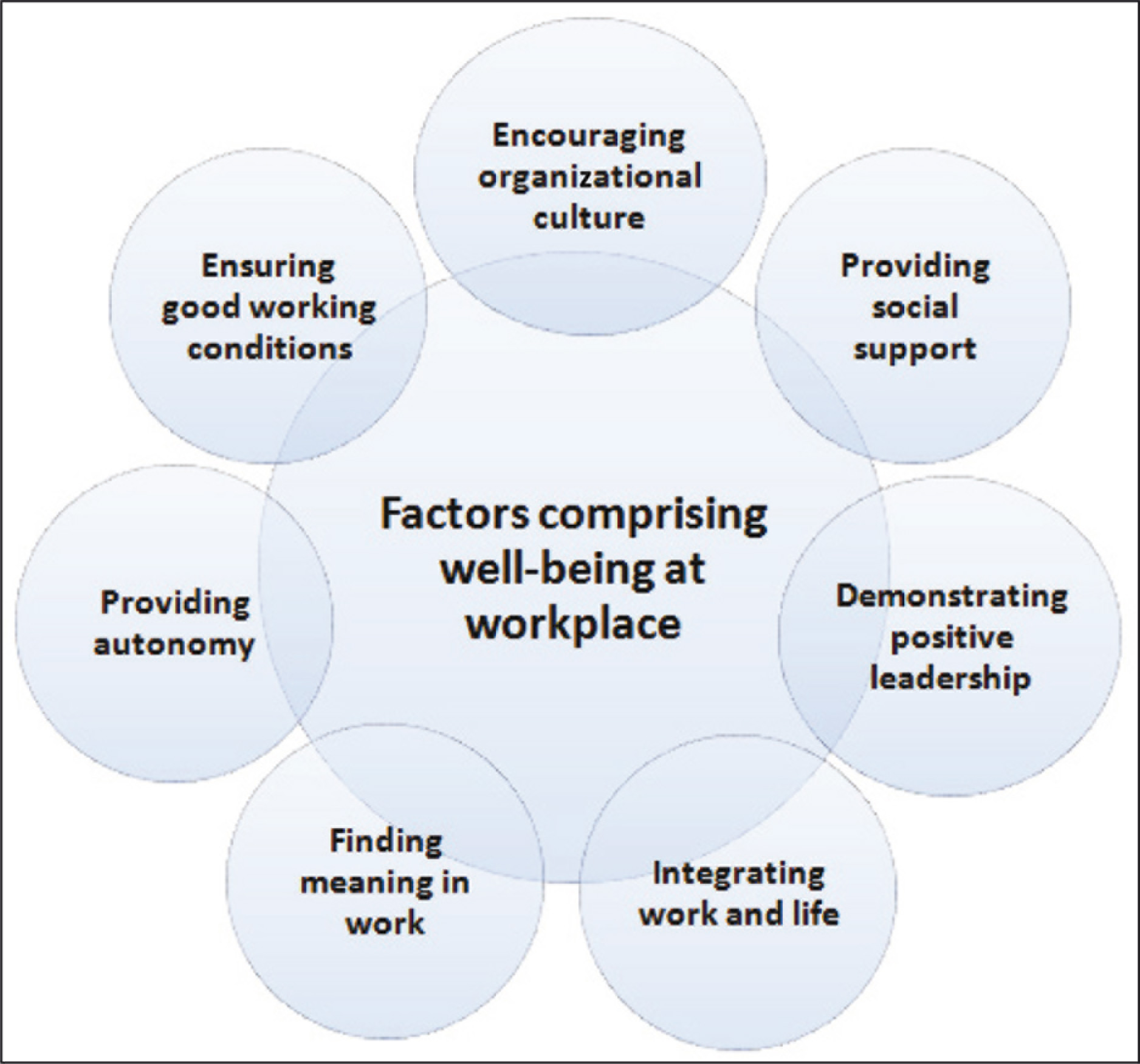
Ensuring good working conditions: ‘Company should provide support for mental and physical health’, notes a respondent. Safety is a critical aspect of the well-being of employees (Hayes et al., 1998). Due to the nature of work of the Indian service sector that may necessitate employees to work late in the evening, adequate physical safety is a key contributor to well-being. Companies today assure safety in office premises and arrange for pick-up/drop services for employees. Further, to ensure good mental health, companies provide counselling facilities and conduct well-being workshops for employees. Besides this, several participants reported an ergonomically designed infrastructure to enhance their well-being. This included adequate desk space, comfortable seating arrangement, and aesthetic common areas. Figure 1 summarizes the factors comprising well-being at workplace.
Contributions
We positioned workplace well-being in the Indian service sector as the central thesis of the present study and identified the different aspects contributing to it. We extend the well-being literature by amassing published empirical works and by synthesizing evidence accumulated from seasoned working professionals in the service sector. We believe our theorizing will be a fruitful ground for future research.
While the identified themes such as encouraging organizational culture, providing social support, and demonstrating positive leadership are prevalent in the existing literature, themes such as finding meaning in work and ensuring good working conditions have scantly surfaced in the scholarly work. More specifically, we found workplace mindfulness impacting employee well-being. Mindfulness, which has its roots in Eastern spirituality, helps individuals recognize the positive states already present in their lives through the concentration of energy (Hanh, 2016). At the workplace, it is important to be mindful of the internal experiences and external events so that employees stay focused and enhance task and contextual performance.
Next, we found Indian employees seeking a balance between their work and life. In the service sector, it is often noted that employees have to work late in the night or in the early morning hours to accommodate the demands of the clients in different time zones across the world. This necessitates organizations to implement policies such as flexible work timings and work from home. Further, the nature of jobs is such that employees are relocated every few years. While it may be a growth opportunity for the employee, relocation often disrupts their personal and family life. This disruption is exacerbated if the relocation is to a place where people speak a different language or there are stark cultural differences as prevalent in India. In such situations, company support to the entire family in recuperating from the pressures of the new environment ensures employee well-being.
Finally, a safe and secure working environment was stated as a crucial aspect of well-being by most employees. With the rising number of cases reported in India for sexual harassment, workplace bullying and a threat to personal safety, employees are increasingly cautious about their physical and mental well-being. Further, several Indian workplaces are not well-designed concerning infrastructure and ergonomics. While ensuring occupational health and safety is a mandate in the manufacturing sector, the same is not enforced in the service sector. Several service sector employees report increasing musculoskeletal disorders and lifestyle diseases due to long working hours, continuous screen time and a sedentary lifestyle. Thus, employees consider an ergonomically designed workplace that provides them with a comfortable working lifestyle as contributing to their well-being.
We also contribute theoretically by extending the scholarly works of Hobfoll (1989) and Fredrickson (1998). Hobfoll’s conservation-of-resources theory highlights the dynamic nature of resources that get depleted or replenished due to negative or positive effects respectively. Individuals use positive effects generated by a positive work environment, good interpersonal relationships and meaningful work to enhance their inner resources and well-being. In a similar vein, Fredrickson’s (1998) theorized that individuals broaden and build their inner resources through positive emotions. Positive emotions may be self-generated or contagious. In our study, we found that well-being contagion from leaders to other organizational members helps develop positive emotions among the latter. This helps in enhancing self-esteem, trust, and fairness among employees that contributes significantly to their well-being. Well-being is not a mere momentary positive feeling but a sustained level of affective outcome that an individual is ultimately interested in. Sustainable happiness can be achieved only by building inner resources such as character strength, resilience, emotional competence and internal locus of control. However, this is possible only when individuals are convinced that well-being interventions are not placebos or quick result exercises. These practices are long lasting and successful only when individuals understand their value and are committed to replenishing their inner resources. Also, autonomy, safety, and work-life integration engender positive emotions among employees which bolster their well-being.
Implications
Occupational health programmes and wellness interventions have become essential tenets of most contemporary firms. Despite the recent proliferation of well-being enhancing interventions, getting employees’ involvement is a tough task towards implementing the initiatives. Further, our study highlights that several factors interplay to impact an individual’s well-being, thus, posing some challenges.
Work-directed interventions that restructure the tasks are effective in reducing work-related exhaustion experienced by employees. Managerial interventions such as job redesigning or job crafting enhance the meaningfulness of work, employee’s control and engagement while creating an optimum balance between job demands and resources. Further, social support from managers and peers is the key ingredient to improve and sustain employee well-being. Thus, managers and team members must be provided adequate autonomy over the job. Further, encouraging organizational culture, good working conditions, work-life integration, and positive leadership behaviours act as levers for the overall smooth functioning and healthiness of the workplace. Thus, leaders must be trained in personal growth, positive, transformational and considerate leadership capabilities. Organizational think tanks must reconfigure their approach towards employees by focusing on basic human values, needs and relations to enhance individual and organizational well-being. Change in leadership behaviour will improve the organizational work environment, thus, enhancing employee well-being.
Limitations and Future Directions
The present study explored well-being in the service sector context, whereas factors impacting the well-being of employees in manufacturing companies may differ. Further, our findings can be validated by conducting quantitative methods of inquiry. Large-scale surveys of employees may be conducted to seek their perception of the importance of these factors contributing to their workplace well-being. Probing the well-being of employees in other industrial contexts and employing quantitative measures will provide a comprehensive understanding of the workplace well-being phenomenon.
Several interventions such as zest, learned optimism, mindfulness, focusing on employee strengths, and expressing gratitude, are being employed by psychologists and behavioural scientists to help individuals enhance their levels of well-being. However, these interventions are not being actively used in companies perhaps due to the lack of awareness of these techniques or the lack of expertise in conducting these exercises. While few firms seek external capabilities for individual-oriented interventions, most companies are apprehensive in undertaking such interventions since these take a few weeks or months to demonstrate evident results. Future research must explicate the value of these interventions to firms if conducted in the true spirit.
Conclusion
Owing to the growing impetus on positive psychology coupled with evidence demonstrating that an individual’s well-being impacts a firm’s bottom-line, organizations are heavily investing in the well-being of its employees. Despite these, employees report reduced levels of engagement and positive emotions at work. Thus, the present qualitative study sought perceptions of service sector employees in India with regards to factors impacting their well-being at the workplace. Employees reported key contributors to their well-being that would culminate in a holistic sense of workplace well-being. These factors included an encouraging organizational culture, providing social support, demonstrating positive leadership, integrating work and life, finding meaning in work, providing autonomy and ensuring good working conditions. We hope this qualitative inquiry will provide a road map to future researchers to consider the interplay between factors and interventions at organizational, managerial and employee levels, to create an enriching and thriving work environment.
Footnotes
Declaration of Conflicting Interests
The authors declared no potential conflicts of interest with respect to the research, authorship and/or publication of this article.
Funding
The authors received no financial support for the research, authorship and/or publication of this article.