






Abstract
The purpose of this study was to develop a theoretically grounded instrument to measure the construct nonviolence at workplace. The academic discourse on psychological mechanism underpinning nonviolence is meager. Relying on extant literature in psychology, sociology, and political science in the field of violence and nonviolence, we have identified four dimensions to capture the measurable features of nonviolence. Next, we developed items to measure these dimensions. Professionals from private organizations in India answered the 32-item scale. The scale was tested for its factor structure, reliability, and validity. The instrument can be used by behavioral scientists and industry practitioners to assess the level of nonviolence among professionals as pre-screening and for academicians to further test and develop theoretical insights of this construct. The unique contribution of this study is that it challenges the basic assumption that nonviolence is absence of violence. The results indicate that nonviolent personalities are active agents in breaking the cycle of violence.
(Áhimsa paramo dharm)
Nonviolence is a supreme duty
(Mahabharata, Vana Parva 207.74, Drona Parva 192.38)
Introduction
According to World Health Organization (WHO), 1.4 million people worldwide die due to violence each year, besides incurring direct financial losses in legal services, medicines, policing and indirect losses in earnings, time, productivity, domestic investment, external investment, tourism, etc. (“Violence and Injury Prevention,” 2014). The Institute for Economics and Peace estimates that the economic impact of containing global violence was US$9.46 trillion in 2012, equivalent to 11 percent of global gross domestic product (GDP; The Global Peace Index, 2013). The amount lost here is more than sufficient to repay the debt of developing world, bring stability in Europe, and achieve millennium development goals. India is the fourth-largest spender (US$186 billion) on violence containment. As per data on workplace violence from WHO and World Bank, India ranked first in 2002, by losing US$7.598 million disability-adjusted life years (DALY; “Economic Value of Disability-adjusted,” 2008) to violence and ranked ninth in terms of economic cost US$3.640 billion. This data reflects cost incurred as an aftermath of a violent outburst. Workplaces are mere reflections of the communities in which they exist. The National Institute for the Prevention of Workplace Violence, Inc., fact sheet, 2013, estimates the financial impact of workplace violence in the USA is US$121 billion a year, 876,000 lost workdays, and US$16 million in lost wages (“New Violence in the Workplace,” 2012). While such detailed facts and figures are not available for India, a single violent episode at the Maruti Suzuki plant at Manesar cost loss of life of a manager, factory's workforce was under investigation for murder, and a plant was shut down (“ Maruti Suzuki Faces Costly,” 2012). Around US$500 million were lost in production and US$570 million were wiped off the market value as investors were spooked. In India, information technology (IT) and manufacturing firms are struggling to survive in the economic downturn and have started exploring lay-offs, contract arrangement, salary freezes, etc. Such acts are likely to be perceived by employees as unfair and may provoke a violent response. There is need to search for compelling drivers that can break the cycle of violence before it takes an ugly form. This study provides preliminary evidence through scale development and scale validation that nonviolence can be one of the drivers to break the cycle of violence by promoting forgiveness and reconciliation. Thus, there is a need to focus on nonviolence (NVT) at workplace, in community and world at large.
Literature Review
Religion and Philosophy
In Jainism, himsa or violence against sentient can be committed by yoga (modes such as mind, speech, and body) and karana (through action such as doing it yourself, getting it done through others, or by giving consent to others). Ahimsa emphasizes the sanctity and dignity of every living being irrespective of species, caste, color, creed, or nationality and it is preached that the practice of ahimsa is both an individual and collective virtue (Sangave, 1991). Themes such as mercy, universal brotherhood, compassion, ahimsa, love, and sacredness of life have resonated in various religious teachings of Buddhism, Christianity, Hinduism, Islam, Jainism, and Judaism although history has revealed that religions have also contributed to violence (Gopin, 1997). This study's focus is on nonviolence which is a literal English translation of Áhimsa. Nonviolence is prescribed in the eight-fold path (Ashtanga Yoga) to achieve control over body, senses, and mind (Sharma, 2003). According to chapter 10, verse 5 in Bhagwad. Gita, nonviolence is the spiritual realization of the true body that enables the evolutionary progressive life of living entity (Prabhupada, 2000). According to Swami Prabhupada, text 8–12 of Bhagwad Gita means that violence is caused when one is trapped in ignorance of material concept of life (Bhagwad-Gita, 1978). Detachment from material entanglement enables nonviolence. According to Mahabharata scriptures, nonviolence is the supreme moral duty (Easwaran, 2007). It means not harming others by thoughts, words and deeds and a universal love for all living creatures (George, 2008). According to Indian philosophy, concentration of mind is achieved by showing friendliness to the happy, compassion for the unhappy, delight in the virtuous, and indifference toward the wicked. Hatred is said to disable mentality (Ram Murthy, 2012).
Sociology, Political Science, and Psychology
The dictionary meaning of nonviolence 1
1. Oxford Dictionaries. Retrieved January 15, 2014, from http://www.oxforddictionaries.com/definition/english/non-violence
The focus of nonviolence is to influence change without injuring the opponent (Bondurant, 1965). Nonviolence is a technique in which, one or both parties to a conflict, can resolve the paradox by reinterpreting the situation (Bondurant, 1965). The distinctive feature of nonviolence is the rejection of the stereotypical interpretation of the “enemy” (Lynd, 1966). It recognizes hardships in self and the opponent (Tolstoy, 1967). The world view that human nature is violent is a distortion of reality and impacts our behavior and interpretation of situation. Such built-in bias toward violence restricts search of nonviolent solutions (Sharp, 1973, Vol. 1). Nonviolence limits man's capacity for unreality and stereotypical interpretation. It attempts to gain an accurate understanding of the opponent's views, motivations, and intention (Sharp, 1973). In a violent struggle, the oppressor is attributed with faults and weaknesses while in nonviolence, “self-suffering” is accepted should the opponent fail to understand or even seek to harm (Cooper, 1973).
Creative nonviolent action requires reorganizing or reinterpreting old information to channelize cognitively controlled anger. It discriminates between a man and his role and recognizes that unjust acts through roles and structures are not necessarily motivated by evil. A nonviolent activist can become a significant force by transforming himself (Pelton, 1974).
It recognizes that the oppressor and the victim are creatures of circumstances. Thus, blame, if attributed should be to both or to none (Sharp, 1979). In nonviolence, truth is a relative and is subject to evolution and reinterpretation. It signifies fight against evil acts and not human beings (Iyer, 1983).
Nonviolent personality is highly empathetic, envisions others perspective, is altruistic, and does not aggress on provocation (Kool & Sen, 1984). It operates in the realm of rationality and accords high level of responsibility toward the violent other. Opponent is not perceived as enemy but simply a creature, which has erred under given circumstances. Thus, individuals are not labeled as wicked (Bose, 1987). Nonviolence is renunciation of physical and psychological violence (Holmes, 1990). A nonviolent person balances humanitarian concerns and justice (Kool & Keyes, 1990).
Nonviolence is human effort to contain aggression and pursue well-being (Asthana, 1990). Nonviolence is de-biasing from a self-referential position by allowing legitimacy to others (Brown, 1990). A negative image of the opponent (a steep self-other attitudinal gradient) is an impediment to nonviolent conflict resolution (Burrowes, 1996). The principle of nonviolence is that what holds good in respect of oneself applies to the whole universe. It does not differentiate between the opponent and the self and recognizes each party's interpretation of reality and truth (Easwaran, 1997). A nonviolent person claims moral superiority over the opponent (McAdam & Tarrow, 2000). Nonviolence does not attribute intentions to the oppressor. It separates the “evil” from the “evildoer” and isolates “evil” while salvaging the “evildoer” (Sharp & Paulson, 2005). Nonviolence is the discipline of the body and a realization that one's self is one's own friend as well as an enemy (Easwaran, 2007).
Four theories of nonviolence are proposed. The first is nonviolence as a psychological variable explained through three dimensions: aggression, moral concerns, and power (Kool, 1990, 1993, 2008). The second is nonviolent strategy classified as principled on one dimension and either reformist or revolutionary on the other (Burrowes, 1996). The third is a circular model of peacefulness or nonviolence represented by the three slices symbolizing peace with oneself, peace with the society, and peace with the nature encompassing the inner circle of universal peace (Brenes, 1999, 2009). The fourth theory is a two-dimensional model of nonviolence classified along the continuum of violence and nonviolence and means and ends. A nonviolent means and nonviolent ends is most likely to break the cycle of violence (Ritter, 2005).
Thus, the salient themes emerging from nonviolence literature are (i) non-personalistic attribution, (ii) reinterpretation of the stereotypical image of opponent, and (iii) change. While causing no harm is a universal value, the real test of nonviolence is only when it is pitted against violence (Borman, 1986). This study endeavors to find “what,” “when,” and “how” of the above themes by extending this search in area of violence.
Violence is an assault on physical self as well as on person hood, dignity, sense of worth of the victim (Scheper-Hughes & Bourgeois, 2004), and often instigated by violence and injustice. A violence cycle escalates from seemingly ambiguous, unintentional, and thoughtless acts into intentional and highly coercive behavior. The stimulus is perceived as unprovoked, cognitively interpreted as interactional injustice, and rapidly escalates into a tit-for-tat spiral by employing counter-aggression for revenge (Andersson & Pearson, 1999). Thus, on one hand, revenge or “getting even” connotes destructive and antisocial behavior (Greenberg, 1990), on the other hand, it can also be constructive and pro-social (Bies, Tripp, & Kramer, 1997). Review of literature suggests that such constructive responses can possibly help to break away or depart from the violence spiral at any stage by two ways (i) ignoring the provocation and (ii) cognitively reinterpreting the provocation (Bies et al., 1997; Masuch, 1985). This not only breaks or defuses the vicious violence spirals but also eliminates the secondary spirals. This study found three ways in which cognitive reinterpretation takes place.
The first cognitive reinterpretation is bringing about a constructive change in self rather than futile attempts or expectation to change the opponent first. The opponent is perceived as unable or unwilling to change. Examples of constructive change in self is a working harder to “prove” the critic wrong as a response to a humiliating public criticism of work performance (Bies & Tripp, 1995; Kidder, 1981), seeking private confrontation with the opponent to solve the problem (Bies & Tripp, 1995; Morrill, 1992), avoiding the harm-doer for a short period of time (Bergman & Volkema, 1989; Bies & Tripp, 1995), and transferring out of the job or department.
The second reinterpretation is that the opponent lacks ability to understand the situation. In Milgram's Experiment, 65 percent naïve subjects administered increasingly severe shocks as punishment (Milgram, 1974, p. 48), but those who did not administer the shock, cognitively reinterpreted that the experimenter was dull and did not see implications of his act (Nissani, 1990).
The third reinterpretation is that the opponent is perceived to be under stress and hence trapped in his/her own biases, policies, and systems (Greenberg, 1990; Sharp & Paulson, 2005; Sitkin & Bies, 1993). Thus, three methods of cognitive reinterpretation legitimize benefit of doubt to the opponent and enable departures from the spiral.
We propose the domain nonviolence in Figure 1 by the extending the current tit-for-tat model proposed by Andersson and Pearson (1999).

Tit. for. Tat Spiral (Andersson & Pearson, 1999) Realm of Nonviolence
Research has proved that people have stable propensity to exhibit certain behavior (Shoda & Mischel, 1993) and the way in which an individual interprets a situation varies as a function of individual differences (Skarlicki, Folger, & Tesluk, 1999). Thus, we contend that nonviolence is a stable personality variable, governed by tendency to de-bias from unitary interpretation of provocation. A nonviolent person visualizes multiple reasons of provocation by the perpetrator, reinterprets the situation, and thus ascribes benefit of doubt to the opponent through non-personalistic attribution.
A nonviolent response of ignoring or bringing about a constructive change in self defuses violent spirals and curbs secondary spirals. We argue that the active cognitive process of reinterpretation, ascribing benefit of doubt, and finally bringing about a constructive change in self is more than simple abstention from violence. Thus, a nonviolent personality is an active agent in defusing violence spirals.
Objective
The objective is to operationally define nonviolence at workplace, develop a scale, and test the factor structure, reliability, and validity.
Operational Definition
Item and Scale Development Process
Deductive method, called “logical partitioning,” or “classification from above” (Schwab, 1980) was used to derive definition of nonviolence. The item generation (Giles & Mossholder, 1990; Yukl & Falbe, 1990) was done using operational definition of nonviolence as a response pattern across four nonviolent departures represented in Figure 1. We created an initial pool of 40 items. While reverse coded items are recommended (Nunnally, 1978), it has also shown to reduce validity of questionnaire response (Schriesheim & Hill, 1981). Thus, we did not use any reverse coded items. The items were shown to three psychologists to check for clarity, ease of understanding, and relevance. Their advice was used to alter the sentence formulation and delete certain items. This procedure reduced the pool of 40 items to 32 items.
Instrument
The final instrument comprised of 32 items. The participants responded on a 5-point likert scale where 1 = Never, 2 = Rarely, 3 = Sometimes, 4 = Often, and 5 = Usually. The maximum–minimum score ranged between 160 and 32.
Participants
One hundred and fifty-eight professionals from IT and manufacturing sector who were also part-time students of Master of Management Studies (MMS) offered by Mumbai University completed the 25-minute questionnaire. The manufacturing sector comprised of all privately owned manufacturing organization in sugar, oil, electronic products, locks, electrical goods, etc. The IT sector comprised of all organization engaged in developing, managing, maintaining, and processing data using information technology. The details are presented in Table 1.
Demographics Details of IT and Manufacturing Professionals

Procedure
The Kaiser-Meyer-Olkin (KMO) and Bartlett's test is presented in Table 2. The KMO measure of sampling adequacy was 0.669, suggesting that the data are suitable for exploratory factor analysis (EFA). The decision on the number of factors that can be retained was simultaneously based on the examination of the Scree Plot (Cattell, 1966) and the eigenvalues-greater-than-one rule (Kaiser, 1974). To achieve meaningful results, items were deleted (i) if they loaded equally heavy on more than one factor (cross loading above 0.30) and (ii) if their loadings were smaller than 0.30. After item deletion, the EFA was rerun. The process of scale purification in this stage reduced the number of items from 32 to 27. Result of EFA on the data (Rotation Method: Varimax with Kaiser Normalization, Extraction Method: Principal Component Analysis with a minimum of 0.30) is presented in Table 3.
KMO and Bartlett's Test

Rotated Component Matrixa for Nonviolence

aRotation converged in six iterations.
*Although less than Nunally's (1978) recommended 0.70 cut-off, internal consistency coefficients greater than or equal to 0.60 are considered to be acceptable for an exploratory study (Hair et al., 1998; Robinson et al., 1991).
A four-factor solution provided the most conceptually interpretable factor structure. The first factor is NVT_Stress was measured by seven items (α= 0.722). Factor two was NVT_Ability and included six items (α= 0.682). Factor three was labeled as NVT_Constructive and contained six items (α = 0.688), and factor four is NVT_Ignore and comprise eight items (α = 0.59). The fourth factor had Cronbach's alpha coefficient 0.59 which is approximately near to the internal consistency of 0.60 recommended (Hair, Anderson, Tatham, & Black, 1998; Robinson, Shaver, & Wrightsman, 1991) and hence accepted. This four-factor model explained 37.35 percent variance. The reliability test of the scale was performed and the Cronbach's alpha on standardized items is within acceptable level. Results are presented in Table 4.
Reliability Statistics

Scale Validation
Nonviolence is a technique of creating goodwill (Bondurant, 1965). It is belief in the human potential to evolve and be humane (Lynd, 1966). It is a positive world view of human nature (Sharp, 1973, Vol. 1). It demonstrates trust on the opponent and converts the opponent's will (Sharp, 1973). Nonviolence is love for fellow human beings (Cooper, 1973). Creative nonviolent action creates love and goodwill by using reflective rather than reflexive action (Pelton, 1974). Nonviolence emanates out of a belief that no one is wicked by nature (Bose, 1987) and it is renunciation of physical and psychological violence (Holmes, 1990). Nonviolence is a conscious effort toward a transition from vegetative life to civilized existence (Asthana, 1990). Nonviolence helps the opponent confront his conscience (Burrowes, 1996). The principle of nonviolence is that all mankind is alike in essence (Easwaran, 1997). It seeks conversion of the opponent (Sharp & Paulson, 2005).
Objective
The objective is to test the construct validity of the scale nonviolence at workplace. If the construct captures the true essence of nonviolence as per theory, then we hypothesize as follows:
H1: Nonviolence will have a significant positive relationship with forgiveness.
H2: Nonviolence will have a significant positive relationship with reconciliation.
H3: Nonviolence will have a significant negative relationship with revenge.
Instrument
Forgiveness, Reconciliation, and Revenge
An 11-item scale used to measure Forgiveness, Reconciliation/Amend, and Revenge (Aquino, Tripp, & Bies, 2006) was used in this study. Response of participants is measured on a 5-point Likert scale where 1 = not at all to accurate up to 5 = very accurate.
Operational Definition
Reconciliation, Forgiveness, and Revenge
Results
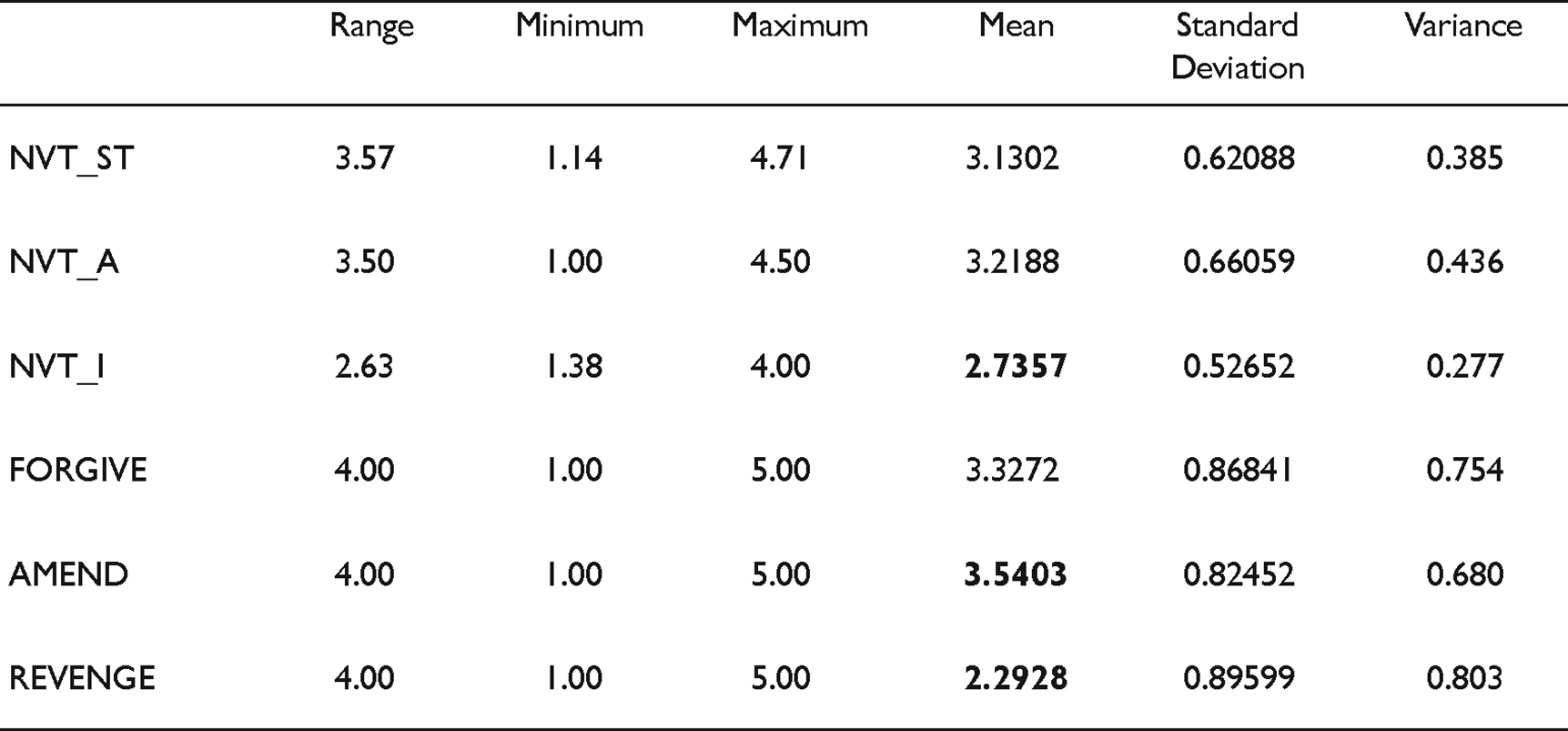
The descriptive statistics are presented in Table 5. It shows that the overall level of nonviolence in organization was moderate and Revenge was the lowest. The highest score was found for NVT_C (M = 3.54, SD = 0.56) and the lowest was NVT_I (M = 2.73, SD = 0.53). Similarly, Amend was the highest (M = 3.54, SD = 0.82) and Revenge was the lowest (M = 2.29, SD = 0.89). Details are presented in Table 2.
Descriptive Statistics
It was hypothesized that a nonviolent person is more likely to forgive. This hypothesis was not supported fully. However, three dimensions of the nonviolence—NVT_Constructive, NVT_ Stress, and NVT_Ignore had significant positive correlation with Forgiveness. NVT_I had significant moderate and positive correlation (r = 0.332, N = 158, p < 0.01). It was hypothesized that a nonviolent person is more likely to seek reconciliation. This hypothesis was not supported fully. Three dimension of nonviolence had significant low and positive correlation with amend/reconciliation. It was hypothesized that nonviolence will have significant negative correlation with Revenge. There were no significant correlations between three dimensions of nonviolence with Revenge; however, NVT_Stress had a significant and small positive correlation with Revenge (r = 0.158, N = 158, p < 0.05). Details represented in Table 6.
Inter-correlations between Nonviolence, Forgiveness, Amend, and Revenge

** Correlation is significant at the 0.01 level (1-tailed).
* Correlation is significant at the 0.05 level (1-tailed).
NVT_C = NVT Constructive, NVT_ST = NVT Stress, NVT_A = NVT Ability, NVT_I = NVT Ignore.
0 < r < 0.25 = low correlation, 0.26 < r < 0.5 = moderate correlation, and r = 0.50+ = high correlation.
Discussion
The main purpose of this study was to develop a theoretically grounded and empirically validated instrument to measure nonviolence at workplace. The scale formed is sufficiently robust in its factor structure and reliability.
In the validation study, the descriptive statistics suggest that ignoring provocations is difficult and seeking revenge is a constructive manner is relatively easy in organization. On the same note, seeking reconciliation is relatively easy as compared to overt acts of vengeance. The correlations results indicate that nonviolence is more likely to predict forgiveness and reconciliation. These results sufficiently provide construct validity to nonviolence.
The results also indicate that two dimensions of nonviolence NVT_Stress and NVT_Ability have small and significant correlation with Revenge. These dimensions are cognitive in nature which indicates that it may be impossible to eradicate violence from thoughts. Thus, residing at the heart of nonviolence is violence. These results challenge the basic definition of nonviolence and contend that the claims of (non-injury in thoughts) nonviolence at thought level may be hyperbolic. However, these revenge cognitions in a nonviolent personality may be channelized to respond in a constructive manner than a destructive one.
Managerial Implications
We contend that this instrument may be useful to enhance insights of young managers in leadership positions because (i) it will enable them to realize their focus in a conflicting situation, (ii) build awareness to focus on issues and not attribute intentions to people, (iii) diffuse violence spirals, (iv) resolve conflicts amicably, and finally (v) encourage more resonating interpersonal relationship.
The implications of this model of nonviolence are grave. Organizational practices of pre-screening for levels of aggression in potential candidates may not achieve the necessary outcome nor does it ensure that violence is averted or curtailed. Research suggests that aggressive behavior may be instigated under both neutral and provocation conditions (Bettencourt, Talley, Benjamin, & Valentine, 2006). Organizations need to relook at their policies and need to actively search for nonviolent individuals who can effectively break the violence cycles. Such candidates will be more suitable as supervisors on shop floor, executives in customer relation, and in labor negotiations.
Thus, the opposite of high violence is low violence and not nonviolence. Our study presents nonviolent personalities as active agents in breaking and defusing the violence spirals. It might be more meaningful for organizations to screen for nonviolence rather than testing for levels of aggressiveness in individuals.
Future Research
The instrument opens up interesting lines of enquiry for future research. Further research is needed to find empirical support for the nomological network and study the role of nonviolence in leadership and conflict resolution. There is also need to study if nonviolent tendencies are trainable.
Limitations
The instrument measures nonviolence at workplace through a survey method. There is need to search for more salient nonviolent responses which are not captured by the instrument through qualitative and experimental research.