







Abstract
Increased internet usage has fueled significant growth in online retailing. The textile business has benefited in all countries thanks to the surge in online sales. Women’s fashion is having a huge impact on the world stage as women are the most concerned about what they wear and also new attractive clothes are released regularly. Electronic word of mouth (EWOM) is considered to be an important source of information and helps potential customers in purchasing decision-making. This study attempts to gather in-depth information about the women’s apparel sector by mining these EWOMs. Topic modeling through latent Dirichlet allocation (LDA) is utilized here for extracting the key aspects about which the customers chat in their reviews that are posted online. A total of 23,486 reviews were accessed on which the LDA technique was applied after preprocessing the data for potential cleaning. LDA technique resulted in six topics, namely, aesthetic, functionality, expressive, performance, extrinsic, and return policy. These are the aspects that the customers mention while commenting about their shopping experience. The findings of this study provide the key aspects that customers expect while purchasing women’s apparel online. The study discusses some implications for online marketers that may help them achieve a competitive edge.
Introduction
The havoc caused by the coronavirus pandemic has changed the apparel industry and the customers’ approach toward buying intention. The changes have been observed based on age, gender, financial background, jobs, and interests of the purchasers. The apparel market size of the United States is estimated to be $316 billion in 2021 (SaveMyCent, 2021). This is a big drop from 2019 when the market was anticipated to be worth roughly $368 billion. Although the decline was not predicted, the sector will need to reconsider its strategy post-pandemic, which will rely heavily on electronic commerce (e-commerce). In 2020, the Indian textile and apparel market was worth $133 billion (Businesswire, 2021). As per the report, the Indian textile and apparel market is expected to develop at a compound annual growth rate of 13.80% between 2021 and 2026.
Textile and apparel manufacturing costs are much lower in India than in many other competitive countries, thanks to a plentiful supply of raw materials and low labor costs (Kumar, 2021). Also, online retailing is witnessing considerable growth in India, fueled by increased internet usage. Consumers are now searching for shopping convenience, a variety of options, better deals, and simple return policies. Because of the rise in online sales, the textile industry can now reach customers from all over the country (Chauhan et al., 2021). Consumers are changing from need-based clothes to aspiration-based apparel as a result of a shift in buying behavior. Buying clothes has become more than a fundamental requirement; it is now an expression of desire, personality, and a status symbol, in contrast to prior years, when Indian consumers purchased fashion products as and when required (Dahiya, 2021). Though basic textiles remain a component of the consumer’s basket, aspirational apparel has seen a considerable surge in demand in recent years.
Women’s fashion has made a significant contribution globally, probably because women are the most conscious of what they wear, as well as the regular release of fashionable clothing. The fashion industry, particularly in women’s apparel, is believed to be worth over $600 billion and employs more people than most other major industries in the globe (Fibre2Fashion, 2021). Moreover, it has been observed globally that the women’s apparel market overshadows the market covered by children’s and men’s clothes. According to current data and market trends, the women’s fashion sector is predicted to increase at a rate of over 5% by 2025 (Fibre2Fashion, 2021). Women’s empowerment, an increase in the number of working women, constantly shifting fashion trends, and the opportunity to spend more on various emerging women’s items are all contributing to this expansion. Furthermore, today’s internet influence has played a huge role, with manufacturers profiting from quick exposure to their products. Other important components are celebrity and social media impact, which allows consumers to learn about new styles and designs. Manufacturers, on the other hand, have been able to expand their reach through online channels by leveraging e-commerce sites, personalization of women’s clothing to match their needs, celebrity endorsements, and discounts (Businesswire, 2021).
With many of the industries focusing on the women’s apparel sector, this study attempts to gather in-depth information about this sector. For this purpose, text mining is utilized to understand the expectations of female customers that shop online for purchasing apparel. Text mining means extracting meaning out of the collected online reviews or electronic word of mouth (EWOM). EWOM is defined as “any positive or negative verbal statement made by potential, actual, or former customers of a product or company” (Sharma & Aggarwal, 2019a). EWOM is considered to be an important source of information and helps potential customers in purchasing decision-making. These online reviews are perceived to be more credible, helpful, and influential in comparison to the information provided by marketers (Sharma & Aggarwal, 2019b). From the firm’s perspective, mining online reviews enlighten the marketers about the evaluations made by past purchasers toward apparel products, which also depicts the success or failure of the firm in generating satisfaction from customers.
Latent Dirichlet allocation (LDA) is an unsupervised algorithm that helps in extracting latent topics out of a corpus consisting of big data and can even handle imbalanced data (Blei et al., 2003). The algorithm is based on a premise that models each document as a mixture of topics to generate automatic summaries of topics in terms of a discrete probability distribution over words for each topic, and further infers per-document discrete distributions over topics (Qiao et al., 2017). This study intends to leverage the LDA technique for obtaining the key topics or aspects that customers emphasize through the reviews posted by them online.
In the line with the above discussion, the objective of this paper is to evaluate the key aspects that apparel customers emphasize while purchasing female clothes through online shopping. This is done by applying the LDA technique to the accessed reviews dataset. Therefore, the key research questions considered here are:
What are the aspects that online customers expect while shopping for women’s apparel? How to extract these meaningful aspects?
The novelty of this study can be discussed as follows. The past studies focusing on the women’s apparel sector have talked about fit problems, rented clothing, apparel quality, and the impact of return policies on purchase intention (Abraham-Murali & Littrell, 1995; Kaushik et al., 2020; Olson & Jacoby, 1972; Rosenau & Wilson, 2014). To the best of the authors’ knowledge, this is the first attempt to gather customer expectations through EWOM. Such a study is required as EWOMs help retailers in understanding what attributes need to be considered by them to achieve their target of customer satisfaction and prospective increase in market share. Also, when customers observe that the retailers can create value among them, they react through recommendations and repurchase intentions. The rest of the paper is organized as follows: The next section discusses the literature on women’s apparel; the following section states the adopted methodology, Section 4 deliberates the research findings based on data analysis. The implications for academicians and practitioners are provided in Section 5. Finally, the last section of the manuscript states the concluding remarks and scope for budding researchers.
Literature Review
Meeting customer expectations has become a prerequisite for generating satisfaction and a favorable attitude toward retailers (Duarte et al., 2018). In traditional offline retailing, customer expectation has been observed to be an important construct while evaluating customer behavior (Ghosh et al., 2010; Varley, 2005). These studies inferred that store attributes and the customers’ experiences from the final offerings play a key role in reflecting the expectations of customers. The selection of a specific retail outlet entails a comparison of the available alternative outlets based on a consumer’s evaluative criteria (Hugo & van Aardt, 2012; Jin et al., 2010).
Learning the lessons from offline counterparts, online retailers have largely focused on the website atmospheric characteristics, such as navigation, accessibility, and website quality, to explore determinants of customer expectations (Chen et al., 2017; Loiacono et al., 2002; Tandon et al., 2017). But, there are still few studies that consider product-centric characteristics while evaluating customer expectations in online shopping (Biswas et al., 2019; Kim & Stoel, 2005). These studies emphasized features such as product quality, pricing, product availability, breadth of the product offering, timeliness, and shipping/return services.
Customer Expectations toward Apparel
The women’s apparel sector has attracted researchers for more than a decade. During this period, they have researched fit issues, rentals, apparel quality, and return policies.
Few studies in the past have focused on the problem of ill-fit that is frequently faced by women customers while making an online buy. Alexander et al. (2005) showed that the fit problem creates dissatisfaction among potential customers and forces them to return or replace the product. Ill-fitting also compromises the comfort level of the purchasers and creates negative cognition toward their bodies (Kinley, 2010). Studies have reported that clothing fit has a direct impact on mental health, buying behavior, and satisfaction. However, these relationships can be moderated by demographic profiles (Alexander et al., 2005; de Klerk & Tselepis, 2007; Jones & Kim, 2010) and psychological factors (Alexander et al., 2005; Kim & Damhorst, 2010). Fit is the first evaluative attribute of clothing which is affected by fashion, culture, industrial norms, and individual perceptions (Fan et al., 2004).
Another set of studies focused on the fit reviews for rental clothing. Shin and McKinney (2017) evaluated rental products based on the negative and positive reviews posted online. Their analysis showed that positive-fit reviews created a favorable environment for rental products and services. Also, the impact of valence fit reviews on online shopping decision-making for rented apparel had been reported (Shin et al., 2020). These studies concluded that negative reviews are more influential and informative than positive reviews. Moreover, the valence of reviews embarks their credibility and helps in distinguishing the products based on their quality level.
Moreover, the quality of apparel has been a topic of concern for researchers. Two forms of quality have been witnessed in the literature, namely, physical and performance (Brown & Rice, 2013). According to their study, the physical dimension contains product aspects such as design (style), materials (fabrics and trim), construction (such as stitching), and finish that cannot be modified without changing the product itself. More customer-related characteristics, such as aesthetics, durability, and fit, are included in the performance dimension. The pioneering study by Olson and Jacoby (1972) categorized apparel quality as intrinsic and extrinsic. Intrinsic attributes are inherent features of products that are impossible to alter without changing the product itself, whereas extrinsic attributes are not part of the product but important. It has been reported that price and the brand name are the most mentioned extrinsic criteria while product composition (style, color/design, fabric, and appearance) and performance (care, fit, durability, and comfort) are the most mentioned intrinsic criteria (Eckman et al., 1990).
Lennon and Fairhurst (1994) discovered that aesthetic aspects were most commonly identified, followed by performance, extrinsic, and utility attributes, using open-ended questions and content analysis. Focus group interviews were used by Abraham-Murali and Littrell (1995) to generate a comprehensive list of attributes comprising physical appearance (fabric, color/pattern/texture, construction, and styling), physical performance (fabric, color, care, workmanship, and garment), expressive attributes (looks good on me, appropriateness, and other people’s comments), and extrinsic attributes (brand, price, store, country of origin, care label and service). Swinker and Hines (2006) discovered that aesthetics was the most important cue, followed by performance (durability, care, etc.) and extrinsic cues (brand, price), but no intrinsic cues were observed, possibly due to the lack of actual clothing. Aesthetics (style, color, fabric, trim items, and fit) and construction elements such as seams, stitches, and pattern matching were examined first, according to Rosenau and Wilson (2014), while durability, comfort, care, and appearance retention were reviewed second.
Extant researchers have started studying the role of return policies in the women’s apparel sector. Past studies have shown that flexible return policies develop interest and confidence in the customers toward that retailer. The return policies are nothing but remedial measures for bad fits (Minnema et al., 2018). Client dissatisfaction with the product provided has been seen many times in the online clothes market since the products are either completely different or incomplete, which is of no value to the customer and leads to sudden returns (Holloway & Beatty, 2008). Therefore, under the cut-throat competition among online retailers, return policies are bestowed as a risk reliever (Kaushik et al., 2020).
Customer Expectations and EWOM
Extant studies have started using EWOM for mining key aspects related to the product/service for evaluating customer expectations. A study by Sharma et al. (2019) showed that hotel guests convey their expectations by rating hotel services based on six aspects, namely, service, room, value, location, sleep quality, and cleanliness. Few other studies in the hospitality sector reported that guest satisfaction is a by-product of successfully meeting guest expectations and can be achieved by focusing on location, amenities, price, value for money, room, service quality, cleanliness, and many more (Padma & Ahn, 2020; Sharma et al., 2019). Text analytics was applied to the Amazon dataset of digital cameras and television for extracting important features. These features were later used for ranking products (Zhang et al., 2011; Zhang et al, 2010). A similar methodology was adopted by Peng et al. (2014) for getting key aspects of mobile phones.
Extracting features to get a proxy for customer expectations has been performed for products such as cameras, laptops, and HDTV (Najmi et al., 2015; Yang et al., 2016). These features were later utilized for product selection purposes. Features of cars have also been text mined and later utilized for generating a selection algorithm (Fanet al., 2018; Liu et al, 2017a, 2017b).
Research Gap
A few research gaps were observed after surveying the previous literature.
Much of the studies focused on customer expectations through website characteristics. Product-centric especially apparels related studies are still lacking.
Enough studies have included the role of EWOM in evaluating the expectations of customers toward the camera, television, HDTV, and cars. Such a study for apparel is still required.
Studies focusing on the women’s apparel sector are still less. This paper makes another contribution to the literature.
Methods
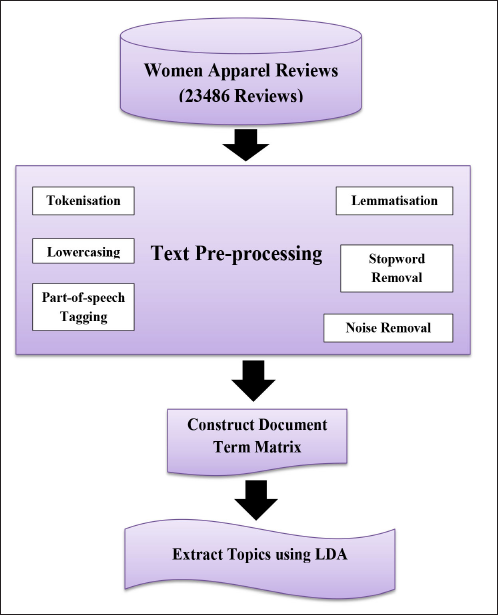
The research framework consists of three steps: data collection, data preprocessing, and topic modeling through LDA. The pictorial representation of the same is provided in Figure 1.
Research Methodology.
Data Collection
This study utilizes the “women e-commerce clothing review” dataset available in the Kaggle repository (
Data Preprocessing
Before forwarding the dataset for analysis, it is preprocessed by separating the sentences into words (tokenization), removing duplicate words (lowercasing), assigned tags such as nouns or adjectives (part-of-speech tagging), and converting the words into their root (lemmatization), removing commonly used words such as a or the (stopword removal), and removing special symbols like hashtag or symbols (noise removal). Later, for topic modeling, a document term matrix is constructed which consists of all the words in a document with the number of occurrences over the entire document corpus.
Topic Modeling
LDA is a more advanced variant of topic modeling approaches such as latent semantic analysis and probabilistic latent semantic analysis that can handle both words and documents (Qiao et al., 2017). As a result, it is essentially an unsupervised method for extracting hidden dimensions or “themes” from enormous documents that are primarily made up of big data. The method is based on the assumption that a document (commonly referred to as a bag of words) is defined by a combination of subjects, with each topic defining a probability distribution of the attachment of words to a certain topic (Blei et al., 2003).
Let a sequence of

where
Data Analysis and Results
Demographic Results
Age is a categorical variable having four groups. The four groups consist of customers within the age group 18–24 years, 25–54 years, 55–64 years, and 65 and above years, respectively. Most of the women customers belonged to the age group 25–54 accounting for 76.90% of the total customers. Positive feedback count refers to the number of positive feedback received by a particular review posted on the platform a.k.a. the helpfulness of that review. Some reviews have received no helpfulness (minimum = 0) while, on the other hand, there are reviews that have received above 100 likes (maximum = 112). On average, a review receives 2.54 likes with a standard deviation of 5.70. Department name represents the category of apparels such as bottoms (16.20%), dresses (26.90%), intimate (7.40%), jackets (4.40%), tops (44.60%), and trends (0.50%). Therefore, most of the women customers that belong to this dataset have purchased tops. There are further 20 different types of clothes (class) as suggested in these data. However, the high gainers are knits (26.90), skirts (20.60), and blouses (13.20).
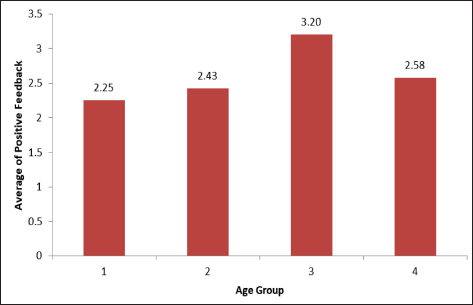
Next, the Chi-square test is used to compare age groups based on department and class. The Chi-square results for age groups versus the levels of the department come out to be significant (Pearson Chi-square = 216.483, p = 0.000). Thus, there is a significant difference between the age groups as per department. It is also observed that the second age group, i.e., 25–54 years dominates all the categories of the department. Similarly, we get significant results for age versus class (Pearson Chi-square = 390.618, p = 0.001). Thus, there is a significant difference between the age groups as per class. Again, the second age group people cover a high volume in each class type. Since the number of positive feedback is a continuous variable, a bar plot is provided to represent age group-wise the average positive feedback (refer to Figure 2). It may be observed from the figure that the reviews posted by people lying in the third age group, i.e., 55–64 have received the most helpful votes, with an average of 3.200.
Age Group versus Positive Feedback.
Topic Modeling Results
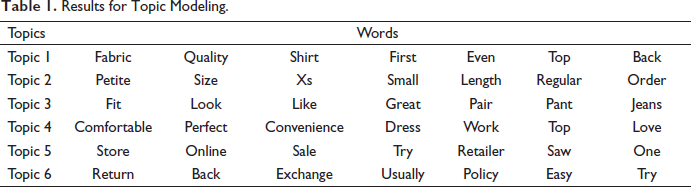
While evaluating online reviews posted by customers it is vital to extract such aspects to get the broad categories of traits that they mention in their reviews, even if they do not’ say so explicitly. Therefore, it becomes necessary to apply a technique that extracts the important properties while ignoring the ones that may impede further analysis (Chen et al., 2015). For this purpose, this study makes use of LDA. LDA results in six topics, as provided in Table 1.
Results for Topic Modeling.
The labeling of each topic was done based on the linking between the features holding high relative weight (an example is shown pictorially for Topics 1 and 2 in Figure 3). This labeling was validated by the names suggested by two different researchers working in the women’s apparel sector, who independently recognized the words in each topic. The suggested names were cross-validated with those obtained through a literature survey.
Topics with Loadings for Words.
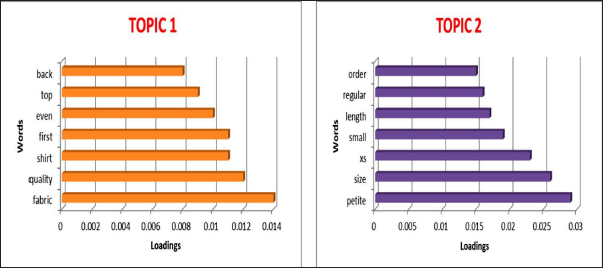
Topic 1 consists of the words “fabric, quality, shirt, first, even, top, back” which depict the appearance of the garment concerning the body. Thus, it is named aesthetic. For illustration consider this review:
This is a nice choice for holiday gatherings. I like that the length grazes the knee so it is conservative enough for office-related gatherings. the size small fit me well - I am usually a size 2/4 with a small bust. in my opinion it runs small and those with larger busts will definitely have to size up (but then perhaps the waist will be too big). the problem with this dress is the quality. the fabrics are terrible. the delicate netting-type fabric on the top layer of skirt got stuck in the zip. Though it matches my shirt color!!
The second topic comprising “petite, size, xs, small, length, regular, order” depicts the physicality of the apparels and thus this topic is named as functionality. For example,
I had such high hopes for this dress and really wanted it to work for me. I initially ordered the petite small (my usual size) but I found this to be outrageously small. so small in fact that I could not zip it up! I reordered it in petite medium, which was just ok. overall, the top half was comfortable and fit nicely, but the bottom half had a very tight under layer and several somewhat cheap (net) over layers. imo, a major design flaw was the net over layer sewn directly into the zipper.
Topic 3 consists of the words “fit, look, like, great, pair, pant, jeans” which portrays the likeliness toward the fit of the apparel. Therefore, it reflects the aspect of expressive. Read the review:
Took a chance on this blouse and so glad I did. I wasn’t crazy about how the blouse is photographed on the model. I paired it whit white pants and it worked perfectly. crisp and clean is how I would describe it, launders well, fits great, drape is perfect, wear tucked in or out - can’t go wrong.
The fourth topic comprising “comfortable, perfect, convenience, dress, work, top, love” portrays the comfort of the garment and is termed performance. For example, “This is a comfortable skirt that can span seasons easily. While not the most exciting design, it is a good work skirt that can be paired with many tops. it also fits well.”
Topic 5 is named extrinsic as it consists of the words “store, online, sale, try, retailer, saw, one.” This topic covers the online or offline infrastructure of the apparel providers, which is not a key characteristic of the product but still essential. A review for illustration is:
Love this dress! it’s sooo pretty. I happened to find it in a store, and I’m glad I did bc I never would have ordered it online bc it’s petite. I bought a petite and am 5’8”. I love the length on me- hits just a little below the knee. would definitely be a true midi on someone who is truly petite.
Finally, Topic 6 is named return policy as it comprises words that point out toward returns, namely, “return, back, exchange, usually, policy, easy, try.” For example,
First of all, this is not pullover styling. there is a side zipper. I wouldn’t have purchased it if I knew there was a side zipper because I have a large bust and side zippers are next to impossible for me. second of all, the tulle feels and looks cheap and the slip has an awkward tight shape underneath. not at all what is looks like or is described as. sadly will be returning, but I’m sure I will find something to exchange it for!
Discussions and Implications
Theoretical Implications
This study provides some implications for academicians. Firstly, past studies have presented website-centric attributes for evaluating customer expectations. This study, on the contrary, provides a combination of retailer-specific and apparel-specific attributes. Secondly, this paper discussed a methodology through which the review text can be mined to extract the key aspects about the women customers mention while/after purchasing apparel online. For this purpose, topic modeling through LDA is utilized. LDA technique has also been used previously for extracting meaningful topics from the review text (Priyantina & Sarno, 2019; Sutherland et al., 2020). Thirdly, LDA results provide a comprehensive list of topics, namely, “aesthetic, functionality, expressive, performance, extrinsic, and return policy” that the customers throw light upon while commenting about their shopping experience. This list is a combination of the attributes that have been covered in various past studies (Abraham-Murali & Littrell, 1995; Kaushik et al., 2020; Olson & Jacoby, 1972; Rosenau & Wilson, 2014). Such usage of EWOMs for extracting customer expectation determinants have been done in the past for products/services such as cars, camera, television, HDTV, mobile phones, and hotels (Najmi et al., 2015; Sharma et al., 2019; Zhang et al., 2011).
Practical Implications
Witnessing the relevance of EWOM in purchase decision-making by customers, online marketers should keep track of the comments posted by past purchasers or visitors and perform their line of actions accordingly. These reviews hail the bad practices of the firms and applaud the good ones, and consequently influence the market share or in turn the reputation of the firm. The key aspects extracted via this study are aesthetic, functionality, expressive, performance, extrinsic, and return policy.
For a firm to succeed in the long run, it must satisfy its customers. Online marketers must provide good quality apparel with varieties to attract potential purchasers. Along with quality, the availability of various sizes of apparel can improve the conversion rate of the site and thus online marketers can work on this part for increasing revenue. Online marketers can create cognitive happiness among prospective customers by providing clothes with fitting and look in conformance to the ones provided online. Online marketers must also strategize their operations and make a knowledgeable decision on whether to move completely online or omnichannel will be a better option. Completely offline or completely online or mixed operations do influence the buying decision-making of customers. Another important factor is the return policy. Since virtually it is difficult to judge the fit of the apparel, online marketers must try to include the concept of returns only after the customer has tried the product and is unhappy with it. Also, the policies should be comprehensible and easy to implement, but without hidden conditions.
Conclusion and Future Scope
As the internet has been more widely used, the concept of EWOM has emerged. Technology, particularly the internet, has made word-of-mouth techniques more simple and more rapid. In this vein, EWOM accessed from an e-commerce website is utilized for extracting meaningful aspects that the customers look for while purchasing women’s apparel. For this purpose, topic modeling with the help of LDA is applied to a corpus of 23,486 reviews. After preprocessing the accessed dataset, LDA resulted in six topics, namely, aesthetic, functionality, expressive, performance, extrinsic, and return policy. These aspects have been successfully reported to impact fit, rentals, returns, or quality of apparel.
Though the study is complete in itself, there exist some limitations. The present study uses the textual component of online reviews. Future studies can inculcate the role of the videos and images attached. Prospect studies can apply other extensions of topic modeling for extracting more refined topics. Moreover, this paper is based on EWOM for women’s apparel. A general study of the apparel industry can be done in the future.
Footnotes
Declaration of Conflicting Interests
The author declared no potential conflicts of interest with respect to the research, authorship and/or publication of this article.
Funding
The author received no financial support for the research, authorship and/or publication of this article.