







Abstract
This research article examines the dimensions of Diversity, Equity, Inclusion, and Belonging (DEIB) in the cultivation and consumption of Kalanamak rice (KNR), a heritage and indigenous agricultural product of India. It explores the historical and contemporary roles of KNR in promoting or hindering DEIB within its cultural and agricultural contexts. The research is a unique attempt to construct the DEIB framework in KNR by using secondary resources and qualitative personal interview data, applying the grounded theory approach. The study provides insights into a rarely studied heritage/indigenous crop in India concerning the DEIB framework in its cultivation and consumption. The case study of KNR indicates that the equity and integration of marginal communities in KNR fall short of the desired level. Nonetheless, there is an acknowledgment of the necessity for progress in establishing a DEIB framework. Challenges such as insufficient financial resources and expertise, stemming from a prevailing power and privilege imbalance, are a threat to DEIB in KNR and need to be addressed by policymakers for the benefit of stakeholders. The article also highlights some of the government interventions to improve the DEIB of the KNR farmers and communities.
Keywords
Introduction
The Diversity, Equity, Inclusion, and Belonging (DEIB) framework is a multidimensional approach that aims to address issues related to diversity, equity, and inclusion to promote the participation of people within organizations and communities (Barney, 2023). It addresses the importance of the creation of spaces where people from diverse backgrounds feel valued, respected, and empowered to express their unique perspectives (Process Insights, 2023). In cultural contexts, DEIB promotes social cohesion by celebrating diversity, fostering inclusion, reducing tensions, and enhancing mutual trust among different people. It stimulates economic growth by harnessing diverse talents and perspectives, driving innovation and entrepreneurship (Wilfred et al., 2023). By emphasizing equity, it promotes equal access to opportunities. Additionally, DEIB nurtures a sense of belongingness among diverse communities, reducing social isolation, and contributing to overall harmony. In both realms, this framework serves as a powerful tool for addressing complex challenges and creating more inclusive, equitable, and sustainable environments for individuals and communities.
The DEIB framework has gained prominence in workspaces of globally acclaimed organizations; however, the same has a long way to go in other sectors in India. Especially in the field of agriculture and cultural contexts, there is a vast potential to drive positive change and foster more inclusive and equitable practices not just pertaining to gender, race, and religion but also to multiple regional nuances, languages, and traditions (Bhardwaj, 2023). Within the agricultural sphere, DEIB conveys a strategic approach to addressing issues of social sustainability, gender equality, and sustainable economic development in the agriculture sector (Dharamshi et al., 2023). Domains such as equitable resource allocation and inclusive policy development ensure that all farmers, including marginalized ones, have access to vital resources, promoting productivity and sustainability, involving diverse stakeholders in decision-making, leading to more comprehensive agricultural policies (Assan, 2014). Moreover, fostering a sense of belonging among farmers strengthens rural communities, nurturing collaborations and well-being.
Despite the understanding of the cruciality of DEIB in the agricultural field, exercising the DEIB framework in agriculture is yet to be seen. The farmers of even the mainstream crops face the challenges of DEIB, requiring the attention of the policymakers and the public at large. This urgency becomes manifold when it concerns a heritage crop that has held a significant cultural value for ages (Kanda, 2020). Kalanamak rice (KNR) is one such indigenous heritage food product of India that, despite holding nutritional, cultural, and spiritual values, is still underexplored, facing multifaceted urgent challenges. The complexities and differentiated nature of KNR (such as cultural and historical significance, geographical indication (GI)-tagged status, unique selling proposition (USP), community-oriented nature, and cropping pattern make it different from other agricultural produces. Applying the DEIB framework is crucial for addressing the complex socio-economic dynamics and disparities within the communities involved in producing and supplying KNR. Once such a framework is identified, it can be applied to other indigenous crops too with similar cultural and historical connections, genetic diversity, and resilience. Furthermore, DEIB measures applied to KNR can very well be applied to common crops that are facing similar challenges of DEIB in agriculture, such as community practices, farming traditions, and socio-economic dynamics, in addition to a tailored approach to DEIB for their distinctive requirements.
This research article, thus, examines the dimensions of DEIB in the cultivation and consumption of KNR as the focal point of this case study using the grounded theory approach. It explores the historical and contemporary roles of KNR in promoting or hindering DEIB within its cultural and agricultural contexts. With its distinct fragrance and unique culinary properties, KNR holds significant cultural and gastronomic value in several regions. Its historical, cultural, and geographical significance, sustainable practices, consumption habits, and promotional strategies underscore the imperative for DEIB adherence among stakeholders. This research seeks to delve into various dimensions of the DEIB framework in KNR by providing a critical analysis of these dimensions and their multiple aspects in the cultivation and consumption of this heritage indigenous crop. The case study exemplifies the DEIB principles in KNR cultivation and consumption, and highlights the lessons learned.
Research Method
Research Objective
This research article examines the dimensions of DEIB in the cultivation and consumption of KNR in the northeastern region of Uttar Pradesh (UP), India.
Research Design
The present research is designed as qualitative research, executed as a case study of KNR, using the grounded theory approach. A case study, as a method of research, is an analysis of a group or person to make generalizations about a larger group or society as a whole (Collins Dictionary, 2006). It allows in-depth multidimensional exploring of a complex issue in its real setting and is widely recognized in social science research, especially where in-depth studies are required (Crowe et al., 2011; Zainal, 2007). Studying the DEIB framework for KNR through the lens of case studies provided crucial insights about the subject of study and allowed in-depth knowledge of KNR stakeholders required to achieve the objectives of the research. KNR is chosen as the subject due to the reason that it is an exquisite and aromatic heritage rice product with a tangible cultural identity that has not been explored much by the researchers for its benefits, cultivation, challenges, marketing, or even DEIB framework. Since the DEIB framework has not been previously examined in KNR, the grounded theory approach suited it the most. The grounded theory approach is a systematic research technique to generate a theory grounded in the data collected, both qualitatively and quantitatively (Chun Tie et al., 2019). Local beneficiaries and stakeholders are the focus of this article, which aims to ensure that all interventions made remain relevant to the development needs of the stakeholders associated with KNR. In this way, the overall goal is to establish a framework that seeks to embrace the full extent of DEIB.
Research Method
Since there is no previously developed framework for DEIB in KNR (or crops in general), the framework has been developed by the researchers primarily from the theoretical underpinnings suggested by other authors/institutions, interactions of the people engaged in KNR cultivation and consumption, and the secondary data available. The research has been carried out by collecting qualitative data through interviews of 15 respondents, including 12 farmers producing KNR independently, 2 private business owners (Siddhibhoomi, KNR) from the supply chain of the produce to market, and an official from ‘Hello Farmers’, a nonprofit organization representing more than 1,500 KNR farmers. The respondents have been selected based on their engagement in the production (farmers) and supply process (suppliers). Their availability, willingness to participate, and experience/knowledge of KNR issues have also been the inclusion criteria. The researchers have carefully recorded and examined the responses. The transcripts have been analyzed using content and thematic analysis manually to identify the DEIB framework in KNR presented in this article. The research further analyzed secondary source data from government archives, such as the Save Indian Farmers (2020), SIDBI (2021), Ministry of Education, Government of India (2022), Department of MSME and Export Promotion (2020), research by scholars like Ravindra and Singh (2017), and online media articles and channels for enriching the analysis.
About KNR
KNR is an exquisite aromatic heritage rice produced in India, honored as one of the “Specialty Rices of the World” by the United Nations Food and Agriculture Organization (PTI, 2022). Popularly known as “Buddha’s Gift,” it holds a cultural significance, as it is believed that Lord Buddha distributed the rice among his followers after his enlightenment as a gift and a mark of homage (Yadav, 2022). The production of authentic KNR happens in the marshy saline soil of the Tarai region of Siddharthnagar district of UP, which is only approximately 30–40 km in area, with specific production processes involved, playing a pivotal role in maintaining agricultural genetic biodiversity. It is deeply intertwined with the cultural fabric of the regions and communities where it is cultivated and believed to carry the same aroma and taste even after thousands of years. Its cultivation and consumption are steeped in tradition, folklore, and culinary practices, with variations in cultural significance observed across different regions and communities. Unlike most rice varieties, KNR is one of the most nutritious varieties. It has an amylose content of 20 percent, which makes it fluffier and firm when cooked, and contains antioxidant “anthocyanin” that has anti-inflammatory and anticancer properties. It also helps prevent various heart and skin diseases. KNR is rich in iron and zinc and is claimed to be beneficial in cases of diabetes, blood pressure (BP), and Alzheimer’s disease (B&B Organics, 2022). Sustainable organic KNR commands a price 20 percent higher than regular rice varieties and boasts profitability three times that of other rice varieties per unit area. According to a comparative analysis between Basmati and improved KNR varieties, the total cost of production for KNR was ₹7,553, compared to ₹16,836 for Basmati, with yields of 30 and 21, respectively. Gross returns for KNR are ₹30,000 and ₹29,400 for Basmati, while net returns stood at ₹22,447 for KNR and ₹12,564 for Basmati. The cost per quintal for KNR has been ₹241, significantly lower than Basmati’s ₹801. Furthermore, the cost–benefit ratio favored KNR, at 3.98 compared to Basmati’s 1.75. These statistics underscore the profitability of cultivating KNR over other rice varieties, emphasizing its economic viability (Mishra, 2005).
The DEIB Framework of KNR
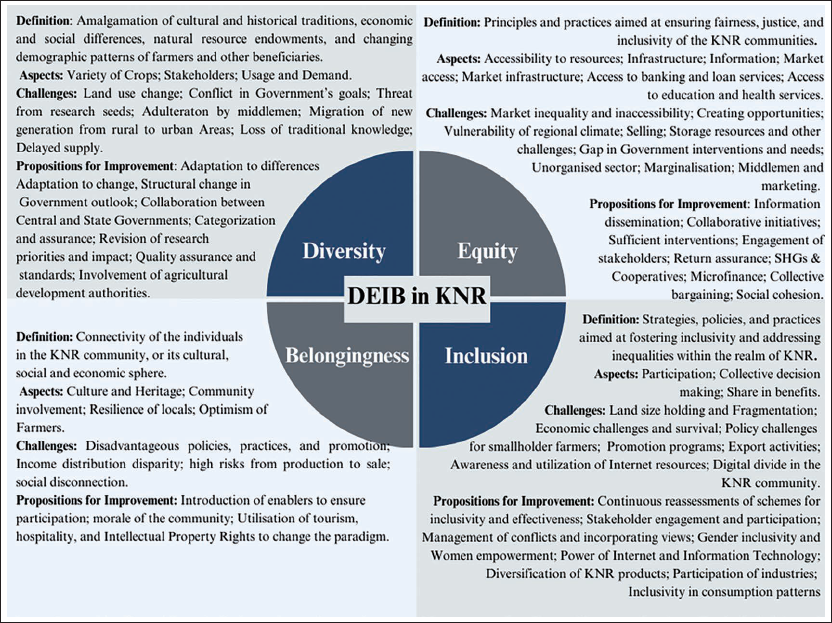
The DEIB framework is an interconnected system where each component relies on and influences the other. Diversity serves as the foundation, encompassing a broad range of differences. Recognizing first the diversity in the KNR crop and community, the DEIB framework of KNR, paves the need for recognizing equity, inclusion, and belongingness further. Without diversity, equity efforts lack representation and may perpetuate inequalities. In the absence of equity, inclusion efforts may overlook systemic barriers, hindering true belonging. Similarly, without inclusion and belonging, diversity and equity efforts may remain superficial and fail to create lasting change (Usanmaz, 2023).
The four interwoven dimensions of KNR’s DEIB framework, presented in Figure 1, cover their major aspects including defining the respective dimension, current status, challenges involved, and propositions for improvements with the objective of comprehensive mapping of the framework. The qualitative analysis of interview transcripts helped in chalking out the imaging to build this framework, which is presented in the section below.
Diversity in KNR
Defining Diversity
Aligned with the EU’s definition of diversity in crops (European Network for Rural Development, 2010), “diversity” in KNR may be referred to as an amalgamation of cultural and historical traditions, economic and social differences, natural resource endowments, and changing demographic patterns of farmers and other beneficiaries, further including the distinctive multiplicity offered by the KNR crop to the existing array of rice varieties. KNR’s diversity spans resources, culture, and demographics, necessitating DEIB backing.
Aspects of Diversity in KNR
Diversity in variety of rice crops
Due to its historical value and rich status as a widely celebrated cultural crop, KNR has become a perfect addition to the variety of rice present in the region ensuring diversity to existing rice crops. Predominantly, Basmati rice had been a staple for consumers post the Green Revolution (State Agriculture Directorate, 2024); however, due to a shift in the paradigm to healthier organic and sustainable food options, rice varieties such as black rice and brown rice have been favorites of many conscious households. KNR adds to the crop diversity of the already cluttered market of Basmati and other rice varieties grown in the northeastern region alongside KNR, such as Sarjoo-52, Swarna Sub/Samba Masuri Sub 1, and Samba/Samba Masuri (BPT-5204). Variety in the researched seeds of KNR developed includes Kiran Kalanamak KN3, Bauna Kalanamak 101, and Bauna Kalanamak 102 (Yadav et al., 2019). It provides additional income opportunities to the farmers by growing and propagating the heritage crop (KNR) that has a wide cultural significance with sustainable production processes. The data shows that KNR variety or premium rice is known for its distinct aroma and good quality eating, has the potential to fetch a higher market price, combat drought, and lodging, and is resistant to submergence. This makes this particular variety a feasible option (Ravindra & Singh, 2017).
Diversity in stakeholders
Diversity in KNR is viewed by the authors with respect to the stakeholders associated with KNR, who come from different backgrounds and fields of study such as farmers, seed breeders, researchers, government agencies, and non-governmental organizations (NGOs) including the Farmer Producer Organizations (FPOs), traders and distributors, consumers, cultural and culinary communities, environmentalists and conservationists, exporters, and importers. According to Save Indian Farmers (2020), the majority of farmers associated with KNR cultivation in Siddharthnagar District, UP, belong to other backward classes (71 percent) and castes apart from reserved categories (17 percent), and unreserved populations (12 percent), indicating the socio-economic complexities in the demographic diversity. Data shows that approximately 30 percent of women are engaged in KNR cultivation in the region. The total number of exporters is just one in the district, exporting to countries like Nepal and Singapore, and the average literacy rate is just 59.25. The percentage of skilled labor is 70 (SIDBI, 2021).
Diversity in usage and demand
KNR is deeply rooted in the local cuisine and cultural celebrations such as weddings, religious ceremonies, and other major events. The respondents have talked about the diversity of KNR in such a way: “Grown specifically in the Tarai, saline, and marshy region, it has a unique aroma, you won’t find anywhere.” KNR is often consumed during harvest festivals as a communal activity and is popular for hospitality and unity as a delicacy for guests, sometimes even in official celebrations such as the recent inauguration of Kushinagar Airport in UP (TNN, 2021). Due to its inherent health benefits, there is high demand for KNR among health-conscious diabetic customers, especially from the region of South India and Gujarat, which are staple rice-eater regions along with a larger chunk of educated and aware consumers (Ministry of Food Processing Industries, 2023). From traditional dishes like Kala Bhaat (black rice), biryanis, and kheer to contemporary fusion cuisines, KNR’s distinctive flavor and aroma have inspired chefs and home cooks to experiment with its unique flavors to create innovative dishes that celebrate both tradition and innovation. KNR is also suited for East Asian kitchen dishes, such as sushi, mochi, and pudding, since these require aromatic sticky rice varieties, leading to a great export potential of KNR.
Challenges to Diversity in KNR
Land use change: According to one respondent, “the problem of land fragmentation is paramount in the Northern Region of India.” Fragmentation of natural habitats disrupts ecological processes, reduces habitat connectivity, and increases vulnerability. It dilutes the size so much that any profitable farming is difficult to conduct.
Conflict in government’s goals: KNR is exclusively an export-intensive crop; however, due to central governments’ guidelines to ban exports of non-white rice, the whole purpose is compromised.
Threat from research seeds: The respondents have agreed that “The research seeds have ruined the variety of KNR, there is a vast difference between traditional and original variety in terms of aroma and texture.” The varieties of KNR researched to increase yield have proven to be of lower quality creating massive confusion in the minds of consumers and affecting producers who grow authentic KNR.
Adulteration by middlemen: Middlemen, to bring down the price, mix inferior quality rice with authentic KNR and adulterate the produce.
Migration of new generation from rural to urban areas, resulting in the loss of traditional knowledge.
Delayed supply of quality seeds in comparison to other rice seed supplies, leading to a slower production cycle of KNR affecting the diversity and inclusivity.
Propositions for Improvements
Present policies need to be capable of adapting to changes in the diversity framework to help beneficiaries make the best use of their distinctive development resources. Individuals have distinct characteristics, and this means that support policies need to be adapted to take account of different local circumstances, not just that they need to contribute to horizontal objectives that are common for all stakeholders of KNR to make the framework more relevant.
Human factors represent an essential element of KNR diversity, recognizing that rural people remain the ultimate driving force in protecting and maintaining this valuable resource base. There needs to be a structural change in the government’s outlook and management of KNR. The priorities of central and state governments also need to work in tandem. Using different Harmonized System of Nomenclature (HSN) codes to categorize non-white rice varieties is imperative and urgent to reassure the farmers. The research could help in sustaining diversity. Many respondents have been of the view that “It could be really helpful if the height of the crop could be short, the present research seeds are extremely bad in quality and it has one way or another made consumers apprehensive of the quality of the rice as claimed, thus more research needs to be done.” There needs to be a revision in the research, taking into consideration the priorities and needs of the farmers at large. The research till now on the diversity of seed varieties has proven to be extremely detrimental to the supply chain of KNR. Even though it was done in good faith to increase the yield and revitalize the crop, many farmers growing authentic KNR have suffered manifold. To check for adulteration, proper care and standards need to be provided in the form of an ‘Agmark’ to vouch for the quality of KNR. Active participation of agriculture development authorities needs to be done at the procurement or harvesting stage. To retain the new generation in the traditional knowledge of KNR, the research, infrastructure, and profitability of the KNR may be given special attention by policymakers.
Equity in KNR
Defining Equity
Equity aims to identify and address disparities and systemic barriers that prevent marginalized or disadvantaged groups from accessing opportunities and resources on an equal basis with others (Barney, 2023). For KNR, equity refers to a set of principles and practices aimed at ensuring fairness, justice, and inclusivity of the communities engaged in the preservation, cultivation, and consumption of KNR. Historically, small-scale beneficiaries and local communities have been the custodians of KNR cultivation. Emphasizing equity involves ensuring that these farmers have access to resources, information, technology, markets, opportunities, and infrastructure, among others.
Aspects of Equity in KNR
Resources: Technique and other resources are equally accessible because KNR does not require any fertilizer or major capital investment. However, since the production of KNR requires extensive water, they become heavily dependent on monsoons for a good yield as the nearby river requires heavy maintenance. The farmers come from individual households, are not associated with any cooperative society, self-help groups (SHGs), and others. They make decisions by consulting their family members only.
Information: There is a disparity in receiving support from the government or any institution. Only a few receive field visits from officials for information dissemination about crop health, manure, pesticides, and hands-on demos.
Market access: The respondents’ remarks included “We are neither able to sell our produce nor get a fair price for it because of the middlemen, they adulterate the produce and bring down the price, never in our life have we ever indulged in such practices. Genuine producers suffer a lot.” Middlemen adulteration and exclusive reliance on researched seeds hinder farmers’ opportunities to tap into different avenues and fair pricing. Compared to other varieties of rice produced in the region, there is a visible inequality in the opportunities for KNR. The health benefits of the product are not well marketed. There is a lack of focus on the creation of a logo, brand name, and tagline while selling the product. There is lesser focus on exporting and packaging and standards assurance. There are little to no dedicated marketing facilities or mandis or any dedicated outlet for selling the rice varieties within the district. There is also a lack of awareness of national and international exhibitions and fairs to promote the product.
Infrastructure: The district has mostly tractor-mounted rice mills with limited processing capacities as compared to the rice mills, leading to a lot of wastage as the efficiency rate is very low. These tractor-mounted mills are not formally registered and are popular among the unorganized sector (SIDBI, 2021). Only less than 20 percent of the population has access to pucca/tar roads. The KNR community collectively encounters difficulty in accessing a suitable marketplace for their produce. Many respondents concurred upon the similar sentiment, “There should be a market infrastructure made for KNR like Basmati, wheat, etc. to motivate our farmers as a word of mouth.” The absence of dedicated infrastructure hampers the ability of farmers to sell their produce efficiently, more so for marginalized farmers. Consequently, KNR is primarily utilized for self-consumption or sold in local markets, to officials, or during weddings as a delicacy. The government’s differing criteria in accepting authentic KNR exacerbates the situation, despite a total yield of 300–400 quintals per season. With local demand nearing saturation, the lack of market access poses a significant obstacle for the beneficiaries.
Access to banking and loan services: The KNR community relies on Kisan Credit Cards (KCC) to secure agricultural loans at a 4 percent interest rate. However, they have not accessed any additional loans beyond this facility. Despite being issued crop insurance cards, they have not received any insurance payouts post an initial payment due to stringent bank regulations, despite a need for coverage against potential losses. The community observes low financial literacy to avail benefits of banking and financial services. Many senior citizens are not even able to fill out withdrawal slips or pensions due to the noncooperation of banks, resulting in losing their money to middlemen. These systemic issues serve to dishearten beneficiaries, exacerbating their already challenging circumstances.
Access to education, health, and other services: Limited basic health services are available to KNR communities under the Ayushman Bharat Scheme, which provides free medicines and low treatment costs to those who own the card. Along with four hospitals in the area, mobile medical services are provided every 15 days to 9 percent of people. There is a satisfactory representation of women and men as teachers and students in different schools, but only 9 percent have access to education showing a great disparity. There is good connectivity with nearby districts in terms of transportation as well as the newly inaugurated Siddharth Nagar Railway Station.
Challenges to Equity
Creating equal market opportunities is a major challenge to equity in the framework as access to resources and necessary contacts is available to only a few. With the absence of proper infrastructure from the government, the situation is worse for poorer and marginalized farmers. Producing an expensive crop like KNR is unattainable for these due to the risks involved. The presence of middlemen adds to the gravity of the issue.
In the context of the vulnerability of agriculture to climate change, Siddharthnagar is ranked the 26th most vulnerable district out of 161 districts studied in the Indo-Gangetic Plain. The vulnerability is due to the low human development index and irrigated area (Sehgal et al., 2013).
A considerable portion of farmers struggle to generate enough income from KNR to cover their daily family expenses, so they take up various other work. The respondents have shared that “Selling is a major issue; I have stored a lot of produce but failed to find any market beyond the local demand which now proves to be limited as well.” Storing of KNR is another issue since storing it without proper infrastructure or facility leads to loss of aroma, which reduces the income of the farmers. Other prevalent issues contributing to the yield gap in various crops are limited adoption of certified and quality seeds, inadequate infrastructure as well as market price, insufficient access to credit, inequitable water resource management, and a sluggish pace of mechanization as the costs are too high.
There is a significant gap between the government interventions and the degree of awareness among KNR farmers. Respondents’ complaints included “Government support hasn’t reached us yet; no plan or schemes are exercised here. No opportunity is being given to us by either the government or any other institution.” Financial inclusion is a very important aspect of equality in which these schemes are instrumental for KNR farmers and communities. There is no direct access to innovative farming techniques, research, and technology that leads to a direct impact on equity, inclusion, and diversity.
The efficacy rate of tractor-mounted mills is less than 50 percent of the actual mills, leading to a lot of wastage. However, 95 percent of it is used by the unorganized sector, impacting the equity and belongingness among KNR farmers.
Traders dominate the supply chain and marketing channel supremacy, and small farmers are more reliant on intermediaries. Thus, price determination is governed by external sources rather than the government, leading to challenges in equal opportunities. There is unavailability of sufficient working capital due to the long production cycle of KNR of approximately 145–150 days, extending up to 180 days sometimes (SIDBI, 2021).
Propositions for Improvements
Interventions like ‘Hello farmer’, a social media initiative that helps to instill awareness and knowledge about the nuances of production in progressive farmers, harboring a following of 19,600, provide innovative ways for farmers to upskill themselves. FPOs) have emerged as a preferred institutional mechanism to mobilize farmers as a lynchpin strategy for doubling farmer income. ‘Save Indian Farmers’ has collaborated with Shohratgarh Environmental Society (SES) to form an FPO that caters to the large population of marginal farmers growing KNR in Siddharthnagar (Save Indian Farmers, 2023). Agriculturists, scientists, as well as government officials impart awareness to the farmers by educating them about the nuances of the cultivation of KNR and providing solutions to address any bottlenecks that might occur because of climate change and other factors. Ongoing swift efforts are there in the production, distribution, and assistance programs by the government. Also, various NGOs, non-profit organizations (NPOs) and start-ups have joined hands to revitalize KNR and protect the farmers. However, implementation on a large scale is yet to be seen. Bottlenecks, such as untrained rural administrative staff (due to understaffing or improper managerial skills), should be addressed to ensure the implementation of policies introduced by the state government.
Encouraging small farmers to produce KNR could only happen if they are assured of proper infrastructure and return. The formation of SHGs and cooperatives in the production of KNR may empower individuals economically, facilitate resource pooling, provide access to credit and microfinance, offer skill development and capacity building, enhance collective bargaining power, and foster social cohesion among members.
Inclusion in KNR
Defining Inclusion
Inclusion in KNR refers to strategies, policies, and practices aimed at fostering inclusivity and addressing inequalities within the realm of KNR. It prioritizes that all stakeholders, regardless of their socio-economic background, ethnicity, or gender, have fair access to resources, markets, and decision-making processes within the sector, in turn fostering diversity, empowering marginalized groups, and enhancing overall productivity and sustainability. By embracing inclusion, agriculture can harness a wider range of talents, perspectives, and innovations, leading to more resilient food systems and improved livelihoods for rural communities (Ociti, 2023). It promotes social justice and drives economic growth, environmental stewardship, and human development in agricultural landscapes. Inclusion in agriculture fosters collaborative approaches that amplify voices often marginalized, including smallholder farmer, women, and indigenous communities.
Aspects of Inclusion in KNR
Participation: Marginalized farmers need support to participate in KNR cultivation and marketing, which is currently absent in KNR. Women get approximately 33 percent of representation in KNR (SIDBI, 2021), which increases during the harvest time of the crop but with menial jobs. The producers find it uneconomical to engage marginalized laborers and women throughout the year, which also reduces the participation of these groups in KNR. No specific provisions for inclusion are there to include differently-abled people in the KNR mainstream.
Collective decision-making: The farmers make collective decision-making but with their families only. The community collective decision-making for the cultivation and promotion of KNR is still absent, as there are no SHGs or very few cooperatives in KNR.
Share in benefits: The majority of farmers work as daily laborers or casual laborers. As a result, do not get included in equitable income distribution or revenues, specifically women and differently-abled people.
Challenges to Inclusion in KNR
Inclusivity is also related to the issues of land size holding, excessive fragmentation, and population. Farmers having land size holding of less than 2 hectares hope to survive only two seasons. In the words of a respondent, “I have contacts and live in a district but that privilege is not for everyone, KNR is such a profitable crop however without any infrastructure or aid from the government, it’s very difficult for common farmers to grow it.” The risk-taking ability is influenced by the side income option or sufficient land size holding. Not more than 2–3 percent of farmers are large-scale farmers. Making a detailed assessment of the needs of the rest of the farmers and making policies that benefit them at large to make the supply chain of KNR simpler could be a challenge for the government and policymakers. State governments have made huge efforts to revitalize and promote KNR farmers to make them globally competent. However, supply chain issues are a challenge when only research seeds are given a thrust, and farmers growing authentic seeds fall behind.
With the ODOP program under the Department for Promotion of Industry and Internal Trade (DPIIT), the Ministry of Commerce & Industry successfully enlisted over 50 aggregators pursuing the goal of uniting organizations dedicated to promoting “Brand India” (PIB, 2024). However, there has not been much of a mention of KNR due to halted export activities of the crop. A lack of awareness of government schemes as well as the ability to benefit from them led to an adverse impact on equity, belongingness, and inclusivity.
Furthermore, a lot more investment is required by the State and Central Government in education, health, roads, and other infrastructure to ensure inclusivity, which, given the limited resources, might be challenging for the Government. It is also a challenge to make beneficiaries from the KNR community aware of the power of the internet and information technology, which can be powerful tools in marketing, selling, and spreading information about the crop since there is not much digital awareness in the KNR community. Few farmer initiatives like “Hello farmer” and influencers like “Think School” are there to generate awareness, but more such efforts at the mass level are required.
Propositions for Improvements
There are some very good schemes proposed by the government for the welfare and inclusivity in rural areas (mentioned in segment 4). However, the effectiveness of these schemes in terms of inclusion can still be improved and accommodated through better execution. Steps may be taken to include a thorough assessment of the farmers and their needs. When talking about minorities, women provide extensive support, especially in the harvesting of KNR. The top-bottom approach is extremely crucial to keeping checks and balances for the same. There is a need to promote inclusive farming techniques by establishing mixed-gender and diverse workgroups to foster collaboration and inclusivity, including differently-abled individuals.
There is a demand for KNR due to the nutritive value associated with it, especially among diabetic and other lifestyle disease patients. There is a need to make its consumption more inclusive. There is also a strong need to diversify the range of KNR products by using it as a key ingredient in consumables, such as rice snacks and others, for children and adolescents. Participation in the food industry might be of great value in improving inclusivity through research, internships, apprenticeships, culinary events, and active engagement in the promotion of KNR products. Adoption of KNR and its community by big businesses under public–private partnerships or foreign collaborations would also improve inclusivity.
The power of the internet is yet to be explored from the perspective of DEIB. In the words of a respondent, “I have never tried online platforms for selling before, I don’t have much information about it.” Thus, social media and networking might prove to be a powerful medium for promoting equity and inclusion in KNR.
Belongingness in KNR
Defining Belongingness
A sense of community and cultural connection is already embedded in KNR as a heritage and celebration crop in the region. Belongingness refers to a psychological need to feel connected, accepted, and valued within a group or community (Allen et al., 2021). With respect to KNR, belongingness refers to the connectivity of the individuals in the KNR community or its cultural, social, or economic domain. It also encompasses traditional practices, culinary heritage, rituals, and cultural identity associated with the cultivation and consumption of KNR.
Aspects of Belongingness in KNR
Culture and heritage: KNR is entwined with cultural rituals and practices as a sacred offering during religious ceremonies, fondly called “Buddha Ka Mahaprasad,” symbolizing purity and devotion. It strengthens the cultural bond among communities and deepens their connection to their heritage.
Community involvement: In the words of a respondent, “It’s having a unique aroma that reminds us of our region and roots, it’s a delicacy in weddings or sold to local officials.” The cultivation and processing of KNR often involve communal efforts. Harvest festivals and processing rituals are occasions for communities to unite, reinforcing social bonds and creating spaces for intergenerational knowledge exchange.
Resilience of locals: The cultivation of KNR embodies traditional agricultural practices passed down through generations. The knowledge associated with its cultivation, from seed saving to natural pest control methods, is a repository of sustainable agricultural practices that contribute to local resilience.
Optimism of farmers: The optimism in KNR farmers and their innovation, involvement, and community well-being amid challenges, such as climate change, market fluctuations, and resource constraints, bind them as a group.
Challenges to Belongingness in KNR
True support in DEIB requires embracing differences and accommodating nuances in policies, practices, and promotion. Income distribution disparity could be a challenge for promoting belongingness in KNR. Due to challenges like poor market infrastructure, low-selling options, risks of storing a high amount of crop, farmers tend to get discouraged and disengaged from the community and sometimes even from the crop. The cost of KNR has been increased from ₹40/kg in 2018 to ₹135/kg in 2021, corresponding to the number of farmers increasing from 2,950 in 2018 to 13,500 in 2021 (NCGG, 2022), leading to low-profit margins and even lesser share for the marginalized fraction of KNR community.
Social disconnection due to migration from rural to urban and the quest for a modern lifestyle have affected the fabric of traditional families, and community structures have undergone significant erosion, thus increasing the feelings of isolation and disengagement among individuals that leave many feeling detached from meaningful social connections.
The challenges in other aspects of DEIB trickle down ultimately to belongingness, hence making a significant impact on the psychological and motivational aspects of an individual and the community at large.
Propositions for Improvements
Introducing enablers such as dedicated fairs as a marketplace for easy and direct exchange between consumers and producers can lead to better opportunities for income generation and promotion of KNR. By educating the farmers and aiding them in marketing their produce properly, the gap in the supply chain and the distance between the producer and consumer may be reduced. Motivators like exchange programs and effective utilization of tourism, hospitality, and intellectual property rights (IPRs), being marketed as “Buddha ka Mahaprasad” and “Buddha Rice,” is a tangible step towards marketing the produce; however, increasing awareness can be done by effectively utilizing the tourism and hospitality sector.
Villages should be treated as a single cluster of community to incorporate views, embrace social cohesions, and serve as a knowledge exchange community center. SHGs could play a very important role here by enhancing community cohesion, solidarity, mutual connectedness, social interactions, and solving their common problems together. KNR is still waiting for its first SHG to be formed.
Interventions Promoting DEIB in KNR
The Government of India and the UP Government have provided interventions to promote the production and marketing of KNR in addition to the initiatives offered by other organizations or stakeholders (Department of MSME and Export Promotion, 2020; Free Press Journal, 2023; Hindustan Times, 2020; PIB, 2022; Save Indian Farmers, 2023; SIDBI, 2021; Swarajyamag, 2020), some of which are listed below with their distinction with the interview data.
Unnat Bharat Abhiyan (UBA) by the Government of India is initiated to improve participation and remove inequalities in rural areas by engaging higher educational institutions to work in tandem with the rural population of India in identifying development challenges and developing solutions for building sustainable growth. However, the same is yet to be taken for KNR farmers with six villages adopted and just one participating institute in Siddharthnagar (Ministry of Education, Government of India, 2022). The efficacy of UBA can bolster the inclusivity among various stakeholders engaged in KNR.
Kalanamak Export Development Foundation is an effort by the District Magistrate of the area to manage conflicts and incorporate the views of 200 members, comprising traders, farmers, and FPOs to provide a platform to resolve the issues regarding export. Currently, only 50 members are associated with it, with many beneficiaries unaware of it since the effort is still in progress.
Udhyam and Udyog schemes: These are initiatives that aid MSMEs actively participating under ODOP in providing registration, necessary information about exhibitions and fairs, and any other development. The inauguration of common facility centers where small traders can sell, store, and process in the district, with the government bearing 90 percent of the cost is a welcome step. The interview data show that the information about these schemes has not reached the respondents.
To promote the production of KNR in the district, the Agriculture Department distributed approximately 5 quintal (Kalanamak KN-102) seeds to the farmers in proportion to the land that they hold during FY 2019–2020. The Agriculture Department also conducted “Pradarshni” of the land of selected farmers and advised them to use organic farming. However, SIDBI (2021) indicates that there is a disproportion in the distribution of seeds.
Subsidies are also provided for setting up solar pumps on farmlands. Expert advice is provided through video calling, where farmers can discuss the health of their soil and how to improve soil fertility for better yield of the crop (ET Bureau, 2018). However, due to the digital divide, the majority of farmers are not able to benefit from the scheme.
‘Participatory Rural Development Foundation’ (PRDF), a Gorakhpur-based philanthropic organization founded by Dr Ram Chet Chaudhary (a leading agri-scientist working for the benefit of the farming community of North India), provides high-yielding KNR seeds to the farmers in the district (PRDF, 2023). The farmer’s perception regarding the researched seed is negative.
‘Grow Indigo’, a company dedicated to providing biological and digital solutions, helps farmers by offering relevant information and improving soil health. However, the respondents express their unawareness about this initiative.
“Hello farmer,” is a social media initiative that helps to instill awareness and knowledge about the nuances of production in progressive farmers. It currently harbors a following of 19.6k. They provide innovative ways for farmers to upskill themselves. Hello Farmer is working very successfully, but only in the case of progressive farmers, which too is highly dependent on government grants.
FPOs have emerged for the production of KNR as a preferred institutional mechanism to mobilize farmers. It is the lynchpin strategy for doubling farmers’ income. Announcements of the inclusion of FPO credit in the priority sector, 5-year tax breaks, and development of 10,000 FPOs underscore the acceptance of FPOs as an institutional form to solve some of the challenges of small farmers. ‘Save Indian Farmers’ has collaborated with SES to form an FPO that caters to the large population of marginal farmers growing KNR in Siddharthnagar (Save Indian Farmers, 2020). In ground reality, the majority of respondents expressed their unawareness about FPOs.
Companies like Bodhisattva, Siddhibhumi, and KalanamakRice too have made significant efforts to cater to the needs of KNR marginal and small farmers. However, their initiatives are at a nascent stage and need time to grow enough to accommodate the needs of the majority of KNR farmers.
The State Agriculture Price Advisory Council has also recommended a hike in the minimum support price (MSP) for 10 Kharif crops for the 2022–23 marketing season and the addition of KNR to the list (PIB, 2022). However, the majority of respondents faced problems in selling despite the addition of KNR.
The interventions mentioned here might be a few individual schemes with their target objectives/benefits in KNR, not primarily focusing on any specific DEIB framework. However, their collective impact might improve the status of farmers and suppliers associated with KNR with respect to DEIB dimensions by enhancing the sustainability of KNR, its promotion, providing equal opportunities, removal of disparities, and favoring directly or indirectly a DEIB framework in KNR. Examining these interventions helped during the process of devising aspects, challenges, and propositions for improvement of the four dimensions of KNR’s DEIB.
Critical Analysis and Application to Other Crops
Adopting a DEIB framework and upholding it will lead to a significant impact on KNR. The UN SDGs as a blueprint share the objective of promoting DEIB under various goals set to be achieved by its member countries by 2030 (United Nations, 2015). Syncing with that, the current research attempted to devise a framework for DEIB in KNR, which, in the absence of any precedent theory/model, had been full of challenges too. Examining KNR for the DEIB framework highlighted that more than 80 percent of the KNR farmers belong to reserved and socially backward communities with 35 percent annual income of less than ₹20,000, only 19 percent with access to schools, 17 percent with electricity, 3 percent to post offices, 9 percent to health and services, 3 percent to banks, 10 percent to weekly markets, and 17 percent to pucca/tar roads. 60 percent of the KNR farmers are not illiterate but only 15 percent have an education up to graduation or beyond (Save Indian Farmers, 2020), showing a disparity in income, education, health services, infrastructure, and opportunities among KNR farmers. Despite its heritage value and health benefits, the product lacks a wider market base, logo, and brand name with almost negligible standard practices with no awareness of national and international selling opportunities, exhibitions, festivals, and other profitable spheres. All these facts are indicative of deeper issues relating to DEIB in KNR that should be considered while making any framework for the upliftment of KNR. Using the grounded theory approach, different aspects of the DEIB framework have been identified, as presented in the previous section. However, all the aspects of KNR’s DEIB are found deeply interlinked and overlapping, implying that making corrective efforts in one dimension can have a snowball effect on other dimensions too, improving all of them together exponentially.
KNR itself is a symbol of diversity and belongingness; what it lacks more is equity and inclusion, which are basic premises for social sustainability, gender equality, and sustainable economic development—the three pillars of the DEIB framework in the agricultural sector as mentioned by Dharamshi et al. (2023). Each dimension of the framework appeared to have its unique challenges and opportunities. However, the overlapping indicated a few common pointers, mentioned below, that may be applied to have a successful DEIB implementation.
Education, research, and skill building: Instilling the entrepreneurial mindset by facilitating knowledge-sharing sessions between experienced personnel and farmers would preserve and enhance traditional knowledge and practices. The engagement of educated/skilled youth in the contemporary challenges of KNR cannot be less emphasized. Promoting innovation strategies that engage youth might help in bringing DEIB. Public–private partnerships, SHGs, adoption of villages/communities by training or business houses, collaborative research and internships, knowledge transfers, global collaboration, and preservation are a few innovative measures suggested by some.
Information can play a pivotal role in improving effective implementation in KNR, provided the informational materials and pamphlets are developed in local languages with timely access. There is a need to ensure proper accessibility of information to not just well-to-do farmers but small marginal ones. Conducting regular field visits by the nodal officer/dedicated staff would bolster the trust of marginal-small farmers and disseminate timely information. Technology might also be a beneficial addition.
Effective institutional support: There is diversity in stakeholders, variety, usage, and demand, providing opportunities for income generation and community participation. This diversity may be further improved through government interventions at various levels. There is a dearth of equal access in terms of resources, information technology, access, and ancillary services in KNR, and questions are raised by respondents about the sufficiency and efficacy of state efforts. Marginalized farmers and women need to be included in a major way by ensuring equal opportunities in income-generating activities and important decision-making roles. The role of women is skewed toward menial jobs and granted temporarily. Improving diversity, equity, and inclusion would have a significant impact on belongingness too. To address the financial gaps, a Memorandum of Undertaking can be signed with banks to provide access to easy credits with personalized touch and empathy.
Connectedness: Apart from the state efforts, community participation and individual motivation are required to improve DEIB in KNR. There is no scarcity of good schemes; however, connectivity is lacking in their implementation. Correction in this situation can happen only by education and awareness for which not only the government can be held responsible but the KNR community also needs to be participative, particularly the younger generation. There is a need to organize regular meetings and forums where farmers can voice their concerns and ideas.
The proposed model is developed for KNR based on the information collected from the interviews of different KNR stakeholders. India is a land of many such heritage crops: Black wheat, Sohiong, Mahua, Perilla, and Chyura where promotional efforts are being implemented by the state and other agencies, but due to the lack of any specific DEIB framework, the effectiveness of the efforts is not reaching its target. The present framework in such a scenario can help in multiple ways. First, it exemplifies that the DEIB framework is possible in crops and communities too. Second, the DEIB is not a linear framework; rather, it is a multifaceted, interlinked network where each aspect is intertwined, making it a complex system. Third, the sustainable effectiveness of the DEIB framework in KNR requires equal participation of government agencies, the community itself, voluntary organizations, industries, and other stakeholders involved. Fourth, the DEIB framework necessitates working on multiple levels such as education, health, research, technology, infrastructure, banking, collaborations, and public policy. Fifth, the given DEIB framework can be utilized with appropriate changes for other crops too facing inequalities and marginalization, specifically the heritage/indigenous crops facing similar challenges and opportunities.
Conclusion
DEIB in multinationals has been promoted thoroughly; however, such a wave is yet to be seen in the realm of agriculture. KNR as an indigenous product is a suitable crop for understanding and recognizing the DEIB framework, which may act as a catalyst for the sustainability of KNR and the people involved in its cultivation and consumption. The DEIB framework is crucial to adopt given today’s need to address intersectionality. Yet, paradoxically, the DEIB framework in agriculture has not been studied properly in India, let alone in indigenous crops. Research on DEIB principles in KNR highlights their profound implications for the sustainability, economic, and cultural preservation of a heritage indigenous crop. It reflects the inclusion of marginal communities in the commercial agricultural value chains (Chamberlain & Anseeuw, 2019) in addition to gender equality. Thus, an effort has been made in this article to develop a DEIB framework for a historically significant variety of scented rice called KNR. The article summarizes the multidimensionality of the DEIB framework in KNR by outlining its different prospects in terms of definition, aspects, challenges, and propositions for improvement, analyzing the responses representing viewpoints of farmers, supply chain owners, and NGOs working for KNR. The article also produces a critical analysis of the DEIB framework in KNR and its applicability to other crops. The article also summarizes important government interventions in KNR. Their success stories offer a glimmer of hope, showcasing the latent potential waiting to be tapped. KNR’s DEIB principles intersect with its cultivation, fostering biodiversity and sustainability, empowering marginalized farmers, and upholding cultural and traditional knowledge. DEIB’s significance lies in their ability to harmonize sustainable practices and cultural legacy. DEIB’s integration into KNR cultivation epitomizes a holistic approach aligning ecological resilience, social parity, and rich heritage. Collaborative commitment from policymakers, farmers, and stakeholders is imperative to ensure KNR’s enduring prosperity and sustainability, fortified by a tapestry of diverse, equitable, and inclusive agri-practices, poised to grace the tapestry of time and ecology. Being the first one in KNR, the proposed DEIB framework can set a beacon for other researchers as a starting point for further research of DEIB in agriculture. The policymakers and government agencies will also be guided by the proposed framework while designing their policies and initiatives, equally applicable to other crops in agriculture. Academicians can use the framework for better understanding the dynamics of KNR, particularly from the perspective of women, marginalized, and differently-abled. Many challenging issues in KNR might be solved by the simple yet highly effective tool of the DEIB framework. Limitations such as resource intensive, subjectivity, and small sample size were faced during the research. Case studies are often prone to bias, which the authors have taken utmost care to avoid during the analysis of data. Furthermore, generalized KNR research can be done on topics such as consumer behavior, sustainable agriculture, global collaborations, conservation, and social entrepreneurship. The DEIB framework might also be replicated for other heritage crops to develop a generalized DEIB model.
Footnotes
Declaration of Conflicting Interests
The authors declared no potential conflicts of interest with respect to the research, authorship, and/or publication of this article.
Funding
The authors received no financial support for the research, authorship, and/or publication of this article.
