







Abstract
The fitness sector is experiencing a swift digital shift, leading fitness businesses to emphasize customer loyalty. This research examined the impact of digital transformation on customer loyalty in fitness services and the mediating influence of customer experience on this relationship. Based on the Stimulus-Organism-Response framework and Trust-Commitment theory, the hypotheses were evaluated based on data from 312 fitness service users in Vietnam. Analysis using structural equation modeling indicated that capabilities in digital transformation and perceptions of quality, mediated by trust and commitment to the relationship, positively affect customer loyalty. The outcomes provide a clearer understanding of how digital activities, serving as stimuli, impact customer loyalty by shaping customer experience, which is facilitated by trust and commitment. The results pointed out the significance of fitness providers embracing a customer-focused digital transformation strategy, emphasizing actions that cultivate trust and encourage dedication to promote lasting customer loyalty. Fitness providers must enhance long-term relationships by increasing customer trust and commitment.
Keywords
Introduction
The fitness business is physical gyms and face-to-face training sessions, a rapid and significant shift fueled by digital technologies. Digital transformation has radically altered fitness services’ delivery, utilization, and experience, leading to a marked shift in customer expectations and behaviors (Sevilmiş & Şirin, 2022). The digital transformation easily applies to fitness services based on online fitness applications, virtual coaching, on-demand classes, personalized fitness tracking programs, wearable tech, high-speed internet, and artificial intelligence (AI) (Dharia et al., 2017). These technologies offer unparalleled flexibility, convenience, and control over their fitness experiences, significantly altering their engagement with fitness providers.
In the digital environment, loyalty has gotten more complicated and is a very important factor in success in the fitness industry. In the past, the location of the gym, the quality of the instructor, and the social milieu were important to achieve customer loyalty (Sevilmiş et al., 2022); however, platform effectiveness, data protection, customized user experiences, and online community interaction have become the most important factors in the digital transformation age (Rane et al., 2023). This change emphasizes the need for fitness providers to adjust and develop new methods to be competitive in a market that is changing quickly.
Although there has been much progress in understanding how digital transformation affects industries like retail and banking, there is still a lack of research on how it affects customer loyalty in the fitness industry. Recent research emphasizes the profound transformations that digitalization has introduced to multiple enterprises. For example, Nambisan et al. (2019) investigate how digital transformation catalyzes value creation within service ecosystems, whereas Lemon and Verhoef (2016) highlight its impact on designing customer journeys in various industries. However, most studies have been on incorporating technology or innovations into corporate frameworks in the fitness industry, with little investigation into how these changes directly affect customer loyalty. Furthermore, customer experience is an element that enhances consumer loyalty; however, its importance in digital fitness has not been deeply explored (Batat, 2022).
In the past few years, Vietnam’s fitness industry has undergone a quick transformation, driven by the swift advancement of digital technology (Ngo et al., 2022). The digital infrastructure in the fitness industry makes it an ideal setting to study the relationship between digital transformation and customer loyalty. Although there are many studies in developed economies, developing countries like Vietnam have not received enough research attention. This problem has created a gap in understanding the impact of digital transformation in the unique context of these markets (Li et al., 2023; Ngo et al., 2022; Vrontis et al., 2019). Hence, research in Vietnam is needed, where cultural, technological, and market elements could significantly differ from developed economies.
The research objective is to explore how digital transformation influences customer loyalty in fitness services, mainly focusing on the mediating role of customer experience in Vietnam. Grasping this interaction is crucial as it pertains to an aspect of the fitness industry that remains underexplored; moreover, it provides businesses valuable insights to align their digital strategies with their customer-focused approaches. This study enhances scholarly discussion and industry application by connecting theoretical and practical perspectives, offering a guide for fitness providers seeking to maneuver through the digital era. The inquiries being examined are:
What is the effect of digital transformation on client loyalty in fitness services? What is the function of customer experience as a mediator of trust and relationship commitment in the connection between digital transformation and customer loyalty in fitness services?
This research article is structured as follows: The second section comprehensively reviews the pertinent literature concerning digital transformation and fitness services, theoretical models, and research hypotheses. The third section outlines the research methodology, covering the data collection process, sample characteristics, and analysis techniques. The fourth section outlines the findings from the empirical study, examining both the direct and indirect effects of digital transformation on customer loyalty through customer experience. The fifth section explores the theoretical and administrative implications of the findings, highlighting the study’s contributions to existing knowledge while providing actionable insights for fitness service providers. The conclusion presents the key findings, acknowledges limitations, and suggests pathways for future research.
Literature Review
Digital Transformation, Information Technology (IT) Readiness, and Fitness Services
Digital transformation is how organizations function and engage with customers by utilizing and integrating digital technology (Vial, 2021). This transformation is not limited to adopting technology; it involves strategic organizational changes, process improvements, and a special focus on the consumer. There are many applications of digital transformation in fitness, including online fitness platforms, the integration of wearable technologies, virtual coaching, personalized workout suggestions, and online fitness communities.
Digital transformation is to utilize digital technologies to alter how fitness services are delivered and experienced. This transition extends the online booking systems and incorporates data and technology to tailor and enhance the fitness experience. An example is wearable fitness devices to monitor biometrics such as blood pressure and glucose levels during exercise sessions. Moreover, fitness apps offer personalized training programs and AI-powered virtual personal trainers that create immediate customer feedback and assistance (Lee & Lin, 2023). Finally, customer relationship management (CRM) platforms enhance the customer experience through customized communication, focused advertising, and the effective handling of client relationships.
An organization’s readiness in IT is a starting point for digital transformation as it encourages the technological framework, skill sets of individuals, and organizational culture essential for effectively utilizing digital technologies (Belhadi et al., 2023). Regarding fitness services, technology readiness encompasses a reliable internet connection, secure data management systems, user-friendly fitness software, technologically adept staff, and a management team willing to embrace new technology (Sungthong et al., 2023). Fitness companies that apply technology will benefit from digital transformation initiatives, ultimately enhancing their capacity to attract and retain customers (Cai et al., 2021).
Theoretical Framework
This research employs two recognized theoretical models, the Stimulus-Organism-Response (SOR) framework and the Trust-Commitment theory, to investigate the relationships among digital transformation, customer experience, and customer loyalty within the fitness industry.
The SOR model, rooted in environmental psychology, provides insight into how external stimuli influence individuals’ internal conditions and, subsequently, their actions (Macintosh & Doherty, 2007; Mehrabian & Russell, 1974). In this research, the digital transformation includes launching virtual fitness platforms, personalized fitness monitoring, and smooth digital interfaces; hence, the stimulus in SOR enhances service excellence and creativity. These technologies are organisms that create customer experience (Tseng et al., 2023; Vrontis et al., 2019). The customer experience includes customers’ trust in the provider, emotional involvement, and customer satisfaction. The response is customer loyalty, which describes repeated purchases and word-of-mouth (Moura et al., 2020; Ruth et al., 2022; Tseng et al., 2023; Vrontis et al., 2019).
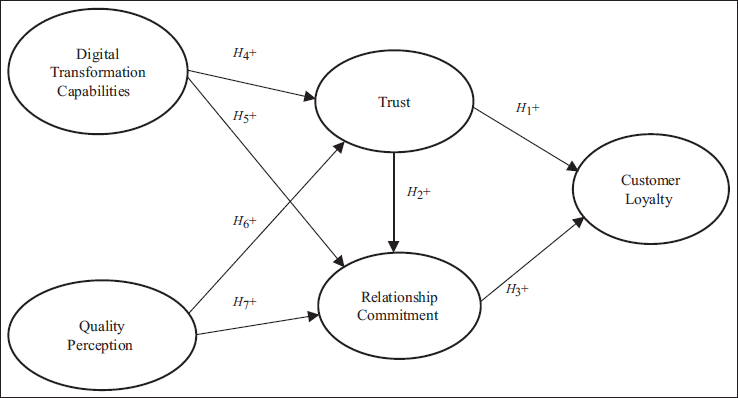
Furthermore, Trust-Commitment theory points out trust and commitment. These factors are key factors in relationship management (Ruth et al., 2022; Vrontis et al., 2019). Trust depends on a service provider’s reliability and honesty (Moorman et al., 1992). Trust creates perceived safety and assurance within the relationship. Commitment represents a powerful inclination to maintain the relationship and to steer clear of alternative choices (Dwyer et al., 1987). In fitness services, trust and commitment are important because they build a deeper relationship between customers and service providers. Consequently, this increases engagement, repeat transactions, and positive endorsements (Lee et al., 2018; Vrontis et al., 2019). Based on the SOR and Trust-Commitment theory, this study proposed the research framework as Figure 1.
Proposed Theoretical Framework.
Hypotheses Development
Trust is essential to increase customer engagement. By reducing perceived risk and boosting trust in the service provider, trust builds customer loyalty (Morgan & Hunt, 1994; Polyakova & Mirza, 2016; Sirdeshmukh et al., 2002; Wang et al., 2012). Confidence is critical in fitness services because customers entrust their health and wellness to the providers. Customers will be loyal to their fitness providers when they know that the provider is skilled, truthful, and genuinely concerned for their welfare. Trust builds dedication in customer relationships (Garbarino & Johnson, 1999; Lee et al., 2018). Customers tend to be loyal to their service providers when they have trust because trust reduces the perceived risks and uncertainties associated with sustaining the relationship (Khoa, 2023; Polyakova & Mirza, 2016). Trusting the provider’s abilities, ethics, and individualized strategy toward fitness services can enhance a strong belief and increase client relationships. Consequently, this research proposed the following hypotheses:
H1: Trust has a positive impact on customer loyalty in fitness services.
H2: Trust has a positive impact on relationship commitment in fitness services.
The connection commitment denotes the emotional bond that a client feels toward a service provider and the customer’s intent to maintain the relationship over the long term (Gwinner et al., 1998; Park, 2023; Verhoef et al., 2021). Customers loyal to a company are less inclined to switch to another supplier, even when attractive alternatives exist. This is due to valuing the relationship and their willingness to invest effort in sustaining it (Dagger et al., 2011). In the fitness industry, engagement is significant for achieving fitness providers’ goals. Commitment to a relationship is the key factor in creating customer loyalty. Consequently, this research proposed the hypothesis:
H3: Relationship commitment has a positive impact on customer loyalty in fitness services.
Digital transformation can enhance customer trust through transparency, personalization, and responsiveness (Barrane et al., 2020); for example, the company can make customer trust through clear data protection strategies, personalized fitness recommendations, and prompt customer support via digital platforms. Fitness service providers must personalize experiences and protect data privacy; digital transformation skills can build and enhance client trust. Recent studies indicate that trust is one of the important factors in digital services, and it can improve consumer loyalty in fitness services (Lee et al., 2018; Srinivasan, 2004). By increasing the convenience, personalization, and interaction, digital transformation can enhance customer loyalty (Hollebeek & Macky, 2022; Yadav & Seranmadevi, 2024). Customers tend to be loyal when they find the online booking systems’ usefulness and ease of use, customize training plans, and engage in online communities. Therefore, their experience and satisfaction can be increased due to digital transformation business activities. Digital transformation can become an effective tool to build long-term relationships and encourage loyalty in the fitness industry, where convenience and tailored service are in high demand. Therefore, this research suggested hypotheses H4 and H5:
H4: Digital transformation capabilities have positive impacts on trust in fitness services.
H5: Digital transformation capabilities have positive impacts on relationship commitment in fitness services.
Ricardianto et al. (2023) pointed out that perceived service quality, which is the customer evaluation of service quality, is a positive factor in building customer trust. High-quality fitness services can make customers more confident by demonstrating competence and dependability. Good fitness services need skilled instructors, well-kept facilities, and effective training programs (Wu et al., 2021). Customers can satisfy their needs and expectations when they see that the provider delivers superior service quality. Amoako et al. (2019) stated that perceived service quality is a great criterion in assessing commitment to a loyal customer. When customers get excellent service, they are more loyal. As they perceive high-value service, they stay in the long-term relationship (Marakanon & Panjakajornsak, 2017). Ongoing support and guidance are required in the fitness industry; hence, quality perception is crucial to consistently delivering high-quality service to build client engagement and loyalty. Hypotheses, including H6 and H7, were suggested:
H6: Quality perception has positive impacts on trust in fitness services.
H7: Quality perception has positive impacts on relationship commitment in fitness services.
Research Method
The scales in this study were adapted from previous studies and were rated using a five-point Likert scale, with 1 being strongly disagree and 5 being strongly agree. Digital transformation capabilities (DTC) were measured by five items based on Nasiri et al. (2020) and evaluated the degree to which fitness service providers have embraced digital technologies and methods to enhance customer experience. Quality perception (QPE) was measured by four items modified from García-Fernández et al. (2021), which assessed the physical environment, interactive quality, and outcome quality. Trust (TRU) was evaluated by four items based on Sirdeshmukh et al. (2002) and demonstrated customers’ trust in the fitness service provider’s reliability, integrity, and goodwill. The relationship commitment (RCO) with the fitness service provider was investigated by four items originating from Morgan and Hunt (1994). Finally, to measure customer loyalty (CLO), this study adapted a three-item scale, which measured consumers’ likelihood to recommend the service, their intention to buy again, and their hesitance to switch to another fitness service provider (Khoa, 2020).
In this study, the potential respondents are individuals, aged 18 or above who actively used fitness services in Vietnam. They have used fitness services such as conventional gyms (e.g., in-person exercise centers) or digital fitness platforms (e.g., mobile fitness apps or online training courses). Participants were gathered through the non-probability convenience sampling method. This online questionnaire was distributed via social media channels (e.g., Facebook) and the fitness chat group of Zalo. Every participant provided informed consent, with voluntary and anonymous conditions. The data were collected in 4 weeks of January 2024. For the data’s accuracy, any incomplete responses were excluded from the study; therefore, 38 of 350 responses gathered were eliminated because they were either incomplete or failed the screening question (Have you ever used fitness service before?).
The valid sample had 312 participants. There were 168 females (53.8%) and 144 males (46.2%). The age breakdown of respondents was as follows: 18–24 (32.1%), 25–34 (41.7%), 35–44 (18.9%), 45–54 (5.8%), and 55 and older (1.6%). The respondents belonged to numerous age groups in the Vietnamese fitness industry due to the diverse ages represented in this study.
The collected data contain information about the roles of the participants, providing an important context for understanding their views on the digital revolution in the fitness industry. In addition, the study design ensures that all participants have a basic understanding of digital transformation ideas and prior experience in traditional, non-digital fitness environments. Including participants with relevant prior knowledge will improve the validity of the results by encouraging a shared understanding of the topics being studied and making it easier to compare digital and non-digital experiences. This strategy allows for a more informed study of the data and provides a stronger foundation for identifying the consequences of digital transformation for the fitness industry.
Result
Based on the data analysis, this section describes results that determine how digital transformation affects customer loyalty in fitness services, with the mediating role of customer experience. The SmartPLS software, for partial least squares structural equation modeling (PLS-SEM), was employed for the data analysis.
Measurement Model
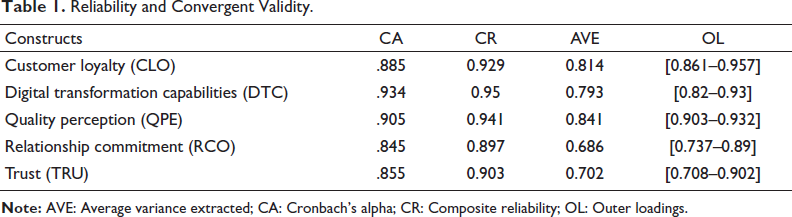
The measurement model assessment included the reliability and validity of measurement scales in this study. For reliability, this study evaluated Cronbach’s alpha (CA). All constructs got higher CA, which was higher than the recommended minimum of 0.7. CA values range from .845 to .950, which is significant. This indicates that each build has a strong internal coherence. Convergent validity is well established, as demonstrated by the composite reliability (CR) value, which is more than 0.7; average variance extracted (AVE) values that are greater than the 0.5 threshold for all constructs (which range from 0.686 to 0.841); and outer loadings (OL) that consistently surpass 0.7 (with ranges from 0.708 to 0.957). The elevated AVE values indicate that each concept accounts for a significant percentage of the variation in its indicators, while the robust OL illustrate a distinct correlation between constructs and their corresponding assessment items. The digital transformation capabilities construct has exceptional reliability (CA = .934, CR = 0.950) and convergent validity (AVE = 0.793, OL = [0.82–0.93]), highlighting its effective operationalization in this work. These results provide a robust basis for the forthcoming structural model analysis, validating the measurement model and bolstering confidence in the study’s conclusions. All constructs exhibited adequate convergent validity, as seen in Table 1.
Reliability and Convergent Validity.
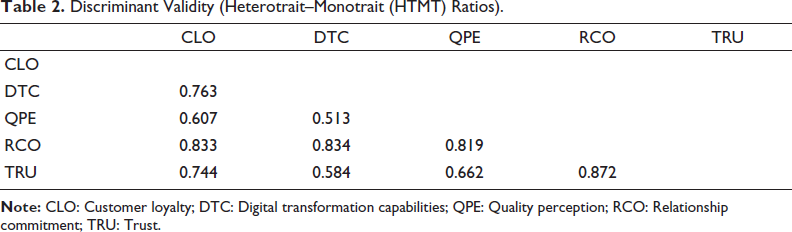
Discriminant validity, which measures the degree to which a construct is separate from other constructs in the model, was evaluated using the heterotrait–monotrait (HTMT) ratio. The HTMT ratio, a rigorous criterion for discriminant validity, must remain below 0.90. The findings in Table 2 demonstrate adequate discriminant validity since all components satisfy both requirements.
Discriminant Validity (Heterotrait–Monotrait (HTMT) Ratios).
Structural Model
After confirming the reliability and validity of the measurement model, the last phase was evaluating the structural model, which investigates the proposed links among the components.
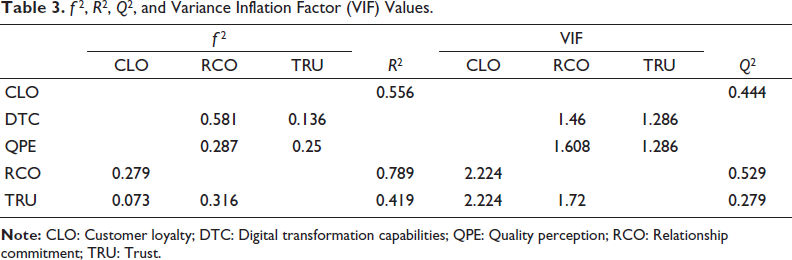
Table 3 indicates that digital transformation skills considerably affect relationship commitment (f2 = 0.581) in fitness services, which subsequently has a notable effect on customer loyalty (f2 = 0.279). Trust is favorably influenced by digital transformation (f2 = 0.136) and quality perception (f2 = 0.25), although its direct effect on loyalty is very little (f2 = 0.073). The model exhibits significant explanatory capability, elucidating 55.6% of the variation in customer loyalty (R2 = 0.556), 78.9% in relationship commitment (R2 = 0.789), and 41.9% in trust (R2 = 0.419). Additionally, the model has strong predictive relevance (Q2 values between 0.279 and 0.529) and little multicollinearity (variance inflation factor (VIF) values ranging from 1.286 to 2.224). These results underscore the need to focus on digital activities and service quality to cultivate robust client connections and augment loyalty in the fitness sector.
f2, R2, Q2, and Variance Inflation Factor (VIF) Values.
The route coefficients, representing the standardized regression weights, were used to evaluate the significance and direction of the proposed associations. Table 4 displays the route coefficients, standard errors, t-values, and p values corresponding to each hypothesis.
Path Coefficients and Hypothesis Testing.
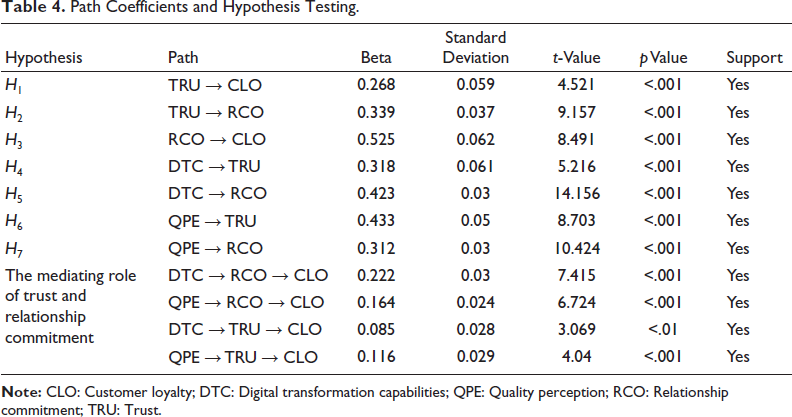
Table 4 indicates that all hypotheses were validated, exhibiting statistically significant route coefficients (p < .001) and positive correlations across the components. The results indicate that digital transformation capabilities positively influence customer loyalty, directly and indirectly, via customer experience mediated by trust and relationship commitment.
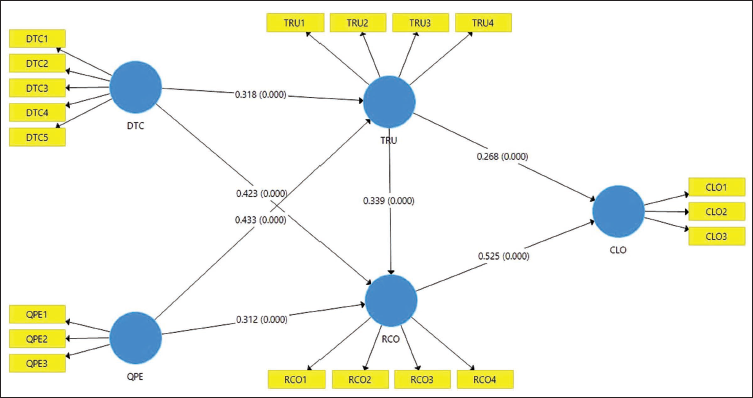
The examination of mediating effects indicates that both relationship commitment (RCO) and trust (TRU) significantly influence the relationship between digital transformation capabilities (DTC), quality perception (QPE), and customer loyalty (CLO). RCO serves as a significant mediating factor, effectively transmitting the beneficial impacts of both DTC (β = 0.222, p < .001) and QPE (β = 0.164, p < .001) on CLO. This underscores the need to cultivate robust client connections to convert digital innovations and favorable service experiences into enduring loyalty. Although trust is a crucial mediator, its impact on the DTC–CLO relationship (β = 0.085, p < .01) is less substantial than RCO’s. Trust significantly mediates the association between QPE and CLO (β = 0.116, p < .001), highlighting the need to provide high-quality services that enhance consumer confidence. These results provide significant insights for fitness providers, highlighting that a customer-centric strategy focused on relationship cultivation and service quality is essential for sustained success in a digitally driven industry. The multiple mediation model is shown in Figure 2.
Discussion
The empirical findings from a sample of 312 fitness service users in Vietnam offer strong backing for all proposed relationships. The research provides multiple significant contributions to the current body of literature.
The results indicate a positive influence of digital transformation capabilities on customer loyalty in fitness services. This finding is consistent with previous studies that have demonstrated the impact of digital transformation on enhancing customer engagement and customer retention in various sectors (Sashi, 2021; Yadav & Seranmadevi, 2024). The study confirms that fitness service providers who effectively leverage digital tools to personalize experiences—by improving convenience and strengthening customer connections—tend to foster greater loyalty toward their customers. This finding, therefore, underscores the necessity for fitness companies to adopt digital transformation to not only enhance customer experience and drive customer loyalty but also achieve sustainable growth in the modern fitness industry, which is driven by digital advancements.
This study confirms that customer experience serves as a mediator in the relationship between digital transformation and customer loyalty. This finding supports the framework of the SOR model, which posits that digital transformation practices, acting as stimuli, shape the customer experience—considered the organism—and lead to customer loyalty, which serves as the response to the stimuli (Mehrabian & Russell, 1974). Specifically, the report highlights the role of digital capabilities in fostering trust and commitment, which drive customer loyalty. This finding is consistent with broader research that emphasizes the importance of customer experience in building customer loyalty across various sectors (Lemon & Verhoef, 2016).
The study articulates how customer experience influences customer loyalty, which is shaped by trust and commitment. This finding aligns with the Trust-Commitment theory, which posits that trust and commitment are essential prerequisites for building strong customer relationships (Morgan & Hunt, 1994). The study suggests that when digital transformation efforts are effectively implemented, they may enhance customer trust by improving transparency, personalization, and responsiveness. For example, the application of robust data protection strategies may reduce privacy concerns, personalized fitness recommendations may increase perceived value, and responsive customer support through digital platforms may foster trust. Similarly, digital transformation may strengthen customer loyalty by enhancing convenience, personalization, and engagement (Verhoef et al., 2021). Moreover, when customers have access to seamless online reservation systems, personalized training plans, and engaging online communities that can enrich their experience and satisfaction, they are more likely to remain loyal to the fitness service providers.
Finally, the study highlights the importance of perceived service quality as a key factor in promoting both trust and commitment. This finding aligns with previous research that emphasizes the significant impact of service quality on customer perceptions and relationship outcomes (Orehovački et al., 2022; Parasuraman et al., 2005). In the fitness services sector, high-quality services can enhance customer trust by demonstrating expertise and reliability. This trust is reinforced through highly skilled instructors, well-maintained facilities, and effective training strategies. Furthermore, delivering exceptional service can foster customer loyalty by enhancing the customer experience and overall satisfaction with the service provider. These findings underscore the necessity of prioritizing service quality and combining it with digital transformation to deliver outstanding service experiences. This combination not only strengthens customer relationships but also drives long-term customer loyalty in the fitness industry.
This research builds upon earlier studies in several respects. This study offers empirical evidence, particularly regarding fitness services, an industry experiencing notable digital disruption, whereas prior research has focused on the impact of digital transformation on customer loyalty in different sectors (Huang & Ren, 2020). Additionally, although earlier research has confirmed the importance of customer experience (Pantano et al., 2022), this study advances the field by empirically demonstrating its mediating function and recognizing trust and commitment as the fundamental mechanisms. Moreover, by focusing on the Vietnamese market, this research contributes to the limited knowledge of digital transformation and customer loyalty in developing economies.
Conclusion
This study contributes to and reinforces the theoretical application of the SOR model and the Trust-Commitment theory by demonstrating their applicability to digital transformation and customer loyalty in the fitness industry. It shows that digital technology, combined with the perception of quality toward modern fitness services, has crucial effects that enhance customer experience through increasing trust and commitment, which drives customer loyalty. In addition, the study emphasizes positive feelings of safety and assurance within customers’ relationships, as part of the customer experiences, as intermediaries in the relationship between digital transformation and customer loyalty in the fitness industry.
The results provide valuable insights for fitness providers, motivating them to embrace a customer-focused strategy by leveraging digital practices. They highlight personalized services, integrated digital platforms, and exceptional service delivery as essential transformations for the traditional fitness industry. These elements enhance customer loyalty and gain a competitive advantage in the evolving digital landscape for fitness companies today.
Theoretical Implication
This study offers empirical proof that validates the importance of the SOR model and Trust-Commitment theory within digital transformation and consumer loyalty in the fitness services industry, thereby advancing the theoretical growth of both models. These findings provide a deeper understanding of how digital actions, acting as triggers, impact customer loyalty by defining customer experiences through trust and commitment. The study highlights the role of customer experience research in delivering greater customer loyalty in the context of digital transformation. These findings underscore the importance of not only developing digital technologies but also ensuring that these technologies provide customers with experiences that are both enjoyable and beneficial. The study explores how trust and commitment moderate the relationship between customer experience and loyalty, providing deeper insights into the psychological processes that drive customer retention in the digital age.
Managerial Implication
This study provides recommendations for fitness service providers who apply digital transformation to gain a competitive advantage. The study highlights the importance of adopting a customer-centric strategy for digital transformation, especially initiatives that enhance customer experience, trust, and customer-technology engagement. Fitness organizations should focus on digital strategies that directly impact customer experience, such as personalized recommendations, user-friendly online booking systems, and interactive online communities.
To enhance the positive impact of digital transformation on customer loyalty, service providers should focus on solutions that provide convenience, personalization, and engagement between customers and the provided services. Fitness businesses need to create personalized, seamless, and engaging digital experiences to drive trust and commitment; including, personalized fitness recommendations and instant communication through digital channels and communities.
Service quality must remain a key element of the customer experience despite the integration of digital tools. This includes maintaining high standards of skilled trainers, well-maintained facilities, and personalized workout programs. Digital transformation should be viewed as a means to enhance service quality, not a replacement. Digital initiatives must enhance the core service experience rather than detract from it. Fitness businesses can build more effective, long-term relationships by placing a high value on trust and commitment in customer interactions. This will help reduce customer churn and increase customer loyalty in the competitive digital fitness industry.
Limitations and Further Research
This study used a cross-sectional design; therefore, it is difficult to establish causal relationships. Due to time and resource constraints, the study focused primarily on individual consumers; however, it ignored social factors such as peer pressure or online community interactions, which may also influence customer loyalty. In addition, the study focused on existing digital technologies and did not consider emerging technologies such as AI. Future research could address these limitations by using a longitudinal approach and expanding the scope of the study to include social dynamics and the impact of emerging technologies (e.g., AI) on consumer experiences and loyalty to fitness services.
Footnotes
Declaration of Conflicting Interests
The authors declared no potential conflicts of interest with respect to the research, authorship, and/or publication of this article.
Funding
The authors received no financial support for the research, authorship, and/or publication of this article.
