







Abstract
In alignment with social exchange theory (SET), the present research aims to explore the mediating effects of psychological empowerment (PE) and change-oriented organizational citizenship behavior (CO-OCB) on the relationship between inclusive leadership (IL) and pro-social rule breaking (PSRB). We collected data from 542 employees working in Fortune 500 information and technology (IT) companies in India through an online survey using pre-existing scales. We conducted data analyses using structural equation modeling (SEM). The findings confirmed the hypothesized positive association between IL and PSRB, mediated by PE and CO-OCB. This research provides valuable insights for the information and technology industry, emphasizing the role of IL in encouraging PSRB behavior, thereby shifting from destructive to constructive. The results can guide top management in fostering IL by creating a psychologically secure workplace where team members feel safe to voice their opinions without fear of negative repercussions. Furthermore, the study establishes that PE and CO-OCB significantly influence the relationship between IL and PSRB.
Keywords
Introduction
Organizations can function successfully and efficiently within the framework of policies and procedures if employees comply and do not break the rules. Policies are an organization’s “intentions and direction, as formally expressed by its top management.” In the Indian information and technology (“IT” hereafter) industry, it is mandated to follow the policies and procedures (Donnelly, 2015). These standards protect the organization and its personnel by preserving their reputation, upholding legal compliance, and safeguarding the stakeholder’s interests (Ghosh & Shum, 2019). If an organization introduces a rule, employees may either accept it reasonably or retaliate, leading to constructive or destructive outcomes (Sharma & Dhar, 2024), while rule-breaking is often associated with negative behaviors such as service sabotage (Lee & Ok, 2014), and stealing (Poulston, 2008). Substance abuse (Belhassen & Shani, 2013), a growing perspective, highlights pro-social rule breaking (“PSRB” hereafter) as a form of positive deviance that explores the constructive side of rule-breaking behavior (Bennett et al., 2024). PSRB refers to behaviors that go against accepted standards or laws to benefit individuals and the organization (Park et al., 2024). This fascinating thought emphasizes the notion that not all rule-breaking is terrible; in fact, there are situations in which violating the law may spur creativity, advancement in society, and enhanced well-being (Shum & Ghosh, 2022). Ghosh and Shum (2019) discovered that 60% of workers in various industries disobey company policies, with 55% resulting from pro-social motivations. Forty percent of the workers violated non-compliance regulations. Employees may now breach the law to assist clients, coworkers, or the company—a shift from destructive to constructive rule-breaking (Ghosh & Shum, 2019). Breaking the rules to promote goodwill in the organization could bring positive change.
Many scholars have argued that PSRB positively affects employee satisfaction, employee loyalty, and innovative job performance (Ghosh, 2022; Shum, 2021), while negatively affecting unethical pro-self behavior, deviant rule-breaking behavior, and employee guilt (Dahling et al., 2012; Morrison, 2006; Vardaman et al., 2014). Given that leadership influences workplace behaviors, a leader plays a crucial role in establishing the company’s culture and encouraging team members to take ownership of their work (Martinez et al., 2023). Leaders who effectively communicate the rationale behind rules and demonstrate a commitment to adhering to them set a positive example for their team. Conversely, if a leader is flexible with rules or does not regularly enforce them, it might cause a lack of responsibility and decreased general adherence. Among various leadership styles, inclusive leadership (“IL” hereafter) stands out because it fosters an environment where employees feel valued, heard, and empowered to challenge norms constructively (He et al., 2021). IL strongly supports workers ideas and initiatives about organizational guidelines and policies, promoting a culture of respect, empathy, and open communication.
In contrast, autocratic leadership may suppress employees’ willingness to break the rules for positive change. In contrast, IL is more likely to encourage PSRB by creating psychological safety and openness to innovation. Leaders of inclusion in the IT industry may find that fostering PSRB within their teams not only drives creative problem-solving and flexibility (Khattak et al., 2022) but also intersects with organizational dynamics, innovation, and social responsibility (Liu et al., 2024).
This study examines how IL impacts PSRB within the context of the IT industry. In this relationship, earlier work has revealed mediating paths for self-efficacy, leadership identification, and psychological safety (He et al., 2021; Khattak et al., 2022). To address the research gap, this study will involve psychological empowerment (“PE” hereafter) and change-oriented organizational citizenship behavior (“CO-OCB” hereafter) as mediators. Social exchange theory (“SET” hereafter) contends that when people feel they are having a constructive and inclusive social exchange with their leaders, they are more inclined to participate in social and psychological relationships (Cross & Dundon, 2019). Concerning this theory, if the leadership is inclusive, it will propagate innovative ideas and PSRB, facilitated by PE and CO-OCB.
The current study adds to the existing literature in three different ways. First, this study investigates the association between IL and PSRB in the IT sector by targeting Fortune 500 IT companies. Although PSRB has been primarily studied in the hospitality industry (Ghosh, 2022; Ghosh & Shum, 2019), few studies have focused on the IT sector. This study aims to address this gap in the existing literature. Second, this research establishes a connection between IL and PSRB via PE and CO-OCB intervening processes. Innovation, employee engagement, improved decision-making, and increased competitiveness in the market are all benefits of IL for organizations (The Economic Times, 2024). As a result, we add to a positive stream of research by incorporating PE and CO-OCB in this relationship. Such contributions support the IT sector by encouraging workers to engage in pro-social work environments, potentially leading to increased involvement and reduced turnover rates among employees who are considering bending the rules for moral purposes (John & Shafi, 2020). By examining the impact of IL on PSRB in the IT industry, this research contributes to theoretical frameworks in leadership, PE, and CO-OCB through the lens of SET, suggesting that when a leader demonstrates inclusivity, employees are more likely to reciprocate with PE, change-oriented behaviors, and positive deviance. It provides actionable strategies for IT leaders to foster innovation, agility, and a high-performance work culture.
Two key research questions serve as the basis for this study:
RQ1: What is the influence of IL on PSRB?
RQ2: What are the mediating effects of PE and CO-OCB in the relationship between IL and PSRB?
The study begins by outlining the theoretical framework, reviewing relevant literature, and developing the hypotheses. We then present the methodology and results, highlighting the discussion, limitations, theoretical and managerial implications, and the future scope of research.
Literature Review and Hypothesis Development
Theoretical Framework
SET
This research builds upon SET, which is essential in understanding the dynamics of reciprocity and mutual benefit that shape organizational behaviors. SET, rooted in the principles of reciprocity and negotiation, suggests that social interactions involve exchanges that are balanced by perceived costs and rewards between two or more individuals (Cook, 2008). According to Cook (2008), “social exchange is a fundamental aspect of social life and the basis of both interpersonal and group relationships.”
SET is key to this study, offering a framework to understand how leader-employee relationships develop into trust-based exchanges that encourage positive organizational behaviors (Zou et al., 2015). In IL, SET explains how open and accessible leaders create an empowering climate, motivating employees to engage in PSRB for the organization’s benefit. Employees are more likely to engage in PSRB when they feel aligned with their leader’s expectations and are less likely when fearing criticism (Ahmed & Khan, 2023; Dahling et al., 2012). SET also supports PE and CO-OCB mediating roles between IL and PSRB, as reciprocal exchanges foster empowerment and motivation to exceed essential roles.
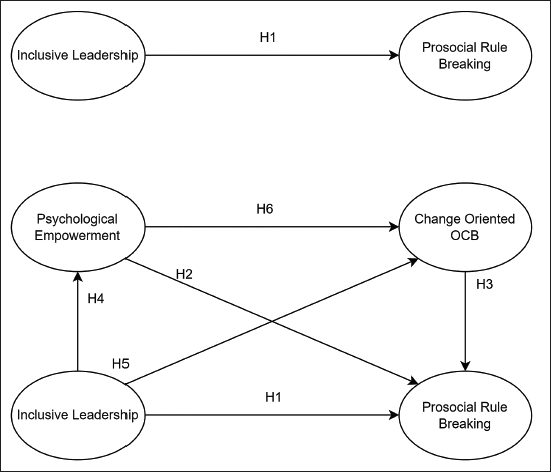
By utilizing SET as our theoretical lens, this study effectively addresses how IL impacts PSRB and elucidates the pathways through which PE and CO-OCB mediate this relationship. Figure 1 visually illustrates these hypothesized pathways, emphasizing the role of trust and reciprocal exchanges as predicted by SET within leader-employee dynamics.
Research Model.
IL and PSRB
IL is an approach to leadership where leaders listen to and value their employees’ input (Choi, 2007; Jaleel & Sarmad, 2024). It can assist employees in believing that their voices are truly respected. Under IL, leaders understand the needs of their employees and demonstrate accessibility, openness, and availability during their interactions with them (Randel et al., 2018; Umrani et al., 2024). Compared to other leadership styles, an inclusive leader can deal with employee proposals more patiently and pay attention to employees’ perspectives (Carmeli et al., 2010). IL fosters an environment where employees feel heard and valued, which can influence their willingness to engage in behaviors that challenge formal rules for the organization’s benefit (Tran & Choi, 2019). Recently, the concept of PSRB has started gaining attention. Morrison (2006) proposed that “any instance where an employee intentionally violates a formal organizational policy, regulation, or prohibition with the primary intention of promoting the welfare of the organization or one of its stakeholders” is PSRB, and Dahling et al. (2012) validated it. Dahling et al. (2012) described several significant PSRB characteristics and conclusively classified this behavior as constructive deviance. First and foremost, PSRB intentionally breaches organizational policies to advance the interests of stakeholders or the company (Malik & Mishra, 2023). Second, PSRB covers breaking established organizational rules, not ineffective or unintentionally created rules inside the organization.
When workers face challenges at work, inclusive leaders support them. Leaders who accept their subordinates’ minor flaws and failures foster better interpersonal skills among employees and highlight how their efforts may result in favorable consequences for their employers (Ullah Khattak et al., 2024); this makes it possible for workers to focus on innovative jobs. IL traits shape PSRB behavior by creating a strong bond between the leader and the subordinate (Khattak et al., 2022). According to SET, when employees perceive fair and supportive treatment from their leaders, they reciprocate with positive discretionary behaviors, including PSRB, to benefit the organization. Similarly, studies indicate that PSRB enhances individual performance by supporting a successful organizational establishment system (Malik & Mishra, 2024; Qureshi et al., 2021). Therefore, IL fosters a strong sense of organizational identity and inspires workers to act responsibly to advance social interests (e.g., organization and stakeholders) (Korkmaz et al., 2022). Considering these arguments, this research study hypothesizes that IL significantly impacts PSRB.
H1: IL is positively associated with PSRB.
PE and PSRB
Rappaport (1987) states, “Empowerment is the process by which individuals, groups, and communities take control of the problems that affect them.” As per the socio-structural approach, empowerment refers to organizational methods, rules, and structures designed to distribute authority so that lower-level employees may decide for themselves and direct their behavior (Kanter, 1983; Sahadev et al., 2024). Spreitzer (1995) developed PE as a motivating variable expressed in four cognitions: impact, competence, self-determination, and meaning. Therefore, PE reflects how employees’ opinions of themselves and their workplaces are ever-changing (Orgambídez et al., 2024). PE plays a crucial role in shaping employees’ willingness to challenge established norms, which can sometimes manifest as PSRB when individuals take the initiative to benefit their organization or its stakeholders (Ahmed & Khan, 2023). Intentional deviations from accepted norms or regulations to foster favorable outcomes for the group or its members are called PSRB (Irshad et al., 2022). People consider rule-breaking incidents pro-social only when individuals break the rules to assist the organization or its stakeholders honorably. Rather than deviating from the informal and emergent norms that arise inside social groups, PSRB entails breaking top-down regulations and procedures established by an organization’s administration (Ullah Khattak et al., 2024).
When employees feel psychologically empowered, they perceive their roles as meaningful, believe they have the competence to perform their tasks effectively, experience autonomy in decision-making, and see their actions as influential in achieving organizational goals (Tu & Luo, 2020). These factors motivate employees to engage in PSRB behaviors that aim to benefit the organization while deviating from formal rules (Ahmed & Khan, 2023). From a SET perspective, when organizations provide employees with a sense of empowerment, employees reciprocate by engaging in discretionary behaviors, including PSRB, to contribute positively to organizational success (Ali et al., 2022). Empowered employees are more likely to engage in PSRB because they feel confident in making decisions that align with broader organizational objectives, even if they bypass formal procedures (Dahling et al., 2012). Therefore, we propose the following hypothesis:
H2: PE is positively associated with PSRB.
CO-OCB and PSRB
CO-OCB is defined as “constructive efforts by individuals to identify and implement changes concerning work methods, policies, and procedures to improve the situation and performance” (Choi, 2007). CO-OCB is an organizational change-focused promotive form of OCB (De Clercq & Pereira, 2024). Two antecedents of CO-OCB have been studied in earlier studies (Malik, 2024). Leadership and working atmosphere fall under the first category of environmental stimuli. The second set includes notions like “felt responsibility for change” that are correlations rather than antecedents. Employees who exhibit CO-OCBs actively participate in organizational changes, identifying and fixing organizational mistakes, and offering recommendations for enhancing work output (Bettencourt, 2004; Choi, 2007; Suhail et al., 2024). According to SET, when employees perceive a supportive and empowering work environment, they feel obligated to reciprocate through discretionary efforts like CO-OCB (Kieserling, 2019). This reciprocal relationship fosters a proactive mindset, motivating employees to take initiative in organizational change efforts. Dahling et al. (2012) suggest that organizational citizenship behaviors, like PSRB, are driven by constructive motivation and include some deviation from the standard of what is usually expected or rewarded. Scholarly works in the past have examined the CO-OCB relationship with goal orientation (Bettencourt, 2004), autonomy orientation, thriving at work, and empowering leadership (Choi, 2007), as well as transformative leadership styles (Muppidathi & Krishnan, 2021). Recent studies have also explored its connection with PSRB (Déprez et al., 2020; Qureshi et al., 2021), suggesting that employees exhibiting change-oriented behaviors may sometimes break organizational rules to drive positive outcomes. Since CO-OCB reflects an employee’s willingness to challenge the status quo and drive constructive organizational change, it naturally aligns with PSRB, which involves breaking the rules to benefit others or improve efficiency. Employees engaging in CO-OCB may recognize inefficiencies or outdated processes and, in their commitment to continuous improvement, engage in PSRB to push for necessary change. Thus, we recommend the following hypothesis:
H3: CO-OCB is positively associated with PSRB.
IL and PE
IL is a leadership style that emphasizes openness, accessibility, and the fair treatment of all employees, ensuring that diverse perspectives are valued and integrated into decision-making processes (Woods et al., 2024). By fostering a supportive and participative work environment, inclusive leaders strengthen employees and enhance employees’ sense of competence, self-determination, meaning, and impact in their roles (Xia et al., 2024). According to Zimmerman (1995), PE is empowerment at an individual’s level of analysis. It involves an employee’s perception of their ability to make meaningful choices and take practical actions (Wood & Bandura, 1989), including perceived efficacy, competence, and control.
Studies have discussed the role of PE (Ullah Khattak et al., 2024; Wang & Shi, 2021) and psychological safety (Khan et al., 2023) concerning IL and PSRB. Marane (2012) indicates that IL motivates employees with high PE to show more initiative in their workplace duties. IL fosters a supportive environment that enhances employees’ autonomy, competence, meaning, and impact. Through openness, accessibility, and involvement, employees feel valued, trusted, and encouraged to contribute their unique perspectives and make autonomous decisions for the organization’s benefit. Employees who perceive their leaders as inclusive and empowering feel obligated to reciprocate by engaging in proactive and discretionary behaviors that benefit the organization (Xia et al., 2024). Inclusive leaders cultivate a climate where employees feel psychologically empowered to make proactive, pro-social choices that sometimes involve rule-bending for the greater good (He et al., 2021; Yang & Chung, 2020). Therefore, we hypothesize the following:
H4: IL is positively associated with PE.
IL and CO-OCB
In today’s dynamic and competitive business environment, organizations increasingly rely on employees’ discretionary efforts to drive innovation and change. The word “change-oriented” is crucial; first, it implies that people should change things already in place in the organization, including work practices, team cultures, or policies. Second, according to Morrison and Phelps (1999) and Chen et al. (2024), CO-OCBs are extra-role behaviors beyond clearly defined role expectations. Third, employees should accept organizational norms and regulations as the foundation for their CO-OCBs. Fourth, enhancing task performance and organizational outcomes is the primary objective of those who participate in CO-OCBs.
IL encourages employees to voice new ideas, challenge existing processes, and engage in proactive behaviors that drive organizational change (Tran & Choi, 2019). By promoting psychological safety and recognizing diverse perspectives, inclusive leaders enhance employees’ willingness to take initiative and contribute to organizational innovation and transformation (Randel et al., 2018). Leaders who foster an inclusive workplace motivate staff members to participate actively in constructive organizational change, benefiting CO-OCB (Lee & Shin, 2024). From the lens of SET, employees reciprocate the support and trust provided by inclusive leaders by engaging in extra-role behaviors such as CO-OCB. Leaders who foster an inclusive workplace motivate staff members to participate actively in constructive organizational change, benefiting CO-OCB (Chen et al., 2020). Hence, we suggest the following hypothesis:
H5: IL is positively associated with CO-OCB.
Relationship Between PE and CO-OCB
The four pillars of PE foster a sense of ownership and intrinsic motivation, encouraging employees to engage in discretionary behaviors that drive organizational improvements. Studies by Lin et al. (2023) highlight PE as a key driver of CO-OCB, as empowered employees are more likely to challenge the status quo and promote innovation. Employees who experience heightened PE proactively take the initiative, contributing to positive organizational change. According to SET, psychologically empowered workers develop more favorable attitudes toward their organization, leading to greater engagement in extra-role behaviors (Jabeen & Ali, 2022). Believing in their ability to make a meaningful impact, empowered employees are more inclined to take courageous actions beyond their formal job scope, further enhancing organizational effectiveness (Lin et al., 2023). The reciprocal nature of SET suggests that when organizations empower employees by fostering autonomy and competence, employees feel obliged to reciprocate through proactive, change-oriented behaviors that benefit the organization. Thus, we propose the following hypothesis:
H6: PE is positively associated with CO-OCB.
Earlier studies have highlighted the mediating roles of psychological safety, leadership identification, leader-member exchange (Ullah Khattak et al., 2024; Wang & Shi, 2021), self-efficacy, employee relations climate (He et al., 2021), and leadership identification (Khattak et al., 2022) in the relationship between IL and PSRB. According to the current research study, IL, through openness and accessibility, empowers employees to explore new ideas and implement initiatives without fear of making mistakes. IL boosts employees’ sense of PE regarding self-determination, impact, competence, and meaning. This sense of empowerment instills confidence and motivation. It gives employees a stronger sense of purpose, increasing the likelihood of contributing creative ideas and consequently increasing CO-OCB, ultimately leading to PSRB. However, this serial mediation is neither theoretically discussed nor empirically explored. Deriving its roots from SET, this relationship suggests that when inclusive leaders foster PE through openness and accessibility, employees perceive a sense of reciprocity, feeling valued and supported. This mutual exchange strengthens their commitment to the organization, motivating them to engage in CO-OCB and ultimately exhibit PSRB.
In combination with the above hypotheses, we propose that:
H7: Inclusive leaders influence PE, encouraging CO-OCB, ultimately leading employees to engage in PSRB.
Methodology
Sampling and Data Collection
We designed this study to employ a purposive sampling strategy to ensure alignment between the methods, research questions, and hypotheses. We used a purposive sampling design to minimize biases and select respondents who clearly understood the study’s context (Sarstedt & Mooi, 2014). We designed this approach to ensure response variability rather than exclusively selecting high-score participants. Specifically, we purposefully selected individuals with relevant leadership experience, roles in organizations that value CO-OCB, and high PE levels and PSRB engagement, ensuring high-quality data and streamlined data collection. We conducted statistical tests to mitigate further potential biases, including the Harman single-factor test and a three-stage data collection process to address common method bias (CMB). We performed robustness checks to validate our findings in the next section. Researchers distributed a standardized scale questionnaire among IT sector employees in Tier-one and Tier-two cities. We opted for this industry because India has emerged as a leading IT hub in the last several years (The Times of India, 2021). Also, this sector is supposed to adhere to strict rules and procedures, resulting in employees indulging in PSRB. We floated the questionnaires using Google Forms and received 656 responses. To reduce the risk of CMB, we conducted data collection in three phases.
While our study does not rely on temporal sequencing, this phased approach helped mitigate CMB by minimizing respondent fatigue and psychological priming effects. It also enabled us to validate constructs across different time points, enhancing the reliability of responses. We collected demographic variables and PE data in the first phase (T1). One month later, in the second phase (T2), we gathered responses on CO-OCB and IL. Another month later, in the third phase (T3), we administered questions about PSRB to those who had completed both T1 and T2. This multi-phase approach improved response quality and reduced the risk of straight-lining biases. After cleaning the data, we removed the unengaged responses. Unengaged responses, indicating a lack of effort or attention, were identified by two criteria:
Straight-lining: Responses in which participants selected the same option across multiple items suggest inattentiveness (Chi et al., 2020).
Low response variability: We removed responses with a standard deviation below 0.25 across Likert items within the same construct because such low variability likely indicates inattentive answering (Chi et al., 2020).
All questions were mandatory, so there were no missing items. After data cleaning, the sample size was reduced to 542, exceeding the required 159 as per G* analysis and the guideline of 10 times the total indicators (Hair et al., 2011). The appendix details respondents’ demographics, including age, gender, and education, which were treated as control variables to mitigate potential influences on the study’s relationships during the design phase (see appendix A and B). We kept these variables constant throughout the study. Additionally, we treated the control variables as independent variables and analyzed their effects on mediating and dependent variables.
Analytical Methods
The PROCESS macro was employed for data analysis (Hayes, 2013). Structural equation modeling (SEM) has been extensively utilized in previous research to analyze survey-derived data due to its robust nature (Moulik & Giri, 2024; Pradhan et al., 2024). We used skewness and kurtosis tests to determine whether the data were standard. Then, we verified CMB using a Harman single-factor test. Next, we conducted path analysis and theory development using SEM (Hair et al., 2011). We conducted the structural model and measurement in two steps. The measurement model determines the measurement scale’s reliability and validity, while the structural model provides the relationships between constructs within a model. Proposed mediators, that is, PE and CO-OCB, were incorporated into the model to establish a serial mediation model. The PROCESS macro (Model 6), which Hayes gave in 2013, was used for this purpose. To enhance scale reliability, we carefully designed each questionnaire statement to ensure clarity and ease of understanding, reducing misunderstandings and promoting consistent responses. We took multiple steps to capture the intended constructs accurately for validity. We reviewed each statement for content validity to ensure it represented the variables’ dimensions and aligned with established literature. We conducted a pilot study to confirm convergent validity and examined item correlations within each construct. We removed one CO-OCB statement (CO-OCB 3) with a low factor loading, which improved construct validity and refined the scale’s reliability.
Measures
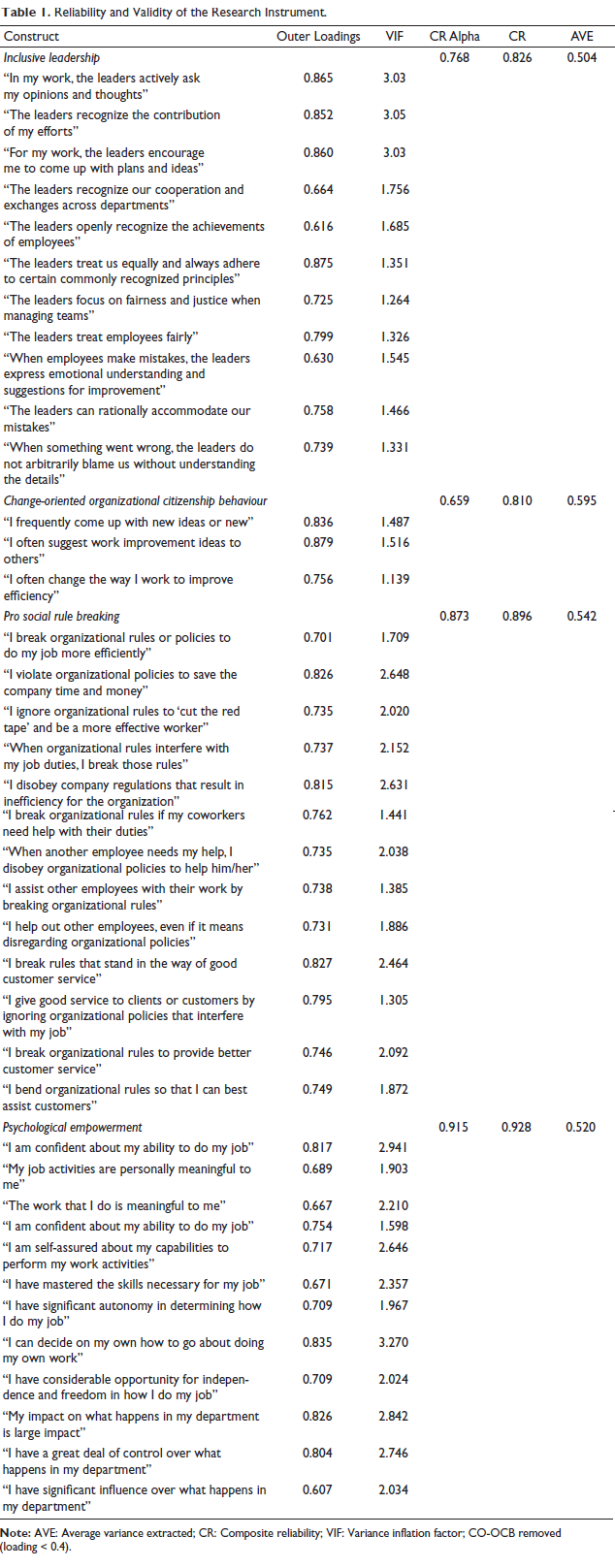
Standardized scales were employed throughout the study to measure the key constructs: IL, PE, CO-OCB, and PSRB. We used a Likert scale in the questionnaire, where one indicated strong disagreement, and five indicated strong agreement. To measure IL (11 items), we adapted questions from Randel et al. (2018). We assessed PE (12 items) using questions from Spreitzer (1995). We evaluated CO-OCB (four items) based on measures from Choi (2007). We derived the PSRB (13 items) from Dahling et al. (2012). We pretested the questionnaire with four HR research experts to ensure clarity and relevance and incorporated their feedback into a revised version. Table 1 presents the finalized questionnaire used as the survey instrument.
Reliability and Validity of the Research Instrument.
Results
Normality and CMB
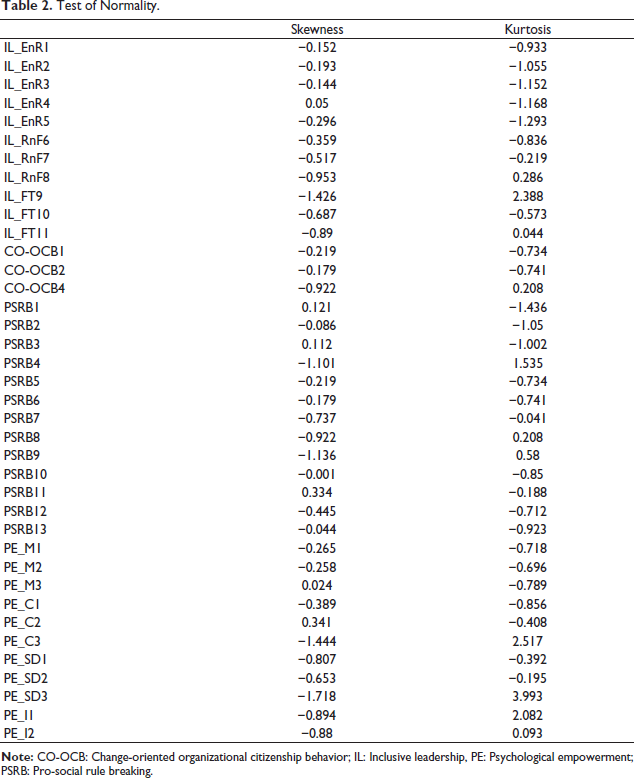
SEM is a widely used non-parametric technique to treat routine and skewed data (Hair et al., 2017; Ringle et al., 2022). However, according to recent research, it is recommended to avoid using highly non-normal data. SEM is suitable as a considerable non-normal distribution is absent in the current study, and the skewness and kurtosis values are within the recommended range. Hair et al. (2017) reported that skewness values for each item lie between −1 and 1, and kurtosis values fall between −2 and 2, indicating that the data are distributed close to a normal distribution. These findings imply that we can regard the data as normally distributed without significant departure from normality (Table 2). To verify the accuracy of the data collected from a single participant regarding independent and dependent variables, we checked for common method variance (CMV). We tested the framework for CMV using Harman’s single-factor test. Since CMV becomes problematic if one factor accounts for most of the variance, we conducted an unrotated principal component analysis (PCA). We found that the first factor accounted for only 35.331% of the variance. This result suggests that CMV does not pose an issue.
Test of Normality.
Measurement Model
Reliability and Validity of Construct
We observed the variance inflation factor (VIF) values for every indicator to assess the collinearity of the proposed model. The VIF values of the model varied from 1.139 to 3.27, which indicates the absence of multicollinearity. Results also demonstrate that CMV is not an issue. The proposed framework includes indicators with a construct loading greater than 0.70 (Hair et al., 2017). Other parameters are similarly significant with p values < .05 (presented in Table 1).
Convergent Validity
Researchers first evaluated the model for convergent validity by examining factor loadings, composite reliability (CR), and average variance extracted (AVE) (Hair et al., 2006). As seen in Table 1, every item loading was higher than the suggested cutoff point of 0.6. The CR score was more significant than 0.7, which was suggested by Hair et al. (2006). The AVE value was more than the recommended threshold of 0.5. Table 1 presents the results for validity and reliability.
Discriminant Validity
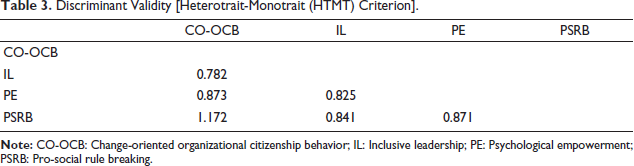
Researchers often use two conservative approaches to confirm discriminant validity: the heterotrait-monotrait (HTMT) ratio and the Fornell–Larcker criterion (Fornell & Larcker, 1982). The value of the HTMT ratio must be smaller than 0.9 to signify discriminant validity (Hair et al., 2019; Henseler et al., 2015). According to these standards, Table 3 shows acceptable discriminant validity using the HTMT criterion, a trustworthy method for evaluating discriminant validity, as opposed to the Fornell–Larcker criterion, which has several limitations and is less rigorous for use in empirical research (Henseler et al., 2015).
Discriminant Validity [Heterotrait-Monotrait (HTMT) Criterion].
Evaluation of Structural Model
We generated models using variance-based SEM, which is recommended for building theories. We employed the SmartPLS program (Hair et al., 2011). Following the recommendations of Henseler et al. (2015), we applied the standardized root mean square residual (SRMR) as the approximate model fit criterion. Researchers consider SRMR a better measure than the chi-square test (Hair et al., 2019). In partial least squares (PLS) path models, experts advise an SRMR value of less than 0.8; an SRMR value of zero denotes a perfect fit. Our model produced a value of 0.100, indicating an appropriate model fit.
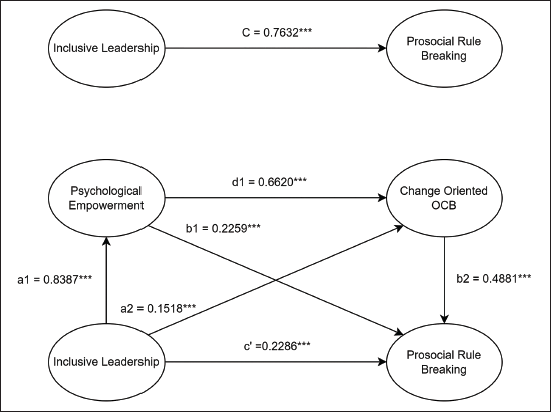
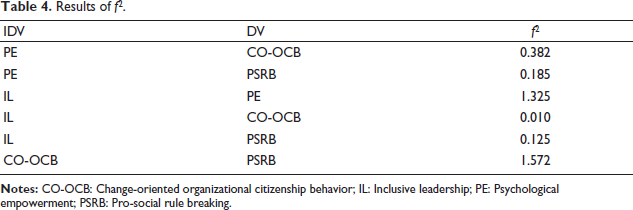
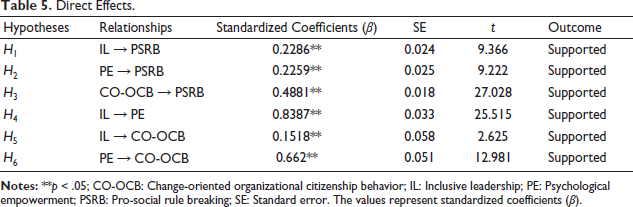
Furthermore, we used R2 values (coefficient of determination) to assess the model’s prediction accuracy and to indicate the influence of dependent variables. R2 levels less than 0.50 indicate moderate accuracy; values less than 0.75 show great predictive ability; and values less than 0.25 show poor accuracy. The highest variance explained is PSRB 89%, PE 57%, and CO-OCB 53% (Figure 2). The f2 values represent the model’s explanatory power (Cohen, 1988). An f2 value of 0.02 is considered a weak effect, 0.15–0.35 indicates a moderate effect, and 0.35 or above constitutes a significant effect. The model’s f2 values (Table 4) show moderate accuracy. The relationship between CO-OCB and PSRB demonstrates the highest explanatory power, with an f2 value of 1.572, suggesting that CO-OCB accounts for a substantial proportion of variance in PSRB; we observe an f2 of 1.325 in IL-PE, reflecting a strong effect. The PE and CO-OCB path also presents a large effect size with an f2 of 0.382. After completing 10,000 rounds of the bootstrapping approach, we assessed the route coefficients for direct links for statistical significance. We found support for all hypotheses. Table 5 presents the results with standardized coefficients.
Results of f2.
Direct Effects.
Mediation Analysis
The study used the Hayes (2013) approach to test the hypothetical model. We used Model 6 PROCESS to estimate the path coefficient. The PROCESS macro, along with investigating the intervening impact of PE and CO-OCB alone, aids in determining the “indirect impact passing through both these mediators.” Figure 2 depicts estimated standardized route coefficients. Hayes (2013) proposes a mediation strategy that “directly examines the mediating effects between the criterion and predictor variables via the bootstrapping procedure.”
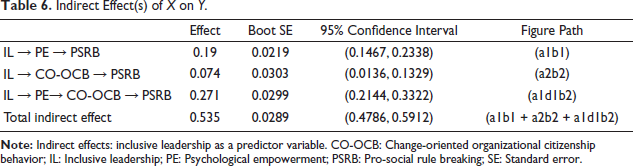
This research used bootstrapping with 10,000 subsamples and found that, at a 95% confidence level, the indirect effects for all the investigated variables (IL, PE, CO-OCB, and PSRB) were not zero. Table 6 demonstrates the serial mediation effects for evaluating H7. There is a considerable indirect impact (indirect effect = 0.271, Boot SE = 0.0299, 95% Boot CI [lower] = 0.2144, Boot CI [upper] = 0.3322) for IL as well as PSRB, where PE and CO-OCB act as mediators. If the relation of X and Y is statistically insignificant when controlled for mediator M, that is, the direct effect of X on Y is not present. If X does not affect Y after including the mediator, then the mediator thoroughly explains the relationship; however, if X still affects Y but with a weaker, yet statistically significant impact, the mediator partially explains the relationship (Abu-Bader & Jones, 2021). The initial direct effect of IL on PSRB was 0.7632, indicating a strong and statistically significant relationship. However, after introducing the mediators PE and CO-OCB, the direct effect of IL on PSRB decreased substantially to 0.2286, though it remained statistically significant. The findings indicate the presence of partial mediation, as the direct relationship between IL and PSRB, represented by H1, remains statistically significant even after accounting for the mediating variables (PE and CO-OCB), this suggests that while the mediators contribute to explaining the relationship, IL still has a direct and independent effect on PSRB. Findings support the study’s H7, which states that IL causes PE and CO-OCB, which results in PSRB.
Indirect Effect(s) of X on Y.
Discussion
This study highlights IL as a catalyst for PSRB, aligning with Morrison (2006) and Dahling et al. (2012), who view PSRB as constructive deviance for organizational benefit. Our results show that IL fosters an environment where employees feel empowered to take pro-social actions, even if it means deviating from policy (Choi, 2007; Randel et al., 2018). This finding supports the idea that IL promotes decision-making and innovation (Jaleel & Sarmad, 2024; Korkmaz et al., 2022). The mediating role of PE aligns with Kanter’s (1983) perspective on empowerment, suggesting that IL enhances PE by fostering an environment of value and control, as defined by Spreitzer (1995). Empowered employees are more likely to engage in positive deviations (Wood & Bandura, 1989). CO-OCB also mediates, reflecting Choi’s (2007) idea of change-oriented behavior to improve conditions. Inclusive leaders encourage CO-OCB by supporting proactive changes (Morrison & Phelps, 1999). These findings indicate that while the mediating variables are important in explaining the pathway through which IL influences PSRB, IL still maintains a direct and independent effect on PSRB; this underscores the crucial role of IL in encouraging employees to be involved in constructive rule-breaking behavior. It implies that IL not only shapes psychological or behavioral mechanisms but also fosters a work environment that supports discretionary, pro-social actions aimed at organizational improvement. We compared the indirect effects of PE and CO-OCB in the IL-PSRB relationship to enhance interpretability. The analysis shows that the indirect effect through PE (0.19, 0.0219, 95% CI: 0.1467–0.2338) is notably stronger than CO-OCB (0.074, 0.0303, 95% CI: 0.0136–0.1329); this suggests that PE plays a dominant mediating role, serving as the primary pathway through which IL influences PSRB, while CO-OCB acts as a secondary, complementary mechanism. While focusing on the IT sector, researchers can contrast the findings with those of industries like hospitality, where PSRB often enhances customer experience rather than technical improvements (Ghosh, 2022). Future research could explore these cross-industry differences to broaden PSRB’s applicability.
In extending SET, this study demonstrates how IL fosters a social exchange dynamic where empowered employees reciprocate leadership support through constructive behaviors like PSRB and CO-OCB. The theoretical contribution of this study lies in its synthesis of SET with constructs such as PE and CO-OCB, providing a nuanced understanding of how IL can nurture pro-social deviance through empowerment and change-oriented initiatives. Furthermore, contextualizing these findings within an exchange relationship framework highlights IL’s unique role in shaping constructive workplace deviance, an area identified as underexplored in prior studies (Yanzi & Yanan, 2019). The following sections thoroughly analyze the implications from a theoretical and management perspective.
Theoretical Implications
This study contributes to the literature in several ways. First, SET is applied to analyze both direct and indirect relationships. SET is the foundation for each hypothesis, emphasizing how IL can directly promote PSRB and indirectly foster PE and CO-OCB. Through CO-OCB, employees are more likely to raise concerns and break rules constructively for organizational benefit, extending SET’s application to these variables.
While the study underscores proactive pro-social rule breaking’s (PPSRB) positive outcomes, it acknowledges its potential risks, especially in fields like IT, where unchecked rule-breaking may lead to data breaches, ethical dilemmas, and regulatory non-compliance; this suggests that PSRB needs alignment with organizational values to prevent adverse outcomes, supporting a balanced view on PSRB to avoid undesired consequences (Dahling et al., 2012; Morrison, 2006).
IL motivates employees to voice concerns and challenge norms, with PE and CO-OCB mediating this effect. IL promotes a supportive work environment where employees feel empowered to speak up and innovate (Van Buskirk, 2020). Introducing CO-OCB as a mediator enriches the understanding of PSRB, as IL fosters CO-OCB, enhancing its impact (Qureshi et al., 2021).
Managerial Implications
This study has important implications for scholars, practitioners, and policymakers, especially in the versatile and rule-bound IT industry. Top management should create a culture where employees break the rules constructively to benefit the organization or society. Leaders should point out rule-breaking, understand its motivations, and ensure it aligns with organizational goals.
IT managers should have clear frameworks for constructive rule-breaking that distinguish constructive and deviant behaviors, clarifying when minor deviations for problem-solving or innovation are acceptable. Moreover, employees should be allowed flexibility and innovation in low-risk scenarios, such as urgent bug fixes, while ensuring accountability through documentation; this would balance agility with control. Managers may also create open forums to discuss potential deviations, fostering trust and providing a “feedback loop,” ensuring responsible rule-breaking. Furthermore, it is important to emphasize that constructive rule-breaking must align with organizational values and ethics, not personal gain, to prevent unintended consequences.
Managers should consider PPSRB trade-offs, such as accountability and compliance risks. Through IL, they can foster a culture that supports responsible PSRB, enhancing innovation, adaptability, and continuous improvement. IL builds trust and loyalty, encouraging employees to challenge outdated norms for the organization’s benefit. Leaders can align constructive rule-breaking with ethical considerations by emphasizing PE and CO-OCB. This study highlights IL’s role in promoting PSRB, enhancing employee satisfaction, loyalty, and innovation, and provides actionable insights for implementing responsible rule-breaking in IT.
Policy Implications
Beyond theoretical and managerial insights, this study has policy implications. First, organizations should invest in training programs to develop IL skills among managers, fostering an environment where employees feel empowered to engage in constructive PSRB. Second, policies should enhance PE by providing autonomy, resources, and support for decision-making, and encouraging employees to take initiative. Third, recognizing and rewarding employees who go beyond their roles through public recognition or incentives can further encourage beneficial rule-breaking. Implementing these policies can create an environment conducive to innovation and positive change driven by IL and PE.
Limitations and Future Scope
This research comes up with some limitations as well. There are ample studies on IL, but quality research is still needed, focusing on all four dimensions of IL. Furthermore, IL can be studied simultaneously with other leadership styles. Future research could also benefit from qualitative analyses, such as in-depth interviews with employees who engage in PSRB, to explore their motivations and experiences in greater detail. The current study analyzed the relationship of IL, PE, CO-OCB, and PSRB well; further studies can study the intervening effects of demographics and control variables, such as the effect of age, income, and gender on the direct relationship between IL and PSRB. Further studies can also see the moderating effects of organizational culture and ethical climate (Vardaman et al., 2014), as these contextual factors may significantly influence the dynamics of IL and PSRB. Similarly, future studies could assess the mediating roles of variables like employee experience and voice. Future work on PSRB can explore the motivating factors that drive employees to break the rules and examine their implications further. Understanding these motivations could provide valuable insights for organizations aiming to foster a supportive environment that encourages innovation while maintaining ethical standards. Lastly, expanding the research on PSRB to include cross-cultural validation would be beneficial, as this study primarily focused on employees within the IT sector in India, which could help generalize the findings.
Conclusion
This research aimed to investigate intriguing insights into IL and to conduct the first empirical investigation of IL’s impact on PSRB through the mediation of PE and CO-OCB. The study helps to understand the cascading effect of IL on employees and gets its significance from its setting, the Indian IT sector. Analyzing the connection between IL and PSRB offers significant insights into the dynamics that support innovation, create a healthy organizational culture, and encourage moral and socially conscious behavior at work. Employees who have a leader who is inclusive in practice tend to engage in PSRB. When organizations promote a culture of openness, employees are encouraged to speak about wrongdoing. When someone reports a wrong issue, those suggestions help the organization improve. Hence, the firm needs to promote inclusive leaders who will encourage pro-social behavior among employees, as it reflects the loopholes in the current system of rules and policies, which are insufficient to address the demands and issues at work.
Authors Contribution
The primary authors Ms. Vishakha Kumari and Dr. Apoorva Tiwari made substantial contributions to the conception and design of the work, drafting the manuscript, revising, and submitting it for important intellectual content; Dr. Aparna Mendiratta contributed specifically by assisting in addressing reviewers’ comments during the revision process; all authors approved the final version to be published; and all authors agree to be accountable for all aspects of the work in ensuring that questions related to the accuracy or integrity of any part of the work are appropriately investigated and resolved.
Footnotes
Declaration of Conflicting Interests
The authors declared no potential conflicts of interest with respect to the research, authorship, and/or publication of this article.
Ethical approval and Informed Consent
This survey-based study involved human participants and was not experimental in nature. Participants were fully informed about the survey’s purpose and procedures, with the option to opt-out at any stage. Privacy declarations were prominently displayed at the beginning of the survey, and participants were required to review and provide their consent before proceeding. Upon consenting, they were directed to the initial survey page. All collected data were handled with strict confidentiality and were not shared with any third party. Privacy considerations remained a priority throughout the research process, ensuring compliance with ethical guidelines.
Funding
The authors received no financial support for the research, authorship, and/or publication of this article.
