







Abstract
To make the success of the brand in the market, basic and one of the most important elements is the “positioning”. For right positioning of the brand in the mind of the customers, study of the consumer behavior is essential. This study includes laptop industry and end users of the laptop brand. The major focus of the study is search for the answer of the question: “Do people buy the laptop brand which resembles their own personality?” In search of the answer, so many literatures have been studied. Aaker (1997) has developed scale “Dimensions of the Brand Personality” and Malhotra (1981) has developed scale to measure Self-concept, Person concepts, and product concepts. According to him the same scales which we are using to measure brand-image can be used to measure self-image. For the study both literature taken as base with others to identify the congruence between the brand personality and user’s own personality correlation analysis have been used. To support this major finding, brand-wise correlation analysis, analysis of variance, and LSD test have been used. It identify there is an association between the role of gender and the laptop own for which the test has been performed.
Introduction
The days have long gone, when firms would able to achieve economies of scale by supplying their standardized products to large customer pool in some of the specific industry. In trying to achieve economies of scale they end up with diseconomies of scale by offering the discounts and the schemes. One of the reasons behind it is continuous change in the technology and lack of proper understanding of their target segment and consumer behavior.
Indian laptop industry clutter with many laptop brands Acer, Apple, Dell, Toshiba, Sony, Lenovo, Samsung, HP/Compaq, HCL, Panasonic, LG, Asus etc. To make unique identity for success, companies need to focus on right positioning of their brand.
While positioning brand it is important to treat it like a human being with specific characteristics (Aaker, 1996; Duboff 1986; Thomas & Sekar, 2008). If targeted consumers are not really able to relate brand with their own specific symbolic criteria, then there will be doubt about the positioning of that brand.
Review of Related Literature
Brand Personality and Self Congruence
Any brand is said to have personality, when a consumer view it as having human characteristics (Aaker, 1997).
Lots of research has been conducted in the area of branding (Aaker, 2004) which include brand personality, personality of the consumer (self personality), and self congruity (association with the brand) (Durgee, 1988; Freling and Forbes, 2005; Sung et al., 2005; Supphellen et al., 2003). Personality can be described as the psychological characteristics that both determine and reflect how a person responds to his or her environment (Schiffman, Kanuk, Lazar, & Wisenblit, 1997).
“One of the major concepts in relational marketing is the congruence between the brand personality and the consumer’s self-image. It counts among the strategic tools which allow firms to understand the analogy between the human being and a given brand” (Achouri & Bouslama, 2010; Bellenger et al., 1976; Chang et al., 2001; Dolich and Ira J 1969). Associating the specific personality features to the brands allows the consumer to express a certain conception of them, so as to acquire some value enhancing, symbolic benefits from a given consumption (Vernette, 2003).
“Brand Personality is an important antecedent in formation of brand attitude” (Aaker, 1999; Azoulay et al., 2003; Batra & Homer, 2004; Chen & Wells, 1999; Helgeson & Supphellen, 2004; Oklevik, 2007).
Why brand personality should have any effect, relates to congruence (Aaker, 1999; Grimm, 2005; Helgeson & Supphellen, 2004; Hem & Iversen, 2002). “The idea behind, that consumers are more likely to prefer brands with image similar to their own self-concept. Self-concept can be interpreted as the present self-concept, the ideal self-concept, the self-concept as perceived by significant others and, the self concept as ideally perceived by significant others” (Belch and George 1978; Helgeson & Supphellen, 2004; Sirgy, 1982). Congruence seems to be especially important when products are used to emphasize any symbolic meaning for the consumer (Aaker, 1997, 1999; Batra, Myers et al., 1996; Hem & Iversen, 2002). Symbolic benefits are the more extrinsic advantages of product consumption (Keller, 1993; Park, Jaworski et al., 1986). “Extrinsic advantages are product-related but not part of the physical product itself. Price, brand name, and level of advertising are examples of extrinsic advantages” (Riezebos, Kist et al., 2003; Szybillo & Jacoby, 1974; Zeithaml, 1988). Such products (which have symbolic benefits) have been classified as social identity products in literature (Shavitt, 1990; Shavitt & Lowrey, 1992).
So many researchers have pointed at the positive influence of the brand personality on the consumers’ preferences toward the brand (Ambroise, 2006; Batra et al., 1993; Jamal & Goode, 2001; Sirgy, 1982; Wee, 2004). Some found the effect of congruence of the image on the attitude of the brand’s consumer in behavioral responses (Onkvist & Shaw, 1989; Sirgy & Samli, 1985; Sirgy et al., 1991; Sirgy et al., 2005; Sirgy and Su, 2000; Park and Lee, 2005).
Govers and Schoormans (2005) and Wee (2004) have shown that congruence between brand personality and human personality is significantly influential on consumers toward the targeted brand. So consumers often prefer the brands or the products which have a high level of congruence with self-image (Phau & Lau, 2001; Sirgy, 1986; Sirgy et al., 1997).
So the main focus of this study is to identify the behavior of consumers: “Do people buy the laptop which resembles their own personality?”
Aaker (1997), in “Dimensions of Brand Personality,” developed a brand personality scale. This study developed a specialized brand personality scale on the basis of personality scales from psychology, personality scales used by marketers’ and original qualitative research of personality traits associated with a mentioned number of brands. Out of 42 variables, Aaker (1997) have found five dimensions of the brand personality (sincerity, excitement, competence, sophistication, and ruggedness).
Malhotra (1981), in “A Scale to Measure Self-concepts, Person Concepts, and Product Concepts,” explains the construction of scale to measure self-concepts, person concepts, and product concepts. This scale would be applicable for coordinating the image of a product with the self-concept of the target market. According to these research, the same scales as brand image can measure self-image (Malhotra, 1981).
The consumer seeks certain congruence between the features of a brand’s image and the way his personality is presented (Belk, 1988; Sirgy, 1982).
Need for the Study
In the current competitive market, right positioning of the brand is very necessary. The research will provide relationship of brand personality with owner’s personality, which will help the companies for proper positioning of the brand in the market. The study will also help firms to prepare right promotional tool for the target audience.
Objectives of the Study
To understand the role of gender in brand preference for the laptop
To identify the most associated brand personality dimension of a laptop computer among the users
To find the most preferred personality of the laptop brand users
To identify whether there is the existence of the relationship between the brand personality and self (personality) congruence.
Methodology
Research Design
For this study, descriptive research design has been used as our research question is “Do people buy the laptop which resembles their own personality?” and lots of literature has been available and studied.
There are different types of scales available. For this study, primary closed ended structured questionnaire has been used as research instrument (different personality traits for laptop owned and for self-image (personality); (5–highly descriptive and 1–not at all descriptive) which uses the Aaker (1997) dimensions of the brand personality and as describe in Malhotra (1981) same scales as brand image can measure self-image. So same have been used to identify association of brand personality with self (user’s) personality (self congruence).
Sampling Design
Samples are taken from the well-known University in Nadiad district, Gujarat, which runs the technical and management courses with large pool of the quality students. For the data collection non-probability; convenience sampling method has been used. Selection of the college students as criteria has been chosen.
Determination of Sample Size
A pilot study was conducted among 50 laptop users and the standard deviation of the items was found to be 0.3670. Hence the sample size was determined to be 207 (the sample size derived from n = (Zs/e)²).
Reliability of the Data
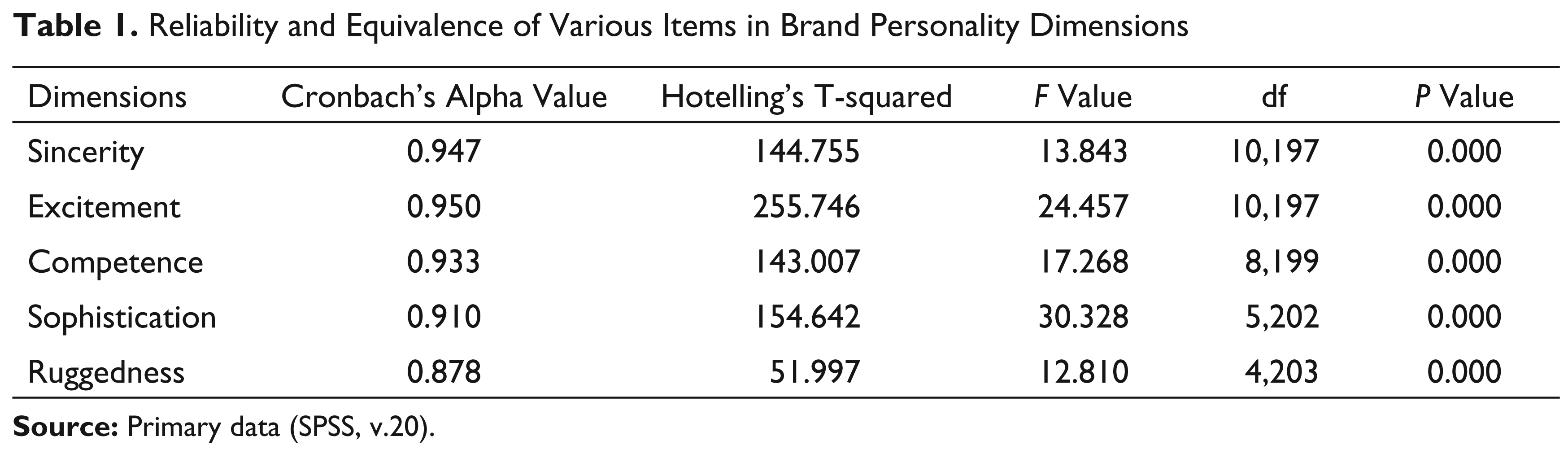
For reliability (Nunnally, 1978) of the data, reliability test has been run. From Tables 1 and 2, the data obtained from the respondents are reliable (Cronbach’s alpha value greater than 0.8 for all the dimensions).
Data Analysis
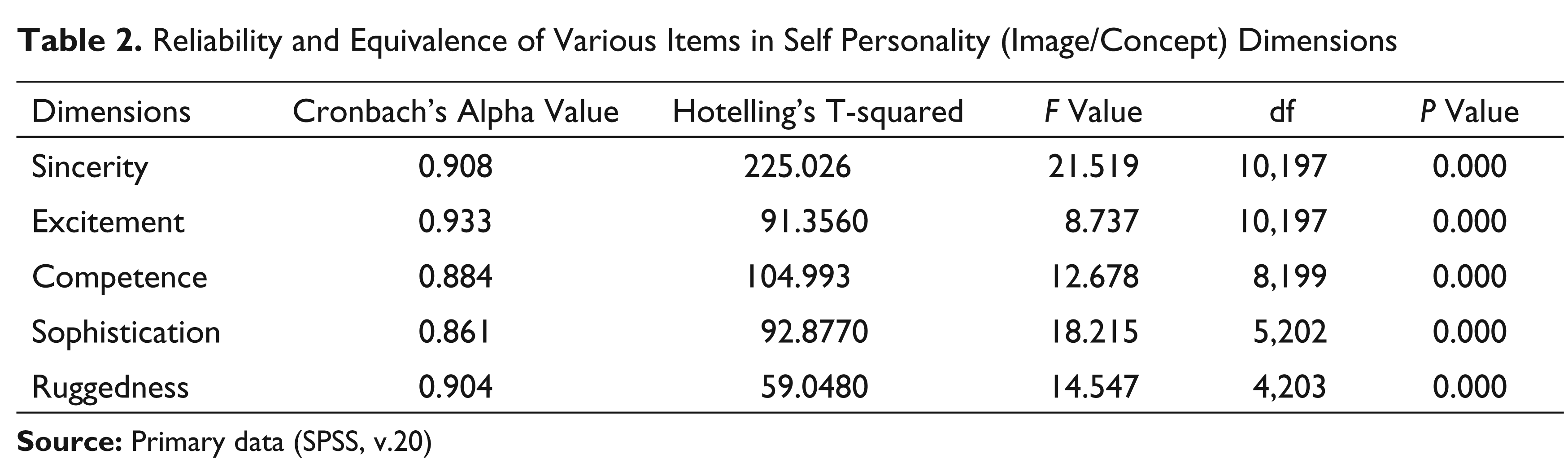
There are total 207 respondents, out of which 127 (61 percent) are men and 80 (39 percent) are women. Out of 207 respondents, owner of Dell are 84 (41 percent) respondents, for HP are 45 (22 percent), for Lenovo are 14 (7 percent), for Sony are 32 (15 percent), for Acer are 19 (9 percent), and for Toshiba are 13 (6 percent).
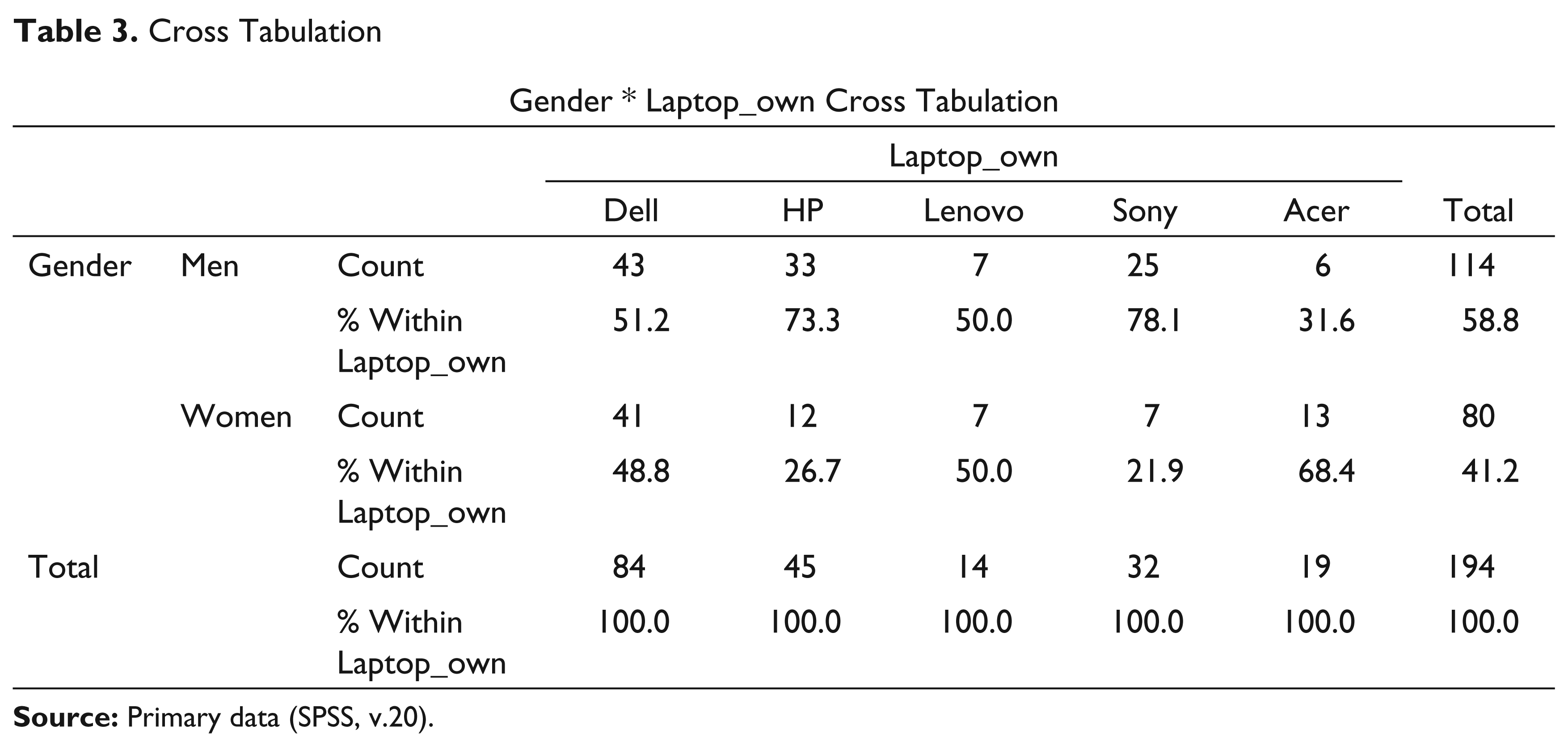
To achieve the first objective, whether there is an association between the gender and laptop own, chi-square test has been performed (Haire, 1950; Kothari, 1985; Malhotra, 2000). In cross tabulation, one cell value has count less than 5. Chi-square test should not be performed (as for Toshiba laptop there are no women respondents). So without Toshiba laptop respondents again the chi-square has been performed.
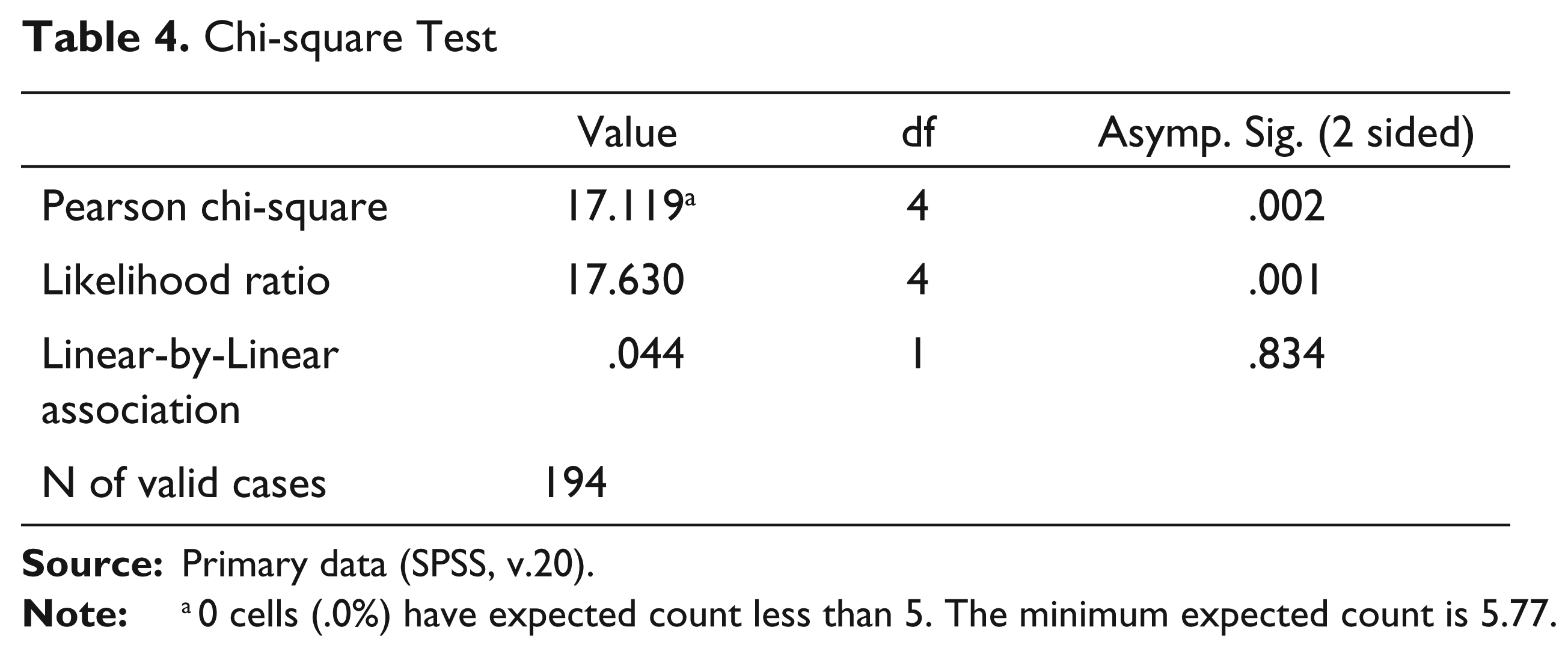
In Table 3 all the cell values are more than 5. Table 4 indicated significance value 0.002 which is less than 0.01 so null hypothesis is rejected. So we can say that there is an association between the gender of the respondents and the laptop own by them.
Reliability and Equivalence of Various Items in Brand Personality Dimensions
Reliability and Equivalence of Various Items in Self Personality (Image/Concept) Dimensions
Cross Tabulation
Chi-square Test
To identify brand personality and self congruence among the respondents, correlation analysis has been performed.
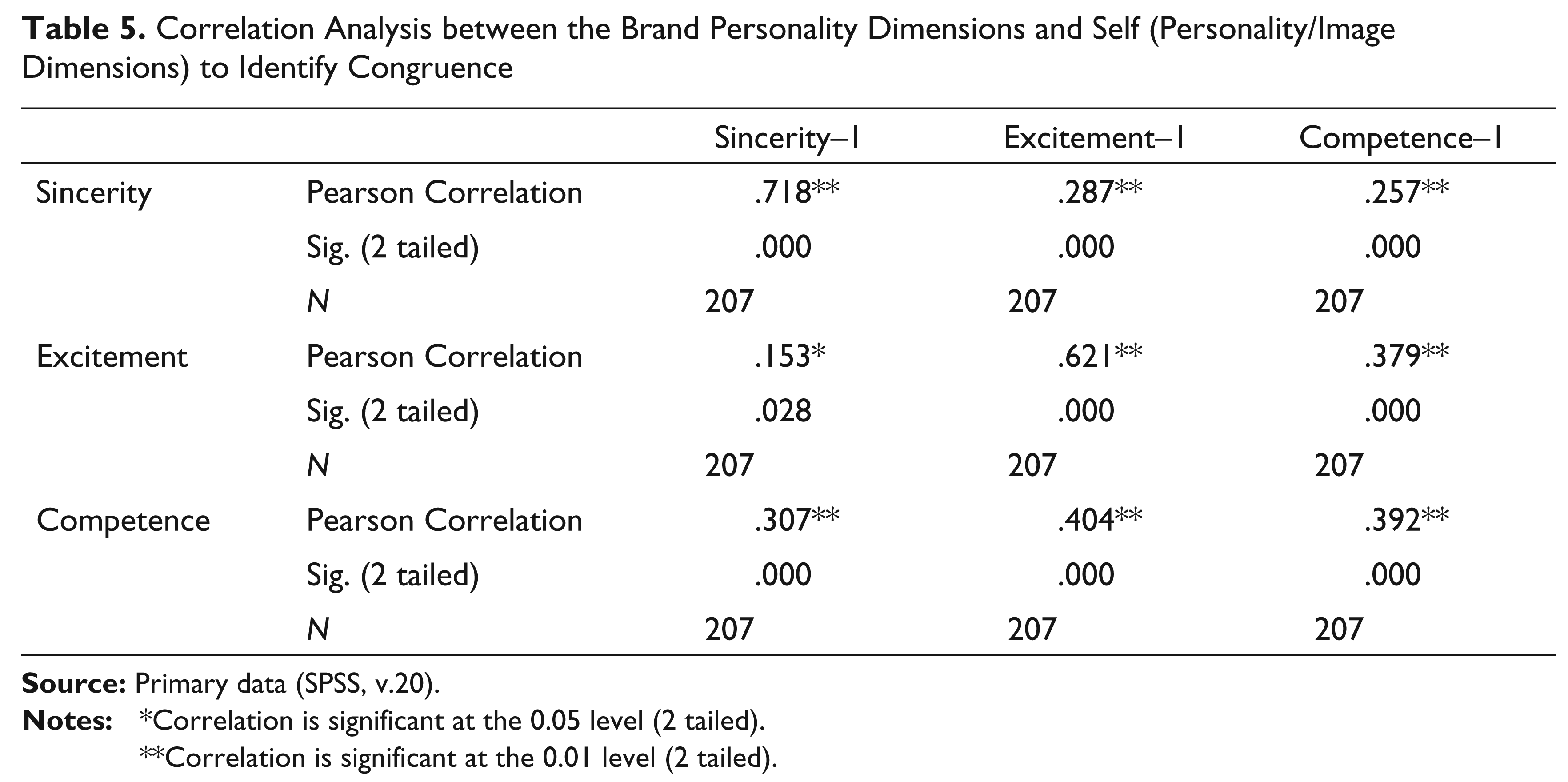
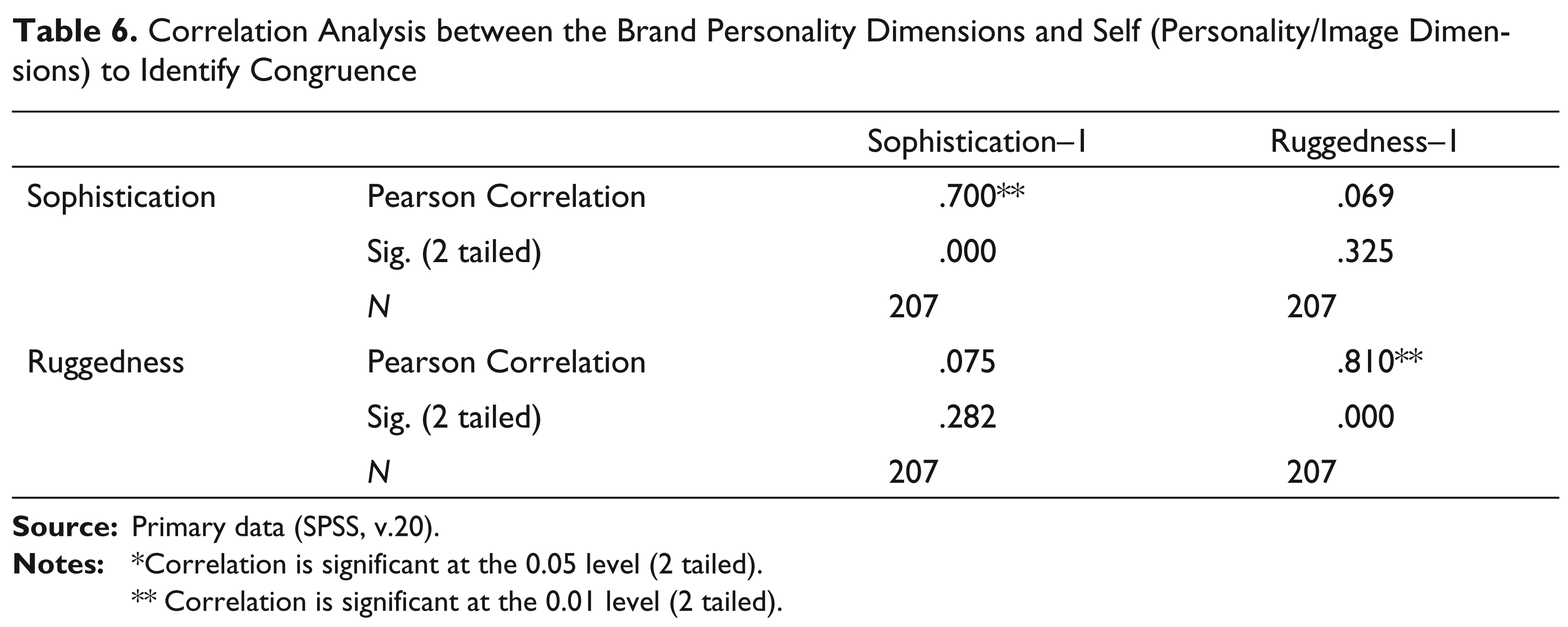
Tables 5 and 6 are the outcome of correlation analysis where for brand personality dimension (sincerity, excitement, competence, sophistication, and ruggedness) and self personality dimension (sincerity–1, excitement–1, competence–1, sophistication–1, and ruggedness–1) the values of Pearson correlation coefficients and significance values have been generated by SPSS version 20. For all the dimension significance values are less than 0.01, so the null hypothesis has been rejected. So, for all the dimension there is the significant correlation between the laptop brand personality and one’s own self personality. Also correlation coefficients explain strong positive correlation coefficient between the brand personality and self personality. While only for one dimension (competence) it shows weak correlation. We can conclude from above results that people do like to buy the laptop which resembles their own self personality.
Correlation Analysis between the Brand Personality Dimensions and Self (Personality/Image Dimensions) to Identify Congruence
**Correlation is significant at the 0.01 level (2 tailed).
Correlation Analysis between the Brand Personality Dimensions and Self (Personality/Image Dimensions) to Identify Congruence
** Correlation is significant at the 0.01 level (2 tailed).
To support the above major finding brand-wise correlation analysis has been generated.
Correlation analysis for the Sony laptop brand:
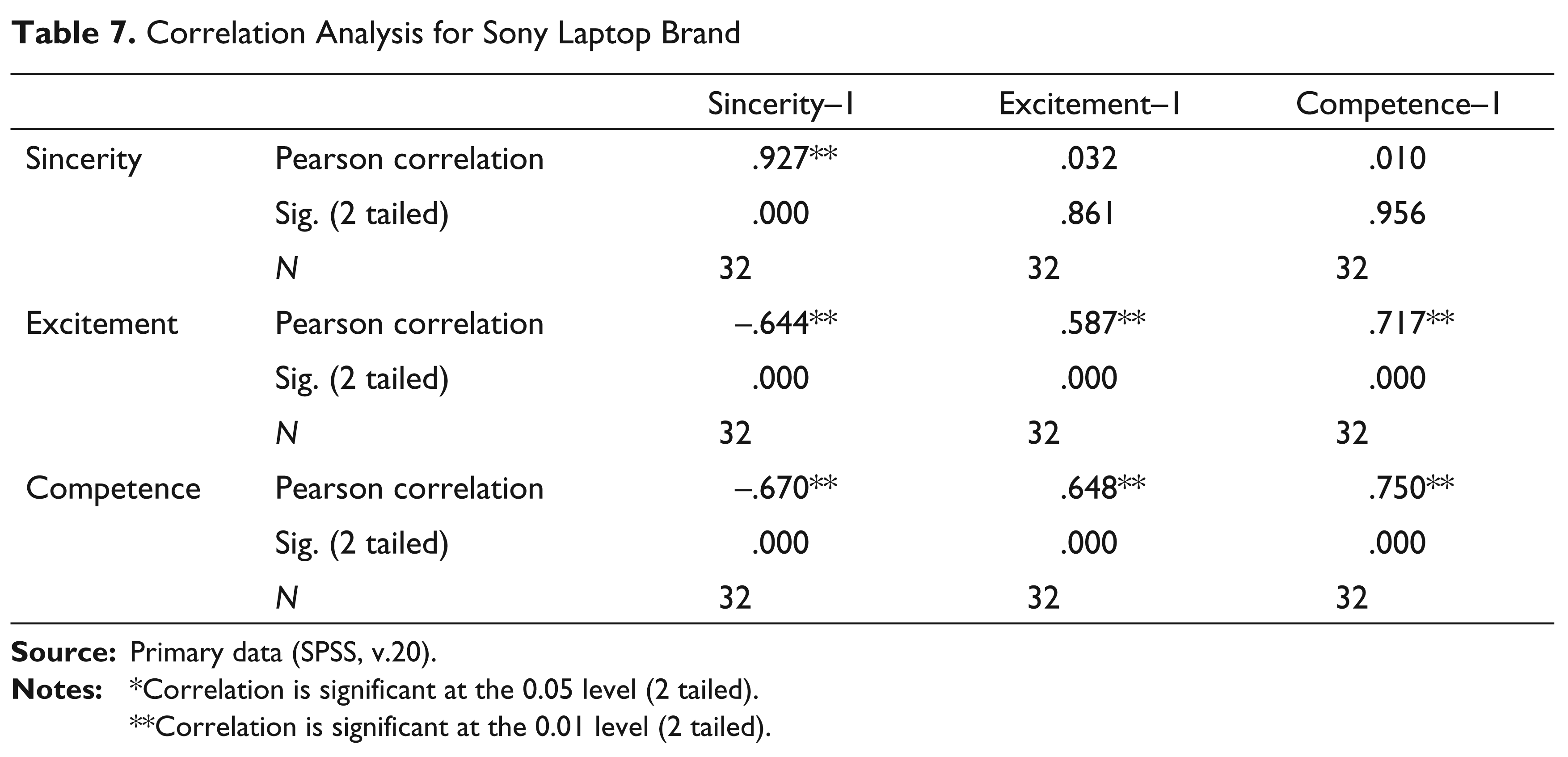
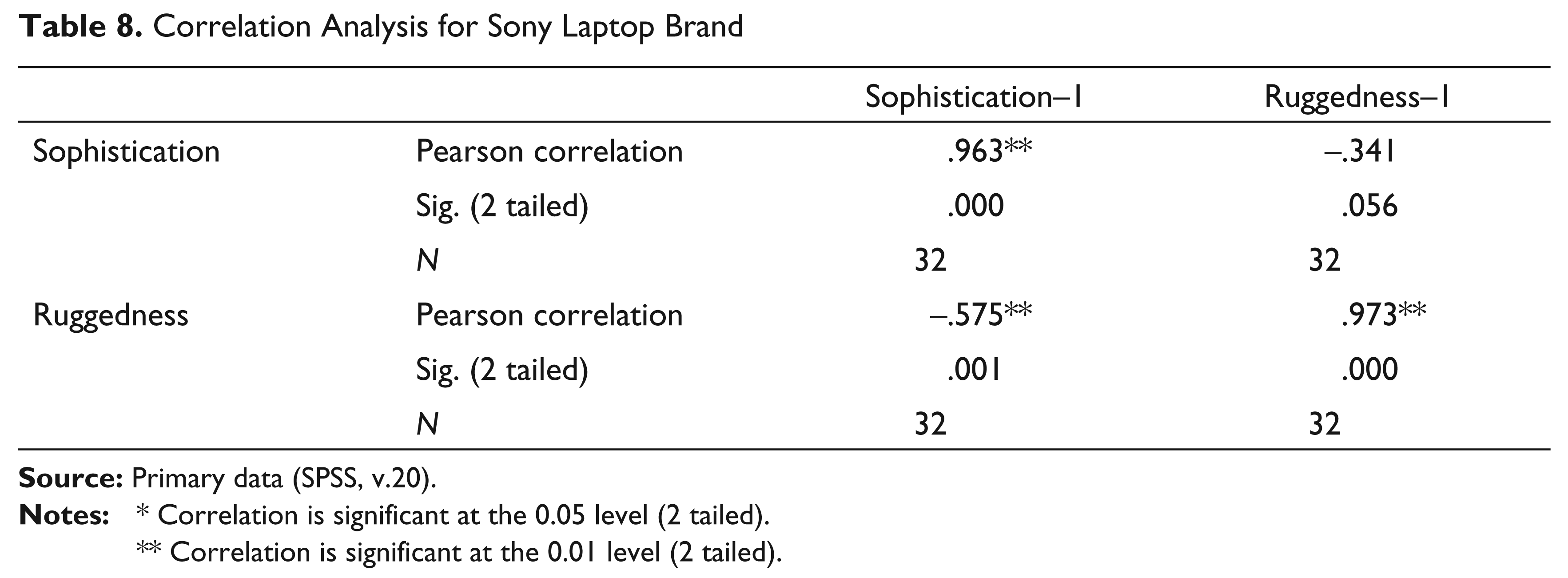
In Tables 7 and 8 for all the dimension significance values are less than 0.01, so the null hypothesis has been rejected and there is the significant correlation between the Sony laptop brand personality and the owner’s self personality. Also correlation coefficients explain strong positive correlation coefficient between the Sony brand personality and the owner’s self personality.
Correlation Analysis for Sony Laptop Brand
**Correlation is significant at the 0.01 level (2 tailed).
Correlation Analysis for Sony Laptop Brand
** Correlation is significant at the 0.01 level (2 tailed).
Like the above for all other brands correlation analysis has been performed. The results summary is shown in Table 9.
Correlation Analysis (Correlation Coefficient r) Brand-wise
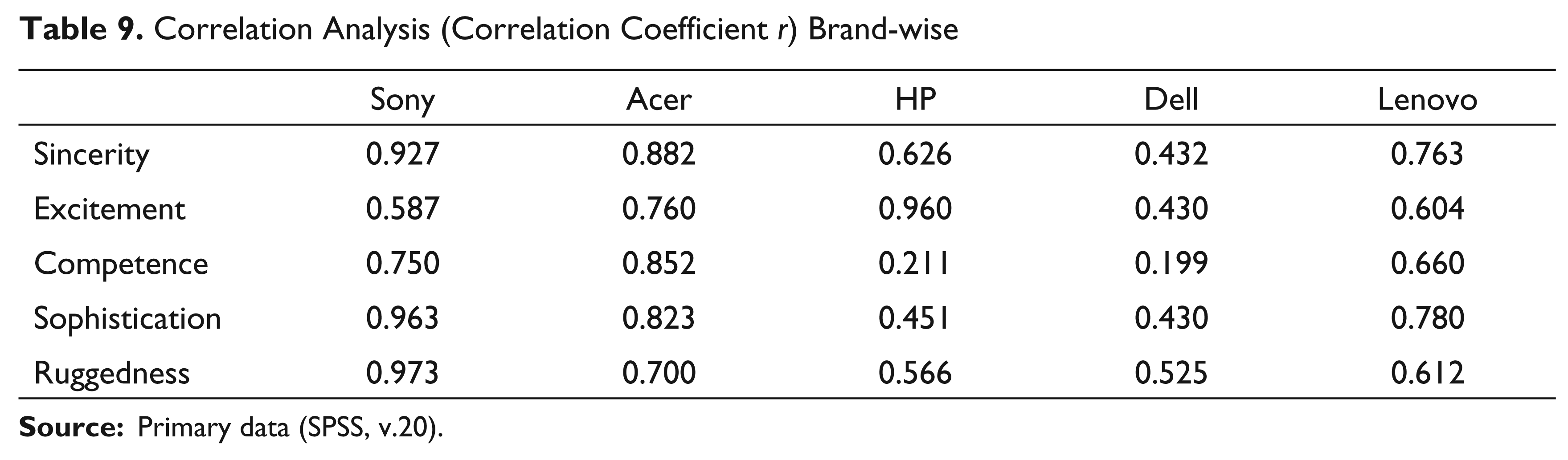
For all brands significance value (0.000) is less than 0.05, so null hypothesis is rejected except for HP and Dell for the competence dimension it is greater. So there is significant correlation between the brand personality dimensions of laptop (brand-wise) and self personality (supporting objective achieved). Correlation coefficients r which is given in Table 9 shows positive correlation. While in some cases it shows strong positive correlation.
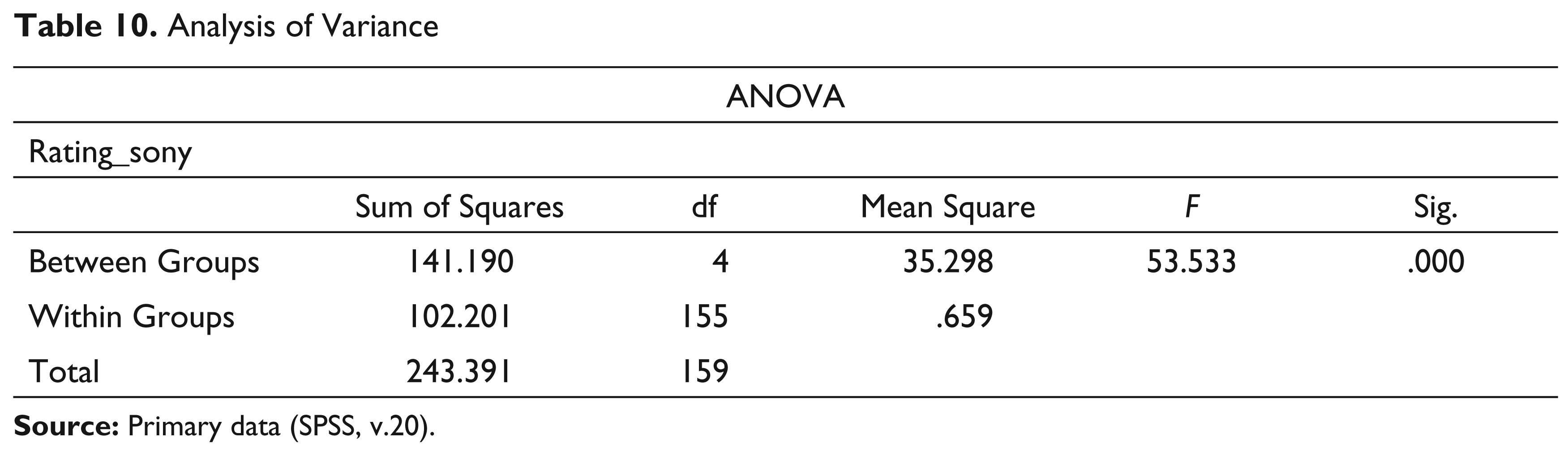
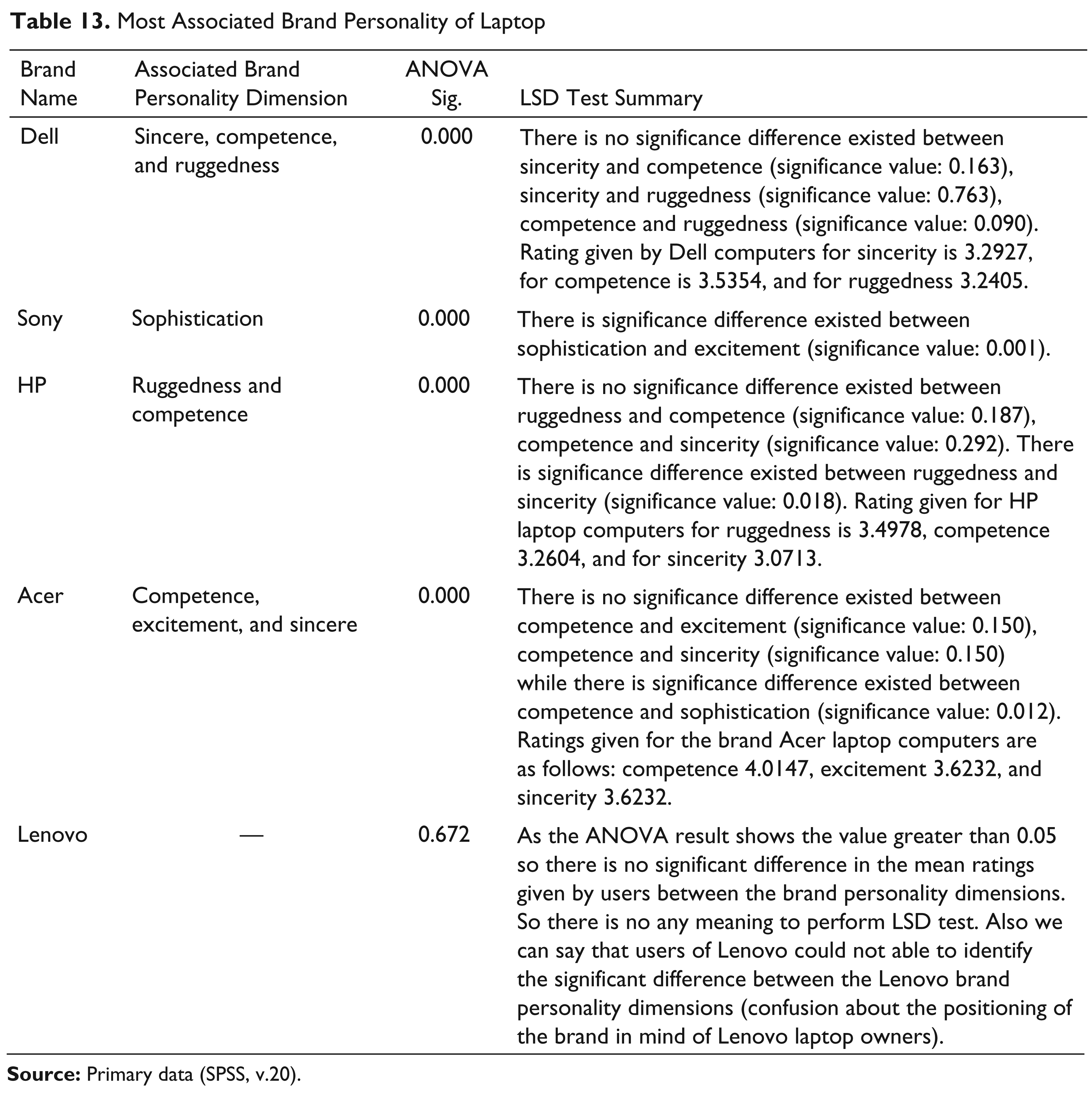
To identify the most associated personality dimension for Sony laptop analysis of variance (ANOVA) and post hoc test: LSD test has been performed. For the brand personality of Sony laptop brand results are as follows:
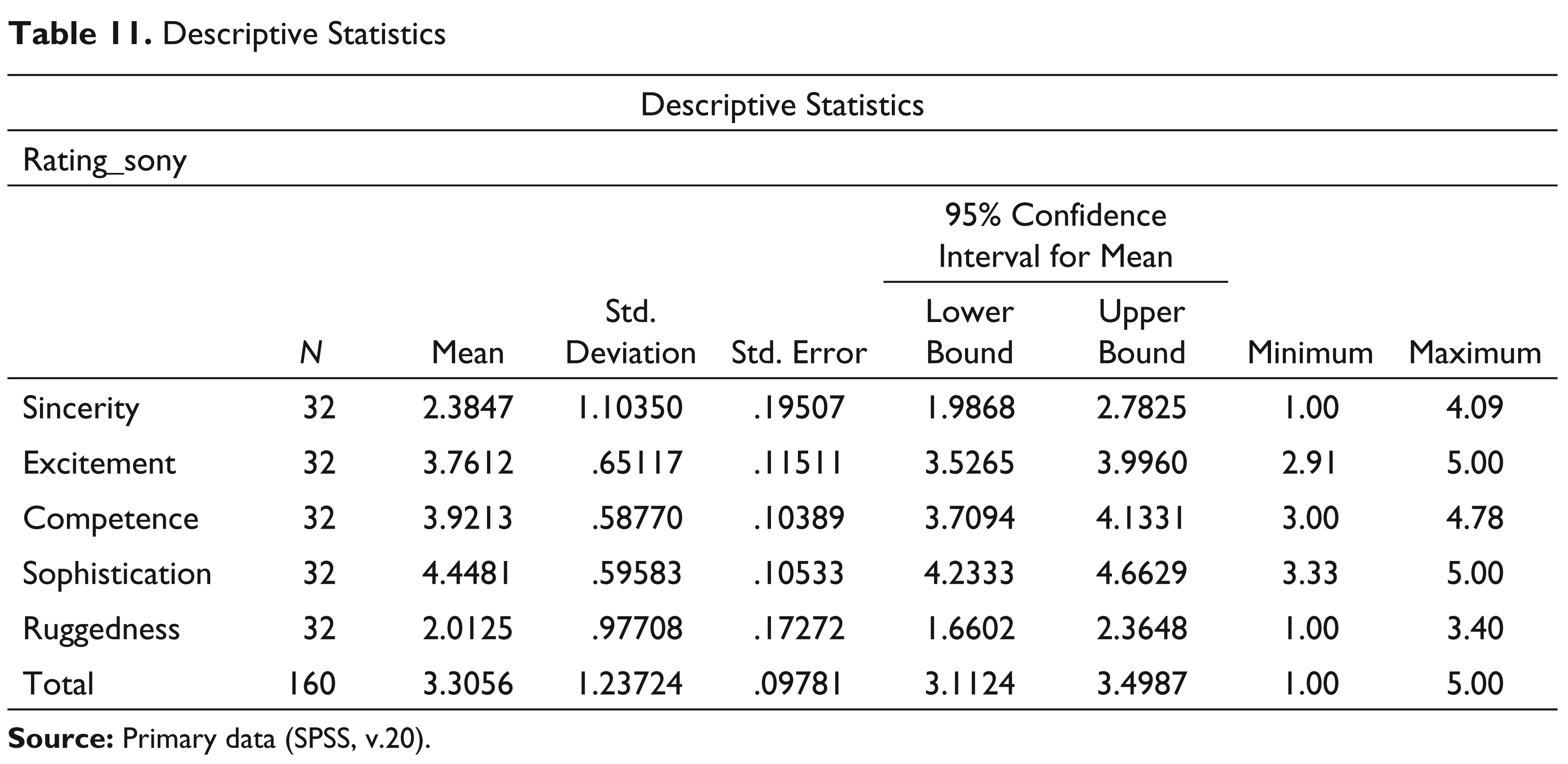
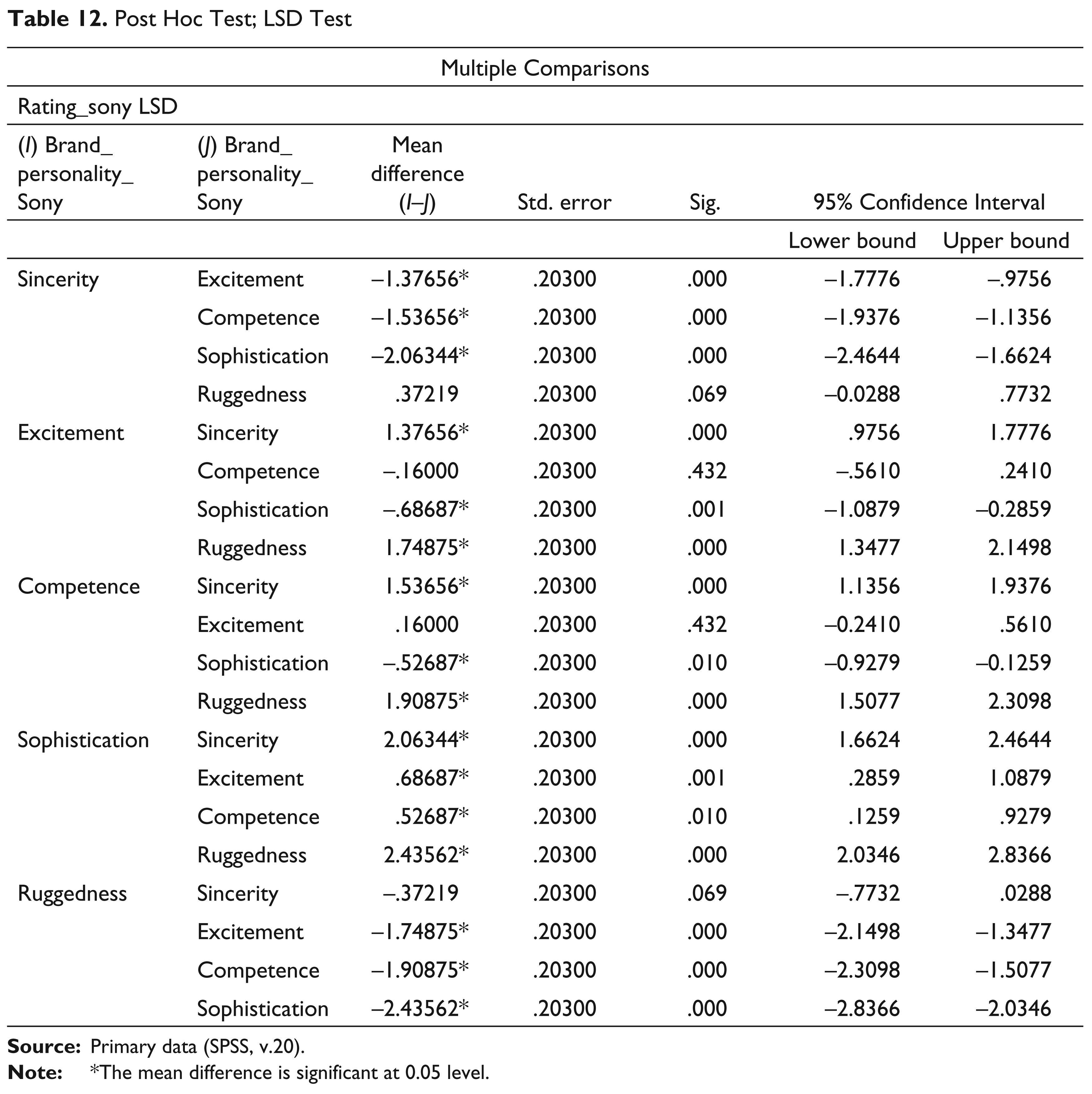
In ANOVA Table 10 significance value is 0.000 which is less than 0.01, so the null hypothesis is rejected. There is significant difference exists between the brand personality dimensions for Sony laptop brand. In Table 12 post hoc; LSD test has been performed. Which shows there is significance difference existed between sophistication and excitement (significance value: 0.001), sophistication and competence (significance value: 0.010), excitement. Also there is no significance difference existed between competence and excitement (significance value: 0.432). Mean ratings given for the brand Sony laptop computers are as follows: Sophistication, 4.4481; competence, 3.9213; and excitement, 3.7612.
Analysis of Variance
So we can conclude that most preferred/associated brand personality dimension of the Sony laptop computers is sophistication.
Descriptive Statistics
Post Hoc Test; LSD Test
Most Associated Brand Personality of Laptop
Most Associated Self Personality (Laptop Owner’s Personality) of Users
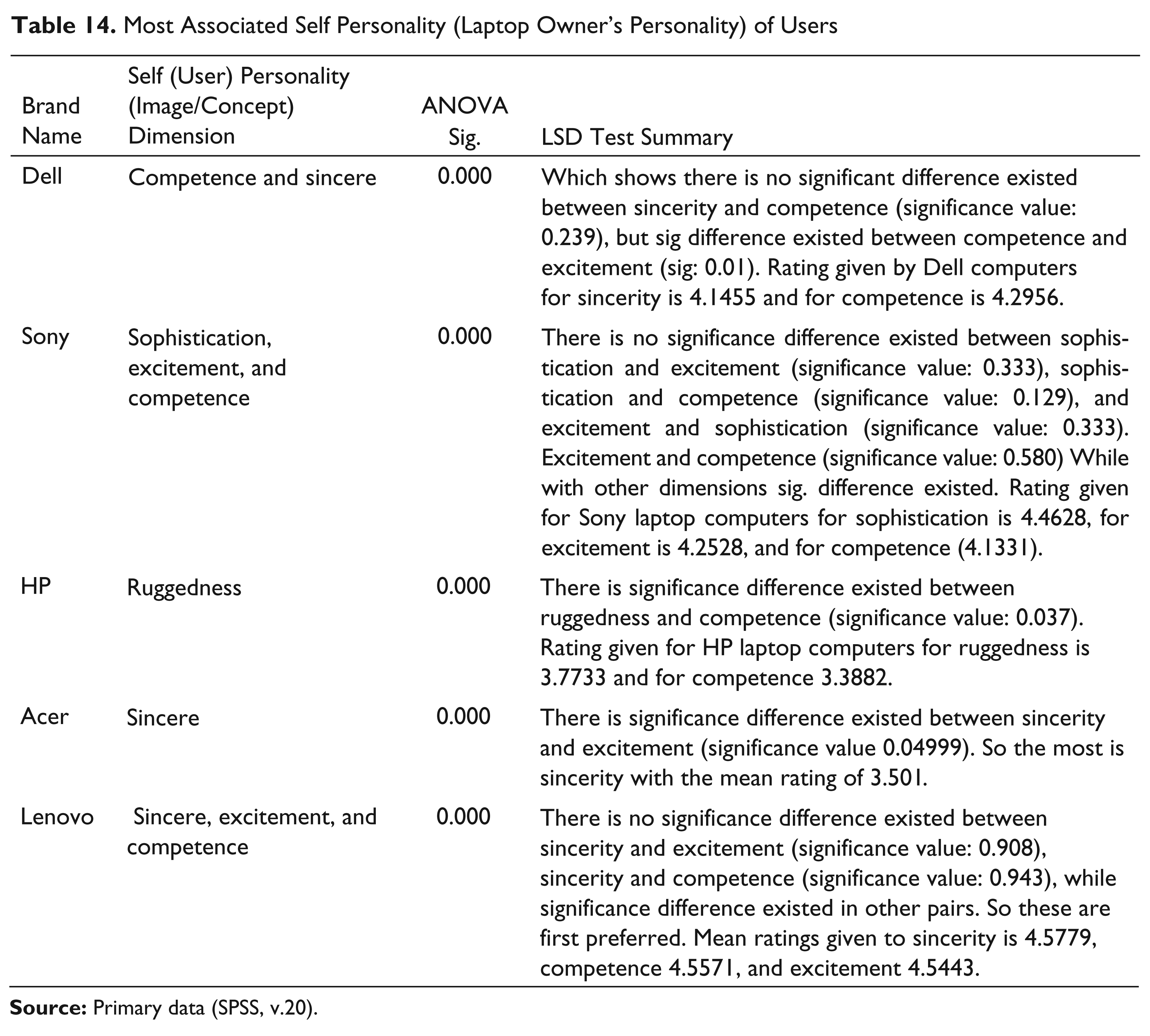
To identify the most associated dimension of personality of user (self personality) again descriptive statistics, ANOVA, and post hoc: LSD test has been performed. The summary is given in Table 14.
Major Findings and Conclusion
There is significant association between the gender of the person and laptop brand they owned
There is significant correlation exists between the laptop brand personality and one’s own self personality (refer Tables 5, 6, and 9 in data analysis).
So there is congruence between the brand personality of the laptop and self (owner of the laptop)
In case of Lenovo, the brand personality could not be extracted because the respondents are not clear about the positioning of the Lenovo brand in their mind.
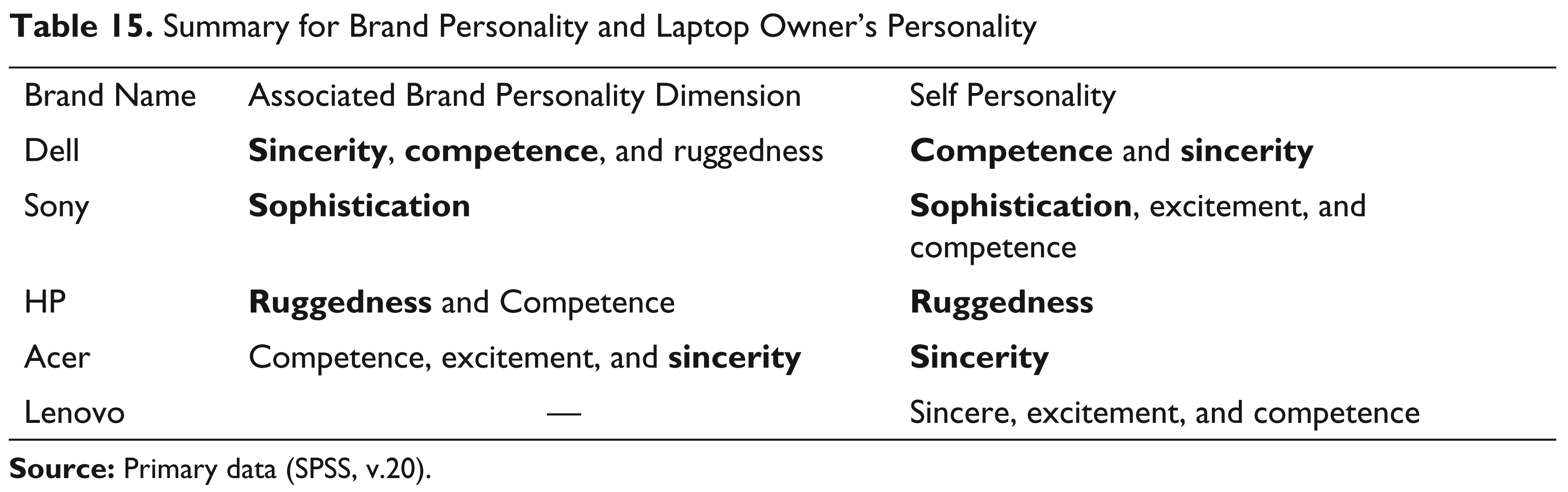
So using the scale of Aaker (1997), reference of Malhotra (1981), chi-square test, correlation analysis, ANOVA, and post hoc: LSD test (refer ‘Data Analysis’ section). We can conclude there is congruence between the brand personality of laptop and self (owner of the laptop brand) (Table 15). In other words, people would like to buy the laptop which resembles their own personality.
Summary for Brand Personality and Laptop Owner’s Personality
Limitations of the Study
Study does not include some of the laptop brand as lack of responses from the owners.