







Abstract
With the increase in diversity in the nature of job and human behavioural complicatedness, a new common phenomenon has emerged in workplaces termed as unethical pro-organisational behaviour which has succeeded to attract the attention of behavioural academicians. As a fairly new concept, there is lack of adequate research in this area of organisational psychology. The article mainly aims at discussing the motives for and the consequences of such behaviours with the help of existing literature available. The author argues that the organisations should express their intentions and actions in order to reduce such behavioural tendencies. The article is expected to help further research in this area by summarising the highlights from existing works available.
Introduction
As the competition for profit and survival among organisations is growing faster than we ever thought once, the world has witnessed a number of business scandals in last two decades. Sanlu milk mess (Duo, Chen, Lu, Li, & Wang, 2018) revealing people to melamine-tainted dairy products, Volkswagen scandal (Castille, Buckner, & Thoroughgood, 2016) of toxic emissions, Catholic churches’ child sex scandal (Castille et al., 2016), Barings bank scandal in the UK (Shaw & Liao, 2018) and Chinese hotpot scandal (Chen & Liang, 2017) of reusing the leftovers are just some highlights among many such behaviours. Many of such behavioural intentions were favourable towards the organisation where many employee argue that such were to serve for the benefit of the organisations where they work (Umphress, Bingham, & Mitchell, 2010). Umphress et al., (2010) termed such behaviour ‘Unethical Pro-organisational Behaviour’ (UPB) defined as actions that are projected to promote the effective operation of the organisation or its members (e.g., leaders, CEOs) and breach the core social values, norms, existing laws or standards of proper code of conducts (Umphress & Bingham, 2011).
Unethical behaviour or deviant organisational behaviour such as fraud, sabotage and counterproductive work behaviour in the workplaces have widely been observed as a common phenomenon (Treviño, Weaver, & Reynolds, 2006), resulting in a substantial research on this area (Xu & Lv, 2018). Such unethical behaviours were mostly observed to be self-interest of employees, whereas some studies have recognised that employees might engage in unethical behaviour for greater organisational benefits (Lee et al., 2017). For example, sales representatives hide negative information regarding the products to customers in order to increase sales. Similar pro-organisational behaviour has been termed unethical pro-organisational behaviour (UPB) having a number of ethical relationship on a societal level and may tentatively produce catastrophic consequences on organisational reputation and external stakeholders even though intended to benefit the organisation (Umphress & Bingham, 2011; Vadera & Pratt, 2013). External stakeholders are as important as internal ones (sometimes treated more important bodies such as shareholders and customers) to whom the organisation has the equal responsibility by upholding the corporate reputation and highest ethical standard. Therefore, it is imperative to discover the internal and external motives for such UPB and the factors to influence employees inducing such unethical misconducts. One of the aims of this article is to explore such motives that drive employees to UPB.
Literature Review
UPB: Brief Overview with Examples
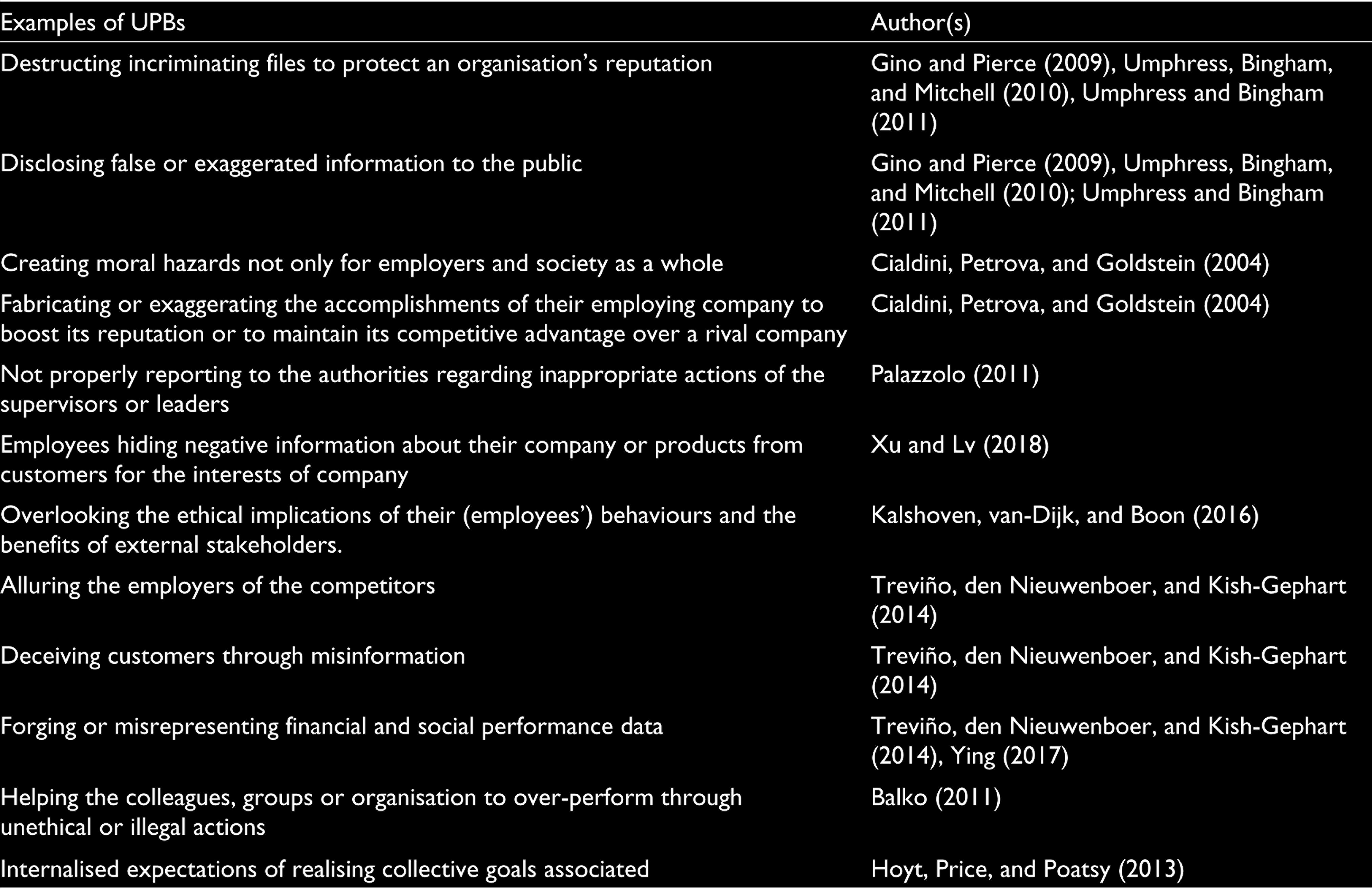
In very brief, unethical pro-organisational behaviours or UPBs are the actions that helps organisation in short term such as hiding information to the customers or tax authorities. Such actions are mostly intended to the benefit of the organisations rather than self-interest. UPB has three elements (Umphress & Bingham, 2011): (1) unethical, immoral and anti-societal actions (Jones, 1991) (2) commission (e.g., adding additional information to save or uphold the organisation) or omission (e.g., to reduce or deduct the actual information) and (3) behaviours are neither specified in formal job descriptions nor ordered by superiors, yet is carried out to benefit or help the organisation (Brief & Motowidlo, 1986). It is important to note that UPBs do not include the: actions conducted without a conscious (intentional) purpose, actions intended to benefit the organisation, while the outcomes of such actions may work contrary to its original purpose and actions which are self-interest oriented (Miao, Newman, Yu, & Xu, 2013). Although, such behaviours are intended for the sake of organisations, in the long run UPB can damage the corporate reputation, brand image and even bankruptcy (an example is the Enron scandal in the USA in 2001) (Jenkins, 2002). Some of the notable UPBs are highlighted below with academic research references in Table 1.
Examples of UPBs
What Really Motivates Employees for UPB?
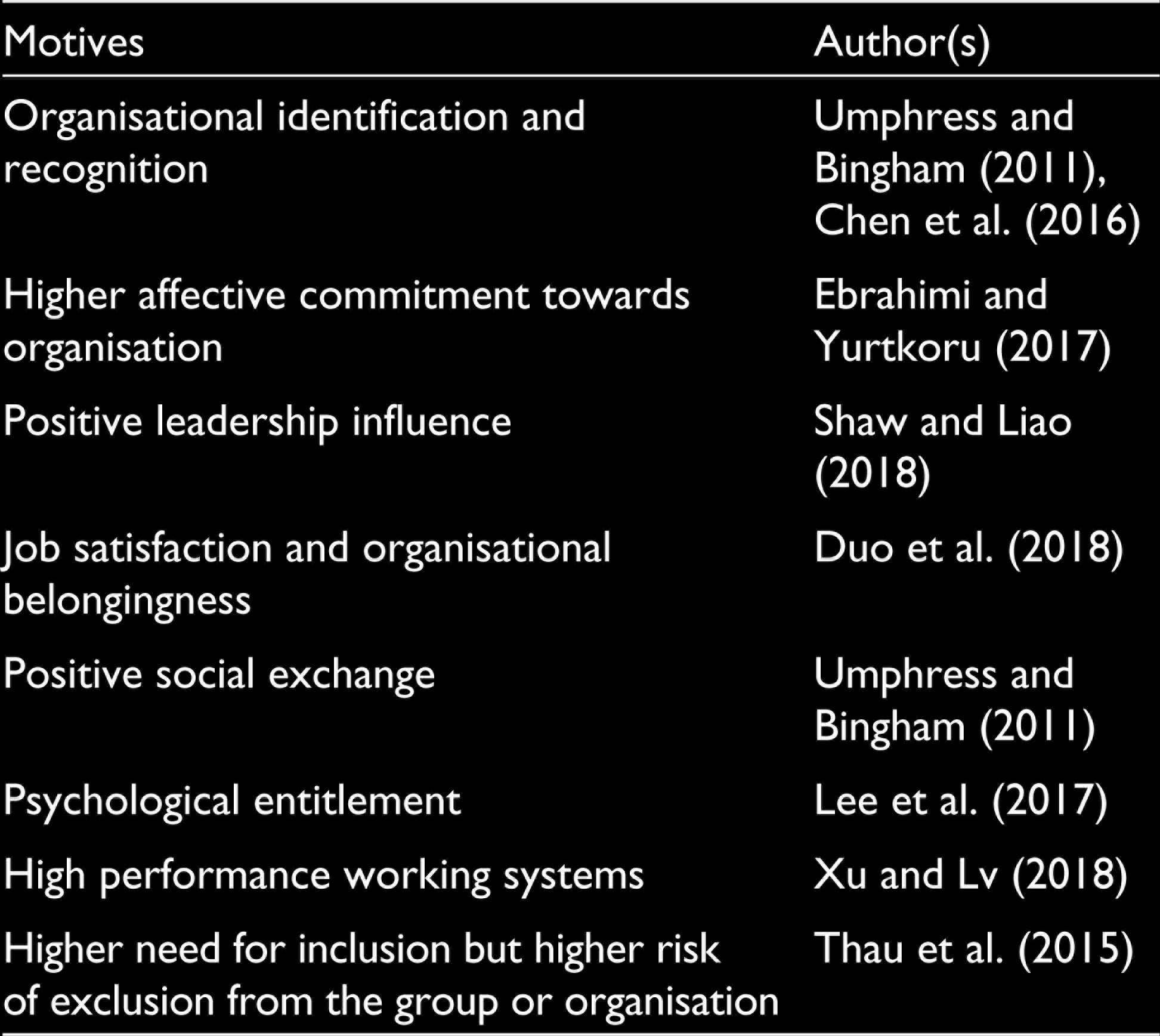
The primary assumption on idea that unethical or immoral behaviour is mainly triggered by selfish motives of employees destroying the organisation (Kish-Gephart, Harrison, & Treviño, 2010; Martin, Kish-Gephart, & Detert, 2014; Moore & Gino, 2013; Thau, Derfler-Rozin, Pitesa, Mitchell, & Pillutla, 2015; Treviño et al., 2014) aroused by individual (e.g., trait-based, cognitive, affective), interpersonal (e.g., peer, leadership) and organisation-level factors (e.g., organisational ethical infrastructures) factors. Such hypotheses of harming organisations by the employees might be understandable and easy to prove. However, in recent times, research has identified that such behaviours are linked to benefit the organisations as well (e.g., destroying incriminating files to protect an organisation’s reputation; disclosing false or exaggerated information to the public; Gino & Pierce, 2009; Umphress & Bingham, 2011; Umphress et al., 2010), creating moral hazards not only for employers, but also for society as a whole (Cialdini et al., 2004). As a result, this new aspect of organisational psychology has attracted substantial attention in recent times although there is still a paucity of research evidence. Some scholars such as Umphress et al. (2010), Gino, Ayal, and Ariely (2013), Miao et al. (2013) and May, Chang, and Shao (2015) have begun to methodically explore and hypothesise about the phenomenon of UPB (Chen, Chen, & Sheldon, 2016). In addition, a few research attempts have been made to identify the driving factors of UPB including Machiavellianism (Castille et al., 2016), organisational identification (Chen et al., 2016), psychological entitlement (Lee, Schwarz, Newman, & Legood, 2017), inter-personal level factors including transformational leadership (Effelsberg, Solga, & Gurt, 2014), ethical leadership (Miao et al., 2013) and employee-organisational relationship (Wang, Long, Zhang, & He, 2018). However, the notable motives of UPBs are summarised in Table 2.
Factors Motivating Towards UPBs
Unintended Consequences of UPB
Although UPBs are primarily intended to benefit the organisation (particularly the internal stakeholders such as management, employees, shareholders), such behaviours can not only harm the external stakeholders like local people, government, customers etc. In the long run, UPBs can even destroy the organisations by reducing the reputation sharply and even lead them towards legal sue or bankruptcy. A glaring example is the energy giant Enron scandal took place in 2001 which ultimately led to dissolve. The reasons are obvious as when the media, general public or customers know about such practices of an organisation, they usually turn against them easily. Although there are a few empirical evidences on the relationship between different organisational factors with UPBs, there is a paucity of research evidence regarding the practical impacts of UPBs on organisational performance. However, based on literature, the author attempts to note a few unintended consequences of UPB might be:
Destruction of company image to the people as a whole. Disturbing mutual harmony creating a competition for UPBs. Sacrificing competitive advantage to the competitions once UPBs are reported. Facing legal action by the government. Reduction in sales as a result of negative image. Winding up the firm.
Limitations and Further Scope
This article is a very simple theoretical paper that discusses the basic details of UPBs. More and more studies should be conducted on this specific arena as not only the identification of UPBs is important from ethical standpoint, but such actions and practices must also be spotted and stopped on an emergency basis to protect organisations from the long-term destruction. Therefore, such behaviours need to be studied in different angles, cultures and management perspectives.
Although there are a few findings regarding UPB based on empirical research, the theoretical foundations on UPB is still relatively little (Liu & Qiu, 2015). Therefore, elevating the theoretical study of the UPB and additionally illuminating the consequences that UPB may guide is the priority concern in the current study.
Conclusion
At present, ethics, corporate social responsibility and sustainable competitive advantage are the three most widely discussed issues in academia and management practices. UPBs are limited to not only personal and organisational scopes, but also greater societal aspects. It cannot be neglected that organisations themselves and the leaders (bosses) can encourage (or discourage) such behaviours to a large extent through transparent, clear policies and leadership influence. A more rigorous, cooperative and sustainable organisational culture with a strong ethical leadership and organisational influence can only reduce such behavioural tendencies. Organisations can arrange ethical training for the general employees and also discourage such behaviours. To be in general, UPBs can be largely reduced through organisational intentions and actions.
Footnotes
Declaration of Conflicting Interests
The author declared no potential conflicts of interest with respect to the research, authorship and/or publication of this article.
Funding
The author received no financial support for the research, authorship and/or publication of this article.