







Abstract
Companies are realising now that business is not only about selling products to rich consumers but also to serve the underserved bottom-of-the-pyramid (BOP) markets. Serving these customers calls for innovative methods. This had led to reinventing business models to expand the nature of their businesses from mere commercial motives to social ones as well; the understanding that businesses succeed if they go beyond their mandate of making profits. The future rests on three paradigm shifts taking place in BOP approaches: innovation, transformation of companies into social enterprises and technological advancements that bring products closer to BOP consumers. That is to say, companies today re-invent their business models and their very approach of doing business. Such companies stand a greater chance of success and long-term survival.
This article describes the concepts of social business, social entrepreneurship and social innovation. We illustrate the concepts with mini case studies or examples of several companies that have achieved innovation in products, business models or processes to serve BOP markets. We describe efforts that solve problems of consumers who are disadvantaged because of distance, education or purchasing power. If this ‘social innovation’ betters the life of consumers, it could result in sustainability and inclusive development.
The world is slowly realising that the existing business models that place importance on relentless pursuit of profits are causing immense damage to our society and environment. The objectives of business must change. Milton Friedman’s famous saying, ‘the sole purpose of a business is to generate profits for its shareholders’ is no longer accepted today as businesses find that they must cater to social objectives as well. This article describes that this can well be achieved, as illustrated by several companies who achieve both—financial profits and social good.
Drawing from examples of successful initiatives, new business models are being created that provide affordable products and services for disadvantaged consumers. We have taken elements from the business models of these companies to figure out what the future looks like. These companies, we find, found solutions through an action-oriented mindset to solve long-standing problems. Firms that embrace experimentation and rapid prototyping stand to win huge new markets and profits. They invest in distribution and training of local resources, develop innovative products and processes, involve stakeholders and above all, build a social purpose in their objectives.
Social innovation and social entrepreneurship shift the focus of governments and companies towards neglected or BOP consumers who are otherwise unapproachable. Examples of social innovation show that it touches the lives of millions of people, empowers them and leads to sustainability. Investments in social innovation that are both sustainable and socially inclusive are the need of the hour.
Introduction
Inequality is a reality in today’s world. The development process has created a very large number of people who simply do not exist for companies as they are too poor buy their products, nor do they exist for governments as they are too poor or live in distant areas. Such consumers make do with whatever resources they have available locally.
Corporate innovation is usually not targeted for this large section of the population living in rural areas or in poverty, simply because they are invisible consumers. Urban-educated managers who run companies and policy makers who advise governments are often not aware of problems faced by such consumers, even though they represent more than half of the world’s population. Such invisible consumers depend on their own ingenuity, solving problems through ‘jugaad’ — making do with local materials. Yet, problems of poor people can be solved by simple means. The most relevant innovation is one that touches the lives of people. Hence, social innovation impacts sustainability and must provide a way for social inclusion.
A business model that focuses on profit ignores more than half of the world’s population is hardly a sustainable one. In the aftermath of the coronavirus, people have lost jobs and businesses. With incomes drying up, customers find it hard to maintain their earlier standards of living. As demand gets squeezed, companies find it very difficult to meet their sales targets. Even before the virus, many companies operated in saturated urban markets and were trying to over-sell to disinterested consumers.
A new business model is thus called for, which makes profits but still solves social problems. Indeed, many companies are trying to do this globally in different ways. Others have transformed themselves to become social businesses.
Towards Social Business
The prevailing model of business is to wage a war against natural resources, encourage people to buy and consume ever newer and more products, thus generating mounds of waste in the process. A slow realisation is dawning that companies cannot continue to operate in the unsustainable ways of the past and even of the present. Not only have environmental problems of the planet multiplied over the years causing threats to its very survival, but the developmental process has neglected millions of poor which has led to unstable societies.
There is thus a rethinking about the model of capitalism that dominates world economies. Companies realise that mere pursuit of profit is not enough. Porter and Kramer (1999) wrote, ‘We are learning that the most effective way to address many of the world’s most pressing problems is to mobilize the corporate sector where both companies and society can benefit.’ Such thinking has been gaining ground over the years.
Many companies are also tweaking their business models to provide products and services that are affordable in BOP markets. This has led to the emergence of the concept of social business, which does not exist for profits alone but primarily serves social objectives. We are happy to see many businesses are modifying their business models for social inclusion. The very nature of doing business is changing and is gearing towards solving problems with simple innovations. People across the world are slowly turning towards entrepreneurial solutions that empower poor populations and solve some of the problems that plague them.
It is also increasingly being felt that while capitalism has contributed to increased wealth and better quality of life for many people, it has also caused deep negative environmental and social scars. Thus, the thinking has emerged that while companies have a legitimate objective of generating profit and its maximisation, it must also be accompanied by economic, social and environmental betterment of society. In other words, the world is heading to a more ‘humane capitalism’. Companies realise that the ‘business-as-usual’ approach—one in which natural resources are exploited ruthlessly—is creating problems of pollution and sustainability across the globe. If such development goes unchecked, we are in for great social and environmental upheavals that may well destroy the planet itself.
The re-orientation of business as a social enterprise is now recognised as essential for the future of business itself and has led to the concept of social entrepreneurship. Writing that the global economic system is under threat, Bower et al. (2011) point out in their book, Capitalism at Risk, ‘business must serve both as innovator and activist—developing corporate strategies that effect change at the community, national, and international levels’.
They argue that businesses must identify the issues that could disrupt the global market system in the coming decades and look to modifying the market capitalism system in which business must lead as an innovator and as an activist, mobilising resources to spread the innovations. All this will shape the future of business: It will depend on how companies fulfil three objectives: those of profits, sustainability and inclusive growth simultaneously. Indeed, The Economist (2019) reports that companies have overturned three decades of orthodoxy to pledge that their firms’ purpose was no longer to serve their owners alone, but customers, staff, suppliers and communities, too’. Echoing this, Reich (2016) writes in his book, Saving Capitalism, ‘we are lurching toward a capitalism so top-heavy it cannot be sustained’.
Slowly but surely the idea of ‘social business’ is taking shape, in contrast to a profit maximising one. Sabeti (2011) describes the emergence of the ‘for-benefit’ organisation that makes profits but invests in social good. Such organisations have two characteristics: a commitment to a social purpose and a reliance on earned profits. They are emerging as a whole new sector of the economy—one powerful enough to change the course of capitalism. Yunus et al. (2015) describe the emerging social business model and demonstrate how radically it differs from traditional low-cost business models: The social business generates profits like other businesses, but the profits are re-invested in the business. In that sense, social business is much more sustainable than non-profit entities, which do not have regular revenue streams and hence cannot sustain on their own for long periods of time. Social business also goes beyond the concept of corporate social responsibility (CSR), in which corporations spend on projects that help society in some ways. Social entrepreneurship goes further because social inclusion is built into their business model and is not limited to spending on a project or two.
Though the objectives of profit-making and social concerns are contradictory, many businesses have achieved them. Our research shows that companies have thrived even as they help society in some ways. The need of the hour is thus entrepreneurship that is primarily social.
Social Entrepreneurship
Social innovation is the result, very often, of social entrepreneurship. Social entrepreneurs are people whose objective is not to make money but to change the lives of poor and disadvantaged people. Martin and Osberg (2015) write that social entrepreneurs are able to develop ‘equilibrium-shifting’ solutions to problems. They target unjust systems and transform them by deploying innovative solutions that in turn lead to an entirely new and sustainable equilibrium. Bornstein (2007) shows how social entrepreneurs can change the world with new ideas. They operate like business entrepreneurs, defining their target customers first and understanding their needs. Often those needs can be satisfied by simple methods. In this way they solve long standing problems to which nobody has given any thought. Several social entrepreneurs are running sustainable businesses all over the world.
These ideas are becoming popular as private companies, NGOs and development agencies are increasingly applying BOP ideas to their initiatives. Eggers and Macmillan (2013) in their book, The Solution Revolution, explain how this is giving rise to the ‘Solution Economy’ in which individuals, businesses and sometimes governments work together to solve societal problems and also make a profit, thereby achieving social inclusion. Three crucial factors are required for its success. First are entrepreneurs who develop or fund solutions, called wave-makers. Second, technical people are required to create solutions for BOP markets. Third, innovative business models must be invented which serve poor populations and also earn profits to sustain over the long term. All three have to operate simultaneously, as shown in Figure 1. Asocial solution must therefore fulfil three requirements: a working technology, a wavemaker to help spread the idea and a business model by which the idea can be commercialised.
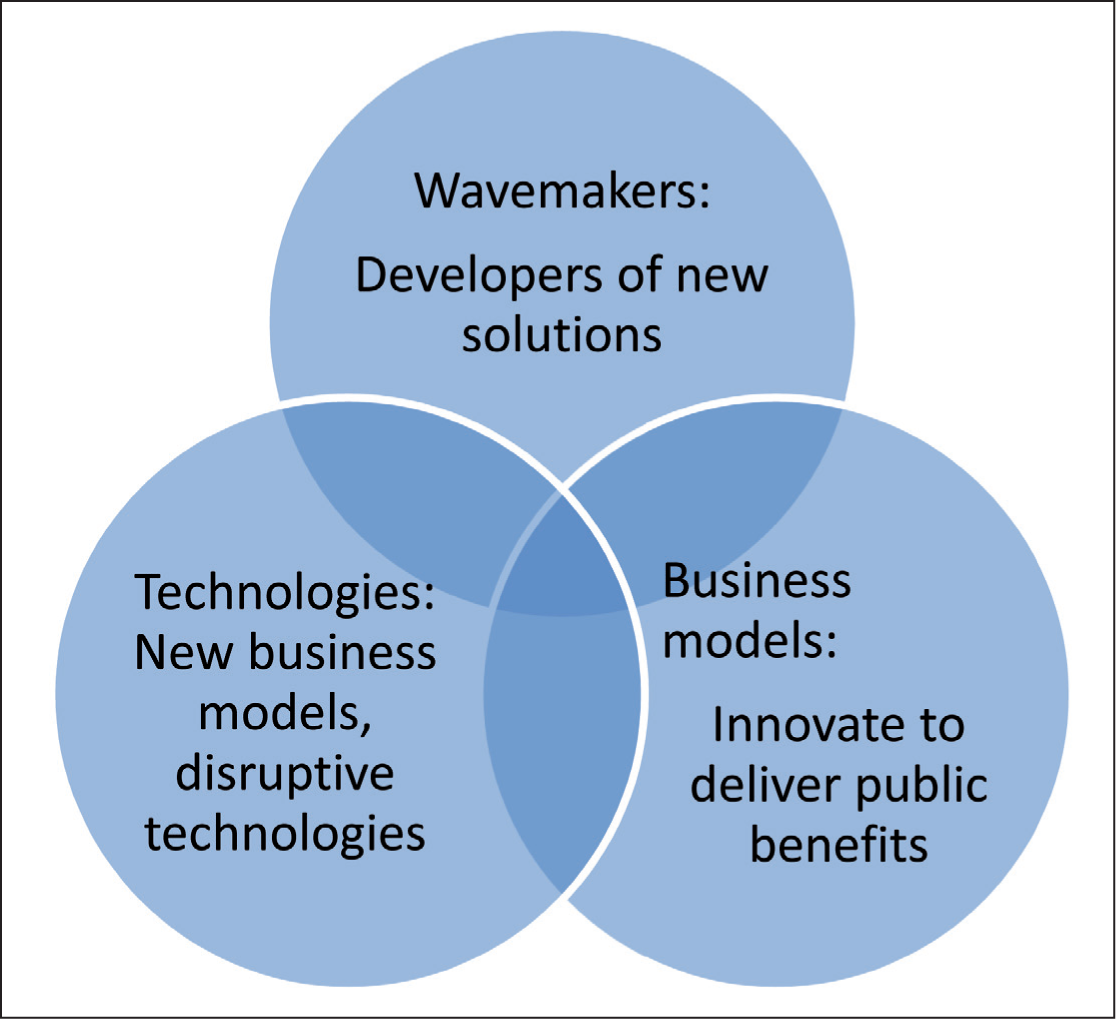
When all three are present, companies change themselves to serve larger markets. Sabeti (2011) writes that there is a blurring in boundaries between ‘for-profit’ and ‘non-profit’ models and a new model is emerging, one that ‘generates earned income but give top priority to an explicit social mission’. At heart of these models is social innovation.
Social Innovation
Social innovation is ‘the practice of using creativity to develop solutions which improve the well-being of people and society’, as defined by Young Social Innovators. 1 The Stanford Social Innovation Review (Phills et al., 2008) adds sustainability to its definition and says that social innovation is any novel and useful solution to a social need or problem that is more effective, efficient, sustainable or just than existing solutions and for which the value created accrues primarily to society as a whole rather than private individuals. It is recognised that ‘social innovation is the best construct for understanding—and producing—lasting social change’, and that is what makes it very important.
Social innovation works for the poor. It consists of developing low-cost solutions for local problems, applying new ideas that help in meeting social goals. These objectives appear to be in conflict with the profit-making objective of commercial companies, but while researching for our book, Rural Marketing (Kumar & Gupta, 2017), we found that several companies have succeeded in doing that—they have adopted unique and innovative approaches to bring about inclusion of the poor and the disadvantaged while also making profits. In each case, problems of the poor and the disadvantaged have been addressed. A little empowerment goes a long way, and when consumers are empowered, they automatically become consumers and become part of the developmental process whereas they were neglected earlier.
The most powerful example of social innovation is that of Grameen Bank in Bangladesh. Its business model inverted traditional banking on its head by giving small loans to people who could not approach banks as they could not provide guarantees. Later, it introduced mobile phones in villages by working out innovative solutions. Its joint venture with Danone provides an affordable milk preparation to meet the nutritional needs of poor children. But the most important contribution of Grameen Bank is in making poor people self-reliant. By giving small loans, it helped thousands of people to start small businesses. Related gains have been made in education and public health by this intervention.
Many other companies are contributing to society in their own ways. Essilor worked out a model in which reading glasses could be provided to people at low cost in rural areas—to people who lacked the means to either get their eyes tested or who could not afford the glasses. Warby Parker gives a pair of glasses to a needy person for every pair of glasses that it sells: its website says, ‘five million pairs of glasses have been distributed through our Buy a Pair, Give a Pair program’. 2 Providing glasses to the poor in remote villages helped them get back to being economically productive activities.
In India, Hindustan Unilever has helped village women set up small businesses to distribute its products. The company devised a unique scheme that trained village women, thus providing them a way to earn an income. Its Project Shakti employed women as Rural Sales Promoters who are coached as Shakti entrepreneurs by teaching them about the company’s products, running a small business and enhancing their soft skills. The company’s website says that it works with nearly 1.20 lakh women micro-entrepreneurs across 18 states. ‘Project Shakti has helped generate income by selling our products and has created a great impact on the livelihoods of women’, it says, showing how a company can employ its own customers in the sales process.
These and other examples show that social entrepreneurship and innovation is spreading in countries around the globe. Café Feminino in Peru ensures inclusion by helping women coffee producers get a fair price for their produce and even offers loans for rural betterment. In France, Renault promises to repair cars of poor customers at nominal cost in its ‘solidarity garages’. 3 Its Mobilize Social Entrepreneurship program invests in projects with high social impact and provides ‘socially responsible mobility solutions with an innovative entrepreneurial approach’. In China, Alibaba created production hubs called taobao village clusters which have been instrumental in creating jobs and growth in remote areas. In India, Amul built cooperatives of milk farmers, made them owners of the company and ushered in a ‘white revolution’. Jain Irrigation educates farmers about irrigation practices and helps increase their incomes. In all these cases, companies have succeeded in using social entrepreneurship to solve local problems and to build business models that incorporate social inclusion with commercial profits.
We see from the initiatives of these companies that social innovation is an idea that mere selling of goods is not enough, but companies have to rise to solve some local problems. As Anderson and Markides (2007) explain, it is not about creating new product features but adapting existing products to customers who have fewer resources or a different cultural background. It is about establishing basic market ingredients such as distribution channels and customer demand from the ground up. While such initiatives help in social inclusion, companies too benefit as they are able to sell to a larger market.
These initiatives also show that innovation is slowly turning towards solving long standing problems of the poor. An interesting observation is made by Gupta (2012), who writes that though cell phones are used around the world, an application to use the phone as switching device for a tube well was developed by a school dropout.
Social innovation consists of:
Developing cheaper products that are affordable through better efficiencies or re-engineering Solving long standing problems faced by poor people through simple innovations Building innovative supply chains that help reach BOP consumers
BOP markets require innovation that is frugal, and this is the challenge that products must meet. Social entrepreneurs use locally available materials to invent solutions. Frugal innovation reduces not just the financial cost of doing business but also its environmental cost. An example of frugal innovation is shown in Figure 2: A water heater that does not require electricity. Freely available crop residues, twigs and dried grass are used in these heaters to get warm water without dependence on electricity. This device can be seen operating in India’s villages, more so in remote regions where electricity supply is not regular. Such a water geyser not only reduces dependence on electricity but also minimises operating cost, which is a boon for poor people.

Carlos Ghosn, former CEO of Renault-Nissan termed such innovation as ‘frugal engineering’. Radjou et al. (2012) write that frugal innovation describes the ability to innovate quickly and at low cost under severe resource constraints. Such innovation is not only cheap and simple but helps large sections of the society and therefore achieves inclusion of hitherto neglected populations.
Social innovation leads to inclusion. It changes lives of the poor and those living in rural areas. Consider the following, simple innovations:
Motorcycle plough: A plough attached to a motorcycle that is used by farmers, reducing their burden and lowering cost. The simple solution uses the chassis and power of a motorcycle in front, fitted with an attachment with two wheels at the rear with a tool bar to fit various implements that help in ploughing, weeding and sowing seeds. Clay refrigerator: A refrigerator called MittiCool, which is a low cost, biodegradable refrigerator made out of clay. It requires limited capital and is made with locally available materials. Metal headstand for carrying water: Women in villages have to carry water over large distances in water-scarce regions. A simple solution is a light metal stand that is attached to the shoulder of a person so that the weight of the water container does not rest on one’s neck. Bicycle sprayer: An attachment to a bicycle which uses the movement of the cycle to move the piston of a spray pump to spray pesticides on farms. Similarly, for farmers who cannot afford bullock or tractor, a weeding device attached to a bicycle helps in weeding farms, reducing their labour considerably.
These are examples of frugal solutions: low-cost innovations that actually solve real problems. Traditional research done in labs and research institutes is simply not able to recognise or understand these problems or develop solutions to them. That is why companies have to work in close connect with grassroots inventors to find products that have immediate relevance in rural markets.
When businesses invest in social innovation and make it widely available, re-investing their profits, they move a step towards becoming a social business.
Social Business
When companies change their business models for social needs, they are able to make a large difference. Hart and Milstein (2003) write that companies like Johnson & Johnson, Dow, DuPont, Coca-Cola and Procter & Gamble are beginning to take steps to understand how to leverage their skills and resources to meet the basic needs of the poor. Earlier, people were merely seen by companies as consumers of their products. Sustainable futures, however, depend on working with local communities and solving their problems. These interventions help in developing technologies and products to meet the needs of poor people. This is illustrated by several case studies.
Case Studies of Social Entrepreneurship
Though social and profit objectives are mutually opposing, many companies have tweaked their business models so as to achieve both. We have studied several companies that have gone beyond their business objectives to innovate processes and business practices that have had a far greater impact on society than traditional CSR. This section describes a few such companies that have achieved innovation in products, business models or processes to serve BOP markets.
Grameen Danone: This case study describes French multinational Danone’s initiatives to address the needs of low-income populations from emerging countries and how it transformed itself in the process into a social business.
Danone had realised by the 1990s that business had a larger objective than to supply products to rich consumers in developed countries. The European understanding of ‘social’ meant that it should treat its employees well. Franck Riboud, the chairman and CEO of Groupe Danone, went beyond that understanding. He is quoted by Yunus (2007) in his book, Creating a World Without Poverty: ‘We don’t want to sell our products only to the well-off people in those countries. We would like to find ways to help feed the poor. It is part of our company’s historic commitment to being socially innovative and progressive, which dates back thirty-five years to the work of my father, Antoine Riboud’.
Grameen Danone Food Limited was formed as a joint venture between Danone and the Grameen Group in Bangladesh, to produce affordable nutrition for poor children. It started producing shokti doi, a traditional Bengali preparation of yogurt, and sold it in affordable packs. The product is aimed to provide the malnutrition needs in children, but the company generates several social benefits as well. Its website says that it helps small local farmers by buying their milk. The product is distributed by ‘Grameen Ladies’ and thus generates employment for them. The venture has had a wide impact. It helps ‘300,000 children in Bangladesh, has created sustainable revenues for 500 farmers, 200 ‘Grameen ladies’ and 117 van pullers’, according to its website (2020).
Grameen Danone obtained the B Corp certification in 2018, which shows ‘that a firm is following a fundamentally different governance philosophy than a traditional shareholder-centered corporation’, write Kim et al. (2016).
Such businesses go much beyond contributing to CSR. Grameen Danone has reinvented the company’s entire value chain to meets its social mission. The company has a no-loss operation, and all profits are reinvested in the business. Antoine Riboud had understood in 1994: ‘There will not be sustainable economic value creation if there is no personal development and human value creation at the same time’. Businesses are slowly developing models that invest in human development as opposed to mere economic development.
Philips—Philanthropy by design: Another example of social innovation is that of Philips, which developed stoves for the poor using its design capabilities. Many households in rural areas rely on clay stoves [chulhas] for their cooking, burning wood or cow-dung patties in them. This results in exposing families to health risks as they inhale smoke while cooking.
In 2005, Philips held a workshop, ‘A Sustainable Design Vision—Design for Sense & Simplicity’, with the aim of envisioning products and services for helping the community. 4 Some 80 design ideas emerged. These were screened for their alignment with company objectives, social investment policy, technological feasibility and UN’s Millennium Development Goals. The approach is called Philanthropy by Design, and leverages on design creativity to provide meaningful solutions for the more fragile categories of society. It works both ways—it helps people living at very low income, but it is also profitable.
The company developed a smokeless wood-burning stove, which is simple to use and maintain.
It is made from easily available concrete coated with local clay. The fumes are carried out by easily assembled chimney pipes. This simple and cheap solution reduces indoor pollution and makes the task of cooking easier. It also solves the problem of inhaling smoke due to cooking on open chulhas. The design was made available free, which made it easy for adoption by village folk. The use of local components means that it can achieve widespread acceptance and distribution. Details of the stove’s design and marketing information were made available for easy installation.
Compared to traditional cooking fires the new design reduces indoor smoke pollution by up to 90%. Philips explains that ‘Philips Foundation and Ashoka are cooperating in a multi-year program to accelerate access to healthcare around the world by connecting social entrepreneurship with industry skills and exploring collaborative action between Philips Foundation and Ashoka Fellows’.
Arzu—A social contract: Arzu was started by Connie Duckworth in Afghanistan. She visited the country as part of a US delegation to improve the lives of women there. She saw village women working on making trinkets and rugs, often employing child labour. The sales were conducted by middlemen or agents, who could sell the rugs at high prices in the USA, but the village folk got none of the profits. To get over this problem, Duckworth established Arzu (Hope), a responsible, sustainable business that employs adults and treats them humanely.
The model followed by Arzu resembles that of Fabindia, a company that sources apparel and other products from villages while ensuring that all its suppliers get paid well. Fabindia runs a chain of very successful stores and has made ethnic wear popular in India. Fabindia remains a model for village production of high-quality fashion products with a social conscience.
Arzu built the supply chain to make carpets and rugs. It buys the wool and helps village women make rugs acceptable in developed markets. Design thinking was used to understanding the lives of the women artisans. In traditional Afghanistan, pregnant women cannot get access to medical care because they cannot leave home without a female companion. Transportation was also lacking. Arzu got involved and introduced a ‘social contract’ with male heads of household that would let women to be employed in carpet making. Under the contract, the families of women workers had to agree to send their children, including girls, to school. It also had a provision to let adult women to attend literacy classes. They were also to transport pregnant women to a clinic if the need arose.
In this way, the profits from selling the carpets in the USA were deployed in providing good wages for the workers, as well as education, healthcare, clean water and sustainable community development programs. Weavers were recruited by a programme of intensive, house-to-house outreach. Tribal elders were consulted in every village and permission obtained for recruiting women workers. It was a win-win situation, since the workers were paid a salary for the work, and an additional bonus for high-quality work. Payments were made in time. Earlier, the workers were exploited because agents would delay payments for months. Once women workers started getting good and timely payments, more people started joining. The word spread, which helped in recruiting more women workers with permission from their families.
The social impact of Arzu has been considerable, transforming lives of many poor women. It too is a powerful example of social innovation and inclusion. Many women in the country are widows and are desperately poor. By removing the middlemen, Arzu has been able to provide weavers with a fair wage and a respectable career. The workers have also gained in literacy in a country where 90% of rural Afghan women are illiterate. Childbirth deaths have also reduced dramatically among its workers.
Riders for Health International: Just as any business knows about their customers’ needs and develops systems to serve those needs, social entrepreneurs have to know their target populations and the environment in which they exist. An example of social entrepreneurship in Africa is that of Riders for Health. Africa is a continent that lags on most parameters of health delivery. Infrastructure is decrepit, and health services suffer as it is not possible to transport available medicines, people and equipment to areas where they are needed. As a consequence, communities are not able to get health care even though people suffer. But most aid agencies and global organisations focus on eradication of disease, not on service delivery. A couple of motorcycle race enthusiasts recognised that the problem lay in transportation of medicines and equipment to areas where they were needed most. Transportation was in a shambles but remained vital in providing health services in remote areas.
Andrea and Barry Coleman saw an opportunity where others could not. They saw that the gap in delivery could be plugged by developing cheap transportation systems that could help in taking health-care delivery where it was needed the most. Riders for Health expanded to provide transportation systems for health in seven countries in sub-Saharan Africa.
Riders for Health set up a service to replace broken down trucks. Its website describes that it helped in transportation of medicines, people and equipment in remote Africa, often using motorcycles by providing fleet management services. The organisation partners with health ministries of African countries and takes up contracts to manage their vehicles. They suggest the right vehicles, such as ambulances for transporting patients to motorcycles to transport health workers, samples and supplies to health centres. Riders for Health is an example of social entrepreneurship that manages the partner’s fleet, providing preventive maintenance and driver training. Regular scheduled maintenance on health-care delivery vehicles is taken up, keeping fleets healthy and avoiding breakdowns. Maintenance is done where the vehicles are rather than in a service station, which helps reduce downtime. Training is provided to health workers on how to operate their vehicles and to conduct basic maintenance such as checking oil levels, tyre pressure, lights, and so son. In this way, Riders for Health is able to help fleets achieve reliability with the lowest cost. Just by tweaking the transportation, the entire health care system has been made more effective.
With their intervention, the Colemans helped haemorrhaging women to be transported in ambulances rather than in wheelbarrows; health workers who earlier had to walk twenty or more miles; and repaired countless abandoned vehicles in a country that needed them most.
The Riders for Health case shows that often large problems can be solved by simple methods. In this way they serve a specific constituency and achieve a new equilibrium.
Simple Solutions
These case studies illustrate that many problems of the world can be solved by simple solutions. The solutions do not require high technology nor heavy investments, but simply a change in mindset. Nor are the solutions ‘top-down’ or imposed by city-educated folk who have no idea about local problems. In every case we see solutions involve local people and knowhow. They are not one-time solutions: Sustainable business models have been built even by serving societal needs. This is the beauty of social business.
For long the poor and the disadvantaged have been ignored by the market-oriented capitalist system. It is heartening to see that many companies are changing direction. As Kim et al. (2016) note, companies have linked the purpose of business with maximising shareholder value. But in the 21st century as the planet is faced with social, health and environmental threats, there is a slow but perceptible shift in understanding of the nature of business. Many companies have adopted ‘triple-bottom line’ reporting that incorporates three dimensions of performance: social, environmental and financial. It differs from traditional reporting as it includes ecological and social measures that are often difficult to measure.
Less Destructive Form of Capitalism
There are countless such examples where companies have transformed themselves through social innovation. They are finding a new purpose, realising that creating wealth for their shareholders is not their primary purpose nor can it be sustainable.
Sometimes such inventions end up being catalysts for other products. Christensen et al. (2006) describe catalytic innovation as support for organisations that are approaching social-sector problems in a fundamentally new way. Innovations such as these actually solve some problems faced by those who are ignored by the market economy. Traditional research done in labs is simply not able to recognise or understand these problems or develop solutions to them. That is why companies have to work in close connect with grassroots inventors to find products that have immediate relevance in rural markets.
The inequalities that plague the world today can be solved if those left behind in the development process can be brought back into it. This calls for innovative approaches that both solve the problems of the poor and also empower people. Social innovation is the way that this can be achieved.
Businesses are putting their resources and expertise to address some of these problems at least. We have described how these problems have been solved inexpensively and the solutions go much beyond urban approach to innovation, which is limited to apps and IT applications. They not only solve problems but are able to involve local people in their design and sales, ensuring a large participation. What is most interesting in grassroots innovations is that they are not only relevant but happen without government or any other support.
This type of innovation touches the lives of millions of people and is therefore very relevant to people’s lives. Since such innovation empowers people, both the private sector and government organisations must invest in social innovation that is both sustainable and socially inclusive.
As the Stanford Social Innovation Review (Marquis, 2020) notes, ‘In the post-COVID era, businesses will be seeking ways to become more resilient and sustainable, and more aligned with social interests’. Perhaps the world is heading for a ‘less destructive form of capitalism’ as described by Werber (2019).
Footnotes
Declaration of Conflicting Interests
The authors declared no potential conflicts of interest with respect to the research, authorship and/or publication of this article.
Funding
The authors received no financial support for the research, authorship and/or publication of this article.