







Abstract
This case study highlights the significance of transitioning towards a zero-waste business model to achieve sustainability goals, focusing on the pioneering efforts of EAT RAJA, India’s first Zero Waste Juice Bar. Founded by Mr Anand Raj B. S. N in 2018, EAT RAJA emerged as a beacon of innovation, redefining waste management strategies and promoting environmental stewardship.
Mr Anand Raj’s journey from being a software engineer and radio jockey to the proprietor of EAT RAJA is characterised by a profound personal experience following his father’s passing. In March 2018, he transformed his father’s juice shop into EAT RAJA, commemorating his legacy while embracing a new vision centred on sustainability.
EAT RAJA’s business model innovation revolves around zero waste principles, demonstrated through the elimination of plastic usage and the utilisation of fruit shells as containers. The company’s commitment to environmental responsibility extends to waste management practices, with fruit shells repurposed as cattle feed or transformed into bio-enzymes. Moreover, the incorporation of vegan options further aligns with EAT RAJA’s ethos of promoting eco-friendly practices. The case study underscores the integration of environmental considerations into strategic management and business models, emphasising sustainability as a driver of competitive advantage and societal value creation.
By embracing innovation and sustainability as core principles, EAT RAJA exemplifies the transformative potential of businesses in driving positive environmental change. The case study offers insights into the challenges and opportunities associated with adopting a zero-waste business model, illustrating the broader implications for corporate sustainability practices and societal well-being.
Overview of Indian Juice Industry
According to consulting firm Technopak, the Indian juice industry is valued at $200 million and is projected to grow at a compound annual growth rate of 15% over the next three years. The increase in people’s disposable income, the adoption of Western culture and, most importantly, the growing concern for maintaining good health are the major drivers of the fruit juice business in India. In the last five years, there has been remarkable growth in the number of juice bars and cafes across the country. The two different product types under fruit drinks, one consisting of 30% fruit content, are the major players, holding 60% of the total market share. The other category of fruit juices with 100% fruit content accounts for approximately 30% of the market and is reported to be the fastest-growing segment. Additionally, giant players like Coke and Pepsi are investing heavily in the fresh fruit packaged drinks category. Conversely, local small players are striking deals with major market players to mark their entry into global markets.
New Opportunities in the Indian Fruit Juice Industry and Changed Consumption Pattern
The Indian fruit juice industry’s outlook is still largely unorganised being dominated by roadside shops. The organised retail players are making their entry into Tier 1 and Tier 2 cities and towns in India in a well-planned manner. Today, every player in the segment is trying to give something new and unique to their customers. They are experimenting with different flavours of juice and unique ways of presenting them. Some players have taken a different route by constructing innovative business models with a concern for the environment.
In 2019, the packaged juice market reported the steepest decline in sales due to growing concerns of customers towards low-calorie, sugar-free and non-alcoholic drinks. People across the globe are looking for fresh fruit juices and nectars with fewer calories in them. Consumers are able to distinguish between fruit-based beverages and fruit juices. There is a dramatic shift in the preferences of customers from aerated beverages to more organic drinks. This has paved the way and great opportunity for many entrepreneurs who want to enter the fruit juice business in India.
Introduction to ‘Eat Raja’
The pandemic situation across the globe has made humankind learn and realise that this is the time to act for a sustainable future. The uncontrolled growth of solid waste, including plastic and electronic waste, is posing an immense threat to the health of humans, wildlife and even our environment. Measures to combat these wastes and innovative ideas to create a more sustainable environment are urgently needed. Mr Anand Raj, a radio jockey turned entrepreneur, decided to make a change!
‘Eat Raja’, India’s first zero-waste juice bar was started by Mr Anand Raj (Exhibit 5), who worked as a radio jockey at a popular radio station for about 12 long years before turning into an innovative and successful entrepreneur. After the demise of his father, B. S. Nagaraj, in September 2017, Mr Raj decided to take over his father’s business, leaving behind his flamboyant career as a radio jockey. Mr Raj recalls his childhood memories, where his father used to fondly say in Kannada, ‘Thinnu Raja, Thinnu Raja’, meaning ‘eat, my king’ when he was a child. In his father’s memory, he renamed his tiny juice bar as ‘Eat Raja’, which would reflect in his start-up’s name, which paved the way to become India’s first zero-waste juice bar.
After his father’s demise, Mr Raj involved his mother in the business. He introduced a new concept called ‘AMMA MADIDDU’, which means ‘MADE By MOM’, in his new venture, serving people with mom-cooked recipes. Mr Raj’s idea was to tell the world that mother’s place is not just in the kitchen.
Transition of an Entrepreneur from ‘Free Bird’ to ‘Care Bird’
This tiny juice bar was the bread earner for Mr Raj’s family, which was run by his father for the past 45 years. However, after the completion of his education, Mr Raj followed his passion to become a radio jockey and had a successful career in that field. His father’s death in 2016 changed his destiny, as the responsibility to run the juice corner came to him. He closed the shop for nearly six months as he did not have any idea of what to do. He was always worried to see an establishment run by an old man, who had built it from scratch, left idle. These made him take the decision to quit his job and take over his father’s business.
While Mr Raj was working as a radio jockey, he came across a lot of environmentalists who impacted his thinking and concern towards environmental crises—be it landfills, waste segregation or plastic waste. While hosting radio shows, Raj had met a few people who were really concerned about the environment and were significantly contributing towards protecting it.
Since his childhood, Mr Raj had seen a lot of waste being generated in their tiny juice centre in terms of used plastic cups, straws, PET bottles and carry bags, which were harmful to the environment. This made him rethink strategies to reduce waste generation and to get rid of this legacy of waste. This became his first step towards the journey of converting a humble, tiny juice shop into Bengaluru’s first zero-waste juice bar. With this, he started meeting groups of environmentalists who were into waste preservation, restoration and improvement of the natural environment.
Steps Taken to Make Eat Raja, a Zero-waste Juice Bar: Early Challenges and Lessons Learnt
As a first step, Mr Raj decided to clean up the existing waste from his juice shop and stop the use of everything that is ‘plastic’. He just could not throw the existing plastic into the dustbin because now the juice shop needs to be zero-waste. Therefore, he decided to give all the dry or plastic waste to Bengaluru’s Dry Waste Centre for effective recycling.
At first, he used reusable and biodegradable cups and straws, but later he realised that it still resulted in landfill and was resulting in a lot of solid waste. This made him rethink ideas for serving fruit juices so that no waste is generated out of them.
To become a plastic-free juice bar, Mr Raj replaced plastic disposable glasses with steel and mason jars, and then finally said goodbye to the use of plastic straws completely. The mission was to eliminate the use of single-use plastic items. Then Raj removed PET bottles from the juice corner, which he tagged as one of his most difficult business choices, as the removal of PET bottles meant not only doing away with Cola bottles at the shop but also packaged water bottles, which were the biggest revenue earners. He decided to sell only fresh fruit juices to customers, along with mom-made special items and homemade chocolates.
One fine day, he experimented by serving the juice in the shells of the pineapple and watermelon fruits and observed that it did not leave any waste. This idea actually helped him in two ways: he could save water used to wash utensils and to utilise the fruit to its fullest, thus reducing the overall waste. Many eco-friendly straw makers supplied straws that are made out of bamboo and other biodegradable items. Today, Eat Raja’s collection includes straws that are made out of paper, steel, banana leaves, bamboo and wheat paste. He had even stopped giving out any plastic or carry bags and encouraged customers to BYOB—Bring Your Own Bag or cutlery for take-away orders. Keeping his spirit alive, he continued experimenting with new ideas that resulted in offering unique flavours of juices to his customers to relish.
Mr Raj said that he did not face too many issues during the transition of his shop to being ‘eco-friendly’ as most of the customers readily accepted the unique concept with an open mind, which motivated Eat Raja to venture out and adopt more green initiatives.
Apart from taking care of his business and structuring new green initiatives, Mr Raj conducts workshops, attends conferences and symposiums to deliver talks addressing young minds across the state.
Environmentally Friendly Processes: Waste Management Techniques Adopted by Eat Raja (Figure 1)
Flowchart Illustrating the Environmentally Friendly Processes Implemented at ‘Eat Raja’.
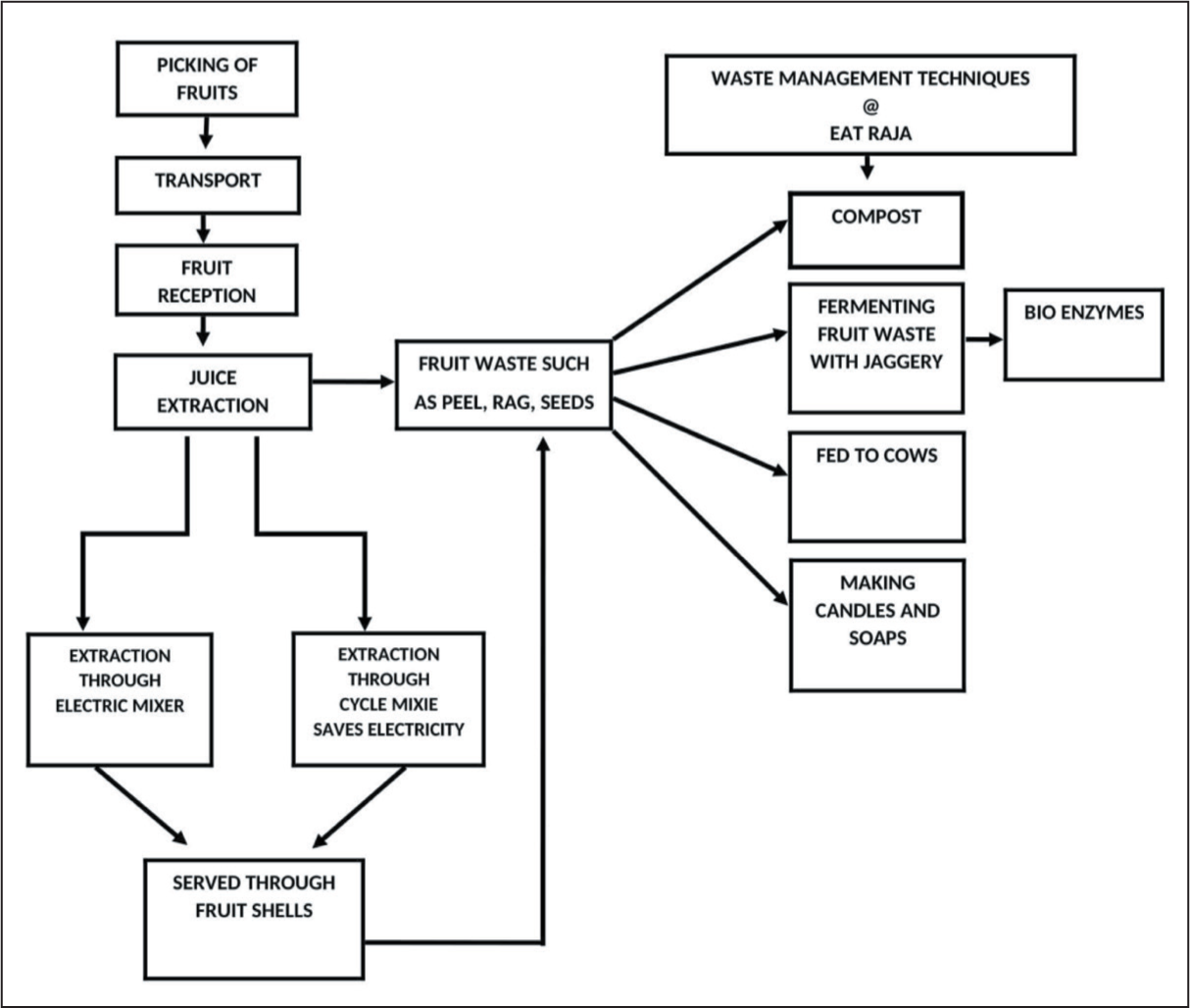
Eat Raja is a zero-waste juice bar, which does not promote any use of plastic or paper cups, straws, or glasses. But it uses fruit shells as its cups. To avoid the wastage of paper, all announcements in the juice bar are made via a blackboard. The fruit juice wastes are gathered in a bin, with Eat Raja collecting four distinct types of waste daily. Each type of waste is processed differently:
This waste management system appears to efficiently handle different types of waste produced at Eat Raja, ensuring proper disposal or recycling of each type according to its characteristics and potential reuse. As told by Mr Raj, ‘His juice-making concept was not just to give his customers fresh fruit juice but to deliver the concept of living a zero-waste lifestyle’.
Marketing Strategies Adopted by Eat Raja
The Positive Effect: Starting a Small Way Also Makes an Impact
Innovation
Organic Creativity! Every attempt of Mr Raj was to create value by reducing the generation of waste in the process of making fresh fruit juice till it is served to his customers.
By attempting to achieve complete usage of fruits without any waste generation, Eat Raja was successful in achieving maximum waste reduction. Juice made from the pulp of the fruit is served in the shell of the very fruit. Coconut shells were used, as some of the fruits did not have solid shell to contain the juice. This usage of shells eliminated the need for glasses. On a busy day, this saved nearly 1,000 L of water!
The residual wastes that remained were fed to cows and were mixed with walnut and Tulsi base to manufacture chemical-free natural soaps. Mr Raj attempted biodegradable packaging by using banana leaves to pack soaps, and this idea eliminated the use of plastic containers or boxes.
Cigarette juice, to wean youngsters from the harmful habit of smoking, Mr Raj started offering free juice to whoever discarded a smoking cigarette into a bin placed in front of his shop. Although appearing to be a gimmick, this inspired many to give up smoking and also caught the attention of a major industry conglomerate in India.
Mr Raj provided a bicycle-mixer to give a unique experience to his customers (please refer to Exhibit 4). Customers could pedal their way on a cycle attached to a mixer, and the pedal power crushed the fruits into juice. Customers had a unique experience and a sense of achievement by peddling their own juice. This in turn reduced the consumption of electrical energy and also contributed to a healthy lifestyle outlook for youngsters.
These innovative ways of waste reduction by Eat Raja have created great attention on social media, such as Instagram and Facebook. In particular, the bicycle mixer videos went viral and created a great buzz for the brand. People were enamoured by the idea of making juice all by themselves by riding bicycles! People quit smoking after using cigarette juice! Concern for health and the environment has gradually gotten embedded in the minds of customers. This shows the small attempt by a budding entrepreneur towards achieving carbon-negative goals!
Business Benefit
The innovative initiatives by Eat Raja caught the fancy of a large clientele who wanted to try out something different and innovative. It was totally a different experience for them—gastronomic relish, emotionally satisfying novelty and intellectually engaging ideas.
Bengaluru, being truly cosmopolitan, houses different cultures and diversity and has become the home to many people from across the country. The consumer behaviour of such a populace is truly psychedelic and offers rich variants of inspiration and opportunities for innovative entrepreneurs. Many of them have found creative ways of offering themselves and have found their niche in Bengaluru. Eat Raja is one such business!
As large number of people visited to try the novel recipes and unique combinations of juices, the business grew by leaps and bounds in a very short time. As the theme of Eat Raja was always to reduce waste generation, there was a total reduction of costs in the process and the benefits were directly passed on to customers. This resulted in customers paying a very reasonable price for naturally made and naturally served fruit juices. In every stage of his business, Mr Raj came up with innovative and new product ideas that were cost-effective.
Soon, the business concept of Eat Raja spread across different states of India and even overseas as Eat Raja was backed up by a sound marketing strategy of franchising. Today, the firm has forayed into foreign markets by opening a franchise in Dubai. There was an increase in demand for franchises and for the brand and processes, which proved that this business had gained currency. Eat Raja had achieved tremendous financial gains. Starting with a turnover of just Rs 100 per day and increasing to an enormous revenue gain per day showed a tremendous success.
Social and Environmental Benefit
Eat Raja—Zero Waste Juice Bar’s approach to waste management has significantly contributed to resource conservation, pollution reduction and energy efficiency.
Overall, Eat Raja’s commitment to zero waste and innovative approaches to waste management not only minimises environmental impact but also promotes sustainability and resource efficiency in its operations. The concept of Zero Waste at Eat Raja serves as a model of inspiration for our planet. Every consumer loves to be a part of it. The adoption of a zero-waste lifestyle on a larger scale in society has become a dream come true. As more and more customers are inspired by Eat Raja’s zero-waste business model and environment, it becomes an aspiration for them as well. Many consumers identify themselves as loving to be part of this movement, indicating that such innovative initiatives will see faster adoption by many people. Surely, this firm has created a ripple effect. Universal concerns such as environmental conservation, water saving, increased fruit consumption, and reduced plastic usage are all addressed by Eat Raja.
Conclusion
The growing clientele is proof that this green journey of ‘Eat Raja’ is sustainable. There is a growing concern for the environment and as long as nature goes on producing natural fruits, these green units like Eat Raja will be supported. It is evident from the above case that green production and green technology have helped in achieving a lot more than just saving money. It helps in resource conservation, pollution reduction and the saving of energy and materials. These companies have used a combination of green manufacturing technology, engineering science and marketing management. A tiny juice bar in Southern India’s Bengaluru is striving to make a big difference. As told by Anand Raj, ‘The innovative ideas at Eat Raja can be easily copied by the competitive business units, but on a larger scale, the process re-engineering towards achieving a green environment will become the greatest contribution by Eat Raja towards society’. Eat Raja has taken waste control to the next level by banning plastic, thus contributing towards achieving carbon-negative goals.
Footnotes
Declaration of Conflicting Interests
The authors declared no potential conflicts of interest with respect to the research, authorship and/or publication of this article.
Funding
The authors received no financial support for the research, authorship and/or publication of this article.