







Abstract
Inclusive social entrepreneurship (ISE) is an appropriate way to tackle the concerns and challenges of society. This study explores the parameters for the inclusion of social entrepreneurship through a literature survey and related research paper mapping analysis with qualitative and quantitative methods. Gender equality, disability, challenges in community development, under-represented groups, migrants, unemployed people, ethnic and cultural differences, languages and communication are the main parameters identified for inclusion in social entrepreneurship in this study. The pilot survey with the defined population of chief functionaries of CSOs gave insight into the number of parameters to be considered, and also the contextual top priority of the parameters for inclusion and social protection. Adoption of best practices, social innovation techniques and relevant international practices will play a major role in better inclusion considered within different contexts. Policy development and its implementation with the ISE network are the main aspects for future study.
Keywords
Introduction
Inclusive social entrepreneurship (ISE) education has the potential to tackle the problems of society with the inclusion of the marginalised community members. The various interlinked issues of an unsustainable global economy need to be resolved and minimised towards social and environmental value and the related complications of this century. In this article, researchers explored various parameters related to the issues of ISE, the current situation and best practices of ISE. Social inclusion can open the door for the younger generation to understand what it is like to produce value for others. Although not yet widespread, there are various examples of inclusion in social entrepreneurship education addressing this potential.
Academics plays a vital role in social entrepreneurship as it creates opportunity for students to learn about the evolution of the culture of their own, and other communities, to develop understanding and respect towards social cultures and religions. Specifically, for the young generation, education helps to imbibe values of respect and sensitivity for diversity. Education can empower those who are from deprived backgrounds to participate in discussions and develop decision-making skills (United Nations Department of Economic and Social Affairs, 2008). Research in the area of inclusivity has focused on women and girls, ethnic minorities, people with disability, migrants and native peoples, but they do not receive appropriate guidance and disabled persons are not aware of their policy benefits (Pilková et al., 2016; Rolle & Kisato, 2019). It ignores variables that are important for the groups to develop in an entrepreneurial venture. This research paper identifies entrepreneurship that highlights inclusivity.
We are living in a new technological era which is transforming at an unprecedented rate. Humankind has many social and environmental problems to address, including poverty, inequality, unemployment and climate change, an interrelated set of ‘wicked’ problems. All countries must now work together as they never have before (British Council India, 2015). All humans are living in a rapidly shifting world and creating knowledge and skills which are not going to address the challenges of the future. A decade ago, teachers could expect that what their students learnt would support them for a lifetime. But today, as the economy and society are changing, schools must train their students for employability that has not yet been created, technologies that are not yet invented and problems that have not yet arisen (Schleicher, 2016).
Entrepreneurship plays a significant role in the economy of nations as it can develop employment opportunities with bringing innovation. It also assists in strengthening social inclusion by producing another income possibility and contributing towards societal well-being. However, this outcome will not be recognised until each person has an opportunity to start their own business and be fruitful in self-employment. Many women and older people are deprived of their business conception and self-employment, while others, such as young people, often develop businesses that tend to have low survival rates (OECD, 2016). Entrepreneurship can become a game changer in creating economic value or developing new companies. Entrepreneurship education at the primary school level is an idea introduced across blogs, including OECD policy documents and a study done by Martin Lackeus. Taking a wide perspective towards social entrepreneurship and introducing it in primary and secondary education is more effective than making it available only at the university level. In some communities, specifically in rural areas or areas of high unemployment, entrepreneurship education has become highly relevant and is a potential requirement that much traditional education lack (British Council India, 2015).
Social entrepreneurship is gaining importance in Indian higher education institutes as they are involved with various social enterprises. The Tata Institute of Social Sciences was the first institute to introduce a two-year programme: MA in Social Innovation and Entrepreneurship in 2007. The course is designed for students who wish to make their careers in social innovation and entrepreneurship for social change. As such, there are other universities and All India Council for Technical Education approved institutions, like Symbiosis Institute of Business Management (SIBM), Ambedkar University New Delhi, Institute of Rural Management (IRMA) Anand, Entrepreneurship Development Institute of India (EDII) Gandhinagar, Azim Premji University Bengaluru and SVKM’s Institute of Management Mumbai, which offer a course either as a one-year diploma or two-year post-graduate degree on social entrepreneurship. The course objectives require that learners are trained and exposed to the knowledge, skills and practical aspects of starting a social enterprise. Teaching the philosophy behind social entrepreneurship is significant to train individuals to utilise the right tool in resolving social issues (Kumar et al., 2021).
Practical implications of subjects such as maths and science would enable better agribusiness models, enhancing the financial conditions and creating more job opportunities. Entrepreneurship education will boost new innovative ideas and have an instant impact on mankind, particularly in different areas of the world where people live in poverty, or where there is a high unemployment rate. Skill deficiency may be a major obstacle to inclusive and social entrepreneurship activities. From past survey studies of social entrepreneurship, it is seen that entrepreneurship skill gaps are present across the population. For example, in the European Union, between 2016 and 2020, it is stated that only 50% of men had sufficient knowledge, competency and skills to start their own business, compared to women, who were lower at 39%. Additionally, there is a need for specific social entrepreneurship skills which needs specific skill sets and access to resources, knowledge and support to uphold the social drive and apply it to specific business models. In general, the government frequently promotes inclusive and social entrepreneurship training programmes through schemes to address these gaps.
Training can be provided by trainers and business mentors, like social entrepreneurship educators, via multiple modes, such as hackathons, courses, bootcamps, coaching and workshops. To enhance entrepreneurship skills, entrepreneurship schemes are planned, which can increase self-employability. Short courses are useful to increase motivation for new innovative business ventures and social entrepreneurship for those who have lower levels of self-confidence. Virtual programmes are emerging rapidly these days and becoming more common. After the COVID-19 pandemic, the use of digital platforms has accelerated rapidly to improve the scope and influence of such schemes, but they also bring challenges for training experts as this mode requires a high level of motivation to self-study. There is also another important trend to move from passive learning to experiential learning (OECD–European Commission, 2021).
In inclusive entrepreneurship schemes, there is a focus on specific obstacles faced by the targeted groups, such as Refugee Launch Pad in the Netherlands, which help refugee entrepreneurs from networks by providing start-up training and co-housing provisions with local entrepreneurs (OECD, 2019). Training of social entrepreneurship greatly places emphasis on problem analysis, social value proposition and questions linked to organising and initiating a social enterprise (Grassl, 2012). Therefore, entrepreneurship training is often active in supporting unemployed people in moving back into work through self-employment (Rotger et al., 2012).
Social entrepreneurship training activities have grown over the past decade, but are not common in central and eastern Europe and rural areas (European Commission, 2021). Tailored policies and programmes can help people who are disadvantaged in the labour market, such as women, immigrants, youth, seniors, the unemployed and people with disabilities. In starting and growing businesses, general entrepreneurship schemes need to be more accessible. A social enterprise is a business which emphasises the interests of specific groups who trade goods and services and does not make a profit for personal use but reinvests to attain some economic and social goals (OECD, 1999, 2018). According to this, social enterprises develop within the social economy (Noya & Clarence, 2013) and have a scope beyond the various traditional forms of the social economy with associations, companies, cooperative organisations and foundations.
Digital skills are seen to be critical for entrepreneurs as they vary widely across the population of entrepreneurs according to the nature of the business operations, gender and age of the entrepreneur. The survey data of the labour force from the European Union emphasise that self-employed seniors (55–74 years old) who utilise cloud computing daily are about one-third when compared to self-employed youth (15–24 years old) (OECD–European Commission, 2019). Financial literacy skills gaps appear to be another significant challenge for entrepreneurship in such cases. Some research studies recommend that these gaps also exist for women entrepreneurs (Oggero et al., 2020). The immigrant and refugee entrepreneurs are less active because of their small professional networks (OECD–European Commission, 2022).
Objectives of the Study
To explore information on the current situation and practices of ISE.
To identify parameters for ISE education.
To study awareness about ISE among the chief functionaries of community social organisations (CSOs).
To identify gaps between challenges and opportunities in ISE, focusing on the parameters identified.
To explore opportunities for enhancing ISE awareness for this entry-level workforce of CSOs.
Literature Review
The literature review describes and explores the work undertaken on ISE. Here, a review of the literature is needed for a better understanding of the nature of the research subject and further developments in detail so that the researchers can identify the parameters of ISE. Critical assessment and evolution of social entrepreneurship will be the first concept explored. Peredo and McLean (2006) provide a flexible explanation of this concept.
Regarding social entrepreneurship, Teasdale et al. (2023) identified four thematic areas as conceptualisation, the search for data, theoretical approaches and social change outcomes. It is important to identify the parameters of ISE and hence the researchers conducted a specific literature search and mapped the related papers using a tool (Litmaps) as shown in Figure 1.
Related Research Paper Mapping.
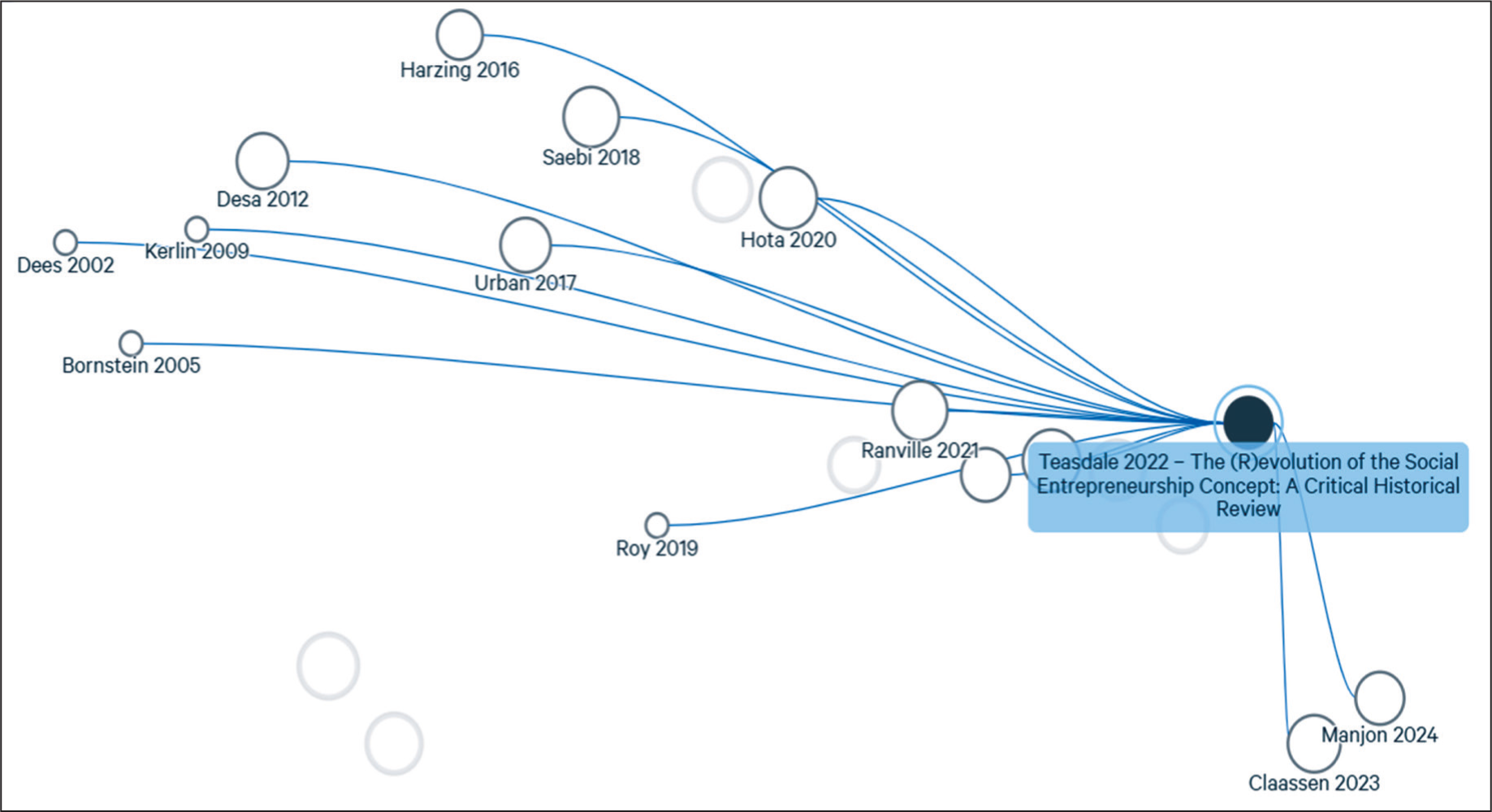
Teasdale et al. (2023) explored the patterns of understandings relating to social entrepreneurship that have been emerged and shifted over time. The authors undertake a review critically with historical development focusing on the each of five with time periods over a period of 30 years.
According to Smith et al. (2017), inclusive and accessible entrepreneurship education in higher education institutions means ensuring that all students from any geographical location, socio-economic, cultural demographic, gender, disability and ethnicity have equal opportunity to experience entrepreneurship education and access to entrepreneurial learning environments. Inclusive and accessible education requires that all students are involved, that all students have equal access to education and are free to be involved with no financial barriers.
Kozuka (2014) states that inclusive development is the expansion of specific prosperity by developing equal chances for all members of society, specifically poverty groups, at-risk or deprived sections of the community, and those who are away from the development process. It is also seeming that inclusive development comprises an upgrading of income, education and health care as well as equality in these three zones.
Johnson and Andersen (2012) have defined inclusive development exclusively from an economic perspective, as development which decreases the income gap and supports people in rising from poverty. Kozuka (2014) further adds that inclusive development is not solely limited to income improvements but includes enhancement to individual well-being. Inclusive development is recognised by minimising gaps between different ethnic groups, genders and age groups.
Haugh and Talwar (2016) focused on entrepreneurial schemes of rural women as emancipatory social entrepreneurship, which is activated by multiple factors, such as limited social networks, social and cultural obstacles, illiteracy, inflexible governance structures, lack of access to market knowledge, inhibited independence and skill deficiency. Gender discrimination, lack of control over the situation they are embedded in, absence of role models, no access to resources, power relationships in family and society and deficiency of empowerment are also the other factors (Ardrey et al. 2006; Bhardwaj, 2014; Rao, 2014; Servon & Doshna, 2000). Advancement of women’s empowerment is one of those tenacious issues that have taken the centre stage of development in emerging economies (Haugh & Talwar, 2016). It had an emphasis on women social entrepreneurs from rural India, which leads to the conclusion on rural women’s emancipatory social entrepreneurship. Further, it had fluctuations in the attitude of men towards women and their work. Society changed its attitude towards gender bias. The role of men has also altered in family units. The success of empowering women through social entrepreneurship is seeded in the business model of the social enterprises (Datta & Gailey, 2012).
Tandon (2014) highlights the qualitative research on social initiatives and their regional frameworks to discover social assemblies by providing learning interactions between workforce and community affiliates that got benefited. The human resource involved in innovativeness, as well as community functionaries with both men and women, is found to be restated in a research study on community-based Indian social initiatives by Sloan et al. (2014). The contribution of the community in the procedures of the enterprise upgraded the social benefits and development in terms of upcoming opportunities and gained incentives, which will lift them above poverty levels. This process enhances the rich social capital which is a significant antecedent for the development of social enterprises in emerging economies in India (Roy & Karna, 2015). Personal traits of social entrepreneurs inspire social innovation and also develop social value by continuously appealing to the recipient communities.
Basargekar and Rawat (2015) found that educational qualifications, background and environmental factors of the family act as strong support in social entrepreneurship in the education field, where a majority of social entrepreneurs are women. Education for the underserved is another aspect of social entrepreneurship in India. About 26.53 million do not have good houses, of which 99% are below the poverty line. A social need is identified by housing sector social enterprises by ‘Janaadhar’ (Mukherji, 2014). The tasks confronted by such enterprises are issues of land purchase, regulatory pressure, high rates, strategy of creating a market and financial problems (Mukherji, 2014).
In India, Mahatma Gandhi discovered community embeddedness over social innovation, which was widely practised for a number of times. Social enterprises in India are also community-based, achieving development of women and liberation from economic problems (Ramani et al., 2017).
According to Include (2019) and Pilková et al. (2016), in a comprehensive society, the people who are deprived are catered to through initiatives and via policy that involves all persons are involved in their development. On the other hand, the lack of inclusiveness, specifically in the economic development of society, leads to marginalised people being left behind and consigned to poverty (Rauniyar & Kanbur, 2009; United Nations Conference on Trade and Development, 2019). According to Rolle and Kisato (2019) and Thompson et al. (2017), various researchers have studied inclusivity in entrepreneurship globally in relation to the United Nations Sustainable Development Goals (UN-SDG, 2030). The research scholars often did their study on the inclusivity of entrepreneurial activity for youth, women and seniors, without addressing persons with disabilities in particular (Pilková et al., 2016).
Strawser et al. (2021) found that about half of the working age population are women, and still, they are not getting equal opportunities in the workforce in many areas, including entrepreneurship. Research from McKinsey & Company (2020) states that this unequal and less active participation may affect the global economy with over 28 trillion dollars of unrealised gains, capping global gross domestic product (GDP) to a projected 108 trillion dollars in 2025. These evaluations explain that if women have equal opportunity in all labour markets, GDP would spike to about $136 trillion by 2025.
Similarly, older persons are being left behind across all regions. In the USA, 28% of individuals aged 65 years and over do not use the internet (Anderson et al., 2019). Persons with disabilities find inequalities and various barriers in accessing the internet. ICTs and assistive technology, including affordability barriers, are there with the limited accessibility of ICT facilities.
Women entrepreneurship is among the fastest budding entrepreneurial solutions (Brush & Cooper, 2012), and the past 30 years have seen vital changes in the field’s treatment of gender and female entrepreneurs’ status weight (Minniti & Naude, 2010). Till now, only a few women have been able to sustain and manage their business worldwide (Georgellis & Wall, 2005). Many times, women entrepreneurs comprise just a small percentage of all research in the field (Brush & Cooper, 2012).
Another important parameter is related to the age of the entrepreneur. In general, a predominant claim which is both simple and spontaneous is that entrepreneurship is a young man’s game (Levesque & Minniti, 2006). Western culture showcases that seniors are less productive as they give more time to their families as compared to work. They are less technologically savvy, prioritise physical, have a low-risk nature and monetary safety and also have less interest in adjusting swiftly in unstable environments (Kanfer & Ackerman, 2004). Nevertheless, contrasting this perception, research on elder entrepreneurs has discovered that individuals can exhibit important entrepreneurial acumen later in life, and transitions to entrepreneurship later in age may be a promising way to address some of the problematic applications of population ageing, with positive consequences for quality of life (Kautonen et al., 2017; Levesque & Minniti, 2006). Worldwide, the human population is ageing at a rate without parallel in the history of humanity. The number of people over 60 years is expected to double from 841 million in 2013 to more than 2 billion by 2050 . It means old entrepreneurs may be unconventional now but not in the near future.
For persons with disability, entrepreneurship may offer a direction towards societal participation and earning an income, as many organisations feel awkward about employing disabled people (Bakker, 2022). According to the US Bureau of Labor (2021) statistics reports, disabled persons are overrepresented among the self-employed rate of 10.3% versus 6.1%. Research does not explicate the reason why entrepreneurs with disability struggle or the barriers they may face when developing businesses (Bakker & McMullen, 2023).
One widespread group of unconventional entrepreneurs who have been more heavily researched is immigrant entrepreneurs. These individuals are immigrants who ‘identify, create, and exploit economic prospects for their new start-ups in their country of destination’ (Malki et al., 2022, p. 1337). Additionally, since a rise in migration across countries flows, immigrant entrepreneurs have gained more attention and are a significant source of economic development and social renaissance in host countries (Malki et al., 2022). Interestingly, an immigrant entrepreneurs’ sub-group is refugee entrepreneurs who have much less researched. Other non-conventional entrepreneurs, refugee entrepreneurs, suffer from various barriers and adversities. The type of adversity experienced by refugee entrepreneurs is discouraging and frightening, including overcrowded camps, extreme poverty, and unhygienic living conditions (Khalil, 2011). In substantial numbers, refugee entrepreneurs may show resilience as opposed to dysfunction (Shepherd et al., 2020). Refugee entrepreneurship has positive elements, including amalgamation in the local community self-sufficiency (Fong et al., 2007; Wauters & Lambrecht, 2008) and development of strong relationships. At the same time, much of what is known about refugee entrepreneurs remains subjective (Shepherd et al., 2020).
In an empirical study in South Africa, it is found that the informal, moderate entrepreneurs come across various challenges such as high levels of inequality, scarcity of resources, lack of employment and other socio-economic issues, which determine the actions and practices they subsequently develop. Despite these noteworthy exclusions, work focusing on low wages incomplete education entrepreneurs remains relatively scarce and is not effectively connected to the research on other clusters of non-conventional entrepreneurs; hence, some intersection in the challenges and opportunities between these groups can be identified and described.
Technology may leverage the growth potential of the underserved. It also mentioned that the education and technological skills of the workforce constrained prospects for developing and scaling businesses (Rolle & Kisato, 2019; Thompson et al., 2017). Young urban people are more likely to be unemployed than rural youths, and young women are half as likely as young men to be in regular employment.
Research Methodology
In this research, a mixed-methods approach was used. It is an approach to address the gap in which the researcher links, in some way, both quantitative and qualitative data to provide a unified understanding of a research problem. In this research, a rating scale and interview tools were used for data collection. A tool, Litmaps, was used to map the related research papers on social entrepreneurship (SE) to identify parameters of ISE. The extensive reviews were used for understanding the current situation and practices of ISE in academia and professional areas in Maharashtra, India. Reports of various international policy brief documents from organisations, such as the OECD, British Council and the European Union, have been referred to for the study to understand the global trends in this area.
The keywords used in the search included: social entrepreneurship, inclusive entrepreneurship, global scenario of inclusive social entrepreneurship, parameters of the inclusive social entrepreneurship, CSOs. The databases utilised to identify appropriate papers were Google Scholar, Scopus, Web of Science, books and training manuals.
Primary data were used for comparison, collected from the 30 chief social entrepreneurs located in the state of Maharashtra, India. The sample consisted of 22 people from a rural area and 8 people from an urban area who acted as social entrepreneur chief functionaries. The data collection was carried out through interviews and questionnaires through online survey tools. Google Forms, Google Meet, Slido and Mentimeter tools were used to collect the data.
Results
The data and information were collected to identify parameters in the development of an ISE model. The researchers used predictive analytics by using bivariate analysis of correlations to identify linear positive correlations in the priority of the parameters of ISE with data collected from chief functionaries of the CSOs. There were eight parameters considered to be priorities for ISE based upon the outcome of the literature survey, which are gender equality, disability, challenges in community development, under-represented groups, migrants, unemployed people, ethnic and cultural differences, languages and communication. The data collected from the CSO functionaries related to their top priority parameter for ISE, as shown in Figure 2.
The graphical representation of the primary data based on the analysis of the demographics area is shown in Figure 2. Unemployed youth is the top priority parameter considered by the rural CSO functionaries, whereas gender equality and unemployed group parameters are equally top priority parameters of the urban CSO functionaries for ISE. Although the survey was undertaken in the state of Maharashtra, migrants were not considered for inclusion as this area scored zero. Eighteen rural CSOs and five urban CSOs are working in the areas of entrepreneurship and placement services for youth as major activities of concern, which may have accounted for the emphasis in this area.
Priority Parameters for ISE as Identified by the CSO.
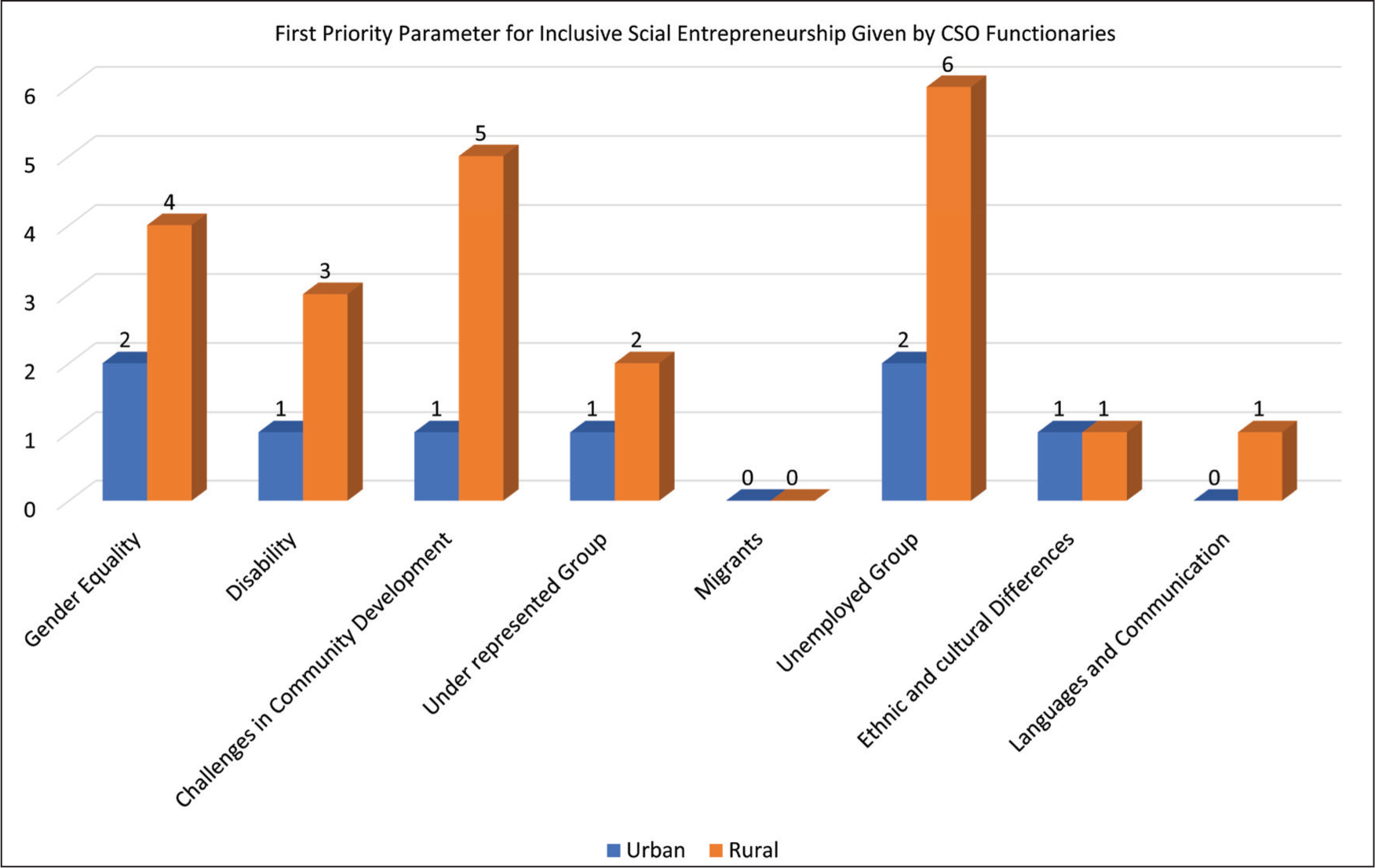
The survey shows that there are eight parameters of inclusion for SE that are contextual to those of the literature survey and the resulting outcome with the qualitative sample data collected from the CSOs. Unemployment is the top priority parameter for the inclusion to the acts of SE followed closely by community challenges. The lowest priority identified by the CSOs was migrants.
Quantitative data collected were further analysed with a statistical method’s correlation to measure the linear relationship between the two variables of the top priority of the eight parameters of inclusion as shown in Table 1. It is a bivariate two-tailed correlation. These predictive analytics gave a correlation matrix showing all possible pairs of variables and indicate the number of causes used to compute them.
Table 1 shows three pieces of information that appear in each cell of the correlation matrix. The topmost number is the value of the Pearson correlation coefficient, the number below is the two-tailed p value for the correlation, and the bottom number is the sample size. Var0001 is the gender equality, whereas Var0002 is the unemployed group. Area is the geographical location as urban or rural. Each correlation appears twice in a square matrix, as the upper right triangle is a mirror image of the lower left triangle.
Correlation Analysis of the Primary Data.
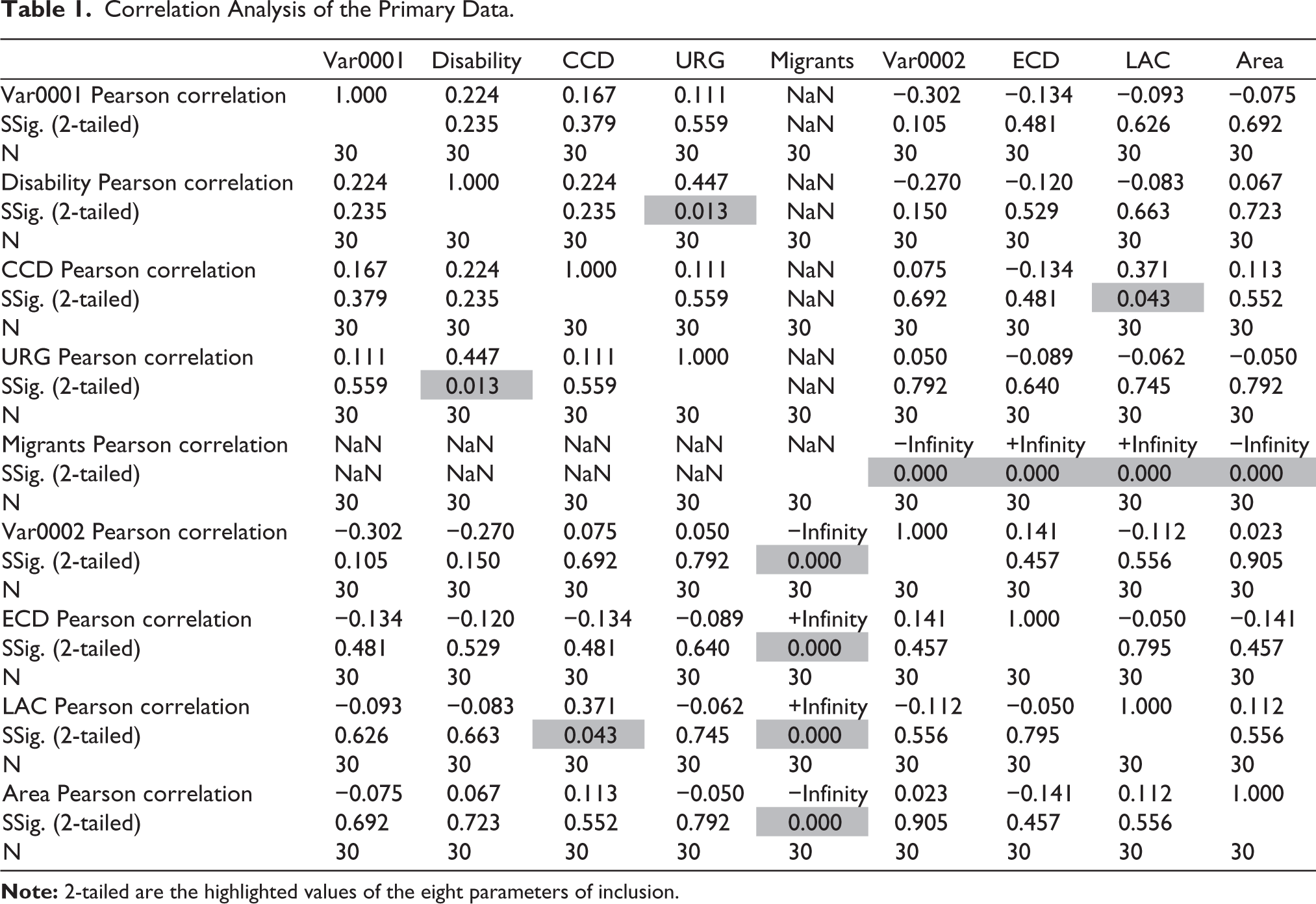
The results of the correlation reveal that there is a linear positive correlation between the under-represented group (URG) and disability. The coefficient of Pearson correlation is 0.447 and is statistically significant as the p value is less than .05. There is also a linear positive correlation between challenges in community development (CCD) and language and communication (LAC). The coefficient of Pearson correlation is 0.371 and is statistically significant as the p value is less than .05. Lastly, there is a linear positive correlation between migrants with VAR0002 (unemployed group), ECD (ethnic and cultural differences), LAC and area. The coefficient of Pearson correlations is correlated negatively as −Infinity and positively as +Infinity and is statistically significant as the p value is less than .05.
With the results of the correlation analysis and the analysis of the open-ended questions, the researchers developed a holistic model of the ISE as shown in Figure 3. The qualitative data of this population with the open-ended questions show that inclusion to address the social concerns must be the top priority. Community challenges are mainly associated with the problem of unemployment among the youths who are suffering from unsustainable livelihoods. It is a major concern in the rural and urban areas. Social entrepreneurs must make a concentrated effort and work in this area along with the local governance system. Gender equality for entrepreneurship is another challenge for the better acceptance of the society and better livelihoods for all.
Holistic Model of ISE.
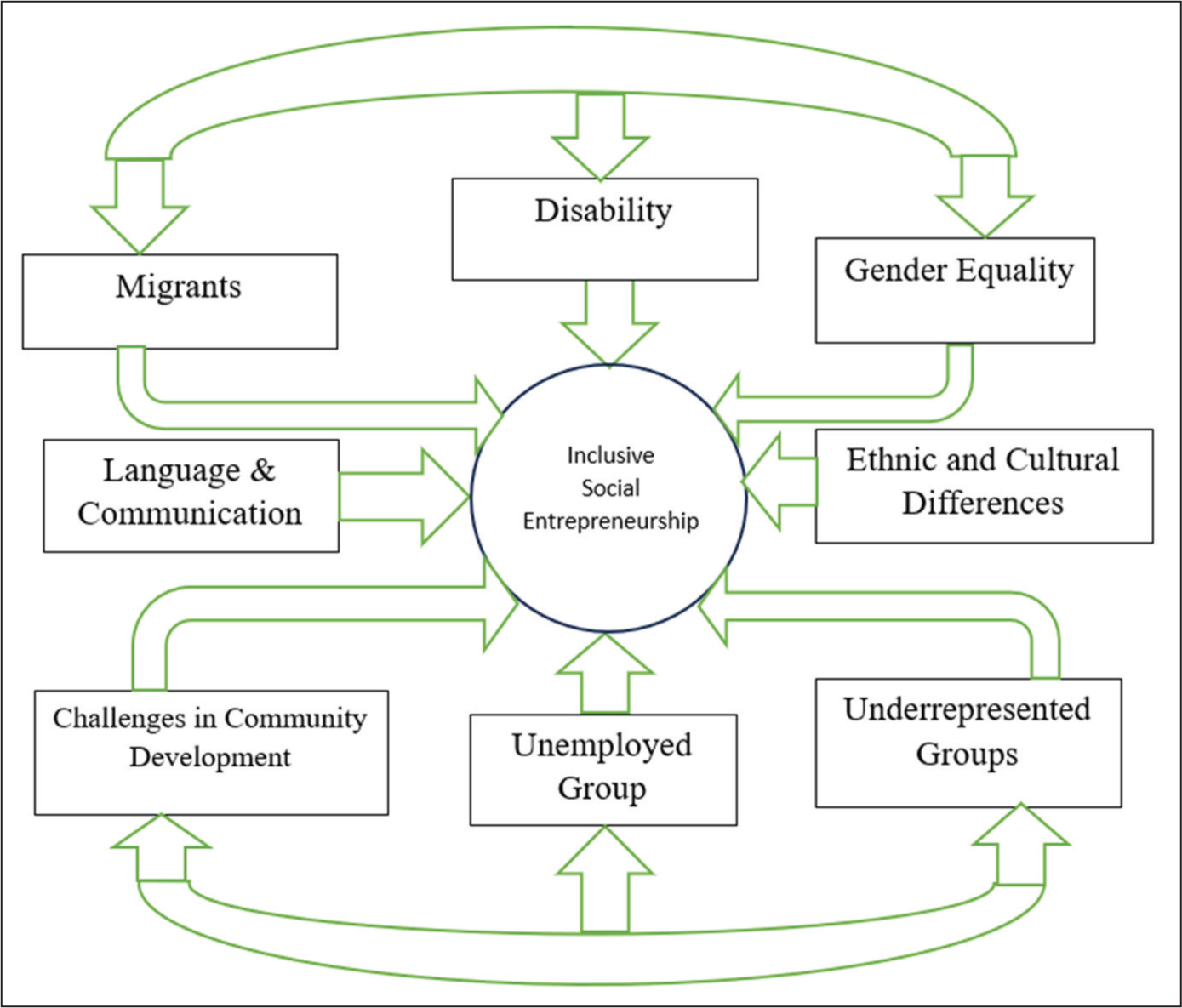
One arm of the holistic model, ISE, represents the three parameters as migrants, gender equality and disability have specified interrelations. Another arm of this model is with CCD, unemployed group and under-represented groups. Both arms are further supported by the independent two parameters of ‘language and communication’ and ‘ethnic and cultural differences’.
Conclusions
In conclusion, researchers explored a few current practices of the ISE and efforts for the development of human resources in this area. Eight inclusion parameters emerged from qualitative data and literature survey. The perception of the chief functionaries of the community service organisations also provided insight into their top priority parameters in the context of the problems identified by them with local concerns. In the context of ISE, governments can provide support to women entrepreneurs, especially by cumulative support for growth-oriented women entrepreneurs with ISE policies and their implementation. This is achieved by increasing the pool of women business associations and decision-makers in venture capital funding, confirming support programmes by increasing responsibility for gender balance in mainstream venture development activities.
Governments can design policies for greater use of youth entrepreneurship policies and schemes to upskill and increase admission to the labour market for young individuals. Outcome measures from evaluations suggest that some approaches for supporting youth entrepreneurship that offers small amounts of support to many and are more rigorous in supporting those who can demonstrate success (OECD–European Commission, 2020). This approach is suitable for short, basic entrepreneurial support and an environment accessible to a number of young people with follow-up after training modules and venture and start-up scholarships who have an interest in pursuing business ideation. Those who are successful in launching ventures can then have access to mentoring, pitching and greater venture capital funding. This type of support has established success with even the most underprivileged youth, as in the case of the Prince’s Trust Enterprise Programme (OECD–European Commission, 2020).
Responding to the post–COVID-19 crisis, particularly in digitalisation, they have a strong potential to drive the economic recovery. The business incubator model holds promise for this profile of youth entrepreneurs since they can effectively deliver packages of support and help them to build their networks by promoting digital skills and artificial intelligence tools for business strategies.
In the future, the policies of ISE need to frame for a more efficient job of targeting support at immigrants who operate high potential businesses. Few governments have initiated innovative business start-up visa programmes to attract immigrant entrepreneurs with a small number of immigrant entrepreneurs, who have the potential for creating jobs, consolidation trade linkages and diffusing innovation.
The expedition towards ISE is not a rectilinear path but a continuous process of learning, growth and innovation. It is about distinguishing that inclusivity is not just a goal, it is a worth, a pledge and well-being of mankind. It is about producing meaningful, applicable and inclusive impact for all with social concerns.
These conclusions are drawn on parameters that emerged through the collection and analysis of literature survey data pertaining to the ISE and thus address the gaps identified in the research.
Footnotes
Declaration of Conflicting Interests
The authors declared no potential conflicts of interest with respect to the research, authorship and/or publication of this article.
Funding
The authors received no financial support for the research, authorship and/or publication of this article.