







Abstract
The organisational workforce is one of the most vital resources. Their skills play a crucial role in achieving its goals. Moreover, self-efficacy strengthens employees’ confidence in their ability to complete tasks within a specific timeframe. Employees with high self-efficacy tend to be more satisfied and better prepared to manage job demands, which ultimately improves their job satisfaction and contributes to their performance. In general, past research has focused primarily on Western contexts, resulting in a lack of studies on how these relationships manifest across diverse organisational, economic and cultural settings. Furthermore, few comprehensive studies have explored job satisfaction as a mediating factor. Therefore, the objective of this study is to examine the effect of self-efficacy on employee job satisfaction and to explore the mediating role of job satisfaction in the relationship between self-efficacy and job performance. The study considers several dimensions of self-efficacy, including performance accomplishments, vicarious experience, verbal persuasion and physiological states, as well as job satisfaction and job performance. This is desk research; it has covered the period from 2004 to 2024. The ultimate objective of the research is to develop a conceptual model grounded in a systematic and empirical review of the existing literature. Hypotheses are formulated based on the literature. The study reveals that the resulting model illustrates the interactions among the identified variables, offering a comprehensive framework for understanding their interrelationships.
Introduction
Human resources are a valuable factor in the management of any organisation. A competent workforce is essential not only for achieving organisational success but also for contributing to the broader development of a nation. Competence, which integrates knowledge, skills and attitudes (Kyndt et al., 2015), serves as a key criterion for evaluating employee performance (Mitchelmore & Rowley, 2010). Furthermore, attributes such as knowledge, skills, understanding and personal qualities significantly enhance an individual’s ability to attain satisfying and successful employment. These attributes also play a crucial role in determining employability, particularly through the constructs of self-efficacy and self-confidence (Pool et al., 2009).
In this context, self-efficacy, defined as an individual’s belief in their ability to execute tasks successfully, emerges as a vital psychological factor. Individuals with high self-efficacy are typically more resilient, less likely to leave their jobs, and demonstrate lower levels of absenteeism. In contrast, those with low self-efficacy often struggle with confidence, avoid difficult tasks and require more time to recover from setbacks, all of which can hinder goal achievement and workplace effectiveness (Gist, 1989). Notably, high self-efficacy also fosters a more positive perception of work, thereby enhancing both job satisfaction and performance. From an organisational standpoint, self-efficacy not only shapes individual attitudes but also directly contributes to overall employee performance. Employees with strong self-efficacy are more likely to be engaged in their roles and aligned with organisational objectives. Thus, the perception of self-efficacy forms a foundation for personal fulfilment and intrinsic motivation. When employees feel competent in their ability to meet goals and perform tasks, they are more likely to experience higher levels of job satisfaction (Lent & Brown, 2006).
Building on this, job performance represents a crucial outcome of workplace behaviour, influencing both individual career paths and overall organisational effectiveness. Since employees exhibit varying levels of self-efficacy, their beliefs significantly impact their job satisfaction. In turn, job satisfaction plays a key role in determining organisational performance. As Bandura (1986) notes, self-efficacy reflects an individual’s internal judgement of their capabilities, basically answering the question, ‘Who are you?’, and stands as a central determinant of workplace performance. Therefore, employees’ self-efficacy, job satisfaction and job performance are all interrelated and essential to evaluating and enhancing overall organisational performance.
Background of the Study
This study focuses on self-efficacy, an employee’s belief in their ability to perform tasks effectively and its impact on job performance, with job satisfaction acting as a potential mediator. This topic takes into consideration self-efficacy; it has consistently been identified as a key predictor of work outcomes. Employees with higher self-efficacy tend to set challenging goals, persist through difficulties and ultimately achieve better performance (Bandura, 2018; Stajkovic & Luthans, 2013). However, the mechanisms through which self-efficacy influences job performance are not fully understood, particularly the role of affective states like job satisfaction.
Job satisfaction reflects employees’ emotional responses to their job roles and working conditions, influencing motivation and discretionary effort (Bowling et al., 2015; Judge et al., 2017). Emerging evidence suggests job satisfaction not only results from self-efficacy but also shapes how effectively employees perform (Hanifa et al., 2024; Zhou et al., 2023). This mediating role is essential, as it highlights the psychological pathway from belief in ability to actual work output, providing a more comprehensive view of employee behaviour. Furthermore, contemporary workplaces face unprecedented obstacles, such as rapid technological development, remote work and higher stress levels, all of which have an impact on employee motivation and well-being (Folkman & Moskowitz, 2017; Humphrey et al., 2020). Exploring how self-efficacy and job satisfaction interact to influence job performance can assist employers in developing targeted interventions, such as motivational programmes, coaching and training, to maintain workforce productivity and satisfaction.
Consider the research gap and limitations of prior studies; whereas many studies have proven direct correlations between self-efficacy and job performance (Bandura, 2018; Stajkovic & Luthans, 2013) or self-efficacy and job satisfaction (Salanova et al., 2014), few studies have extensively explored job satisfaction as a mediator explaining how self-efficacy transforms into actual performance outcomes (Yusuf Iis & Yunus, 2016). This implies that the psychological process linking belief (self-efficacy) and behaviour (performance) is insufficiently explored (Hanifa et al., 2024; Zhou et al., 2023). And also, most research has been undertaken in Western contexts. There is a scarcity of research into how these relationships develop across different cultural, organisational and economic settings (Rubasree & Rangarajan, 2023). This limits the generalizability of the findings. Moreover, few studies distinguish between task and contextual performance when studying self-efficacy and job satisfaction outcomes (LePine et al., 2016; Wang & Netemeyer, 2018).
Therefore, this topic is highly relevant for both academic research and practical management, offering insights into boosting employee effectiveness through psychological empowerment and job fulfilment. The researcher identifies two objectives in order to accomplish this purpose.
The first objective is to examine the effect of self-efficacy on employee job satisfaction. The specific reason for selecting this objective for this research, self-efficacy, defined as an individual’s belief in their ability to perform a specific task (Bandura, 1977), has been widely acknowledged as a central psychological factor influencing workplace behaviours and attitudes, and numerous studies have demonstrated that employees who possess higher levels of self-efficacy also tend to have higher levels of job satisfaction (Judge et al., 2001; Luthans et al., 2007). Individuals who are self-efficacious are more confident in overcoming job-related challenges, leading to a greater sense of control and competence at work (Stajkovic & Luthans, 1998). This internal sense of mastery often explains higher satisfaction levels, as individuals feel more capable and valuable within their roles (Saks, 1995). Furthermore, research indicates that self-efficacy contributes positively to intrinsic motivation, work engagement and reduced burnout, all of which are key drivers of job satisfaction (Schaufeli & Salanova, 2007). Thus, studying the relationship between self-efficacy and job satisfaction is vital for understanding how psychological resources contribute to positive employee attitudes.
The second objective is to explore the mediating role of job satisfaction in the relationship between self-efficacy and job performance. While self-efficacy has been directly linked to job performance (Bandura, 1986; Stajkovic & Luthans, 1998), there is growing evidence that job satisfaction may play a crucial mediating role in this relationship (Ilies & Judge, 2003; Judge et al., 2001). Job satisfaction is not only an outcome of self-efficacy but also a motivational state that influences employees’ behavioural outcomes, including performance (Locke, 1976; Weiss, 2002). Further, employees who feel competent and satisfied are more likely to put in extra effort, persist and perform better (Organ & Ryan, 1995). Moreover, empirical studies have shown that self-efficacy enhances job satisfaction, which leads to improved performance, implying a mediating pathway (Tschannen-Moran & Hoy, 2001; Yeo & Neal, 2006). As a result, it is significant to explore job satisfaction as a mediator to understand the full mechanism through which self-efficacy constructs into actual job performance. The subsequent sections will present a review of relevant literature to support the formulation of this model.
Literature Review
This literature review explores key theoretical and empirical foundations related to social cognitive theory, self-efficacy, sources of self-efficacy, job satisfaction, job performance and the interrelationships among these constructs in workplace settings.
Social Cognitive Theory
The concept of self-efficacy first emerged in psychological theories of motivation during the 1950s (Kear, 2000). However, it did not gain significant traction until nearly two decades later, when it became a central construct in Albert Bandura’s social learning theory of behavioural change (Bandura, 1977; Kear, 2000). Eventually, Bandura revised the name of this theory to social cognitive theory in 1986 to emphasise the dynamic interaction between personal, behavioural and environmental influences (Bandura, 1986, 2001). According to Bandura (1977, 1978), self-efficacy is a core element of social cognitive theory. The theory asserts that individuals operate within a reciprocal system, where personal factors (cognition and emotion), behaviour and environment continuously interact; this interaction is referred to as triadic reciprocal causation (Bandura, 1997). Self-efficacy in this framework is a belief in one’s ability to organise and execute the courses of action required to manage prospective situations. Bandura’s theory further posits that individuals are capable of self-reflection, self-assessment and forethought. This enables them to evaluate their competencies, behaviour and environment, which in turn influences their motivation and future actions. From a behavioural perspective, self-efficacy influences not only how people think and feel but also how they act and persist in the face of challenges (Davis et al., 2015). Social cognitive theory has proven to be heuristically, practically and theoretically valuable in modern psychology (Betz et al., 1996). Early work by Miller and Dollard (1941) laid the groundwork for this theoretical tradition by demonstrating that humans are motivated to learn behaviours through observation and imitation of others’ actions. This emphasis on modelling and observational learning remains foundational to understanding how self-efficacy develops and functions in social contexts.
Self-efficacy
Self-efficacy refers to an individual’s belief in their ability to successfully complete a given task. It is a personal belief rooted in perceived competence (Ivancevich et al., 2006). Employees with strong self-efficacy are able to accomplish the tasks they believe themselves capable of and cultivate additional skills necessary to navigate challenges across various life domains, including employment, family, social relationships, marriage, occupation and parenthood (Chan et al., 2017). Also, self-efficacy functions as an internal resource that positively influences employees’ emotional resilience and commitment to retaining their jobs (Bandura, 2009; Holmgreen et al., 2017). As a psychological factor, it significantly influences an individual’s motivation and behaviour (Bandura, 1994).
Employees with high self-efficacy are more willing to embrace new skills, engage in challenging tasks and contribute meaningfully to organisational outcomes (Lunenburg, 2011). Likewise, individuals with high self-efficacy tend to focus more on finding solutions to problems rather than dwelling on their shortcomings. This mindset significantly influences work motivation and its related outcomes, including job performance, job satisfaction and overall workplace well-being (Judge et al., 2007; Stajkovic & Luthans, 1998). Additionally, they demonstrate a strong willingness to gain knowledge and master new domains (Cherian & Jacob, 2013). The primary dimensions of self-efficacy are discussed below.
Performance Accomplishment
Performance accomplishment refers to personal experience and past success, and it is widely regarded as the most reliable indicator of an individual’s ability to succeed in future tasks (Bandura, 1997). When individuals feel confident in their capabilities, they are more likely to achieve favourable outcomes (Bandura, 1986). This sense of confidence is often shaped by repeated successes, which serve to enhance self-efficacy over time. Conversely, repeated failures can diminish self-efficacy, weakening an individual’s belief in their abilities (Crain, 2000). Therefore, past experiences act as a critical foundation for the development of self-efficacy, either strengthening or undermining confidence depending on whether those experiences are characterised by success or failure (Bandura, 1986, 1997).
Vicarious Experience
Vicarious experience, or learning through the observation of others, represents another powerful source of self-efficacy. Individuals can build confidence by watching role models succeed, particularly when those models are perceived as similar in terms of age, ability or background (Bandura, 1977; Schunk, 1987). This process of modelling success allows individuals to internalise the belief that they too can overcome similar challenges (Bandura et al., 1980; Kazdin, 1974). Beyond influencing confidence, role models also play a key role in shaping professional aspirations (Douglas & Topping, 2020; Krueger et al., 2000) and fostering strategic adaptability (Auken et al., 2006), especially among young people navigating uncertain career paths. As such, vicarious learning contributes to the development of self-efficacy not only through social modelling but also through social persuasion, reinforcing both belief and motivation (Bandura, 2000).
Verbal Persuasion
Verbal persuasion involves encouragement and positive reinforcement from others, serving as a significant source of self-efficacy. When individuals receive affirming feedback, their belief in their own capabilities is strengthened, reinforcing the perception that they can succeed (Bandura, 1997). Such encouragement can also help shift an individual’s mindset, leading them to attribute success to effort and perseverance rather than to fixed or innate ability. This, in turn, emphasises the important role of social support and constructive feedback in fostering self-efficacy and motivating sustained effort towards goal achievement (Bandura, 1997).
Physiological State
Physiological and emotional states, such as fatigue, pain, excitement and stress, can significantly influence an individual’s perception of self-efficacy (Bandura, 1986; Ewart, 1992). Physical discomfort often serves as a signal of inefficiency or limitation, which may lower confidence in one’s abilities. In contrast, heightened emotional arousal, when interpreted positively, can enhance performance and boost self-efficacy (Taylor, 2008). Moreover, positive emotional states not only strengthen belief in personal capability but also contribute to increased motivation and greater job satisfaction, further reinforcing effective behaviour and workplace well-being.
Job Satisfaction
Job satisfaction has been defined in various ways, depending on the focus of the research (Kantas, 1998). Generally, it refers to an employee’s positive or negative feelings towards their job (Singh, 2013), which are shaped by factors such as the work environment (Aboyade et al., 2017) and the nature of the job content itself. Due to its broad implications, job satisfaction is frequently used as a diagnostic tool to assess both workplace well-being and the alignment between employees and organisational values (Brooke et al., 1988; Okoye, 2011). High levels of job satisfaction are associated with a range of positive outcomes, including reduced stress, improved mental and physical health and increased engagement in workplace activities (Crohan et al., 1989; Kreitner & Kinicki, 1995). Conversely, low job satisfaction can have detrimental effects, such as high employee turnover, reduced organisational effectiveness, increased absenteeism (Currivan, 1999; Nguni et al., 2006; Van Scooter, 2000), strained workplace relationships, inflexible policies, inadequate compensation and feelings of job insecurity (Okpara, 2004).
Job Performance
Job performance refers to how well individuals execute their tasks and fulfil their responsibilities within an organisation. It is influenced not only by technical competence but also by human behaviour, which is shaped by underlying attitudes and levels of motivation (Mangkunegara, 2011). Scholars have offered various definitions to capture the complexity of this construct. For instance, job performance has been described as the ability to achieve work-related outcomes (Siregar, 2011), as behaviour that aligns with and supports organisational goals (Van Scooter, 2000), and as the effective execution and completion of assigned tasks (Simanjuntak, 2020). Others emphasise observable job behaviour, activities that contribute to organisational effectiveness (McCloy et al., 1994; Motowidlo, 2003) or the overall contribution of employees to organisational performance. Taken together, these perspectives highlight that job performance is a multifaceted construct, shaped by a combination of individual competencies, motivational factors and the surrounding work environment.
Self-efficacy and Job Performance
Self-efficacy surveys are commonly used to assess an individual’s perceived capability to perform tasks, achieve goals and overcome challenges. A growing body of research has consistently demonstrated a positive correlation between self-efficacy and job performance (Cherian & Jacob, 2013; Fadzilah, 2006). For example, Chan et al. (2017) confirmed that self-efficacy plays a significant role in enhancing job performance across different work contexts. Foundational research by Bandura (1977, 1982) and his colleagues (Bandura et al., 1977, 1980) further emphasised that self-efficacy is a stronger predictor of future performance than an individual’s past behaviour. However, this view is nuanced by Locke et al. (1984), who found that self-efficacy tends to be more strongly correlated with past performance than with future outcomes, suggesting a bidirectional relationship between belief and experience.
Despite such nuances, more recent meta-analyses reinforce the idea that self-efficacy remains a robust predictor of job performance across industries and occupational roles (Luthans et al., 2007; Stajkovic & Luthans, 2013). This relationship is explained by the tendency of self-efficacious employees to set more challenging goals, demonstrate greater persistence in the face of difficulties and allocate more effort towards achieving superior results (Chen et al., 2020). Thus, the evidence consistently supports the significant role of self-efficacy in driving effective performance in organisational settings.
Self-efficacy and Job Satisfaction
An individual’s behaviour is significantly shaped by their belief in their own abilities, known as self-efficacy, which has been shown to enhance performance, problem-solving skills, self-regulation, task effort and resilience in the face of challenges or failure (Bum, 2018; Kolo et al., 2017; Vogelpohl, 2017). At the same time, job satisfaction, defined as both a cognitive evaluation and an emotional response towards one’s work (Judge et al., 2012), is recognised as a strong predictor of employee characteristics and outcomes (Okpara, 2004; Parker, 1993).
Empirical evidence confirms a significant and positive relationship between self-efficacy and job satisfaction (DeSimone et al., 2018; Judge et al., 2001; Perdue et al., 2007), suggesting that belief in one’s capabilities influences not only how work is performed but also how it is experienced emotionally. This relationship is further explained by findings that self-efficacy promotes mastery experiences and reduces workplace stress, both of which contribute to greater job satisfaction (Salanova et al., 2014; Skaalvik & Skaalvik, 2019). As a result, employees who feel confident in their abilities are more likely to perceive their jobs as fulfilling and rewarding, leading to enhanced levels of satisfaction (Chang et al., 2021).
Job Satisfaction and Job Performance
Employees who have confidence in their capabilities are more likely to successfully accomplish tasks. This sense of confidence, often rooted in self-efficacy, is closely tied to job satisfaction, as individuals who believe in their ability to complete work-related responsibilities tend to experience greater fulfilment in their roles. In turn, job satisfaction significantly influences employee engagement and motivation, which directly impacts job performance.
A substantial body of research has established a positive relationship between job satisfaction and job performance (Hossain, 2014; Khan, 2014; Prasanga & Gamage, 2012; Pushpakumari, 2008). Satisfied employees are generally more committed to their work and contribute more effectively to achieving organisational goals. They also tend to demonstrate higher levels of motivation, sustained engagement and increased productivity (Bowling et al., 2015; Judge et al., 2017). Moreover, recent longitudinal studies provide further support, indicating that job satisfaction is a strong predictor of future performance outcomes (Lu et al., 2016). These findings reinforce the importance of fostering both self-efficacy and job satisfaction as integral components of enhancing overall job performance.
Relationship Among Performance Accomplishment, Job Satisfaction and Job Performance
Performance accomplishment, rooted in an individual’s previous achievements, serves as a fundamental source of self-efficacy and supports persistence when facing challenges (Bandura, 1982). These mastery experiences not only build confidence but are also strong predictors of both job satisfaction and job performance (Bandura, 1997; Tschannen-Moran et al., 2007). When individuals succeed in completing tasks, their belief in their capabilities increases, enhancing their ability to overcome future obstacles (Pattinson et al., 2017).
In addition, research has shown that past work experience positively influences overall well-being and job satisfaction, suggesting that professional growth through repeated successes contributes to more fulfilling work lives. Prior studies also confirm that performance accomplishments measured as successful task completions directly strengthen self-efficacy and significantly improve performance outcomes (Bandura, 2018; Kraiger & Ford, 2014). Moreover, empirical findings highlight that repeated mastery experiences not only solidify self-efficacy but also lead to continuous improvement in future job performance (Zhang & Bartol, 2015). Taken together, the evidence suggests a strong and interconnected relationship among performance accomplishment, job satisfaction and job performance. Success at work enhances confidence and satisfaction, which in turn motivates sustained high performance.
Relationship Among Vicarious Experience, Job Satisfaction and Job Performance
According to social cognitive theory, observing role models facilitates learning by allowing individuals to acquire new skills and strategies through vicarious experience (Myers, 2020). While much research focuses on positive observational effects, the potential negative impacts of observing others have received comparatively less attention (Bandura, 1997). When employees witness others succeed, their self-efficacy and confidence often increase, which in turn enhances their job satisfaction. Moreover, seeing role models perform successfully strengthens employees’ beliefs in their own abilities, thereby contributing to improved job performance (Lee et al., 2019; Schunk & Pajares, 2018). Mentorship and social learning serve as essential mechanisms by which these observational experiences transform into enhanced workplace outcomes (Liao & Chuang, 2014). Bandura (1997) emphasises that vicarious experiences enable individuals to evaluate the strategies and actions that lead to success, reinforcing the principles of social learning theory. This theory posits that observation not only boosts self-efficacy but also positively influences job satisfaction, creating a pathway for improved performance (Bandura, 1997; Gist & Mitchell, 1992).
Relationship Among Verbal Persuasion, Job Satisfaction and Job Performance
Verbal persuasion, encompassing constructive feedback and encouragement, plays a major role in enhancing self-efficacy by reinforcing individuals’ beliefs in their capabilities (Bandura, 1997; Karl et al., 1993). Research further confirms that such persuasive communication not only strengthens self-efficacy beliefs but also positively influences job performance (Schunk & DiBenedetto, 2020; Seibert & Kraimer, 2019). Supportive communication is linked to increased task engagement and higher work output (Judge et al., 2012).
Beyond mere encouragement, verbal persuasion builds employees’ confidence, motivates sustained effort and helps prevent premature withdrawal from challenging tasks (Bandura, 1997). Feedback, whether positive or negative, enables employees to assess their performance and make necessary adjustments (Hackman & Oldham, 1976; Pattinson et al., 2017). When feedback is timely, adequate and consistent, it contributes significantly to employees’ job satisfaction. This heightened satisfaction, in turn, fosters greater organisational effectiveness and improved overall job performance (Andrews, 2003).
Relationship Among Physiological State, Job Satisfaction and Job Performance
Physiological states, encompassing both emotional mood and physical well-being, play a significant role in shaping job satisfaction and performance outcomes. Research indicates that physiological conditions such as stress and fatigue can negatively impact self-efficacy, which in turn affects job performance (Folkman & Moskowitz, 2017; Humphrey et al., 2020). Conversely, positive physiological states enhance concentration and task execution, thereby improving performance levels (Beal et al., 2014).
Moreover, positive emotional experiences promote favourable attitudes towards work, contributing to higher job satisfaction (Judge & Bretz, 1992). Hasibuan (2014) further argued that job satisfaction emerges when employees’ emotional attitudes align closely with their sense of attachment to the organisation. Supporting this, Carmeli (2003) found a direct correlation between positive physiological states and improved job performance, highlighting the importance of emotional and physical well-being in the workplace.
Association Between Self-efficacy and Task and Contextual Performance
Both task performance and contextual performance represent essential behavioural dimensions within organisational settings (Conway, 1999; Van Scotter et al., 1996). Task performance pertains to the technical execution of job duties, while contextual performance involves behaviours that support the organisational environment, such as assisting co-workers and upholding company values (Borman & Motowidlo, 1993). Research consistently demonstrates a strong positive correlation between self-efficacy and both task and contextual performance, with task performance often exhibiting a slightly stronger association (Bandura, 1982; Chambliss et al., 1979; Feltz, 1982; Jawahar et al., 2008; Locke et al., 1984).
Nevertheless, several studies emphasise a significant positive link specifically between self-efficacy and contextual performance as well (Bogler & Somech, 2004; Chen et al., 2012; Haworth et al., 2001). More recent research reveals that self-efficacy enhances task performance by fostering greater persistence, effort and allocation of cognitive resources towards job tasks (Chen et al., 2015; Zimmerman, 2016). Employees with high self-efficacy not only demonstrate better accuracy and productivity (Wang & Netemeyer, 2018) but also exhibit enhanced contextual behaviours such as cooperation and helping, which contribute substantially to organisational effectiveness (McAllister & Bigley, 2015; Podsakoff et al., 2014). Furthermore, recent studies underscore that confident employees play a pivotal role in fostering a positive workplace culture (LePine et al., 2016).
Mediating Role of Job Satisfaction
Job satisfaction and job performance are both positively associated with high levels of employee self-efficacy (Judge et al., 2001). Self-efficacy not only boosts individual confidence but also contributes to strengthening organisational culture by enhancing employees’ satisfaction and performance (Lis et al., 2016). When employees successfully complete mentally challenging tasks, they develop their skills and experience a sense of achievement, which increases their overall job satisfaction (Bull, 2005). This heightened satisfaction, in turn, has a positive influence on job performance, as satisfied employees are more likely to be motivated, engaged and productive.
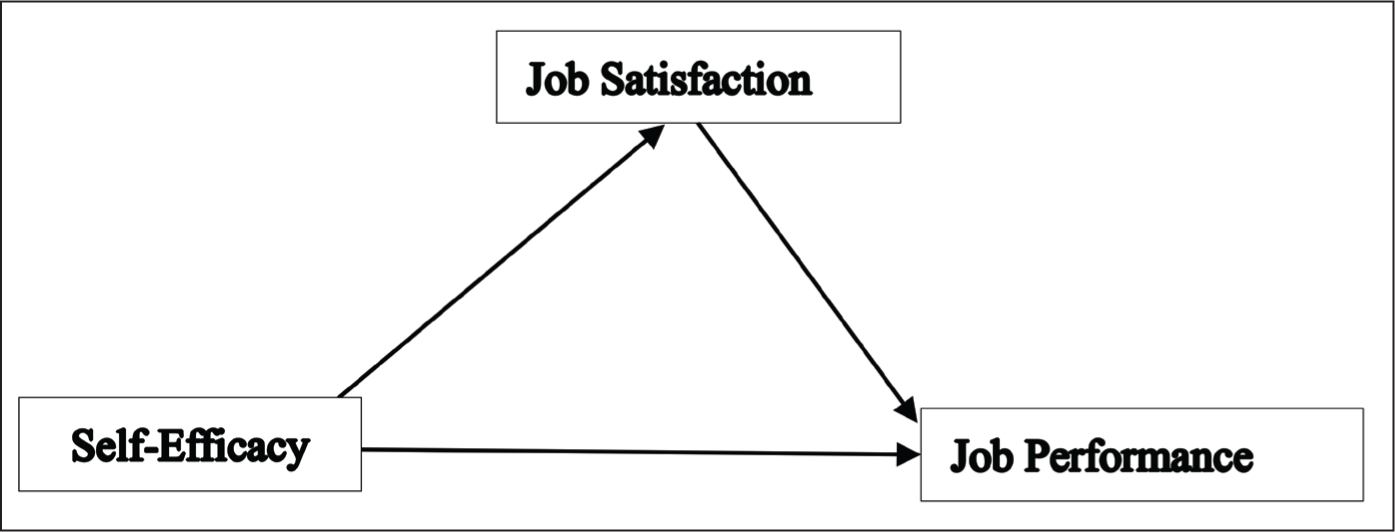
Employees with strong self-efficacy tend to experience greater job satisfaction, which enables them to contribute more effectively to organisational outcomes. This dynamic supports the hypothesis that job satisfaction acts as a mediator in the relationship between self-efficacy and job performance. In other words, self-efficacy influences performance both directly and indirectly, through its impact on job satisfaction. Recent empirical research reinforces this perspective, indicating that job satisfaction significantly mediates the effect of self-efficacy and performance outcomes (Hanifa et al., 2024; Rubasree & Rangarajan, 2023).
Further, evidence from Zhou et al. (2025) reveals that job satisfaction also mediates the relationship between self-efficacy and work engagement, a key driver of job performance. These findings are consistent with earlier studies (Hanifa et al., 2024; Zhou et al., 2023), which highlight job satisfaction as an essential psychological mechanism in translating self-efficacy into improved work outcomes. Thus, self-efficacy enhances satisfaction, which in turn motivates higher performance, forming a robust indirect causal pathway (Rubasree & Rangarajan, 2023).
Methods
This study aims to develop a conceptual model that explores the mediating effect of job satisfaction on the relationship between employees’ self-efficacy and job performance. As desk-based research, it draws upon existing theoretical and empirical literature considered from 2004 to 2024. Relevant data were collected from reputable sources, including peer-reviewed journals, conference proceedings, academic theses, abstracts and other scholarly materials. Based on the comprehensive literature review, a set of hypotheses has been formulated to investigate the interrelationships among the core variables.
Hypothesis Development
Based on empirical insights from prior studies, the following hypotheses are proposed:
H1: There is a significant relationship between self-efficacy and job performance of employees. H2: There is a significant relationship between self-efficacy and job satisfaction of employees. H3: There is a significant relationship between job satisfaction and job performance of employees. H4: There is a significant relationship between performance accomplishment and job performance of employees. H5: There is a significant relationship between verbal persuasion and job performance of employees. H6: There is a significant relationship between vicarious experience and job performance of employees. H7: There is a significant relationship between physiological state and job performance of employees. H8: There is a significant relationship between self-efficacy and task performance of employees. H9: There is a significant relationship between self-efficacy and contextual performance of employees. H10: Job satisfaction mediates the relationship between self-efficacy and job performance of employees.
Measurement of Variables
The sources of self-efficacy are measured by the four variables. First, performance accomplishment indicators are the situational circumstances of the performance, the transitory patterns of success and failure of the performance, the expenditure of effort, the perceived difficulty of the task and the diagnosis (Bandura, 2009). Second, the influencing factors of the vicarious experience are the similarity of the attributes of the model, the similarity of the performance of the model, the mastery or adaptation modelling, the multiplicity and diversity of the modelling and the representation of the demand task (Bandura, 2009). Third, the dimensions of verbal persuasion are credibility, expertise, consensus, degree of disparity in assessment and familiarity with task requirements (Bandura, 2009). Finally, factors influencing the physiological state are the degree of attentional focus on somatic states, the perception of the source of emotional arousal, the level of arousal, and the situational circumstances of arousal (Bandura, 2009).
With regard to job satisfaction, this variable is measured by the Job Satisfaction Survey, which was developed by Paul E. Spector in 1985. Specifically, it includes the variables of pay, promotion, supervision, fringe benefits, contingent rewards, operating procedures, co-workers, nature of work and communication.
In addition, job performance is measured by task and contextual performance (Borman & Motowidlo, 1993). This dual approach is considered the best prediction method to assess job performance. To clarify, task and contextual performance should be differentiated; the task varies considerably from one job to another. Typically, it is related to cognitive ability, whereas contextual performance links more closely with personality. In terms of assessment, task performance is measured through job-specific task proficiency, non-job-specific task proficiency, written and oral communication, supervision and management administration. Meanwhile, contextual performance is measured by interpersonal facilitation behaviour and job dedication behaviour.
Development of the Conceptual Model
In alignment with the research objectives and grounded in a comprehensive review of existing literature, this study proposes a conceptual model that integrates the relationship among self-efficacy, job satisfaction and job performance. Specifically, the model hypothesises that job satisfaction serves as a mediating variable in the relationship between self-efficacy and job performance. This mediating role highlights the psychological mechanism through which belief in one’s capabilities translates into effective job outcomes. Furthermore, the model incorporates the four key sources of self-efficacy identified by Bandura, namely performance accomplishment, vicarious experience, verbal persuasion and physiological state, to provide a more inclusive understanding of how self-efficacy is developed and how it influences job satisfaction and performance (Figure 1).
Conclusions
The results of this study emphasise the interrelationship among self-efficacy, job satisfaction and job performance, particularly within organisational contexts. To support these findings, the researcher drew on early literature to substantiate the evidence and strengthen the significance of the relationships among the variables. Building on this foundation, the study proposed a conceptual model informed by an extensive body of literature, offering a practical and strategic framework applicable to organisations across the public, private and non-governmental sectors. The model is particularly relevant for managers, HR professionals and policymakers, as it highlights the importance of recognising and developing different sources of self-efficacy among employees.
Identifying the distinct dimensions of self-efficacy enables organisations to implement targeted strategies that build employee confidence, thereby enhancing both individual productivity and overall organisational performance. This is especially important among younger employees, for whom belief in personal capability is closely linked to motivation, job satisfaction and performance outcomes.
Ultimately, self-efficacy, job satisfaction and job performance are deeply interconnected concepts that contribute to a healthy and productive work environment. Supporting the development of self-efficacy at all organisational levels, from senior management to frontline staff, can drive sustained improvements in employee well-being and organisational success.
Footnotes
Declaration of Conflicting Interests
The authors declared no potential conflicts of interest with respect to the research, authorship and/or publication of this article.
Funding
The authors received no financial support for the research, authorship and/or publication of this article.