







Abstract
The study examined customer satisfaction with complaints management practices in Bahi District Council in Tanzania. Purposive, snowball and convenience sampling strategies were used to get respondents. Questionnaires and interviews were used to collect data, while the Statistical Package for Social Science and the MAXQDA Analytics Pro 2022 (Release 22.5.0) were used to analyse data. Results show high dissatisfaction with complaints management practices. The inactive complaints management office facilitated the diverted complaints reporting.
Introduction
Customer satisfaction with service provision and/or products has gained strength in public and private service provision research. Scholars have emphasised the importance of customer satisfaction with services and products (Grigoroudis & Siskos, 2010; Isoraite & Akpan, 2017; Stauss & Seidel, 2019). Satisfaction of customers is a reference standard of performance and reliable feedback from customers (Grigoroudis & Siskos, 2010; Isoraite & Akpan, 2017; Stauss & Seidel, 2019). Satisfaction of customers is contextualised, but it could be achieved when the expectations and perceptions of customers are fulfilled (Stauss & Seidel, 2019). The study examined the experiences of customers (referred to in this article as complainants) on complaint management practices. Respondents to the research questions were those who complained at the Bahi District Councils and some key selected informants.
Expectancy disconfirmation theory guided the study. This theory assumes that dissatisfaction or satisfaction from service users is determined by an established comparative standard (a referent) and perceptions of performance. According to this theory, expectations from service users are standards to measure performance. Service users who had complained to the Bahi District Council were used to provide satisfaction or dissatisfaction information.
Studies at global and national levels have reported a significant relationship between the satisfaction of service users and the positive reputation of an organisation (Al Kurdi et al., 2020; Engdaw, 2019; Kashif et al., 2014; Leninkumar, 2017; Maduhu, 2023). Despite the significant relationships, scholars have reported poor attentiveness and unresponsive and slower service provision: poor communication, low assurance, lack of tangibility and reliability of services (Engdaw, 2019; Maduhu, 2023; Selvanathan et al., 2016). USAID (2018) reported improved complaints management in two districts and two municipal councils in Tanzania (Bahi and Kishapu district councils and Ujiji and Mikindani municipal councils). The following section presents the methodology used.
The Study Design and Approach
This was an explanatory case study design. Complementation and triangulation of the data brought the need to use a mixed research methods approach to collect and analyse quantitative and qualitative data (Creswell, 2014; Onwuegbuzie & Leech, 2005). Purposive, convenience and snowball sampling techniques were used to get key informants and 34 complainants. A confirmation and/or disconfirmation site was selected to prove or disprove of initial findings (Grey, 2017; Teddie & Tashakkori, 2009).
Sampling frames (lists of complainants) at Bahi District Councils were missing during the data collection period (July–August 2022). Bahi District Council was selected based on the improved complaints management reported by USAID in 2018 and by the President’s Office-Public Service Management and Good Governance in 2021. Despite the reported improvement at Bahi, the USAID report did not reveal if service users (complainants) were satisfied with complaint management practices. The council was selected to examine the extent of satisfaction of complainants with complaint management practices.
The main variable tested was the experiences in complaint management practices. The variable included questions on the means used to report complaints and the office where they filed complaints. Service/office complaints against and their resolution were also asked. Expectations, satisfaction and/or dissatisfaction and reasons for satisfaction and dissatisfaction questions were also asked. Data were collected using a questionnaire and interview guide. The Statistical Package for Social Science (SPSS) was used to analyse quantitative data. Only frequencies of distribution and percentage were analysed. The MAXQDA Analytics Pro 2022 (Release 22.5.0) was used to code and analyse qualitative data. An interactive quote matrix was used to identify more relevant quotations. The next section presents the results of the experiences of complainants in complaint management.
Means Used to Report a Complaint
Results show that face-to-face and the suggestion box were more commonly used means to report complaints. Twenty-nine (85%) respondents reported using the ‘face-to-face’ and eight (24%) used the ‘suggestion box’. Only five respondents (15%) reported complaints by telephone calls. No respondent admitted the use of e-Mrejesho, e-mail and small message services (SMS).
Those who reported by calls called the higher-level leaders like the District Commissioner, the District Executive Director, the council chairperson and the councillors. One complainant was noted as satisfied with the complaints management in Bahi. The complainant was probed and asked the reason for satisfaction. The complainant said: ‘My sister called the District Executive Director, and explained our concern … we were helped and given another plot of land.’
The nature of the complainants met by the researcher could be a reason for the choices above. Most complainants were citizens around the Bahi District Council headquarters. They were citizens complaining about uncompensated land. The land was taken by the government to establish a new Bahi District Council. Other complainants were Bahi District Council employees who were following up on their long-reported complaints.
The digital divide revealed by Mothobi and Moshi (2017) could be another reason for not using electronic means such as e-mail and e-Mrejesho. The left electronic means need a stable internet connection and electronic devices. During data collection (July and August 2022), the internet connection was not stable in Bahi District Councils. Some officers left the office for Dodoma town, where the internet connection was stable. During the interview session, Case 7 confirmed the poor internet connection. The case reported:
It is not a practice, by this time we were busy with data cleaning exercises, so all of us left Bahi for Dodoma city where the internet connection was stable. Also, we could concentrate more than here. This exercise is demanding and time is limited, it has a time limit. After the exercise, all things will be ok. (Interview with Case 7, 1st August 2022)
Similarly, SMS needs vouchers (money). Sometimes sending SMS could be expensive in terms of money. Since complainants were around the District Council, walking to the council could be a way of saving money. Despite being used by fewer, an observation noted that the suggestion box in the Bahi District Council was rarely opened. The low use of the suggestion box was confirmed by interview Case 2 when asked, ‘How often the suggestion box is opened?’ The case replied:
I do not remember when it was opened … we shared the office with the complaints management … I never saw an opening … maybe it was opened by the District Executive Director. (Interview with Case 2, 27th July 2022)
Complaints’ Reception Office
Complainants were given an open-ended question to fill in at the office where they filed complaints. The purpose was to give them the freedom to say where they reported complaints.
Results show that 15 (44%) complainants reported complaints to the district human resource management office, while 11 (32%) reported to respective departments. Seven (21%) reported complaints to the District Executive Director. Only one (3%) reported to the registry, while no one reported to the District Commissioner.
In practice, the established complaints office/desk is responsible for receiving, sorting and initially resolving complaints. Forwarding unresolved complaints to the respective department and making follow-ups is the responsibility of the established office.
The hard availability of a complaint management officer could be a reason for filing complaints to different offices. During the data collection period (July and August 2022), the complaints management officer was not in office. The officer was attending census seminars. The tendency was proved by Case 2:
Madame … have you seen them since you have come here? They are the bosses; they do not care. All of them are not in office for a long time, and people come and go with their problems. (Interview with Case 2, 26th July 2022)
In addition, overloaded complaints management officers could be among the reasons why the complaints office was not active. The complaints management officer was not exempt from the basic duties and responsibilities. Complaints management was assigned as an extra duty, but it was the most demanding duty. Another reason could be the poor motivation of complaints management officers. The officers were not motivated in terms of extra duty allowances, even stationery. This could be a reason for the Bahi District Council’s complaints management officer to go to the census seminar. In the interview, Case 7 confirmed:
Also, the one appointed to handle complaints is not exempted from the substantive duties and has to fulfill all, sometimes overloaded. Maybe, if possible, a complaints management scheme should be put in place and a person should be employed to handle complaints only. Also, complaints management has no budget which is difficult to implement as per requirements. (Interview with Case 7, 18th August 2022)
Service Complaints Against
Complainants were asked about the services or office they complained against. Results show that 15 (44%) respondents complained about administration and human resource services, while 13 (38%) complained about land services. Moreover, two (6%) complained about secondary education, two (6%) about the District Executive Director services, one (3%) about finance and trade and one (3%) about primary education.
The 15 respondents who complained about administration and human resource services could be those who were making follow-ups about their reported complaints. Most of them were complaining about not being served for a long time. The 13 complainants over land issues could be those who were making follow-up on uncompensated lands. Since 2018, land has been a critical issue in local councils (Lubuva et al., 2018).
Resolutions over Reported Complaints
Complainants were asked if the complaints they reported were resolved. Results show a higher number of complainants admitted, ‘no’ meaning that reported complaints were not resolved. Twenty-two (65%) out of 34 respondents reported that complaints were not resolved. Only 12 respondents (35%) admitted ‘yes’, literally meaning that complaints were resolved.
The high number of complainants who opted for the ‘no’ answer could be those who complained about the land. Some complainants were heard murmuring against unfulfilled land promises. Two employees were seen as disappointed with long-time unpaid arrears, while one was heard complaining about unresolved complaints on the promotion.
Meeting the Expectations of Complainants
Complainants were asked if their expectations were met. Results show a negative response. Out of 34 respondents, 25 (75%) admitted that their expectations were not met. The complainants who met with the researcher looked angry. One complainant reported:
Madame … have you worked in District Councils … in District Councils it is difficult to meet expectations, particularly on issues related to payments…. We were transferred here from Chamwino District Council…. Legally, we deserve to be paid a transfer allowance…. If you want to quarrel with leaders, claim your rights. (Conversation with complainant, 26th July 2011)
Complainants’ Satisfaction Level
Complainants were asked a satisfaction question. Results indicate a high dissatisfaction level. Results indicate that 22 (65%) complainants were dissatisfied with the process of managing complaints. This number included 13 (38%) who were dissatisfied and 9 (27%) who were very dissatisfied with how the solution was reached. Only 12 (36%) complainants were satisfied. They included six (18%) who were very satisfied and another six (18%) who were satisfied.
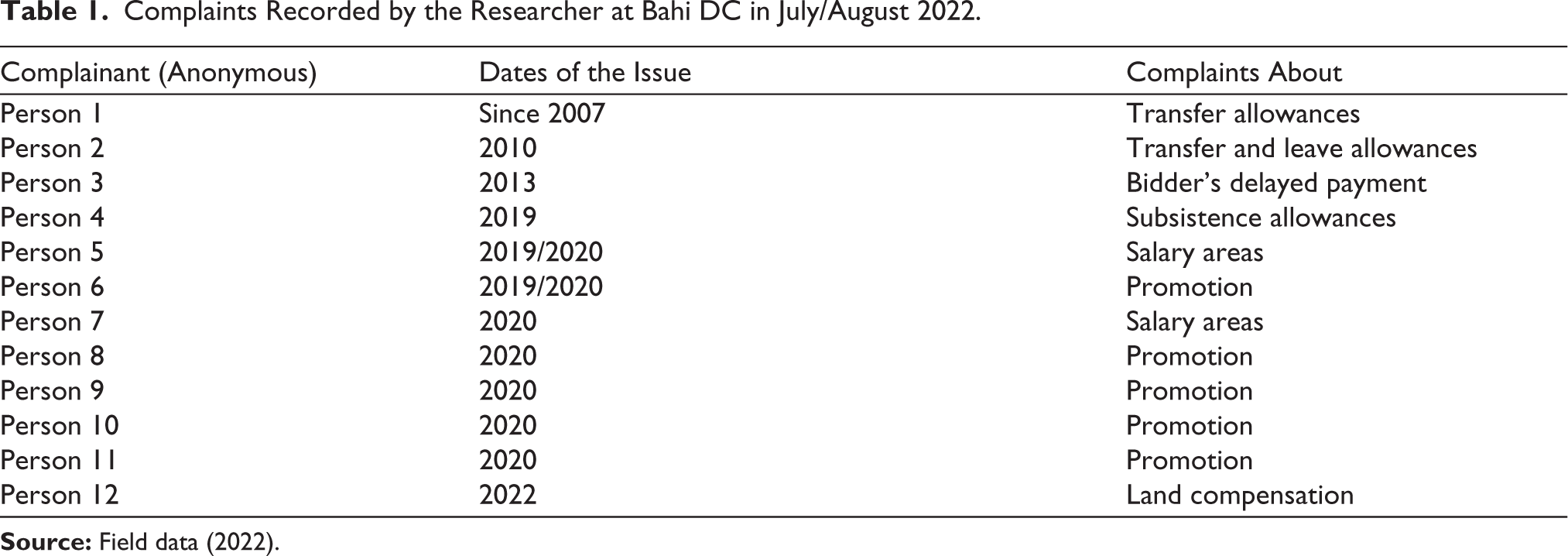
It was true that satisfaction was not met. Most complainants needed compensation in terms of money and surveyed land (see Table 1). On 28 July 2022, a compensated citizen was demanding additional land, complaining that the given plot was not equal to the one taken by the District Council. Equally, other complainants were complaining about money (salary areas and other allowances). Most complainants were dissatisfied because compensation is seen as a big issue. Interview cases confirmed:
Most of land complaints are about compensation. I cannot compensate by myself, I have to forward it to CMT meeting. (Interview with CASE13, 29th July 2022) Most citizens complain over land issues … compensation is a big complaint … we tell them that, we will pay. But the government has no money…. We cannot tell citizens that the government has no money … we keep it secret … we are here to protect our government … do you do the same. (Interview with Case 37, 17th August 2022)
Complaints Recorded by the Researcher at Bahi DC in July/August 2022.
Reasons for Satisfaction/Dissatisfaction
The complainants’ experiences were examined through selected satisfaction and dissatisfaction factors. Most satisfaction factors were not met. Twenty-two (65%) complainants indicated a careless reception of complaints. Besides, 27 (79%) complainants indicated no quicker response, while 32 complainants (94%) indicated that there were few means to report complaints.
Moreover, 30 (88%) indicated that they were mistreated. Similarly, all 34 (100%) complainants were not encouraged to complain by council employees, especially complaints management officers. Equally, 32 (94%) complainants indicated poor follow-up. Similarly, 32 (94%) complainants indicated the absence of polite language.
Similarly, 19 (56%) complainants indicated that their complaints were not acknowledged. Moreover, 23 (68%) complainants were dissatisfied because of the very long process of complaint management. Good enough, 25 (74%) complainants confirmed that filing complaints was not expensive. Referring to the complaints management practice found in Bahi District Council, it is obvious that complainants are dissatisfied. Even if it were me, my land was taken, for over 10 years, no compensation or legal allowances were paid, my answer could be dissatisfaction.
Conclusion and Recommendation
Results show a dominant use of two means for reporting complaints. Face-to-face and suggestion boxes are more commonly used than telephone calls, SMS, e-mails and the e-Mrejesho. Even if the suggestion box was fixed but was rarely opened. Results revealed the persistence of diverting complaints. Complainants admitted to reporting complaints to any office. The office of the district human resource, respective departments, the Office of the District Executive Director and the registry emerged as the sole complaint reception offices. Land, finance and trade, and administration and human resource offices/services are more complained about than other services/services. Results revealed more unresolved complaints, which led to a high level of dissatisfaction. Complaint management was not given more attention, and complaint management officers were not motivated.
Complaint management should be officialised and be a section under the human resource division, and the officer in charge of complaint management could be a member of the Council Management Team (CMT). This would make complaint management an official CMT meeting agenda. More awareness could be created on how to use other e-Mrejesho means to report complaints. For example, awareness of how to use the *152*00# code for filing complaints should be created through radio and TV programmes. Flyers should be distributed to citizens and to Mtaa/Village government offices on how to use this free means to report complaints. The other e-Mrejesho platforms, such as websites, e-mails, mobile apps, calls and SMS, are constrained by the digital divide revealed by Mothobi and Moshi (2017). Awareness creation on using the *152*00# could add a quicker and more confidential complaint reporting mechanism.
Footnotes
Acknowledgements
Data analysis could have been difficult without Dr Godfrey Nkwera and Mr Mathew Kilasi, who assisted the researcher on quantitative and qualitative data analysis.
Declaration of Conflicting Interests
I declare that I did not have any potential conflict of interest concerning the research, authorship and publication of this article.
Funding
I did not receive any funds for research and I do not have any sponsorship for publishing this article.