







Abstract
Recently, it has been observed that there is an increasing awareness within the corporates on the significance of going green and adopting various environment-friendly management techniques. The corporate world is experiencing a shift from a conventional-based economy to a modern capacity-based economy by exploring the green economic facets, thus competing with the global world. Green human resource management (green HRM) has resulted in a key business strategy in many organisations where human resource departments play an active role in going green in their organisations. The present study largely focuses upon the various green HR practices which can be pursued by the organisation towards employee commitment. The present study also adds extant literature to discuss the future direction of some green HRM functions. Finally, the study suggests the potentially prolific HR initiatives that could be implemented for green organisations.
Keywords
Introduction
The twenty-first century has been showing heightened interest in environmental concerns all around the globe, irrespective of related fields, be it politics, public or business. Globally, there was an interest and specific treaties to combat climate change (Victor, 2001). Owing to the denigrating consequences of industrial contamination and industrial waste, governments and NGOs across the globe promoted ordinances and policies for slowing down to some extent and reverse the devastation of natural resources and their damaging effect on mankind and society (Christmann & Taylor, 2002; Shrivastava & Berger, 2010).
Today, the corporate world has to deal with economic issues, besides discovering means and techniques to reduce ecological footprints. To succeed and benefit all the stakeholders, the corporate community has the obligation to concentrate on social and environmental factors along with economic and financial factors (Daily et al., 2007; Govindarajulu & Daily, 2004).
Implementation of sustainable corporate strategies within an organisation requires both strong leadership and a concrete process (Glavas & Kelley, 2014). Though there is a fast-moving awareness on incorporating ‘green’ into the corporate strategy and becoming the priority of the corporate leaders across the globe, the concept still seems to be uncomfortable with most of the practitioners in the HR environment (Wirtenberg et al., 2007).
The most important contributor to implement any corporate environmental programme is the HRM unit, which has to work together with other functions in the organisation, such as HR, marketing, IT, finance and so on. The major stakeholder in addressing environmental issues is the corporate world. A larger part of the workforce in the corporate world is concerned about the environment, where employees are committed and endorse proactive green measures taken by their organisations.
A worldwide consensus has emerged in the past two decades for the need for proactive environmental management (González-Benito & González-Benito, 2006). Against this background, vast literature on green marketing (Peattie, 1992), green accounting, green retailing (Kee-hung et al., 2010) and green management (McDonagh & Prothero, 1997) has impregnated the domain of management. Moreover, the active participation of the corporate sector in the adoption of environmental management strategies (Boiral, 2002; González-Benito & González-Benito, 2006) paved the way for a green management perspective. HRM, being considered the light of sustainability all over the corporate world, the green HRM has become the most significant element of sustainability.
Mampra (2013) defines green HRM as the use of HRM policies within the business enterprise to encourage the sustainable use of resources and promote the cause of environmentalism, which boosts employee morale and satisfaction. Others describe green HRM as the use of HRM policies to promote sustainable use of resources and thwart any adverse harm arising from environmental concerns in organisations (Zoogah, 2011). Green initiatives form a part of wider programmes of corporate social responsibility within the HRM. Green HR essentially consists of two major elements, namely environment-friendly HR practices and the preservation of knowledge capital (Mandip, 2012). HR policies and practices are responsible for planning and executing eco-friendly policies to create a green atmosphere. Without facilitating the human resources and implementing sustainable policies, going green would be a hard nut to crack.
Though there is a substantial existing literature which deals with the topic of green HRM, still there is ambiguity within the organisations in the effective implementation of green HR management policies around the globe to attain an absolute green corporate culture.
This study exclusively focuses on the green HRM, where HRM is engaged in dealing with the environment within the business enterprise.
This article comprehends how the company is taking initiatives to endorse environmental management programmes by developing and implementing human resource policies and ascertaining different processes involved in green HRM. Further, the article reviews the literature on HR aspects of green HRM, which helps in identifying how corporates today develop human resource policies for going green. The study provides simplified insights into green HRM processes and suggests some green initiatives for HR.
The study is organised as follows. After the introduction, the need for green HRM, the literature review and practices and policies of green HRM, the objectives of the study, hypotheses development, methodology and through research design, sample size, data collection, data analysis and measurement are discussed. Subsequently, the study presents the empirical results. Finally, the study concludes by providing both theoretical and practical implications with limitations and suggesting further studies that may be useful for both academicians and practitioners.
Need for Green HRM
The last two decades have witnessed the need for a realistic environmental management drive all over the world. It has been evident that the damaging effects of different pollutants, including industrial wastes, have been worsening and depleting the natural resources. In June 1972, the first United Nations (International) Conference on Human Environment was held in Stockholm, which resolved to defend and improve the human environment for present and future generations, which has become an imperative goal for mankind (Shaikh, 2010, p. 122). Researchers are today analysing various HR and managerial practices which can lead to the attainment of the goals of green HRM and to make a significant impact on the environmental competitiveness of organisations.
Literature Review
A great extent of literature has focused on the adoption of environmental practices with the support of the human resource practices framing a key objective in organisational functioning (Cherian & Jacob, 2012, p. 25). Daily and Huang (2001) proposed the need to balance the industrial growth as well as preservation of the environment by endorsing green practices, where companies may earn more profit than before (Murari & Bhandari, 2011).
Haden et al. (2009) stated that the integration of strategic development goals and environmental objectives of a company results in an effective environmental management system.
It has been identified that the greater the implementation of green human resource policies, the greater will be the intensity of adoption of environment management systems (EMS) and policies by different companies (Bohdanowicz et al., 2011).
Implementation of green HRM depends on the HR managers to identify unique patterns of green decisions and behaviours (Jackson et al., 2011). The internalisation of environmental objectives into the strategies for the overall strategic development goals helps organisations in arriving at an effective EMS (Haden et al., 2009). Policies in the field of employee recruitment, performance appraisal management, training, employee relations, compensation and reward systems are considered powerful tools for aligning employees to the company’s environmental strategy (Renwick, 2008).
A great deal of technical and managerial skills are required among all employees to promote and implement an effective corporate green management system (Daily et al., 2007). However, according to Unnikrishnan and Hegde (2007), some organisations started engaging themselves to look at innovative tools and initiatives for effective environment management (EM), which promotes a competitive advantage and will impact the sustainability of the firm (Hart, 1997; Lin et al., 2001).
Therefore, effective human resource practices, including stern recruitment policies (Grolleau et al., 2012), appraisal management, training and empowerment programmes (Unnikrishnan & Hegde, 2007) and reward systems, should be assessed from the environmental awareness perspective (Jabbour et al., 2010) to resolve and facilitate the novel skills and competencies among the employees of ‘pro green’ organisations. Thus, irrespective of the methodology adopted, the literature suggests the proper alignment of human resource policies and practices with the objectives of green management in an organisation.
Studies conducted during the last decade have started focusing on the relationship between the practices of green HRM and employee commitment, in particular environmental or green commitment. Many studies have found positive direct relationships between green HRM practices (e.g. green recruitment, green training and green rewards) and the commitment of employees to the environmental objectives. For example, Pham et al. (2019) discovered that green training, green rewards and a green organisational culture positively impact the environmental commitment of employees, and the interaction between these practices can further enhance commitment in some cases.
Recent empirical research has extensively supported the role of employee commitment as the result of green HRM and as an intermediary between the HR practices and the green behaviours. Based on the manufacturing industry data, Jnaneswar et al. in 2023 found that the existing correlation between green HRM and pro-environmental behaviour of employees is mediated by a psychological green climate and commitment of employees. Similarly, Faezah et al. (2024), in the framework of the higher education system, proved that employee commitment is a pivotal mediating variable in the relationship between green HRM practices and ecological behaviour.
The most recent multi-sector and country studies also demonstrate the same findings: Gomes et al. (2024) in the Portuguese tourism sector discovered that the relationship between green HRM and eco-friendly employee behaviour and performance is mediated by affective/green commitment, which implies that commitment assists in converting HR practices to the visible consequences of the environment. Similarly, Rajkumar et al. (2024) state that strategic green HRM (recruitment, selection, training, appraisal and rewards) has a significant positive impact on employee commitment and environmental performance in different settings. In addition to mediation, moderators have become critical conditions. Gomes in 2022 demonstrates that the biosphere of values among employees (i.e., how much individuals are interested in the biosphere) reinforces the connection between green HRM practices and affective commitment—the more employees are motivated themselves, the more they are keen on green HRM practices. This implies that there is a joint influence of individual differences (values) and organisational climate on whether green HRM results in a stronger commitment and eventually behaviour change. Although these improvements have been made, there are still a number of gaps. Most of the studies are sector- or country-focused (manufacturing, tourism, higher education), and a smaller number of studies test simultaneously a wide range of green HRM practices in one model in addition to investigating direct and interactive impacts on commitment. Interaction effects were tested by Pham et al. (2019), and some of the synergies were observed (e.g. training × culture), yet other recent studies that consider multiple practices tend to consider mediation or a single moderator instead of a complete interaction matrix. The current research adds to this body of literature by testing the seven green HRM practices jointly and the direct and interactive effects on the environmental commitment of the employees.
Primarily, this study focuses on green HRM, which, according to Dutta (2012), includes the major elements of environmental-friendly HR practices and safeguarding the knowledge capital. Green HRM refers to promoting sustainable environmental practices and increasing employee awareness of the issues of sustainability (Mandip, 2012).
Green HRM focuses on employees’ environmental behaviour, which in turn gestates such a pattern of consumption in their private life (Muster & Schrader, 2011).
The foremost objective of green HRM is to create awareness in employees about the intricacies of EM that motivates and develops a sense of pride in them for being a part of the ongoing green programme.
Practices and Policies of Green HRM
Implementation of green HRM helps to create a green workforce and a green work culture in an organisation. Such green initiatives can uphold their green objectives from the process of recruitment, training, compensating, developing and advancing the firm’s knowledge capital (Dutta, 2012). The HR department plays a substantial role in the creation of sustainability within an organisation (Harmon et al., 2010). It transforms green HR policy into practice (Renwick, 2008); therefore, human capital and its organisation can be instrumental in the fulfilment of environmental objectives.
Consequently, HR function has become a potentially important contributor to such strategic issues and thus became instrumental in bringing organisational change, which is aimed at acclimatising to the newfound issue. Ulrich et al. (2009) pointed out that for the organisation to achieve its strategy alignment of HR systems, there is a need to increase the likelihood to achieve its strategy. Cherian and Jacob (2012) found recruitment, training, employee rewards and motivation as the most important human dimensions that contribute to the enactment of green management principles.
It is crucial that HRM functions are adopted or modified to ensure that employees in organisation get the right inputs on green management and green performance of the job (Opatha & Arulrajah, 2014, p. 107). This next section describes a few specific functional HRM activities which have been identified for the sustainability of the natural environment at the workplace and provides opportunities for research in the future.
Green HRM: Job Design and Recruitment
Green HRM should start even before acquiring and inducting new employees into the organisation. The process of designing or approving job design and descriptions should be on the basis of green HRM, and so it is crucial to have job design that highlights the tasks related to environmental protection and to mirror organisations ecological concerns even while advertising for job.
Green HRM: Selection Process
Organisations should ensure that the screening and selection process of the candidates includes aptitude towards green behaviours. Questions relating to environment and climate change in the process of selection or during the group dynamic process that composes a business case with sustainability issues can help an organisation to understand the degree of ecological awareness of the candidates.
Green HRM: HR Policies
Implementation of technology has led many companies to digitalise and adopt paperless communication, encouraging and promoting a green environment, which has been in place since recruiting new employees.
Companies started using online portals and drives from archived documentation right from offer letters, employee credentials and all official communication to their employees regarding health insurance or contracts, salary or information on other benefits.
Furthermore, induction programmes are to be designed to integrate the company’s green consciousness, highlighting the company’s concerns on environmental issues and the action plan being established from the employees’ side to its value chain with other stakeholders, besides presenting the company’s achievements, awards, recognition, policies, practices and procedures.
Green HRM: Performance Appraisal Management System
Performance appraisal management system (PAMS) is the process where employees are stimulated to augment their skills that help them to achieve the organisational goals and objectives. Thus, to create a green company, the PAMS has to include sustainability goals measured with specific environmental metrics.
The biggest impediment to green PA is the accuracy in measuring the data on environmental performance. To overcome this, companies can start applying for ISO certification, which will help them collect data and at the same time get some advice on how they can become more sustainable. Thus, the decisive goal of green PM is to assess the employees’ ability with the measurable outcome in meeting ecological objectives and targets which are set forth in the organisation’s environmental plans and policies.
Green HRM: Learning and Development
Learning and development focuses on developing employees’ KSAs on green HRM. The objective of green learning and development is to enhance the awareness on the environmental issues arising worldwide—through pamphlets, newsletters or briefings, thereby educating employees about the working methods that will allow them to reduce waste by recycling, save energy by appropriate usage of power and save resources by optimum utilisation. Thus, the green learning and development is to thrust the company’s workforce into an environmental safeguard mindset and thereby making the workforce act consciously for a more sustainable future.
Green HRM: Compensation and Reward Management
Green compensation and reward management (CRM) should aim at recognising the employee contribution in creating a more sustainable company. The success of employees lies in achieving the company’s strategic goals aligned with environmental sustainability and the proof that is being mirrored and accomplished.
Green HRM: Employee Relations and Go Green Management
It is vital to ratify ‘eco-intrapreneurs’ who add value to the company’s products and/or services with efficient and optimum utilisation of the available financial, human and natural resources. This can be the source of encouraging employees to get involved in the environmental initiatives organised by the company.
Green HRM: Exit Interview
As part of the strict compliance of the green HR strategies and policies, and depending on the seriousness of the delinquency and its impingement, companies can take actions where ecologically unfriendly behaviour may constitute a breach of contract and be the possible ground for dismissal. If this materialises, it is really important to mark exit interviews to evaluate the employees on the basis of the company’s ecological practices.
Consequently, the main objective of the study is to explore the green HRM and employee commitment towards the green environment by employing the quantitative approach to analyse the main inquiries driving this work:
RQ1: Whether green HRM practices affect employee commitment towards the environment or not? RQ2: Whether the interactions of green HRM practices affect employee commitment towards the environment or not?
Objectives
The main purpose of this study is to:
provide a basic understanding of Green HRM to the readers; elaborate on various green practices that can be incorporated for building a green workplace; study the perception levels of the employees’ on the green HR practices (job design and recruitment, selection process, HR manoeuvres, PAMS, learning and development, compensation and reward management, employee relations and go green management) and suggest some green initiatives for HR in the organisation.
Hypothesis
The article employs the social exchange theory to argue the direct consequences of green HRM practices on employee commitment towards the environment. Employee attitude and commitment is an important aspect of HRM activity; hence, a good HRM strategy results in positive and significant employee commitment in the workplace.
Moreover, employees’ active and regular participation in the environmental activities reinforces their commitment to corporate environmental targets and policies (Jabbour et al., 2010). Thus, green HRM practices may stimulate employee commitment towards a green environment through knowledge sharing, and with the increase in employees’ perception of green HRM (Ren et al., 2018). This brings progressive changes to employees’ green knowledge, awareness and skills, and accordingly it leads to the adoption of a green attitude of employees at the workplace (e.g. employee environmental commitment).
Thus, it is expected to discover the interactions of green HRM practices—green job design and recruitment, green selection process, green HR policies, green PAMS, green learning and development, green compensation and reward management, green employee relations and go green management).
Consequently, this study hypothesises that
H1a: Green job design and recruitment have a significant effect on employee commitment towards the environment. H1b: The green selection process has a significant effect on employee commitment towards the environment. H1c: Green HR policies have a significant effect on employee commitment towards the environment. H1d: Green PAMS has a significant effect on employee commitment towards the environment. H1e: Green learning and development has a significant effect on employee commitment towards the environment. H1f: Green CRM has a significant effect on employee commitment towards the environment. H1g: Employee relations and go green management have significant effects employee commitment towards the environment.
The interactions of green HRM practices, including (green learning and development × green CRM), (green PAMS × green CRM), may influence employee commitment towards the environment.
Consequently, this study hypothesises that:
H2a: There is a two-way interactive effect of green learning and development × green CRM on employee commitment towards the environment. H2b: There is a two-way interactive effect of green PAMS × green CRM.
Research Design, Data Collection and Analysis
A quantitative approach was employed in the study, aiming to infer the population’s characteristic, attitude or behaviour from a sample. The study relied on primary data collected through a structured questionnaire survey, while secondary data from existing literature were used to support the theoretical foundation and research framework. The objective of the research is to evaluate the interactive effects of green HRM practices on employee commitment towards the environment.
Thus, the study employed the survey strategy and the questionnaire technique to apply a quantitative study and to assess the associations between variables. Data collection was performed through a framed and structured questionnaire with closed-ended questions to the respondents, both in hard copy and soft copy via e-mail. The items in the questionnaire would be measured using the five-point Likert scale, which ranged between strongly disagree (0) and strongly agree (5). Everything was based on scales of previously tested green HRM and employee commitment scales (e.g. Jabbour et al., 2010; Pham et al., 2019) and had good content validity, as well as congruence with the previous research. A pilot test was carried out in which 10 employees were involved to trim down wording and ensure it is clear. To make the data relevant to the objectives of the study, a purposive sampling strategy was employed, whereby employees in organisations, where some environmental management practices had been implemented, were targeted.
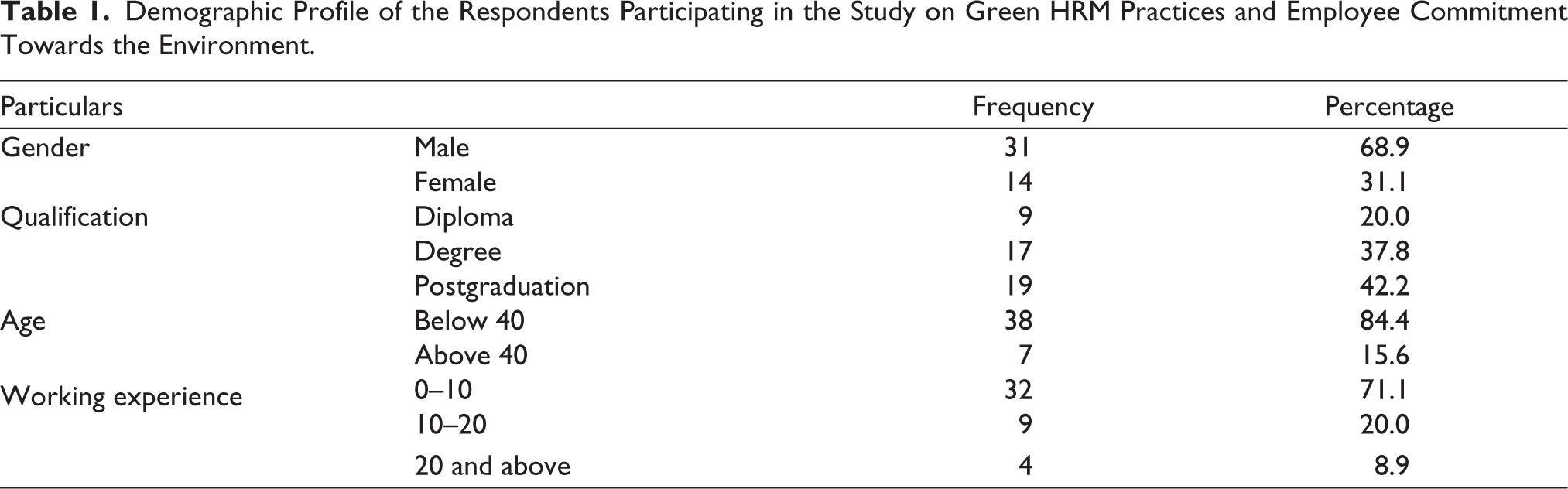
After having checked carefully the received questionnaires, 45 valid responses became the dataset for the analysis. According to the number of the structural paths shown in Figure 1, the sample size of 45 is consistent as per the argument of Hair et al. (2010), who suggest that the sample size should be calculated more than 10 times the largest number of structural paths directed at a particular construct. Table 1 shows the profiles of the sample.
Concerning the data analysis, we first employed statistics to assess internal consistency, reliability, convergent validity, discriminant validity of the measurement, regression coefficient and correlation matrix to test three hypotheses H1a, H1b, H1c, H1d, H1e, H1f, H1g and H1h. Later, the data were utilised to investigate the interactive effects of green HRM practices on employees’ environmental commitment to test hypotheses H2a and H2b. A reliability test is applied for analysing the consistency of the data collected. The internal consistency and validity of the data have been tested by using the Cronbach α test. The α value should range from 0 to 1. The α value greater than 0.7 is said to be reliable. The Cronbach α test results are tabulated in Table 2. The α value is 0.772, which is greater than 0.7. This means that the data are of good consistency and validity. Correlation is used to find the covariation of the variables in the study. Regression is used for analysing the association and causation effect.
Demographic Profile of the Respondents Participating in the Study on Green HRM Practices and Employee Commitment Towards the Environment.
Reliability Test.

Cronbach α was used in order to test the reliability of the tool and yielded a coefficient of 0.772 over the seven dimensions of green HRM, which demonstrates that the tool has an acceptable internal consistency. Construct validity was also supported by the fact that the questionnaire items were modified as per the previously validated scales. SPSS (27) was used to analyse the data.
Measurement
All constructs applied were measured with five-point Likert scales. We applied the SPSS software to assess the measurement. The assessment of the measurement model was analysed through a regression and correlation coefficient analysis.
Hypotheses Testing
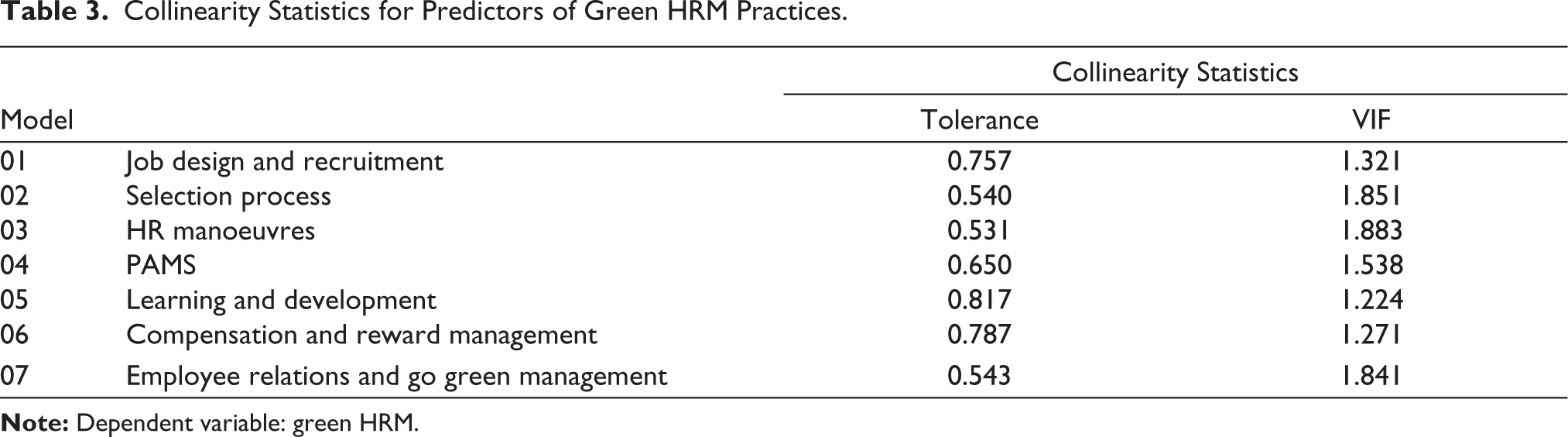
After the confirmation of the reliability and validity by the researcher, the next step consists of assessing and testing the hypotheses. First, this work evaluates the collinearity of the model to measure the severity of the collinearity in the regression model. The recommended VIF values should be less than 5 (Hair et al., 2010). The results range from 1.271 to 1.883, showing that there are no collinearity problems interfering with these results (Table 3).
Collinearity Statistics for Predictors of Green HRM Practices.
H1a: Green job design and recruitment have a significant effect on employee commitment towards the environment.
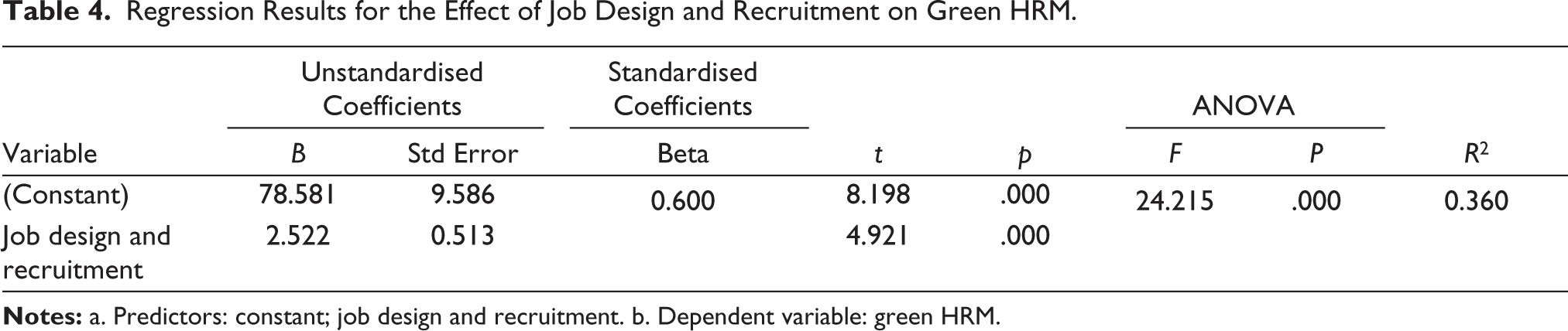
The R2 value is 0.360. This means that 36.0% of the green HRM is explained by job design and recruitment. The impact is moderate. The coefficient of the independent variable, job design and recruitment, is 2.522, which means that green HRM increases by 2.552 when job design and recruitment increases by 1 (Table 4). The p value is .000, which is less than 0.05 at the 5% level of significance. Hence, the alternate hypothesis is to be accepted. Therefore, it can be concluded that there is a significant positive impact of job design and recruitment on green HRM. The regression equation for job design and recruitment is: green HRM = 78.581 + 2.522 (job design and recruitment).
Regression Results for the Effect of Job Design and Recruitment on Green HRM.
H1b: Green selection process has a significant effect on employee commitment towards the environment.
The R2value is 0.503. This means that 50.03% of the green HRM is explained in the selection process. The impact is moderate. The coefficient of the independent variable selection process is 2.98, which means that green HRM increases by 2.980 when the selection process increases by 1 (Table 5). The p value is .000, which is less than 0.05 at the 5% level of significance. Hence, the alternate hypothesis is to be accepted. Therefore, it can be concluded that there is a significant positive impact of the selection process on green HRM. The regression equation for the selection process is: green HRM = 73.237 +2.980 (selection process)
Regression Results Showing the Effect of the Selection Process on Green HRM Practices.

H1c: Green HR policies have a significant effect on employee commitment towards the environment.
The R2 value is 0.510. This means that 51.0% of the green HRM is explained in the HR policies. The impact is moderate. The coefficient of the independent variable selection process is 3.609, which means that green HRM increases by 3.609 when HR policies increase by 1 (Table 6). The p value is .000, which is less than 0.05 at the 5% level of significance. Hence, the alternate hypothesis is to be accepted. Therefore, it can be concluded that there is a significant positive impact of HR policies on green HRM. The regression equation for HR policies is: green HRM = 59.707 +3.609 (HR policies).
Regression Results Showing the Effect of HR Policies on Green HRM Practices.

H1d: Green PAMS has a significant effect on employee commitment towards the environment.
The R2 value is 0.500. This means that 50.0% of the green HRM is explained in the PAMS. The impact is moderate. The coefficient of the independent variable PAMS is 2.796, which means that green HRM increases by 2.796 when PAMS increases by 1 (Table 7). The p value is .000, which is less than 0.05 at the 5% level of significance. Hence, the alternate hypothesis is to be accepted. Therefore, it can be concluded that there is a significant positive impact of PAMS on green HRM. The regression equation for the PAMS election process is: Green HRM = 74.325 + 2.796 (PAMS).
Regression Results Showing the Effect of Performance Appraisal and Management Systems on Green HRM Practices.

H1e: Green learning and development has a significant effect on employee commitment towards the environment.
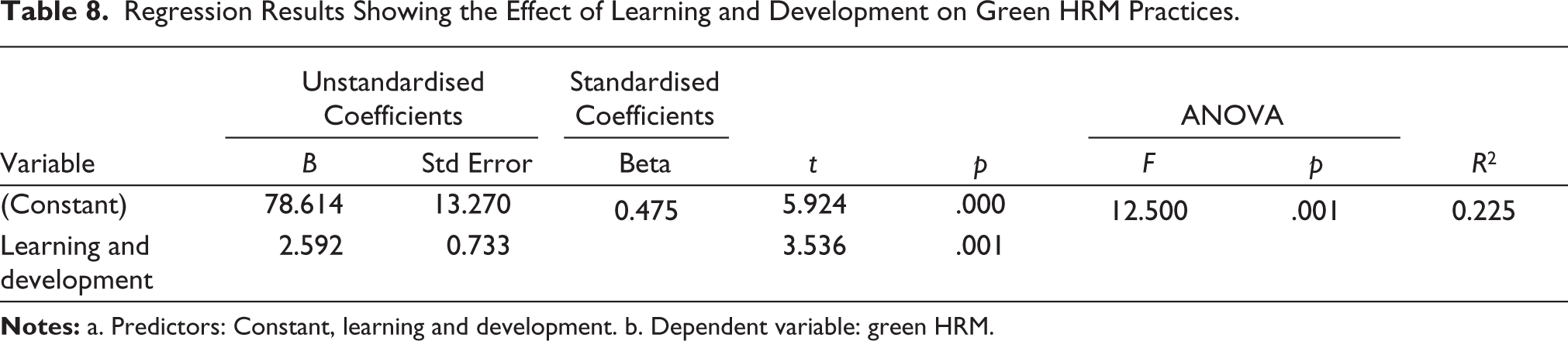
The R2 value is 0.225. This means that 22.5% of the green HRM is explained in the learning and development. The impact is minimal. The coefficient of the independent variable selection process is 2.592, which means that green HRM increases by 2.592 when learning and development increases by 1 (Table 8). The p value is 0.001, which is less than 0.05 at the 5% level of significance. Hence, the alternate hypothesis is to be accepted. Therefore, it can be concluded that there is a significant positive impact of learning and development on green HRM. The regression equation for learning and development is: Green HRM = 78.614+2.592 (learning and development).
Regression Results Showing the Effect of Learning and Development on Green HRM Practices.
H1f: Green compensation and reward management (CRM) has a significant effect on employee commitment towards the environment.
The R2 value is 0.302. This means that 30.2% of the green HRM is explained in the CRM. The impact is moderate. The coefficient of the independent variable selection process is 2.952, which means that green HRM increases by 2.952, CRM increases by 1 (Table 9). The p value is .000, which is less than .05 at the 5% level of significance. Hence, the alternate hypothesis is to be accepted. Therefore, it can be concluded that there is a significant positive impact of CRM on green HRM. The regression equation for CRM is: Green HRM = 74.706 + 2.952 (CRM).
Regression Results Showing the Effect of Compensation and Reward Management on Green HRM Practices.

H1g: Employee relations and go green management (ERGGM) has a significant effect on employee commitment towards the environment.
The R2 value is 0.593. This means that 59.3% of the green HRM is explained in the employee relations and go green. The impact is moderate. The coefficient of the independent variable selection process is 3.309, which means that green HRM increases by 3.309 employee relations and go green increases by 1 (Table 10). The p value is .000, which is less than .05 at the 5% level of significance. Hence, the alternate hypothesis is to be accepted. Therefore, it can be concluded that there is a significant positive impact of employee relations and go green on green HRM. The regression equation for employee relations and go green is: Green HRM = 59.707 +3.609 (HR policies).
Regression Results Showing the Effect of Employee Relations and Go-green Management on Green HRM Practices.

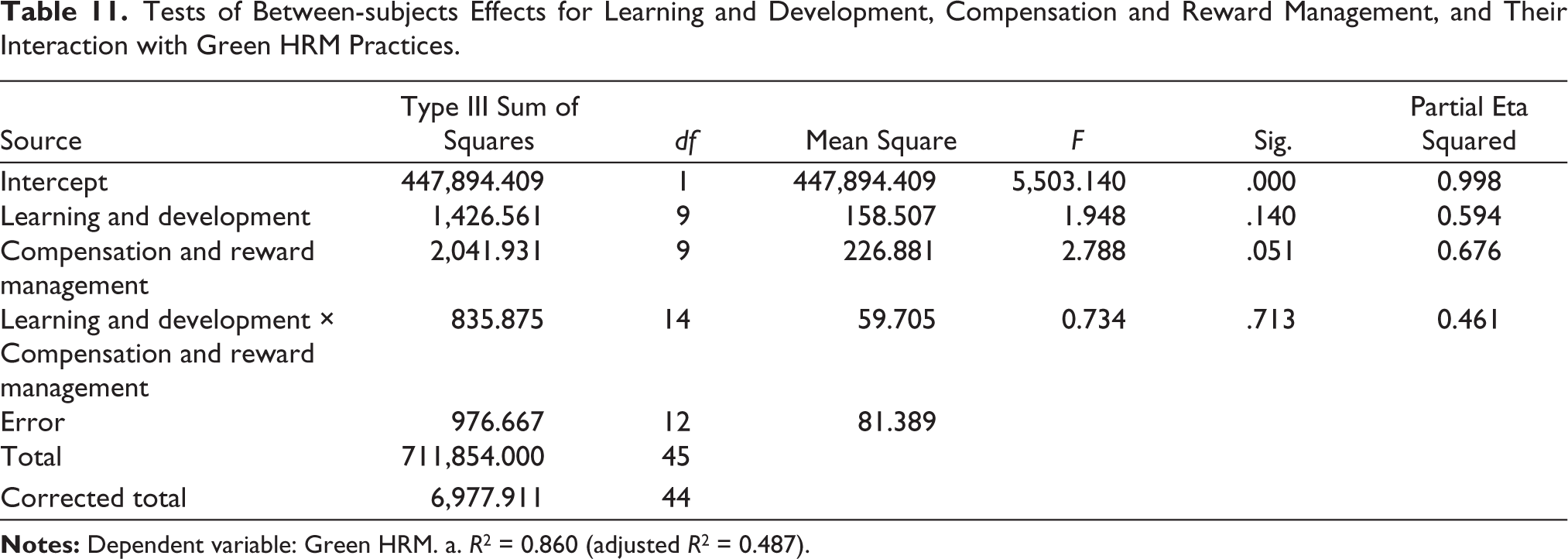
H2a: There is a two-way interactive effect of green learning and development × green compensation and reward management on employee commitment towards the environment.
Learning and development and compensation and reward management effects were statistically not significant at p is more than .000. The main effect of learning and development yielded an effect size of 0.594, indicating that 59.4% of the variance in the green HRM scores was explained by learning and development (F (9, 12) =1.948, p = .140). The main effect of compensation and reward management yielded an effect size of 0.676, indicating that 67.6% of the variance in green HRM scores was explained by learning and development (F (9, 12) = 2.788, p = .51) (Table 11). The interaction effect was not significant (F (14, 12) = 0.734, p = .713) at the 5% level of significance, indicating that there was no combined effect for learning and development and CRM on the green HRM scores.
Tests of Between-subjects Effects for Learning and Development, Compensation and Reward Management, and Their Interaction with Green HRM Practices.
H2b: There is a two-way interactive effect of green PAMS × green CRM.
PAMS and CRM effects were statistically not significant as the p-value is more than .000. The main effect of PAMS yielded an effect size of 0.839, indicating that 83.9% of the variance in the green HRM scores was explained by PAMS (F (12, 11) = 4.777, p = .007) (Table 12). The main effect of CRM yielded an effect size of 0.778, indicating that 77.8% of the variance in green HRM scores was explained by CRM (F (9, 11) = 4.290, p = .13). The interaction effect was not significant (F (12, 11) = 1.764, p = .658) at the 5% level of significance, indicating that there was no combined effect for PAMS and CRM on the green HRM scores.
Tests of Between-Subjects Effects.
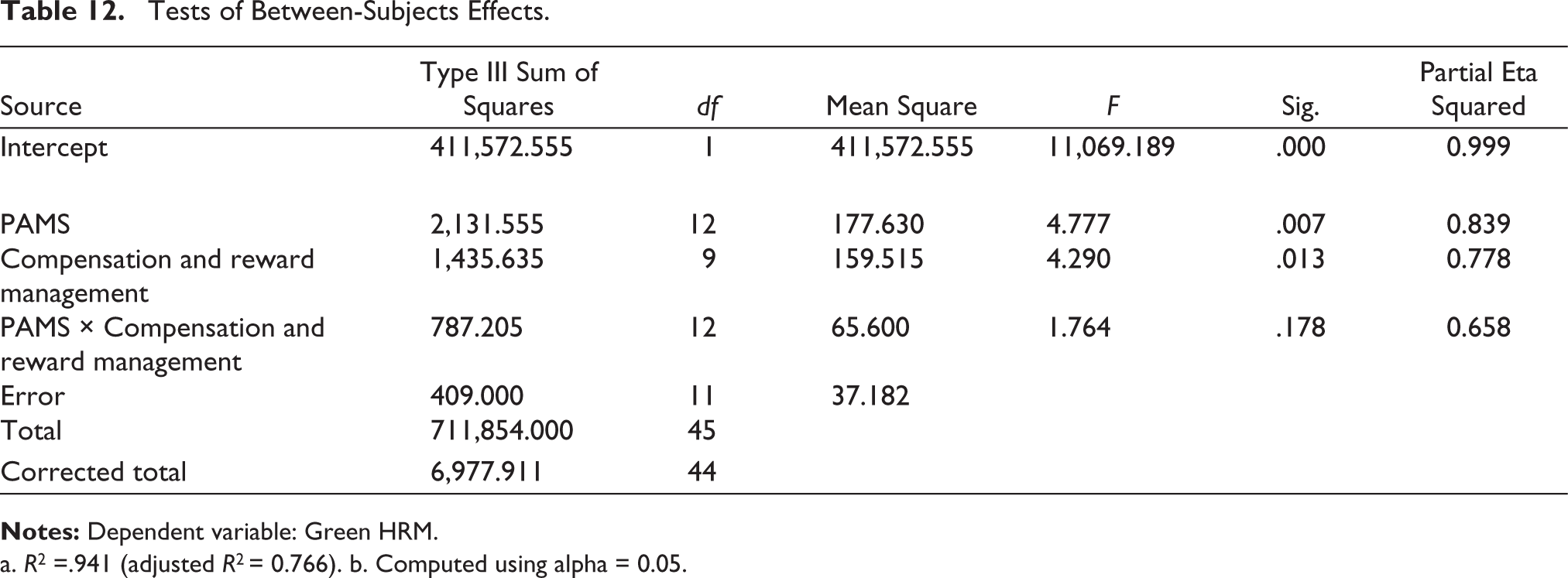
a. R2 =.941 (adjusted R2 = 0.766). b. Computed using alpha = 0.05.
Discussion
The results of this research suggest that all seven green HRM practices—recruitment and selection, training and development, performance appraisal, rewards and compensation, HR policies, job design and employee relations—have a strong positive impact on employee environmental commitment. As an example, regression analysis revealed that the HR policies explained the variance of commitment (R2 = 0.510, B = 3.609), and the selection process explained it (R2 = 0.503, B = 2.980) as well. On the same note, performance appraisal (R2 = 0.500, B = 2.796) and job design and recruitment (R2 = 0.360, B = 2.522) turned out to be powerful predictors. These findings offer quantitative evidence to the statement that the independent effect of green HRM practices is the increase in the pro-environmental commitment of employees.
This result is similar to those of the previous research. An example of such a study is by Pham et al. (2019), who created a correlation between the green training, green rewards and organisational culture and the environmental commitment of its employees and established a positive effect between the two variables. The current study supports the direct effects only, but not the interaction effects, since there were no significant interactions. Such a difference might be because of contextual differences: the sample size (N = 45) of the current dataset might not be sufficient to identify synergies because Pham et al. also used a larger sample size and placed more emphasis on the organisational culture.
The findings also echo those of Jnaneswar et al. in 2023, who found that green HRM had a positive impact on a green behaviour in the manufacturing industry in terms of employee commitment and psychological climate of green. Equally, the authors determined that commitment mediated the relationship between green HRM and ecological behaviour in institutions of higher learning, and that this also applies to the Portuguese tourism industry (Gomes et al., 2024). The fact that some of the practices that were used to explain the variances in the present study (e.g., the HR policies and selection, each of which explains more than 50% of the variance) have a high explanatory power of green HRM as a predictor of commitment across sectors.
Moreover, Rajkumar et al. (2024) indicated that strategic recruitment, selection, training, appraisal and rewards can be used to improve employee commitment and environmental performance within any organisational setting. This helps in the generalisability of the current results, although other studies vary in terms of sample size and industry.
Besides mediation, moderators have been brought into the limelight of the previous studies. An example is Gomes in 2022, who concluded that the biosphere values of employees enhanced the connection between green HRM and affective commitment. The current study was not able to test such moderating effects but that offers grounds to further work, as it has shown that similar direct effects on all practices are consistent.
Collectively, the findings contribute to the literature by testing seven green HRM practices jointly; they offer both statistical and theoretical support that all the practices on their own increase employee commitment; however, the effect of interactions is not as consistent and may be investigated further.
Conclusion
It is a fact that human resources is the most knowledgeable resource in managing the employees. With the increased trend of global awareness on the environment, HR managers have the additional responsibility of incorporating green HR philosophy in the corporate mission. Incorporation of changes in corporate perspectives related to environmental perspectives can be seen and visible in the policy statements, environmental job titles, marketing strategies, capital investments, auditing practices, new product design and development and production processes (Sharfman & Fernando, 2008). Green HR policies are gradually becoming embedded in corporate practices, complementing existing environmental initiatives. By integrating such policies, organisations can achieve efficiencies, cost reductions, employee retention and productivity gains, alongside broader sustainability outcomes.
Though the green movement and green HR are still in the microscope stage, growing awareness has compelled companies to embrace environment-friendly HR practices focusing on waste management, recycling, reducing the carbon footprint and using and producing green products. Clearly, a majority of the employees are concerned about the environment and exhibit greater awareness, commitment and job satisfaction towards an organisation in striving to go ‘green’. The effects of green HRM practices are multifarious and require constant monitoring to recognise their potential impact on HRM.
HR managers have to create awareness among the new entrants and the existing employees of the organisation on the green HRM, green environment movement, effective utilisation of natural resources and thus guiding the corporate to have environmental consciousness, and retain the available natural resources for our future generation, that is, sustainable development (Mathapati, 2013, p. 2). Green HRM seems promising for all the stakeholders, be it the employers, employees, practitioners or academicians.
I propose that green HRM has significant scope for research in the field of management but practice within the academic arena; hence, there is a dire need to bridge the gap between professional green HRM practices and preaches in research and education on environmental management. Pushing further, we need to have more insights on the topic that can highlight the role of corporates and their HRM activities in supporting green initiatives.
Studies which observe the overall impact of green HRM would be particularly helpful in this regard. These studies can help corporates to reduce environmental degradation and become healthier physically and financially to make the world a cleaner, safer and secure place to live.
Corporates and their HR policies and practices play a major role in the implementation and execution of green HRM principles, practices and policies. Apart from this, HR has to play a crucial role from the time of recruitment and selection of workforce who have more knowledge and shown responsibility towards green business practices, thus saving mother earth.
At last, we assert that HR has a significant role to play and has an opportunity to bestow the corporates’ green movement in galvanising, aiding and inspiring employees for adopting green practices for greener business.
Footnotes
Declaration of Conflicting Interests
The authors declared no potential conflicts of interest with respect to the research, authorship and/or publication of this article.
Funding
The authors received no financial support for the research, authorship and/or publication of this article.