







Abstract
This study examines how job satisfaction (JS) influences the link between work–life balance (WLB) and organisational commitment (OC) among information technology (IT) employees in Uttar Pradesh. Data were gathered using a quantitative research design from 552 respondents across 5 major IT hubs in the state: Lucknow, Noida, Ghaziabad, Kanpur and Prayagraj. Quota sampling was employed to ensure proportional representation of technical, managerial and other roles within the IT workforce. Mediation analysis revealed that WLB significantly influences JS, which in turn positively impacts OC, thereby confirming partial mediation. The results highlight how important it is to cultivate WLB to enhance JS and OC, which offers practical implications for organisational strategy intended to enhance employee dedication and well-being. Future studies may explore this model in other industries and regions.
Keywords
Introduction
Context of the Research
Work–life balance (WLB) has appeared as a crucial determinant of employee well-being (Cvenkel, 2020; Gröpel & Kuhl, 2009; Hoffmann-Burdzińska & Rutkowska, 2015; Lunau et al., 2014; Saraswati & Lie, 2020) and organisational success (Chaudhuri et al., 2020; Garg & Yajurvedi, 2016; Gaur & Saminathan, 2018; Thevanes & Harikaran, 2020; Wong et al., 2020) in the modern workplace. Amid increasing demands of work and personal life, achieving an equilibrium between the two has become a priority for employees and employers alike. In organisational contexts, WLB not only enhances employee satisfaction (Aruldoss et al., 2022; Kasbuntoro et al., 2020; Paudel et al., 2024; Yusnita et al., 2022) and productivity (Apraku et al., 2020; Marecki, 2023) but also minimises stress and burnout (Volk et al., 2024), thereby improving overall organisational performance. For the information technology (IT) industry, characterised by its dynamic and high-pressure environment, fostering WLB is particularly crucial to retain talent and sustain competitive advantage.
Relevance of Organisational Commitment for IT Employees
Organisational commitment (OC) reflects the emotional attachment, loyalty and dedication employees exhibit to their organisation (Lo et al., 2024). In the IT sector, where rapid technological advancements and high turnover rates prevail, fostering OC is essential to ensure workforce stability (Paramita et al., 2020) and long-term organisational success. High OC employees are more inclined to support company objectives, demonstrate higher performance levels and remain with their employers despite external challenges. Thus, understanding the factors influencing OC, particularly WLB, is imperative for IT companies wanting to improve employee engagement and retention.
Job Satisfaction’s Mediating Role
Job satisfaction (JS) is the extent to which workers are happy and fulfilled in their positions, and it plays a pivotal role in shaping organisational outcomes (Baxi & Atre, 2023). As a mediator, JS bridges the connection between WLB and OC (Hasan et al., 2021; Sari & Seniati, 2020), emphasising how employees’ perceptions of work–life harmony translate into their commitment to the organisation. The mediating function of JS underscores the interdependence of these constructs, suggesting that improvements in WLB not only enhance JS but also indirectly strengthen OC. This mechanism is particularly relevant in the IT sector, where JS can mitigate the challenges posed by demanding work environments. In educational contexts, emotional intelligence has additionally been recognised as a key predictor of JS, reinforcing its importance across sectors (Usmani et al., 2024).
Research Gap and Justification for the Study
Very few studies have empirically tested mediation using the PROCESS macro in Indian IT sector settings. While extensive research has explored WLB, JS and OC individually, limited studies have examined their interrelationships, especially when considering the IT sector in Uttar Pradesh, a burgeoning hub for technology-driven employment. Existing literature often overlooks the nuanced role of JS as a mediator in this dynamic, leaving a critical gap in understanding how WLB influences OC through JS. Addressing this gap is essential to developing targeted interventions that encourage employee well-being and organisational loyalty. Therefore, to close this gap, this research looks into the mediating effect of JS in the link between WLB and OC, offering insights specific to the IT workforce in Uttar Pradesh.
The Goals and Extent of the Research
This study’s principal goal is to examine the effects of WLB on OC, with JS as a mediating factor, among IT employees in Uttar Pradesh. By employing robust statistical methods and quota sampling, the study aims to:
Identify the direct effect of WLB on OC. Assess the impact of WLB on JS. Evaluate the mediating effect of JS in the WLB–OC relationship.
The scope of the study encompasses IT professionals across five key cities in Uttar Pradesh: Lucknow, Noida, Ghaziabad, Kanpur and Prayagraj. The findings are intended to offer practical suggestions for IT companies looking to improve JS, commitment and overall organisational performance.
Literature Review
WLB and Its Impact on Job-related Outcomes
WLB has become a crucial element impacting both the success of the organisation and employee well-being (Wong et al., 2020). Characterised as the equilibrium between obligations in one’s life, both personal and professional (Sirgy & Lee, 2016), WLB significantly affects JS (Aruldoss et al., 2022; Kasbuntoro et al., 2020; Paudel et al., 2024; Yusnita et al., 2022), productivity (Apraku et al., 2020; Marecki, 2023) and OC (Eriyanti & Noekent, 2021; Greenhaus & Allen, 2011; Shabir & Gani, 2020). Employees who experience a better WLB report lower stress levels (Aruldoss et al., 2021), enhanced job performance (Susanto et al., 2022; Wijaya & Suwandana, 2022) and greater organisational loyalty. Conversely, poor WLB is linked to burnout, absenteeism and turnover intentions (Kalliath & Brough, 2008). Employees in the IT industry frequently deal with hard workloads and lengthy hours, fostering WLB can mitigate job dissatisfaction and enhance retention rates (Gupta & Agarwal, 2020; Mounica & Malhotra, 2024). A recent review further highlights the complex interplay of digital pressures and organisational support structures in shaping WLB among IT employees (Ali & Siddiqui, 2025).
OC and Its Determinants
OC reflects the emotional and psychological attachment of employees to their organisation, a psychological state that ‘binds the individual to the organization’ and reduces turnover likelihood (Allen & Meyer, 1990; Gašić et al., 2024). Meyer and Allen (1991) stated that it is a multifaceted construct that includes affective, continuation and normative commitment, in which affective commitment denotes employees’ emotional bond, continuance commitment highlights their perceived costs of leaving, and a moral need to stay is reflected in normative commitment (Kotzé & Nel, 2020; Meyer & Allen, 1991). Determinants of OC include workplace culture, leadership style, JS and WLB. Research indicates that employees who perceive support for their personal and professional needs have a higher chance of being deeply committed (Mathieu & Zajac, 1990). For IT employees, organisational initiatives such as flexibility in work arrangements and career development programmes can play a key role in strengthening OC (Gašić et al., 2024; Santos et al., 2024).
JS as a Mediator in Organisational Behaviour Research
JS has long been acknowledged as a crucial indicator of organisational results and work performance. It represents an employee’s satisfaction with their position, impacted by elements including the workplace, compensation and interpersonal relationships (Locke, 1976). Recent studies emphasise the mediating role of JS in linking organisational practices with outcomes such as commitment, performance and turnover intentions. For instance, in a sample of 386 nurses, JS partially or fully mediated the link between WLB and turnover intentions (Gautam et al., 2024). Likewise, in a private-sector emerging market context, JS was shown to mediate the effects of WLB and work conditions on OC (Hasan et al., 2021). Regarding WLB and OC, JS serves as a bridge, explaining how improvements in WLB translate into heightened OC. This mediating effect underscores the importance of fostering JS through supportive policies and practices. Empirical evidence supports this view: A study in small and medium enterprises (SMEs) discovered that JS partially mediates the relationship amidst WLB and job performance (Sultana et al., 2022). Moreover, a contemporary cross-sectional survey across universities and multinational firms demonstrated JS’s mediating role between WLB and employee commitment (Mensah & Adjei, 2023). This body of evidence underlines that to strengthen OC, especially via WLB, organisations must first elevate JS. However, most studies focus on Western populations, leaving a gap in the Indian IT context.
Conceptual Framework and Hypothesis Development
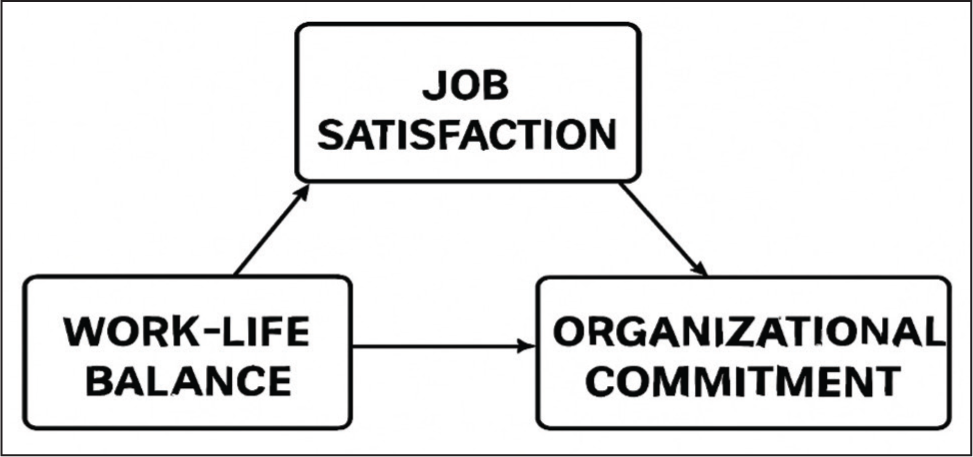
Building on existing literature, this study posits that WLB positively influences JS, which in turn impacts OC. The conceptual model is consistent with the partial mediation model, suggesting that JS mediates the relationship between WLB and OC. This framework is grounded in prior research that highlights the direct and indirect effects of WLB on organisational outcomes through job-related constructs (Greenhaus & Powell, 2006).
H01: There is no significant effect of WLB on JS. H02: There is no significant effect of JS on OC. H03: There is no significant effect of WLB on OC. H04: There is no significant indirect effect of WLB on OC through JS.
Methodology
Research Design and Sampling Strategy
A quantitative research technique was used in the research to investigate the link among variables, WLB, JS and OC, with reference to IT employees in Uttar Pradesh. A quota sampling strategy was utilised to ensure proportional representation across key workforce categories, including technical, managerial and other roles. This approach allowed for the inclusion of diverse perspectives, ensuring that the sample accurately reflected the make-up of the region’s IT industry workforce.
Study Population Description
The participants in the study included IT professionals from five prominent cities in Uttar Pradesh: Lucknow, Noida, Ghaziabad, Kanpur and Prayagraj. These cities were selected due to their rapid growth as IT hubs and their diverse employee demographics. The respondents included individuals from various professional backgrounds, job demands and work arrangements, providing a holistic understanding of WLB dynamics within the IT sector.
Data Collection Tools and Techniques
A well-structured questionnaire was put to use for collecting data in order to seek demographic information and measure variables related to WLB, JS and OC. The instrument included a mix of closed-ended, dichotomous, multiple-choice and Likert scale-based questions. The survey was administered through online platforms and direct distribution in IT organisations across the selected cities. Measures were taken to take care of the clarity and relevance of the questionnaire, minimising potential response bias and improving the data’s dependability. The scales used to measure WLB, JS and OC were adapted from established literature and demonstrated sufficient reliability (Cronbach’s α > 0.80).
Statistical Methods
The analysis employed descriptive statistics to give a summary of the participants’ demographic traits and the distribution of important variables. To perform mediation analysis, the Hayes PROCESS macro was utilised, a robust statistical tool for evaluating indirect effects in mediation models (Hayes, 2017). This method enabled the assessment of the function of JS as a mediator in the interaction between OC and WLB. Key metrics comprising confidence intervals, t values, p values, standard errors and coefficients were reported to ensure the transparency and scientific rigour of the findings.
Interpretation and Analysis of Data
Descriptive Statistics of the Sample
Interpretation
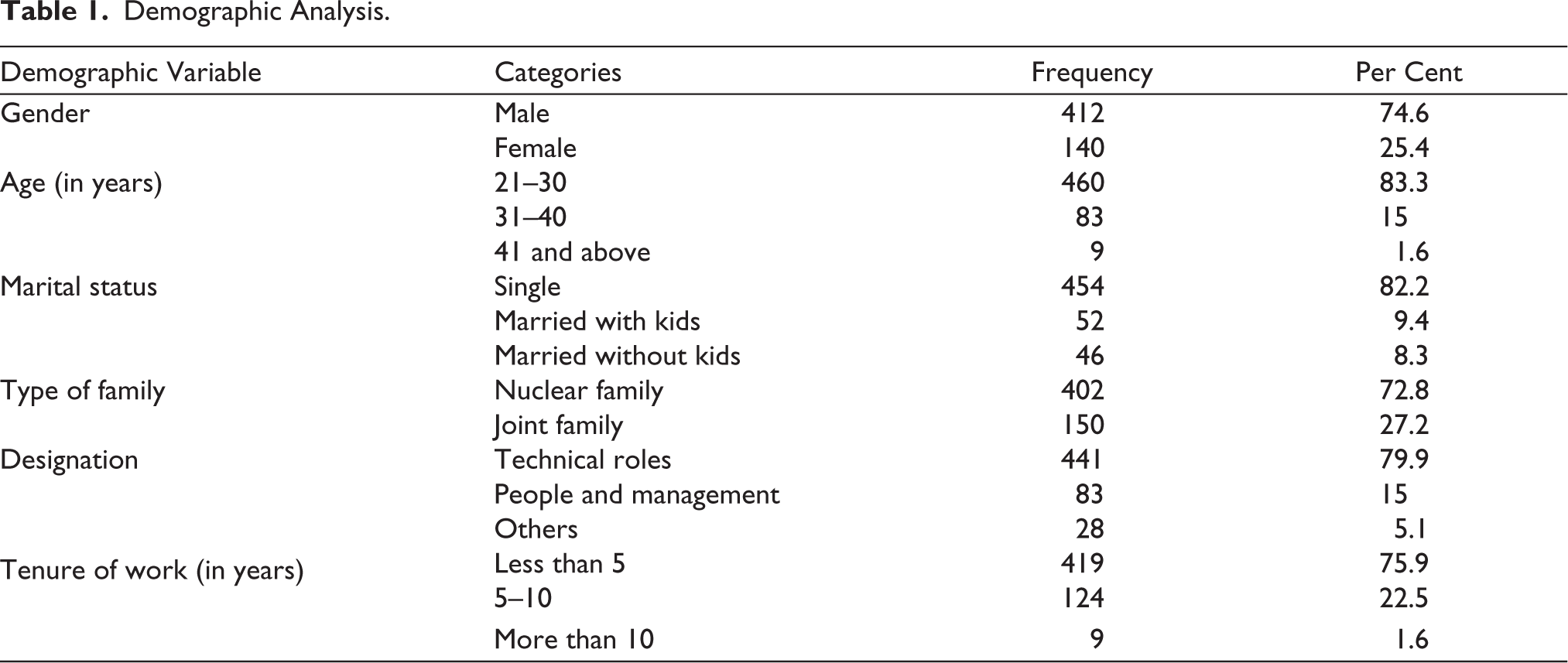
Table 1 presents the demographic profile of the respondents, summarising key characteristics such as gender, age, marital status, family type, designation and tenure of work. The demographic analysis of the study sample (N = 552) highlights a predominantly male representation (74.6%), with the majority of respondents aged 21–30 years (83.3%). A significant portion of the participants were single (82.2%) and belonged to nuclear families (72.8%). Regarding professional roles, 79.9% of the respondents were engaged in technical roles, while 15% were in people and management positions, and 5.1% were in other roles. Most participants (75.9%) reported having less than five years of work experience, underscoring a relatively young and early-career workforce.
Demographic Analysis.
Mediation Analysis: Examining the Impact of WLB on OC with JS as a Mediating Factor
Interpretation
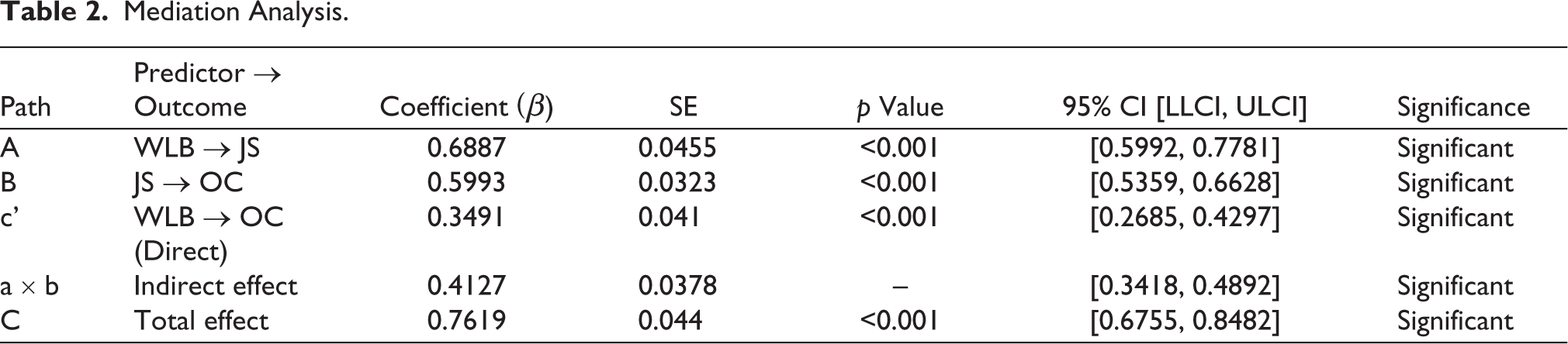
Figure 1 illustrates the proposed mediation model depicting the direct and indirect relationships between work–life balance, job satisfaction and organisational commitment. Table 2 can be interpreted as follows.
Mediation Effect Model.
Mediation Analysis.
Overview:
Independent variable (X): Work–life balance
Dependent variable (Y): Organisational commitment
Mediator variable (M): Job satisfaction
R² = 0.2938: Approximately 29.38% of the variance in JS is explained by WLB, indicating a moderate but significant relationship. WLB coefficient (β = 0.6887, p < .001): For each unit increase in WLB, JS increases by 0.6887 units. This relationship is statistically significant, confirming that better WLB leads to higher JS. Therefore, H01 is rejected.
R² = 0.6026: This indicates that 60.26% of the variance in OC is explained by JS, showing a strong model fit. JS coefficient (β = 0.5993, p < .001): For each unit increase in JS, OC increases by 0.5993 units. This relationship is statistically significant, confirming that higher JS leads to greater OC. Therefore, H02 is rejected.
WLB coefficient (β = 0.3491, p < .001): For each unit increase in WLB, OC increases by 0.3491 units. This relationship is statistically significant, confirming a direct positive effect of WLB on OC. Therefore, H03 is rejected.
Indirect effect (via JS, β = 0.4127): The indirect effect of WLB on OC through JS is 0.4127. 95% Confidence interval (LLCI = 0.3418, ULCI = 0.4892): The confidence interval does not include zero, confirming the statistical significance of the indirect effect. This finding was determined using the Hayes PROCESS macro (Hayes, 2017), where significance was assessed based on the confidence interval, not the p value. This indicates that JS significantly mediates the relationship between WLB and OC. Therefore, H02 is rejected.
WLB coefficient (β = 0.7619, p < .001): The total effect of WLB on OC is 0.7619. This represents the overall relationship between WLB and OC, combining both the direct and indirect effects via JS. For each unit increase in WLB, OC increases by 0.7619 units. This relationship is statistically significant, confirming that better WLB leads to higher OC.
Discussion
Interpretation of Results in Light of Existing Literature
The demographic profile of respondents reveals a predominantly young, male and single workforce engaged in technical roles, with most having less than five years of experience. These findings align with prior studies highlighting the youthful nature of the IT workforce, characterised by high demands, skill volatility and dynamic work environments (Gupta & Sharma, 2020a, 2020b; Nair & Kaushal, 2021). The prevalence of nuclear families among respondents suggests that familial structures may influence perceptions of WLB, as noted in earlier research indicating that nuclear family set-ups often require individuals to balance work and domestic responsibilities independently, potentially increasing work–family conflict (Kalliath & Brough, 2008; Yadav & Dabhade, 2014).
The mediation analysis confirms that WLB significantly influences JS, which in turn positively impacts OC (Hasan et al., 2021; Sari & Seniati, 2020). This finding supports prior research demonstrating WLB’s vital function in promoting JS (Aruldoss et al., 2022; Kasbuntoro et al., 2020; Paudel et al., 2024; Yusnita et al., 2022) and OC (Eriyanti & Noekent, 2021; Greenhaus & Allen, 2011; Haar et al., 2014; Rhoades & Eisenberger, 2002; Shabir & Gani, 2020). The partial mediation observed indicates that while WLB directly impacts OC, a substantial portion of this relationship is mediated through JS, highlighting the multifaceted nature of OC determinants (Mensah & Adjei, 2023; Sultana et al., 2022). These results reinforce the need for IT organisations to prioritise WLB initiatives to strengthen both satisfaction and retention outcomes.
Insights into the Partial Mediation Model
The results validate the hypothesised partial mediation model, wherein JS serves as a significant mediator between WLB and OC. The strong direct effect of WLB on OC underscores its independent influence, suggesting that initiatives improving WLB can directly enhance organisational loyalty. Simultaneously, the mediating role of JS highlights its importance as an intermediary mechanism through which WLB exerts its influence on OC. This is consistent with the two-factor theory of Herzberg, which posits that factors enhancing JS are distinct yet complementary to those reducing dissatisfaction (Herzberg, 1968). Hygiene factors like WLB may reduce dissatisfaction, while motivators like JS foster commitment. The statistical significance of both direct and indirect effects indicates that organisations aiming to enhance employee commitment should adopt a dual strategy: directly addressing WLB issues while simultaneously fostering JS. This dual approach can help optimise organisational outcomes by addressing both intrinsic and extrinsic employee needs.
Practical Implications for Organisations
The findings give organisations practical advice on how to improve the well-being and commitment of their employees. First, enhancing WLB through flexible work arrangements, workload management and supportive policies can lead to significant improvements in both JS and OC. Previous studies have shown that sustainability-oriented HR strategies like Green HRM can also enhance the performance of employees and JS (Bajpai et al., 2022). Tailored programmes specific to difficulties that young professionals encounter in technical roles, such as career counselling and skill development initiatives, could further bolster satisfaction and commitment.
Second, organisations should focus on fostering JS by recognising employee contributions, providing career growth opportunities and creating a productive workplace. WLB and OC’s relationship is mediated by JS; strategies targeting satisfaction can amplify the positive effects of WLB initiatives.
Lastly, the study emphasises the value of a comprehensive strategy that combines WLB guidelines with more general organisational tactics meant to improve employee engagement and well-being. Organisations may develop a dedicated and productive workforce and eventually achieve long-term success by giving priority to these areas.
Conclusion
This research was targeted to explore the mediating role of JS in the link between WLB and OC among IT employees in Uttar Pradesh. The analysis demonstrated that WLB significantly influences JS, which in turn positively affects OC, thereby confirming a partial mediation model. These results highlight the significance of WLB as a crucial factor for enhancing both JS and OC, which are necessary to raise company productivity and employee well-being. The demographic analysis revealed a predominance of young, single male employees in technical roles, with a significant portion having less than five years of experience in the workplace. This underscores the youthful composition of the IT workforce, with a strong inclination towards technical roles, which may influence their perceptions of WLB and its impact on job-related outcomes.
By offering empirical support, the study contributes to the body of literature regarding the mediating function of JS in the relationship between WLB and OC, especially when considering the IT sector in Uttar Pradesh. Previous studies have examined these relationships separately, but this research integrates them into a comprehensive model, offering new insights into how WLB initiatives can foster JS and, subsequently, increase OC (Greenhaus & Allen, 2011; Judge & Kammeyer-Mueller, 2012). By focusing on the IT sector, this study also adds value to the expanding corpus of studies on worker well-being in high-demand, fast-paced industries.
In practical terms, the results indicate that organisations should prioritise improving WLB to foster a more satisfied and committed workforce. Policies aimed at elevating WLB, such as flexible work arrangements and supportive organisational cultures, could be effective in increasing JS and OC. This could, in turn, lead to improved employee retention and organisational performance. These insights can guide HR strategies aimed at improving retention in high-turnover sectors.
This study does have certain drawbacks, though. The sample may not accurately reflect the larger Indian workforce or other industries because it is restricted to IT workers in Uttar Pradesh. Furthermore, the study’s cross-sectional design limits the ability to draw causal inferences. Longitudinal studies could be investigated in future studies to look at WLB’s long-term impact on JS and OC. A more comprehensive knowledge of the variables affecting OC may also be possible with the inclusion of additional potential mediators, such as leadership style or organisational culture.
This study concludes by highlighting the significant role that WLB plays in raising OC and happiness, providing insightful information for both organisational practice and scholarly research. To further evaluate and expand the findings, future research should examine similar links across various industries and geographical areas.
Footnotes
Acknowledgements
The authors wish to express their sincere gratitude to the respondents who participated in this study. We also thank the research administration and academic mentors at Integral University for their continued support and guidance throughout the study.
Data Availability Statement
The data supporting the findings of this study are available from the corresponding author upon reasonable request. The dataset has been anonymised to protect participant confidentiality.
Declaration of Conflicting Interests
The authors state that none of the studies described in this study could have been influenced by any conflicting financial or non-financial interests.
Ethical Approval and Informed Consent
Survey participation was based on the free will of the respondents. Responses were anonymised to ensure protection of privacy.
The study was conducted in accordance with the ethical standards of Integral University. Prior to participation, informed consent was obtained from all respondents. Participants were assured of confidentiality and the voluntary nature of their involvement.
Funding
This research received no specific grant from any funding agency in the public, commercial or not-for-profit sectors.
Use of AI Tools
The authors used AI-assisted tools (ChatGPT and OpenAI) solely for language editing and improving the readability of the manuscript. The AI was not involved in the creation of content, analysis, interpretation or drafting of any substantive part of the article. The final version reflects the authors’ original intellectual contributions.