







Abstract
In the quest to increase dependence on non-conventional energy sources, India over the past few years has laid additional emphasis on the renewable sector. Within the renewable sector, wind power has emerged as the single-largest energy contributor in the country. The sector has been appreciated for having limited adverse implications on local communities, environment and ecology. However, off late, studies on individual projects and analysis of available sectoral data reveal that there are critical environmental and social (E&S) issues that the wind power sector needs to address. The present article, based on the review of available literature (articles/case studies, newspaper clippings, books and E&S Impact Assessment reports), has identified the key social issues affecting the sector. Based on discussions with renewable energy specialists and an assessment of available mitigation measures, recommendations have been proposed to address the identified areas of concern. It is believed that addressing the social issues of concern in the present article will contribute towards promoting socially responsible and long-term generation of renewable power in consonance with the renewable and wind power policies of India.
Introduction
Production and distribution of various forms of renewable and non-renewable energy in India is managed by different departments and ministries of the Union government such as the Ministry of Power (MoP), Ministry of New and Renewable Energy (MNRE), Ministry of Petroleum and Natural Gas, etc. As of 2010, India is the fifth largest producer of energy next only to the People’s Republic of China (PRC), the United States of America (USA), the Russian Federation and Saudi Arabia (US Energy Information Administration, 2010). However, in the year 2015, the country was ranked third in terms of primary energy consumption and accounted for a global share of 5.3 per cent (British Petroleum, 2015). Despite a steady increase in energy production, the country was projected to witness an energy shortage to the tune of 2.1per cent for the fiscal year 2015–2016 (Jog, 2015).
The Global Wind Energy Council (GWEC) has released its flagship publication ‘Global Wind Report: Annual Market Update’ for 2016. A review of the information on its website suggests that India, with an installed capacity of 28,700 MW, is in the fourth position globally when it comes to the total wind power installed capacity (Figure 1).
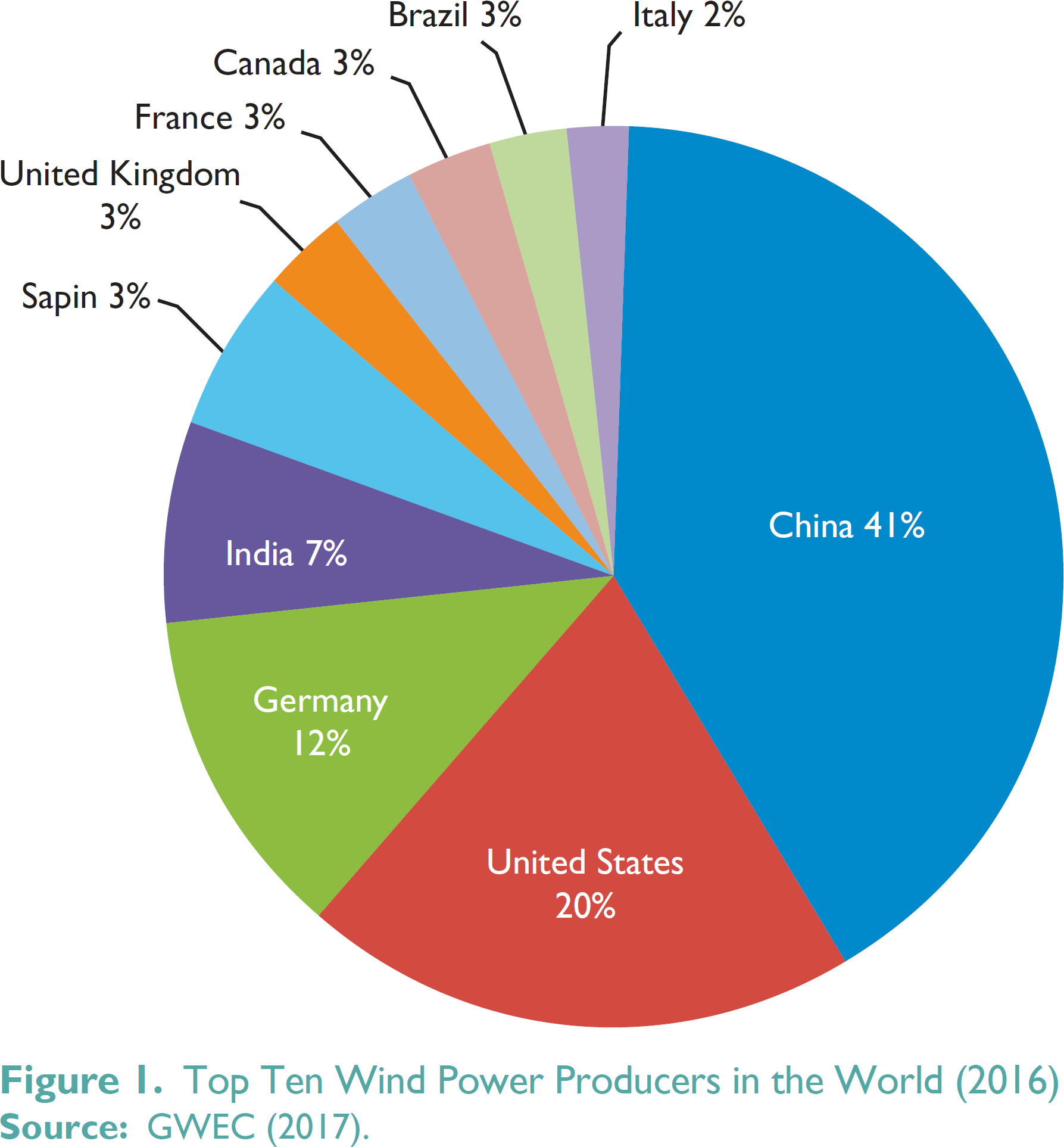
In India, renewable energy currently accounts for 15 per cent, or 45,917 MW, of the total installed capacity of 310,005 MW. Of this, wind energy projects alone account for around 28,700 MW. India plans to achieve 175 Giga Watt (GW) of renewable energy capacity by 2022 as part of its climate commitments (Bhaskar & Aggarwal, 2017). In fact, at the Paris climate summit in December 2015, India promised to achieve 175 GW of renewable energy capacity by 2022. This includes 60 GW from wind power, 100 GW from solar power, 10 GW from biomass and 5 GW from small hydro projects. It also promised to reduce electricity generation from non-fossil-fuel-based energy resources to 40 per cent by 2030 (Aggarwal, 2017). Further, around 293 global and domestic companies have committed to generate 266 GW of solar, wind, mini-hydel and biomass-based power in India over the next 5–10 years. The initiative would entail an investment of about US$310–350 billion.
The present study encompassing relevant literature is being undertaken in the backdrop of the ambitious renewable power generation goal of 175 GW by 2022 set by the Government of India (GoI). The study assumes special significance as it has endeavoured at systematically collating, analysing and presenting the social issues impacting the renewable sector as well as proposing recommendations to overcome the identified concerns. It is believed that the this approach will help in promoting socially responsible and long-term generation of renewable power in consonance with the renewable and wind power policies of India.
Owing to the privacy terms on the basis of which the three ESIA reports were made available for review; the names of the concerned projects, developers, site locations and third parties (firms who developed the reports) are not being mentioned in the present article. The document that was referred to did not have any heading. Hence, no title of the work for the reference can be provided (especially in the ‘Key social concerns and Recommendations’ sections of the article).
Wind Power Generation in India: A Historical Perspective
Promotion of renewable energy in India effectively started with the setting up of a Commission for Additional Sources of Energy in the Department of Science and Technology in 1981 (Bhattacharya & Jena, 2009). An independent department—the Department of Non-conventional Energy Sources—was set up in 1982; the department was converted into the Ministry of Non-conventional Energy Sources (MNES) in 1992. Indian Renewable Energy Development Agency (IREDA) was established in 1987 to finance renewable energy projects. Subsequently, in October 2006, the MNES was renamed to MNRE.
The wind power programme in India witnessed policy interest towards the end of the Sixth Plan, in 1983–1984. Apparently, since the beginning, a market-oriented strategy was adopted for the development of technology. The broad-based national programme includes wind resource assessment activities; research and development support; implementation of demonstration projects to create awareness and opening up of new sites; development of infrastructure capability and capacity for manufacture, installation, operation and maintenance of wind electric generators; and policy support. The wind resources assessment programme is being implemented through the state nodal agencies, Indian Institute of Tropical Meteorology-Field Research Unit (IITM-FRU) and Centre for Wind Energy Technology (CWET) (Indian Wind Energy Association, 2016).
As part of the government efforts to promote wind power in the country, the National Institute of Wind Energy (NIWE), Chennai, was established in Tamil Nadu in 1998 as an autonomous institution under the administrative control of the MNRE. The key activities of the NIWE include resource assessment and testing and certification. The potential for wind power generation for grid interaction has been estimated at about 102,788 MW (Ministry of New and Renewable Energy, 2017).
In the early 1990s, India was the first country in the world to set up a ministry in the Union government for renewable energy. As indicated earlier, the MNES was rechristened as MNRE in the year 2006. As of March 2014, renewable sources including large hydroelectricity projects account for 28.8 per cent of the total installed energy generation capacity of India (BS Reporter, 2014). In fact, the installed capacity of energy in the renewable sector including wind, solar, biomass, small hydropower and waste-to-power sources in India stands at 42.85 GW as of April 2016 (Chandrasekaran, 2016). As regards the wind farm sector, the country has witnessed a significant increase, of approximately 426 per cent, in the generation of wind energy between 2005 and 2015. As of 2015, the top three wind energy producing states Tamil Nadu (7,455.2 MW), Maharashtra (4,450.8 MW) and Gujarat (3,645.4 MW) together account for nearly two-thirds (66.32%) of the total wind power generation in the country (Kavitha & Padhmanaban, 2017).
Despite an impressive growth in the overall installed renewable power capacity, declining power tariffs, especially in the solar power sector, have resulted in fewer clean energy deals. This is because power producers are not sure that electricity offtake commitments at higher tariffs will be honoured (Livemint, 2017). In fact, the solar power tariffs have declined from ₹10.95–₹12.76 per kilowatt hour (kWh) in 2010–2011 to ₹3.15 per kWh in February 2017.
Some of the key players that have emerged in the wind power sector over the last 3–4 years are ReGen Powertech Pvt. Ltd, Leap Green Energy Pvt. Ltd, Singapore-based Sembcorp Industries Ltd, Siemens Gamesa Renewable Energy Pvt. Ltd, ReNew Power Ventures Pvt. Ltd, Hero Future Energies Ltd, RP-Sanjiv Goenka Group’s CESC Ltd, Mytrah Energy (India) Ltd, Green Infra Ltd, Ostro Kutch Wind Pvt. Ltd and Inox Wind Infrastructure Services Ltd.
Evolution of the Regulatory Framework for the Wind Power Sector in India
EIA is not required for wind power projects as per EIA Notification, 2006. Prior to March, 2016, wind power projects required consent to establish (CTE) and consent to operate (CTO) from the State Pollution Control Boards (SPCBs) in most of the states under the Water (Prevention and Control of Pollution) Act, 1974 and the Air (Prevention and Control of Pollution) Act, 1981. As per the directions of Central Pollution Control Board (CPCB) dated 7 March 2016, wind power projects are categorized under the white category and thus do not require CTE and/or CTO from the SPCBs, and only intimation to the concerned SPCB regarding the setting up of the project shall suffice. However, before CPCB directions were issued, CTE and CTO were required for wind power projects, and some states such as Rajasthan had specific guidelines relating to this aspect. The decision to put the wind and solar power projects into white category further gives credibility to common understanding that E&S impacts are considered limited.
The discourse over the possible E&S impacts of wind power projects was perhaps started in India by the Centre for Science and Environment (CSE) when it published a report titled, ‘EIA Guidelines for Wind Power Projects’ in 2013 (Centre for Science and Environment, 2013). Couple of years later, in 2015, the World Bank also came up with Environmental, Health and Safety (EHS) Guidelines for wind energy (World Bank Group, 2015).
Key Social Concerns in the Wind Power Sector
Fragmentation of Landholding and Consequent Loss of Livelihood
Energy from wind power is generated through wind turbine generators (WTG). In the Indian context, the installed power generation capacity of WTGs varies from 1.8 MW to 2.1 MW. Consequently, the size of land required for installing a WTG is in the range of 2–3 acres and the land requirement increases by 3–4 acres per MW, which including access road and other utilities required for power generation. WTGs are normally located in a dispersed manner; as a consequence, even the land adjoining the WTG sites is used for carriage and vehicular movement during the construction phase of the project. Other typical components of a wind power project include (a) roads, (b) pooling substation, (c) batching plant and (d) right of way (RoW) for transmission line poles. Consultations with renewable energy experts and review of the available literature indicate that nearly 40 per cent of land required for wind power projects are sourced from private owners.
Procurement of private land for wind power projects in India is regulated under specific policies of the state governments, and these policies vary from one state to another state. For example, in Rajasthan, ‘The Policy for Promoting Generation of Electricity from Wind, 2012’ issued by the Energy Department, Government of Rajasthan in July 2012 (Energy Department, Government of Rajasthan, 2012) governs issues surrounding land procurement for wind power projects. Section 9.4 of the policy—‘Procurement of Private Land for Establishing Wind Generation Projects’—provides scope for wind power developers to purchase private land for setting up of wind power plants. Although the section mandates the conversion of land use from private to industrial, the policy is silent on several key social issues, including (a) landlessness owing to the sale of land, (b) assessment of the loss of livelihood and taking measures for livelihood restoration and (c) minimization or avoidance of physical displacement.
It is noteworthy that the purchase of land is done under the Land Revenue Acts of the respective state. Similarly, the transfer of ST/Tribal land is governed by state-specific procedures, guidelines and government notifications. A detailed comparison of the wind energy policies of the various states does not fall within the ambit of the present study.
ESIA Reports for the three wind power projects state that nineteen land owners were reported to have sold land to the wind farm projects. The findings relating to land fragmentation and loss of livelihood as deduced from the review of the three ESIA reports and articles/case studies are as follows:
Landlessness: At least 20 per cent of the land sellers have become landless post selling their land and further 30 per cent have become marginal farmers. 1
Land fragmentation and loss of livelihood: In the case of at least 50 per cent of the total land sellers, the sale of land has resulted in fragmentation/division of landholding. Fragmentation has rendered certain land parcels unusable for farming, which has in turn adversely affected the livelihood of its owners, sharecroppers and agricultural labourers engaged in cultivation on it. Almost all the sharecroppers and agricultural labourers who witnessed fragmentation of their landholding reported at least 50 per cent decline in their monthly income.
The background information on private land procurement for wind power projects shared in the ESIA reports were triangulated with the available literature on the socio-economic contours of the states wherein wind farm projects have been set up over the past few years. The triangulation indicates that there are a range of factors that have prompted private land owners to sell their landholding. These include the following:
The farming sector has witnessed distress owing to poor monsoon, lack of irrigation facilities and consequent decline in crop yield in states such as Rajasthan, Karnataka and Maharashtra. With the returns not being encouraging, farmers reported willingness to sell their land.
Coupled with the cost and hassles involved in the upkeep of land (such as regular payment of land tax, eviction of encroachers, etc.), several migrant land owners have reportedly sold their land to industrial buyers, which includes wind farm players.
Loss of Income from Government and Forest Land
As indicated earlier, at least 60 per cent of the total land requirement for wind farm projects is sourced from the government. Under most circumstances, the government allocates revenue and diverts forest land on a lease basis to private players for setting up of projects. However, there are rare instances wherein government through its competent agencies has acquired land from private owners and in turn allocated it to developers for setting up projects in the renewable energy sector. Large swathes of land used for wind power and solar power projects are reported to be dry, rocky and scarcely vegetated and hence unsuitable for cultivation. Consequently, farming on nearby available cultivable land (though government land), especially by the landless lower caste communities, and also otherwise in states such as Rajasthan and Madhya Pradesh, is a common practice. However, cultivation on encroached government land is not recognized under the regulatory system of several states such as Rajasthan as well as under the legal system of India (Business Standard, 2016). As a consequence, in the event of allocation of such land for public purpose, not only its cultivators lose their livelihood but are also excluded from any resettlement benefits.
There is no mention of any mechanism for dealing with the issue of encroachers or squatters cultivating on government and forest land in even some of the most progressive state policies on renewable energy such as ‘the draft Karnataka Renewable Energy Policy 2014–2020 (Wind, Small Hydro, Biomass, Cogeneration and MSW)’, ‘The Policy for Promoting Generation of Electricity from Wind, 2012’ of Rajasthan or ‘The Rajasthan Land Revenue (Allotment of Land for Setting Up of Power Plant Based on Renewable Energy Sources) Rules, 2007’. The policies also do not provision for compensating loss of income resulting out of diversion of government land for wind power projects.
All the three ESIA reports confirmed the use of government-allotted and/or forest land by the respective project proponent. Section 9.3 of the aforementioned policy deals with the modalities relating to the allotment of land to wind power developers. While the maximum allowable land has been set at 5 ha per MW (Section 9.3.3), the policy has provisioned for allotment of government land at a concessional rate of 10 per cent of the applicable circle rate (Section 9.3.2).
One of the ESIA reports even mentioned that a few local farmers and sharecroppers who engaged in cultivation on government land and/or foraging on forest land that were subsequently allotted to wind power developers had completely lost their livelihood. The findings relating to the loss of income from government and forest land highlighted in the ESIA reports are as follows:
Loss of income/livelihood: All the seven sample respondents earlier cultivating government land or depending on forest land reported a steep decline in their income. Two out of the seven sample respondents solely dependent on the government land allotted to a project reportedly lost access to their sole source of livelihood. Similarly, owing to the loss of access to forest land allotted to two projects, at least three sample respondents have lost their supplementary income source, that is, foraging.
Lack of resettlement benefits: The ESIA reports did not make reference to any Livelihood Restoration Plan (LRP) or Resettlement Action Plan (RAP) that was prepared for the affected communities. It is noteworthy that even in projects that do not involve physical displacement and that only constitute economic displacement, LRP/RAP may be developed as a measure to mitigate the adverse economic implications on local communities. Consequently, it is assumed that neither were the seven sample respondents provided any compensation for their loss of livelihood.
All the seven sample respondents earlier cultivating government land or depending on forest resources for supplementing their income were reported to be landless. Consequently, their vulnerability on account of the setting up of the project gets maximized.
Lack of Access to CPRs
Adverse impacts on local Common Property Resources (CPRs) have been identified as one of the major social insinuations of almost all development ventures. CPRs in the context of the present study include community ponds, grazing land, burial and cremation grounds, playground, community forestry or village forest, temples, youth clubs and structures of other social and religious institutions. The said impact on CPRs can be categorized under two broad heads: direct impacts and indirect impacts. While direct impacts are a result of the procurement/acquisition of CPRs, indirect impacts might range from loss of or restricted access to CPRs to the progressive degeneration/degradation of CPRs. Owing to the sandy and dry terrain of the location wherein the said wind power projects have been set up, the CPRs were reported to be mostly limited to burial and cremation grounds, playground, community forestry and temples.
All the major renewable power policies: ‘The Draft Karnataka Renewable Energy Policy 2014–2020 (Wind, Small Hydro, Biomass, Cogeneration and MSW)’, ‘The Policy for Promoting Generation of Electricity from Wind, 2012’ of Rajasthan and ‘The Rajasthan Land Revenue (Allotment of Land for Setting Up of Power Plant Based on Renewable Energy Sources) Rules, 2007’ are completely silent on the issue of CPR and the mechanism to be followed to avoid negative impacts of renewable projects on them. However, clause 9(B) of ‘The Draft Karnataka Renewable Energy Policy 2014–2020 (Wind, Small Hydro, Biomass, Cogeneration and MSW)’ mandates proponents of all renewable energy projects to mark the break-up of private/revenue/forest land and furnish the same to the competent authority for clearance.
CPRs were reported to have been impacted through restricted access in at least two out of the three ESIA reports and in a couple of research papers reviewed. Even newspaper clippings and other reviewed literature revealed that in, some projects, land procured from even private owners for WTG points resulted in restricted access to CPRs.
The findings relating to the loss of access to CPRs are as follows:
Loss of access to community pond: Based on the review of the ESIA reports, other secondary literature, consultations held with renewable specialists and professional judgement used by the researcher–authors, it can be stated that owing to the lack of adequate fresh water resources in the study area wherein the projects for which ESIA reports have been commissioned are located, the loss of access to the only community pond within the vicinity must have had maximum impact on local communities.
Loss of access to cremation ground: Similarly, one ESIA report indicated the lack of access to the cremation ground in one project locality and narrated the difficulty with which a sample respondent had to carry the dead body of his grandfather to the nearby village for performing death rituals.
Loss of access to grazing land: One ESIA report mentioned the restricted access of the local cattle population to the nearest grazing land. Subsequently, the local dairy farming communities were reported to be facing difficulty in meeting the dietary needs of their bovine population. This lack of adequate diet was also observed to be affecting the diary output of the cattle.
Recommendations
The following recommendations can be proposed to address the findings of the current article:
Avoiding landlessness: Amendments to policies such as ‘The Policy for Promoting Generation of Electricity from Wind, 2012’ of Rajasthan should be made in order to avoid landlessness. Thorough verification of land records of every potential land seller should be undertaken by the developer in order to ascertain that the person concerned will not be rendered landless post the proposed land sale. The said amendments to relevant wind-sector policies should mandate the developer to provide a ‘land statement’, indicating a detailed account of the landholdings of the prospective land seller to the local tehsil/mandal office. The policies should also provision the tehsil office, after assessing the ‘land statement’ to issue a ‘No Objection Certificate (NOC)’ to the developer. The NOC should formally trigger the process of land transfer.
Minimizing land fragmentation and loss of livelihood: Efforts should be made by the design team of wind power projects to draw the layout plans in a manner that ensure the utilization of even the land parcels contiguous to independent WTG sites. For instance, other components of wind power projects such as the pooling substation, roads and transmission lines may be built on such land. Such a layout plan will need land to be procured at a stretch rather than in patches. With respect to sharecroppers and agricultural labourers, efforts should be made by the developer with the local tehsil and members of the Panchayati Raj Institutions (PRI) to identify such people and prepare a LRP for their economic rehabilitation.
Livelihood restoration: Efforts should be made to restore the livelihood of people dependent on government land allotted to the project. For instance, land at a subsidized rate should be purchased and allotted to the impacted person with financial contributions from the host government, project proponent as well as the impacted person. Similarly, in the event of allotment of forest land, rules within the applicable policies should be framed to mandate creation of forests on alternate land identified near the project area.
Enumeration of economically displaced and their inclusion under LRP/RAP: Besides people who have become landless because of wind power projects, economically displaced communities—as indicated earlier—should also be brought within the fold of resettlement entitlements or livelihood restoration activities. For the purpose, third-party agencies empanelled by the state and Central governments to undertake socio-economic baseline studies and prepare LRP/RAP should be engaged. Within the economically displaced category, landless families should be provided preference in matters of employment opportunities, issuance of work contracts for project-related construction activities, etc.
Providing mandatory access to and contributing towards the development of CPRs: Amendments should be made to the applicable policy provisions so as to mandate project proponents to provide access to CPRs to the local communities. Consequently, provisions should also be made for the development and conservation of CPRs. A corpus fund encompassing funding from the project proponent, district administration/renewable energy department and local communities may be created for the purpose.
Recreation of CPRs: Where measures for mitigating or minimizing the impacts of renewable power ventures on CPRs fail, efforts should be made for their re-creation by the project proponents prior to the start of any project-related activities. In fact, construction activities should only commence after an ‘NOC’ is issued by the gram panchayat, indicating the satisfactory re-creation of CPRs to be lost or made inaccessible by the proposed project. Relevant amendments should be made to the applicable policy provisions to facilitate implementation of the aforementioned mechanism for recreating CPRs.
Concluding Remarks
With growing activism around the social and environmental impacts of renewable power projects in the country, the findings and recommendations proposed in the present article are expected to bust several myths, especially the ones concerning the social aspects of wind power ventures in India. Similarly, the present literature review study is also anticipated to lend a clearer perspective on issues relating to and available mitigation measures for land, and livelihood issues in particular, that are often exaggerated and overstated by the mainstream media. Demystifying myths concerning the social impacts of wind power projects will certainly help project proponents in countering vested-interest groups and convincing the community of the benefits that they will receive from a proposed renewable power venture. A correct appreciation of the realities surrounding land, livelihood and other community issues will help reorient the community viewpoint towards renewable power developers and their ventures. All the implications of the present article are expected to contribute towards sustainable generation of power in the country and achieve the ambitious target set by the MNRE, GoI of producing 100 GW of renewable power by 2022.
Footnotes
1.
The Census of India defines ‘marginal farmers’ as those who possess less than one hectare (2.41 acres) of land holding.
