







Abstract
Latvia is a Belt and Road Initiative country and can contribute to its Eurasian Land Bridge. The existing railway infrastructure can be used for establishing the Eurasian Land Bridge Northern Branch via Latvia, but the problem is a lack of cargo for this route. It can be integrated into the existing Eurasian Land Bridge with specialization to connect China and some European countries—the Scandinavian countries. The aim of the study is to assess the potential volume of Latvian cargo for the Eurasian Land Bridge Northern Branch through Latvia. The methods of the study are statistical analyses and the forecasts of experts. Forecast of experts is an innovative method for investigating this topic. The study contributes to the discussion regarding One Belt One Road and Eurasian Land Bridge. The research shows that it is possible to establish regular container block train between Latvia and China for distribution of Chinese goods in the Scandinavian countries and vice versa because cargo potential for this route is growing, the seaport of Riga in Latvia is the shortest route to the seaport in the European Union and previous demonstration trains were successful.
Introduction
Growing Chinese economy is facilitating the development of new routes for transportation of its export and import goods. The latest achievements are the establishment of rail routes between China and Europe, as well as promulgation of governmental policies and projects, for example, Belt and Road Initiative (Cheng, 2016; Huang, 2016). The most developed rail route between China and Europe is, so called, New Eurasian Land Bridge where the number of trains increased from 17 in 2011 to 623 in 2015 (Yang, Pan, & Wang, 2017). Some Belt and Road European countries are already connected with different cities in China, for example, the Czech Republic and Poland, but not Latvia. Latvia is managing 16 + 1 Logistics Cooperation Union, that is, sub-project of Belt and Road Initiative for 16 Central and Eastern European Countries (Vangeli, 2017). Most of the previous studies on Eurasian Land Bridge were devoted to analysing and comparing transport cost, time and other factors among different rail routes, or sea, air and rail routes (Rodemann & Templar, 2014; Seo, Chen, & Roh, 2017; Theocharis, Pettit, Rodrigues, & Haider, 2018; Yang et al., 2017). Freight transportation by rail is an alternative to sea and air freight for the transportation of goods between Europe and China. Sea and air freight represent two extremes for shippers because sea freight has long lead time and low transport cost, but air freight has short lead time and high transport cost (Rodemann & Templar, 2014). Currently, all operating routes to Europe go via Russia (Moscow) and Belarus (Brest). There is a lack of studies analysing value and potential of cargo for Eurasian Land Bridge rail routes, as well as case of Latvia in it (Theocharis et al., 2018). This study is contributing to filling this gap.
Methodology
One Belt One Road is the comparatively new field for scientific studies because it is topical since its promulgation by the president of the People’s Republic of China in 2013. Despite this fact, there are numerous studies on this issue. Diverse methods are applied to study, in the range from essays to game-theoretic approach (Cheng, 2016; Huang, 2016; Theocharis et al., 2018). It is because of the fact that One Belt One Road is a new issue for research and includes in itself cooperation in different economic sectors, as transportation, infrastructure and finance.
The aim of this study is to assess Latvian cargo potential for Eurasian Land Bridge via Latvia, analysing dynamics of trade relations and trade structure between China and Latvia, as well as developing an expert forecast of trade relations and trade structure between China and Latvia for 2020. It can help to understand, first, value, structure and trends in trade relations between both countries, and, second, to find out directions for future studies.
Latvia in the Eurasian Land Bridge
There are three seaports for international cargo transit in Latvia: Riga, Ventspils and Liepāja. In the framework of ‘New Silk Road’, Riga can specialize in serving container cargo, but Ventspils and Liepaja can specialize in Ro-Ro cargo. The biggest seaport in Latvia is Riga as shown in Figure 1.
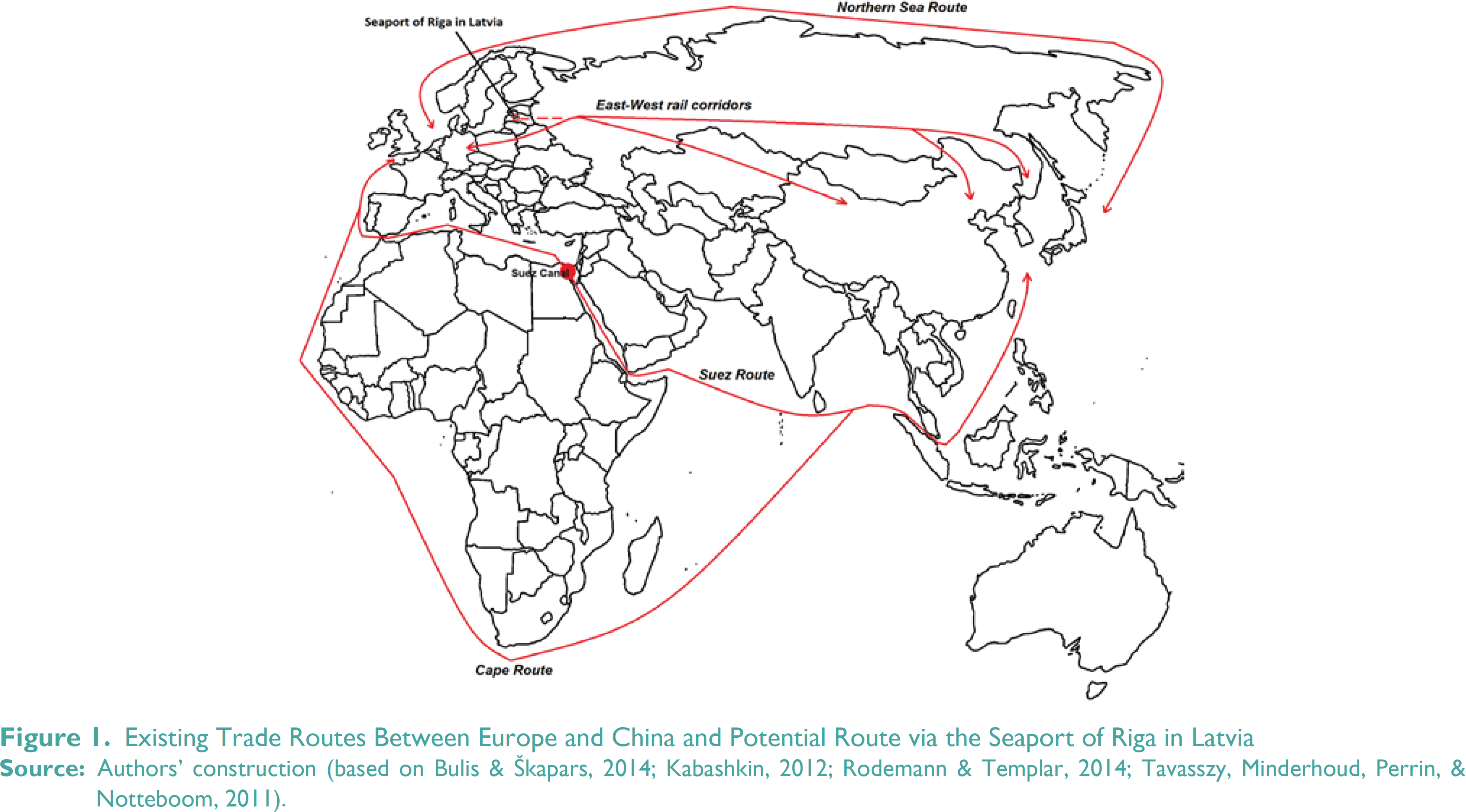
Cargo turnover at the seaport of Riga was 40 million tons in 2016 (Central Statistical Bureau of the Republic of Latvia, 2016). In 2008, a demonstration container block train from Ürümqi (China) to Riga (Latvia) was organized and it was successful (Bulis & Škapars, 2014). Riga is a spoke seaport in the European hub-spoke seaports system. Latvian seaports mostly operate in the East–West cargo transportation corridor. Main target markets are Russia and other Commonwealth of Independent States (CIS) countries, and cargo flows to and from these countries. The main commodity groups are coal, oil and its products, and general cargo.
Riga has three advantages in East–West logistics. First, geographical position because Latvia is located between two extensive markets—the European Union and Russia (Bulis & Škapars, 2013). Second, the seaport of Riga is the nearest foreign seaport to Moscow. Third, there is a flexible workforce with Russian and English language skills, as well as experience in working in a multicultural environment and with partners from the CIS countries and Western countries.
Potential Latvian Cargo for Eurasian Land Bridge
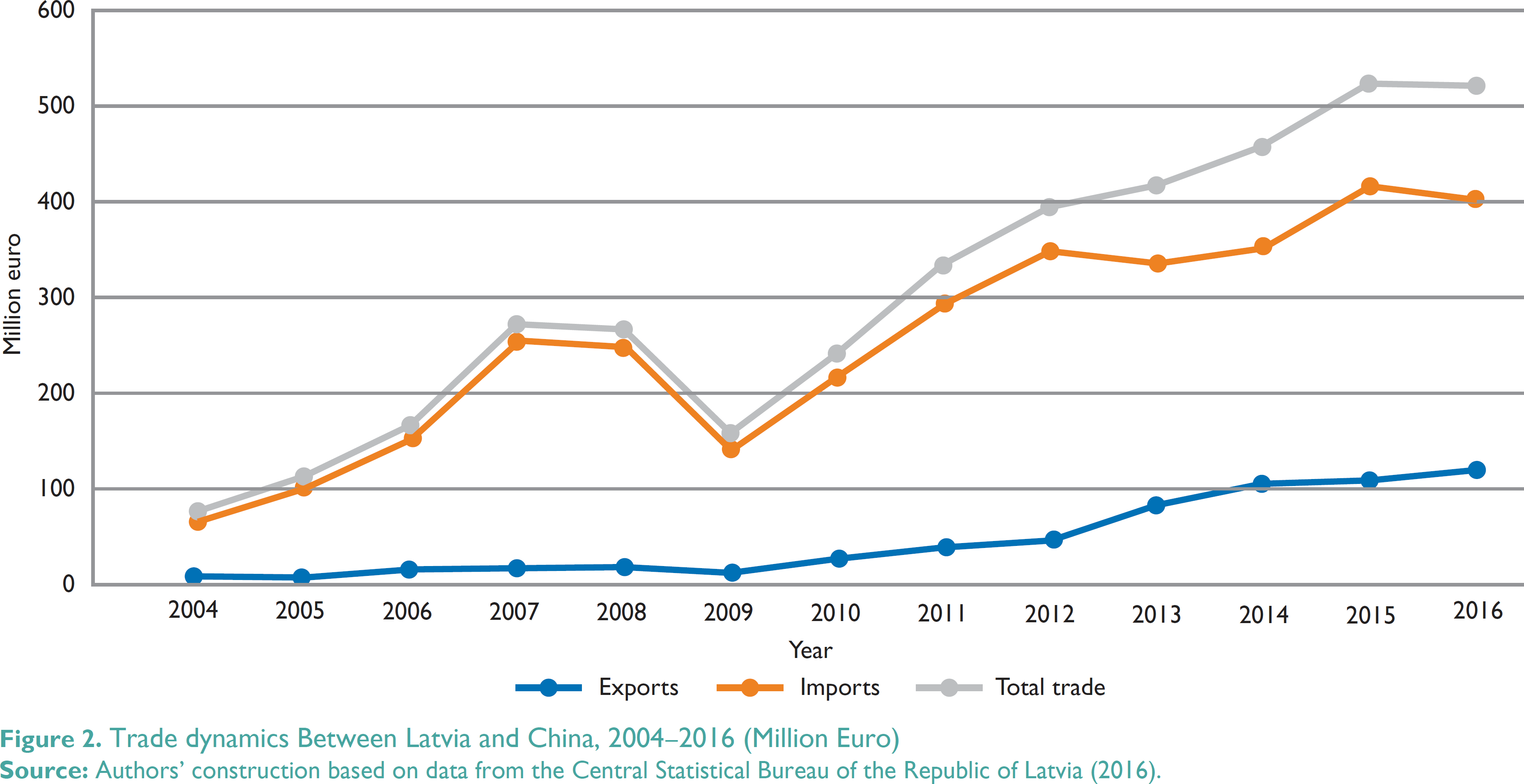
The trade volume between Latvia and China has growing in the period of analysis (2004–2016). It was 522 million euro (EUR) in 2016, but in 2004, it was 76 million EUR, that is, growth was 6 times. Total trade was the largest in 2016 and the smallest in 2004. The only year when it dropped down because of the global economic downturn was 2009.
Latvian exports to China has been growing since 2004, excluding 2009 when a decline was observed in the volume of 2.5 million EUR in comparison with the previous year as presented in Figure 2. The largest export volume from Latvia to China was observed in 2016 as 120.32 million EUR, which was 108.49 million EUR more than in 2015. Imports from China into Latvia has a growing trend and the largest was in 2016 as 402.04 million EUR. Latvia’s trade balance with China is negative and with a growing trend. In 2015, it was the largest, that is, –306.98 million EUR.
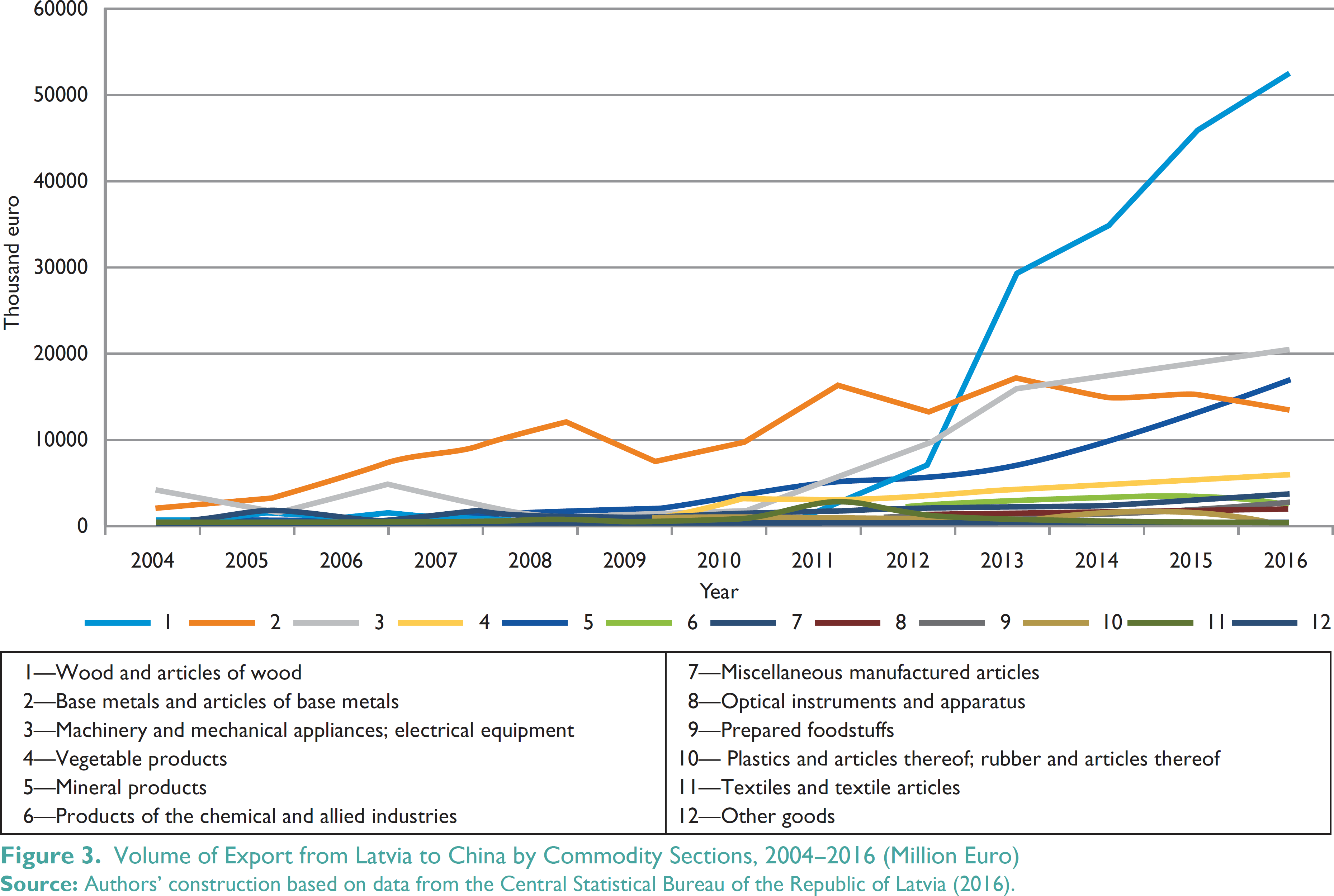
The main commodity section of Latvian exports to China is wood and articles of wood that were exported in a volume of 50.86 million EUR in 2016, shown in Figure 3. The other main commodity sections of Latvian exports to China are base metals and articles of base metals, mineral products, as well as machinery and mechanical appliances, and electrical equipment. Each of these three commodity sections were exported in a volume of 13.05 million EUR, 16.40 million EUR and 19.76 million EUR, respectively in 2016. Latvian companies export goods to China in other commodity sections as well, for example, vegetable products; products of the chemical and allied industries; optical instruments apparatus; prepared foodstuffs; plastics and articles thereof, rubber and articles thereof; and textiles and textile articles.
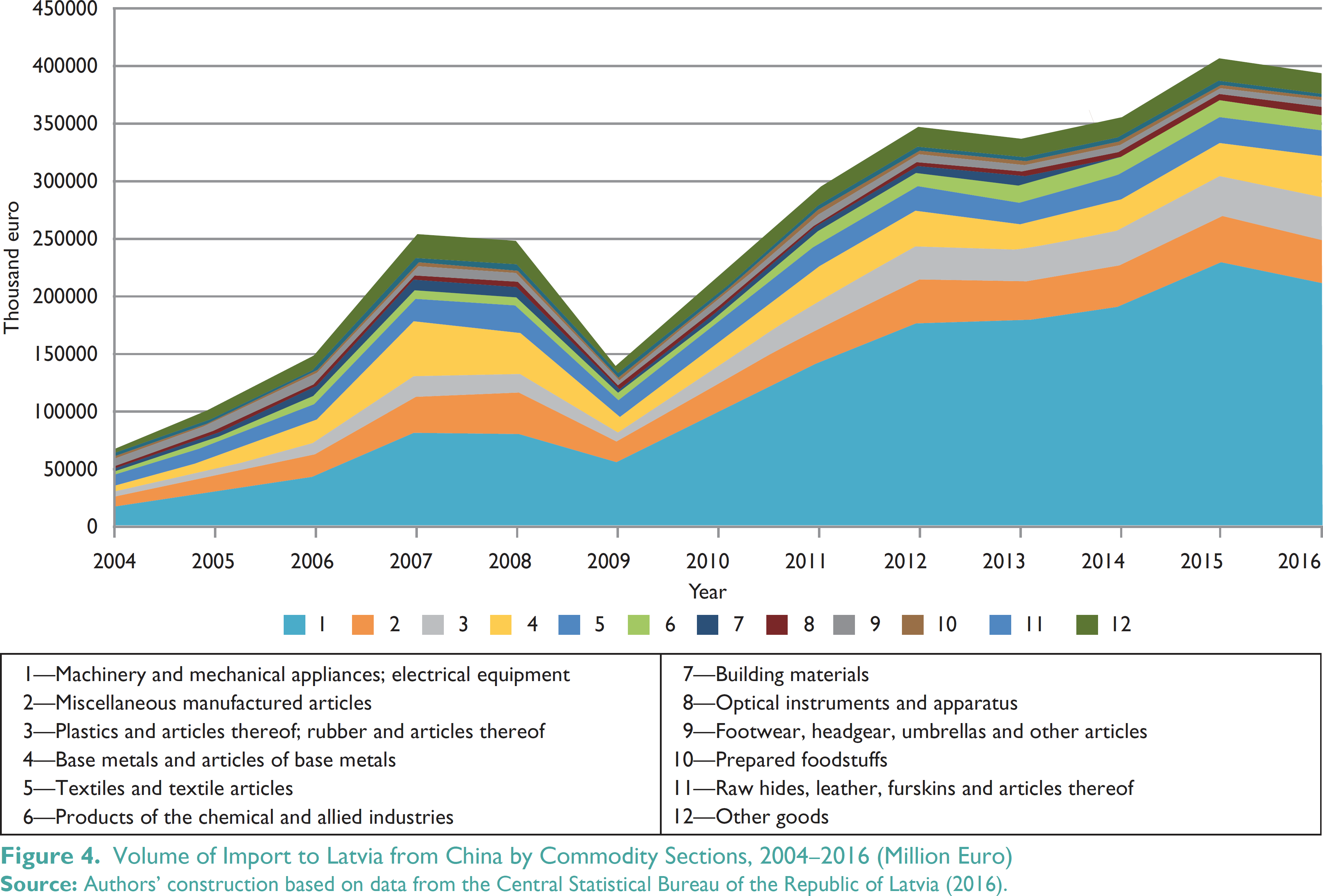
Machinery and mechanical appliances, and electrical equipment provide more than a half of Latvian imports from China that were imported in a volume of about 212 million EUR in 2016, shown in Figure 4. In 2016, this commodity section was imported four times more than it was in 2009. Other significant commodity sections that Latvia has imported from China in 2016 are miscellaneous manufactured articles; plastics and articles thereof, rubber and articles thereof; base metals and articles of base metals; textiles and textile articles; and products of the chemical and allied industries.
In total, 161 Latvian companies exported to China in 2016. Out of them, 30 were exported services, 37 companies were distributors and 94 companies were manufacturing companies (based on the authors’ calculations and data from the Central Statistical Bureau of the Republic of Latvia [2016]). Analysing 94 manufacturing companies, 20 of them were producers of wood and articles of wood, 18 companies were producers of machinery and mechanical appliances, electrical equipment, but 12 companies were producers of products of the chemical and allied industries. These three commodity sections provided more than half of the manufacturing companies that exported goods to China in 2016. Textiles and textile articles were exported by nine manufacturing companies, optical instruments and apparatus were exported by eight companies, miscellaneous manufactured articles were exported by six companies, base metals and articles of base metals and prepared foodstuffs were exported by five companies each. Mineral products were exported to China by four companies in a volume of 6.8 million EUR. Exports were provided by some manufacturing companies in the framework of each other’s commodity sections that were exported from Latvia to China in 2016.
Forecast of Latvian Exports to China
To find out the future trends in Latvian exports to China, the authors have conducted a survey of experts. A total of 10 appropriate experts in Latvia from academia, government institutions and companies filled out the questionnaire regarding probable export volume from Latvia to China in 2020 by commodity sections and in comparison with other main Latvian export markets. Experts were selected based on their experience in cooperation with partners from China (at least 5 years’ experience) and snowball principle. In total, 13 of the most authoritative experts were selected and 10 of them agreed to participate in the survey.
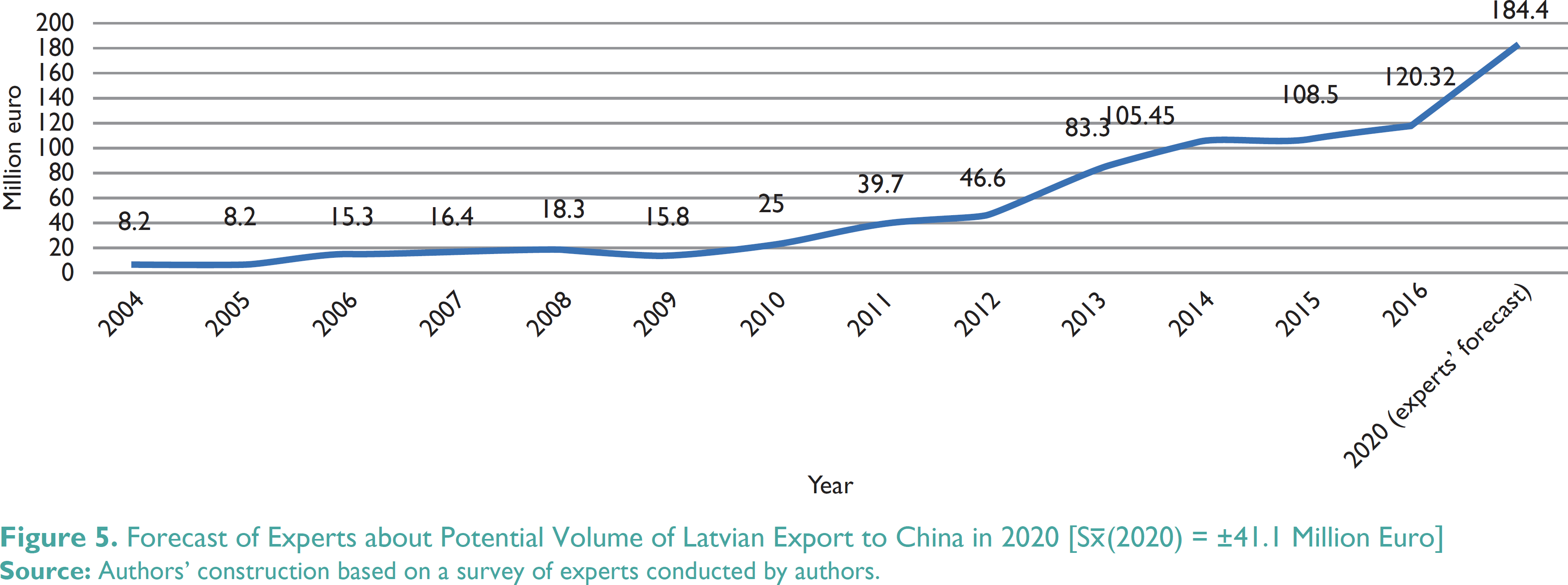
Taking into account the mean of experts’ assessments, in 2020, Latvian export to China will be 184.4 million EUR, which will be 64.32 million EUR more than in 2016, as shown in Figure 5. This forecast is with a standard error ±41.1 million EUR. It means that the minimal volume of Latvian export to China will be 143.3 million EUR, but the maximum volume will be –225.5 million EUR in 2020. All the experts forecasted that Latvian exports to China in 2020 will be larger than in 2016. This positive assessment could be explained by some arguments. First, since 2004 the volume of Latvian exports to China has been growing. Second, the Chinese market has been growing in the 21st century and continues to grow. Third, experience and interest for operating in the Chinese market is growing among Latvian companies. Fourth, the support of Latvian government institutions for the operation of Latvian companies in China is improving as well.
Experts forecast that the proportion of Latvian export volume to China in total Latvian export volume will increase in 2020 by 3.1%, shown in Figure 6.
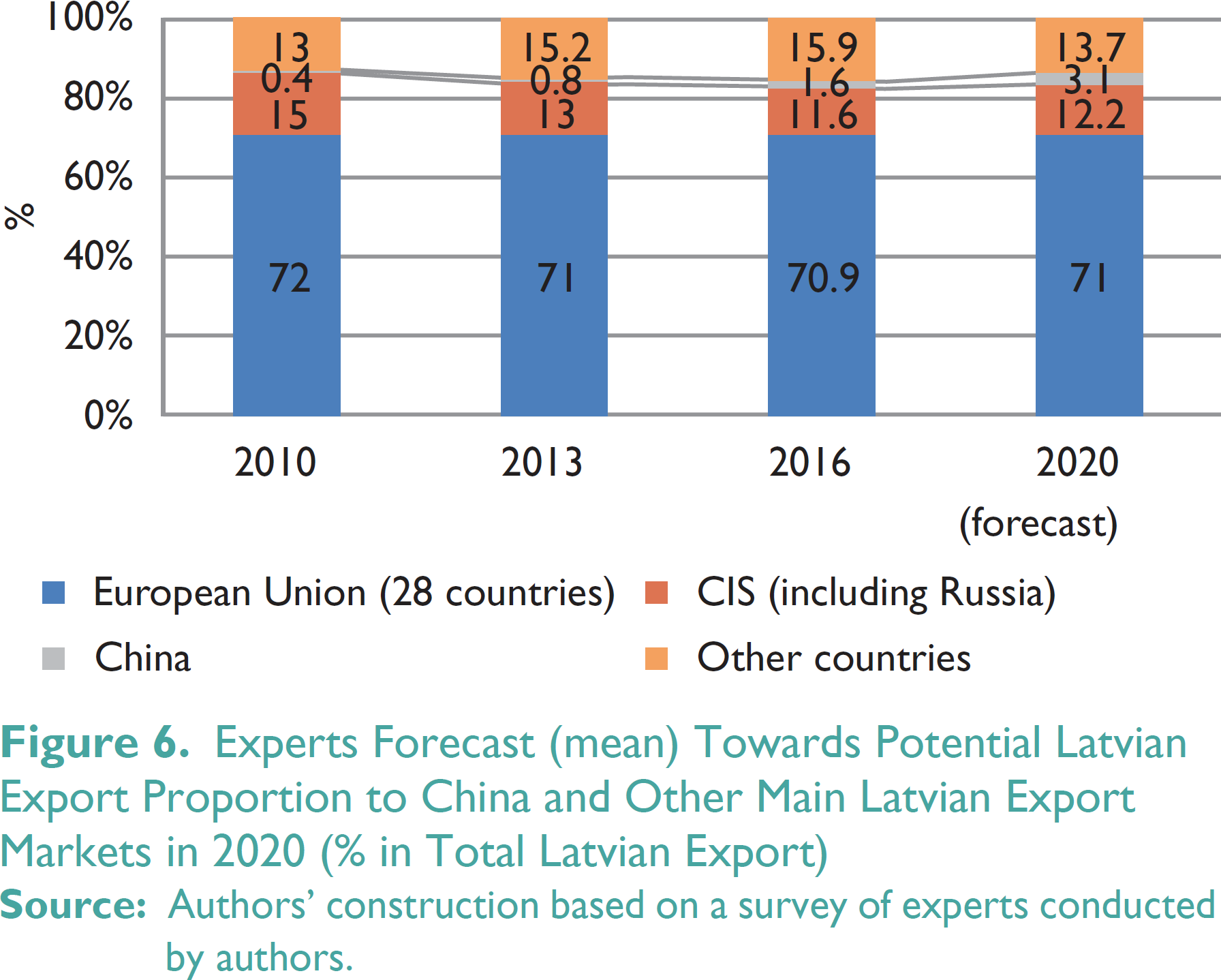
It is indicated that this indicator could increase twice in 2020 in comparison with 2016 when it was 1.6%. The faster growth of Latvian export volume to China than to other countries is related with the saturation of the European (the European Union) market and the Russian market, as well as growing and undigested high volume Chinese markets in different industries.
The experts’ survey forecasted that in 2020, the proportion of Latvian exports to the European Union countries will be increased by 0.1% as compared with 2016. The proportion of Latvian exports to the CIS is decreased in 2016 in comparison with 2013 by 1.4% because in 2014 mutual economic sanctions between Russia and the European Union began (Mau & Ulyukaev, 2015; Moagăr-Poladian & Drăgoi, 2015), but by 2020 the volume of Latvian exports will increase in comparison with 2016 because economic sanctions between the European Union and Russia would be reduced or cancelled. The proportion of Latvian exports to other countries in total Latvian exports in 2020 will decrease in comparison with 2016. This could be explained with the fact that by 2020 the volume of Latvian exports should increase because by 2020 Russia would have cancelled the existing import sanctions for the food industry from the European Union countries that were imposed in 2014 (Moagăr-Poladian & Drăgoi, 2015).
The experts forecast that in 2020, in comparison with 2016, the proportion of Latvian exports by commodity sections to China will decrease in such commodity sections as wood and articles of wood, base metals and articles of base metals, machinery and mechanical appliances—that were the main Latvian export commodity sections to China in 2016, shown in Figure 7.
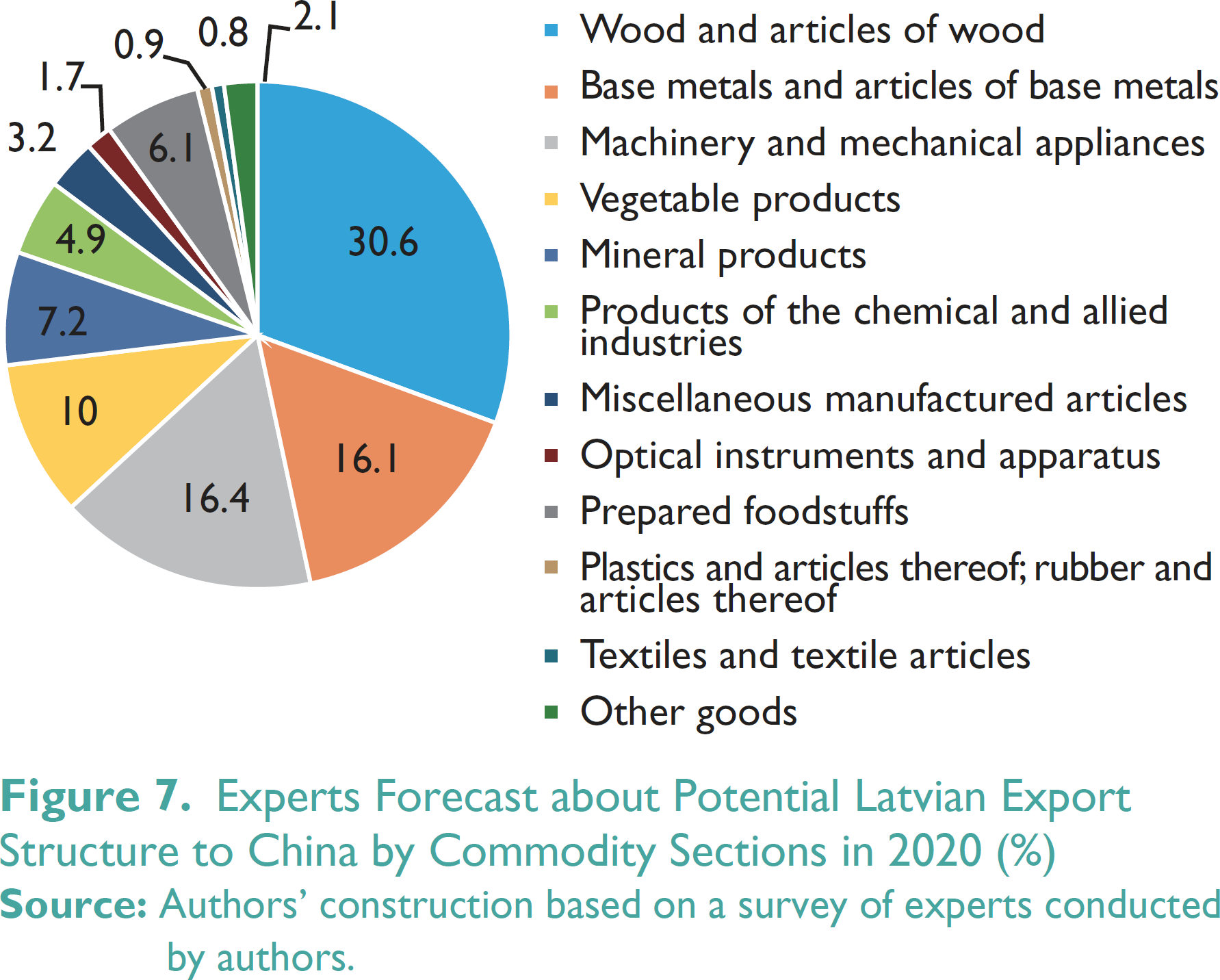
Latvian export volume to China will increase in the following commodity sections: wood and articles of wood (28.4 million EUR in 2013, 50.86 million EUR in 2016, 56.4 million EUR in 2020), base metals and articles of base metals (16.5 million EUR in 2013, 13.05 million EUR in 2016, 29.7 million EUR in 2020), machinery and mechanical appliances (15.5 million EUR in 2013, 19.76 million EUR in 2016, 30.2 million EUR in 2020). The data indicate that the proportion of some commodity sections in total Latvian exports to China decreases, but it will increase in some other commodity sections and the total volume of Latvian exports to China will increase as well.
The experts forecast that the proportion of Latvian exports to China will increase in some commodity sections in total Latvian export volume to China in 2020 in comparison with 2016: vegetable products; other goods; prepared foodstuffs; plastics, rubber and articles thereof; textiles and textile articles.
The results of the experts’ survey shows that in 2020, in comparison with 2016, the proportion of Latvian export commodity sections to China in total Latvian export to China will decrease in following commodity sections:
Wood and articles of wood (42% in 2016, 30.6% mean in experts’ survey for 2020);
Machinery and mechanical appliances, electrical equipment (16.72% in 2016, 16.4% mean in experts’ survey for 2020).
The proportion of mineral products will decline in total Latvian exports to China as well (13.84% in 2016, 7.2% for mean in experts’ survey for 2020). Resources of wood, metals and minerals are limited in Latvia, therefore their proportion in Latvian total exports to China is expected to decline. The proportion of these commodity sections will decline in total Latvian exports to China, but volumes in monetary terms of these commodity sections will increase, but not as fast as the total Latvian export volume to China.
Comparing the expected Latvian export proportion trends by commodity sections in 2020 and 2016, some commodity sections will experience significant growth:
Vegetable products (5.23% in 2016, 10% mean in experts’ survey for 2020);
Products of the chemical and allied industries (2.3% in 2016, 4.9% mean in experts’ survey 2020); and
Prepared foodstuffs (2.26% in 2016, 6.1% mean in experts’ survey for 2020).
The experts forecast that the proportion of prepared foodstuffs will experience the fastest growth in total Latvian exports to China—in 2020, three times in comparison with 2016. The data from the Central Statistical Bureau of the Republic of Latvia shows that the main Latvian manufacturing export products are prepared foodstuffs, wood and articles of wood, base metals and articles of base metals, as well as machinery and mechanical appliances, electrical equipment. All the aforementioned commodity sections, excluding prepared foodstuffs, are among the leading commodity sections in Latvian exports to China. The experts forecast that the food industry will experience the most remarkable competitiveness growth among other Latvian industries in the Chinese market. The barrier to exporting Latvian prepared foodstuffs to China is the long certification process in China. The experts are convinced that the advantages of Latvian food in China are that it is produced in the European Union and Latvia is the second ‘greenest’ country in the world. The assessments of experts surveyed in this study regarding opportunities to export more foodstuffs to China is recognized in other scientific studies as well. It is recommended to export more foodstuffs to China because China is not capable of producing all the necessary foodstuffs for its own consumption (Anderson & Strutt, 2014; Xu et al., 2006).
Conclusions
According to the expert survey conducted by the authors, Latvia tries to attract cargo and partners for its direct rail route with China and establish Eurasian Land Bridge Northern Branch via Latvia. The existing rail infrastructure can be used for it because this route was tested in 2008 and is successful. This study reveals potential cargo value for this route generated by trade between China and Latvia.
The study shows that export and import value between China and Latvia is growing. Since 2004, Latvian export to China increased 15 times, but import from China increased 6 times. This trade volume is small in comparison with Central and Eastern European Countries the Czech Republic and Poland that have direct rail route with China. The trade volume of the Czech Republic with China was 34 times larger than trade volume between China and Latvia in 2015, meanwhile the trade volume between Poland and China was 40 times larger than trade volume between Latvia and China in the same year (Vangeli, 2017). It means that Latvia has a small potential volume of its own cargo for direct rail route between cities in China and Latvia. Managers in Latvia have to think about the attraction of additional cargo for developing this route. Latvia can serve as the transit country for other countries with China, for example, for Scandinavian countries in their trade with China.
The main commodities in Latvian export to China that could be transported in Eurasian Land Bridge rail route from Latvia to China are wood and articles of wood, base metals and articles of base metals, mineral products and machinery and mechanical appliances, and electrical equipment. Meanwhile the main commodities in Latvian import from China that could be transported in Eurasian Land Bridge rail route from China to Latvia are machinery and mechanical appliances, electrical equipment; miscellaneous manufactured articles; plastics and articles thereof, rubber and articles thereof; base metals and articles of base metals; textiles and textile articles; products of the chemical and allied industries.
According to the experts’ forecasts conducted by authors, all experts forecast that Latvian export to China in 2020 will be larger than in 2016—it was 120 million EUR in 2016, but it will be 184 million EUR in 2020. The volume of Latvian export to China will increase in such main commodity sections in Latvian export to China as wood and articles of wood (28.4 million EUR in 2013, 50.86 million EUR in 2016, 56.4 million EUR in 2020), base metals and articles of base metals (16.5 million EUR in 2013, 13.05 million EUR in 2016, 29.7 million EUR in 2020), machinery and mechanical appliances (15.5 million EUR in 2013, 19.76 million EUR in 2016, 30.2 million EUR in 2020).
The experts surveyed in this study forecast that the commodity section, which in proportion to the Latvian export structure to China, that will increase the most will be prepared foodstuffs. In 2016, the proportion of this commodity section in Latvian exports to China was 2.26%, in 2020 it could be 6.1%, in monetary volume it is 2.69 million EUR and 11.2 million EUR, respectively.
According to the findings of this study, it is recommended to continue research about the development of Eurasian Land Bridge Northern Branch via Latvia, first, by devoting research efforts on cargo generation issue and, second, by comparing different rail routes through Latvia with other competing rail routes in the Eurasian Land Bridge. It could be useful for managers to understand if Latvia can provide a good strategic location and transport facility that reduce transportation cost and shorten transportation time.
Footnotes
Declaration of Conflicting Interests
The authors declared no potential conflicts of interest with respect to the research, authorship and/or publication of this article.
Funding
The authors received no financial support for the research, authorship and/or publication of this article.