







Abstract
Abstract
The study investigates the phenomenological impact of gender cues in advertisements on the perceived gender identity meanings of the advertised product. The study utilizes a randomly assigned participants design that exposes three separate groups of participants to differently gendered advertisements of the same product and captures the distinction in the participants’ construction of the gender identity meanings of the advertised product under experimental conditions. Results establish the significant influence of gender cues in advertisements on the perceived gender identity meanings of the advertised product. Results also underscore the difference in the perceptions of men and women under the same stimulus. Theoretical contributions and implications for marketers are discussed.
Introduction
Despite the fluid gender identities of the current generation (Hans, Kersey, & Kimberley, 2012; Galinsky, Aumann, & Bond, 2012; Morton, 2002) and claims that we have entered the post-gender era (Patterson & Elliot, 2002), product gender remains a significant aspect of the overall marketing mix (Schiffman & Kanuk, 2007).*
An earlier version of this article was presented at the International Conference on Management and Information Systems (ICMIS), 2016, at Bangkok, Thailand.
While the contention that the gendering of products and even services is universal and ubiquitous (Avery, 2012; Fischer & Gainer, 1994) remains unchallenged, the reasons that contribute towards the development of product gender identities and meanings remain unexplored in consumer research (Debevec & Iyer, 1986). It remains by and large unknown whether specific product attributes, typical product usage, individual’s own gender identity, mass media imagery or a mix of all these factors confers gender on products (Gainer, 1993; Latif, Syed, Halepoto, Nazar, & Shaikh, 2012; Stuteville, 1971). As such, consumer research is replete with call for research in this particular area of inquiry (Bellizzi & Milner, 1991; Fugate & Phillips, 2010).
The present study addresses this call for research in the area of mass media cues, with specific reference to advertising cues. It empirically investigates the impact of gender cues in television commercials on the perceived gender identity meanings of the advertised product. It also examines the differences between the perceptions of men and women.
In this study, the author first reviews the extant relevant literature and highlights the rationales that provide support for product gendering. The author also exposes the limitations of the existing research. Subsequently, the author describes the study design and findings. The study concludes with a discussion on the theoretical contributions and managerial implications of the study.
Theory
Gendered Products
Gendered products typically carry masculine or feminine identities (Gainer, 1993) that indicate their suitability for a particular gender type only (Avery, 2012). Gendered products target one of the genders and ignore the opposite gender. Previous scholars argue that gendering a product, that is, attributing a gender to a product, is rampant (Fischer & Gainer, 1994) and involves the use of marketing communication that selectively addresses ‘women as women, men as men and people as people, regardless of sex’ (Bellizzi & Milner, 1991, p. 73). Thus, gendered products appeal to the gender of the consumers.
Within the broader framework of the gender schema theory (Bem, 1974), many researchers have examined whether products and services have a gender (Fugate & Philips, 2010; Iyer & Debevec, 1986; Milner & Fodness, 1996). The results of all these studies are consistent and establish that more often than not, products and services have either male or female gender identities (Stern, Gould, & Tewari, 1993). These identities are neither ambiguous (Fugate & Philips, 2010) nor particularly predisposed to revision (Bellizzi & Milner, 1991; Frieden, 2013; Tuncay & Otnes, 2008).
There is some research that reports recent attempts of marketers to diffuse the strictly gendered consumption domains and encourage consumers of both genders to co-opt previously gendered products (Avery, 2012; Firat, 1994). Empirical evidence is available that suggests that while both genders resist gender bending of their products, men tend to be more offended when the gender spectrum of their products is expanded to include women (McCracken, 1988; Worth, Smith, & Mackie, 1992). They perceive it as the contamination of the gender of their products (Avery, 2012).
Product Gendering: The Rationale
Literature on product gender typing is replete with the recompenses of gendering products (Fugate & Phillips, 2010). Scholars believe that as compared to gender-neutral products, gender-typed products can be more effectively marketed (Milner & Fodness, 1996). It is also generally understood that gender typing products helps consumers categorize products (Fugate & Phillips, 2010; Penaloza, 1994). This categorization hastens the purchase decision.
An excursion into ethnography and sociology reveals the reasons that support product gendering. In their seminal work on gender, West and Zimmerman (1987) suggest that unlike the dichotomy of the biological sex of an individual, gender is a range of beliefs and personality traits. It is a spectrum of emotions and ideologies (Eagly, 2013) that help individuals conform to or resist the culturally sanctioned and popularly understood definitions of masculinity and femininity (Butler, 2004; Gherardi, 1995; McDonald, 2013). In understanding their subjective gender, individuals selectively choose and discard gendered behaviors and practices (Lorber, 1994; Sandhu, 2017; Wetherell & Edley, 1999), and develop a personal sense of masculinity or femininity (Johnson & Wassersug, 2010). This sense is commonly referred to as gender identity.
The construction of gender identity is a complex and ongoing project (Avery, 2012; Kerr & Multon, 2015). The influence of media (Orenstein, 2011; Sandhu, 2016, 2018; Wood, 2012), social and cultural norms (Collinson & Hearn, 1994; Fugate & Phillips, 2010), discriminatory actions and agendas for men and women (Czarniawska, 2013), peer pressure (Shepard, Nicpon, Haley, Lind, & Liu, 2011), parental and family influence (Kerr & Cohen, 2001), and last but not least, direct communication (Wood, 2012) coerce individuals into gendering.
Once an individual develops a gender identity he/she displays or performs it in a number of ways: actions and acts (Butler, 1990; Gherardi, 1995), choice of props (Lorber, 1994), possessions (Avery, 2012) and so on. Of particular concern to the present study is use of consumption symbols to display gender.
A common way to accomplish or enact gender is to appropriate products that reflect or synchronize with the intended gender image that individuals desire to convey (Holt & Thompson, 2004; Palan, 2001). Individuals adorn their gender with gendered products that enact as markers of their gender identity (Avery, 2012). Literature suggests that since gendered products contain ‘masculine or feminine identity meanings that are socially shared among members of a culture’, they ‘help materialize gender’ (Avery, 2012, p. 323). Scholars have gone to the extent of claiming that individuals often purchase gendered products to make a gender statement rather than for the actual functional usage of the product (Grubb & Grathwohl, 1967). Such a tendency is higher in individuals whose gender identity is integral to their overall identity (Quester, Karunaratna, & Goh, 2000).
Individuals seeking to create gender displays with the help of products often look up to marketers to provide gender cues that can assist them in understanding the product gender and hence the suitability of the product for purchase (Fugate & Philips, 2010). If the target audience consists of individuals seeking high congruence between their own gender identity and that of the product (empirical evidence indicates that men and the older generation of consumers belong to this category [Fugate & Philips, 2010]), marketers are expected to be more obvious in conveying the product gender (Fugate & Philips, 2010). This explains why marketing commentary, in general, and ad campaigns, in particular, contain many gender cues that derive their meanings from traditional gender stereotypes (Schroeder & Zwick, 2004). Other reasons often quoted in the extant literature that provide support for use of gender-typing cues in product promotion are enhanced effectiveness in terms of the credibility, perceived quality, purchase intention and likability of the advertised product (Kanungo & Johar, 1975; Kanungo & Pang, 1973).
Product Gendering: Modes and Methods
Product packaging, choice of colours, shape of the product, logo, brand name, graphics, choice of marketing medium and so on are popular cues employed by marketers to imply the product gender (Alreck, Settle, & Belch, 1982; Bellizzi & Milner, 1991; Fugate & Philips, 2010; Wolin, 2003). As long back as 1982, Alreck and colleagues found that products with a feminine name confer a feminine gender identity on the product and vice versa. The researchers also suggested that choice of the marketing medium has a bearing on the perceived gender of the product in question. For example, placement of advertisements in magazines generally read by women, gender types the advertised product as female (Alreck et al., 1982). Similarly, gender segregation of products is also sought by carefully choosing the time of telecast of advertisements. Since men are likely to watch more television on weekends and during late evenings, the incidence of ads for products/services targeting men is higher on weekend and late evening television (Craig, 1990). Use of the color pink and sparkles in product packaging, logos, advertisements or the product itself typify the product as feminine (Orenstein, 2011). Marketing narration that singles out the target audience indicates an attempt to woo men, since women do not like to be directly targeted (Bellizzi & Milner, 1991).
Since the present study specifically concerns with advertising cues and their impact on product gender identity, the subsequent paragraphs of this section categorically deal with gender cues in advertisements.
Advertising literature extensively reports the use of gender cues in advertisements. Early references to use of gender cues in advertisements can be found in the work of Kanungo and Pang (1973), Doolittle and Pepper (1975), Kanungo and Johar (1975), McArthur and Resko (1975), and Verna (1975). Since then, many studies have been conducted that document the overt and covert use of gender signals in advertisements (Ali, Ali, Kumar, Hafeez, & Ghufran, 2012; Harris & Stobart, 1986; Kaufman, 1999).
The gender cues employed in advertisements can be primarily divided into two categories—verbal and visual cues. The most commonly used verbal cues include gendered captions (Avery, 2012; Knupfer, 1998), soundtrack volume (Browne, 1998) and gender of voiceover (Sandhu, Mahajan, & Sharma, 2012). Use of gendered nouns and pronouns in the ad caption, such as, he, she, boy, man and woman indicate the gender suitability of the advertised product (Knupfer, 1998). For example, the ad caption of Femina, ‘The Woman of Substance’, indicates that the magazine is for women. Similarly, high soundtrack volumes and male voiceovers target male consumers and vice versa (Childs & Maher, 2003; Maher & Childs, 2003; Neto & Pinto, 1998; Sandhu et al., 2012; Siu & Au, 1997).
The popular non-verbal gender cues in advertisements are gender of the models in the ad (Bretl & Cantor, 1988; Furnham & Bitar, 1993; Rubie-Davies, Liu, & Lee, 2013) and imagery, setting or the graphics used (Fugate & Philips, 2010; Macklin & Kolbe, 1983). Gender of the models in ads is a widely researched area (Furnham & Bitar, 1993; Knupfer, 1997). It is believed to be a ‘direct and high impact gender signal’ (Childs & Maher, 2003, p. 414). Gender of the spokesperson (Debevec & Iyer, 1986; Kanungo & Johar, 1975), placement of models of different genders in the ad (Harris & Stobart, 1986), frequency of appearance of male and female models (Rubie-Davies et al., 2013), gender of central character (Bretl & Cantor, 1988; McArthur & Resko, 1975), gender of main product user (Doolittle & Pepper, 1975) and gender of the person who delivers the end comment (Neto & Pinto, 1998) are various ways in which advertisers make use of models of different genders to indicate the gender suitability of the advertised product. An exclusive or higher incidence of male models in any of the above forms is a powerful gender cue that specifies the advertisers’ attempt to pursue men and vice versa. Further, some research also indicates that the imagery in ad, as communicated by the ad setting (Bailey, 2006; Smith, 1994), graphics (Fugate & Phillips, 2010), gendered images (Shepard et al., 2011), collection of gendered objects visible in the ad (Knupfer, 1998), aggression and activity level (Browne, 1998), and exhibits of gendered activities that can be performed with the aid of the advertised product (Kaufman, 1999), is a powerful product gender-typing hint. Outdoor and office settings target male consumers, and domestic and indoor settings target female audience (Johar, Moreau, & Schwarz, 2003; Rutherford, 1994). Images that denote or convey power, strength, knowledge, control, dominance, achievement and so on sway the consumer base towards men (Davies, Spencer, & Steele, 2005; Mazzella, Durkin, Cerini, & Buralli, 1992). On the other hand, images of beauty and attractiveness appeal to female consumers (Downs & Harrison, 1985). Advertisers seeking to connect the advertised product with men also conspicuously display male-gendered objects, such as, masculine clothes, power tools, footballs, male supplies, weapons and so on in the ad (Knupfer, 1998). Similarly, a collection of female stereotyped objects, for example, cosmetics and utensils polarize the product as fit for women (Orenstein, 2011; Rutherford, 1994). High aggression and activity levels in the ad attract male consumers and vice versa (Ali et al., 2012; Browne, 1998). Last but not least, the advertiser’s claim that the activities typically associated with women, such as cleaning and shopping, can be performed more efficiently with the aid of the advertised product indicates an attempt to conflate the product with women and vice versa (Kaufman, 1999).
Other gender cues documented in advertising research are ad focus (Knupfer, 1998) and frequency of telecast of gendered ads (Smith, 1994). Ads focusing on product features and function typically target men. Ads that focus on looks particularly aim to attract women (Knupfer, 1998). If for the same product differently gendered ads are on air, a higher frequency of telecast of a female-gendered ad indicates an attempt to imply that the advertised product may be more appropriate for women than men and vice versa (Smith, 1994).
A review of the relevant literature indicates that while gender cues in ads have been extensively researched, the ability of the gender cues to confer a gender identity on the advertised product remains relatively unexplored. In her famous work on advertising and gender, Woolfolk (1995) hypothesizes, but does not claim, that gender cues in advertisements significantly help confer gender identities on products. Other researchers who examined the same phenomenon established that gender characteristics in advertisements significantly impact the audiences’ perceived eligibility for the purchase and use of the advertised products (Childs & Maher, 2003; Knupfer, 1998; Sandhu et al., 2012; Taris & Bok, 1998). However, with the exception of Debevec and Iyer (1986), the author did not come across any other study that categorically examined the impact of gender cues in advertisements on the gender identity of the product. Debevec and Iyer (1986) examined the impact of the gender of the spokesperson on the product gender identity and empirically established that products endorsed by female spokespersons are perceived as significantly more feminine than those endorsed by male spokespersons and vice versa.
Since little literature is available that indicates the apt gender cues that can be effectively used to gender type products (Fugate & Philips, 2010), the present study is justified. Therefore, with the help of a multi-method experimental design, the present study attempts to examine the impact of gender cues in audio-visual commercials on the perceived gender identity of the advertised product. It also seeks to underscore the difference between the perceptions of men and women.
Methodology
Content Analysis of Selected Ads
Selection of Advertisements
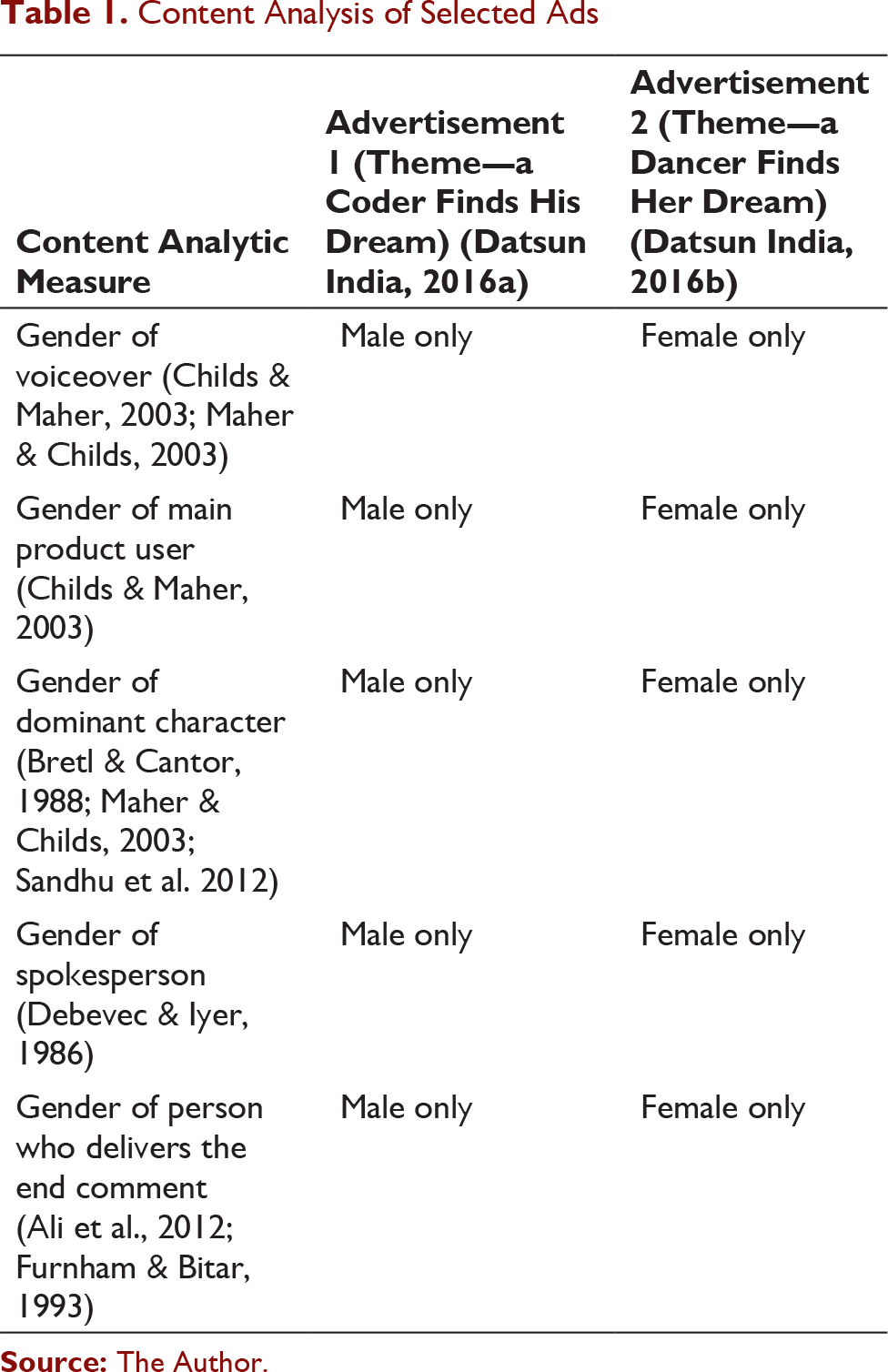
To meet the purpose of the current study, it was vital that the selected advertisements satisfy two criteria. First, availability of differently gendered ads of the same product was imperative. Second, in order to avoid response bias because of participants’ previous exposure to the ads, previously unseen ads were required. As such, in February 2016, the launch ads of the car Datsun Go were recorded. The author carefully examined the gender roles in the ads. Previous literature indicates that content analysis of ads is the most popular and effective method of assessing the use of gender in ads (Rouner, Slater, & Domenech-Rodriguez, 2003; Rubie-Davies et al., 2013; Sandhu et al., 2012). This method was employed and, after much deliberation, two ads that suited the present requirement were shortlisted. Table 1 captures the content analysis of the two selected ads.
As can be seen from Table 1, both the selected ads are either male-gendered or female-gendered. This gender exclusivity was the main reason for the selection of the ads (despite the fact that a number of ads of Datsun Go were simultaneously on air). Further, since the launch ads were recorded and the experiment was conducted a few days after these ads were first telecast on national television networks, very few study participants had previously seen the ads. The responses of such participants were discounted in the final analysis. To sum up, it can be said that the shortlisted ads qualified both the prerequisites for ad selection, and over and above the two prerequisites, both English and Hindi versions of the selected ads were available.
Preparation of Coding Sheet
In order to design the coding sheet for capturing the responses of participants to the experimental conditions, an unaided elicitation task was used (Avery, 2012), ‘if we personify Datsun Go, describe the kind of person it would be’. The elicited meanings helped structure a set of 17 differential scale items contained in the final coding sheet. Exact opposites for 10 of the 17 scale items were readily available (Stylish/Unstylish, Rural dweller/Urban dweller, Modern/Traditional, Young/Old, Stays in a nuclear family/Stays in a joint family, Male/Female, Rich/Poor, Reckless/Safe, Masculine/Feminine, Ordinary/Extraordinary). For the remaining seven items, it was difficult to find perfect opposites (Someone looking for a good bargain, Innovative, Sports lover, Enthusiastic, Spendthrift, Career-oriented, Individualistic). Therefore, the former items were anchored on a bipolar scale, and the latter items were anchored on a unipolar scale. For each of the 17 scale items, a seven-point scale was used. Although the study was only concerned with the gender identity meanings of the advertised product, all the 17 items were retained in the coding sheet to mask the true purpose of the study. The coding sheet also contained questions related to the demographic profile of the participants.
The Study
Demographic Profile of the Participants in Percentages
The Sample
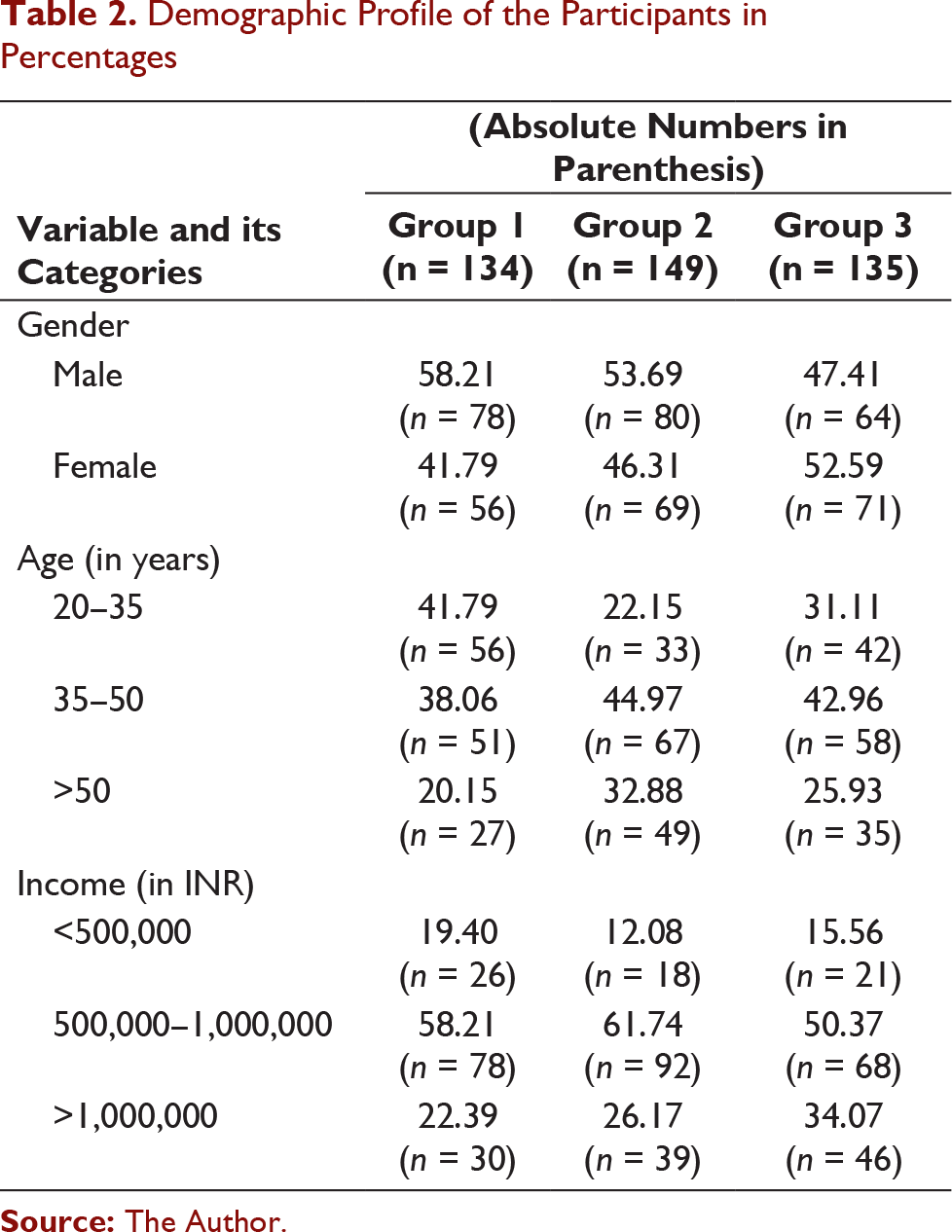
After discounting the unusable responses, the final sample consisted of 418 responses (Group 1, n = 134; Group 2, n = 149; Group 3, n = 135). Table 2 exhibits the demographic profile of the respondents for each of the three groups of participants separately.
Results
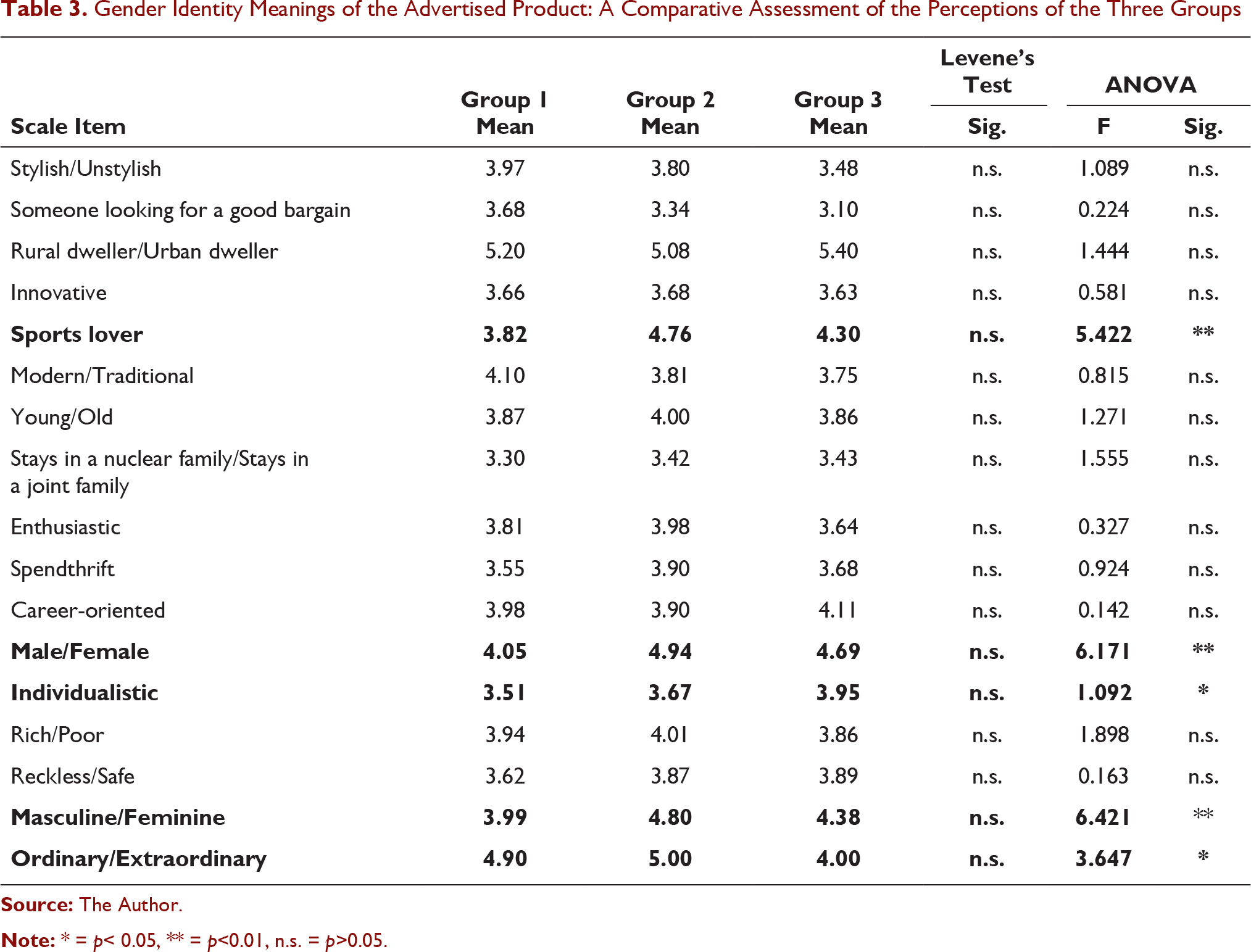
In order to analyse the data, the author first conducted Levene’s test across the three different groups for each of the scale items. Further, one-way analysis of variance (ANOVA) was used to examine the collected data for each case in which the results of Levene’s test were not significant. For the one case in which Levene’s test produced significant results, the Welch and Brown Forsythe tests were used.
Gender Identity Meanings of the Advertised Product
The gender identity meanings of the advertised product extracted by the study have been shown in Table 3. The results related to the variables significantly influenced by the experimental conditions have been highlighted. Results establish that the advertised product shares 12 identity meanings across the three experimental groups and only five identity meanings (Sports lover, Male/Female, Individualistic, Masculine/Feminine, Ordinary/Extraordinary) were significantly impacted by the experimental conditions. It may be of particular concern to this study that two of these five identity meanings are closely linked to gender identity (Male/Female, Masculine/Feminine) and one of the variables is a common gender stereotype (Sports lover; Avery, 2012). This clearly indicates that gender cues in advertisements significantly influence the perceived gender identity of the advertised product.
Gender Identity Meanings of the Advertised Product: A Comparative Assessment of the Perceptions of the Three Groups
Gender-Based Comparison of Participants’ Perceptions
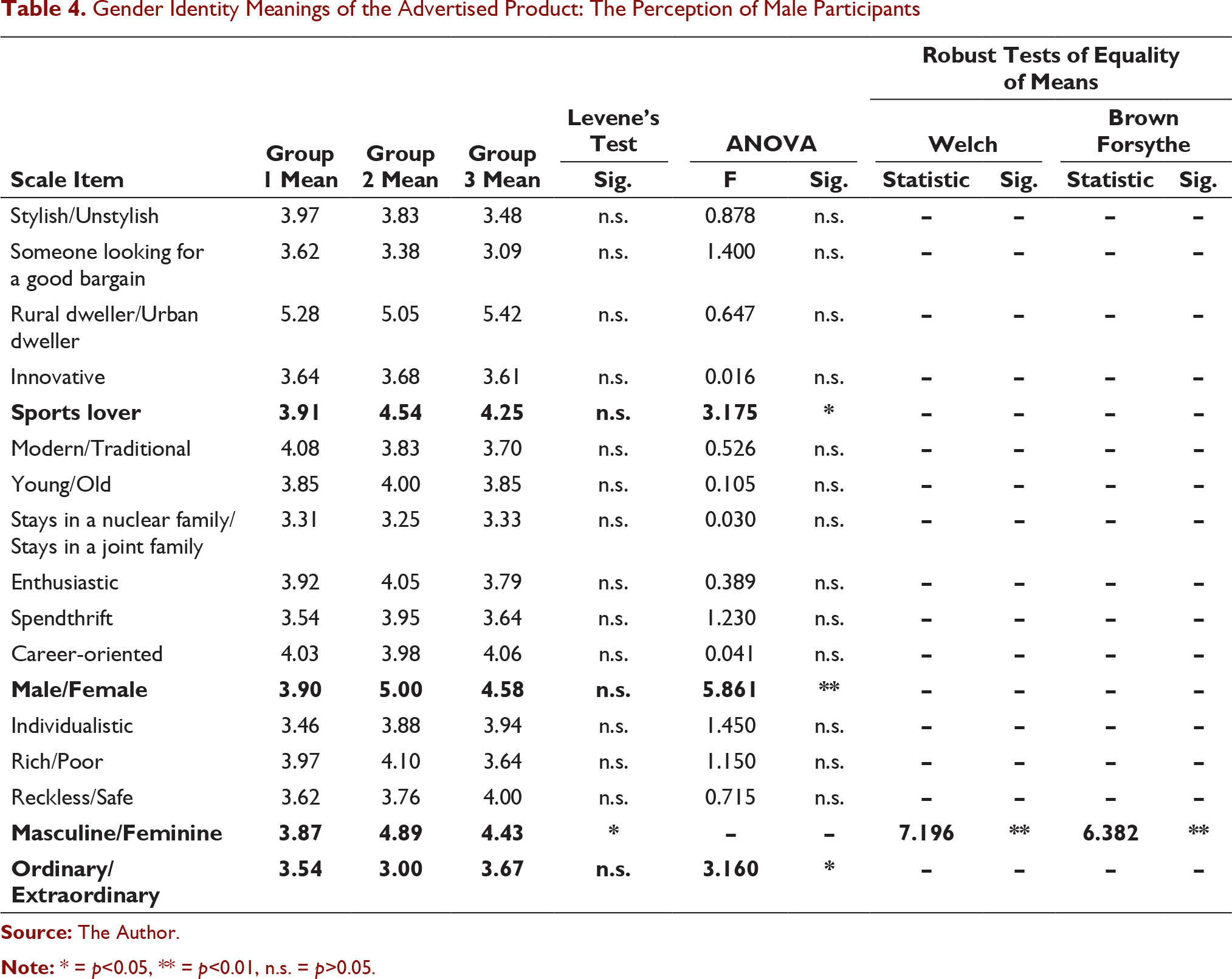
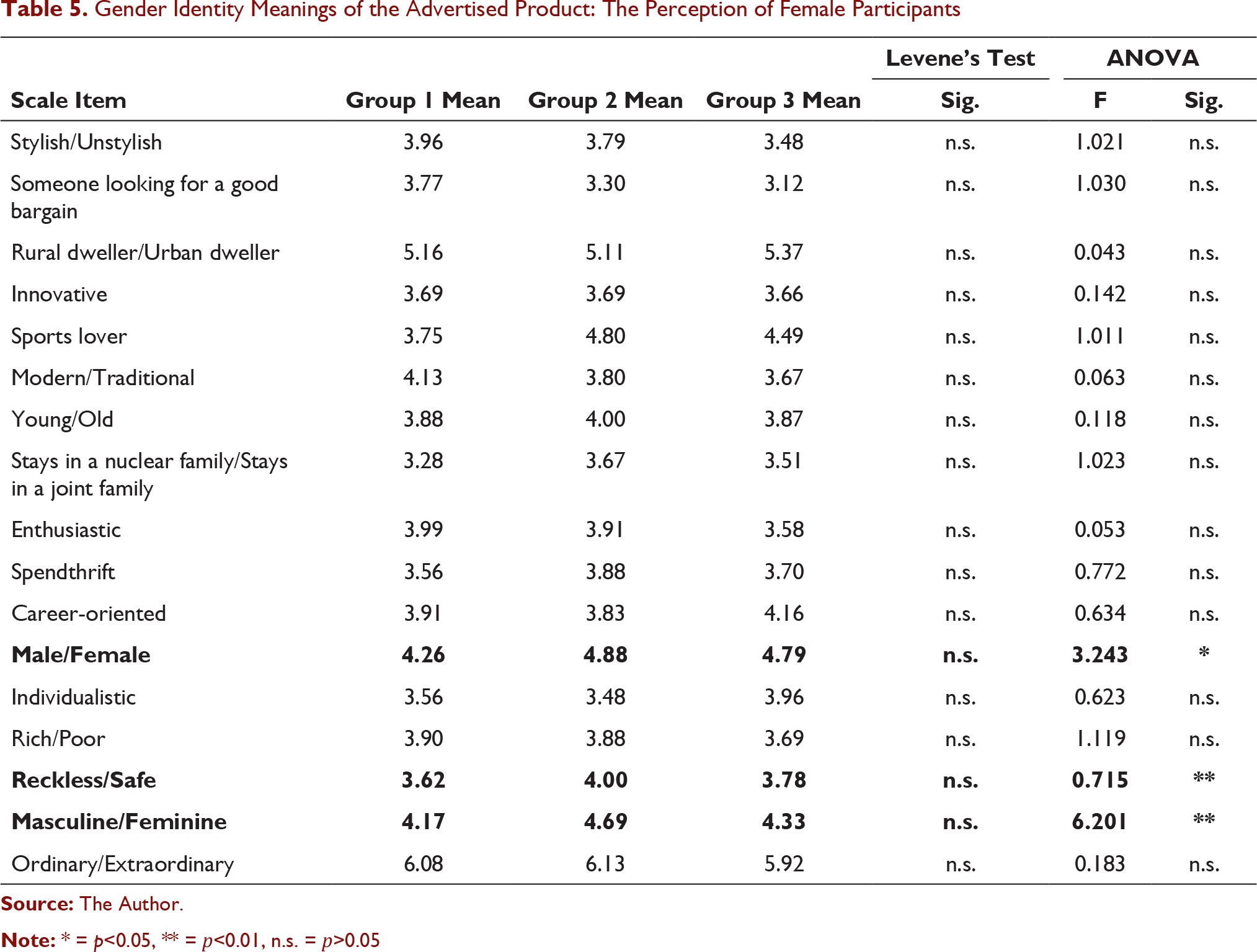
This section highlights the perceptions of the male and female participants of the study regarding the gender identity meanings of the advertised product separately (for details, refer to Tables 4 and 5, respectively). Once again, results related to the variables significantly impacted by the experimental condition have been highlighted. A separate assessment of the perceptions of men and women has been undertaken to facilitate a gender-based comparison of the perceptions of the participants.
A distinct examination of the perceptions of male participants reveals that four variables were significantly influenced by the experimental conditions. Again, two of these variables denote gender identity—Male/Female and Masculine/Feminine, and one of them is a popular gender stereotype—Sports lover (Avery, 2012). A separate scrutiny of the perceptions of the female participants reveals that three variables were significantly influenced by the experimental conditions. In this case also, two identity meanings—Male/Female and Masculine/Feminine—refer to gender identity, and one of them is a popular gender stereotype—Reckless (Avery, 2012). The two variables denoting gender identity are significant in the overall model for both the male and female participants.
Gender Identity Meanings of the Advertised Product: The Perception of Male Participants
Gender Identity Meanings of the Advertised Product: The Perception of Female Participants
Discussion
Theoretical Contributions
First, the results of the current study establish that gender cues in ads significantly impact the viewers’ perception regarding the gender of the advertised product. As such, advertisers can confer gender on advertised products with the help of appropriate gender-typing cues. Also, the gender cues used in the ads compliment the gender identity meanings bestowed on the advertised product.
Second, the study establishes that use of the same gender-typing cues in ads impacts the perception of men and women differently. Previous literature indicates that men tend to perceive masculine products as more masculine and feminine products as more feminine (Alreck et al., 1982; Frieden, 2013). As such, men tend to exaggerate the gender of different products. Conversely, under the same external stimuli, women have more moderate perceptions regarding the gender of products (Frieden, 2013). The results of the present study support these findings.
Implications for Marketers
Evidence is available that establishes that the consumer behavior of a person compliments his/her gender identity (Fugate & Philips, 2010). People tend to match their own gender with the product gender (Avery, 2012; Fugate & Phillips, 2010). Within this context, the results of the present study may be particularly useful for advertisers intending to confer gender on products with a view to specifically target either men or women. This will help consumers understand ‘what is culturally theirs’ (Milner & Fodness, 1996, p. 41) and easily connect with the advertised product. Thus, advertisers seeking to elicit a positive response from men may use more male gender-typing cues in ads and vice versa.
Advertisers may also selectively use a mix of different gender-typing cues in ads to moderate or bend the gender of existing products. This will encourage men and women to use products traditionally targeted towards a particular gender only, and enhance the overall appeal and market of the product in question. This strategy may be particularly useful given the emergence of the ‘unisex’ trend in products and brands. Marketers may find the results of the present study specifically helpful in the design of cross-gender marketing strategies.
Extant research also shows that ads activating any schema, particularly gender, tend to be more effective and enhance the likelihood of product purchase (Maldonado, Tansuhaj, & Muehling, 2003). Given this understanding, the results of the present study have a definite practical significance since they establish that gender cues in ads activate the gender schema. Advertisers may find the results of the present study helpful in developing ads.
Limitations and Future Research
It is the author’s understanding that the results of the present study may be subject to ad-specific, product-specific and experiment-specific limitations. Though the ads for the study were chosen after much deliberation, the results of the study may be tied to the particular ads used. As already pointed out, the ads used for the study were severely gendered. Results may change if less or even more severely gendered ads are used. The results may also change if the gender cues in the ads change. Further, though Datsun Go is not considered a particularly masculine brand (Sandhu & Singh, 2017), an automobile is basically a male-gendered product (Belk, 2004; Fugate & Phillips, 2010; Lane & Sternberg, 1985; Thompson & Holt, 2004). This may have also influenced the study results. Future investigators may examine if these results hold good under different treatments—change of product, ads and so on.
Further, apart from the gender-related variables, only two other variables—Individualistic and Ordinary/Extraordinary —were significantly influenced by the experimental conditions. The other variables denote economic status, social class and the likes. Future researchers may try to establish the advertising cues that significantly impact these identity meanings.
Declaration of Conflicting Interests
The author declared no potential conflicts of interest with respect to the research, authorship and/or publication of this article.
Funding
The author received no financial support for the research, authorship and/or publication of this article.
Footnotes
About the Author