







Abstract
This study uses the network approach of entrepreneurship to investigate the relationship between networks and the growth of entrepreneurial ventures. Most of the earlier researchers have maintained a static view of entrepreneurial networks which underplays the dynamic nature of networks. This study attempts to identify the major network characteristics during different growth stages of the ventures in the context of India. The data were collected from 173 information technology entrepreneurs through a cross-sectional survey. The study found that the characteristics of network diversity and network governance have a significant discriminative magnitude and thus play a significant role across all growth stages. Endorsement and embeddedness characteristics also have a significant discriminative magnitude but not in the initial stages. However, network inertia and relational mix were found to have a discriminative magnitude only during the survival and success stages of growth. Overall, the study contributes to further extend the dynamic view of entrepreneurial networks with evidences from an emerging market.
Introduction
Entrepreneurship has been explained by a variety of perspectives, including social, economic and innovation. According to one perspective, ‘entrepreneurship, like the rest of social life, is a collaborative social achievement’ (Drowning, 2005, p. 196). The role of entrepreneurial networks has increasingly been emphasized in the contemporary dynamic business world (Hoang & Yi, 2015; Hite, 2000; Jack et al., 2010; Stuart et al., 1999), and researchers have developed an understanding about the role of networks in the growth and success of entrepreneurial ventures (Hansen, 1995; Hite, 2005; Larson & Starr, 1993).
While examining the role of entrepreneurs’ network in the growth and performance of their venture, most of the scholars have maintained a static view of networks (Jack et al., 2008; Liao & Welsch, 2003; Maurer & Ebers, 2006). This static view underplays the dynamic view of networks as the resource need of firms brings changes in the characteristics of networks as the firms grow. The nature, types and characteristics of entrepreneurial network dynamically evolve as the venture passes through different stages. In order to maintain the networks at different growth stages of the venture, entrepreneurs should know the relative importance of the nature and characteristics of networks, so that their venture keeps performing well in a given context. This will require learning how networks develop as the venture grows (Hoang & Yi, 2015; Slotte-Kock & Coviello, 2010; Stuart & Sorenson, 2007). More exploration is needed to learn as to which characteristics of networks, for example, diversity, relational mix and governance, influences the growth of ventures more in different stages of growth. Moreover, not much is known about the role of the contextual factors in shaping the entrepreneurs’ handling of networks to sustain the growth of their venture (Batjargal, 2006).
This study, conducted in the context of the Indian information technology (IT) and IT-enabled services (ITeS) industry, aims to investigate the changes in the network of new ventures along their growth stages. The study considered six network characteristics—diversity, inertia, relational mix, endorsement, governance and embeddedness—and the five-stage venture growth model (Churchill & Lewis, 1983) to investigate their linkages. Subscribing to the dynamic view of networks, the paper attempts to answer the question whether these network characteristics change significantly as the venture grows through the five stages. Moreover, the study also identifies the key network characteristics that shape the growth trajectory at every stage by finding out which ones contribute more to the initial stages and which ones in the later stages. These findings would help entrepreneurs to prioritize their attention and resource allocation to achieve sustainable growth. The paper also contributes to expanding the understanding of entrepreneurial network–growth linkages in the regional context of India. Finally, the study offers a framework that explains the dynamics of the co-evolution of entrepreneurial network and entrepreneurial growth.
This paper is organized as follows. Literature Review looks at the extant literature related to networks and organizations. Methodology introduces the approach used for this research, sample, measures, survey process and all related aspects. Analysis presents the analysis carried out and the empirical results obtained. The last section draws conclusions and discusses the implications in terms of theory and practice along with indicating possible future research directions.
Literature Review
Networks and Growth of Ventures
The network approach to entrepreneurship is viewed as a sound theoretical approach in the literature (Bruderl & Preisendörfer, 1998). Network as a concept has well been explored in social sciences such as psychology and sociology. Social acquaintances make people stay connected, underlining the Small World Phenomena emphasized by social psychologist Stanley Milgram in the 1960s. Researchers from various fields have worked on this theme and concluded that it is not what-you-know, but who-you-know that matters. Seeing that networks play a catalytic role in the evolution of organizations (Birley, 1985), Aldrich and Zimmer (1986) further examined the issue and offered a perspective that considered entrepreneurship as well embedded in the networks of continuing social relations.
Typically, scholars characterize entrepreneurial firms with a lack of limiting resources along with other start-up handicaps as conceptualized in the form of ‘liability of newness’ (Stinchcombe, 1965) and ‘liability of smallness’ (Baum, 1996). Overcoming the lack of limiting resources, networks can provide access to some resources such as markets, know-how, technologies and domain-related knowledge. This necessitates a better approach to understand the dynamic nature of networks and their implications (Larson & Starr, 1993; Reese & Aldrich, 1995; Salancik, 1995). As the firm evolves, its corresponding networks also tend to evolve and contribute to the organizational growth. The evolution of networks includes changes in the form of their relational mix and other characteristics related to governance, embeddedness, content and structure.
Hite and Hesterly (2001) explored the evolution of networks for firms in transition from emergence to early growth stage. They observed that the evolution of networks of emerging business firms was influenced by their changing requirement for resources and resource acquisition challenges, as the firm grew through the successive emerging stages. They concluded that while moving through the growth stages, the firm evolves from ‘more identity-based, path-dependent networks during emergence to more calculative, intentional networks during early growth’ (Hite & Hesterly, 2001). In other words, networks based on personal relations are more dominant in early-stage firms, which ultimately tend to move to more transaction-based relations with the successive growth stages and hence firm and its network ‘co-evolve’.
Researching how ventures’ networks changed in terms of four main characteristics, viz., type, number, source and location, over a period of three years, Schutjens and Stam (2003) observed that
the shift from social to business contacts over time, as hypothesized in the literature, only holds for outsourcing, supplier, and cooperative relationships. This means that upstream contacts become increasingly commercial over time. In contrast, downstream contacts (sales relationships) become increasingly social in source. (p. 130)
Characteristics and dimensions of networks have been offered as one way in which network change might be considered (Nahapiet & Goshal, 1998). Stuart and Sorenson (2007), though, have claimed that not much is known in terms of network emergence and evolution. However, attempts have been made to develop theoretical frameworks and models to support the proposition that evolution of organizations and networks go hand in hand (Slotte-Kock & Coviello, 2010). Strobl and Kronenberg (2016) studied hospitality entrepreneurs’ network and observed that the network configuration was triggered by the entrepreneurs’ generational transition and changes in the dynamic competitive settings. Thus, the dynamic context of the environment begets the network dynamism.
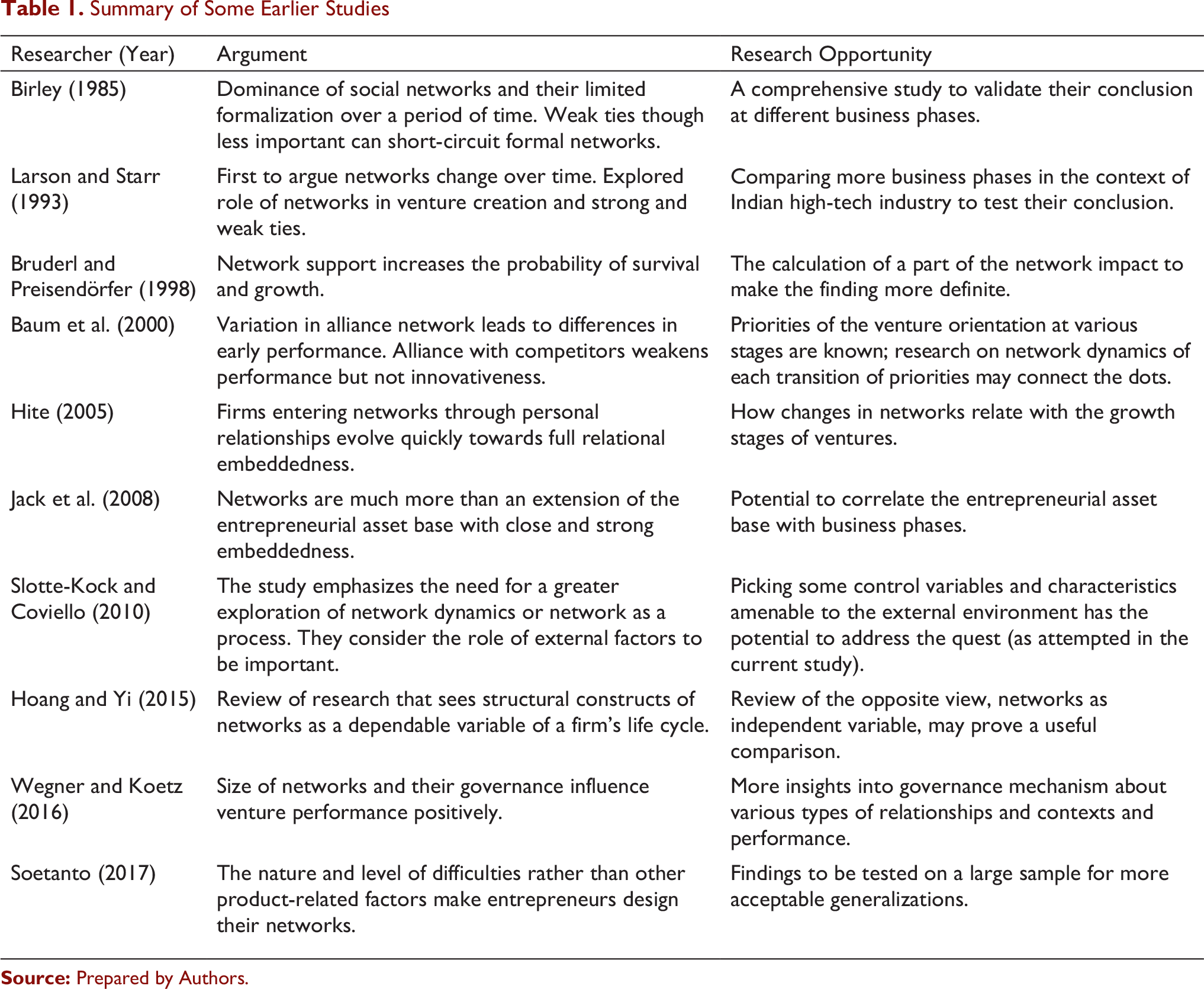
The work done so far has been criticized for not considering how networks might change over time and how such changes in a network might affect the entrepreneurial venture performance (Hoang & Antoncic, 2003; Jack, 2010; Slotte-Kock & Coviello, 2010). While there appears to be a consensus on the effective role of network for emerging ventures, views on the relative advantage of network characteristics for firms’ growth, especially during the early stages, do not converge (Hite & Hesterly, 2001). In their extensive review of network-based research, Hoang and Yi (2015) recommended further exploration to clarify how a venture’s development and life cycle affects network development. Their recommendation leads to an important research area of how network characteristics of firms change while they grow from the early stage to the advanced stages. The dynamic nature of entrepreneurial network characteristics makes entrepreneurial learning more difficult, underlining the importance of understanding of networks (Soetanto, 2017). So, the researchers appear to have realized the need to develop a more explanatory and integrated understanding of network change of entrepreneurial ventures in varied contexts (Hoang & Yi, 2015; Rosenblatt, 2018). Table 1 presents a brief overview of the studies conducted in the area of entrepreneurial networks.
Most of the earlier studies appear to agree on the importance of the role of networks in supporting entrepreneurial ventures, but there seems to be no consensus on how networks might develop over a period of time and if there could be any characteristics of the networks that can help the growth of entrepreneurial ventures. So, the focus has mostly been on studying certain characteristics such as strong and weak ties, while all other characteristics have been ignored. These overlooked characteristics seem to have a significant impact on the determination of networks. Other factors, such as the type of industry, stage of growth and so on, may also influence the networks and related developments. Other limitations of the literature are related to the scope, in terms of a comprehensive coverage, of the network characteristics such as diversity, inertia, endorsement, relational mix, governance and embeddedness, suggesting a framework for the co-evolution of networks and venture growth may be in order. Thus, there is a good scope to study advanced theoretical underpinnings of entrepreneurial networks in the context of the IT industry of an emerging market such as India. The IT ventures with their high growth orientation make it a rich context to study the network dynamics.
Hypotheses Development
Summary of Some Earlier Studies
Networking in entrepreneurship is considered as well embedded across the sociocultural context. The context in which dynamic relationship of entrepreneurial network and growth exists consists of the factors which influence the network characteristics such as relational mix, governance and so on (Wegner & Koetz, 2016). Moreover, the presence of institutional voids leads to more entrepreneurial activities in emerging markets (Khanna, 2014; Khanna & Palepu, 2005) and hence the interplay between networks and the growth of ventures. In a qualitative study of seven technology Indian ventures at various stages of growth, Bhushan and Pandey (2015) explored the linkages between network characteristics and venture growth. Exploring deeper into the entrepreneurial mindset, they provided some propositions, linking them with some of the existing theories within the Indian socio-economic context. However, this study lacks the statistical evidence for their propositions.
H 1 : Network diversity significantly discriminates among various growth stages of ventures.
Firms find it difficult to face changes in their network ties because of network inertia. Network inertia relates to a characteristic of the network that highlights the organization’s resistance to changes in inter-organizational network ties or the problems that an organization faces when it tries to build new network ties in place of the old ones, specifically while moving upwards through growth stages. Kim et al. (2006) offer several propositions for the behaviour of inertia as a concept with respect to like firm size, firm age, the amount of change it has witnessed so far, the duration of its network ties, its own perceived status and the overall business environment. However, firms need to perform a ‘balancing act’ in order to sustain their network (Bhushan & Pandey, 2015). The venture learns to manage its resistance to change as it scales up its operations by realigning their networks. So, we hypothesize:
H 2 : Network inertia significantly discriminates among various stages of growth of ventures.
Firms tend to improve their reputation and hence find a better acceptance among various stakeholders with their inter-organizational exchange relationships, which act as endorsements (Stuart et al., 1999). Network endorsement relates to the characteristics of the venture networks helping to enhance their visibility and improve the desired recognition. The endorsements of the ventures by well-recognized stakeholders help to mitigate the uncertainty and liability of the newness (Stuart, 2000). New ventures look to acquiring prestigious affiliations to build up strong links hoping that ultimately, through these contacts, they will have access to some stakeholders such as customers and partners, and improve their legitimacy (Elfring & Hulsink, 2003). Thus, endorsements appear to play a significant role in the growth of new ventures, especially a more dominant one in the later stages of growth. So, we hypothesize:
H 3 : Network endorsement significantly discriminates among various growth stages of ventures.
Entrepreneurs during the early stages of their venture largely leverage personal networks with friends and family but slowly start tapping into business networks as their venture grow. Hence, they witness a transformation of their network relational mix. Network relational mix is that characteristic of the network by the virtue of which firms use various types of networks constituents such as social, business, structure and spatial proximity in successive development phases (Lechner et al., 2006; Soetanto & Jack, 2011). In a research study, Lechner et al. (2006) observe that relational mix is a relatively better way of linking network change with the evolution of a firm if compared to the network size. The overall network of the ventures matures and formalizes as ventures move up through different growth stages. So, we hypothesize:
H 4 : The network relational mix significantly discriminates among various growth stages of ventures.
Firms need to put a proper network governance mechanism in place to realize the gains of relational rent, which is influenced by that governance (Dyer & Singh, 1998). Network governance is a form of mechanisms that influence adaptation and coordination and safeguards exchanges in the network (Larson & Starr, 1993). One type of governance may be reinforced amidst changing the external environment (Provan et al., 2007). There are possibilities that hub type of governance undergoes changes as the network evolves along with the growth stages. Researchers have also observed that the network governance mechanism influences the firm performance (Wegner & Koetz, 2016). However, scholars are still not much clear, though, about how different types of governance emerge and also how they get institutionalized. It implies that network governance plays a critical and different role across the growth stages of ventures. So, the study hypothesizes:
H 5 : Network governance significantly discriminates among various growth stages of ventures.
One perspective considers entrepreneurship as well embedded in the networks of continuing social relations (Aldrich & Zimmer, 1986). Network embeddedness, although economic in nature, refers to relationships which have some additional personal attributes, such as loyalty and sympathy, attached to them and also to an increased frequency of contact and a higher degree of commitment to that contact (Granovetter, 1985). Moreover, strong and close embeddedness of networks makes them much more than simply a part of the entrepreneurs’ assets (Jack et al., 2008). Ventures tend to enter the networks based on the entrepreneurs’ personal contacts, approach fast towards relational embeddedness and can influence the benefits including sales performance at different stages of growth (Hite, 2005; Pia & Katja, 2011; Westerlund et al., 2017). Hence the hypothesis:
H 6 : Network embeddedness significantly discriminates among various growth stages of ventures.
Methodology
Sample and Data
The sample for the study composed of respondents from ventures in the ITeS industry located in technology (IT)-rich clusters, mostly in the National Capital Region (NCR) and Bangalore. IT firms are characterized as industries with heavily science-centric innovation, high research expenditures and a high proportion of scientist and engineer employees, compared with other types of firms (Allen & Stearns, 2003) and hence makes a rich case for research. These respondents included founders and co-founders of the technology ventures. As per the National Association of Software and Services Companies (NASSCOM), which is a trade association of the Indian IT and business process outsourcing industry, NCR and Bangalore are the two strongest hubs of technology ventures and home to almost 50 per cent of the around 3,000 technology ventures in India. Bangalore is also called the Silicon Valley of India. The population for this research included independent entrepreneurs of Indian IT ventures and who met the following criteria:
Their venture is located in India and within the defined geographical clusters of NCR or Bangalore. The individuals are owners or co-owners of the venture. The individuals operate in IT and related sectors.
Summarily, the sample constituted of individuals who had founded a venture in India related to IT or in areas such as software consulting, product development, e-commerce, internet-enabled services, web applications etc. Multiple sources and industry associations were used to identify such ventures. Some of the major sources include NASSCOM, Confederation of Indian Industries (CII), Indian Software Product Industry Round Table (iSPIRT) and LinkedIn. The data were collected directly from the founder-owners of the sample ventures. Seeing the nature of the study, respondents, area of the study etc., data collection using an online survey method was the obvious choice. A list of prospective respondents was prepared after exploring the possibility of getting responses in view of convenience and accessibility. The researchers also took help of some IT professionals from their professional network to finalize the sample. The link for the online survey was shared with 532 respondents who had consented to participate in the survey. The respondents were either owner-founders or co-founders who had witnessed the growth of their ventures almost since inception. Out of the total 532 invitations sent out, 173 (32.7%) responses were received. To ensure that there were no incomplete or invalid responses, all questions were marked as compulsory for the completion of the survey.
Discussion with professionals and academicians for the construction of questions was also a part of the study. The questionnaire contained questions regarding the measurement of six network characteristics. Each characteristic defined four to six questions whose answers were aggregated to provide an overall meaning for that parameter. The questions asked for responses on a five-point Likert scale well accepted by researchers in social sciences (Selltiz et al., 1976). In addition to questions related to measuring the network characteristics and growth stages, there were also some general questions seeking basic information such as the age of the firm, number of employees and area of work.
Variables and Measures
The study considered six network characteristics as defined by earlier researchers, viz., diversity (Burt, 2000), inertia (Kim et al., 2006), endorsement (Elfring & Hulsink, 2003), relational mix (Lechner et al., 2006), governance (Larson & Starr, 1993) and embeddedness (Granovetter, 1985). To study the evolution of these ventures, the five-stage growth model, which was specifically developed for small and growing businesses by Churchill and Lewis (1983), is used. The five stages are as follows:
Existence stage includes the initial formative stage when firms are not too sure of customers, products, services etc. Survival stage provides for establishing a firm as a viable business entity with a few customers and sustaining their satisfaction with its products/services. Success stage is characterized by the firms growing large enough and requiring functional groups to be run efficiently, with adequate funding etc. Growth stage is reached when the firm looks towards a rapid growth and mechanism to finance itself. Maturity stage is when a firm consolidates and controls the value created through rapid growth. At this stage, detailed strategic and operational plans get formalized along with well-developed processes and systems.
Validity and Reliability
The researchers could find widely used and published standard constructs available to measure the network characteristics. A few of these characteristics, such as network inertia and network relational mix, are too new with just a handful of research papers which proposed these constructs. In addition to the inputs based on the pilot survey, the measures of all six constructs were developed through an extensive literature review and validated by academicians and professionals. All six constructs so developed were extensively brainstormed internally as well as externally with academicians, industry professionals and entrepreneurs before they took a final shape.
The reliability of scales developed to measure the network parameters was tested using Cronbach’s alpha, a widely used reliability quotient for the internal consistency of data. The generally accepted alpha is 0.7. However, Nunnally (1978) proposed allowing lower limits, such as 0.60 or even 0.50, for an exploratory work that involved using newly developed scales. A high alpha does not always mean a high degree of internal consistency (Tavakol & Dennick, 2011). Alpha mainly depends on the number of items composing the scale. One can get a reliable scale if the scale is long enough despite using items with poor internal consistency (Nunnally, 1978). The results obtained for this measure for the various network parameters, shown in Table 2, can be considered to have an acceptable level of internal consistency.
The data were analysed through SPSS version 23 using canonical linear discriminant analysis, a classical form of discriminant analysis. Discriminant analysis makes certain assumptions with regard to the normality of independent variables, homogeneity of variance and multicollinearity. Moreover, discriminant analysis sometimes tends to explain the relationship between the variables rather than to explain the causality; also, normally, equations are not written when the measures used in the study are not very objective measurements (Ramayah et al., 2010).
Data Analysis and Discussion
The data for independent variables were found to be normally distributed with skewness values between −1 and +1 and kurtosis values between 0 and 3. With regard to the homogeneity of variance, Box’s M test of sphericity was performed for equal population covariance (significance value 0.314). A correlation test was done to test for multicollinearity of the independent variables, and no significant correlation was found.
Cronbach’s Alpha

Discriminant Analysis: Structure Matrix
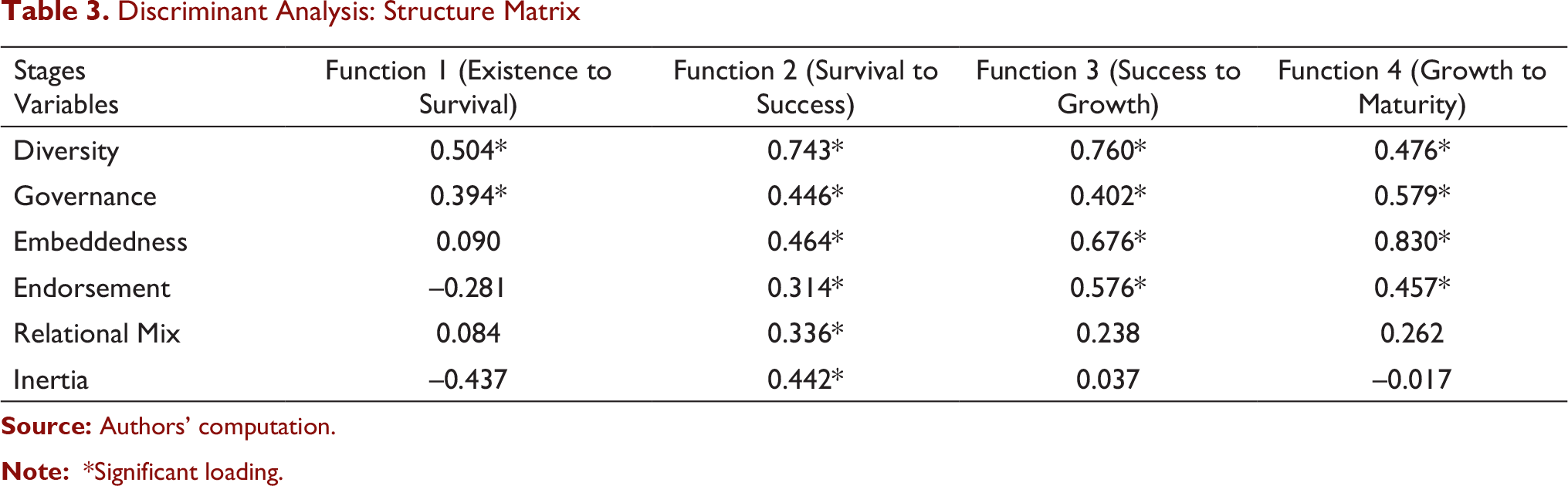
Two network characteristics, diversity and governance, with a measure of more than 0.3, undergo a significant change for firms which are at the existence and survival stages. All network characteristics, that is, diversity, inertia, embeddedness, relational mix, governance and embeddedness, have a measure of more than 0.3 and hence undergo a significant change for firms that are at the survival and success stages. The transition between these two stages is probably the most radical where the network gets transformed for all six parameters under study.
Diversity, embeddedness, endorsement and governance characteristics of networks undergo a significant change for firms that are at the success and growth stages, while relational mix and inertia do not change significantly between these two stages. However, diversity, governance and endorsement characteristics no longer seem to exhibit significant change between these two stages. Moreover, the magnitude of discrimination also changed.
Co-evolution Framework
Figure 1 shows the framework that emerged from the findings of this study. The framework gives more specific insights into the co-evolution of the network and the venture. The stage-level network characteristics studied for the given stages have provided useful insights into the changes observed from stage to stage. The framework suggests that for the transitions of high technology ventures from the existence to the survival phase, network diversity and network governance parameters undergo a significant change. It means that these are the two network characteristics that the entrepreneur should focus more for a successful transition between these two stages. Of these two characteristics, diversity has a higher discriminant dimension (0.504) as compared to governance (0.394). Going by this, diversity is relatively more important than governance for the transition between existence and survival phases of the venture.
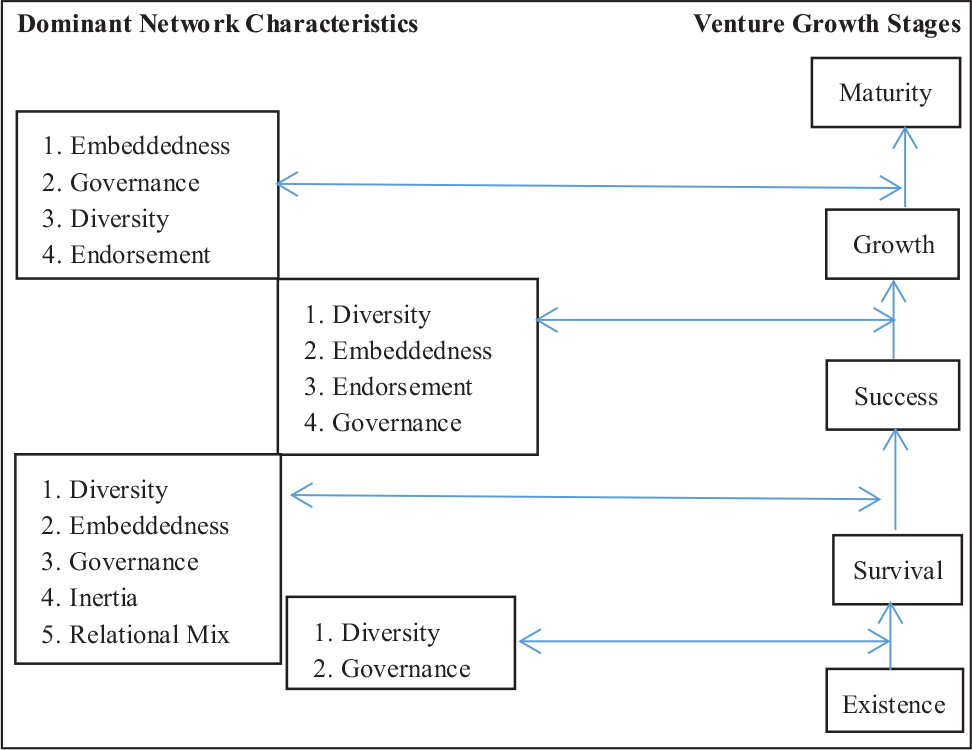
For the transition from survival to the success stage, all six network parameters undergo a significant change. This transition is a critical phase as it is the stage where the venture is fully stable with enough cash, customers and functional units in place. Getting to this stage needs all network characteristics to play their part in a major way. It means that the entrepreneur should focus more on all six network characteristics for a successful transition between these two stages. Out of these six characteristics, diversity has a higher discriminant dimension (0.743), followed by embeddedness (0.464), governance (0.446), inertia (0.442), relational mix (0.336) and endorsement (0.314). Going by this, diversity is relatively most important for the transition between survival and success phases of the venture. This is followed by embeddedness, governance, inertia, relational mix and endorsement.
For the transition from success to the growth stage, four network parameters, viz., diversity, governance, embeddedness and relational mix undergo a significant change. It means that these are four network characteristics that the entrepreneur should focus more on for a successful transition between these two stages. Out of these four characteristics, diversity has a higher discriminant dimension (0.760), followed by embeddedness (0.676), endorsement (0.576) and governance (0.402). Going by this, diversity is relatively more important for the transition between success and growth phases of the venture. This is followed by embeddedness, endorsement and governance.
For the transition from growth to the maturity stage, four network parameters undergo a significant change. Out of these four characteristics, embeddedness has a higher discriminant dimension (0.830), followed by governance (0.579), diversity (0.476) and endorsement (0.457). Going by this, embeddedness is relatively more important for the transition between growth and maturity phases of the venture. This is followed by governance, diversity and endorsement.
The framework and the findings help answer some of the questions from the existing literature related to a venture life cycle and network change. The findings are specific to IT and ITeS ventures operating within the Indian socio-economic context. The framework shows what changes from stage to stage for a typical technology firm based on the stage life-cycle theory with respect to the six network characteristics that formed a part of the scope for this research. As per the extant literature, diversity as a network characteristic has been extensively argued by theorists to help have increased access to an extensive range of information about potential markets, sources of capital, innovations, new business locations, and, of course, potential investors (Batjargal, 2006). The co-evolution model derived from this research shows that diversity is a discriminating factor for all dynamic stages, right from existence to the maturity.
With respect to network inertia, the discriminant analysis shows that inertia is a discriminating factor for one dynamic stage transition, that is, from survival to success. Our findings show that the overall network capabilities of a firm significantly impact the structure of its networks and the way they morph in the future as a part of the evolution process. Firms able to manage their network well can drive significant changes in their network. In this regard, the findings of our research do not seem to support network inertia in the Indian socio-economic context of high technology ventures.
Smaller technology ventures need some sort of endorsement from prominent players in their respective industry (Stuart et al., 1999). Discriminant analysis results show that endorsement is a discriminating factor for all dynamic stages except existence and survival. The result is similar to what Wu et al. (2008) found in their seminal work. During the transition from existence to the survival stage, a start-up has to prove its legitimacy on its own. Although Wu et al. (2008) urge to use ‘risky situation’ as a control variable, the present study has been limited to normal business situation. Using situation as a control variable might give different results.
Lechner et al. (2006) raised the question from the practical perspective that which tie (social versus business) matters when. The present study reports that during the transition only from success to the growth stage, the firm tends to rely more on social relationships. In all other dynamic situations, the firm relies on business relationships. This is because the transition from success to growth requires stabilization, which is requisite of the inward-looking approach, and it is vice versa in other cases. Lechner et al. (2006) further mention that young firms rely more on social networks. This is consistent with the results of the present study in the Indian IT context. Thus, liability of newness for the young firm is effective only when it moves from success to the growth stage.
The results about stage-level network changes as obtained from discriminant analysis also show that governance as a network characteristic has a significant discriminating magnitude. Governance is a discriminating factor for all dynamic stages, showing that formalization of things increases from stage to stage. This is consistent with the observations of earlier research (Provan & Kenis, 2007; Wegner & Koetz, 2016). Hoang and Yi (2015, p. 43) concluded: ‘A more complex picture is emerging that suggests that some aspects of networks may contribute to better performance along some dimensions but not others (for example, survival versus growth).’ The present study extends this conclusion by identifying what aspects of the network characteristics contribute the most for which stage.
Conclusion
This study analysed responses from founders-cum-entrepreneurs and contributed to the literature on entrepreneurial networks in the context of the Indian IT and ITeS industry. It investigated how during various stages of growth of the ventures the dominant characteristics—diversity, governance, relational mix, embeddedness, inertia and endorsement—of entrepreneurial ventures’ networks change. A more complex picture emerges that suggests that some aspects of networks may contribute to better performance along some dimensions but not others, for example, survival versus growth (Hoang & Yi, 2015). This study answers how the network configuration changes as the firm transitions through its growth stages. Network diversity and network governance were found significant for all five stages of the venture’s growth. So, the finding about network diversity, which brings innovative ideas, resources and new knowledge to the entrepreneurs, confirms the observations of Soetanto and Jack (2011). Structural changes in the network governance mechanism enrich the understanding of venture’s network governance for marshalling the growth in a given context. In the case of relational mix, it was observed that a firm tends to rely on social relationships only during the transition from success to the growth stage. In all other dynamic situations, firms rely more on business relationships. Overall, the study shows how the network configuration in the Indian IT context changes.
Contribution and Implications
This study adds to the existing knowledge in the areas of strategy, entrepreneurship and network development. The study supports findings of Wu et al. (2008) on maintaining the relationship of trust even after the start-up successfully survives through the initial stages. However, evidence does not support the theoretical arguments on network inertia (Kim et al., 2006) about difficulty and challenges when ventures attempt to change the network ties. In response to the question about the influence of network governance, findings of the study are consistent with those of earlier studies (Albers, 2010; Wegner & Koetz, 2016). Networks have to be meticulously crafted as practitioners will be able to see trends in network development such as what works, what does not. This can give them better insights to look at their network strategies and align them optimally during a given stage of growth. The suggested framework can be of potential help in providing guidance towards some commonly occurring situations in which entrepreneurs knowingly or unknowingly get trapped during their quest for growth.
Limitations and Future Directions
The study has some limitations too. It was conducted in the context of one Indian industry only, and the sampling was limited to only two IT clusters in India. Also, the homogeneity of industry-specific network dimensions makes the study’s results generalizability across all industries limited. Further, the scope of the study was restricted to consider only six characteristics of networks without accounting for their interdependence. This study used cross-sectional research design in view of time and resource constraints. Future researchers can take up findings of this study and possibly test them for different contexts. In this way, the findings can be further validated, generalized and used as a generic instrument. The nature of networks is evolutionary. So, future studies can use a longitudinal research design to capture how networks change as a venture grows through different stages. Another direction for future research can be incorporating some more variables, e.g., strategic orientation, cluster location, entrepreneur’s personality and entrepreneurial ecosystem as moderating or control variables. We suggest that a study should be conducted to explore the role of entrepreneurial networks in filling the institutional voids for strengthening the entrepreneurial ecosystem in emerging markets.
Footnotes
Declaration of Conflicting Interests
The authors declared no potential conflicts of interest with respect to the research, authorship and/or publication of this article.
Funding
The authors received no financial support for the research, authorship and/or publication of this article.
