







Abstract
This study explores how employees in hybrid organizations navigate institutional contradictions in the context of India’s evolving energy sector. Drawing on a qualitative case study of VTPL, a public–private hybrid firm, we examine how non-managerial and contractual employees experience and respond to tensions arising from conflicting public and private logics. Framing the case study as a process investigation, we identify four coping strategies: pragmatic role-switching, symbolic compliance, contractual worker resilience and legitimacy shielding. These strategies reflect a dynamic process of sensemaking and adaptation, moving beyond static models of conflicting logics in hybrid organizations. Our findings contribute to research by demonstrating how employees actively construct hybrid work identities and shape responses from the bottom up. The study offers insights into how hybrid organizations can foster adaptation and flexibility to sustain performance in complex environments.
Keywords
Introduction
Hybrid organizations (HOs), situated at the intersection of public and private logics, are increasingly prominent in emerging market contexts. These entities blend the bureaucratic traditions of public sector undertakings (PSUs) with the entrepreneurial ethos of private firms, often to address complex socio-economic challenges (Arslan et al., 2024; Kanon & Andersson, 2023). In an organizational context where institutional logics manifest as shared practices, strategies and priorities to guide decision-making and behaviours, HOs often operate with divergent institutional logics. Driven by the plurality of institutional goals and stakeholder expectations, such conflicting logics can cause tensions, necessitating managers to embrace the interdependence of competing demands to resolve these tensions (Lewis & Smith, 2014).
While hybrid organizing has attracted significant scholarly interest (Battilana & Lee, 2014; Jay, 2013), most studies focus on managerial or structural strategies for reconciling institutional logics. Less is known about how non-managerial employees, particularly those in precarious or contractual roles, operationally navigate these tensions by making sense of, and responding to, conflicting logics. Essentially, existing studies treat non-managerial and contractual employees as passive recipients of institutional complexity (Battilana & Dorado, 2010; Reay & Hinings, 2009). The scarcity of research in this area is especially problematic for emerging markets, where employment arrangements are often fluid, and frontline employees operate under competing expectations of accountability, flexibility and performance. For instance, in the Indian context, public–private HOs, such as those in the energy sector, face similar conflicting logics, including balancing profit with public service or delivering process compliance with market agility. However, the lived experiences and coping mechanisms of those navigating these contradictions have remained underexplored.
In this study, we position employees, particularly non-managerial employees, as active navigators of hybridity, whose actions constitute the micro-foundations of hybrid organizing. Drawing on Alvesson and Sandberg’s (2011) call to ‘problematize the gap’, we argue that the dominant focus on leaders and organizational structures renders invisible the tensions, improvisations and informal strategies developed by frontline employees who are often most directly exposed to conflicts of hybrid organizing. Their roles demand compliance with bureaucratic norms while also requiring agility and innovation, especially in sectors like energy, where state regulation meets competitive market pressures. We examine how employees navigate competing organizational logics in their daily work in the context of Vidyut Trade Pvt Ltd (VTPL), 1 a leading Indian energy-trading firm with hybrid public–private roots. By using a process research approach (Langley, 2009), we explore how individuals engage with tensions over time and how their coping strategies contribute to organizational adaptation.
The central research question in this study, then, is: How do non-managerial employees in hybrid organizations navigate competing institutional logics in their operational work? Importantly, how do they navigate these pluralities to shape and negotiate meaning in response to conflicting institutional pressures? In examining these questions, this study makes three key contributions: First, it refocuses the analytical lens to non-managerial workers, a group often overlooked in hybrid organizing literature. Second, it identifies novel coping mechanisms, including pragmatic role-switching, symbolic compliance and legitimacy shielding, which deepen our understanding of logics navigation. Finally, it delivers insights into the process of navigating conflicting logics, revealing how everyday actions accumulate into broader organizational learning and adaptation.
In the sections that follow, we outline the theoretical foundations of hybrid organizing, present our methodology and empirical context, and detail the emergent coping strategies identified through our fieldwork. We conclude with implications for theory and practice, particularly around enabling more responsive and inclusive forms of hybrid organizing.
Theoretical Anchoring
Hybrid Organizing and Institutional Logics
HOs combine elements of multiple institutional logics, typically public and private, to address complex societal and economic challenges (Battilana & Lee, 2014; Jay, 2013). These organizations defy traditional sector boundaries by pursuing both commercial goals and public or social missions (Battilana et al., 2012; Haigh & Hoffman, 2012), straddling market-based efficiency and mission-based legitimacy. Typified by multiple stakeholders, conflicting goals and divergent, inconsistent activities (Mair et al., 2015; Ménard, 2022), their hybrid form also invites complex tensions across goals, governance and accountability (Ebrahim et al., 2014; Mair et al., 2015). Their evolution spans a spectrum of forms—from contracts and subcontracts to supply chain systems, distribution channels, networks and collective trademarks within franchises—to achieve operational efficiency, market reach and sustainability (Vassallo et al., 2019).
Public–private hybrids, including corporatized PSUs, are particularly prominent in developing contexts, where governments seek to enhance service delivery while leveraging private sector expertise and innovation (Gibson et al., 2023; Karré, 2021). Such organizations are often tasked with achieving dual mandates, specifically delivering public value while ensuring financial sustainability, thereby embodying multiple, often conflicting institutional demands (Smith & Besharov, 2019). Emerging market hybrids operate within dynamic institutional environments marked by regulatory ambiguity, infrastructural constraints and heightened social expectations (Alexius & Furusten, 2020; Sharvini et al., 2018). They are also subject to unique challenges and opportunities stemming from intricate sociopolitical systems, inadequate technology and infrastructure, and socio-environmental challenges (Morioka et al., 2017). In such contexts, hybrid organizing is both a necessity and a challenge that demands innovative responses to competing logics across state and market domains (Pache & Santos, 2013). As an example, the Indian context exemplifies these tensions, where reforms aimed at liberalizing public services have produced hybrid entities with overlapping institutional features and ambiguous organizational identities (Ray, 2020).
Despite these complexities, hybrid organizing continues to gain traction as a viable model for addressing pressing development goals. However, managing the inherent contradictory tensions embedded in hybrid logics requires not only nuanced organizational design but also everyday practices of negotiation, especially among those frontline employees navigating across these dual systems (Battilana et al., 2017; Skelcher & Smith, 2015).
Employee Experience and Response to Competing Institutional Logics
Institutional logics offer guiding frameworks that shape employee values, roles and decision-making in organizational settings (Greenwood et al., 2011; Thornton & Ocasio, 2008). In HOs, the coexistence of multiple logics often balancing both public and private sector expectations can generate confusion, tension and friction, especially for employees navigating these expectations in their daily work (Besharov & Smith, 2014; Pache & Santos, 2013). While these tensions can spur innovation, they also demand continuous adaptation.
Recent studies have highlighted how employees engage in ‘practical coping’—informal, situational responses that allow them to move between conflicting expectations without derailing their work (Jarzabkowski et al., 2013; Reay et al., 2017). These micro-level strategies are especially important in environments where institutional boundaries are blurred, as is often the case in emerging markets (Gulbrandsen et al., 2015; Jemine & Blaise, 2024). Institutional logics, while constraining, can also enable new coping behaviours when individuals interpret and combine their responses to competing logics in innovative ways (Smets et al., 2012).
Non-managerial employees, in particular, experience institutional complexity not as abstract dilemmas, but as everyday operational challenges. Unlike senior managers who might manage tensions through policy or strategic framing, these employees often rely on informal workarounds and improvisation. Their responses can be defensive (e.g., selectively aligning with one logic) or proactive (e.g., reframing contradictions as complementary) (Lewis, 2000; Putnam et al., 2016; Torfing et al., 2024). Some employees develop hybrid professional identities, integrating aspects of both logics into how they see their work and themselves (Besharov, 2014).
Despite the growing literature on hybrid organizing, the everyday reality of navigating institutional complexity remains underexplored at the non-managerial level. Much of the research has supported insights into organizational design, leadership strategy or field-level negotiation, leaving gaps in our understanding of how non-managerial actors sustain hybrid functioning through localized, informal efforts. Hybrid stability may not only be maintained by formal mechanisms but by micro-level practices embedded in routines, relationships and cultural norms (McPherson & Sauder, 2013; Smets et al., 2012). Exploring these dynamics is especially relevant in public–private contexts, where conflicting expectations around accountability, efficiency and mission delivery often converge on frontline roles. This study builds on that insight by analysing coping as a process of adaptation grounded in individual discretion and situated action.
The Research Gap: Non-managerial Employees in HOs
While research on HOs has deepened our understanding of organizational design, governance and managerial responses to institutional complexity (Battilana et al., 2017; Jay, 2013), far less is known about how non-managerial employees, especially those at the forefront of navigating competing logics in their daily routines, cope with such tensions (McPherson & Sauder, 2013; Reay & Hinings, 2009). These employees are often framed as passive implementers of top-down strategies, rather than as active participants who interpret, negotiate and respond to institutional contradictions through informal, situated action (Jarzabkowski et al., 2013; Lok, 2010).
This gap is especially notable given that hybrid stability often hinges not only on formal structures but also on the micro-level adaptations embedded in routines, interactions and cultural norms (McPherson & Sauder, 2013; Smets et al., 2012). Bottom-up practices such as symbolic compliance, role-switching and localized improvisation can serve as critical mechanisms through which hybrid organizations sustain coherence over time. Yet, such practices remain undertheorized, particularly in emerging markets where institutional logics are fluid, resources are constrained and tensions around equity, compliance and performance are especially salient.
Recent scholarship calls for greater attention to this bottom-up lens. Battilana et al. (2022) highlight the need to investigate the everyday coping practices of hybrid workers, while Gehman et al. (2018) advocate for theory–method alignment to better capture process dynamics. These calls remain particularly unheeded in non-Western settings. By situating both managerial and non-managerial employees at the centre of analysis, this study responds to these gaps by offering a process-based, context-sensitive account of how conflicting logics are navigated within VTPL. In doing so, it contributes to more inclusive and dynamic theories of hybrid organizing that better reflect the lived realities of non-managerial employees.
Empirical Setting and Method
This study adopts a qualitative, inductive case study approach (Eisenhardt, 1989) to examine how non-managerial and contractual employees navigate conflicting logics within public–private HOs. This design is particularly well suited for exploring complex and under-researched social phenomena where contextual understanding is critical (Eisenhardt, 1989; Gretschel et al., 2023; Hestad et al., 2020; Lincoln & Guba, 1985). By focusing on contextual experiences of employees, this approach enables an in-depth investigation of how hybrid tensions are interpreted, enacted and navigated at the individual level in organizational settings.
The exploratory nature of the study is justified by the limited research in this domain, especially in the context of the Indian energy sector. Qualitative methods allowed participants to share their experiences and interpretations to highlight sensitivities to the local culture, hierarchy and institutional complexity (Gupta & Awasthy, 2015; Strauss & Corbin, 1998). By adopting an inductive and process-oriented lens (Langley et al., 2013), the study showcases how employees’ navigation of HO logics evolves through individual and collective action over time.
Theoretical Sampling
The case of VTPL, an energy distribution firm in a metropolitan Indian city, was selected using theoretical sampling (Eisenhardt, 2021) to capture hybridization in action. VTPL exemplifies a public–private HO, and the case was selected for both intrinsic and instrumental values (Stake, 2005). As one of the early public–private model-based HOs in India’s energy sector, VTPL has maintained sustained performance for over 25 years. It reflects a blend of institutional logics, state legacy layered with market responsiveness, making it a compelling site for studying hybridity and competing logics (Eisenhardt, 2021; Yin, 2018). Additionally, the broader context of the Indian energy sector—marked by post-1991 liberalization, a push for sustainability, and privatization of state assets—further makes VTPL ideal for exploring hybrid organizing processes and mechanisms (Dhillon & Kaur, 2024; Trivedi et al., 2024).
VTPL’s organizational culture reflects a blend of bureaucratic traditions and agile practices, shaped by its public-sector roots and evolving market orientation. As hallmarks of hybrid organizing, hierarchical structures, status consciousness and procedural formality coexist with customer responsiveness and operational flexibility. The physical environment reinforced these cultural undercurrents, featuring Indian deities and conference rooms named after sacred rivers, symbolizing continuity, reverence and identity deeply embedded in the national culture. With its founding members and most employees drawn from PSUs, and a governing board comprising public and private sector leaders, VTPL embodies institutional pluralism. Importantly, its strategic reliance on contractual employees for direct customer engagement, particularly in a cultural setting that values hierarchy and relational harmony, offered a compelling context for examining how non-managerial employees make sense of, and adapt to, competing institutional logics. This contextual embeddedness provided both constraints and affordances for navigating institutional logics, making VTPL an ideal site for exploring coping as a dynamic, situated process.
Data Collection and Access
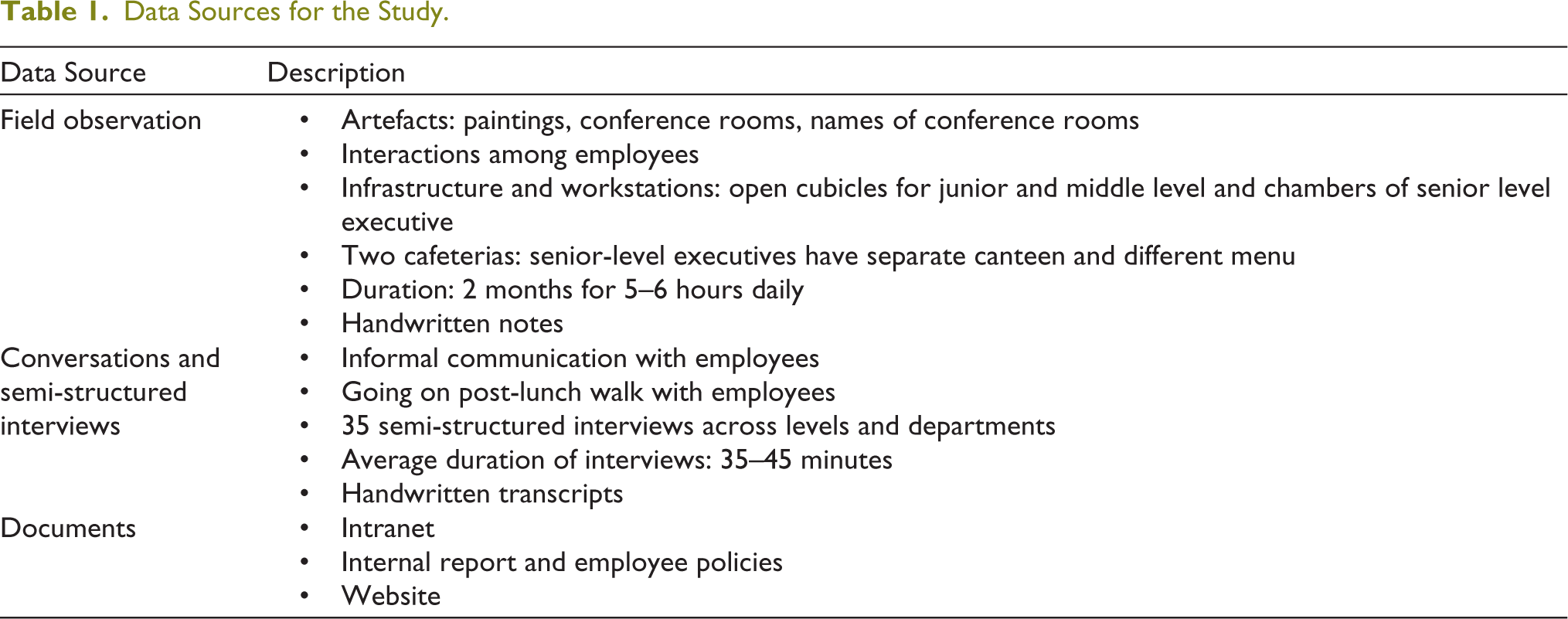
Access to VTPL was facilitated through professional networks. The first author spent approximately 2 months at the organization, engaging in multiple forms of data collection including non-participant observations, informal conversations, semi-structured interviews and document analysis. Out of a total workforce of 105 employees, we conducted 35- to 45-minute interviews with 35 employees across hierarchical levels and departments. This group included 10 top management, 15 middle managers, 7 lower-tier managers and 3 contractual relationship managers. Participants were selected using criterion-based purposive sampling (Nyimbili & Nyimbili, 2024; Patton, 2002) to ensure diversity in perspective and relevance to the study’s objectives. Although only three contractual relationship managers were interviewed, the challenges they raised were consistently echoed by respondents across various levels and departments. Despite the small sample, their concerns were reinforced through broader organizational narratives, providing data saturation and triangulation that support the credibility and relevance of these findings (Guest et al., 2006).
Due to confidentiality constraints imposed by VTPL, interviews were not recorded. Instead, adhering to ethical guidelines (Halai, 2006), hand-written notes were taken. All participants were assured anonymity. Interviews were supplemented with non-participant observations (Walsham, 2006), informal communication (e.g., post-lunch walks) and review of artefacts (e.g., paintings, conference room names), HR documents, policy reports and the organizational website. Observations revealed nuances related to organizational structure such as hierarchical seating and separate cafeterias for executives, details relevant to understanding the hybrid organization in its cultural context. Table 1 summarizes the data sources and their contribution to triangulation.
Data Sources for the Study.
Data Analysis
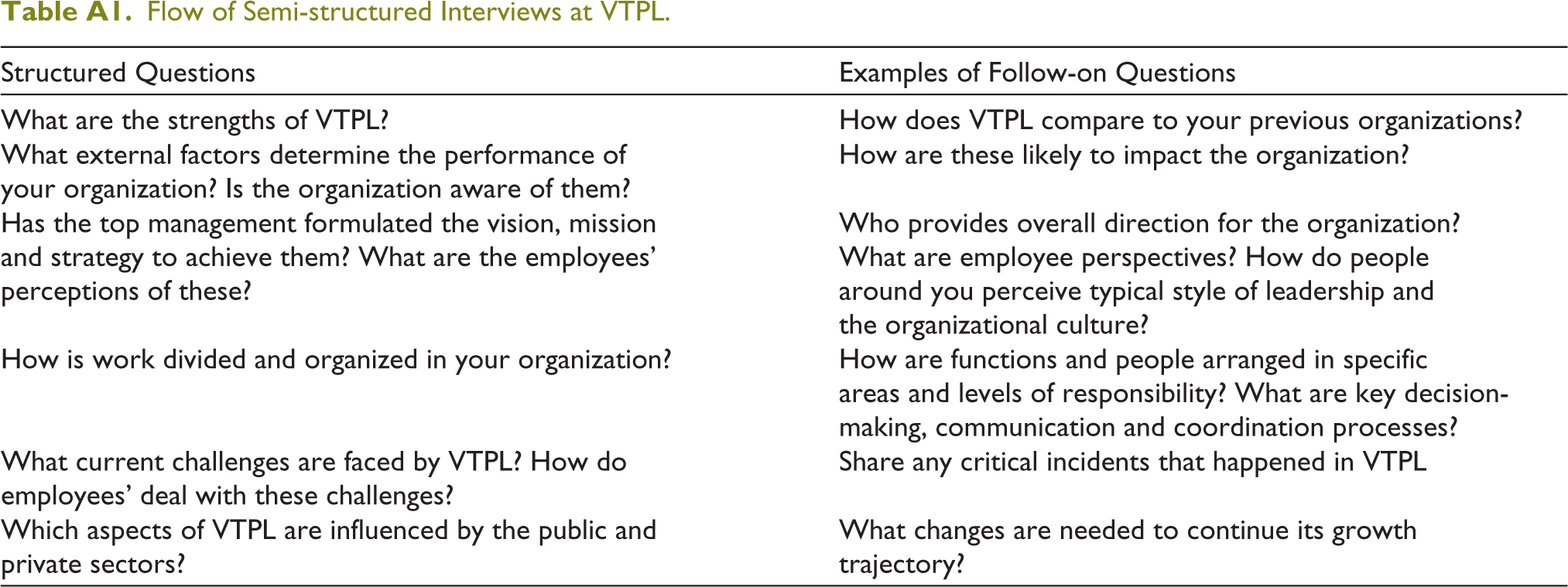
In line with Cloutier and Langley’s (2020) perspective on process theorizing, this study aimed to uncover how navigation of conflicting logics unfolds over time through situated coping practices. Rather than treating coping as a fixed set of responses, we conceptualized it as an emergent, recursive process shaped by sensemaking, action and organizational feedback. Data were analysed using thematic analysis (Braun & Clarke, 2006, 2019), with an inductive orientation (Eisenhardt & Graebner, 2007; Strauss & Corbin, 1998). The first author and a senior associate independently familiarized themselves with the data, generated initial codes and identified recurring themes. These were refined iteratively and validated through cross-checking with field notes and internal member validation with VTPL participants. Themes were triangulated with observational and documentary data and supported by relevant literature (Nowell et al., 2017). For instance, the theme ‘duality of mission and strategy’ was supported by Alberti et al. (2017). Refer to the Appendix to see the typical flow of interview questions.
The first author acted as an ‘outside researcher’ (Walsham, 2006), participating in data collection without being embedded in the organization. Although culturally proximate to the research site, the researcher sought to minimize confirmation bias by engaging with participants across levels and functions, focusing on critical incidents. Construct validity was ensured by using multiple sources of data and engaging key informants in data review (Amerson, 2011; Fusch et al., 2018). Thematic validation involved mapping observations to organizational design elements such as structure, coordination and culture (Farquhar et al., 2020). Inter-rater reliability was achieved through coding consensus between two researchers and by sharing themes with senior members of the organization. While single case studies are not statistically generalizable, they offer rich, contextualized insights and contribute to theory development in underexplored domains (Yin, 2018). By focusing on the micro-processes through which conflicting logics are navigated, this study builds a foundation for broader inquiry into the dynamics of hybrid organizing in emerging economies.
Findings
VTPL employees navigated institutional tensions through a dynamic evolution that entailed: (a) emergence of mission duality stemming from conflicting hybrid logics, (b) employee sensemaking of the challenges stemming from these logics, (c) development and refinement of coping responses and (d) organizational adaptation to hybridity. Interviews uncover how employees’ strategies developed over time and how their localized coping practices collectively contributed to hybrid organizing.
Conflicting Institutional Logics and Mission Duality
At the core of VTPL’s functioning lay a defining tension: the co-existence of its public-sector heritage and its ambition as a competitive, market-oriented enterprise. This institutional duality shaped the firm’s mission, strategies and structure in ways that often conflicted with one another, embedding an institutional complexity that employees had to navigate on an ongoing basis. Founded with strong PSU roots and tasked with shaping India’s evolving energy market, VTPL embraced the duality of a market facilitator while operating in an increasingly competitive and deregulated public industry.
Senior leaders were keenly aware of this dual mandate and often spoke of it as a source of both strategic advantage and operational complexity. The director of operations articulated the organization’s balancing act between legacy and innovation:
Although we are the offspring of the public sector, we compete for tenders with private players. The developmental mission guides VTPL to support power generators.
Others reinforced this view, emphasizing how the company’s credibility and influence were grounded in its PSU origins even as it operated in competitive spaces:
Marketing Manager: ‘Being hybrid is beneficial for VTPL. We are operating in a regulated sector. We are perceived as a government organization and give value to our proposals. We are able to influence policy makers’.
VTPL’s strategic mission to transform India’s energy markets while remaining profitable further reinforced its hybrid identity. Leaders envisioned the company not merely as an energy trader, but as a market-shaping institution:
Business Development Manager: ‘The mission is [to be the] largest trader, and create power market and cross-border trade, [and] remove market aberration’. Senior Executive: ‘We are managing the complete energy portfolio of many states and utilities’.
This duality also informed how leaders framed relationships with stakeholders. On the one hand, VTPL prided itself on providing customer-centric solutions akin to private firms; on the other, it retained a logic of institutional primacy:
Manager, Business Development: ‘We give them advice on the best possible way to save costs. Our focus is on “win-win,” but VTPL should win first, then customers’. Director, Commercial: ‘We are market creators in the energy sector … resilience is high. We understand local businesses better than competitors and maintain relationships with stakeholders. You love it or hate it, but you cannot avoid VTPL’.
This duality of VTPL, simultaneously bureaucratic and entrepreneurial, extended into organizational practices and employment structures. VTPL preserved hierarchical decision-making and status-consciousness characteristic of PSUs but also incorporated cost-cutting and customer-facing practices commonly associated with private firms. An important manifestation of this blend was the company’s reliance on a flexible, contractual workforce, particularly in revenue-generating roles.
These contractual employees, colloquially referred to as ‘Dhanda laane walla’ (those who bring in business) were entrusted with critical tasks: managing client portfolios and relationships, liaising with state utilities and responding to grievances. Yet their temporary status and limited recognition reflected the dissonance between the value they created and their marginal institutional position, further underscoring the tension between VTPL’s market-driven roles and its bureaucratic undercurrents:
Relationship Manager: ‘Our role is to provide service to customers, look for new customers and educate them about energy trade.… We get targets every financial year and those are decided by our boss’. Relationship Manager: ‘… [we] deal with client issues. We have to do everything’.
Relationship managers noted often that despite their significant role in the firm, they remained contractual employees and received less salary than others. Collectively, these perspectives highlight how institutional complexity was not only embedded in VTPL’s formal mission but also permeated its day-to-day operations, stakeholder engagement and employment models. Employees had to reconcile logics of service and profit, permanence and impermanence, and hierarchy and agility. This organizational backdrop formed the foundation upon which sensemaking and coping strategies emerged as employees interpreted and navigated VTPL’s dual identity within their unique domains.
Employee Sensemaking
Sensemaking refers to the process through which individuals interpret ambiguous or conflicting cues to construct meaning and guide actions (Weick, 1995). In HOs, where employees must reconcile competing institutional expectations, sensemaking can help navigate uncertainty and maintain coherence in daily operations. At VTPL, sensemaking was embedded in social interactions, informal alliances and pragmatic adjustments. Employees continually interpreted and reinterpreted organizational cues to reconcile what the firm stated it valued, that is, efficiency, innovation and service, with how it actually operated (hierarchical, process-heavy and status-driven). This ongoing interpretive work enabled employees to make practical decisions, implement workarounds, preserve their role identities and sustain workflow despite misalignments between mission, structure and culture.
While VTPL’s hybrid mission set the stage for organizational tensions, it was in the day-to-day experiences of employees that these contradictions became personally meaningful. As employees attempted to make sense of their roles within a dual logic system, they encountered persistent dissonance between what the organization aspired to be and how it functioned internally. Employees, particularly middle managers and contractual staff, found themselves navigating a blurred terrain where legacy norms and market-driven performance demands collided.
Middle managers were expected to bridge senior leadership and operational teams, but they often described themselves as structurally marginalized. Although many had been promoted from within, they found themselves without authority, clear responsibilities or meaningful involvement in decision-making processes:
Mid-level Employee: ‘I am promoted, but I do not have a reportee.’ Data Analyst: ‘… decision was taken outside the committee and members had to endorse those decisions’. Mid-level Employee: ‘When leaders put juniors’ ideas down, it creates a barrier .… It made a junior a laughing stock’.
An overly tiered organizational hierarchy, with over 20 employee grades for fewer than 100 staff, fuelled confusion about roles and responsibilities and created a perception of limited career progression and stagnation. Initiative was perceived as unrewarded. Coordination and communication failures across departments compounded these frustrations. Cross-functional collaboration, often essential in HOs, was often superficial. Employees relied on informal interventions, repeated follow-ups and managerial authority to resolve routine issues. Multiple calls from senior executives were necessary to address miscommunication. Informal dynamics were also evident in how juniors often relied on senior colleagues to resolve delays in information-sharing and task completion. Ad hoc conversations before formal meetings frequently revealed pre-aligned positions, with employees prioritizing personal alliances over the substantive merits of the discussion.
Contractual employees, especially those in client-facing roles, experienced a similar disconnect. Tasked with revenue generation and external stakeholder engagement, they were essential to VTPL’s market presence but remained peripheral in organizational status and recognition. Their contract status heightened uncertainty, insecurity and emotional fatigue:
Relationship Manager: ‘Many of us are in a state where [we] do not know our fate. We are on contract and do not know whether we would continue after the year. For the last one or two years I was feeling dissatisfied. However, now I am fine. VTPL is a brand, and I will continue with it [But] job security is also a need for relationship managers. We are kept on a contract to save cost. Customer relationships are long-term activities that involve prolonged interactions with customers, and relationship managers are recruited for a year’. Junior Manager, Commercial: ‘Senior[s] are good, junior[s] are good. Still there is a gap, something is missing. It’s like spice is missing from a meal’.
This sense of being overlooked, despite delivering essential business outcomes, contributed to feelings of undervaluation. During one of the interviews, the first author overheard telephonic communication between a manager and a relationship manager. The relationship manager seemed to be complaining about the amount of work they do, and yet they are on contract. The manager acknowledged and affirmed their contribution by observing, ‘You guys are doing main business. Dhandaa laane walla sabse important hota hai’ (the person who brings business is the most important).
These dissonances were echoed in critiques of VTPL’s performance management system. While designed to be more goal-driven, the system often appeared inconsistent, rewarding tenure or position rather than contribution.
Project Manager: ‘We do have defined KRAs [Key Responsibility Areas] and if I achieve my targets I would get rewards. However, if I am not able to achieve those, even than I would be getting something’.
Junior Manager: ‘I left my MNC job and came to VTPL because I was inspired by the mission .… However, there is a lack of career progression’.
During lunch breaks, junior employees expressed similar frustrations. One employee was overheard saying:
Performers and non-performers are treated equally.
Employees also highlighted inconsistencies in professional development. While some had been sent abroad for training, others received little feedback or growth support. Appraisals were rarely followed by actionable input. These experiences deepened a sense of stagnation and misalignment between VTPL’s aspirations and its internal practices.
Underlying these frustrations was a deeper identity tension—an uncertainty about what VTPL stood for and how employees should position themselves. As one employee explained:
Manager, Investor Relations: ‘Most of the seniors are from PSUs. They have a public sector mindset but want to be like a private sector. We have an identity crisis. Depending on the client, in order to get a project, we project ourselves either a PSU or a private company. Why do we always say that we were formed by PSUs? Why can we not say we are from VTPL? We have [this] dilemma. We do not take our stand’.
This dissonance was not only structural but also emotional, manifesting in feelings of frustration, disengagement and underutilization. Speaking of employee engagement initiatives, an HR business partner observed:
When we started monthly get-togethers, we had 90% participation, while now 80% of people do not participate.
Despite this challenging environment, employees did not remain passive. As the next section reveals, both managers and frontline employees developed a repertoire of adaptive and pragmatic coping strategies that enabled them to reconcile conflicting demands and sustain hybrid functioning on the ground.
Initial and Refined Coping Mechanisms
At VTPL, non-managerial and managerial employees alike played critical roles in navigating the tensions between public-sector legacy and private-sector aspirations. These coping strategies emerged through lived experiences, some improvised spontaneously while others were refined over time. Collectively, these served to sustain hybrid organizing. While non-managerial employees focused on navigating contradictions in their roles and expectations, managers enabled, reinforced and at times modelled the behaviours that made hybridity function in practice.
Managerial Reframing of Duality and Enabling Behaviours
Managers and leaders at VTPL played a critical role in supporting employees’ navigation of institutional contradictions by reframing hybridity not as a problem, but as a strategic advantage. They emphasized the firm’s integrated business model and dual mission to serve public interests while competing in a deregulated energy market.
Company Secretary: ‘Mission is two-fold: to trade maximum power to help customers and make money’.
Associate Vice President, Corporate Strategy Planning: ‘VTPL manifests bird’s eye view to gauge manifold factors for fulfilling its objectives’.
Manager, MIS: ‘Obviously, mission is to become number one company in India’.
Rather than issuing top-down directives, VTPL’s managers enabled coping through informal modelling, permission to flex processes and cultural reinforcement. They encouraged discretion and reframed contradictions as manageable, giving employees the confidence to act without fear of reprisal. This consistent messaging helped employees see institutional contradictions as manageable, not paralyzing.
Associate Vice President, Marketing: ‘We work as fast as a private firm. If needed, we take approval over email, WhatsApp, or messages’.
VTPL’s leadership approached blended hierarchical structure with agility. While decision-making resembled PSU-style top-down processes, leaders were responsive and goal-oriented, reflecting private-sector influence. They maintained transparency and embraced multifaceted goals that included profitability, customer service and social impact. Hiring and socialization practices reinforced this hybrid approach, drawing largely from PSU backgrounds while allowing flexibility in execution.
Leaders also fostered a cultural environment that provided emotional grounding amid role ambiguity. VTPL’s culture reflected Indian traditions and PSU values, and this was visible in workplace design, symbolic references to holy rivers and deities and an emphasis on status. But these were combined with people-centred practices that made the organization feel personal and supportive. Managers were described as approachable, and leadership care extended beyond work into employees’ personal lives.
HR Business Partner: ‘When an employee was suffering from a life-threatening disease, the organization was supportive in offering extraordinary leave, relaxation in working hours at work, and medical support’.
Assistant Manager: ‘Small-small things matter a lot … in times of crisis or family emergency, we could come late’.
Relationship Manager: ‘Whenever I visit the corporate office, it is a nice feeling. Our boss is strict at work, but after work we enjoy’.
In an observed interaction within the marketing team, a senior-level executive asked one of the executives to follow up with finance to ensure relationship managers’ payments were made on time. This informal, relationship-oriented environment seemed to create psychological safety, which aided employees in coping with performance demands and structural contradictions.
Employees also appreciated their leaders’ efforts to balance ambition with security. Compensation structures, flexibility and development opportunities were described as better than in traditional PSUs, without the high stress associated with private companies.
Manager, Finance: ‘ … we work like a private company such as if needed we come to office on Saturday, work beyond 9 am–5 pm, travel extensively. Culture is unique–neither government nor private. In the government, people carry an easy-going attitude. People experience high levels of stress in the private sector. In VTPL, people have an opportunity to grow’.
Senior System Administrator: ‘VTPL culture is like a PSU culture because many people, especially top is from PSU. People are good, educated, and talented. The job security is high. The nature of business is such that we will never be out of business. Energy demand will never be low’.
This inclusive culture extended to contractual staff. Managers fostered respectful relationships and recognized contractual employees for their contributions to revenue and client relationships.
Relationship Manager: ‘We are on contract, but we are getting payments fairly and on time’.
Relationship Manager: ‘Though we are on contract, when we meet seniors and colleagues, they treat us well’.
Relationship Manager: ‘We meet informally after office hours and they respect us. VTPL is a good brand’.
In line with findings by Heres and Lasthuizen (2012), VTPL’s leadership demonstrated a commitment to altruism, transparency and societal accountability. Even while bureaucratic elements persisted, managers were approachable and viewed as role models by many junior employees. Informal approvals and swift action were not only tolerated but also facilitated by leadership.
Through these layered actions of strategic messaging, flexible approval norms, symbolic support and relational care, VTPL’s managers created an environment in which employees could cope effectively with institutional duality while remaining aligned with the organization’s mission and performance goals.
Non-managerial Adaptation and Embedded Coping
VTPL employees employed a repertoire of coping strategies to navigate the persistent tensions arising from conflicting public- and private-sector logics. These strategies evolved over time, beginning with more immediate, tactical responses and progressing towards more embedded and adaptive forms of action. Pragmatic role-switching and symbolic compliance emerged as initial coping mechanisms as short-term, situational responses that enabled employees to maintain operational effectiveness while aligning superficially with institutional expectations. As employees became more familiar with the hybrid environment and developed informal support systems, more refined strategies took shape. Contractual resilience and legitimacy shielding reflect this progression: rather than merely responding to contradictions, employees actively built credibility, cultivated influence and strategically invoked institutional identity to navigate complexity. Together, these strategies revealed a dynamic, temporal process of coping that shifts from individual adaptation to collective, embedded practice.
At VTPL, employees actively engaged in pragmatic role-switching, the flexible shifting between public-sector and private-sector behaviours depending on task, context or stakeholder audience. This coping strategy allowed employees to balance dual institutional logics by selectively activating elements of each logic to maintain effectiveness and legitimacy. Role-switching was evident through situational identity shifting when employees tailored their behaviours and self-presentation depending on who they were interacting with. Depending on the context, employees would either emphasize public-sector heritage or private-sector agility to align with stakeholder expectations.
Manager, Investor Relations: ‘… we project ourselves either as a PSU or a private company depending on the client’.
Director of Operations: ‘Although we are the offspring of the public sector, we compete for tenders with private players.’
This behavioural adaptation enabled employees to frame VTPL’s identity to resonate with divergent external logics. Role-switching was also evident in the duality of how employees framed legitimacy. They navigated hybrid expectations by actively aligning themselves with whichever institutional identity offered greater legitimacy in the moment, drawing on public status when engaging with regulators and private sector agility when interfacing with clients or meeting performance targets.
Assistant Manager, Sales: ‘VTPL is seen as a government company that helps when we are dealing with discoms [distribution companies]. But when we are negotiating bids, we act like a private company’.
Senior Analyst: ‘We have PSU culture in our roots, but we do market work—we switch as needed’.
These shifts were not random but part of a tacit, shared understanding among employees about how best to navigate institutional complexity while protecting VTPL’s market position and credibility.
Employees at VTPL also employed symbolic compliance as a coping mechanism to publicly adhere to formal procedures and expectations associated with public-sector logic, while informally prioritizing outcomes aligned with market-driven logic. This allowed them to present an image of rule-following without being constrained by institutional bureaucracy.
Reflecting rule adherence without rule obedience, employees subtly altered their practices to ensure performance outcomes.
Manager, Corporate Planning: ‘We send all data through the reporting channel. What is not appropriate gets pushed back. But we have to show we are following all protocols’.
Senior Analyst, Compliance: ‘We will show the file went through four approvals, but in reality, we got it done in one day. That is how the system works’.
This enabled employees to ‘check the box’ of public expectations while circumventing red tape when needed. Second, employees used dual signalling to internal and external stakeholders when they communicated differently depending on their audience. This enabled them to project procedural rigor to public-sector stakeholders while signalling efficiency to private clients and internal teams.
Director Operations: ‘We always speak in the language our audience understands—if it’s the Ministry, then it’s about compliance; if it’s a client, then it’s about delivery’.
Project Manager: ‘We play both games—on paper and off paper’.
This dual signalling helped maintain legitimacy with both sides of the hybrid identity—ensuring compliance with government ethos while signalling agility and outcomes to private sector actors.
Contractual resilience refers to the proactive strategies adopted by precariously employed, client-facing staff to build credibility, informal influence and job continuity in the absence of formal protections. At VTPL, contractual employees, particularly relationship managers, demonstrated resilience by cultivating performance-based legitimacy and informal networks to buffer against employment uncertainty. Contractual employees sought to prove their indispensability through client acquisition, service delivery and revenue generation—making themselves integral to VTPL’s financial success.
Relationship Manager: ‘Our role is to provide service to customers, look for new customers, and educate them about energy trade. We get targets every financial year and those are decided by our boss’.
Relationship Manager: ‘“Dhanda laane walla” is the most important person in a trading company.’
These employees knew that bringing in ‘business’ was their key source of leverage and legitimacy within the organization.
Beyond meeting targets, contractual employees built informal alliances with internal decision-makers and invested in long-term client relationships—using relational capital as a buffer against role insecurity.
Relationship Manager: ‘We are on contract, but we are getting payments fairly and on time’.
Relationship Manager: ‘Though we are on contract, when we meet seniors and colleagues, they treat us well. We meet informally after office hours and they respect us’.
Observed Interaction
During one interview, a senior executive was overheard ensuring timely payments to contractual employees after a complaint—an act that signalled informal recognition and support.
This ability to generate trust and maintain visibility with senior leadership provided psychological safety and informal protections otherwise unavailable in their formal contracts.
Suggesting legitimacy shielding, VTPL employees strategically invoked the organization’s public-sector legacy to gain trust, reduce resistance or justify actions, particularly when interacting with conservative stakeholders. This tactic allowed employees to frame the organization as aligned with public-sector values even while pursuing private-sector goals internally, thus shielding themselves from scrutiny and maintaining institutional legitimacy. Legitimacy shielding was evident in employees’ strategic use of public-sector identity and their emphasis on buffering internal practices from external scrutiny. Employees emphasized VTPL’s PSU heritage when engaging with regulators, state-owned utilities and government partners to build trust and credibility.
Marketing Manager: ‘We are perceived as a government organization and give value to our proposals. We are able to influence policy makers’.
Director of Operations: ‘Although we are the offspring of the public sector, we compete for tenders with private players’.
Manager, Investor Relations: ‘Depending on the client, in order to get a project, we project ourselves either as a PSU or a private company’.
By leveraging the symbolic capital of VTPL’s origins, employees gained cooperation from bureaucratic actors who might otherwise resist market-based approaches. Employees also used VTPL’s public image to justify internal practices or decisions that might otherwise be challenged, particularly in contexts where market agility clashed with regulatory conservatism.
Executive, Marketing: ‘In the public sector, negotiating is not possible … but we educate customers that they can get electricity through bidding’.
Associate Vice President, Marketing: ‘We wave off some of the surcharges .… In the public sector, these things are not done, but we do it carefully’.
This shielding effect allowed employees to maintain operational agility without drawing attention to practices that diverged from traditional public-sector norms.
Organizational Adaptation
VTPL’s approach to managing institutional contradictions extended beyond individual coping and leadership support. As the organization evolved, its response to hybrid tensions became embedded in both its strategic orientation and cultural identity. Managers and employees alike adapted to VTPL’s public–private duality not by choosing one logic over another, but by enacting both through innovation, operational efficiency and cultural integration.
Some leaders articulated an aspirational vision that extended beyond national growth, that of seeking regional leadership through cross-border energy trade and market influence.
Associate Vice President, Finance: ‘We are doing cross-border trade with neighboring country … we want to be front runner and create a vibrant power market’.
Associate Vice President, Corporate Strategy Planning: ‘VTPL manifests bird’s eye view to gauge manifold factors for fulfilling its objectives’.
To deliver on this expansive mission, VTPL leveraged forward and backward integration, built a robust supply chain, mentored market entrants and made early investments in renewable energy. It competed actively in both domestic and international tenders and built relationships with diverse stakeholders including government agencies, commercial partners and consumers. It strategically invested in workforce readiness to support these innovations.
Vice President, HR: ‘We send people to different countries to learn best practices’.
VTPL’s market orientation was also evident in its pricing strategies and customer engagement. It combined private-sector agility with a PSU-backed trust advantage. For example, customized plans were created based on usage patterns, while pricing flexibility and negotiation practices varied by customer profile.
Manager, Business Development: ‘We customized supply as per customer needs. At the end of the month, we tell customers about their consumption patterns and offer the best plan. We work as fast as a private firm’.
Executive: ‘We educate customers that they can get electricity through bidding’.
Associate Vice President, Marketing: ‘VTPL suppl[ies] energy from customer A to customer B. We collect money from the discom … we wave off some of the surcharges .… Through rebates and surcharges, we make money. We focused on reconciliation. In the public sector, negotiating is not possible’.
Innovation not only spurred growth but also served as a tool for managing competing institutional logics. Managers emphasized new product development, financial sustainability and business diversification—even in times of sector-wide downturns.
Vice President, HR: ‘Good thing about VTPL is that we have been coming up with new products and have enough investment’.
Associate Vice President, Marketing: ‘Last 3–4 years, power [was] doing bad, but we [were] constantly making profit. We can get into multiple things, such as recently got into renewable energy’.
These innovations, however, did not exist in a vacuum. They were supported by increasingly established cultural norms and organizational structures that reflected PSU heritage, public sector logics and Indian sociocultural values. Employees described VTPL’s identity using metaphors of duality, ambiguity and persistence. The organization’s ability to reconcile contradictory demands was grounded in culturally familiar concepts such as hierarchy, patience and tolerance for uncertainty.
Employee: ‘It is Sarkari [government], but people work’.
Executive Vice President, Operations: ‘… self-content is the culture of [this city]. People focus on their limited domain—work only’.
VTPL’s growth drivers defied conventional norms and emphasized strategy, business model and customer-centricity over traditional factors such as organizational culture and HR effectiveness. As summarized by an employee:
Manager Finance: ‘Despite all challenges over the time, we realized that people are good and want to continue with VTPL for its unique culture-blend of public-private, growth orientation, and employee care’.
Ultimately, VTPL’s organizational adaptation was not driven by a formal restructuring or cultural overhaul, but through an incremental, context-sensitive layering of public and private logics. Its innovations in customer delivery and market expansion were matched by an equally important embeddedness in cultural values, producing a hybrid capable of navigating internal and external contradictions with continuity and growth.
Discussion
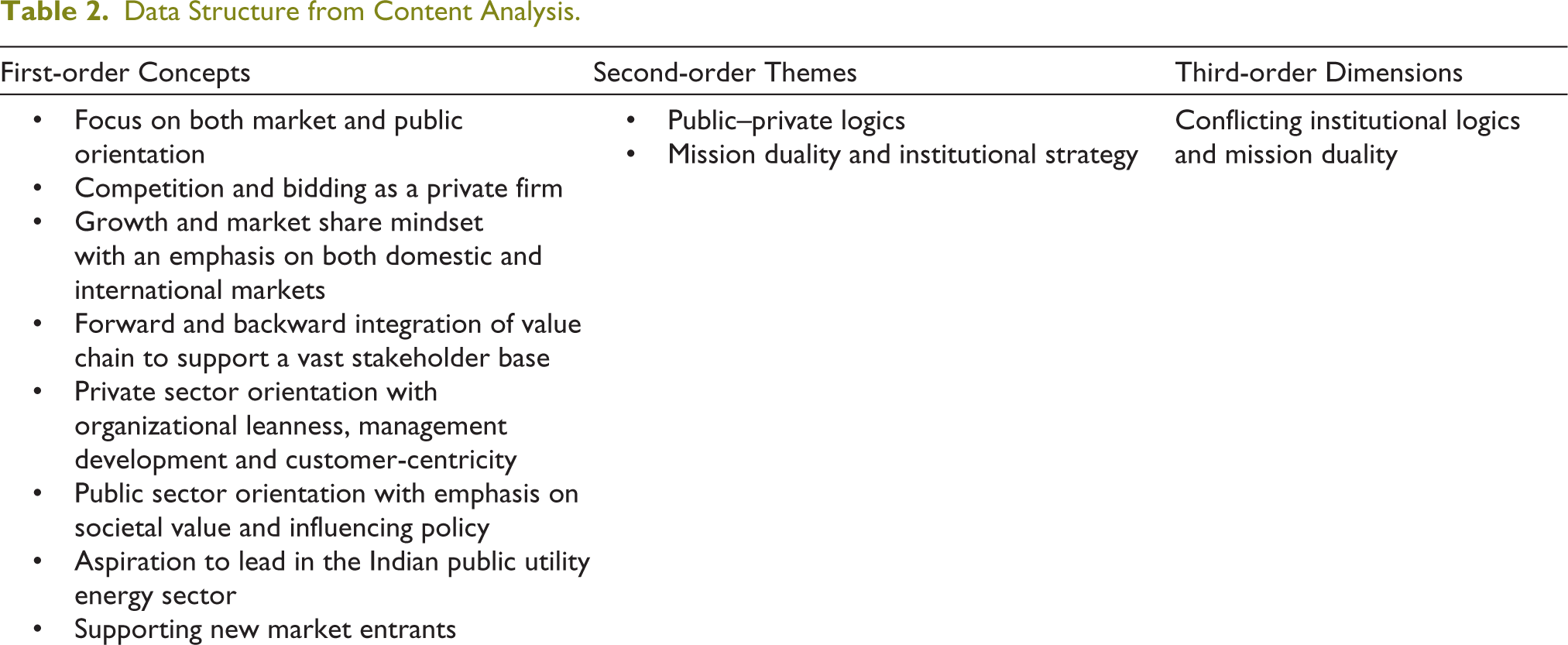
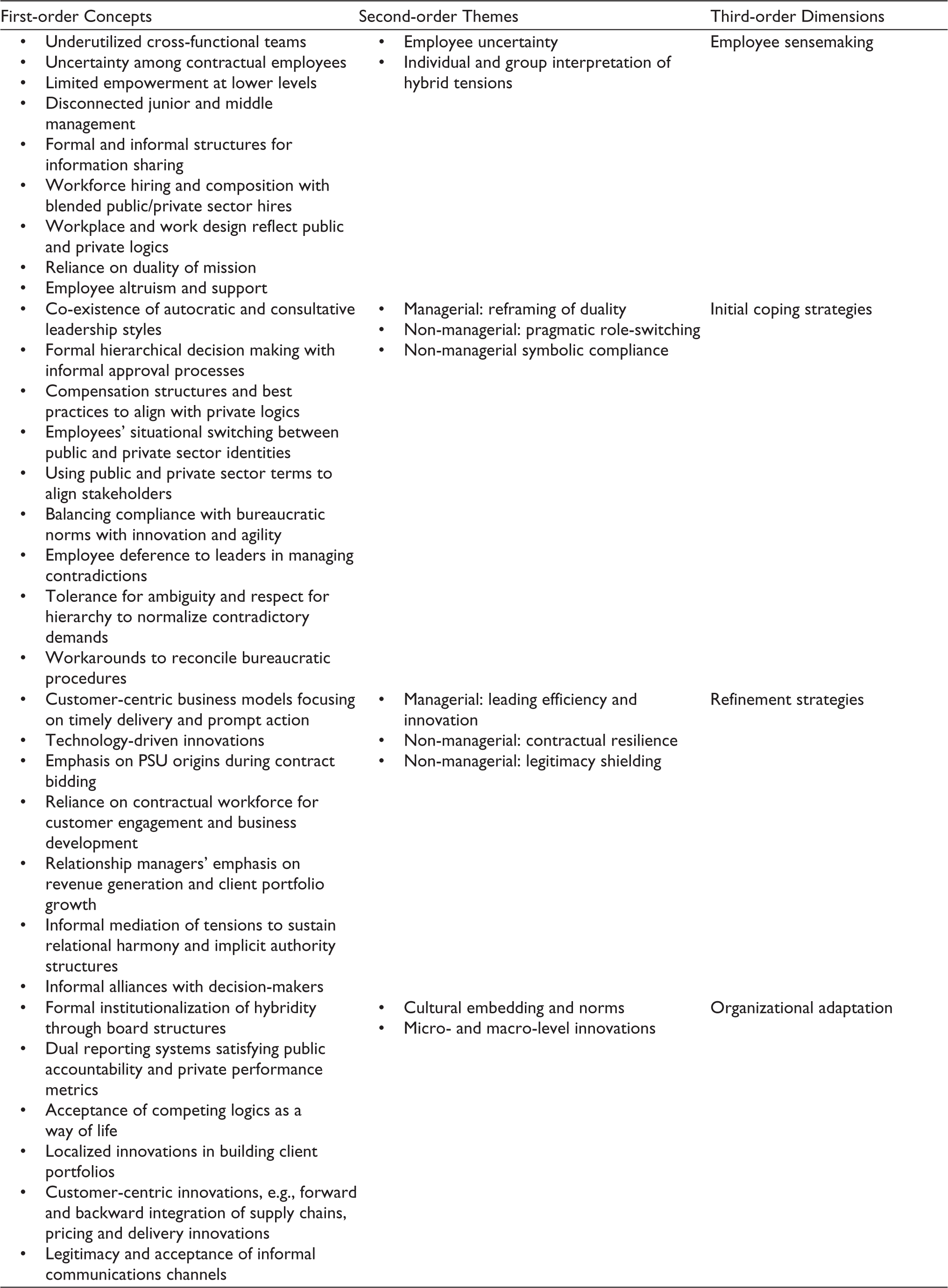
VTPL’s 23-year success in outperforming expectations while navigating institutional pluralism relied on mechanisms to deliver on its dual goals. Three primary observations emerged from this case: (a) the duality of VTPLs mission was understood at and reflected in both managerial and non-managerial levels; (b) however, organizational design and decision-making practices at VTPL reflected a PSU orientation, leading to dissonance among non-managerial employees; (c) whereas managers doubled down on mission, innovation and customer-centricity to navigate this dissonance, non-managerial employees seemed to manifest coping mechanisms beyond those traditionally reflected in existing literature including selective coupling (Pache & Santos, 2013) and identity compartmentalizing (Besharov, 2014). Evidence of these emergent outcomes is summarized in Table 2 and discussed next.
Data Structure from Content Analysis.
Mission Alignment
In HOs, upper management plays a crucial ‘boundary spanning role’ in bridging the often-conflicting institutional logics of public–private sectors (Battilana et al., 2015). This involves creating a shared vision that integrates the values of both logics, ensuring that stakeholders at all levels understand and commit to the organization’s overarching mission. Through strategic communication and symbolic leadership, upper management can emphasize the interconnectedness of public and private goals, reducing the perception of conflict between them (Smith & Besharov, 2019). This boundary-spanning role of upper managers was reinforced at VTPL through three key elements—customer-centric service, innovation through flexible product lines and global growth, and delivery of efficiency through technological investments. This vision carried clearly throughout the organization as reflected in commentary from relationship managers, business managers and line managers. Leadership behaviours such as transparency, proactive problem-solving and expediency of decision-making to deliver mission continuity reinforced alignment of diverse interests (Besharov & Smith, 2014) across all organizational levels.
Structural Dissonance in Institutional Logics
Public–private HOs often experience dissonance between their mission and institutional design due to the integration of conflicting public and private logics. The tension arises because public logics prioritize values such as inclusiveness, accountability and service to the community, whereas private logics emphasize financial performance and operational efficiency (Smith & Besharov, 2019). This duality in institutional design often leads to ambiguities in organizational identity and decision-making processes, as employees and managers navigate these competing demands. These ambiguities were directly reflected in VTPLs board and employee composition, top-down decision-making authority and hierarchical processes.
Even as governance frameworks and mechanisms for accountability are solutions for managing these tensions (Besharov & Smith, 2014), the fact that VTPLs board and leadership emerged from PSU organizations, and ongoing recruitment emphasized the same, the emergent governance mechanisms likely reflected PSU mindsets. While participants prioritized profitability and efficiency through innovations and technological implementations, misalignment between mission and logics limited the full exploitation of efficiencies, mission drift and prioritization of public-sector mechanisms over its private profit-making goals (Smith & Lewis, 2011). Marked by tension structures that led to poor information-sharing, top-down management and unclear career pathways, VTPL’s employees reflected some uncertainty with reference to their organizational fit and ability to fully deliver on its dual goals.
Coping Mechanisms and Refinement Strategies
The coping mechanisms used to manage competing logics at VTPL reflected a mix of proactive and defensive strategies previously identified in the literature (Torfing et al., 2024) while also revealing additional strategies not yet documented. VTPL employees demonstrated both established and newly emergent coping mechanisms. Selective coupling (Pache & Santos, 2013) emerged as a defensive mechanism, with managers emphasizing private-sector logics while non-managerial employees highlighted public-sector logics. These disparate orientations enabled employees to align their work with VTPLs goals, especially where ambiguity and contradictions were prevalent. Whereas employees maintained integrity of private logics, specifically market, innovation and efficiency orientations of VTPL, their emphasis on public purpose of the institution and experiences with institutional contradictions kept them from fully embracing private logics.
Proactive coping mechanisms were also evident in employees’ acceptance of organizational culture and their reliance on national cultural norms (Awasthy & Gupta, 2021; Panda & Gupta, 2004; Sinha & Kanungo, 1997). At VTPL, a culture that prioritized employee welfare and encouraged upper management’s involvement in conflict resolution fostered virtuous cycles of trust and cohesion. These dynamics supported the normalization of organizational duality. Situated within the Indian sociocultural context, VTPL benefitted from a national culture that is generally more tolerant of contradictions. Cultural dimensions such as collectivism, high power distance and low uncertainty avoidance (Hofstede, 2001) influenced how employees perceived and responded to tensions. These norms enabled employees to navigate ambiguous organizational expectations and to accept, rather than resist, the conflicting logics embedded in VTPL’s hybrid structure and operations (Calciolari et al., 2017; Lægreid & Rykkja, 2021).
This study also identified four previously undocumented coping mechanisms employed by non-managerial employees at VTPL to navigate persistent institutional conflicting logics. These emergent strategies evolved over time—starting with initial coping strategies that included role-switching and symbolic compliance and dynamically adapting to contractual resilience and legitimacy shielding. Pragmatic role-switching reflects an agency-driven approach to hybrid organizing. Rather than rigidly adhering to one set of institutional norms, VTPL employees fluidly shifted between logics in response to situational cues. While prior work has explored selective coupling at the strategic level (Pache & Santos, 2013), our findings extend this by showing how frontline employees engage in identity-based coupling, blending personas rather than simply aligning tasks. Symbolic compliance reflects a deeper form of decoupling, where formal practices are displayed to align with institutional expectations, but actual behaviour diverges to achieve functional goals. While prior studies have focused on symbolic managerial action, this finding shows how non-managerial employees also adopt symbolic forms of alignment, balancing visible conformity with practical reframing.
As a longer-term, evolved strategy, contractual resilience illustrates how employees in precarious roles actively manage institutional contradictions by leaning into performance, visibility and relational influence. Unlike symbolic compliance, which emphasizes navigating bureaucracy, this coping mechanism underscores agency in building legitimacy from the ground up. It expands coping typologies by highlighting how employees use their vulnerability not as a constraint, but as a prompt for action. In doing so, they transform a precarious status into informal power. VTPL employees’ use of legitimacy shielding demonstrated how hybrid identity can be strategically deployed to manage tensions between stakeholder expectations and operational demands. Unlike symbolic compliance, which we note as primarily inward-facing, legitimacy shielding is externally oriented to shape perceptions and manage trust among institutional actors. This expands the understanding of coping mechanisms by showing how hybrid employees do not just navigate internal contradictions, but also actively curate organizational identity across boundaries.
The Process of Managing Conflicting Logics
Process theorizing emphasizes how organizational phenomena unfold over time through sequences of actions, interactions and adaptations (Cloutier & Langley, 2020; Langley et al., 2013). In line with this approach, we noted that logics navigation at VTPL was not as a fixed repertoire of responses but as an evolving process shaped by institutional context and actor agency. Findings from this study noted how non-managerial employees at VTPL made sense of, responded to and adapted within these dissonant logics through dynamic, stage-based coping mechanisms. The process model presented in Figure 1 illustrates this dynamic and evolving sequence of responses.
Process-Model of Employee.
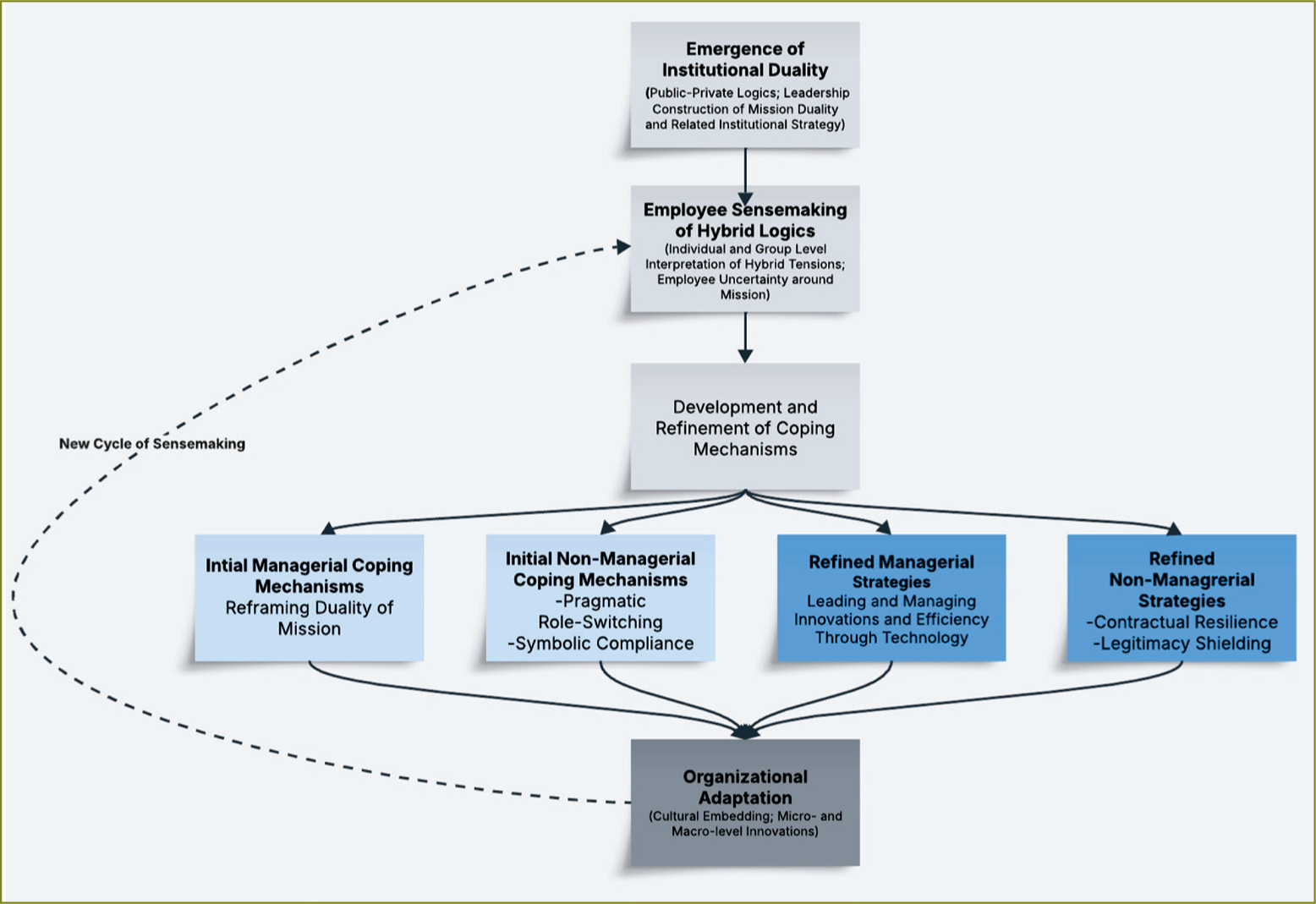
Adapting to duality of competing HO logics begins with employees’ exposure to institutional logics, especially to tensions arising from public–private logics, contractual ambiguity and conflicting performance expectations. In response, employees engage in sensemaking to interpret and contextualize these tensions within their roles, organizational norms and stakeholder relationships. This sensemaking forms the foundation for initial coping strategies such as compliance with formal procedures or the compartmentalization of conflicting demands across roles or contexts. Over time, however, employees develop more refined and proactive strategies, moving beyond compliance towards flexible and adaptive responses, including pragmatic role-switching, symbolic compliance, contractual resilience and legitimacy shielding. These mechanisms allow employees to adaptively reconcile contradictions, build informal authority and secure both performance outcomes and institutional legitimacy. As these practices are repeated, they begin to shape broader organizational routines and cultural expectations, representing a shift from individual-level adaptation to emergent organizational learning and adaptation.
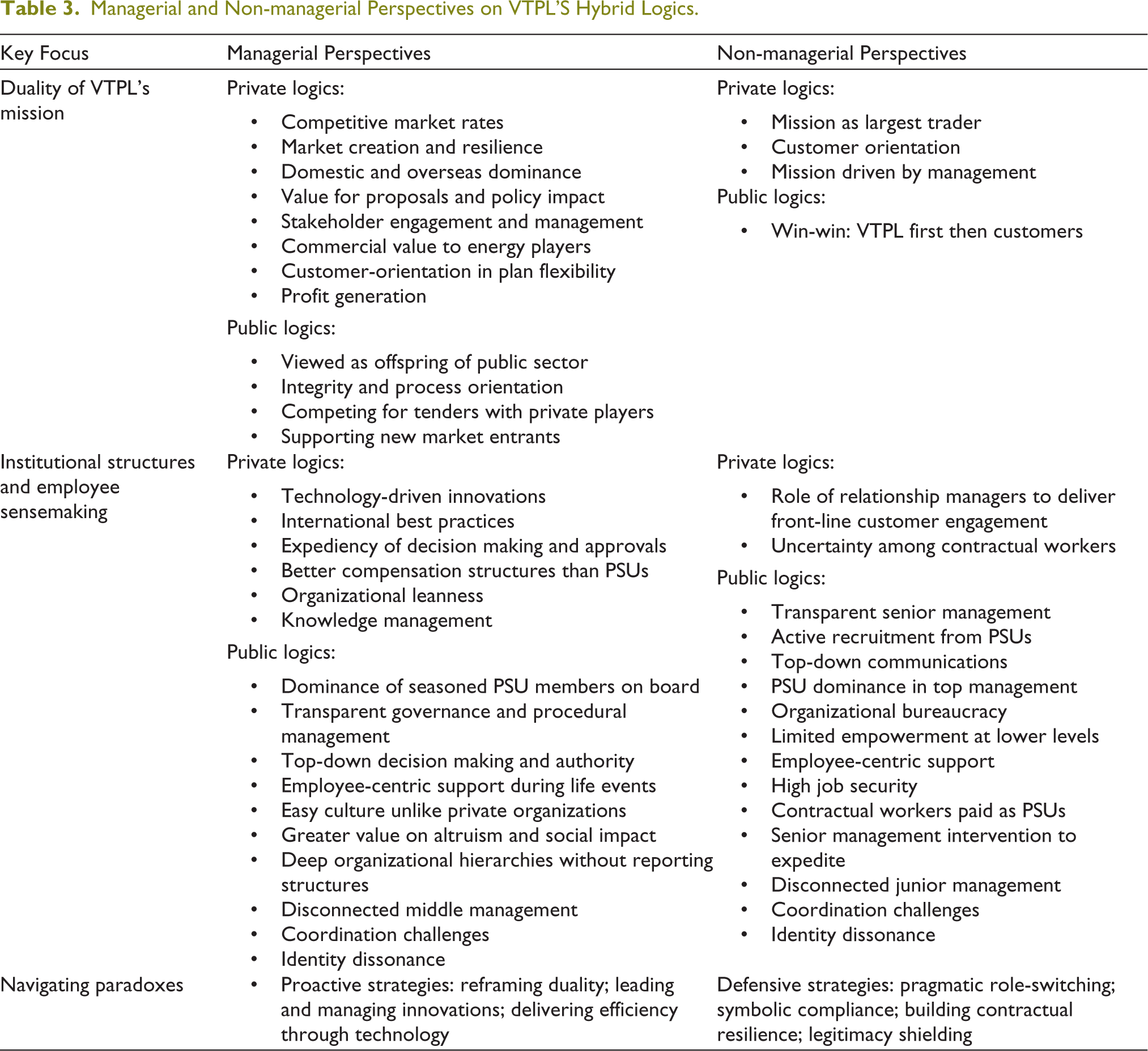
In summary, non-managerial employees at VTPL do not passively absorb the tensions of competing logics; rather, they engage in active, evolving forms of navigation. These coping strategies are embedded in social interactions, stakeholder dynamics and performance expectations. Together, they constitute a bottom-up repertoire for engaging with the operational tensions of hybridity in emerging-market organizations. These findings contribute to literature by illustrating how managerial and non-managerial employees not only construct flexible, context-sensitive responses to enduring institutional tensions but also play an active role in shaping the organization’s broader adaptation to conflicting institutional logics. Table 3 summarizes these perspectives.
Managerial and Non-managerial Perspectives on VTPL’S Hybrid Logics.
Implications and Future Research Directions
Contributions
This study offers several implications for theory and practice by emphasizing the purposeful involvement of non-managerial employees in navigating hybridity, an underexplored aspect in the literature. First, it extends paradox theory by illustrating that coping with institutional contradictions is not solely the domain of top managers or organizational designers. Instead, non-managerial and contractual employees who are often at the frontline participate in the ongoing construction of hybrid organizing through situated, improvised actions that blend logics and reframe expectations. By surfacing novel coping strategies such as pragmatic role-switching and legitimacy shielding, the study enhances existing coping typologies that often view employee responses as reactive or defensive.
Second, this research brings a micro-level, process-oriented perspective to hybrid organizing. It responds to recent calls to move beyond structural accounts and to examine how competing logics are lived and managed through interactional, adaptive routines (Battilana et al., 2017; Dorobantu et al., 2024). The process model developed here demonstrates how employees navigate from sensemaking to initial and refined coping, illustrating that managing competing logics is an iterative, socially embedded process. This view complements structural approaches by emphasizing that hybrid integration is sustained not just through design but through everyday micro-practices.
From a practical standpoint, the findings underscore the need for organizations to recognize and support competing logics at all levels, not just in leadership. Managers in hybrid organizations should be trained to identify and legitimize the informal strategies employees use to reconcile conflicting logics. Rather than viewing actions like symbolic compliance or informal role-shifting as deviant, organizations could cultivate these as forms of strategic flexibility. This means encouraging informal problem-solving, valuing practical judgement and recognizing how employees navigate competing demands. Managers can support this by paying attention to employee insights, incorporating them into practice and adjusting training and performance systems to reinforce these adaptive behaviours. By legitimizing such coping strategies, organizations can turn operational-level navigation of conflicting logics into key strategic advantage for the institution.
Additionally, human resource and organizational development functions should recognize the contribution of non-managerial and contractual employees in maintaining institutional agility and responsiveness. This calls for more inclusive practices in training, evaluation and job design, particularly in emerging-market contexts where hybrids play a growing role in public service delivery. Enabling employees to take an active role in navigating organizational tensions can help build more resilient workplace cultures, strengthen stakeholder trust and improve the organization’s ability to adapt.
Limitations and Future Research
The evaluation of VTPL’s performance was limited by the availability of client data, growth metrics and key business statistics. Additionally, although the study draws on rich qualitative insights, it is based on a single case, highlighting the need for validation through comparative research across other organizations and contexts. The absence of electronic recordings during interviews also posed a risk of recall bias; however, the authors addressed this through detailed and systematic note-taking. Finally, our interview questions were intentionally designed to elicit mechanisms abductively through open-ended responses. This approach was chosen to avoid imposing assumptions—particularly the presumption that all employees experienced an organizational identity crisis.
This study opens several avenues for future research. First, scholars could examine the extent to which the new coping strategies identified in this study, particularly symbolic compliance and contractual resilience, are context-dependent or transferable across different sectors and geographies. Responses to institutional complexity are often shaped by local logics, actor positions and field-level dynamics (Greenwood et al., 2011; McPherson & Sauder, 2013). Understanding this variability can advance a more robust theory of institutional logics that can account for institutional and cultural contexts. This can also offer practical insights for leaders designing and scaling hybrid structures, equipping them to anticipate which coping mechanisms are likely to emerge and under what circumstances might they be impactful or counterproductive. Comparative studies across hybrid organizations in different regulatory or institutional environments could help unpack boundary conditions of these strategies.
Future studies could compare how these navigation tactics are developed, deployed and interpreted across hierarchical levels. For instance, are these coping mechanisms evident in managerial roles as well? Do they take different forms at other levels or are they driven by different institutional pressures? How do managers perceive or respond to practices like legitimacy shielding or symbolic compliance when enacted by non-managerial employees? These levels of analyses could clarify how power dynamics, role expectations and access to resources shape the emergence and processes of negotiating conflicting logics, and whether similar strategies across hierarchies foster alignment or introduce new tensions across managerial and non-managerial boundaries.
Further research could also investigate the long-term consequences of employee-led strategies. Do practices like pragmatic role-switching contribute to organizational adaptability, or do they risk undermining formal accountability systems over time? Longitudinal designs could help trace how micro-practices scale up to influence institutional change or stability. Additionally, what are the relational dynamics involved in accommodating to conflicting logics? How do peer relationships, managerial recognition or informal mentorship structures shape which coping strategies are developed, sustained or abandoned? Scholars might also develop a multi-level framework that integrates individual coping mechanisms with team- or organization-level responses to HO logics. Such a framework could shed light on how individual actions and institutional logics influence each other, offering a fuller understanding of how hybrid organizations adapt and stay resilient.
Finally, given the process-oriented outcomes of this study with reference to coping, future research could further investigate how the negotiation of conflicting logics unfolds over time, particularly in relation to moments of disruption or institutional change. What triggers a shift from initial proactive or defensive coping to more advanced strategies? Do the processes of navigation become embedded, adapted or abandoned as organizations evolve and how so? Investigating these dynamics through deeper process research can help understand how coping becomes an ongoing organizational capability rather than a one-time response. It can also help uncover conditions under which adaptive strategies are reinforced or replaced, offering valuable insights for organizations undergoing transformation or operating in evolving institutional environments.
Conclusions
This study sheds light on how non-managerial employees in hybrid organizations actively and creatively accommodate institutional logics. By uncovering additional coping mechanisms such as pragmatic role-switching, symbolic compliance, contractual resilience and legitimacy shielding, we move beyond macro-level or managerial-centric accounts of logics management. These strategies, and the process through which they evolve, illustrate that reconciling conflicting logics is not a fixed resolution, but a dynamic journey embedded in everyday practices. As such, this study contributes a process-based understanding of conflicting logics navigation by non-managerial employees. It aligns with Cloutier and Langley’s (2020) call for research that theorizes how phenomena unfold over time through dynamic, contextualized processes and offers a micro-level view of how coping unfolds and adapts in response to institutional ambiguity.
VTPL’s case offers valuable insights for both scholars and practitioners interested in hybrid organizing. It shows that coping strategies are context-sensitive yet generative, helping shape organizational culture, identity and performance. Future research can build on this foundation by examining how these strategies travel across roles and contexts, how they interact with organizational structures and leadership styles, and how they evolve over time. Understanding the navigation of conflicting logics as a continuous and layered process opens new directions for theorizing hybridity, organizing and institutional change. In doing so, this research calls for a more inclusive, process-oriented and bottom-up approach to studying how organizations survive and thrive amid persistent contradictions.
Footnotes
Acknowledgements
We are deeply grateful to the review team and the editor for their valuable feedback, which continues to help us improve our article and its contribution. We have carefully revised the article in response to editorial and reviewer suggestions and have ensured that all references and formatting are as per the journal’s guidelines.
Declaration of Conflicting Interests
The authors declared no potential conflicts of interest with respect to the research, authorship and/or publication of this article.
Funding
The authors received no financial support for the research, authorship and/or publication of this article.
Note
Appendix
Flow of Semi-structured Interviews at VTPL.
| Structured Questions | Examples of Follow-on Questions |
| What are the strengths of VTPL? | How does VTPL compare to your previous organizations? |
| What external factors determine the performance of your organization? Is the organization aware of them? | How are these likely to impact the organization? |
| Has the top management formulated the vision, mission and strategy to achieve them? What are the employees’ perceptions of these? | Who provides overall direction for the organization? What are employee perspectives? How do people around you perceive typical style of leadership and the organizational culture? |
| How is work divided and organized in your organization? | How are functions and people arranged in specific areas and levels of responsibility? What are key decision-making, communication and coordination processes? |
| What current challenges are faced by VTPL? How do employees’ deal with these challenges? | Share any critical incidents that happened in VTPL |
| Which aspects of VTPL are influenced by the public and private sectors? | What changes are needed to continue its growth trajectory? |