







Abstract

The methodological rigour of empirical investigations in social science (especially business management) fundamentally depends upon the judicious selection of respondents. Behavioural science is the foundation of business management research. Business management research largely differs in context and perspectives. Therefore, systematic consideration of the sample characteristics and their demographic attributes play a vital role in empirical investigations aiming to solve business management research. The representativeness of the sample is particularly important for ensuring both internal and external validity, as it directly influences the reliability, generalizability and inferences of research findings (Meyer & Mayrhofer, 2022; Van Haute, 2021). Demographic variables such as age, gender, education, managerial experience and socio-economic contexts are not merely descriptive statistics but constitute substantive decision elements that shape managerial and thought leadership, strategic direction and organizational outcomes (Qi et al., 2018; Vasan, 2020; Weems et al., 2003).
Scholars often face issues with logically justifying respondents’ selection criteria in their empirical research. We usually struggle to justify who were chosen as respondents, how these respondents were chosen over others, and why their responses are important. This becomes more important for a pluralistic country like India. Because India is a fast-growing modern economy famous for its unique characteristics as religious practices, modern culture, rural areas, emotional and family culture, peace of digitalization, democracy, natural beauty, growth of economy, ancient civilization, architecture, cuisines, vibrant festivals and celebrations, massive diaspora hub, and much more. Alongside, India is the largest English-speaking country with a global culture, a hub for technology and innovation, the world’s largest democracy, have the capacity to host and serve the world. Hence, research in the Indian context has the capacity to offer unique and groundbreaking findings.
Why Selecting Respondents Is Important in Empirical Research?
Selecting respondents in business management research requires a rigorous and multi-dimensional approach to ensure methodological validity, relevance, and generalizability. The process begins with a precise definition of the target population and aligning it with the research objectives. To have a clear synchronization between context, research objectives/questions and target population, it requires a clear respondents’ inclusion and exclusion criteria (Meyer & Mayrhofer, 2022; Robinson, 2014). Sampling strategies, whether probability-based (e.g., random, stratified) or non-probability (e.g., purposive, convenience), must be chosen based on the need for representativeness, feasibility, and the nature of the research question (Barragán-Landy et al., 2020; Meyer & Mayrhofer, 2022; Parry et al., 2021; Robinson, 2014). For empirical quantitative studies, representative samples are essential to minimize bias and support generalization (Parry et al., 2021; Robinson, 2014). Researchers are also expected to report transparency, such as self-selection bias, nonresponse bias, and endogeneity, where careful respondents’ selection safeguards internal validity (Clougherty et al., 2016). Justification for respondent selection should be grounded in theoretical alignment, methodological rigour, and practical constraints, with full transparency in documenting the sampling process, rationale, and limitations. This comprehensive approach enhances the reliability, validity, and scientific contribution and helps highlight unique perspectives and leftover contexts.
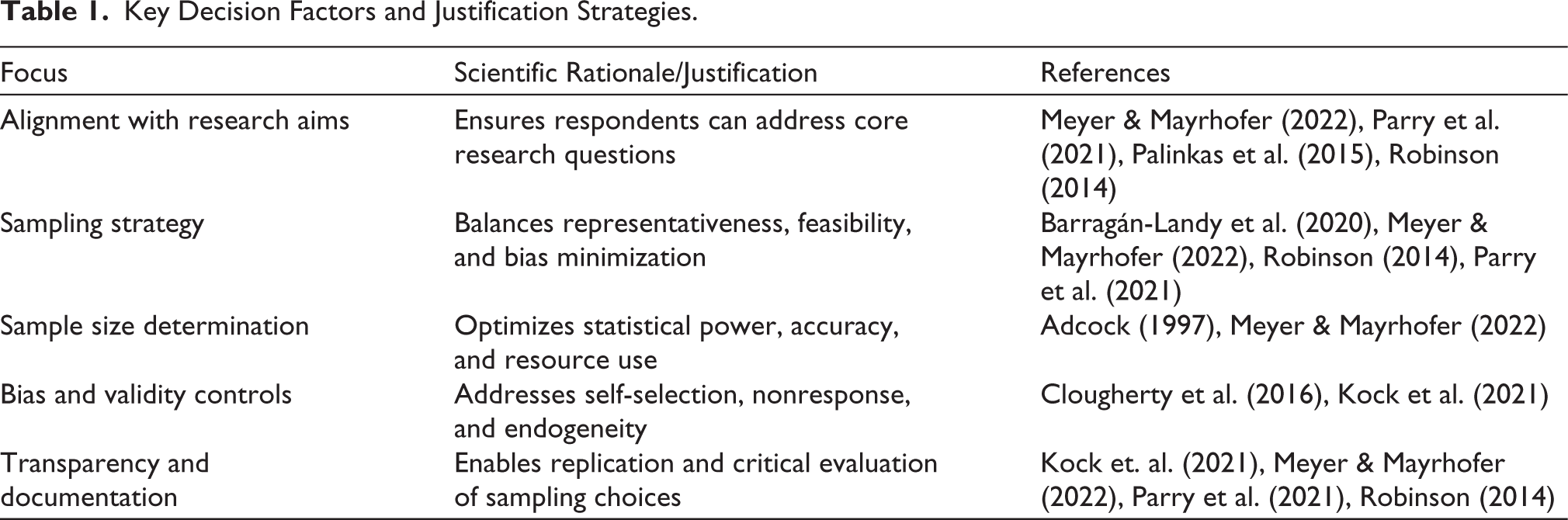
Moreover, a clear alignment between the sample and the target population is essential, particularly in heterogeneous contexts (Coppock et al., 2018; Degtiar & Rose, 2023; Stuart et al., 2015). Table 1 summarizes the key factors and rationale on sample justifications. Various parts of India differ from each other in economic, business, geographic, and sociocultural characteristics. Therefore, respondent selection can often involve selection bias and endogeneity, resulting in compromising the theoretical assertions and empirical estimates (Clougherty et al., 2016; Infante-Rivard & Cusson, 2018).
Furthermore, demographic heterogeneity among respondents can moderate the relationship between respondents’ choices, management practices and estimated organizational performance (Qi et al., 2018; Weems et al., 2003). Unfortunately, literature does not offer any specific criteria for choosing respondents; it depends on objectives and gaps addressed by the research and is largely influenced by the knowledge and experience of the researchers. Acknowledging inherent limitations in the selection criteria, theoretically informed and transparent selection of respondents, coupled with unique characteristics, is a methodological imperative that underpins the credibility, relevance, and impact of empirical research in business management (Degtiar & Rose, 2023; Meyer & Mayrhofer, 2022; Naong & Makhoali, 2024; Qi et al., 2018; Vasan, 2020; Van Haute, 2021).
Key Decision Factors and Justification Strategies.
How and Why Indian Respondents Are Important?
The Indian context and respondents can offer a variety of unique perspectives to business management research due to the distinctive sociocultural, institutional, and economic context of India. India’s pluralistic culture, characterized by collectivism, hierarchy, spirituality, influences leadership styles, consumption patterns, decision-making, entrepreneurship, investment decisions, business development opportunities, employee relations, and other areas important for routine business decisions. This context also offers cross-cultural management frameworks for multinational enterprises operating in the region (Parry et al., 2021). The predominance of small and medium-sized enterprises (SMEs) and family-owned businesses in India further underscores the need to examine entrepreneurial orientation, organizational learning, and supply chain management through a local lens, as these factors mediate business performance in ways not fully captured by Western-centric research (Jayaram et al., 2014; Mantok et al., 2019). Thus, including Indian respondents not only enriches theoretical development and practical insights for emerging markets but also challenges and extends the historical management knowledge, fostering a more globally relevant and contextually grounded discipline (Christie et al., 2003; Mantok et al., 2019; Sheth, 2011).
In the rapidly evolving Indian business landscape, understanding the distinct characteristics and values of different generations is important. To utilize the unique context, this editorial explains how respondents from these generations of Baby Boomers, Generation X, Millennials, Generation Z, and Generation Alpha are essential for advancing effective management practices, economic development, talent enhancement, and innovation. The interplay of these generational cohorts shapes practices across management disciplines.
This Editorial addresses the question of which respondents are fit for a particular problem and objectives. The editorial also aims to solve the dilemma that respondents from which generation should be selected to address what type of research questions/objectives. Let us understand how choosing respondents from a particular generation can help us in addressing methodological rigour and strengthening theoretical advancements.
Distinctive Characteristics of Baby Boomers and Generation X in India
In the Indian context, Baby Boomers (born 1946–1964) and Generation X (born 1965–1980) carry some distinct characteristics evolved by their formative years and socio-economic changes took in India post independence. Baby Boomers are generally characterized by a strong sense of loyalty, respect for authority, and a preference for hierarchical organizational structures. These generations tend to value job security, stability, and extrinsic rewards such as status and recognition within organizations. These generations value face-to-face communication, reflect their traditional approach towards consumption, culture, and workplace interactions (Becton et al., 2014; Gupta et al., 2016). However, Generation X is also influenced by the desire for autonomy, flexibility, and a balanced approach to work and life. Members of Generation X are more independent, adaptable to change, and open to innovation, often seeking immediate recognition and career advancement compared to baby boomers. Generation X is comfortable with technology and blended learning environments, but they still appreciate clear guidelines and structure (Gursoy et al., 2008; Mahmoud et al., 2021). Uniquely, Generation X in India demonstrates a pragmatic approach, balancing traditional values with a willingness to embrace new developments. These generational differences influence workplace dynamics, conflict resolutions, ethical marketing practices, safe investments, balanced risk, rational decision-making styles, and organizational commitment, making it essential to recognize and address the unique needs and strengths of business management discipline (Becton et al., 2014; Gupta et al., 2016; Mahmoud et al., 2021).
Why to Choose Millennials as Respondents?
Millennials are at the progressing phase of their lives. developing new ways to create a work-life balance and aim to achieve quality of life. Millennials are now moving towards upper managerial roles, making strategic decisions and hence, are responsible for transforming business organizations. Millennials in India are popular for their technological fluency, optimism, and assertiveness. They value diversity and are receptive to different cultures. Indian millennials are receptive and adaptive to practices free from gender, cast, creed, region, religion, socio-economic classes, and sexual orientation, which enables them to make informed decisions and embrace global perspectives (Kim & Park, 2020). However, Millennials are driven by objectives, learnings, name and fame, and reward systems rather than traditional loyalty. This generation believes in exploring new developments, bringing transparent systems, rethinking performance matrices, product and process innovations, global culture, branding, influencers, reviews and ratings, sharing feedback, and is open to learn. Further, millennials also practice fairness & healthy competition, and challenging work experiences. On the downside, millennials also undergo peer pressure, remain perpetually dissatisfied, face contradicting priorities, overexcitement, and overconfidence, and they are sensitive to criticism. They feel responsible for sustainability practices. If your study aims to solve objectives around these situations, choosing millennials as respondents is going to be more relevant.
Why to Choose Respondents from Generation Z and Generation Alpha?
Generation Z explores new consumer markets (digital/physical and phygital), practices autonomy, and brings a new set of expectations and behaviours. Shaped by a technology-driven upbringing, Gen Z is open to diversity in all forms and highly adept at leveraging digital tools for learning and problem-solving (Pichler et al., 2021). This generation usually has high career aspirations and values flexible work environments. Unlike Millennials, Gen Z is less motivated solely by monetary rewards; they seek meaningful work and opportunities for rapid skill development (Pandita, 2022; Sakdiyakorn et al., 2021; Stewart et al., 2017). Their collective consciousness, comfort, influenced by global events and technological advancements, fosters values such as universalism, benevolence, self-direction, and achievement (Sakdiyakorn et al., 2021). Gen Z’s practices involve online shopping, entertainment over savings, digital networking, and brand communities (Thangavel et al., 2021; Watkins et al., 2025). Unfortunately, Generation Z suffers from stress and anxiety, a short attention span, and instability in their decisions. They believe in trial-and-error experiments over learning from others’ experiences. The emergence of Generation Alpha, though still nascent in business practices, is marked by a strong attraction to personalization in everything, such as learning at their own pace and comfort, personalized feedback, their own style, fan following, and multiple role models. This generation is expected to be a more financially stable one. While empirical research on this cohort is limited, early trends suggest that their expectations will amplify those of Generation Z, with a focus on hyper-personalization, seamless digital integration, and global connectivity.
The co-existence of these generations in India offers scope, perspectives, developments, and challenges. Hence, careful selection of respondents is vital for empirical investigations. Researchers may also like to use quotas and selection of respondents from different generations to check the variations and make their research theoretically grounded. I suggest that scholars use two- or three-wave data collection because it helps in addressing causal relationships over time. Multi-wave data collection can observe changes, assess the direction of effects, and reduce biases related to measuring variables simultaneously. Furthermore, two- or three-wave data collections also address more complex analyses like mediation or reciprocal influences and provide stronger evidence across contexts. This will support richer and more reliable insights into dynamic business scenarios and bring more depth to research standards.