






Abstract
This article reinterprets liquid consumption through an experiential lens grounded in Bauman’s theory of liquid modernity and Dewey’s theory of experience. Existing research on liquid consumption has largely emphasized on structural characteristics such as ephemerality, access-based consumption and dematerialization, while offering limited understanding of how consumers experience liquidity in everyday life. Addressing this gap, the study conceptualizes indulgence as a manifestation of liquid consumption expressed through voluntary procrastination and wishful consumption. Drawing on Dewey’s framework, the article explains how consumers experience liquidity through the dimensions of interaction, continuity and situation to illuminate how consumers negotiate fluidity, temporality and uncertainty across contemporary marketplace environments. The article further develops an inquiry framework for future consumer and service research related to materialism, loneliness, well-being, surveillance and digital consumption. By shifting attention from structural properties towards lived and situated experiences, the study contributes to a richer understanding of contemporary consumption in increasingly transient and digitally mediated marketplace contexts.
Introduction
Contemporary consumption increasingly unfolds through transient service encounters, digital platforms and access-based marketplace relationships that privilege experience over ownership. Consumers today stream rather than collect, access rather than possess and participate rather than permanently attach themselves to material objects. Such transformations indicate that consumption is becoming increasingly fluid and experience-centred. Such transformations reflect what Bardhi and Eckhardt (2017) conceptualize as liquid consumption, characterized by ephemerality, access-based consumption and dematerialization. Zygmunt Bauman’s idea of liquid modernity serves as the foundation for the understanding of liquid consumption (Bauman, 2000, 2003, 2007, 2013a, 2013b, 2013c, 2013d, 2013e). Liquid modernity refers to a condition in which social institutions and structures are increasingly transient and unstable and can no longer guide human actions and experiences (Bauman, 2007).
Transformations in social institutions that used to guide human behaviour are widely evident (Agnihotri & Bhattacharya, 2020). For example, the rise in global nomadism (Bardhi et al., 2012) has transformed political institutions with the inclusion of global human resources. Similarly, the institution of marriage transformed with the inclusion of gay marriages (Siegel et al., 2022). Scholars studied the transformation in marriages and demonstrated its impact on consumption rituals (Eichert, 2015; Siegel et al., 2022). These changing social arrangements influence how consumers construct identities, relationships and meanings through marketplace experiences.
Interestingly, marketing scholars have increasingly acknowledged these transformations through the concept of liquid consumption (e.g., Allayarova et al., 2024; Bardhi et al., 2012; Bardhi et al., 2020). For example, Belk’s earlier conceptualization of materialism and identity focused on possessions and ownership (Belk, 1985, 1988). However, the emergence of digital consumption (Belk, 2013) and collaborative consumption (Belk, 2014) altered traditional assumptions regarding ownership, attachment and identity formation.
Despite the growing attention towards liquid consumption, important conceptual gaps remain in the literature. Existing studies have primarily focused on the structural characteristics of liquid consumption, particularly ephemerality, access-based consumption and dematerialization (Bardhi & Eckhardt, 2017), while comparatively less attention has been devoted to understanding how consumers experience liquidity in everyday life. As contemporary consumption increasingly unfolds through fluid marketplace relationships, there is a need to examine liquid consumption as an experiential condition rather than merely a structural transformation in ownership and materiality.
Furthermore, current research has insufficiently incorporated temporality, continuity and situated interaction into explanations of liquid consumption. Although liquid modernity emphasizes uncertainty, fluid identities and unstable social arrangements (Bauman, 2000, 2007), existing liquid consumption literature offers a limited understanding of how consumers negotiate these conditions experientially across personal, social and situational contexts. Relatedly, indulgence-oriented forms of consumption, such as voluntary procrastination and wishful consumption, remain underexplored within liquid consumption scholarship despite their increasing relevance in rapidly accelerating marketplace environments.
Addressing these gaps, this study advances the liquid consumption theory in three ways. First, the study conceptualizes indulgence as an experiential manifestation of liquid consumption comprising voluntary procrastination and wishful consumption. Second, drawing on Dewey’s theory of experience (Dewey, 1925, 1934, 1938), the study reinterprets liquid consumption through the dimensions of interaction, continuity and situation to explain how consumers experience liquidity across everyday life contexts. Third, the study develops an experiential inquiry framework that offers future directions for consumer and service research related to materialism, loneliness, well-being, surveillance and digital consumption.
The article proceeds as follows. First, the study reviews the literature on liquid modernity and liquid consumption. Second, the paper conceptualizes indulgence as an experiential dimension of liquid consumption. Third, drawing on Dewey’s theory of experience, the study develops a three-dimensional experiential inquiry framework based on interaction, continuity and situation. Finally, the study discusses implications for consumer and service research and proposes future research directions for understanding contemporary consumption in liquid modernity.
Background Theory
Concept of Liquid Modernity
Zygmunt Bauman turned away from postmodernism, which is regarded by the pluralism of authority and centrality of choice (Gane, 2001), and presented the theory of liquid modernity (Bauman, 2007, 2013a). The social condition in liquid modernity is represented as light or liquefied, which is not constructed and administered but a diffuse, permeating and saturating modernity (Beilharz, 2001). Liquid modernity is guided by the fluidity of mobile, smooth, deceitful and fugitive power (Lee, 2006) that becomes an internalized process supported by evaporating social bonds and progression in consumer culture as the dominant feature of identity (Binkley, 2008). Nationality, gender, class, family, marriage and other social institutions are increasingly transformed within liquid modernity. Globalization (Bauman, 1998) and frequent mobility (Bauman, 1999) have contributed to liquid modernity.
The emergence of liquid modernity was observed with the reduction in industrial production and rise in services (Bauman, 2000, 2013a). The trend towards flexible specialization, subcontracting, downsizing and free-floating labour marked production as a non-significant source of development, and consumption increasingly occupied a central position (Lee, 2006). Consequently, contemporary life increasingly unfolds through service encounters, digital platforms, temporary access arrangements and fluid marketplace interactions. The contemporary world is organized around consumption and market logic, governing every aspect of life and re-sketching class boundaries (Bauman, 2013c, 2013e). Bauman ascribed liquid modernity to globalization supported by information and technology flow. The rise in uncertainty and insecurity as a result of globalization blurred the boundary between public and private spaces (Bauman, 1999). The growing uncertainty and globalization contributed to the emergence of the inevitably transient, unbounded and ephemeral nature of the social world. Such conditions contribute to increasingly transient, flexible and episodic forms of everyday experience.
Modernity is evolving from a ‘solid’ to a ‘liquid’ state when social structures that restrict choices and institutions that set the standards for appropriate behaviour are no longer expected to maintain control (Bauman, 2013e). Society is viewed as a network rather than a structure that is increasingly becoming devoid of long-term thinking, planning and acting, and enthralled by episodic lives. Lack of institutional stability in resolving individual problems results in less-enduring relationships and new forms of loneliness (Binkley, 2008; Kumar, 2024a, 2024b).
From an experiential perspective, consumers increasingly navigate fluid social environments in which identities, relationships and consumption practices are continuously reconstructed across changing situations and interactions. Liquid modernity therefore provides an important foundation for understanding contemporary consumption as fluid, processual and experience-centred. These broader transformations in social life, marketplace systems and consumption practices provide the foundation for what scholars conceptualize as liquid consumption.
Liquid Consumption
Deriving from Bauman’s liquid modernity, liquid consumption was conceptualized by Binkley (2008) and Bardhi and Eckhardt (2017). Liquid consumption refers to increasingly fluid, transient and access-oriented forms of consumption that emerge within digitally mediated and rapidly changing marketplace environments. Existing literature has primarily conceptualized liquid consumption through the structural dimensions of ephemerality, access-based consumption and dematerialization.
Ephemerality signifies the short-lived nature of liquid consumption. A shorter product life cycle due to technological advancement and the increasingly fluid social structures brings ephemerality in contemporary consumption. In liquid modernity, Bauman (2000) argues that society lost its emancipatory ideal of consumption but gained an incessant desire for more luxurious consumption, which has glued the society together. The transient nature of social institutions that no longer guide consumption contributes to the ephemerality of consumption. Consequently, the modernity of possibility replaced the modernity of order, and the society of consumers replaced the society of producers. The coercive power is no longer effective and replaced by the power of seduction and temptation (Bauman, 2013b, 2013c, 2013d). Within contemporary service and digital environments, ephemerality is reflected in temporary subscriptions, short-lived platform interactions, rapidly shifting brand affiliations and continuously evolving marketplace experiences. Consumers increasingly encounter experiences designed for immediate engagement rather than enduring attachment. Consumers are overwhelmed by the freedom to consume and the consumer symbols that can readily be adapted to proffer a self-identity (Atkinson, 2008). This gets reflected in shortened consumer-brand and consumer–service relationships.
Access-based consumption is possible through the market-mediated mechanism of renting, sharing or borrowing without ownership (Bardhi & Eckhardt, 2017). For access-based consumption, Bardhi and Eckhardt (2012) identified six dimensions: temporality, anonymity, market mediation, consumer involvement, the type of accessed object and political consumerism. Access-based arrangements are increasingly visible in service ecosystems such as streaming platforms, mobility services, co-working spaces and subscription-based digital offerings, where temporary access often replaces long-term possession. In liquid consumption, consumers are allowed to consume and exploit every need through a perpetual plethora of choices. However, the responsibility for the consequences of choices may become a source of anxiety and ambiguity (Bauman, 1998). This anxiety, which is the feature of liquid consumption, is the very basis to enable consumer society (Bauman, 2007, 2013e). Liquid consumption presents a paradox in which, on one side, consumers are free to choose an identity but, on the other side, consumers are responsible for the choice of identity without even knowing which one to choose (Atkinson, 2008; Bauman, 2007, 2013a). As a result, identities increasingly become fluid, situational and continuously negotiated across multiple consumption environments.
Dematerialization of consumption means using the minimum possible material to achieve the same functionality level (Bardhi & Eckhardt, 2017). The advancement in technology has initiated digital consumption, resulting in the increasing presence of lighter, smaller and more portable products (Magaudda, 2011). Several studies have focused on the impact on consumer behaviour due to digitalization. Belk (2014) revitalized the concept of an extended self because of the advancement of the digital world, which resulted in dematerialization. Siddiqui and Turley (2006) noted that pictures, collections, letters and music had seen dematerialization. Watkins and Molesworth (2012) indicated that the digital world offered dematerialization because of its intangible nature, availability within the software realm and easiness of copying and production. Jensen Schau and Gilly (2003) investigated why people create personal websites, what they want to communicate, what their strategies are and how Web page strategies are different from strategies for real-life presentation. Dematerialization is especially visible within contemporary service contexts where experiences increasingly replace ownership-based consumption. Streaming services, cloud storage, virtual communities, digital wellness platforms and app-based ecosystems illustrate how consumption is becoming progressively detached from physical possession and increasingly embedded within fluid digital experiences. However, consumers ascribe less value to the digital version than to the physical version of the same good (Atasoy & Morewedge, 2018). The intangibility of the digital world brings a high level of uncertainty and influences the consumption pattern (Belk 2013).
Methodology
The study is a conceptual work as conceptual works are usually devoid of data but provide a clear line of arguments through the integration of literature, as suggested previously by scholars (e.g., Hulland, 2020; Jaakkola, 2020; Rana et al., 2020, 2022). Conceptual articles are important for advancing marketing knowledge because they enable scholars to identify, revise, integrate and delineate theoretical ideas that may not yet be sufficiently developed empirically (MacInnis, 2011). Following earlier conceptual studies, the present study aims to integrate insights from various areas such as psychology, sociology and marketing.
Drawing upon MacInnis’s (2011) framework for conceptual contributions, the present article primarily adopts a revising and integrating conceptual approach while also delineating the experiential dimensions of liquid consumption. The revising contribution emerges through the reinterpretation of liquid consumption from an experiential perspective grounded in Dewey’s theory of experience. The integrating contribution lies in combining Bauman’s theory of liquid modernity with Dewey’s experiential philosophy and contemporary consumer and service research. Further, the study delineates how liquid consumption is experienced through the dimensions of interaction, continuity and situation.
As suggested by MacInnis (2011), the study developed a theoretical premise to offer the experiential reinterpretation of liquid consumption and subsequently offered theoretical and practical implications of the study. Accordingly, the study was developed through four interrelated conceptual phases: (a) problem identification, (b) conceptual revision, (c) conceptual integration and (d) experiential delineation. First, the study identifies theoretical gaps in the existing liquid consumption literature, particularly the limited attention towards experiential and service-oriented dimensions of consumption. Second, the study revises the existing conceptualization of liquid consumption by introducing indulgence as an experiential manifestation reflecting voluntary procrastination and wishful consumption. Third, the article integrates concepts from liquid modernity, consumer culture theory, service research and experiential philosophy to explain the increasingly transient nature of consumption. Fourth, the study delineates liquid consumption experiences through Dewey’s experiential framework consisting of interaction, continuity and situation/place.
Dewey’s theory of experience (Dewey, 1925, 1934, 1938) serves as the interpretive framework guiding the conceptual development of the article. Dewey conceptualized experience as dynamic, contextual and continuously reconstructed through the interaction between individuals and their environments. This perspective aligns closely with the fluid, transient and access-based characteristics of liquid consumption. Unlike static ownership-oriented perspectives, Dewey’s framework enables a richer understanding of consumption as an evolving experiential process shaped through social interaction, temporality and situational contexts.
The continued relevance of Dewey’s framework is particularly visible in digitally mediated and service-centred consumption environments where experiences are increasingly ephemeral, platform-based and interaction dependent. Contemporary service experiences such as streaming platforms, access-based services, wellness experiences, social media interactions and digitally mediated consumption are processual rather than possession centred. Therefore, Dewey’s experiential lens provides an appropriate theoretical foundation for understanding how consumers navigate and experience liquid forms of consumption in contemporary society.
The conceptual development of the study involved an interpretive synthesis of literature from sociology, consumer culture theory, service research, psychology and marketing to examine how liquid consumption manifests across contemporary consumption contexts. Rather than treating liquid consumption as a fixed marketplace structure, the study approaches it as an evolving experiential condition shaped through temporality, interaction and situational contexts. Illustrative examples from digitally mediated, access-based and service-oriented consumption environments are incorporated to demonstrate how consumers experience fluidity, uncertainty and indulgence in everyday life. This interpretive approach enables the study to generate a richer and experientially grounded understanding of liquid consumption within contemporary marketplace systems.
Indulgence as an Experiential Manifestation of Liquid Consumption
Among the various experiential conditions associated with liquid modernity, the present study focuses on voluntary procrastination and wishful consumption as expressions of indulgence within contemporary consumption environments. These conditions reflect the increasingly fluid, temporally compressed and gratification-oriented nature of consumption in liquid modernity.
Indulgence is understood as yielding to desire or gratification (Kivetz & Simonson, 2002). Since indulgence is based on two fundamental elements of action and faster gratification (Kivetz & Simonson, 2002; Liu, 2022), the article discusses these elements. In the context of liquid consumption, indulgence is experienced through two interrelated manifestations: (a) voluntary ‘dilatoriness’ or voluntary procrastination and (b) wishful consumption (Figure 1).
Experiential Manifestation of Liquid Consumption.
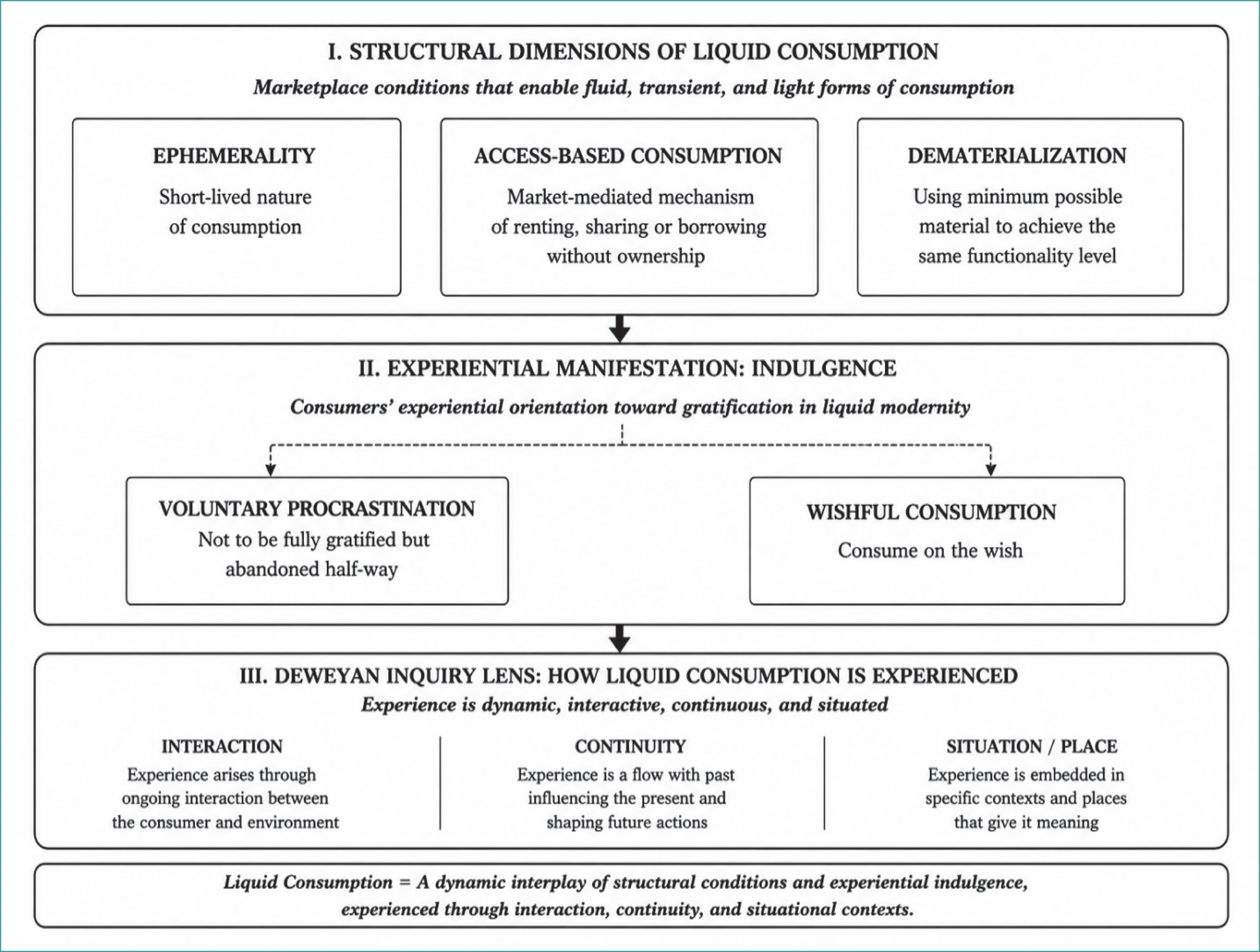
As illustrated in Figure 1, the dimensions of liquid consumption are interconnected rather than mutually exclusive. While ephemerality, access-based consumption and dematerialization primarily describe structural transformations in contemporary consumption, indulgence captures consumers’ experiential orientation towards gratification, desire and temporally fluid consumption practices. Figure 1, therefore, provides a conceptual foundation for understanding liquid consumption not only as a marketplace condition but also as a lived experiential phenomenon.
Voluntary Procrastination
Procrastination is a voluntary but irrational delay of an intended course of action (Astakhova et al., 2022). Although scholars consider procrastination as a personality trait (Azimi et al., 2020), which could be characteristic of individuals in liquid modernity, researchers confirm that it operates at both the task level and the individual level (Azimi et al., 2020). At the task level, consumers avoid tasks by procrastination as tasks are aversive. Empirical evidence (e.g., Jiang & Yinghao, 2018) suggests that tasks are likely to be procrastinated when the reward of the task is temporally distant, indicating that delayed incentives can motivate people to procrastinate. This can be understood from the example when the task involves consumption-related activities. Consumers are likely to delay the consumption if they realize that the reward of consumption will be received in the distant future, fostering procrastination. At the individual level, a consumption-driven society requires distinctive gratification (Hwang et al., 2020). In Derrida’s (1972) term pharmakon, that is not to be fully gratified but abandoned halfway (Bauman, 2000) and self-controlled.
Bauman (2000) argues that procrastination is time lived during a pilgrimage, inching towards a target that is ambivalent. On one hand, consumers in liquid modernity voluntarily procrastinate to grasp things that truly matter, while on the other hand, grasping things will mark the conclusion of the journey. Max Weber (see Bauman, 2000) argues that a particular dilatoriness rather than impatience has resulted in innovations. This suggests that a greater opportunity for self-indulgence would arise from stronger self-restraint. Liquid modernity supports more work, resulting in more earnings, savings, spending and consumption. Voluntary procrastination is also supported by the proliferation of avenues to complete the desired work. The digital world has reduced barriers to task completion while simultaneously enabling new forms of voluntary procrastination through abundant consumption choices and distractions.
From a Deweyan perspective, procrastination reflects an experiential negotiation between anticipation, temporality and situational desire. Consumption is therefore not merely delayed behaviour, but part of an ongoing experiential process through which consumers navigate uncertainty, gratification and fluid aspirations.
Wishful Consumption
Wishful consumption explicates that consumers increasingly consume in response to transient wishes rather than enduring desires. Desire needs time to grow and mellow, but in the transient nature of the contemporary world, the cultivation time for desire seems very long. Therefore, marketplaces are designed with fast arousal and the quick extinction of wishes (Bauman, 2007). Scholars (e.g., Nowlis et al., 2004) suggested that a delay increases consumption enjoyment for pleasurable products when actual consumption occurs but decreases enjoyment for imagined consumption. In liquid modernity, a primary feature of consumer society is not consumption per se but consumption’s emancipation from functionalities. This means that liquid consumption needs justification through nothing but ‘pleasurability’ as consumption has its specific purpose and is self-propelling (Bauman, 2013c).
Voluntary procrastination and wishful consumption are illustrated through the example of shopping. The pragmatics of shopping increasingly shape everyday life orientations and identity projects (Bauman, 2000). Liquid modernity has uninterruptedly promised a new beginning when long-term planning seems impractical. This new beginning opens a wide space for personal growth in which making and re-making of identity is an unending project. Under such conditions, consumers are left with the experience of shopping to act upon. In liquid consumption, things are important not because they are owned but because they are consumable (Rojek, 2004).
The ‘shopping of life’ involves a cognitive representation suggesting how our life is shaped around shopping activity followed by the knowledge about making competent choices. Bauman suggests that the shopping list is never-ending. This presents a paradox for consumer society. One side promises instant gratification about anything, while another side proclaims the impossibility of gratification by the availability of inexhaustible new and improved objects of consumption from the shopping list (Bauman, 2013c). Kivetz and Simonson (2002) showed that consumers choose myopic luxury reward over cash or greater value because of their pre-commitment to indulgence to ensure that their earned awards or points do not get used in necessities. Indulgence has been studied as a motivation in the context of spa, wellness tourism and medical tourism (Akamatsu & Fukuda, 2022; Hu & Min, 2022; Wright & Schultz, 2022). Within contemporary service environments, such wishful consumption is increasingly visible in digitally mediated experiences designed for instant engagement, rapid gratification and continuous experiential renewal.
In the next section, the article presents the three dimensions of inquiry space which help us to better understand liquid consumption.
Deweyan Inquiry Lens
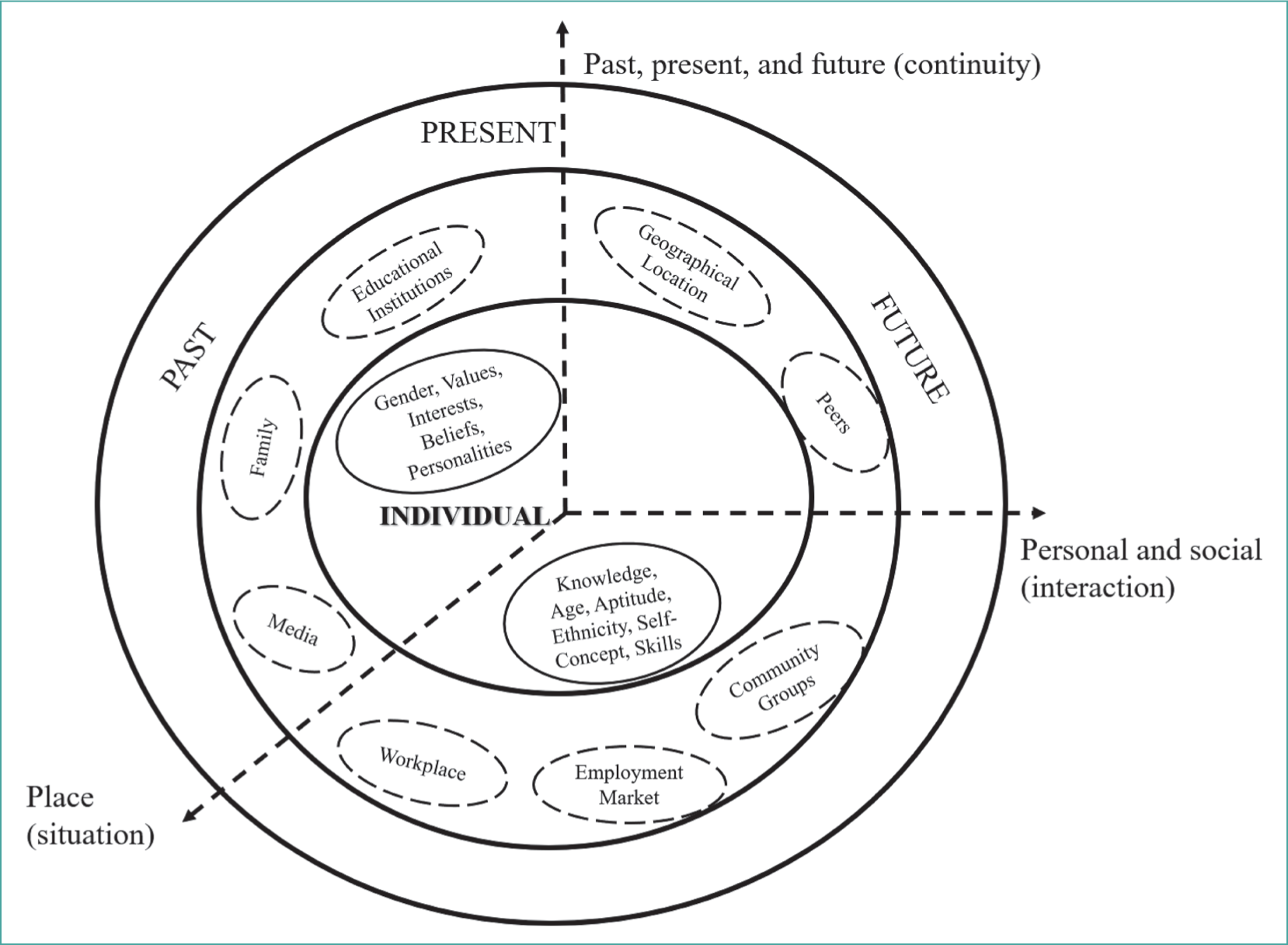
Deriving from Dewey’s theory of experience (Dewey, 1938), Clandinin and Connelly (2000) presented a three-dimensional metaphoric space for inquiry. These dimensions are (a) personal and social (interaction); (b) past, present and future (continuity); and (c) place (situation) (Figure 2).
Inquiry Space.
Personal and Social (Interaction)
The access-based nature of liquid consumption suggests that there is constant interaction between personal and social spheres. But the increasingly short-lived nature of these relations in liquid modernity has resulted in the flux of relationships. Within service ecosystems, such interactions increasingly unfold through temporary platform relationships, digitally mediated encounters and fluid participation across multiple communities and networks. Bauman (2003) suggests that individuals invest in relationships and treat them as a transaction in the hope of mitigating the uncertainty and fear of loneliness. However, an individual may feel lonely and insecure irrespective of the relationship. Liquid consumption offers unprecedented freedom of experimentation along with the responsibility of coping with the consequences (Bauman, 2000). This freedom creates multiple and fluid identities.
The development in the social sphere constitutes a new identity, whereas consumption in the personal sphere reshapes existing identity. Consumption is also related to the development of the social sphere, which offers aporetic experiences. Such experiences emerge through participatory forms of consumption in which consumers temporarily engage with communities, platforms and social networks without necessarily developing enduring attachments. These identities are fluid due to the episodic life that liquid modernity offers. Therefore, identity is constantly in flux through flexibility, openness and mobility. The personal and social interaction is contextualized by the uncertainty that liquid consumption offers. Fear and uncertainty are related to the rise in privatized, deregulated and flexible work patterns similar to the shift in marriages to cohabitation in personal space (Bauman, 2000). Individuals are insecure about their position, identity and livelihood and uncertain about the long-term, ownership and community (Bardhi & Eckhardt, 2017). The emergent uncertainty, which refers to ‘not knowing the ends’, is overpowering the traditional uncertainty which refers to ‘not knowing the means’.
Past Present and Future (Continuity)
The continuity highlights as to how personal, social and political changes affect individuals’ identities. Individualization, an important feature of liquid modernity, consists of transforming identity from given or born-with to acquire using tasks and taking responsibility for that task along with its consequences (Bauman, 2000). In liquid modernity, individualization is fate, not a choice (Bauman, 2000) except for some communities (e.g., the United States), in which individualization is practised as a choice. Moschis (2007) suggested the growth of an individual is guided by the tole theory, which indicates that participants play different roles that shape their identity. During the lifespan of individuals, they encounter a multiplicity of options and roles to play. The plethora of choices has resulted in the proliferation of pursuable ends. Digital life has also contributed to the individualization and transformation of identity (Bauman, 2013e).
Belk (2014) acknowledged the shift in identity from ‘you are what you have’ to ‘you are what you can access’. Bauman metaphorically relates life in the liquid modernity to an episodic life of a shopping mall, where individual consumers are free to shop in the supermarket of identities, only limited by resources at their disposal. However, the individual’s life will be spent agonizing over choices rather than finding the means to an end (Gane, 2001). Individuals cannot assess continuity, that is, sync between past, present and expected future, due to which they have to constantly revise their stories, reshuffle memories and perform a new selection of occasions that align with their new roles, experiences and possible future outcomes (Clandinin & Connelly, 2000; Moschis, 2007). Stories build around development, growth, role assignments, acquisition of knowledge, competencies and responsibilities offer a way to understand continuity. Consequently, contemporary consumers continuously revise their identities across changing service encounters, digital interactions and platform-based experiences.
Place (Situation)
Bauman argues that the digital world has changed the situations in which people live. Liquid modernity has offered enough space to alter the situation as per our will. The response to situations is not limited by space. The liquidity increases the feeling of perpetuity to indicate the new extent of freedom. But at the same time it melts the bond that concludes the feeling of security. These signs and images signifying liquidity create new and limitless objects of consumption. Consumers respond to these objects to fulfil their wishes. Consumers are so fixated on consumption that they ignore their own predicament.
The freedom that liquid modernity offers is also linked to situations. The mixed feeling of freedom refers to the dilemma that liquid modernity brings in daily life. Contemporary life is as free as it could be imagined, which offers several alternatives but also presents challenges (Bauman, 2000). One of the main challenges is that individuals have to take charge of their actions and consequences without support from traditional institutions. This leaves people preoccupied with their own personal troubles, resulting in the increasing presence of private issues in public life (Gane, 2001). Moreover, individuals do not consider that the increasingly liquid nature of traditional institutions can be of any help. Bauman (2000) suggests revitalizing the private–public spheres for a better future. Situational fluidity is particularly evident within digitally mediated service environments where consumers navigate multiple consumption spaces simultaneously across physical and virtual settings.
Discussion and Implications
The primary objective of this study is to reinterpret liquid consumption through Dewey’s experiential lens and to explain how consumers experience fluidity, temporality and indulgence within contemporary service-oriented and digitally mediated consumption environments. The novelty of the study lies in repositioning liquid consumption from a predominantly structural understanding towards an experiential interpretation grounded in Dewey’s theory of experience while simultaneously conceptualizing indulgence as an experiential manifestation of liquid modernity. Voluntary procrastination entails intentional delays in consumption due to task aversiveness or temporally distant rewards, reflecting a paradox where self-restraint enables greater indulgence (Astakhova et al., 2022; Bauman, 2000). Wishful consumption captures consumers’ pursuit of desires not yet realized, emphasizing pleasure over functionality in a rapidly changing, transient consumer environment (Bauman, 2007, 2013). The metaphor of the ‘shopping of life’ illustrates the ongoing, unfulfilled pursuit of gratification amidst a vast array of consumable objects, underscoring the contradictory nature of liquid consumption. The present study emphasizes how contemporary consumers increasingly experience fluidity through transient, digitally mediated and service-oriented marketplace environments. From this perspective, liquid consumption is understood less as a fixed structural category and more as an evolving experiential condition shaped through temporality, interaction and situational contexts.
Theoretical Implications
This conceptual article contributes to the enhanced theoretical understanding of a concept as suggested earlier (e.g., Rana, 2018a, 2018b; Rana et al., 2022). The study contributes to the enhanced understanding of liquid consumption, by repositioning liquid consumption as an experiential condition rather than solely a structural transformation in ownership and materiality. For example, Smith et al. (2018) examine the role of loneliness on store experience by adopting a traditional perspective. However, a liquid consumption approach to studying loneliness would examine how loneliness is perceived or felt and how the ephemerality of loneliness changes the store experience. A life course inquiry would delineate the subjective dimensions of loneliness, which is very difficult to capture by using an objective measure of loneliness scale. Scholars (Kumar, 2024b; Verma & Kumar, 2022) took the liquid consumption approach to study loneliness and explored the multidimensional and ephemeral nature of loneliness by using the life course approach. Soni et al. (2026) studied how the loneliness of metaverse users promotes depression. Similarly, Bardhi et al. (2012) took the liquid consumption approach to study possessions.
The study also contributes to Bauman’s theory of liquid modernity (Bauman, 2013c) by extending its relevance into contemporary consumer and service research through Dewey’s experiential framework. Rather than conceptualizing liquid consumption solely through structural properties, the study demonstrates how consumers experience liquidity through interaction, temporality, uncertainty and situational fluidity across digitally mediated environments. Indulgence is therefore positioned not as a separate structural category but as an experiential expression of liquid modernity.
Further, this study responds to Ranaweera and Sigala (2015) and Yadav (2010), who argued the need for a conceptual enhancement to take the field of service and marketing research forward. The study has enhanced the conceptualization of consumption and introduced the characteristics of liquid consumption. By revitalizing the inquiry approach in consumer research, the study aims to reenergize the research approach as well as offer a perspective to look at any research agenda from a liquid consumption perspective. This article is an attempt to reinvigorate the existing concepts and stimulate further discussion as to how liquid consumption manifests the various domains, in a way replying to MacInnis (2011). The study encourages researchers to relook into the existing concepts from a liquid consumption perspective. The study believes that inquiry approaches would bring some new dimensions of liquid consumption over time and have the power to alter the structure and shape of existing concepts.
Guidelines for Future Research
The conceptual framework presented in Figure 1 provides a foundation for future research on liquid consumption across consumer and service contexts. Specifically, the structural dimensions of liquid consumption—ephemerality, access-based consumption and dematerialization—offer opportunities to examine changing marketplace relationships, digital consumption practices and fluid forms of ownership and attachment. Further, indulgence as an experiential manifestation of liquid consumption opens new directions for understanding temporally compressed consumption, gratification-oriented behaviour, loneliness and well-being. Finally, the Deweyan inquiry dimensions of interaction, continuity and situation provide an experiential lens for examining how consumers negotiate liquid consumption across social, temporal and contextual environments. Accordingly, the future research agenda presented below is derived from the conceptual relationships illustrated in Figure 1. The liquid consumption perspective can be applied to studying various consumer-related phenomena for both products and services. Following previous studies (e.g., Kaurav & Gupta, 2022; Rana, 2018a, 2020), the article here lists a few areas and outlines the theoretical and practical implications.
Materialism, Self and Brand Relationship
One of the characteristics of liquid consumption is dematerialization, which is in contrast to materialism. Belk (1985) stated that ‘people are what they possess’. He conceptualized materialism as a personality trait; later, Richins and Dawson (1992) conceptualized materialism as a personal value. Materialism requires a makeover from the point of liquid consumption, which stresses less of material use. Material possession is considered important while building an identity (Belk, 1985). However, the meaning of material possessions is changed in liquid consumption. The transient nature of liquid modernity is classified with fewer material possessions.
Belk (2014) incorporated the liquid modernity aspects in materialism and proposed ‘people are what they can access’, essentially arguing that people do not adhere to possessions and like to associate with possessions only when the need arises. Studies on materialism have not yet incorporated the fluidity of life. This proposes that the very nature of the inquiry to understand materialism needs to be relooked.
Stronger attachment to possessions indicates stronger relevance for self. Scholars argue that a fit between brand personality and self reflects a stronger association with brand (Belk, 2013). When the association between brand and self is viewed in the transient phase, it may offer newer dimensions to explore. For example, consumers will not develop an emotional association with a car-sharing brand due to the ephemeral nature of ownership in car-sharing services and thus may not reflect the association between the brand and self (Bardhi & Eckhardt, 2012).
In other words, consumers are temporarily associated with attachments. Brands that anchor consumers to stable past identities may create tension within liquid consumption contexts, where identities are increasingly fluid and continuously reconfigured. Thus, scholars may wish to explore the self and brand association in the liquid attachment, which may be of small duration, less material or indulgence. Scholars may also investigate the phenomenon of liquid identity and how consumers balance their liquid or evolving selves.
Loneliness
Loneliness refers to an aversive feeling of being isolated from others (Pieters, 2013). Loneliness has been a subject matter of concern in psychology, sociology and marketers, but most of the studies on loneliness have not utilized a liquid consumption approach (e.g., Wang et al., 2011). Pieters (2013) studied the relationship between materialism and loneliness. He established that treating possessions as the measure of happiness or success increases loneliness in the long term. Loneliness affects the marketplace choices and self-esteem of Individuals.
Huang et al. (2016) argue that nostalgia can counteract loneliness, but reoccurrences of nostalgic experiences are rare. Therefore, people like to relish those experiences by extending reminiscing time about them. Evidence of this has been seen in advertisements of brands that attempt to evoke childhood memories. However, brands that may anchor consumers to past relationships or identities solidify their identity, which is in contrast to identity in liquid consumption. Thus, the phenomenon of consumers’ loneliness requires a fresh look from the liquid consumption perspective. Indulgence as a characteristic of liquid consumption indicates the consumers’ wishful consumption or consumption on demand may be related to reducing the extent of loneliness, as this may allow consumers to forget about the negative experiences and focus on the hedonic pleasure of consumption and develop an association with other consumers.
However Wang et al. (2011) argue that Americans are increasingly becoming lonely despite the prevalence of social networks and technologies to enhance interactions. People are dealing with a new form of loneliness, which is the result of grand seminal changes that liquid modernity and liquid consumption bring in. Understanding loneliness requires a liquid consumption approach in which the transient aspect of consumption is understood in greater detail.
Health and Well-being
Strong orientations towards material consumption have shown a close relationship with well-being (Kasser & Ahuvia, 2002). Most of the studies have identified a negative relationship between materialism and well-being (Shrum et al., 2014). Loneliness, which has shown a close association with materialism, has been found to be detrimental to health and well-being (Pieters, 2013). Loneliness is related to anxiety, lower self-esteem, disorientation in consumption patterns and other health-related issues. The well-being includes the prevalence of mental health problems and life satisfaction.
Further, scholars found a zero-order correlation among children between materialism and well-being. These results demand to consider other contextual variables which liquid modernity brings in while studying well-being. Shrum et al. (2014) acknowledge that it is not clear what relates materialism to lower well-being. It could be the actual materialistic values that drive the results, or it could be the deficiency in fundamental human needs which leads to such results. These results may also be related to the way materialism is operationalized as belief, value or financial aspirations. An understanding of well-being requires a close discussion with participants to understand the extent to which liquid consumption is influencing their health and well-being. The transient nature of state institutions has turned people away from social structures. Therefore, people moved towards self-help.
The prevalence of portable devices for health check-up in several homes has altered the way health services are consumed. Thus, the stories shared by participants can illuminate the role of the contextual variables along with the role of main variables in determining health and well-being. Future service research may therefore examine how digitally mediated wellness platforms, self-tracking technologies and therapeutic consumption environments shape consumers’ well-being experiences in liquid modernity.
Social Media, Surveillance and Consumption
The liquid consumption perspective has implications for social media, surveillance and how we consume. Liquid modernity marked an era of non-engagement. In liquid modernity, the panoptic model of dominance, which was used for supervising and surveillance, is fast being dismantled and is paving the way for self-supervision and self-control by market-driven objects (Bauman, 2013c). Bauman (2000) suggests that we are in a post-panoptical era, where the powerful people responsible for operating the levers of power can escape any moment into sheer inaccessibility.
Digital surveillance and big data are new forms of the panoptic model that can control and alter individual sentiments. Social media and big data offer practitioners an opportunity to plan, promote and regulate consumption patterns. In liquid consumption, marketplace sentiments can transform consumption patterns. Marketplace actors, for example, activists, brands and consumers, produce varied sentiments, which can be used to discipline consumers using social media (Gopaldas, 2014). Villarroel Ordenes et al. (2017) highlight the use of social media data in sentiment analysis. Humphreys and Wang (2017) suggest that although the singular analysis of big data cannot help in studying all phenomena, it is very useful in identifying patterns. Consumers are constantly being watched by companies regarding their daily consumption.
The prevalence of mobile, Web and other technologies, which seeps into all parts of lives, is generating a vast amount of data for companies. For example, e-commerce platforms are monitoring every click of users, and after analysing those clicks, they send customized deals. Analysis of social media data helps in identifying patterns, segmentation and targeting of consumers, launching new products and customized market offerings. Consumers also do self-surveillance to regularly monitor their health, fitness and household consumption on several apps. Consumers are increasingly sharing their stories of consumption on digital platforms. Bardhi and Eckhardt (2017) suggest that surveillance in liquid consumption is a powerful tool for self-governance; however, it has negative consequences for consumers. Also, scholars have revisited the concept of consumption in a sharing economy and explored how consumers become service providers. Lang et al. (2022) studied the consumers of Airbnb and identified four stages (catalysts, enablers, drivers and glue) of them becoming the provider of Airbnb. This indicates the changing nature of consumption.
Footnotes
Declaration of Conflicting Interests
The author declared no potential conflicts of interest with respect to the research, authorship and/or publication of this article.
Funding
The author received no financial support for the research, authorship and/or publication of this article.