







Abstract
Objectives:
To evaluate the surface roughness and color change of different highly translucent zirconia with or without glaze after toothbrushing simulation and thermocycling.
Methods:
Forty squared-shaped specimens (3 × 3 mm and 2 mm thick) were milled from two different highly translucent zirconia CAD-CAM blocks (n = 20): Ceramill Zolid FX Multilayer 71L A1 and Ceramill Zolid HT+ Preshades 71L A1 (AmannGirrbach). Half of the specimens of each zirconia (n = 10) were stained and glazed (IPS Ivocolor, Ivoclar Vivadent). The surface roughness, confocal microscopy images, and color parameters were obtained at baseline and after aging (48,000 cycles in a toothbrushing simulator followed by 10,000 thermocycles between 5°C and 55°C). The data obtained before and after aging were statistically compared at a significance level of α = 0.05.
Results:
For both types of zirconia, the surface roughness was found significantly higher for glazed specimens at baseline and after aging (p < .05); however, the surface roughness of Preshades zirconia significantly decreased after aging for both specimens with (ΔRa: −0.15) or without glaze (ΔRa: −0.13) (p < .05). Although glazed specimens presented higher lightness after aging, the color change of Preshades specimens was significantly higher than Multilayer specimens (p < .05). With the exception of glazed Multilayer zirconia, the color change of all specimens was considered clinically perceptible (ΔEab > 1.2; ΔE00 > 0.8); moreover, except for Multilayer zirconia with or without glaze, Preshades zirconia exhibited a color change deemed clinically unacceptable (ΔEab > 2.6; ΔE00 > 1.8), regardless of the glazing.
Conclusion:
Both highly translucent zirconia covered by a glaze layer became rougher and showed greater color change after brushing and thermal cycling.
Introduction
Ultra-thin veneers for anterior teeth can be milled from lithium disilicate glass-ceramic, feldspathic ceramic, zirconia, or leucite-reinforced glass-ceramic CAD/CAM blocks. 1 These materials have been constantly improved in terms of mechanical and optical properties to better mimic the aesthetics of natural teeth. 2 Despite their excellent esthetic appearance, thin restorations made from feldspathic or lithium disilicate glass-ceramic based on lithium disilicate have lower mechanical strength than those made from zirconia, which is also an accurate and biocompatible material. 3
Initially, zirconia presents a monoclinic configuration, and upon sintering above 1,400°C, it transforms into a tetragonal structure. When cooled to room temperature, zirconia assumes the monoclinic form again, which causes a 3%–4% volumetric increase that could lead to the occurrence of cracks and/or fractures. Therefore, yttrium oxide is added to stabilize the tetragonal phase at room temperature, thus enhancing mechanical properties as well as improving the optical properties of zirconia.4–6
Still, tetragonal polycrystalline zirconia is excessively opaque to restore anterior teeth due to an oxygen vacancy in the lattice, leading to birefringence, and thus needs to be covered by other ceramics.7,8 The development of zirconia-containing grains with reduced number size, and with a higher proportion of yttria, allowing a higher cubic phase proportion, led to an increase in light transmittance throughout the restoration. 5 The so-called highly translucent zirconia, due to their higher translucency and higher flexural resistance in comparison to glass ceramics, can be used to manufacture monolithic crowns, veneers, inlays, onlays, and fixed posterior prostheses up to three elements.9–11
Most zirconia types, including the highly translucent zirconia, are monochromatic, and the superficial layer of the restorations needs to be characterized with stains to mimic the tooth structure. 12 Moreover, the stains are covered by the glaze, which is a thin layer of alkali aluminosilicate glass that is fired at a melting temperature lower than zirconia.13,14 This layer is expected to maintain a long-term color stability and glossy appearance even after mechanical and thermal challenges. 15 In order to mimic the tooth structure more accurately, novel polychromatic and highly translucent zirconia has been developed, presenting an intrinsic shade and translucency gradient with smooth transitions that imitate enamel, dentin, and cervical shades; thus, extrinsic characterization with stains and, consequently, the application of glaze may become unnecessary.16–18
While an increased yttria content stabilizes the cubic phase of zirconia and improves its translucency, it also modifies the wear susceptibility of these materials, resulting in significantly lower mechanical properties compared to conventional 3Y-TZP.19,20 Considering that zirconia restorations are constantly subjected to variations in pH, temperature, mastication load, and abrasion, their color and surface stability have been investigated21,22; however, there is a lack of knowledge on the long-term maintenance of glaze applied on novel highly translucent zirconia. Therefore, this study aimed to evaluate the surface roughness and color change of different highly translucent zirconia with or without glaze after aging, simulating abrasion and thermocycling challenges. The null hypotheses tested were that: (a) surface roughness and (b) color change of two highly translucent zirconia with or without glaze were not affected by toothbrushing simulation and thermocycling.
Methods
Sample Preparation and Group Division
The brands, manufacturers, and compositions of the materials used are described in Table 1. Forty squared-shaped specimens (3 × 3 mm and 2 mm thick) were designed in CAD software (exocad GmbH, Darmstadt, Germany) and then milled from two different highly translucent zirconia CAD-CAM blocks (n = 20): monochromatic Ceramill Zolid HT+ Preshades 71L A1 (AmannGirrbach, Koblach, Austria) and polychromatic Ceramill Zolid FX Multilayer 71L A1 (AmannGirrbach, Koblach, Austria). The blocks were milled at the same CAM unit (Ceramill Motion 2, AmannGirrbach, Koblach, Austria). Then, the specimens were sintered at 1,450°C for 2 h.
Materials Used in this Study.
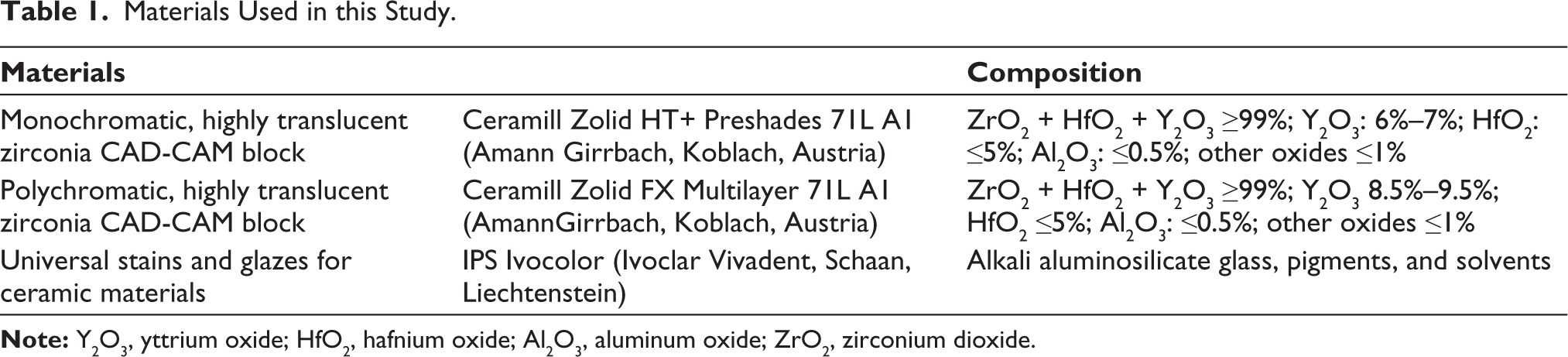
Half of the specimens of each zirconia (n = 10) were stained and glazed (IPS Ivocolor, Ivoclar Vivadent, Schaan, Liechtenstein), following the recommendations provided by the manufacturer. Specimens were then positioned in an oven at 450°C, and fired up to 850°C (heating rate of 40°C/min, drying time of 5 min, and holding time of 1 min), so the glaze could be sintered.
Surface Roughness Measurement
The baseline surface roughness of each specimen was measured three times using a digital profilometer (Surfcorder SE 1700, Kosaka, Tokyo, Japan). The arithmetic average height (Ra) between the three measurements was calculated considering a 4.5-mm length, five sequential 0.8-mm cut-offs, and a drive speed of 0.5 mm/s.
Laser Confocal Microscopy Analysis
The two most representative specimens of each group were selected for qualitative analysis using laser confocal microscopy (LEXT 3D Measuring Laser Microscope OLS 4000, Olympus, Tokyo, Japan). Photomicrographs of the surfaces of the samples were obtained at a 100 × magnification at baseline.
Color Measurement
The baseline CIEL*a*b* color parameters (L*, a* and b*) of all specimens were obtained using a digital spectrophotometer (Easyshade, VITA Zahnfabrik, Bad Säckingen, Germany). L* indicates lightness and varies from 0 (black) to 100 (white), while a* and b* indicate red–green and yellow–blue axes, respectively.
Aging: Abrasion and Thermocycling Challenges
All specimens were positioned into chambers of a toothbrushing simulator machine (Biopdi, São Carlos, SP, Brazil) containing a slurry of toothpaste (Oral-B Pro Saúde, Procter & Gamble, Cincinnati, Ohio, USA). The slurry was prepared according to ISO 11609 standards by mixing the toothpaste with deionized water at a ratio of 1:3 (w/w) until a homogeneous suspension was obtained. Soft-bristled toothbrushes (Sensi-Soft Oral B, Procter & Gamble, Cincinnati, Ohio, USA) were used under a 250 g load, and the glazed surfaces of the specimens were subjected to 48.000 cycles (90 cycles/min), simulating 5 years of brushing. 23
Next, all specimens were subjected to 10.000 thermocycles (MTC, Elquip, São Carlos, SP, Brazil) between 5°C and 55°C with a 30-s dwell time. 24
After Aging Analyses
After aging, the surface roughness of each specimen was remeasured as described above and compared to baseline values. Moreover, confocal microscopy images were obtained from two representative specimens.
The L*, a* and b* parameters of all specimens were remeasured after aging and the CIEL*a*b* color change (∆Eab) was calculated by using the formula [∆Eab = ([∆L*]2 + [∆a*]2 + [∆b*]2)1/2], where ∆L* = Lfinal − Linitial; ∆a* = afinal − ainitial; and ∆b* = bfinal − binitial. In addition, the CIEDE2000 color difference (∆E00) was determined through the formula ∆E00 = √(∆L´/kLSL)2 + (∆C´/kCSC)2 + (∆H´/kHSH)2 + RT(∆C´/kCSC) (∆H´/(kHSh), in which ∆L* indicates lightness variance (black-white axis), ∆C indicates chroma variance, ∆H indicates hue differences, RT is a function for the hue and chroma differences interaction in the blue region of the spectrum. Moreover, kL, kC, and kH are the parametric factors for viewing conditions and illuminating conditions influence, while SL, SC, and SH are the weighting functions for the color difference adjustment considering the location variation of L*, a*, and b* coordinates.
Statistical Analysis
The surface roughness data were statistically analyzed using a general linear model for repeated measures, which included the factors “zirconia type,” “glaze,” and “aging,” along with their interactions. Color changes were analyzed using the Mann–Whitney non-parametric test to compare both zirconia and glaze conditions, while the Wilcoxon non-parametric test compared the color changes after aging. All tests were performed at a 5% significance level using the R software (R Foundation for Statistical Computing, Vienna, Austria).
Results
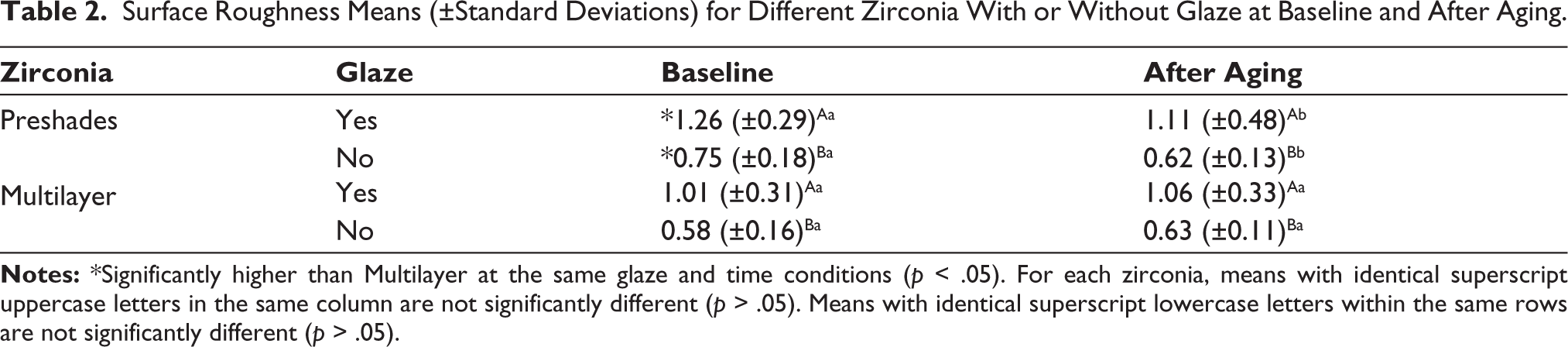
For both specimens with or without glaze, the Preshades zirconia showed significantly higher surface roughness than Multilayer only at baseline (p < .05). For both zirconia types, the surface roughness was found significantly higher for glazed specimens at baseline and after aging (p < .05). The surface roughness of Preshades zirconia significantly decreased after aging for both specimens with or without glaze (p < .05) (Table 2).
Surface Roughness Means (±Standard Deviations) for Different Zirconia With or Without Glaze at Baseline and After Aging.
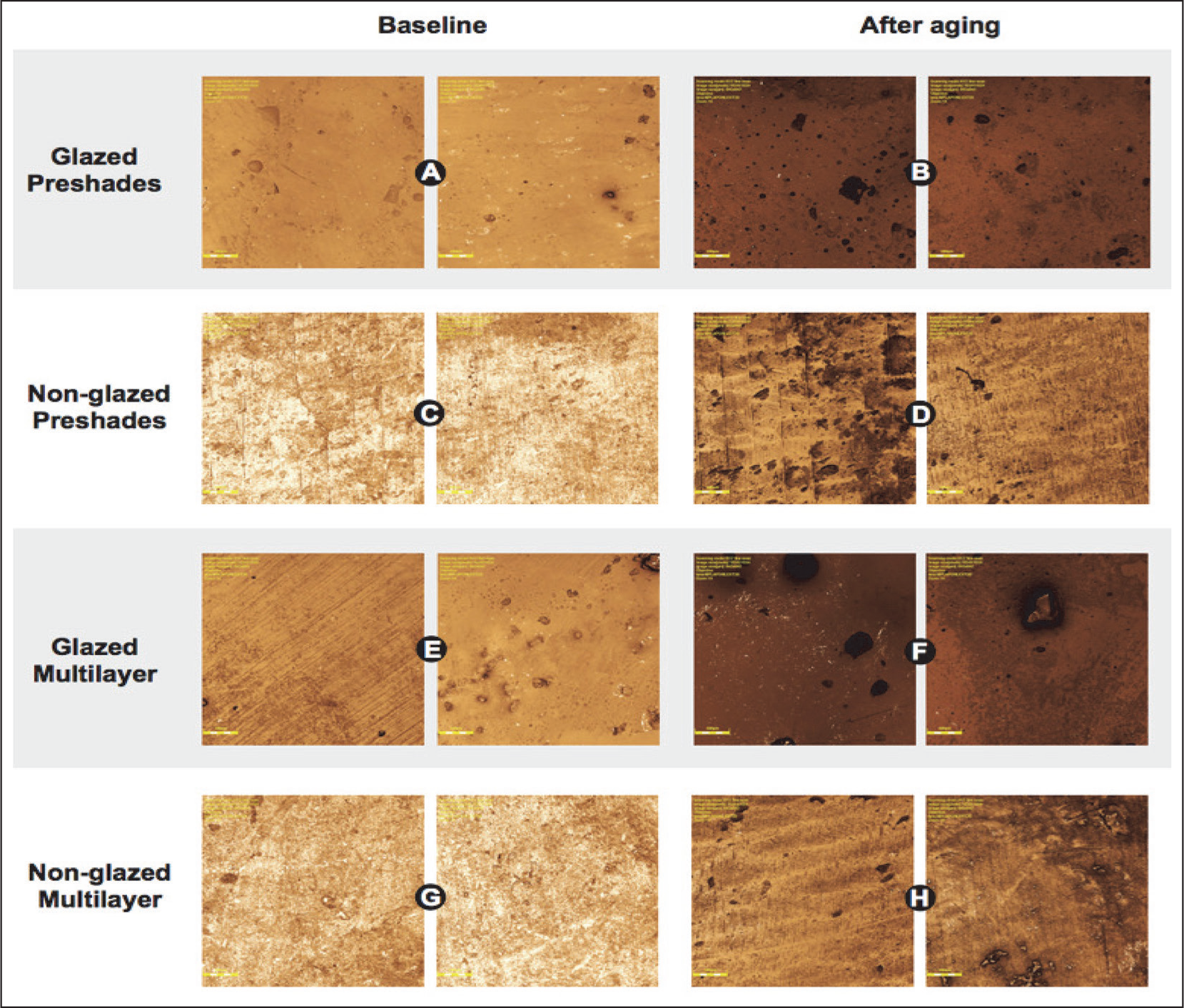
Regardless of the zirconia type, the morphology of non-glazed specimens (Figure 1C, 1D, 1G, and 1H) showed a smoother surface than glazed specimens, which presented irregular topography (Figure 1A, 1B, 1E, and 1F). At baseline, the Preshades specimens (Figure 1A and 1C) showed a surface with more grooves and irregularities than Multilayer (Figure 1E and 1G). After aging, the surface of Preshades specimens became less rough (Figure 1B and 1D).
Confocal Microscopy Images of Representative Specimens of Different Zirconia With or Without Glaze at Baseline and After Aging. Original Magnification: 100 ×.
A significant decrease of L* value after aging was only observed for non-glazed Multilayer specimens (p < .05). L* values of glazed specimens were significantly higher than non-glazed specimens (p < .05), except for Preshades zirconia at baseline (p > .05) (Table 3).
Medians (Minimum; Maximum) of Color Parameters of Different Zirconia With or Without Glaze at Baseline and After Aging.
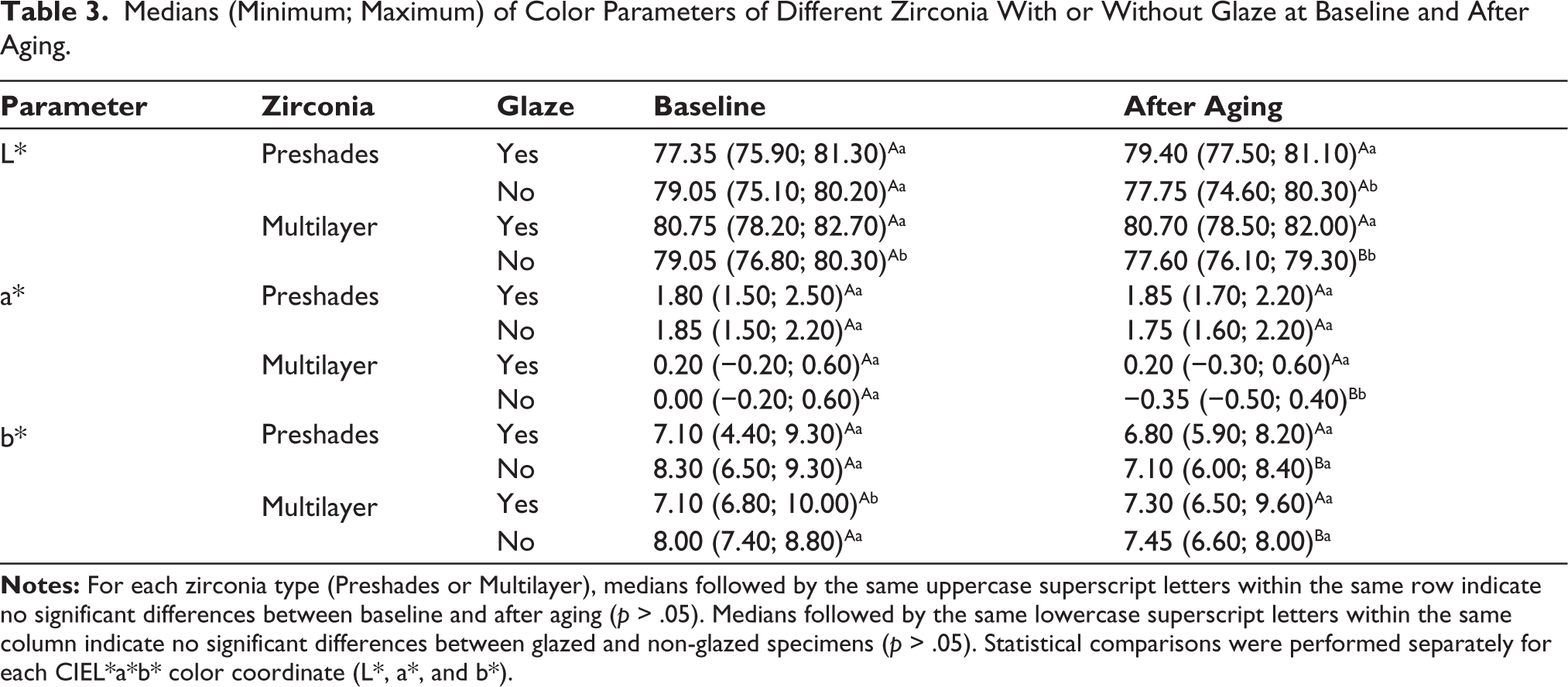
In comparison to the baseline, non-glazed Multilayer specimens showed significantly lower a* values after aging (p < .05). After aging, glazed Multilayer specimens showed significantly higher a* values than non-glazed specimens (p < .05) (Table 3).
For both types of zirconia, b* values of non-glazed specimens were significantly lower after aging (p < .05). At baseline, b* values of non-glazed Multilayer specimens were significantly higher than those of glazed specimens (p < .05) (Table 3).
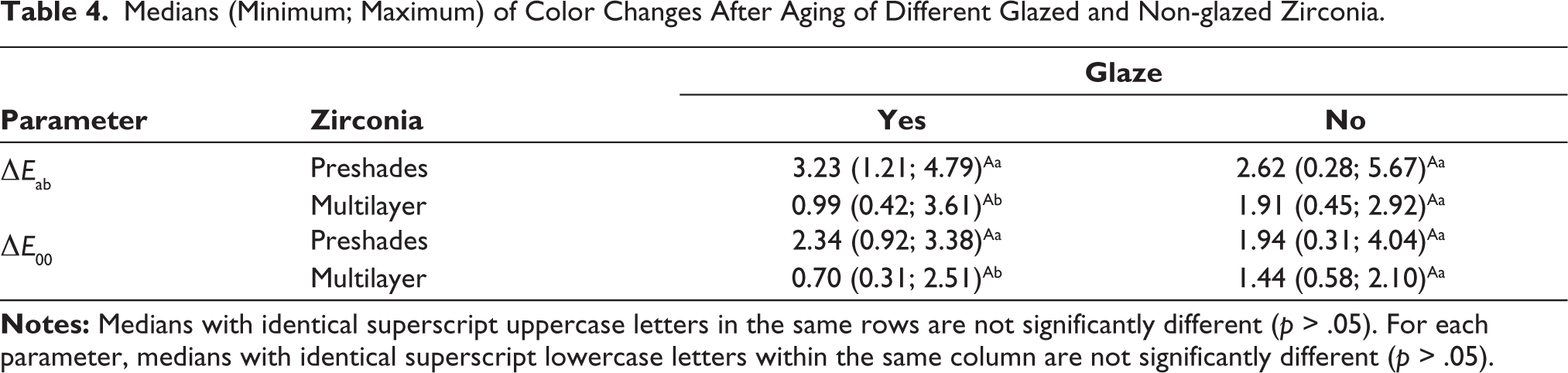
Both ΔEab and ΔE00 of glazed Preshades specimens were significantly higher than glazed Multilayer specimens (p < .05); however, there was no significant difference between non-glazed specimens (Table 4).
Medians (Minimum; Maximum) of Color Changes After Aging of Different Glazed and Non-glazed Zirconia.
Discussion
Since superficial staining of zirconia restorations aims to mimic the aesthetics of natural teeth, it is important to evaluate the maintenance of the glaze layer subjected to mechanical and thermal challenges in the oral environment. This study evaluated the surface roughness and color change of highly translucent zirconia (mono and polychromatic) after simulated brushing and thermocycling.22,24 Both surface roughness and color change were determined with the aid of a profilometer and a spectrophotometer, which allow a more accurate evaluation than visual techniques. 25
Regardless of aging, glazed specimens of both zirconia presented a significantly rougher surface than non-glazed specimens and, therefore, the first null hypothesis was rejected. Figure 1A, 1B, 1E, and 1F show the presence of topographic defects in the glazed specimens with an aspect of increased porosity. This finding is consistent with the inherent characteristics of the glaze layer, which typically exhibits a more irregular and less homogeneous microstructure than zirconia, even at baseline conditions.26,27 The glazing process involves the application and firing of a glassy coating that may result in surface undulations, micro-porosities, and incomplete flow or leveling, leading to higher roughness values compared to the dense and highly sintered zirconia substrate.26,27
A relevant clinical implication of a restoration with a rougher surface is an increased adhesion and retention of bacteria that form biofilm 28 ; in addition, surface roughness above 0.2 µm increases the risk of caries and periodontal inflammation. 29 In this study, glazed zirconia specimens were well above this threshold and could increase biofilm formation. A rough restoration can become more easily stained, have reduced fracture resistance, and damage antagonist teeth. 30 Furthermore, after simulating 5 years of aging, both Preshades and Multilayer showed Ra values higher than the threshold at which the roughness can be distinguished by the patient’s tongue. 31
In addition to the intrinsic roughness of the glaze layer, interfacial phenomena between zirconia and glaze may influence surface topography after aging. Ultra-translucent zirconia and dental glaze present different coefficients of thermal expansion (CTE), with zirconia generally exhibiting lower CTE values than conventional glazes. 32 This mismatch can generate tensile stresses in the glaze layer during cooling after firing and during thermocycling, favoring the formation of microcracks at the glaze–zirconia interface. 33 These microcracks may propagate toward the surface and contribute to increased roughness, as reported in the literature for glazed zirconia systems subjected to thermal and mechanical aging.32,33
In the present study, even after thermocycling with variations between 5°C and 55°C, Multilayer ultra-translucent zirconia specimens did not exhibit significant roughness changes after aging, which may be attributed to their optimized microstructure, higher cubic phase content, and more uniform CTE distribution across layers,34,35 reducing interfacial stress and microcrack propagation. Conversely, preshaded ultra-translucent zirconia specimens showed a reduction in surface roughness after aging, possibly due to the smoothing of initial surface irregularities introduced during the shading procedure, as well as the removal of loosely bound glaze particles or surface asperities during brushing and thermocycling.36,37
Since novel polychromatic zirconia with intrinsic translucency and shade gradients recently became available, the actual need for individual characterization of ceramic restorations with stains to resemble natural teeth should be considered. 38 It is worth mentioning that the evaluated specimens were not mechanically polished before measurement, which could effectively reduce the surface roughness of zirconia. 39
Regardless of glazing, the baseline surface roughness of Preshades was significantly higher than that of Multilayer, which may be related to their different compositions and saturations. Preshades and Multilayer CAD/CAM blocks are respectively composed of 6%–7% and 8.5%–9.5% yttrium oxide 40 ; in addition, Multilayer is a polychromatic material with smooth transitions from incisal to cervical third.
Baseline Ra values of 1.26 and 0.75 µm found for respectively glazed and non-glazed Preshades specimens corroborate the grooves observed in confocal microscopy (Figure 1A and 1C); however, Ra values after aging significantly decreased to 1.11 and 0.62 µm, respectively. A remarkable attenuation of superficial defects and a reduced number of grooves was also observed (Figure 1B and 1D); thus, brushing may have polished the zirconia surface as reported by Yuan et al. 23
The color parameters significantly changed after aging for some combinations of zirconia type and glaze condition; thus, the second null hypothesis also had to be rejected. For both zirconia, the L* values of glazed specimens were similar or slightly higher after brushing and thermocycling; thus, the reduction of lightness due to their higher surface roughness was prevented by the glaze layer. 41 The L* values of non-glazed Multilayer specimens were significantly lower after aging, which highlights the importance of the glaze layer on lightness maintenance. The lightness of tooth restorations is affected by both the refraction index and the surface topography of the restorative; thus, the specular reflection of zirconia varies in function of their composition and polishing conditions. 42
The reddish (higher a* values) appearance of Preshades may be related to its marked saturation level, while the polychromatic Multilayer shows smooth transitions in terms of shade, justifying the lower a* values.43,44 Even so, the application of glaze on Multilayer specimens led to a significant increase of a* values after aging. The effect of aging was observed in non-glazed specimens of both zirconia due to a significant reduction of b* values and a bluish appearance. The literature indicates that the abrasiveness of silica-based toothpaste can reduce yellowness and increase whiteness perception.45,46
The ΔEab formula proposed by O’Brien et al. 47 is valuable to objectively determine the color difference between two objects. In this line, the multicentric in vitro study conducted by Paravina et al. 48 respectively, determined as 1.2 and 2.7 the 50%:50% perceptibility and acceptability thresholds, respectively, for CIEL*a*b* ΔEab of dental ceramics. Moreover, these thresholds are ΔE00 = 0.8 and ΔE00 = 1.8 for the CIEDE2000 system. In this study, ΔEab and ΔE00 of glazed Preshades specimens were significantly higher than Multilayer and corroborate the results reported by Yuan et al. 23 This may be explained by the increase of Preshades saturation due to glazing. The results of this study suggest an important clinical implication: the color changes of restorations made from both Preshades and Multilayer, with or without glaze, are very likely to be perceived after long-term aging due to ΔEab and ΔE00 exceeding the abovementioned perceptibility thresholds (Table 4). Nevertheless, some in vivo studies suggest that the perceptibility threshold can reach up to 2.6, even for experienced dentists 49 ; thus, it can be expected that the perceptibility threshold for color change of non-trained individuals is even higher.
The aim of the present study was to quantitatively evaluate surface alterations in ultra-translucent zirconia specimens after aging, with or without glaze application. Surface roughness and color changes were selected as primary outcome measures, as they directly reflect clinically relevant alterations induced by mechanical aging protocols. Confocal laser scanning microscopy was employed to illustrate and complement the quantitative findings obtained from profilometry and spectrophotometric analyses, allowing a qualitative visualization of surface topography changes. Structural and chemical characterization techniques, such as X-ray diffraction (XRD) and scanning electron microscopy (SEM), would provide valuable additional insights into aging-induced phase transformations—particularly regarding the monoclinic-to-tetragonal ratio in high-yttria zirconia (4Y-PSZ and 5Y-PSZ)—as well as detailed wear patterns such as pitting or striations. Accordingly, future investigations incorporating XRD analyses and SEM-based surface characterization may further elucidate the mechanisms underlying the observed surface and optical changes.
It can be concluded that both highly translucent zirconia with a glaze layer became rougher and significantly changed their color; thus, the use of a polychromatic CAD/CAM zirconia could provide an acceptable aesthetic without a glaze layer that can jeopardize the surface in terms of roughness and color stability. Nevertheless, further studies are needed to address the effect of other glazing techniques as well as mechanical polishing of the zirconia surface.
Footnotes
Authors’ Contribution
All authors contributed to the study conception and design. Material preparation, data collection and analysis were performed by Jade Cavalcante Barros Macêdo. The first draft of the manuscript was written by Jade Cavalcante Barros Macêdo and all authors (Leonardo Santos Barros, Kamila Rosamilia Kantovitz, Daiane Cristina Peruzzo, Regina Guenka Palma-Dibb and Fabiana Mantovani Gomes França) contributed to previous versions of the manuscript. This study was supervised by Fabiana Mantovani Gomes França. All authors read and approved the final manuscript.
Data Availability Statement
Data will be made available upon request.
Declaration of Conflicting Interests
The authors declared no potential conflicts of interest with respect to the research, authorship, and/or publication of this article.
Ethical Approval Institutional Statement
This study was dismissed by the local ethics committee since it did not involve any participants or human material.
Funding
The authors received no financial support for the research, authorship, and/or publication of this article.
Informed Consent
Not applicable.