







Abstract
Abstract
This study aims to examine some ‘circumstances’ that may influence trust formation and, in general, pro-social behaviours in game situations characterized by complex strategies, that is, not dichotomous choices. We consider the potential role played by one-way communication (cheap talk), social history, and ‘climate effects’ induced by meditation in a single experiment based on the investment game. Our main findings are that meditation enhances trust formation, while social history and cheap talk have limited or no effect on it—at least on average.
Introduction
The aim of our research is to understand how pro-social behaviours and trust formation are influenced by different factors. There is a large strand of literature focusing on this topic. However, many aspects are still unexplored. 1
See among other the surveys provided by Cooper and Kagel (2009), Johnson and Mislin (2011) and Balliet and Van Lange (2013).
The main novelty of our contribution is that we consider the effects of yoga meditation. A comparative perspective is used: we test the pro-social impact of short-term meditation against different scenarios. The advantage of our approach is that we consider the impact of different factors within the same experiment. The situations compared to yoga meditation are one-way communication (cheap talk) and social history, which are usually found to support pro-social behaviours. As reference benchmark, we also consider a counterfactual where meditation, cheap talk and social history are not present.
Our experimental design is based on the investment game introduced by Berg, Dickhaut and McCabe (1995). Therefore, we focus on interactions characterized by complex strategies, where coordination and cooperative behaviours are potentially more difficult to be implemented compared to the case of dichotomous choices, which have been extensively explored in the literature.
Empirical evidence, as said, supports the potential positive impact of communication and social history on pro-social behaviours—at least under some circumstances. 2
The effects of communication are studied, among others, by Charness and Dufwenberg (2006, 2010), Bracht and Feltovich (2009), Ben-Ner, Putterman and Ren (2011) and Ben-Ner and Putterman (2009). The role of social context and history is emphasized by Coleman (1990), Berg et al. (1995) and Cox (2009). The rationales for communication and social history effectiveness in enhancing cooperation are discussed in the next section.
Short-term exposition to mind–body practices can reduce cognitive rigidity, defined as a resistance to change in beliefs, attitudes, habits or the tendency to develop and persevere in the use of mental or behavioural sets. For instance, Tang et al. (2007, 2009), Farb et al. (2007) and Ding, Tang, Tang and Posner (2014) find that short-term meditation induces more attention and stress control.
A general result emerging from the health literature is that the emotive effects of meditation are immediate and transitory, while effects on health occur only after long practice and last long. 3
Effects of meditation, explicitly including yoga, are surveyed by Cahn and Polich (2006) and Thomas and Cohen (2014).
It is plausible to suppose that the above emotive changes induced by meditation may also affect the way people interact. However, there are no studies about the effect of yoga on social behaviour. One exception is Kirk, Downar and Montague (2011). They report that experienced meditators can have a great control of anger and that this, in turn, affects their behaviour in ultimatum games. Kirk et al. (2011) in fact provide evidence that Buddhist meditators are more likely to accept unfair offers compared to a control group; when assessing unfairness, they activate a different network of brain areas compared to other subjects enabling them to uncouple negative emotional reactions from their behaviour. It is worth noting that the behaviour of Buddhist meditators leads to Pareto improvement.
Differently from Kirk et al. (2011), we focus on short-term meditation; we thus look at the temporary effect of meditation on emotions of people instead of something more persistent as changes in the style of life. Moreover, by using a standard investment game (Berg et al., 1995), we investigate the effects of different contexts on trust formation instead of anger.
We expect that meditation activities support pro-social behaviour. Our rationale is related to both individual and group motivations. (a) Meditation reduces cognitive rigidities and emotional stress, increasing the probability of converging to a Pareto superior equilibrium. (b) Meditation practice creates a sort of group effect and sense of community within participants induced by its rituals. Our assumption is supported by Jayaram et al. (2013), who document that meditation seems to increase the level of oxytocin in the blood. It is worth noting that oxytocin is often associated with pro-social behaviours (see, e.g., Kosfeld, Heinrichs, Zak, Fischbacher, and Fehr, 2005).
Our main findings are that meditation enhances trust formation, while social history and cheap talk have limited or no effect on it. Reciprocity is not directly affected by any of them. However, since reciprocity is conditional to the amount received by the trustee, the more generous investors’ behaviour observed under meditation also implies a higher degree of reciprocity. Coherently, we also find that investors expect to gain more in the meditation treatment compared to the others.
The remainder of the article is structured as follows. Section two describes experimental design and procedures. Section three illustrates and discusses the main results. Section four concludes.
Context Factors and Pro-social Behaviour
We build a design to test the effect of communication, social history and meditation in enhancing pro-social behaviour. We expect that all of them lead to more cooperation compared to our benchmark (a simple investment game). Specifically, we first compare the outcomes of an investment game where subjects were exposed to pre-play communication (or social history or meditation) to those stemming from a control where subjects were not involved in any of the above activities. 4
Indeed to eliminate possible biases related to the pre-play activities, control group participants were also requested to complete some simple tasks.
The effects of communication on pro-social attitudes are documented in the literature. The basic idea is that promises are effective.
The rationale for promise keeping is based on two theories. Promises represent a moral obligation (Ellingsen & Johannesson, 2004); breaking a promise induces a psychologically costly since it, for example, may lead to a reduced self-esteem. Alternatively, in a psychological game perspective, promises raise the expectations and, since individuals are guilt averse, people tend to keep them as an equilibrium result (Charness & Dufwenberg, 2006).
However, many factors can weaken the correlation between communication and cooperation, for example, misunderstanding and bare or false communication (Charness & Dufwenberg, 2010).
The role of social context and history is explained, among others, by Coleman (1990), Berg et al. (1995) and Cox (2009). Pro-social effects associated to social history are found on social norms. According to this view, interactions among individuals are mediated by informal and formal rules that depend on the social context. As long as behaviours are observed, they are imitated and became social norm; the social history attempts to model and test this idea.
Finally, we expect that meditation lead to pro-social behaviours. As said in the previous section, the rationale of our expectation is twofold.
We guess that the reduction of cognitive rigidities and the increase in attention favour cooperation and Pareto superior solution by reducing the diffidence and the sense of competition between individuals (individual emotional effect).
5
This effect is similar to that found by Kirk et al. (2011) for long-term meditators.
Meditation practices may also create a sort of empathy within participants induced by its rituals, that is, a sort of group effect supporting cooperative behaviours—at least among people involved in meditation (group membership effect).
As the scope of this article is limited to test the effect of meditation, we leave the task of disentangling between the two potential explanations to future studies.
The Experiment
Experimental Design
We build the following experimental design formed by a pre-play activity and an individual task. Treatments only differ in the former, while the latter is common in all of them. We consider four kinds of pre-play activities; thus, we have four treatments. The individual task always consists of an investment game as Berg et al. (1995). Participants were randomly assigned to the different treatments.
Pre-play Activities
We consider four pre-play activities (index by C, M, Y and S), which correspond to the four treatments. All pre-play activities have an equal duration and last 30 minutes. In C, participants write free comments about some pictures (C is our counterfactual). In M, they can send a free-form message to their partner. 6
Specifically, before playing, the trustee can send a free, non-binding message to the investor.
Experimental Task
The baseline experimental task is a two-stage investment game (Berg et al., 1995). All participants are endowed with 10 tokens. They interact in two stages during which they can increase or decrease their initial endowments depending on their choices. In the first stage, one of them (called A, investor) can transfer part, all, or none of her/his endowment (i.e., from 0 to 10 tokens) to subject (called B, trustee). Before being delivered to B, any amount transferred is multiplied by 3. In the second stage, B could return part, all or none of the tripled amount of tokens received from A. The payoff of each participant is the initial endowment plus the tokens received minus those sent.
Procedures
The experiment was conducted at the University of Teramo in 2012. Participants were undergraduate students recruited by e-mail using lists of voluntary potential candidates. 7
Lists were compiled in advance by advertisements placed on the university notice boards and by using the universities’ mailing lists.
This occurs for C, Y, S; in M, instead participants were assigned to their roles at the beginning of the experiment so that, in the pre-play, subjects B can send a message to their partners (see note 5).
Each subject does not know the subject s/he is paired with—neither during nor after the experiment.
At the beginning of each session, subjects were required to provide identification cards. A database with name verifies that there was no repeat participation. All the decisions made during the experiment were anonymous. Anonymity was guaranteed by using identification codes; names remained unknown to all—including experimenter and controllers. During the experiment, two controllers checked that the instructions were correctly followed by participants. However, the controllers could not answer any questions from the participants as they had the same information. Therefore, if participants had doubts, they could only read the instructions again. Participants were not allowed to talk to each other during the entire experiment.
At the end of the experiment, we used a between-subjects random-lottery incentive system for payments. 10
In dynamic-multi-task environments, between-subjects random lottery incentive systems might induce some biases in risk aversion (because of a carry-over effect); however, in a single task context, as our case, it performs well. For a detailed discussion, see Starmer and Sudgen (1991), Beattie and Loomes (1997), Cubitt, Starmer and Sugden (1998) and Baltussen, Post, van den Assem and Wakker (2012).
Experimental evidence on eliciting subjects’ beliefs indicates that effort and accuracy in the presence of a flat fee are comparable with the results obtained by implementing the quadratic scoring rule (Sonnemans & Offerman, 2001). See Bardsley et al. (2010) for a more detailed discussion of the point.
Experiment Hypotheses
We analyze whether different contexts affect trust and reciprocity. Specifically, we adopt the following methodology.
We evaluate trust, by looking at investors’ average behaviour. Specifically, we compare, one-by-one, the average amount sent in treatments M, Y and S to the counterfactual C. A positive difference implies that the pre-play activates associated to the treatment considered enhance trust. Regarding reciprocity, as noted by Cox (2004) and Cox, Friedman and Sadiraj (2008), tests cannot be based on mean comparisons, but they should be done by using a regression approach that is to measure reciprocity conditional on both the treatments and the amounts sent by investors. This is needed because initial conditions for the recipients in the experiment and in the counterfactual are not necessarily the same, as they depend on the amounts sent by investors, which may generate different initial distributions in the two samples—if they are small.
12
An alternative approach to eliminate this potential problem and obtain more accurate results is an experimental design that allows controlling for inequality (see Di Bartolomeo & Papa, 2016).
Formally, our hypotheses can be described as follows.
Concerning trust, for each treatment x ∈ X= {M, S, Y}, we assessed whether the average amount sent by A subjects in x is different from that observed in C:
H1x: Trust in x ∈ X ax – aC = 0
where the subscript indicates the treatment. The null hypothesis is that the amounts sent are the same in the treatment x compared to the control scenario.
Regarding reciprocity, for each treatment x, following Cox (2004), we estimate a censored (Tobit) relationship between amounts sent by A (a) and amounts returned by B (b). Formally,
H2x : Reciprocity x∈X b(i) = α + β D(i) a(i) +γ a(i) + ɛ(i)
where D is a dummy that takes value one if observation i refers to the treatment x, zero if it refers to C (control group). The bounds for the estimations are those imposed by the experiment design: 0 and 3ai.
In the above expression, the coefficient β measures the effect of the treatment x compared to the control group. The null hypothesis is that β is equal to zero: The treatment does not support reciprocity more than the control does. The coefficient γ measures the positive or negative correlation between amount sent by investors and trustees.
Finally, in order to test the robustness of our results about trust, following Coricelli et al. (2006) and Di Bartolomeo and Papa (2016), we also consider the average investor’s expected gains (i.e., the difference between average expected paybacks and average amounts sent). Formally, we look at
H3x: Expected gains in x ∈ X E(bx) –ax – [E(bC) –aC] = 0
where E is the expectation of A about the feasible payback from B. The null hypothesis is that the expected gains in the treatment are the same of those stemming from the counterfactual (i.e., the control group).
We compare the expected net gains to trust intentions. Therefore, we expect that if H1 is rejected, H3 will also be rejected.
Results
H1 Parametric and Nonparametric Tests for First Movers
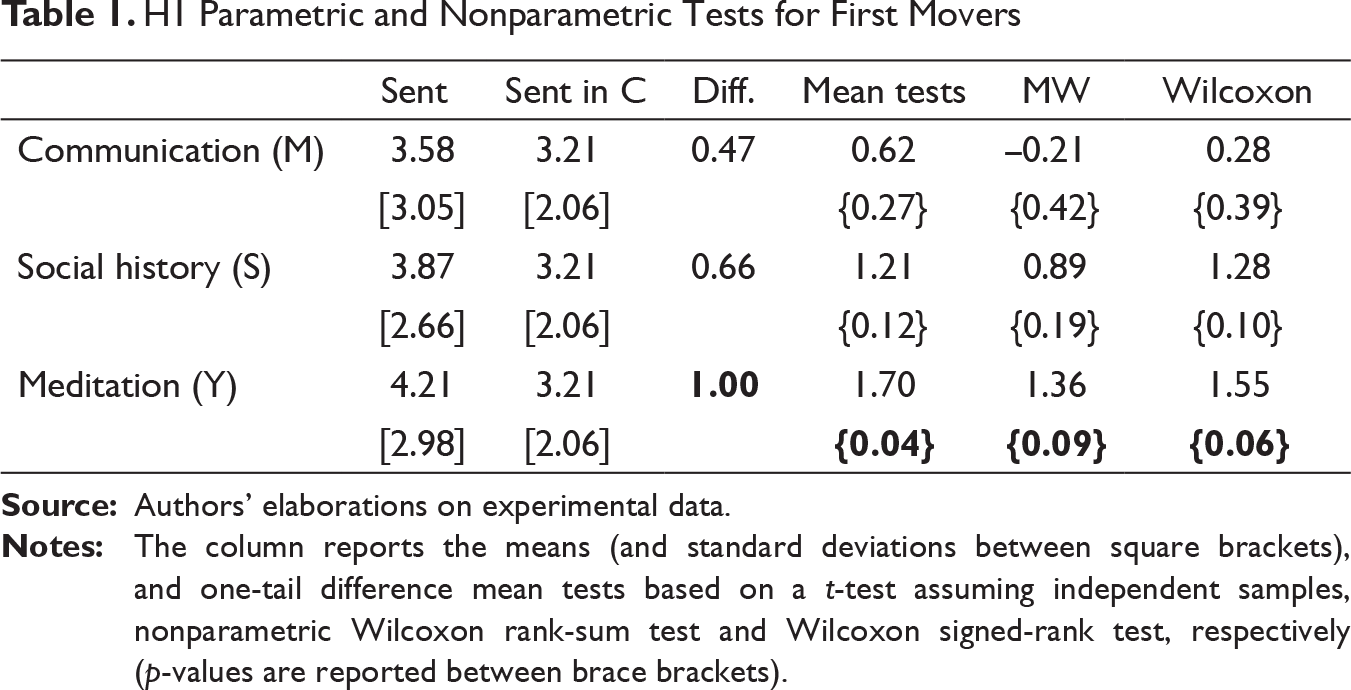
In first row, we compare the outcomes of communication (M) to the counterfactual (C). The average amounts sent by subjects A are 3.58 and 3.21 tokens in M and C, respectively. The difference (0.47) is not significantly different from zero, as indicated by t-test, nonparametric Wilcoxon rank-sum test and Wilcoxon signed-rank test (columns 4–6).
The second row reports the results from social history (S). The case of S is similar to M, there is not a significant difference with the counterfactual: 3.87 against 3.21 tokens (the difference 0.66 is not significantly different from zero—as indicated by all tests).
By contrast, meditation (Y) has an impact on participants’ behaviours compared to the control group. In this scenario, reported in the third row, participants send 4.21 tokens on average, 1.00 token more than in C. This difference is significantly greater than zero, as indicated by all tests.
Summarizing, behaviours observed in M and S are not significantly different from those observed in C as average amounts sent in M, S are not significantly different from that sent in C. By contrast, meditation has a specific effect. The difference between the average amounts sent in Y and C is the greater and significantly different from zero.
Regarding communication and social history, we thus cannot reject the null hypothesis in H1. They have no effects on a specific effect on trust compared to controls; pre-play communication and the observation of previous choices made by other subjects do not seem to play any role on amounts sent by investors on average.
By contrast, in the meditation scenario, we have to reject the null hypothesis in H1 as we observe a strong effect of short-term yoga meditation on trust formation. We interpret this result as driven by an individual emotional and/or a group membership effect.
Our intuition about the absence of effects associated to social history is that it is determined by the complex nature of the investment game. Here, the identification of social norms that coordinate individuals’ behaviours is more difficult than in case where choices are dichotomous (e.g., ‘roll’ vs. ‘not roll’ in Charness & Dufwenberg, 2006). The agents should coordinate to a fair level of trust that varies between 0 and 10.
Communication is also less effective for the same reason illustrated above. Given the large set of strategies, free-form messages are likely to generate misunderstandings. By investigating the messages in details, that is, cataloguing according to their contents (see, e.g., Charness & Dufwenberg, 2006, 2010), we find that promises enhance cooperation, but ambiguous messages reduce it compared to the counterfactuals. 13
However, the sample is too small for a formal investigation based on comparison of averages.
H2—Tobit Regressions for Second-mover Data from the Treatments
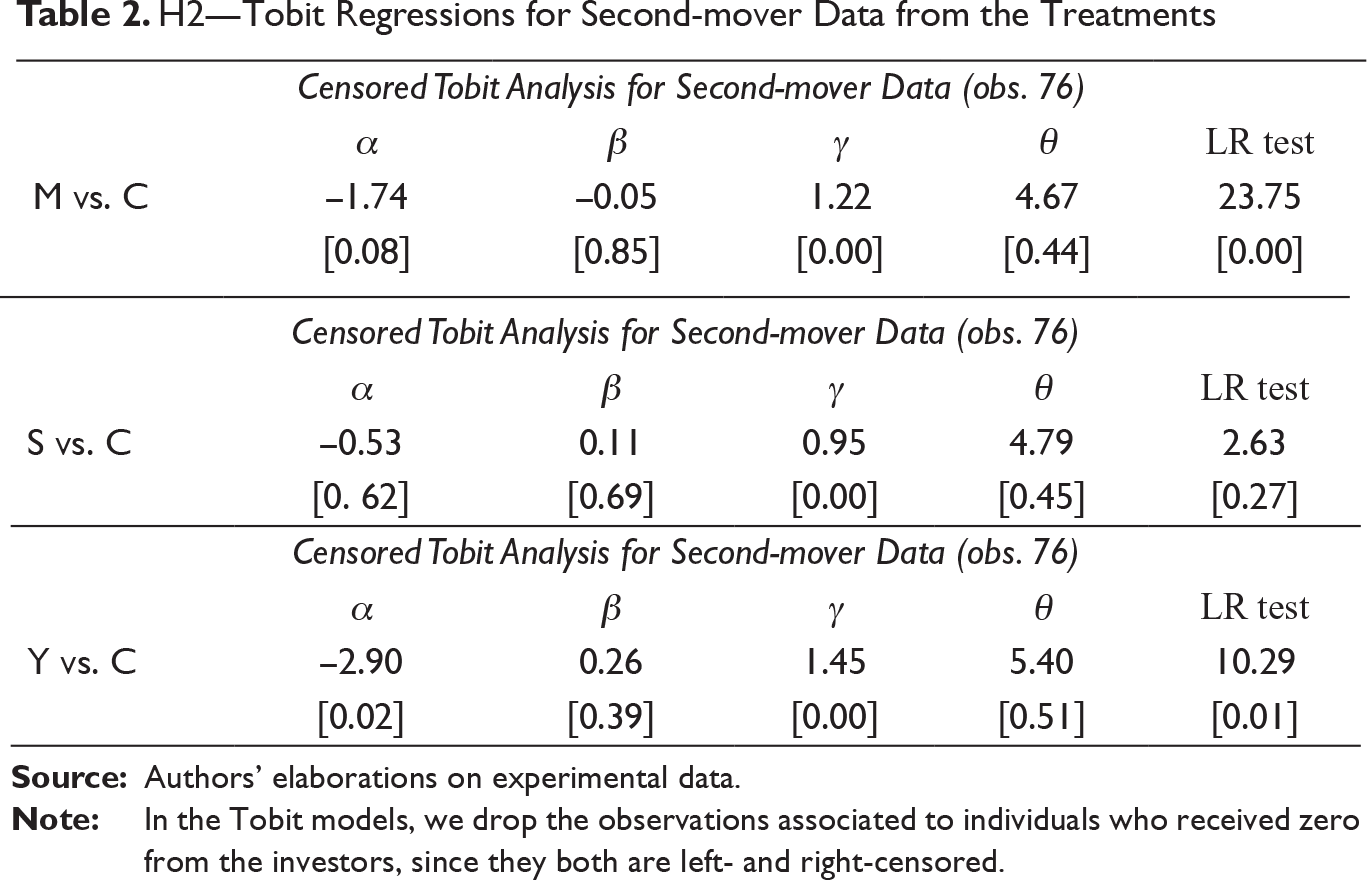
In all the treatments considered, the null hypothesis in H2 cannot be rejected. We do not observe further reciprocity in any treatments considered compared to the control group. Parameter β is in fact not significantly different from zero in all the Tobit regressions. 14
The outcomes of the Tobit regressions must be considered with caution unless large sample or strategy method is used to collect data, which permits to control for inequality. Problems may arise because of the potential different initial conditions faced by trustees in the experimental and control group. These are, in fact, endogenously determined by the experiment, that is, by investors’ choices (see, for details, Di Bartolomeo & Papa, 2016).
In Table 3 reports expected net gains in all the treatments. These are high in Y, whereas they are very low in the other cases. Expected gains in S are close to zero, indeed negative. We interpret this result as an expectation mismatch, which derives from the difficulty of identifying social norms in complex designs. 15
Note that in C expected gains are positive. Thus, since there are not significant differences in average trust levels (a) in S and C (cf. Table 1), the negative observed gains in S should depend on a low expected payback (Ea(b)). Then we interpret the negative gains in S as an expectation mismatch. Differently from simple trust games, in our complex design, it could be difficult to identify the level of trust or reciprocity associated to a social norm. The information from the summary could polarize the expectations on some lower bounds. In S, some investors overestimate the fair division in favour of the trustee and, as a result, they expect to gain less compared to C. Thus, investors underestimate the reciprocity of their partners.
H3—Expected Net Gains (between treatments), Parametric and Nonparametric Tests
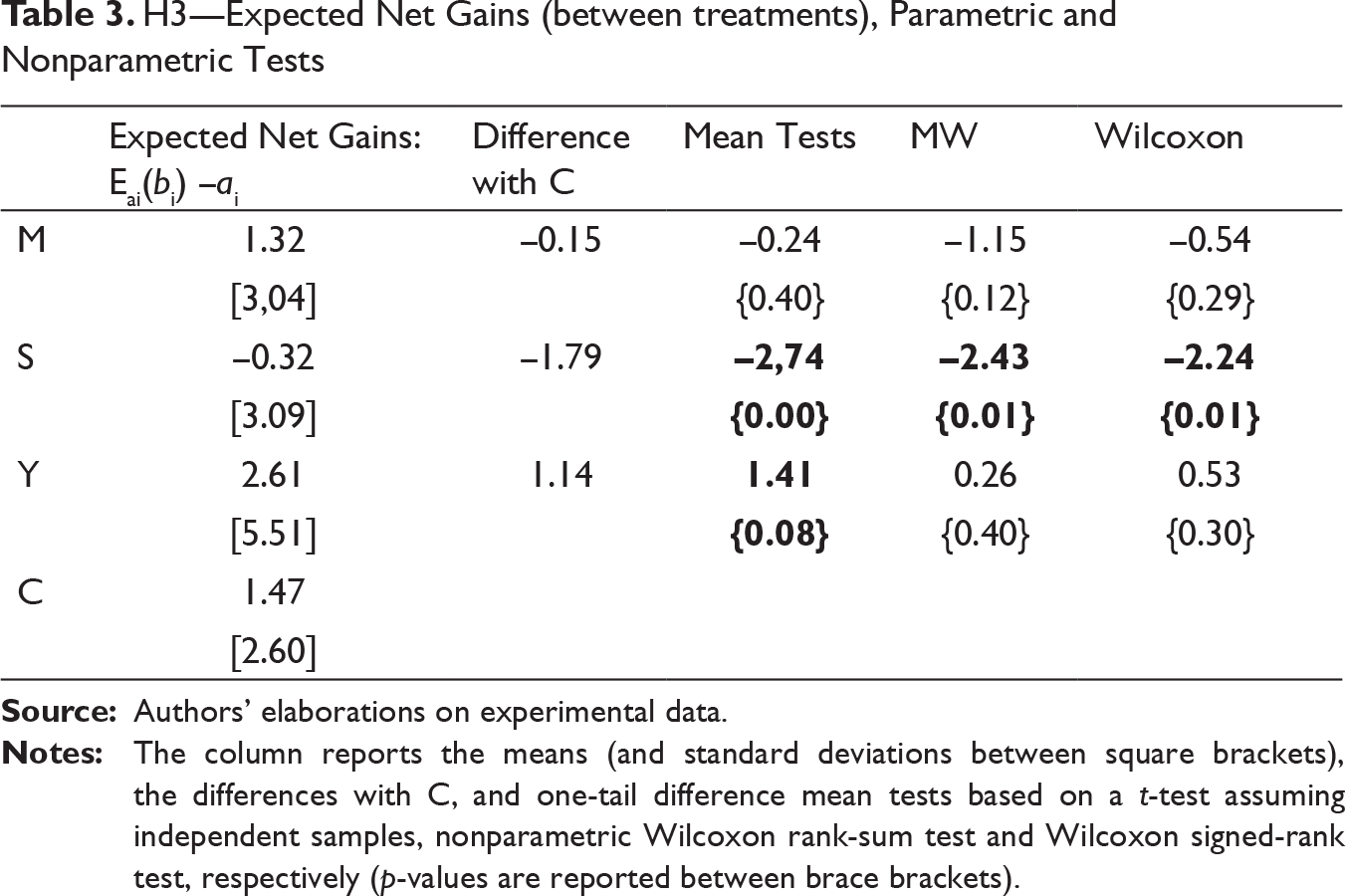
In the third column, the table compares the difference between treatments and C. The null hypothesis is that the expected gains in the treatment are the same as those stemming from the counterfactual (H3). Considering M, first row, we cannot reject the null hypothesis. There are not significant differences of expected net gains in M compared to C. This result is in line with the outcomes of Table 1. In S, second row, the difference is even negative.
By contrast, in Y, we reject the null hypothesis H3 (recall that we also rejected the null hypothesis in H1). Therefore, coherently, compared to controls, we find that investors expect to gain more in the meditation treatment (we reject H3), where we have also observed an effect on average trust (we reject H1).
Concluding Remarks
By using counterfactual experiments, we investigated whether trust and reciprocity are influenced by different factors. We considered social history, unilateral communication (cheap talk), and meditation. Specifically, comparing the outcomes from an investment game where the above-mentioned factors are allowed to those obtained from a canonical one (control group), we find that only meditation may enhance cooperation.
Our scenarios in fact lead to different participants’ trust behaviours when compared to the control group. The average amount sent by investors in the control treatment is the lowest compared to others scenarios. However, a significant difference is verified only when yoga meditation is considered.
Our intuition is that meditation by reducing cognitive rigidities, diffidence and competition may lead to a climate that favours cooperation. In a complementary way, induced by its rituals, meditation may also create a sort of group effect within participants. As mentioned, the two effects are not mutually exclusive, but complements. However, in our setup, they cannot be disentangled, we leave this task to future investigations.
Concerning the small effects associated to social history and communication, the intuition is as follows. In our design, choices are complex compared to simple dichotomous games; thus, communication is likely to generate misunderstandings that may offset the potential positive effects of messages on average. Similarly, in the case of social history, in a complex choice environment, the observation of other subjects’ previous choices may lead to coordination problems since individuals may face difficulties in identifying the ‘common’ level of trust or reciprocity associated to a social norm.
Acknowledgements
We thank the journal editor Prof Somdeb Lahiri, an anonymous referee, Fabio Bonomo, Saverio Bellomo, Valentina Meliciani and Luca Stanca for comments on previous versions. Usual caveats apply. A previous version of the present article has circulated with the title: ‘How to Improve Trust and Cooperation in Investment Games’.
Appendix: Meditation Protocol
Participants were exposed to one meditation session before playing a Berg et al.’s (1995) investment game. The meditation session lasted 30 minutes. All the participants were beginners, with little or no meditation experience. Meditation sessions were guided by an experienced meditator in Raja Yoga and based on a combination of exercises, including the Superbrain Yoga (brain synchronicity) as described by Kok Sui (2005, Ch. 2.), and basic meditation techniques as taught by Self-Realization Fellowship, founded by Paramahansa Yogananda in 1920 in Los Angeles.
Each session included the same sequence of exercises:
Brain synchronicity (6 minutes); Affirmation (3 minutes); Chanting (3 minutes); Concentration (15 minutes); Chanting (3 minutes).
Exercises are described in detail as follows.
Exercise of brain synchronicity
The exercise of brain synchronicity aims to put in synchronicity the left and right sides of the brain. After assuming the correct standing position, one has to stimulate the left and right ears, and regulate the breathing: While inhaling slowly, one should execute a squat (1/4), that is, an internal angle of leg–knee of about 120–130 degrees. While exhaling slowly, one should go back to the standing up position, with an internal angle of leg–knee of about 180 degrees. The extended version of the exercise uses a full squat.
Exercise of affirmation (Yogananda, 1958)
Affirmation is preparatory to the concentration exercise, and is supposed to act on sub-conscious thought processes. Affirmations are repeated several times for a period of 3 minutes, first loudly, then in a normal tone of voice, then in a whisper, and finally only mentally. The affirmation chosen for this exercise was the following: ‘I am feeling well. I feel at ease with my mind and the minds of one another.’
Exercise of chanting
Chanting helps to enter a meditative state of mind; it is therefore preparatory to the silent and calm exercise of concentration. For this exercise, we chose the ‘Om’ chant from the ‘Cosmic Chants’ (Yogananda, 1938, p. 26). This chant can be sung either with or without instrumental accompaniment. In our exercise, it was accompanied by large crystal Tibetan bells played by an expert musician, Fabio Bonomo.
Exercise of concentration
The concentration exercise brings the participant’s attention to her/his breath. The participant is sitting on a chair without armrests, and focuses on the process of breathing. S/he tries to eliminate any thought from his/her mind and concentrates on the breath coming in and out (one-breathing cycle). In order to facilitate concentration, two different words are used during each breathing cycle that should be repeated mentally. In our exercise, participants were instructed to mentally say ‘harmony’ when inhaling, and ‘mind’ when exhaling. The exercise lasted 15 minutes. The expert meditator guided the participants with a soft voice through the breathing, with incrementally longer pauses. One of the first requisites for meditation is the correct posture. The following meditation pose is recommended: Sit on a straight armless chair with the feet resting flat on the floor. Hold spine erect, abdomen in, chest out, shoulders back, chin parallel to the ground. The hands, with palms upturned, should rest on the legs at the juncture of the thighs and the abdominal region to prevent the body from bending forward. If the correct posture has been assumed, the body will be stable yet relaxed, so that it is easily possible to remain completely still, without moving a muscle. Now, close your eyes and gently lift your gaze upward, without straining, to the point between the eyebrows, the seat of concentration.