






Abstract
During the 16th Lok Sabha elections, the BJP achieved unprecedented successes in rural as well as urban constituencies. Its progress has resulted from its growing popularity among almost every social group, its expansion being significant beyond its core supporters cutting across various classes, castes and communities—except the Muslims. While it remained more popular in the urban constituencies, the BJP has therefore largely blurred the traditional urban–rural divide. But this distinction has not been totally neutralized, as is evident from regional and social variations which need to be explained. The impact of the rural–urban divide remained particularly strong in UP, Gujarat, Maharashtra and Karnataka where the village dwellers voted significantly less for the BJP than the urban citizens. These variations mostly stem from the new attraction for the BJP among OBCs and, to a lesser extent, Dalits residing in urban settings. Their rallying around the BJP probably reflects their joining of the ‘neo-middle class’, which identified more closely with Narendra Modi’s development agenda. Urbanization has also favoured the BJP as the crucible of communal polarization, a process which explains that the more urban they are, the more inclined to vote Congress the Muslims are, whatever their caste or class.
Introduction
India’s transition from an overwhelmingly rural society to a more urbanized setting is accelerating. Officially, according to the 2011 Census, urban dwellers represent 31 per cent of the population, but the real proportion may be higher because the criteria defining villages and towns are not relevant any more. One may also argue that there is today a continuum in the making with the creation of a ‘rurban’ space integrating villages and small (or large!) towns. This physical integration is reinforced by a psychological one due to the penetration of village India by modern means of communication, including the social media. Such a development has probably contributed to the convergence of the turnout rates of rural and urban constituencies during the 2014 Lok Sabha elections (Auerbach, in press).
The urbanization process was bound to help the Bharatiya Janata Party (BJP), which has traditionally been stronger in towns and cities. In 2014 again, the party performed well in the 40 most urbanized constituencies—it won in 27 of them, including a complete sweep in Delhi, Bangalore and Ahmadabad (Auerbach, in press). But, in fact, the BJP did almost equally well in rural constituencies, which tends to reconfirm the overall convergence process mentioned above. However, some regional and social variations have to be explained. Certain states, social groups and communities have been more sensitive to the political impact of urbanization. While the first section examines the relatively minor impact of locality and community on BJP’s vote, the second section will focus on these variations and will try to explain them by examining socio-economic and communal factors.
BJP across the Board
The Decline of the Urban–Rural Divide
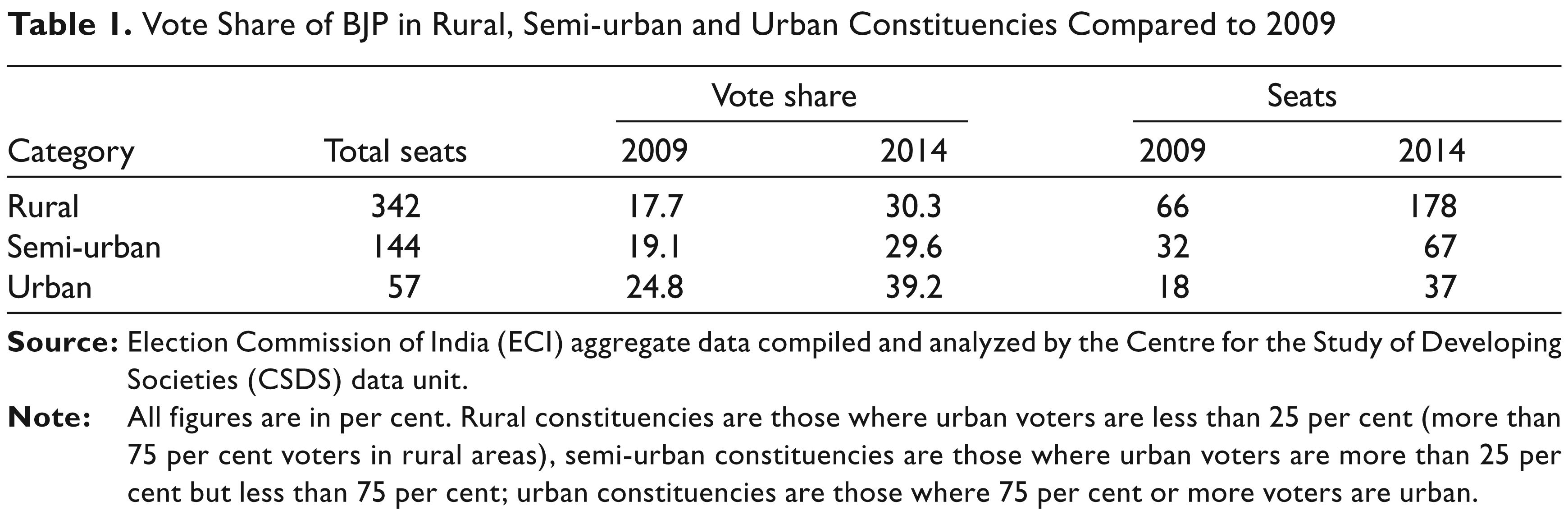
The BJP has been known as a party of urban India. Over the past several elections, the party polled disproportionately more votes among the urban voters compared to the rural voters. During the 2014 Lok Sabha election, the party’s vote share still remained higher in urban constituencies compared to the rural constituencies, but the party managed to increase its vote share in rural areas in a significant manner. Compared to the national average vote share of 31.1 per cent, the BJP polled 30.3 per cent votes in rural constituencies, 29.6 per cent in semi-urban constituencies and 39.2 per cent in urban constituencies (Table 1). The vote share of BJP remains marginally lower in rural constituencies compared to the average vote share and significantly lower compared to its vote share in urban constituencies. But expansion in rural support for the party results in more voters getting added to the party as large proportion of Indian voters live in villages. Clearly, the BJP has managed to reach out to the rural voters in much bigger numbers in this election compared to the past.
Vote Share of BJP in Rural, Semi-urban and Urban Constituencies Compared to 2009
Crossing the BJP’s Traditional Boundaries
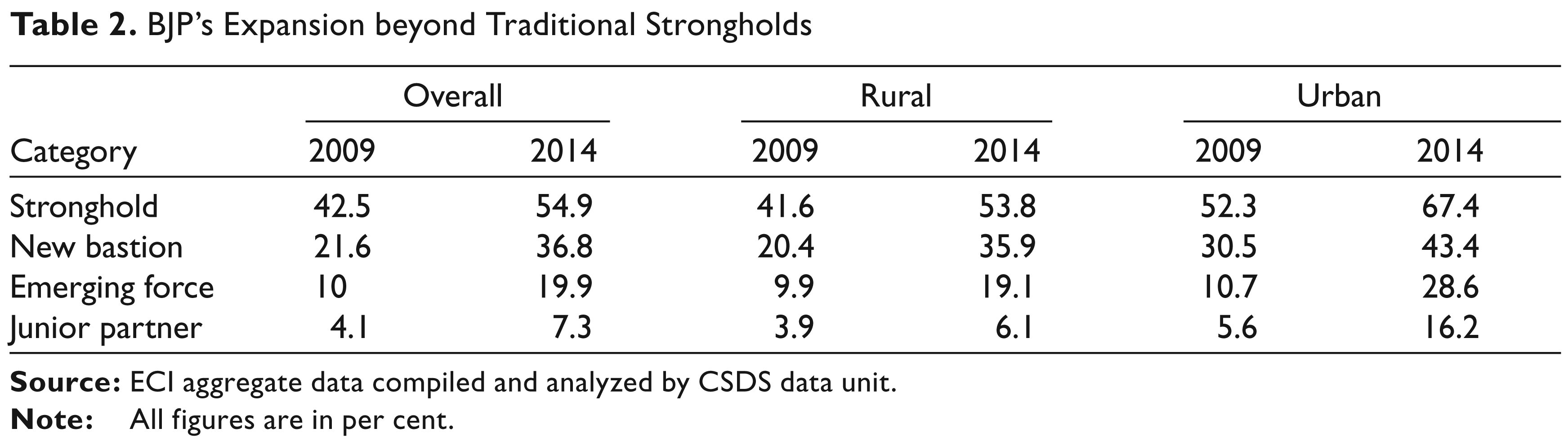
The BJP has not only expanded in the rural constituencies but has also managed to expand its support base in states and regions beyond its traditional strongholds. In particular, the BJP managed to expand its support in three states of eastern India, namely, West Bengal, Assam and Odisha, where it made inroads in rural as well as urban constituencies. Looking at how BJP managed to garner support or increased its vote share in different states, it may be useful to divide the states into four types, the BJP’s traditional strongholds, which includes states like Goa, Gujarat, Himachal Pradesh, Madhya Pradesh, Rajasthan, Chhattisgarh and Uttarakhand; the new bastions like UP, Delhi, Haryana, Bihar, Karnataka, Maharashtra and Jharkhand; states where the BJP is the emerging political force, like Assam, Jammu and Kashmir, Kerala, Odisha and West Bengal; and states where it is a junior alliance partner, like Andhra Pradesh, Telangana, Punjab and Tamil Nadu.
It is important to note that the BJP not only managed to expand its support base in its traditional strongholds where it is pitted in direct contest against the Congress (Rajasthan, MP etc.), it has also managed to make significant inroads in the states of UP and Bihar and also managed to expand its support in some other new states, among which the noticeable states are Odisha, West Bengal and Assam. Now, the expansion of BJP support is not due to its increased popularity among the urban voters; it is largely due to party’s increased support base among the rural voters. In its traditional strongholds the BJP’s rural vote increased by 12.2 per cent compared to 2009 while in the emerging new bastions its rural support increased by 15.5 per cent (Table 2). Even in states like Odisha, West Bengal and Assam the rise of BJP is credited to its significant popularity among the rural voters. In these states, the BJP’s rural votes increased by 9.2 per cent compared to the 2009 Lok Sabha elections, while its urban support increased by 17.9 per cent during the same period.
BJP’s Expansion beyond Traditional Strongholds
Expansion in the Support Base: Who Moved Towards the BJP?
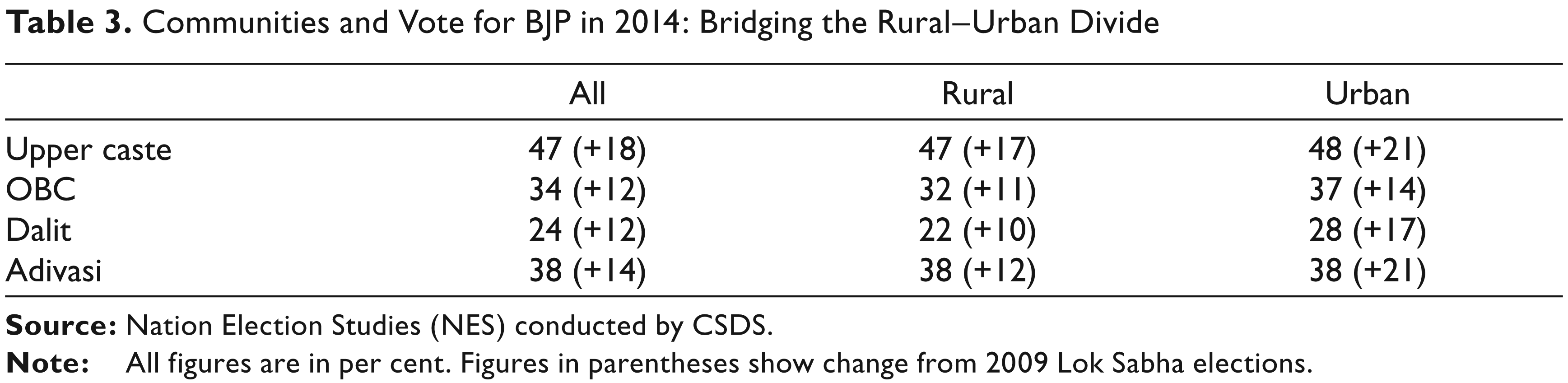
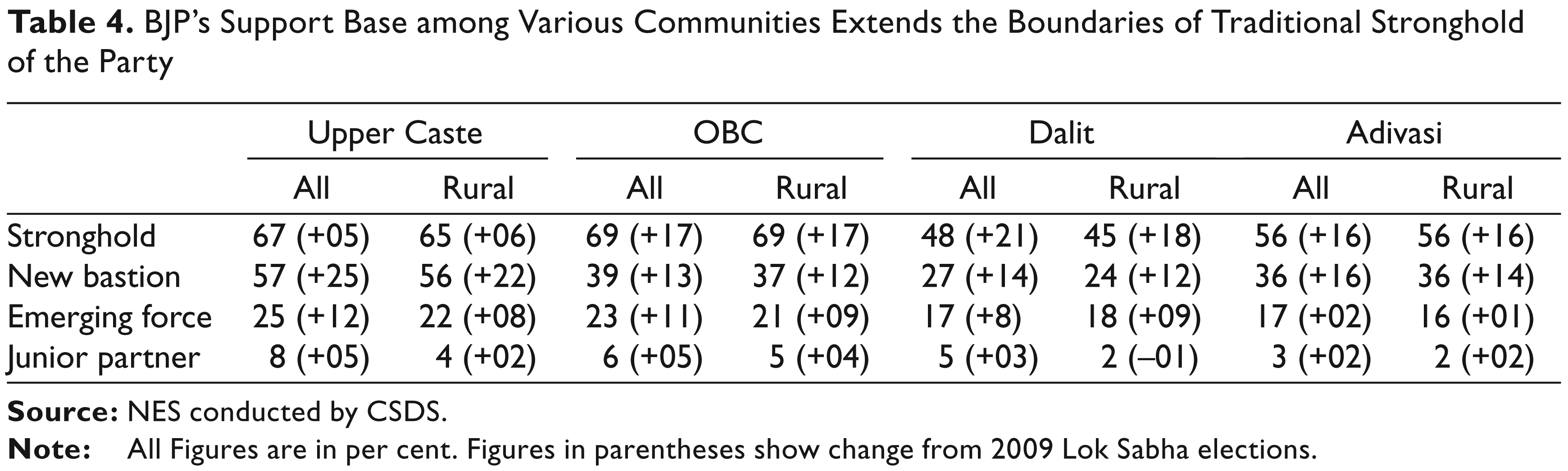
The BJP has been known largely as a party with support base concentrated among the urban, upper-caste and upper-class voters. Trends in this election indicate that the BJP had moved beyond this straitjacketed support base. It is true that the BJP continues to draw huge support among the upper-caste and upper-class voters besides its new support base among the other backward classes (OBC), but it is important to note that BJP’s expansion in support bases among the upper caste and upper class no more remains limited to the urban locations; it has moved much beyond this. The rural upper-caste and rural upper-class voters have also voted for BJP in large numbers in this election. Compared to the 2009 Lok Sabha elections among the urban upper caste BJP’s support increased by 21 per cent and among the upper-caste voters living in villages it also increased by 17 per cent (Table 3). Similarly, among the OBC voters living in cities and towns, BJP’s vote share increased by 14 per cent while among the OBC living in villages it increased by 11 per cent, only marginally lower compared to the urban OBC voters. The expansion of BJP’s support among the Dalits and the Adivasis is more due to its increased popularity among the urban Dalit and Adivasi compared to their rural counterparts (Table 4).
Communities and Vote for BJP in 2014: Bridging the Rural–Urban Divide
BJP’s Support Base among Various Communities Extends the Boundaries of Traditional Stronghold of the Party
What Contributed to BJP’s Expansion? Expansion of the Core Support as well as New Voters
This election marked the expansion of the BJP’s support base among both its potential core and noncore voters. 3 Between 2009 and 2014 there has been an expansion of this core constituency, which has increased from slightly more than one-tenth (13 per cent) in 2009 to more than one-fifth (21 per cent) in 2014. The expansion has taken place in both rural and urban areas. In rural areas, it has increased from 9 to 17 per cent while in urban areas it has increased from 23 to 29 per cent (Table 5). Findings of the survey also indicate that this expansion in BJP’s core constituency also cuts across various caste communities (Table 6). Amongst the upper-caste voters, as per survey estimates there were 24 per cent voters who would fall in the category of core voters in 2009, which has expanded to 31 per cent in 2014. Similarly, among the OBC the proportion of core support for BJP has expanded from 11 per cent in 2009 to 20 per cent in 2014. We witness similar expansion in the core supporters of the BJP among the two other communities, the Dalits and the Advasis, between 2009 and 2014.
Expansion of BJP’s Core Constituency in Rural and Urban Locations

Expansion of BJP’s Core Vote across Communities
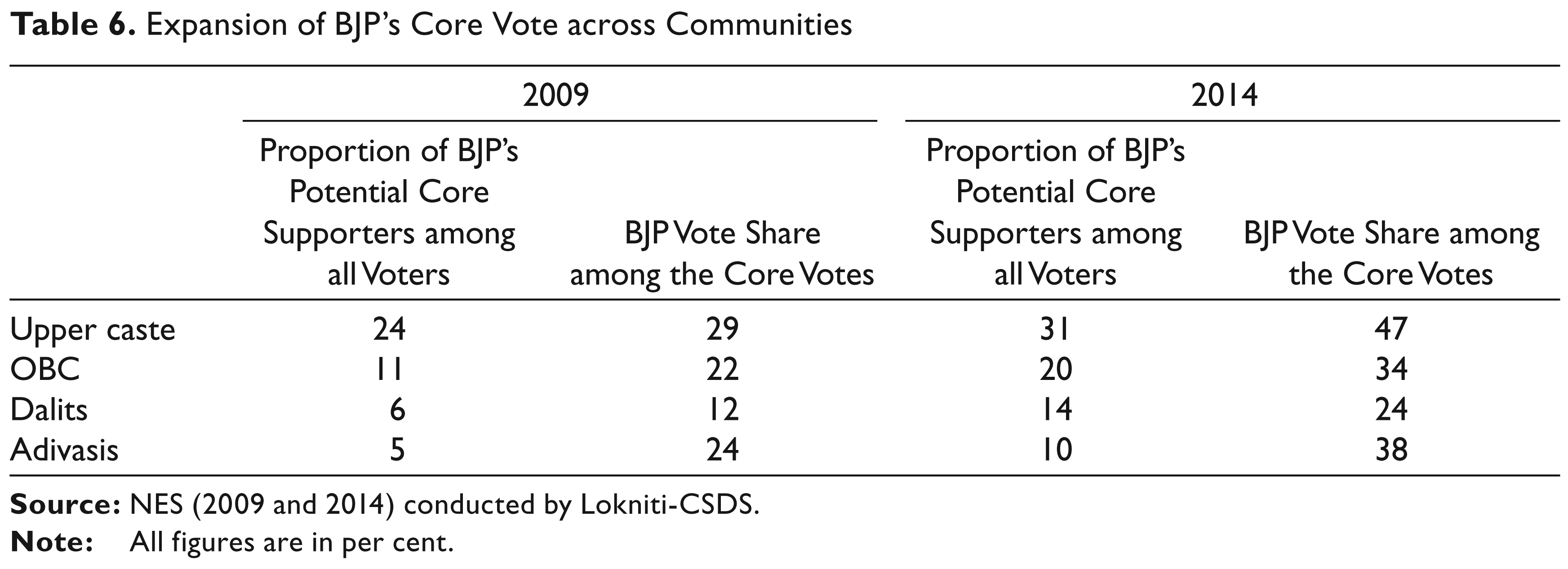
Figures in Table 6 also indicate that BJP’s vote among all these caste communities increased significantly between 2009 and 2014 elections, but it is important to note that this increase is much more than the increase in the proportion of core supporters of the BJP among these social groups. Within each group, the BJP received more votes compared to the proportion of core supporters among each group. Clearly, the BJP’s support base at least in 2014 draws not only from its core supporters, it has also attracted voters besides the core supports within each caste community. In the past, particularly between 1999 and 2004, we have witnessed significant decline in BJP’s vote share due to moving away of its core supporters from the BJP. Attracting voters beyond its core voters, the BJP has managed to create a cushion of support should its core desert it again.
Regional, Social and Religious Variations: Why the Rural–Urban Divide Still Matters Electorally
In this second section of the article, we will replace the categories of ‘rural’, ‘semi-urban’ and ‘urban’ by those of ‘village’, ‘towns and cities’ and ‘metros’ in order to study the largest cities separately.
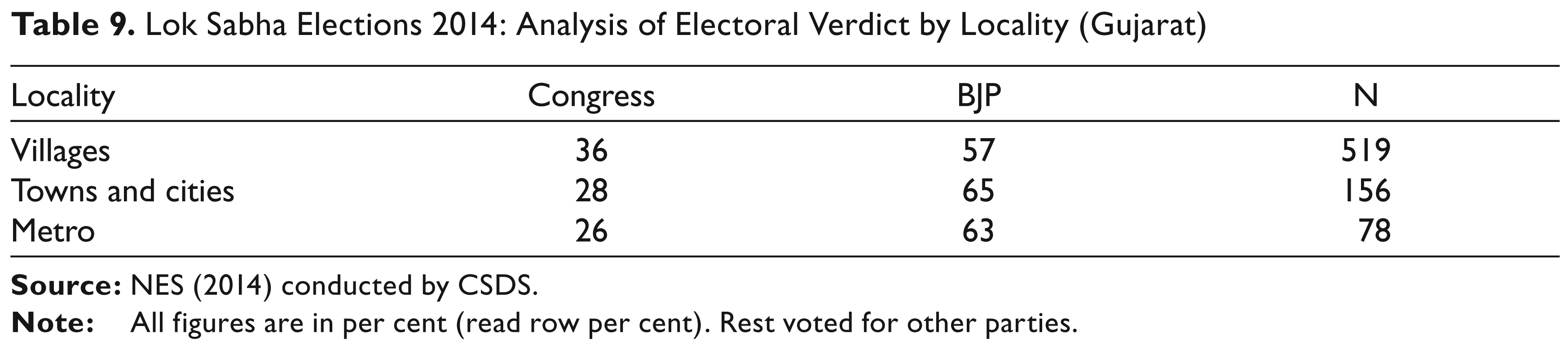
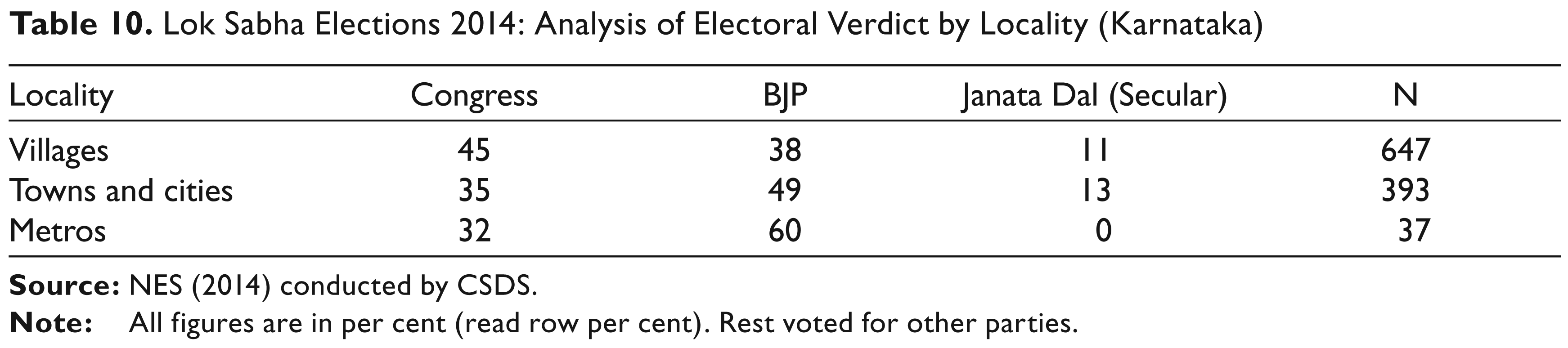
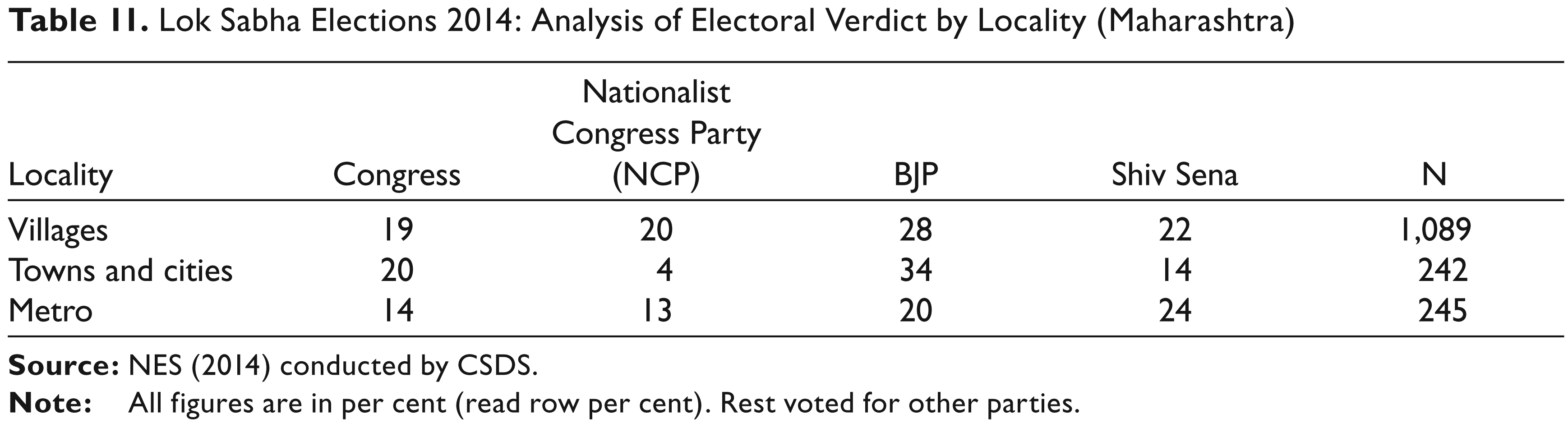
Table 7 comes as a confirmation of the findings of the first section; the BJP receives an almost equally strong support in villages, small and medium towns and metropolitan cities. However, this pan-Indian, macro-perspective obliterates major variations. In four important states, Uttar Pradesh (Table 8), Gujarat (Table 9), Karnataka (Table 10) and Maharashtra (Table 11), we witness a strong correlation between urbanization and the BJP vote. In Karnataka, this relation is linear, the party being more popular in metros than in small and medium towns and the least in villages. In UP, the BJP is also the most popular in metros but more in villages than in small and medium towns. In Gujarat and Maharashtra, the support for BJP is greater in small towns and cities than in villages, but it is also greater in small towns and cities than in metros.
Lok Sabha Elections 2014: Analysis of Electoral Verdict by Locality (All India)
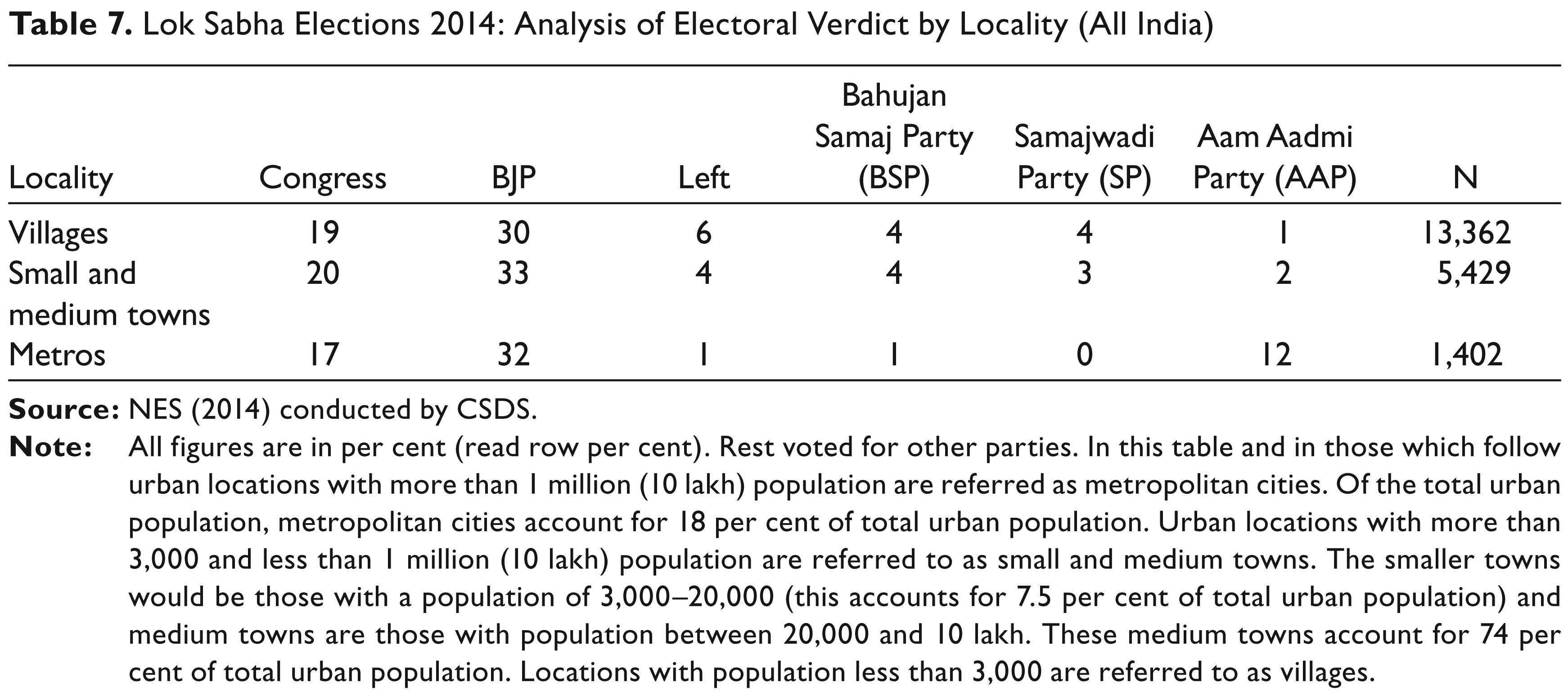
Lok Sabha Elections 2014: Analysis of Electoral Verdict by Locality (Uttar Pradesh)
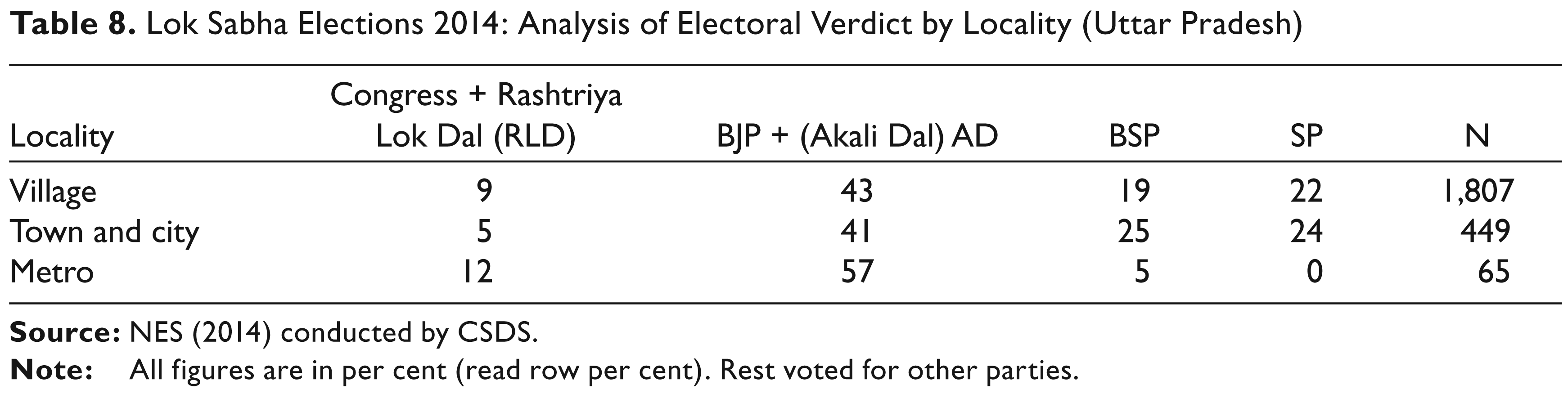
Lok Sabha Elections 2014: Analysis of Electoral Verdict by Locality (Gujarat)
Lok Sabha Elections 2014: Analysis of Electoral Verdict by Locality (Karnataka)
Lok Sabha Elections 2014: Analysis of Electoral Verdict by Locality (Maharashtra)
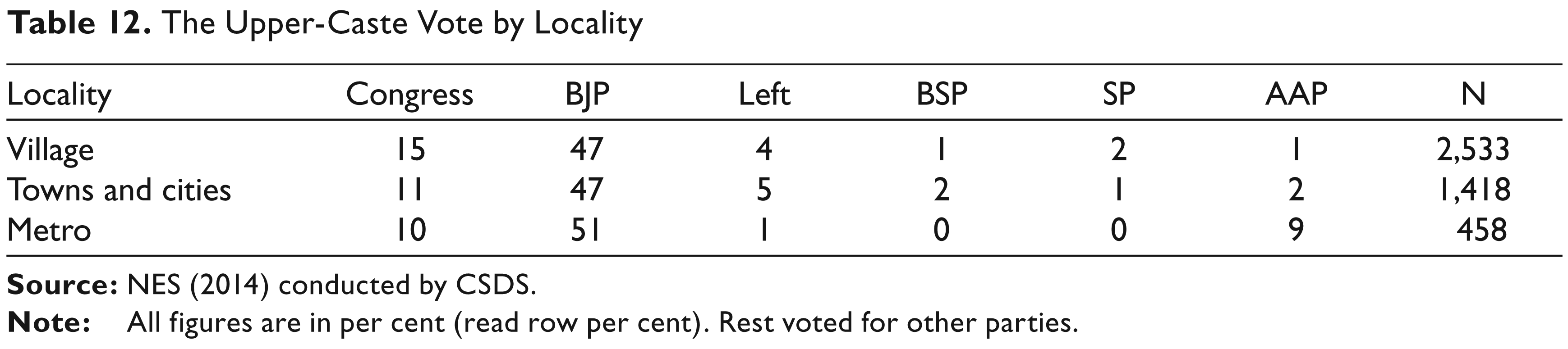
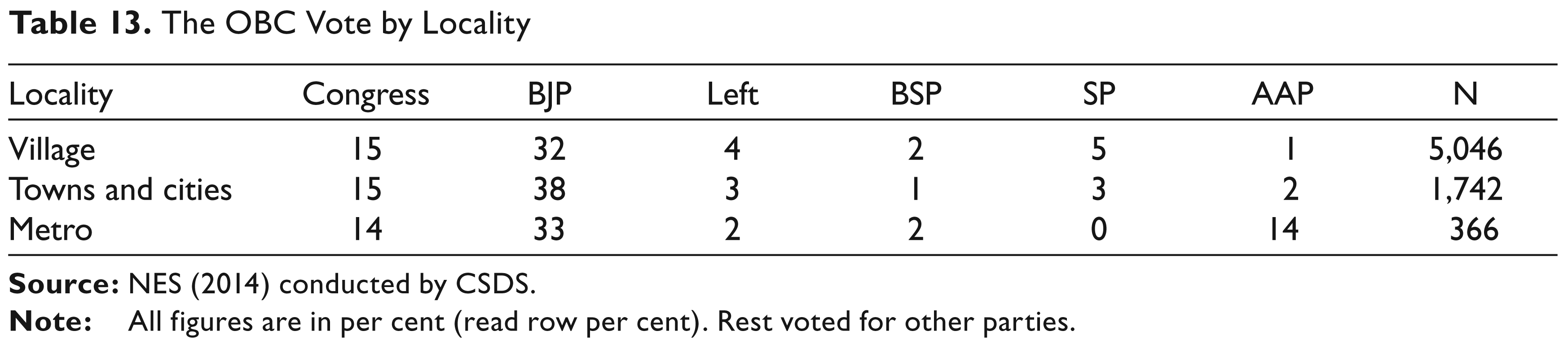
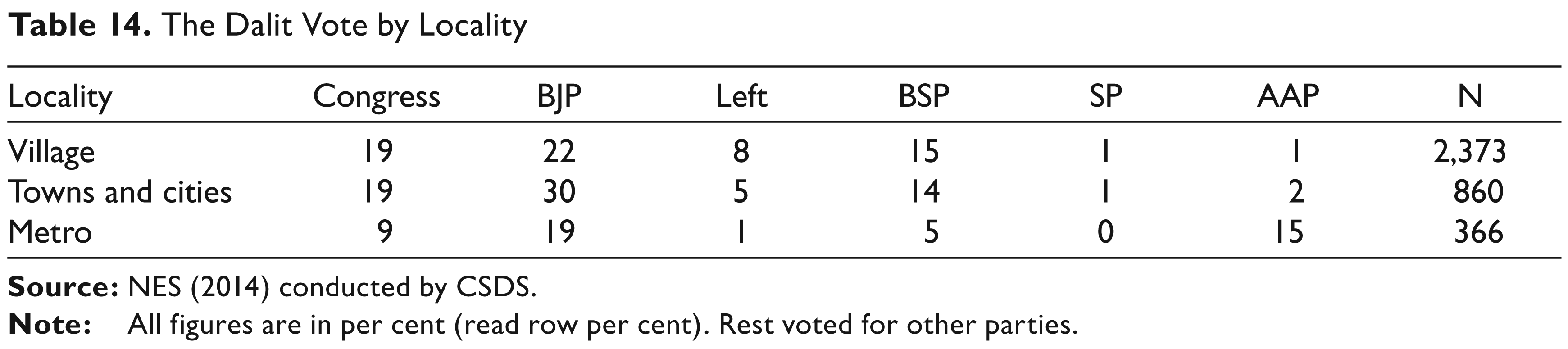
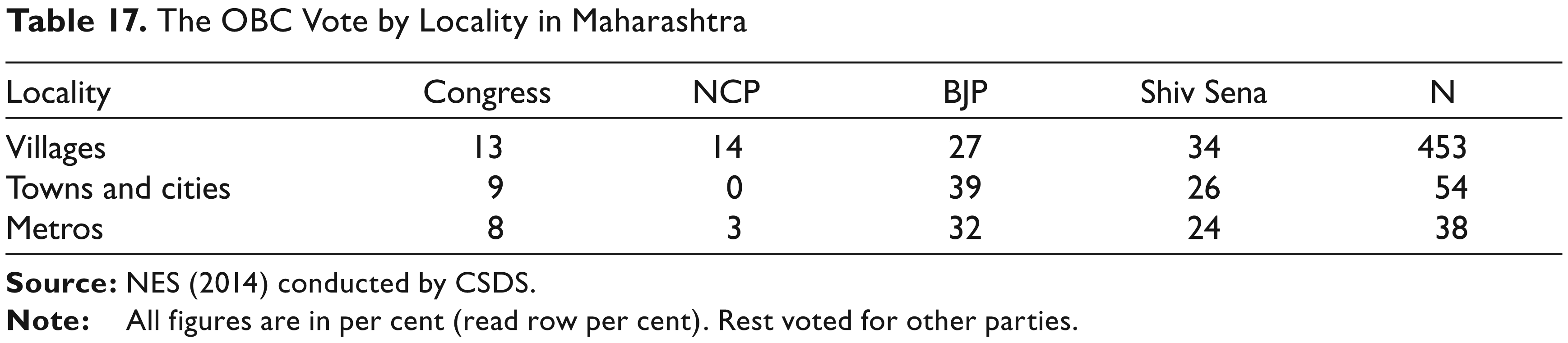
In addition to regional variations, the voting pattern according to localities shows social variations. Caste group is a case in point. The OBCs, and to a lesser extent the Dalits, tend to rally around the BJP when they got urbanized (in towns, cities or metros), whereas the upper castes are almost equally pro-BJP in villages, towns, cities and metropolises (Tables 12 to 14).
The Upper-Caste Vote by Locality
The OBC Vote by Locality
The Dalit Vote by Locality
The OBC Vote by Locality in Gujarat
The OBC Vote by Locality in Karnataka
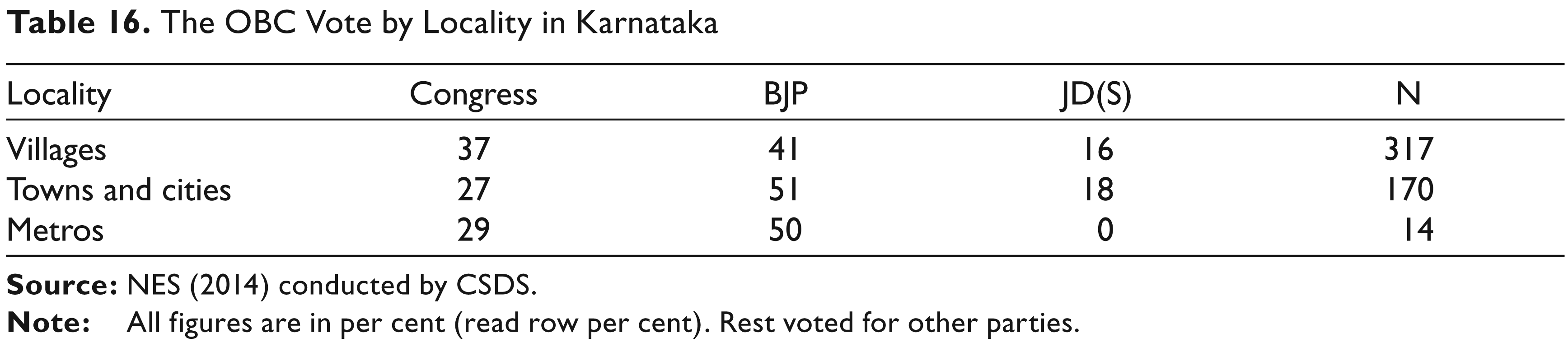
Table 13 and Table 14 show that the correlation is far from linear: it’s not as if the bigger the city in which they live the more BJP-oriented the OBCs and the Dalits are, because in the metropolises, they tend to support the BJP less than in towns and cities. This invert U curve is partly due to the competition of the AAP, which gets 14 to 15 per cent of the OBC and Dalit votes in the metropolises.
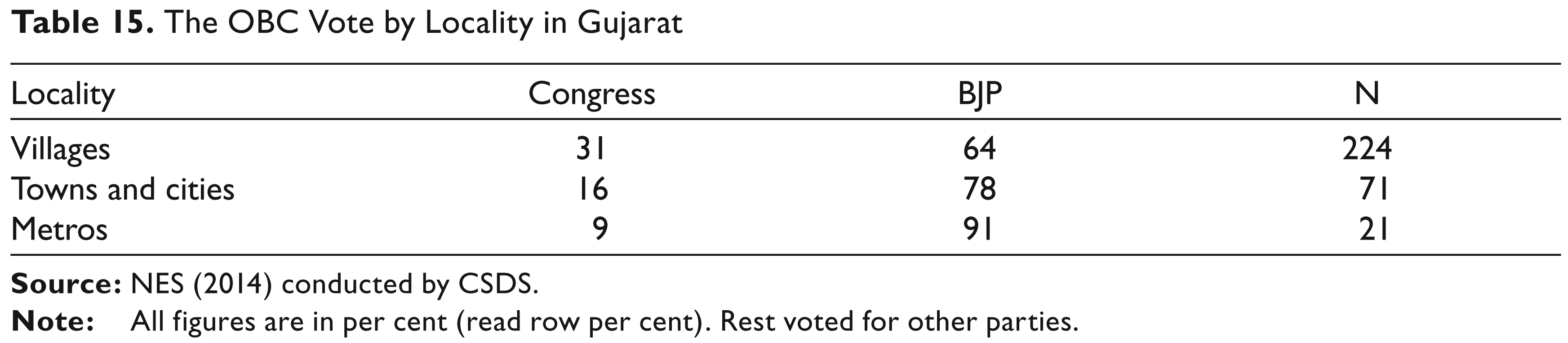
These social variations are not evenly distributed across India. The shift of the OBCs towards the BJP once they leave the village (or once their village becomes part of a town) is more pronounced in some of the states we have already focused on. In Gujarat, the impact of urbanization is dramatic: while 64 per cent of the OBCs living in villages vote for the BJP, 78 per cent of those living in medium and small towns and 91 per cent of those living in metros do the same (Table 15). In Karnataka, the proportion of the OBCs living in small and medium towns and voting BJP is 10 percentage points higher than for those residing in villages (Table 16). The difference is even more pronounced in Maharashtra (12 percentage points) (Table 17).
The OBC Vote by Locality in Maharashtra
In some states a similar phenomenon worked in favour of the BJP among the Dalits too. In Karnataka the proportion of the Dalits living in small and medium towns and voting BJP is 18 percentage points higher than for those residing in villages (Table 18).
The Dalit Vote by Locality in Karnataka
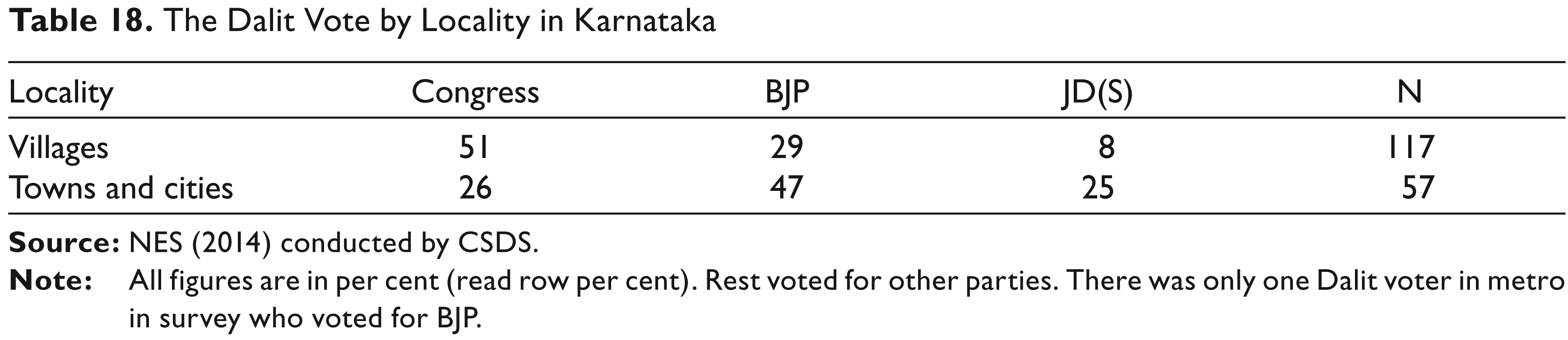
How can we explain the differential impact of urbanization noticed above? We hypothesize that voters of the same low-caste groups, which in the context of the village support the BJP in smaller numbers, shift towards this party when they are located in towns and cities—or when their villages are absorbed by urbanization—because of a twofold, class-related transformation. First, sociologically, they turn to new professions in the secondary or tertiary sectors (the industry or the services). Second, psychologically, their horizon becomes broader and they develop new aspirations. These social and psychological dimensions are the mainstays of what Narendra Modi has called the ‘neo-middle class’. This category, as explained in Christophe Jaffrelot’s article in this issue, tends to support Modi because of his promises to improve life in the urban settings (and build 100 smart cities) and to create jobs in towns and cities. During the 2014 election campaign, Modi’s development agenda was more in tune with the aspirations of the urban neo-middle class, as obvious from key sections of the BJP’s election manifesto, like the one titled ‘Employment and Entrepreneurship’:
The country has been dragged through 10 years of jobless growth by the Congress-led UPA government. Under the broader economic revival, BJP will accord high priority to job creation and opportunities for entrepreneurship. We will
strategically develop high-impact domains like labour-intensive manufacturing (viz. textile, footwear, electronics assembly etc.) and tourism; strengthen the traditional employment bases of agriculture and allied industries and retail;—through modernization as well as stronger credit and market linkages; harness the opportunities provided by the upgradation of infrastructure and housing, for its job-generating potential; encourage and empower our youth for self-employment—incubating entrepreneurship as well as facilitating credit; address the employability issue by initiating a multi-skills development programme in mission mode—focus will be on job creation and entrepreneurship, in both rural and urban areas; and transform our Employment Exchanges into Career Centres—connecting our youth with job opportunities in a transparent and effective manner through the use of technology as well as providing counselling and training (Bharatiya Janata Party, 2014, pp. 4–5).
Other promises directly addressed the housing and urbanization problems that the ‘neo-middle class’ was facing, as in the section of the manifesto called ‘Urban Areas—High Growth Centres:
‘More than one-third of our population is already living in our cities and towns. Soon, the urban areas will cover half our people. Moreover, our cities should no longer remain a reflection of poverty and bottlenecks. Rather they should become symbols of efficiency, speed and scale. We will look at urbanization as an opportunity rather than a threat. Major steps will be undertaken in transport and housing for “Urban Upliftment” in India. We will initiate building 100 new cities, enabled with the latest in technology and infrastructure—adhering to concepts like sustainability, walk to work and so on, and focused on specialized domains. The approach to urban development will be based on integrated habitat development—building on concepts like twin cities and satellite towns. Upgrade existing urban centres, transitioning focus from basic infrastructure to public utility services like waste and water management—for a clean and healthy city life. Cleanliness and sanitation will be given priority—efficient waste and water management systems will be set up. Model towns will be identified for rolling out integrated waste management infrastructure. Wi-Fi facilities will be made available in public places and commercial centres. Urban poverty alleviation scheme would be a key thrust area. Use technology for scientific, strategic and long-term town planning, including GIS-based mapping. Build quality integrated public transport systems, discouraging usage of private vehicles’ (Bharatiya Janata Party, 2014, pp. 4–5).
It can also be hypothesized that urbanization has benefited the BJP for another reason: this process results also in less religious mixing and more exposure to the Hindu nationalist propaganda. In a village, Hindus and Muslims who have been neighbours for centuries sometimes tend to share rituals and beliefs. Hindus would go to Muslim shrines (including dargahs) to benefit from the baraka of the sufi saint—and vice versa. In cities, especially the riot-prone ones, these practices are less likely to take place, not only because of a more individualistic lifestyle but also because of the ghettoization process which diminishes the chances of interreligious relationships (Gayer & Jaffrelot, 2012). Second, urban dwellers are easily targeted by ideological messages and images. Politics is on television, on the Internet, on mobile phones and on walls, not to say anything of the state of quasi-permanent mobilization that Hindu nationalists have cultivated in some states and which is primarily an urban phenomenon.
The impact of urbanization on the communal polarization of society is reconfirmed, a contrario, by the Muslims’ voting pattern: the more urban they are, the more Congress-oriented they are too. While only 33 per cent of the Muslims living in the countryside supported the Congress, the proportion of those residing in metros who did the same was 51 per cent (Table 19). Such a massive rallying of the Muslims around the Congress in the urban setting suggest that they were looking for a protector after experiencing the communalization processes mentioned above, including certain forms of violence. Riots are still mainly an urban phenomenon as evident from the fact that the most riot-prone areas remain Ahmedabad and Mumbai. Here, urbanization is an independent explanatory variable of the Muslim voting pattern in an urban setting.
The Muslim Vote by Locality
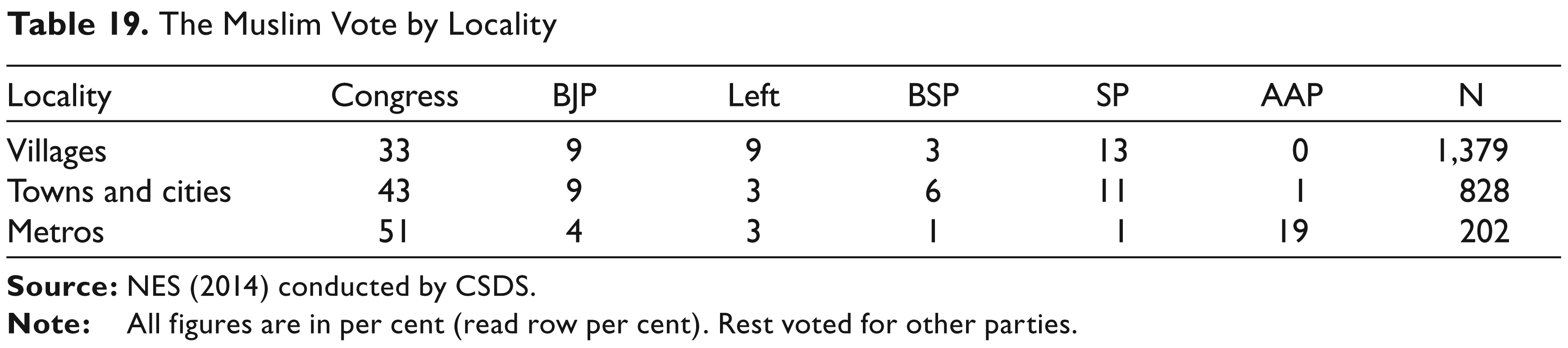
However, the Muslims of the metropolises did not vote for the Congress only, they shifted also towards the AAP, a party they almost totally ignored in the countryside, towns and cities. 4
Conclusion
In the 2014 Lok Sabha elections, the BJP has made significant progress in rural as well as urban constituencies across the board. Its rise has been almost equally remarkable in every social group. While it remained more popular in the urban constituencies, its expansion beyond its core supporters has cut across various classes, castes and communities—excluding Muslims. This success has largely blurred the traditional urban-rural divide discussed by the psephologists. But this distinction has not been totally neutralized. First, the BJP still did better in the urban setting. Second, a detailed analysis show regional and social variations: not only the impact of the rural-urban divide was stronger in UP, Gujarat, Maharashtra and Karnataka where villagers were much less supportive of the BJP than urban citizens, but some social groups—OBCs and, to a lesser extent, Dalits—were also influenced by urbanization. The BJP was significantly less popular among those who resided in the countryside than among those living in an urban setting, probably because the latter had become part of a ‘neo-middle class’ which identified more closely with Narendra Modi’s development agenda. Urbanization has also favoured the BJP as the crucible of communal polarization, a process which explains that the more urban they are, the more inclined to vote Congress the Muslims are.
The correlation between urbanization and the support for the BJP should help the party in the future because of the growth of the urban population. But the BJP may also benefit from the communalization of social life in rural parts of India. The Muzzafarnagar riots which have taken place in 2013 and which have polarized the voters along religious lines in West Uttar Pradesh in 2014 have shown that relations between Hindus and Muslims could also result in forms of violence and ghettoization in a rural context too. The development of new means of communication—including social networks—is also blurring the urban–social divide.
However, the BJP will consolidate more easily the recent urban gains it has made in the ‘neo-middle class’ if its government delivers on the promises Narendra Modi made in terms of jobs and ‘development’ at large.