







Abstract
This article examines a broadly accepted assumption that presence of women personnel makes police forces more gender-just, and makes an attempt to study in the context of Delhi Police, how the inclusion of women personnel impacts gendered hierarchies and patriarchal social norms operative within the space of a thana. Drawing on ethnographic research, I argue that the day-to-day practices and relations between men and women personnel in a police station do not give out a picture of a gender-just institutional set-up. Further, I argue that abuse and humiliation of women personnel within the thana is not something totally disconnected from what the institution’s official attitude towards women is, as could be read from various public campaigns of Delhi Police that infantilize and objectify women while talking of ‘protective’ men as role models. In this context, it is argued that merely inducting women into the institution without an active feminist practice against essentialization of women would not bring emancipatory outcomes.
Introduction
After the Delhi gang-rape of 16 December 2012, widely known as the Nirbhaya case, the issue of women’s safety has received prominence in public discourse across the country. The city of Delhi saw massive protests by outraged citizens in the aftermath of the rape. The Delhi Police was a target of severe criticism, for its failure to maintain law and order in the city. It suffered further bad publicity as the force harassed the protesters and targeted them with water canons, lathi-charge and tear gas. Following these developments, safety of women and role of police have remained central issues in public debates, election campaigns and in the publicly bitter relations between the Delhi government and the Delhi Police working under the central government’s Ministry of Home Affairs (MHA). The police force in Delhi, which had always been a target of public criticism due to its alleged inefficiency and corruption, has increasingly been blamed for its inability to control crimes against women.
The Delhi Police has responded to such sweeping criticism through various measures. One of these was an announcement from the MHA soon after the December 2012 incident. It said that 1,000 new appointments at constable level would be made immediately, out of which 500 posts would be reserved for women. The then Union Home Minister Sushil Kumar Shinde also directed that there should be at least one woman officer posted in each police station (The Asian Age, 27 January 2013). In March 2015, the central government had passed a proposal for reservation of 33 per cent posts for women, at the lower levels in the police forces in all union territories including Delhi (Press Information Bureau, 20 March 2015), and the Lt Governor of Delhi, Najeeb Jung had announced that the number of women in the Police Control Room (PCR) vans would be increased to 500 to ensure greater security of women (The Times of India, 12 August 2015). Further, various publicity mechanisms of Delhi Police routinely focus on the ‘gender-sensitive’ nature of the force by highlighting provisions, such as a women’s help desk in every police station, investigation of rape cases by women officers only, induction of more women at the police station level and training of officers on gender issues (India, Delhi Police, 2012).
Such measures seem to be based on the assumption that presence of women in the police force makes it sensitive to gender crimes, and thus more effective in preventing and handling such cases. Such assumptions often do have a legal and social context. Historically, the police in India is known for its role in perpetrating violence towards marginalized sections including women. The Maya Tyagi rape case of 1980 2 is one of the prominent cases where several Uttar Pradesh police personnel were convicted by a district court in 1988. In the context of such lawlessness of the police, the National Human Rights Commission in its guidelines on arrest has made it legally binding that women police officers should be present at the time of arresting women as far as practicable. The fate of the Mathura rape case 3 also led to legal professors’ and activists’ and the women’s movement’s concerns with the prevalent law, resulting in Criminal Law (Second Amendment) Act 1983 to the effect of defining custodial rape and shifting burden of proof from the accuser to the accused. Other reforms following the Law Commission Report of 1989, such as incorporation into the Criminal Procedure Code Section 46(4) (through Criminal Procedure Code (Amendment) Act, 2005), which prohibits arrest of women between sunset and sunrise, except in exceptional circumstances, and Section 46(1) (through Criminal Procedure Code (Amendment) Act, 2008), which states that unless the arresting officer is female, a woman while being arrested will not be actually touched on her body, were further steps towards curbing police violence against women. Other rules such as Section 51(2) of Criminal Procedure Code, which requires that body searches of women should be strictly by another female, along with other provisions, made it increasingly important to have women in the police forces.
However, the place of women in the institution, and whether their rights are safeguarded or not—in an environment which proved to be violent towards women requiring legal mechanisms to deal with it—was not dwelt upon much. In fact, it was only with an innovative use of the Bhanwari Devi rape case 4 that guidelines to prevent sexual harassment at workplace were laid out by the Supreme Court of India through the Vishakha judgement in 1997.
My attempt in this article is to examine this aspect of workplace gender dynamics. The precise focus is upon inclusion of women into the police force in Delhi on the assumption of their special suitability to deal with gender-based crimes, and to study what impact such inclusion has on the structures of gendered hierarchy operative in the police station as a workplace. Given that policing has traditionally been seen as a ‘man’s job’, how do the women police personnel balance between being a woman and a police personnel at the same time? While examining the everyday strategies of women police personnel in Delhi in their day-to-day work lives, I observe that the individual woman personnel has to continuously oscillate between two contrary enactments of what Susan E. Martin (1980) calls a policewoman and a policewoman. Drawing on insights from ethnographic fieldwork, I argue that inclusion of women on such terms does not make them equal members of the force, but only signifies a balm-applying strategy to rectify rampant gender imbalance in numbers within the institution. Such inclusion, I argue, has not yet led to any real progress in terms of making a gender-just institution.
That the inclusion of women only serves as a token in the present form could also be gauged from the way the police force in Delhi is officially conceptualized. In the last section of the article, by reading through various publicity documents released by the organization from time to time, I argue that the institution often relies on overtly masculinist rhetoric which signals towards deep-rooted ideas of masculine and feminine role types inherent in the ideology of the institution. I argue that the daily practices of harassment to women colleagues in the police force are only an underside to its officially projected face which portrays the force as that of ‘masculine protectors’.
The field research for this work was conducted between October 2011 and March 2012, and included semi-formal interactions with police personnel in various police stations across 11 districts under Delhi Police as well as in-depth observation of day-to-day policing in a specific police station in the North-west district, facilitated by permission from the deputy commissioner of police (DCP) of that district. Another important primary material is print advertisements by Delhi Police which frequently appear in newspapers and Delhi Police annual reports, and which can also be accessed at the Delhi Police website. Other materials such as reports and documents of government and non-governmental organizations and available literature on policing and women are consulted too.
Policing, the Female Cop and ‘Hegemonic Masculinity’
Policing, together with fighting wars, has traditionally been seen as a masculine job (Morash & Greene, 1986), backed by ‘Victorian ideals of manhood’ (Vanita, 2014, p. 1). Physical force, the capacity to calculate situational needs fast and bravery are seen as crucially important for this job: features that are often associated with men and seen as absent in women. 5 The categories of ‘man’ and ‘woman’ assume specific symbolic qualitative contents in the process of discursive constructions of gender (Schippers, 2007, p. 90), and in accordance with such qualitative contents, specific jobs get assigned to men and women.
Despite traditional association with ‘masculinity’, however, most contemporary police forces formally recognize the equality of male and female personnel. There has also been a shift in organizational principle of police forces from being solely crime-fighting agencies to the role of community policing, involving four styles of policing (as identified by Miller, 1998, p. 164, discussed in DeJong, 2013, p. 257), namely, peacemaking and caregiving, empathy and communication, emphasizing connections among family and community and problem solving. All these aspects of policing are seen as embracing a new ‘feminine’ side (Miller, 1998 discussed in DeJong, 2013, p. 257). Police forces around the world today, including some in India, emphasize such gender-differentiated requirements of the institution to include specific feminine aspects, and for which women personnel are inducted and even special women’s units are organized (DeJong, 2013, pp. 249–265; Hautzinger, 2007; Martin, 1990).
Earlier academic works have raised questions about the role and presence of women in police forces. Mostly in the context of the police departments in the US, and some from other countries, these works dealt with the process through which women entered the traditionally masculine occupation (DeJong, 2013, p. 249). Some other works focused on how the work of women personnel within forces outside Europe and the USA has been limited to traditionally defined feminine aspects, such as dealing with juveniles and women, and that in many cases, women officers were given supervisory powers only over female subordinates (Aleem, 1989; Chu & Sun, 2007; Natarajan, 2008; Yang, 1985). Mangai Natarajan (2008), who studies policewomen in the context of Tamil Nadu, India, argues that in a traditional ‘closed’ society like that of India, an alternative route has to be found in the form of All Women Police Units (AWPU), to bring women to an equal status with that of men in the male-dominated occupation of policing. This, according to Natarajan, is an effective way to break gender hierarchies and to let policewomen out of the trap of performing ‘support functions’ to male personnel through clerical and desk work. Field-based critiques of such a theoretical position could be found in Sarah Hautzinger’s work (2007) in the context of Brazil, and in a recent publication by the Commonwealth Human Rights Initiative (CHRI) studying the scenario in four South Asian countries of India, Bangladesh, Pakistan and Maldives (CHRI, 2015). Hautzinger has noted on the basis of her anthropological study of all-women police stations in the Bahia district of Brazil that even after more than 20 years, this mechanism had remained in its incipiency. Though there have been changes at the level of laws and policies, women, including those in all-women police stations, rarely ‘confront long-entrenched codes and scripts of machismo’ (Hautzinger, 2007, pp. 4, 221–256). The CHRI report on the other hand notes that all-women police stations in India 6 often end up being a recording and forwarding agency of cases related to women, without having the capacity to investigate them on their own. The personnel working in these stations also get fatigued by dealing with the same kind of cases continuously, and do not get an opportunity to broaden their skill-sets (CHRI, 2015, pp. 73–75).
While there have been works which observe that women are often seen within the police forces as essentially different from men and thus need to be assigned differentiated work based on their field of ‘feminine’ expertise, very few works have examined a tension within individual women personnel between being a woman and at the same time being a police personnel—a role more often associated with ‘masculinity’. The police forces often highlight women’s ‘feminine’ nature as the reason for their inclusion. But does merely playing such a ‘feminine’ role, in practice, provide enough justification for receiving equal regard with men personnel?
One prominent work dealing with this aspect of the role and position of women personnel is by Susan E. Martin (1980). Martin makes a typology of policewomen and policewomen: The first type describes women personnel who emphasize their professionalism and consider the fact of being female as irrelevant, whereas the second type describes women personnel who emphasize their femininity and thus more comfortably play a subordinate role to the male colleagues at the job. While managing their position within the profession and enacting/defining their identities at work, Martin argues, policewomen fall into various spaces of the continuum between the two poles of policewomen to policewomen (Martin, 1980, p. 216). Martin’s classification does not consider the fact that in many police forces today around the world, women are often officially incorporated specifically to perform ‘feminine’ functions of caring and being compassionate to deal effectively with other women and children (Aleem, 1989; Natarajan, 2008). But that does not take away the relevance of Martin’s classification for the purpose of this study. 7
I benefit from Martin’s understanding while examining the men–women relationships within the police force in Delhi, but in distinction from Martin, I argue that the categories of policewomen and policewomen are marked by a context-dependent interchangeability in the same women personnel, that is, the same woman may move from being a policewoman in one context and a policewoman in another, depending on whom she is relating to. Such an understanding helps us comprehend the processes of a complex identity formation or ‘enactment’ of the self (borrowing from Srivastava, 2012, p. 16), where the woman police personnel often feels the pressure to be a woman and a police personnel simultaneously, without having an option to choose one identity over the other. Further, such enactment of gender roles within the space of the thana is also revealing in terms of how our identities and performances are framed by intersectional structures of power, to the extent that what such gender enactments do to the space of the thana may not necessarily translate in a similar way at higher echelons of the police hierarchy. While women who enter the institution of police at the lowest rungs—often coming from a lower socio-economic, caste and educational background—would struggle to balance between their identities as a police personnel and as a woman, a woman officer entering the force at a higher and socially respectable position, such as an Indian Police Service 8 officer, may feel comfortable in performing whatever gender role she chooses to perform, without being forced to choose either or both.
In this context, it is important to clarify that when I talk of women police personnel’s need to oscillate between enactments of a woman and a police personnel, I do not assume that gender performances are otherwise fixed. I note that gender performances are often fluid, and people do not behave in exactly the same manner in every context. What I attempt to highlight is rather the requirement or compulsion of oscillation between two enactments which are often seen as exclusive of each other, and the subsequent concern of how, in this scenario, construction of a self-identity through dialogical relations with the significant others—male colleagues in the thana as well as civilians who interact with women police personnel on various capacities—may produce newer forms of exploitative relations. 9
In order to explore this process further, I take help from the concepts of ‘hegemonic masculinity’, ‘emphasized femininity’ (Connell & Messerschmidt, 2005) and ‘pariah femininities’ (Schippers, 2007). The concept of hegemonic masculinity was first formulated by Connel (1982, 1983) for a gendered analysis of power structure, and has been reformulated in recent times with modifications in the light of subsequent conceptual and sociological developments (Connell & Messerschmidt, 2005). Masculinity, to quote Sanjay Srivastava, ‘refers to the socially produced but embodied ways of being male. Its manifestations include manners of speech, behaviour, gestures, social interaction, a division of tasks “proper” to men and women…’ (Srivastava, 2012, p. 13, emphasis in original). The concept of ‘hegemonic masculinity’ presumes the presence of multiple masculinities, in the sense of real practices, and argues that out of these multiple masculinities, one becomes hegemonic at a specific point of time or context. This hegemony operates by subordinating other forms of masculinities as well as femininities. The subordination here is not a simple domination, but is marked by ‘cultural consent, discursive centrality, institutionalization, and the marginalization or delegitimation of alternatives’ (Connell & Messerschmidt, 2005, p. 846). As the concept of hegemonic masculinity is a relational concept, it brings notions of subordinate masculinities and, significantly, of ‘emphasized femininities’, the latter having been always subordinated to the hegemonic masculinity. Subsequent work by Schippers (2007) has commented upon how there are hierarchies within femininities as well, between an ‘emphasized femininity’ and ‘pariah femininities’. ‘Emphasized femininity’ is the ideal form of femininity marked by an exact lack of the characteristics which marked hegemonic masculinity, whereas ‘pariah femininities’ are those roles played by females that do not fit into the ideals of ‘emphasized femininity’. A woman, even if she behaves in a ‘masculine’ way, would never be considered masculine, but would be seen as incompletely feminine, or feminine in a way which is abject (Schippers, 2007, pp. 95–96). Further, Connell and Messerschmidt, while talking of the possibility of a change in hegemonic masculinity over time, hope for a hegemonic masculinity (Connell & Messerschmidt, 2005, p. 833) that would believe women to be equals of men. These conceptual tools help us analyze men–women relations within the police force in Delhi. I examine the specific nature of hegemonic masculinity/masculinities and enactment of gender roles in the context of policing in Delhi, which provide crucial insights into the gender-relative operations of power.
Before proceeding to the next section, a paragraph on the understanding of sex and gender would not be out of place here. In a large body of feminist literature, the two are often seen as closely related, and as the second naturally following from the biological reality of the first through socialization. 10 This work, while studying masculinities and femininities, that is, socially produced but embodied ways of being men and women, however, approaches the question of a two-sex model itself as an unsettled category produced as a significant marker through discursive practices and thus as not automatically natural. The understanding is influenced by Butler’s conceptualization of sex as not a ‘temporal before’ to gender but as discursively produced by various scientific discourses in the service of other political and social interests (Butler, 1999). If sex itself is seen as an unstable category, then it opens up avenues for newer forms of social relations of power, where, rather than hoping for the development of a newer form of masculinity where women would be seen as equal to men, the essentialist difference that is made out would disperse.
Women in Policing in Delhi
According to claims made by Delhi Police, it was the first police force in India to include women into its ranks, starting from 1948–1949 (India, Delhi Police, 2011, p. 63). The force maintains a separate women’s cadre. The intake of women began modestly with 21 women personnel in 1948, who were recruited mainly for ensuring the safety of the prime minister in the context of distressed refugee women of partition violence contacting him every day, as well as for the security of abducted and refugee women (Bhardwaj, 1999, p. 89). Women’s presence, however, has always remained much lower than men’s, and according to data provided in the ‘Crime in India’ reports, as late as in the decade between 2004 and 2013, the actual strength of women personnel in Delhi Police has consistently been less than 8 per cent (Figure 1).
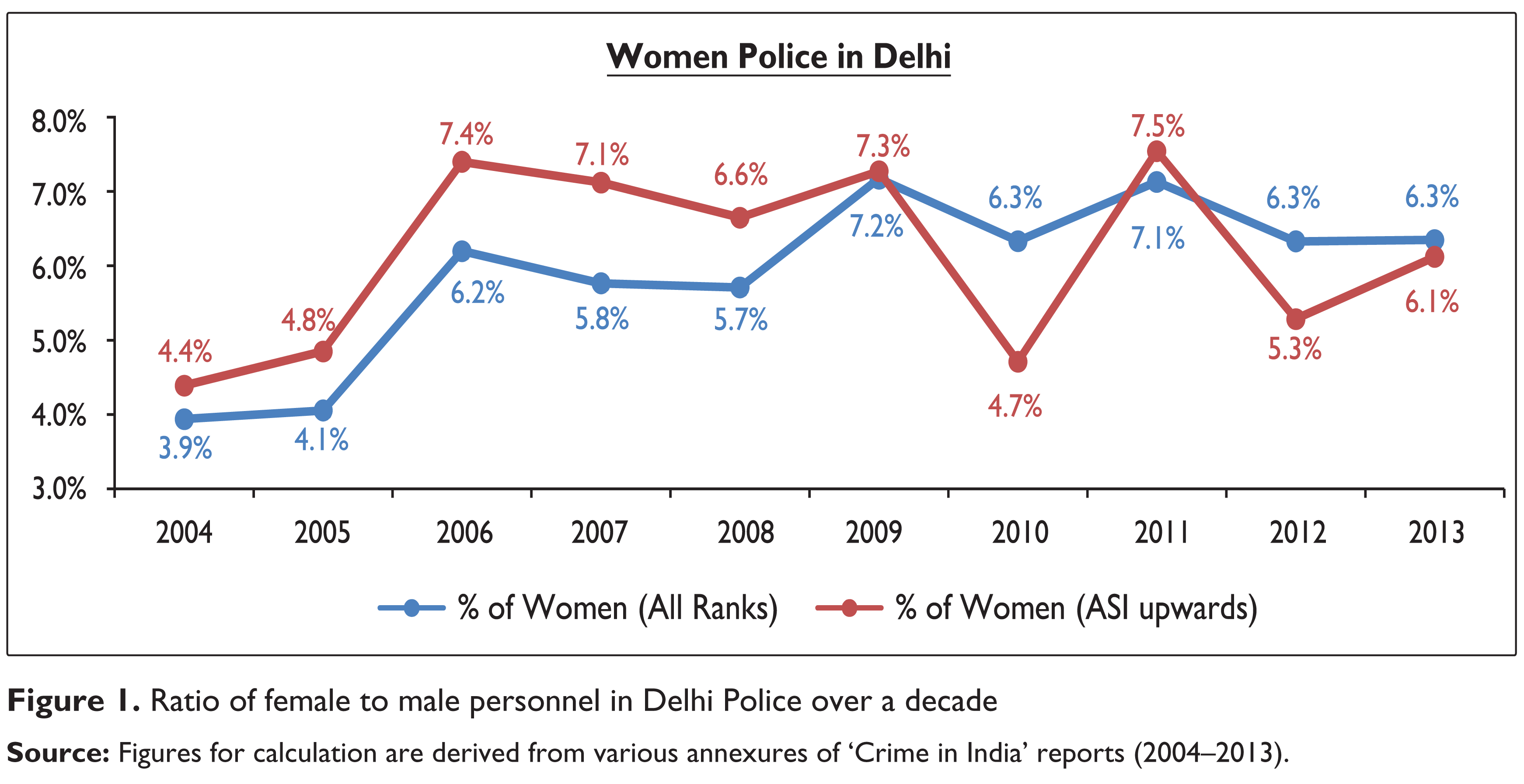
While the Delhi Police attempts to offer a women-friendly face by incorporating more women, the male presence is still overwhelming. And while women personnel are incorporated, their distinct role in the force as performers of ‘feminine caregiving’ tasks has always been highlighted.
Methodology
Percentage of women in all ranks = (civil women + armed women)/(civil man and women + armed men and women) × 100
Percentage of women ASI upwards = (civil women ASI upwards + armed women ASI upwards)/(civil man and women ASI upwards + armed men and women ASI upwards) × 100
Definition:
Civil women: Actual strength of civil police including district armed police (women only) Armed women: Actual strength of armed police (women only) Civil man and women: Actual strength of civil police including district armed police (men + women) Armed men and women: Actual strength of armed police (men + women) ASI upwards: (DG/Addl DG/IG/DIG) + (SSP/SP/Addl.SP/ASP/Dy.SP) + (inspector, SI and ASI)
Such differences/specializations of women personnel come out through two discursive frameworks: one an unofficial but everyday discourse of a dominant patriarchy emerging out of a standpoint of difference and inferiority, within which women personnel are seen not only as different but also as lacking some crucial characteristics of what makes a ‘policeman’. The second discourse is composed of official narratives of a modern liberal benevolent but nonetheless patriarchal state arguing from a standpoint of specialization. In this second discourse, while the difference of women personnel is noted, this difference is presented in terms of skill-based division of labour, which, however, assumes a dichotomous skill set, innately and exclusively carried by men or by women. In the following sections of this article, we see that while the first discourse makes it difficult for a woman to work in the force and neither the second discourse holds out much hope for a fuller inclusion. Both of them together, however, construct a unique model of ‘deviant’ femininity.
Between the Tough and Powerful Police women and Flirty Little Women Co-workers
The duty officer’s (DO) desk and the women’s help desk are generally the first structures that one encounters at a police station. The women’s help desk is always attended by women personnel, and the DO’s desk too is often attended by female DOs and daily diary (DD) writers during the day shift from 8 am to 4 pm. As the DO’s desk is the approach point for all kinds of reporting at a police station, DOs remain occupied throughout their shift.
In my visits to various police stations, the women personnel, especially women Dos, were generally nice to me, but they did look stern and bossy when talking to people who came with complaints or those who were brought to the thana on some charge of offence. Routinely, however, most women—even the ones who appeared grouchy to others—would talk very differently with their male colleagues. Young women constables would generally talk in a pleasant and naive way to their male superiors and colleagues, often with a childlike demeanour. The older women personnel would talk more comfortably than their younger counterparts but shedding the regular stern tone in which they speak to visitors. Some girls worked silently. But I did not come across a woman talking very confidently or authoritatively to her male colleagues for a very long time.
In Uday Nagar 11 thana, women Head Constables Chhaya and Jyotsna alternated at being the DO most of the time during the shift from 8 am to 4 pm. Chhaya is a tall lean woman, in her early forties. She generally keeps a straight face and speaks in a flat voice. When people come to report the loss of a mobile phone or a purse, she asks, Kya chhahte ho? (What do you expect?). What she means to ask is if they want the police to find their mobile phone or only to sign and stamp a copy of the application, so that they can take another SIM card for the same number. If somebody writes in their application that their mobile phone is stolen, she asks, Tumhe kaise pata ki kho gaya hai? Ho sakta hain gir gaya ho? (How do you know it is stolen? It is possible that it just fell off). If they say they are not sure whether it fell off or somebody took it, then she asks them to write the application anew stating that the mobile phone fell off. She has an authoritative, definitive and firm tone. She does not shout, but speaks in a way that it is difficult to confront her or answer back. She also has a strange sense of humour. Once she asked a complainant where he lived. The man answered that he lived in Rasheela Bagh. Very calmly Chhaya said, Purey Rasheela Bagh me akele rehte ho? (Do you live alone in the whole of Rasheela Bagh?). When the man could not make out what she meant, she said in the same stern manner: ‘Kuch house number hoga, jhuggi number hoga.’ (There must be some house number, some jhuggi number?). If somebody kept speaking, even after she indicated in her own ways—verbal and non-verbal—that she had heard them and understood, after a while she would calmly say, mujhe jyada bolna pasand nahi (I don’t like too much speaking). Chhaya looks stern and speaks little to everyone, including male officers senior in rank to her.
Head Constable Jyotsna appears to be very different in nature from Chhaya. I did not ask her about her age, but she too is a woman probably in her late thirties or early forties. She, unlike Chhaya, is very talkative. When complainants come, she asks them a lot of questions, responds to each of their questions with a lot of energy and drama, though holding a sense of power and authority over them, and very often shouts at people. She would often ask a policeman to beat up or slap a detained man. While the personalities of the two women—Chhaya and Jyotsna—are very different from each other, both come across as tough dominating persons when they talk to the complainants and other civilian men and women at the police station.
Jyotsna, however, acted differently and in a cheerful manner at other times. She steals the show when she is at lunch with others. She talks of diverse things starting from cooking to soft toys, but not really policing. She also often engages in discussing matters of love and life with male colleagues. Jyotsna, however, did not get along very well with Chhaya, and often avoided talking to her. Chhaya on her part seemed exceptionally determined in maintaining her strict demeanour even with her male colleagues.
Most other policewomen, even when they are stern with the complainants and the accused, seemed to turn on their submissive selves when talking to male colleagues. Such behaviour, it appears, is produced by a pressure to be accepted in the force, which officially projects its women personnel as valuable, but, unofficially, in the day-to-day practices, denigrates women personnel as incompetent. As Chhaya put it for me over lunchtime conversations, wo kaushish karte hain ki khush rakhe logoko (they try to keep people happy). When I asked her as to why she is so strict with everyone, including her male colleagues, she said: ‘In the thana you need to maintain that. Otherwise people don’t take you seriously.’ Chhaya, however, did not seem to be very popular among either her male or her female colleagues.
Chanchal is a senior woman ASI, with streaks of grey hair dyed with henna, in a Central District police station. She is two ranks senior to a constable and the distance of two ranks is quite a lot in the profession, given the slow pace of promotion. Constable Ashok comes in and with a smile introduces Chanchal to a visiting constable from another police station: Ye hai yaha pe humari mataji jaisi (She is like our mother here). The other man who appears to be in his early forties touches her feet in an animated way, and says aap to maa jaisi ho, aap mujhebhi god lo, aur tab dekho kitna sewa karta hoon main aapka (As you are like a mother, you adopt me too and then see how much I serve you). He then sits on the arm of the DO’s chair, where Chanchal is sitting, and starts pressing her arms and back. Chanchal does not look bothered, and with a smile talks about food brought from home and how it is better than the mess food. 12
In another police station, a woman ASI calls out to a young woman constable as ‘Munni’. All the men present there laugh loudly. The woman ASI says, mere liye to munni hi hain (for me she is a kid only). The men laugh again and one of them says, Haan yahape bahut sari munni hain (Yes there are many Munnis here), breaking into a line of a popular Hindi movie song Munni badnam hui, darling tere lie (Munni got disgraced, for you darling). In Hindi, ‘munni’ means a young girl, and it can also be a girl’s name, but they are amused by the unintended reference to the song in the 2010 blockbuster film Dabangg where the male lead actor played the role of a police officer. The cool manner in which the women in the thana responded to such comments shows how such behaviour towards women colleagues has assumed a form of hegemonic masculinity within the institution. In such instances, women in the thana are mocked highlighting their ‘feminine’ qualities such as that of motherhood or being a beloved, but at the same time the boundaries of what is acceptable behaviour towards a ‘feminine’ woman in the given social milieu is crossed over too frequently, through unusual physical proximity, or reference to their falling from ‘honour’.
Such instances of denigrating treatment towards women colleagues indicate an overall culture of contempt towards women in the role of policing. While the higher ranked male officials did not easily speak of such things to a researcher, the men at the middle and lower ranks routinely expressed such contempt towards female colleagues. Once, I asked a Sub-inspector in a New Delhi district police station, why most of the time women personnel act as DOs. His reply was this: Unka aur koi kaam hi nahi hain, kuch to kaam mein lagana hoga na (They don’t have any other work: they have to be engaged in something, right?). 13 While I was in Uday Nagar thana, a young male constable, who took me around several times in his official motorbike on calls, advised against ‘wasting’ time talking to the female constables and officials: Wo toh bekaar hai. Unko kuch aata nahi police ke kaam. Jo log field me rehte hai unhiko cheeze pata hoti hai. (They are useless. They don’t know anything about policing. Only those who are really on the field know things.)
The facts that women are often not offered field-duty and they do not show interest in taking these up, appear to be a product of such dominant understanding of their role in the thana. Their non-participation in core policing activities appears to be the accepted norm, as I could gauge from the conspicuous absence of women personnel from the SHOs work briefings even when they were present in the thana, sitting right outside the SHO’s room, while every single male personnel on duty would attend those briefings in full uniform.
In such situations, apparently, constructions, reconstructions and refashioning of gender identities and roles are called for, just to maintain one’s dignity at workplace. When I say this, I by no means assume that women who join the police force had been living a life beyond the pressures and demands of a gender-defined hierarchy before entering the force, or that women in general live a life free of gendered hierarchies outside the force. Rather, most women and most men living in patriarchal social set-ups, have to, and do, consciously or unconsciously, bring themselves closer to an ideal form or role (those of hegemonic masculinity and emphasized femininity) and only an exceptional few choose not to conform.
The complexity of the case under study is due to the fact that policing as a profession is seen as masculine, and women are seen as naturally feminine. This leads to a practice where women have to juggle between developing an overtly masculine identity to conform to the so-called ‘demands’ of the job and an emphasized feminine identity side by side, towards male personnel who are not yet ready to accept that women could be real policemen (sic). The association between men and masculinity gives men superiority and privilege, and thus it is not surprising that male police personnel are hostile to women who attempt to imbibe masculine roles and act like a policewoman. ‘Masculine’ aggressiveness, when enacted by women, poses a threat to male dominance, and thus they are stigmatized. Playing just a policewoman seems insufficient for this reason.
Though there may be women who do not submit to the pressure of being submissive and pleasant to the male colleagues and choose to be defined by their policing personality, such women are targeted by the male colleagues who often joke about how they are not really ‘women’. Such a case fits well with Martin’s classification of policewoman. Despite not being seen as a real ‘woman’, she is not allowed the camaraderie that is offered to ‘real’ male colleagues. Rather than being seen as an ideal, she is seen as aberrant. This identification fits well with Schipper’s understanding of ‘pariah femininities’ where women who do not conform to models of emphasized femininity are rejected as a ‘bitch’, as a ‘badass’ or a ‘slut’ (Schippers, 2007, p. 95).
There, however, seems to be another category in-between, that is, a more complex layer of ‘pariah femininities’. The majority of other women personnel, who attempt to avoid being labelled a ‘bitch’, are not really better placed, as they have to endlessly play a double role, and strive for acceptance. Like the policewoman, they have to act tough, even tougher than a male personnel, towards the detained/accused/complainant to ‘earn’ their respect. At the same time, they have to act soft and submissive to male colleagues, whether higher or lower in rank, to avoid extreme forms of workplace abuse.
This constant push and pull between an attempt to be recognized as a policewoman and as a policewoman makes one think about a critical form of gender enactment, where one has to constantly strive to perfect two completely opposing ideal gender models, that of ‘hegemonic masculinity’ and ‘emphasized femininity’.
Looking through such a prism, some apparently innocuous artefacts and mannerisms also appear to be tools of a continual production of a dichotomy between a woman and a police personnel. One such artefact is the rank badge worn by police personnel. Unlike the male personnel’s rank badges, the women personnel’s rank badges do not simply state the rank but also mark them out as women by the letter ‘w’. While men and women constitute separate cadres in the force—an attribute which itself has been seen to be having negative implications for women 14 —such markers of gender/sex are attached only to the uniforms of female personnel and not to those of men. This, in a way, perpetuates the dominant patriarchal discourse of male/maleness as the standard/regular/normal and the female as an aberration, which is thus marked out.
On a different dimension, I observed that many who come to the thana, men and women alike, call the female duty officers ‘sir ji’, an address very clearly for men. This aspect indicates the intersectionality of power in practice. While women personnel in the thana are often seen as infantilized, hyper-feminized and inferior co-workers by male police personnel, the same women personnel who wield larger power in comparison to the regular visitors to the thana—mostly people living in slums and without regular means of income—are seen and addressed by these people further from the margins, in a masculinized way. Does such masculinized address of female police personnel by further marginalized people show that gender identities are at core produced by relations of power and not by some innate psychological or biological traits? If so, then isn’t the assumption that incorporation of women would give a feminine sensitivity to the force a false assumption at the level of concepts?
In the next section, I examine how the way in which women personnel are denigrated in practice is intrinsically linked to the official position of Delhi Police about ideal role of men, women and police. This section also further illuminates upon my assertion that inclusion of women as women may not be able to break the way structured injustices operate.
Official Understanding of Women Police and Policing
On a quick glance, the everyday practices of inequality towards and harassment of women police personnel seem to be against the ideals propagated by a modern liberal police force, which claims to be continuously working for the ‘safety’ of ‘vulnerable groups’ like women. Provisions such as women’s help desks and a special police unit to respond to difficulties faced by women are often projected as the force’s effort to rid society of gender-based crimes. A closer look at the ideological background of such efforts, however, shows us that everyday practices of harassment of women colleagues are not strange and unlikely coincidences of official norms, but rather an underside to it. These two are related to each other, I argue, through an overarching patriarchal ideology, but they work within two different yet complementary forms of ‘hegemonic masculinity’.
The police force as a domain of masculinity could be studied through the advertisements put up by the force. Melissa T. Brown, reading advertisements by the US armed forces to study notions of masculinity, notes that though the recruitment advertisements she studied do not always represent the real nature and practices of the armed forces, they represent what the armed forces want themselves to be seen as, or what kind of an image about themselves the armed forces believe would be attractive to potential recruits and their social circles (Brown, 2012, pp. 6–7). In the same way, I would read the advertisements put up by the Delhi Police as portraying what they want to be seen as, that is, portraying their notion of an ideal police force, regardless of how far this ideal is practiced in real life. These advertisements, thus, may not be able to tell us directly about the everyday practices of a police culture in Delhi, but they, nevertheless, tell us about the hegemonic forms of masculinity held by the force. And the two dimensions of portrayal and practice, as we would see in the following, are not without some interesting connections.
In the following, I would look at some advertisements by Delhi Police about women’s safety. In analyzing these advertisements, I follow an interpretive textual method, that is, I attempt to read the published words in connection with the images that are presented, by paying attention to the semiotics, and the rhetorical, ideological and psychoanalytic aspects, to understand how and what kind of a social meaning is produced for the viewer.
In the first one (Figure 2), a woman is harassed at a bus stop by several men. The picture shows seven men and two women in a bus shelter. Three of the men are positioned with aggressive gestures, while the others are seated and all of them are staring at a woman clad in a salwar kurta with a dupatta, holding her hands and a bag close to her body, which signals that she is frightened. There is another woman casually looking at her, but who does not seem to be interested in intervening. The caption to the picture goes, ‘there are no men in this picture, or this wouldn’t happen.’
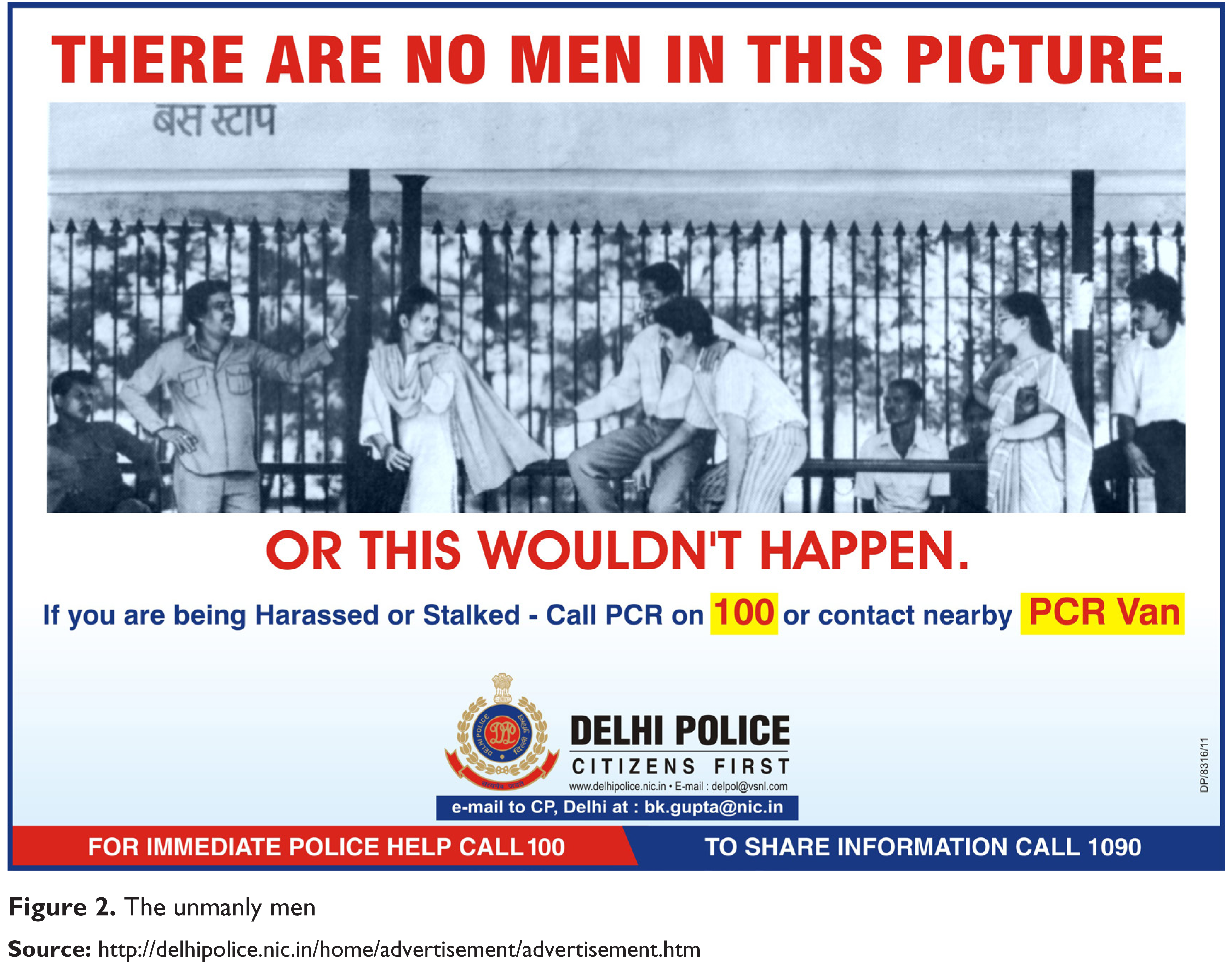
The advertisement targets the men in the picture as non-existent, as they do not display chivalrous behaviour, or do not intervene to ‘protect’ a woman. Interestingly, the advertisement does not comment on the other woman who is merely an onlooker of the harassment that was going on, making one wonder if the underlying implication is that it is completely acceptable, and even expected, for a woman to not intervene when another woman is being harassed. The portrayal here is clearly backed by a hegemonic masculinity of chivalrous men who are the protectors of women. While denying the presence of men in the picture, and at the same time not commenting on the woman bystander, the picture portrays non-man/non-chivalrous as equivalent to women. Thus, the unreal man in the language of hegemonic masculinity is equivalent to the feminine: the feminine which is either a victim or someone who is not supposed to ‘protect’ and ‘support’ a victim. 15
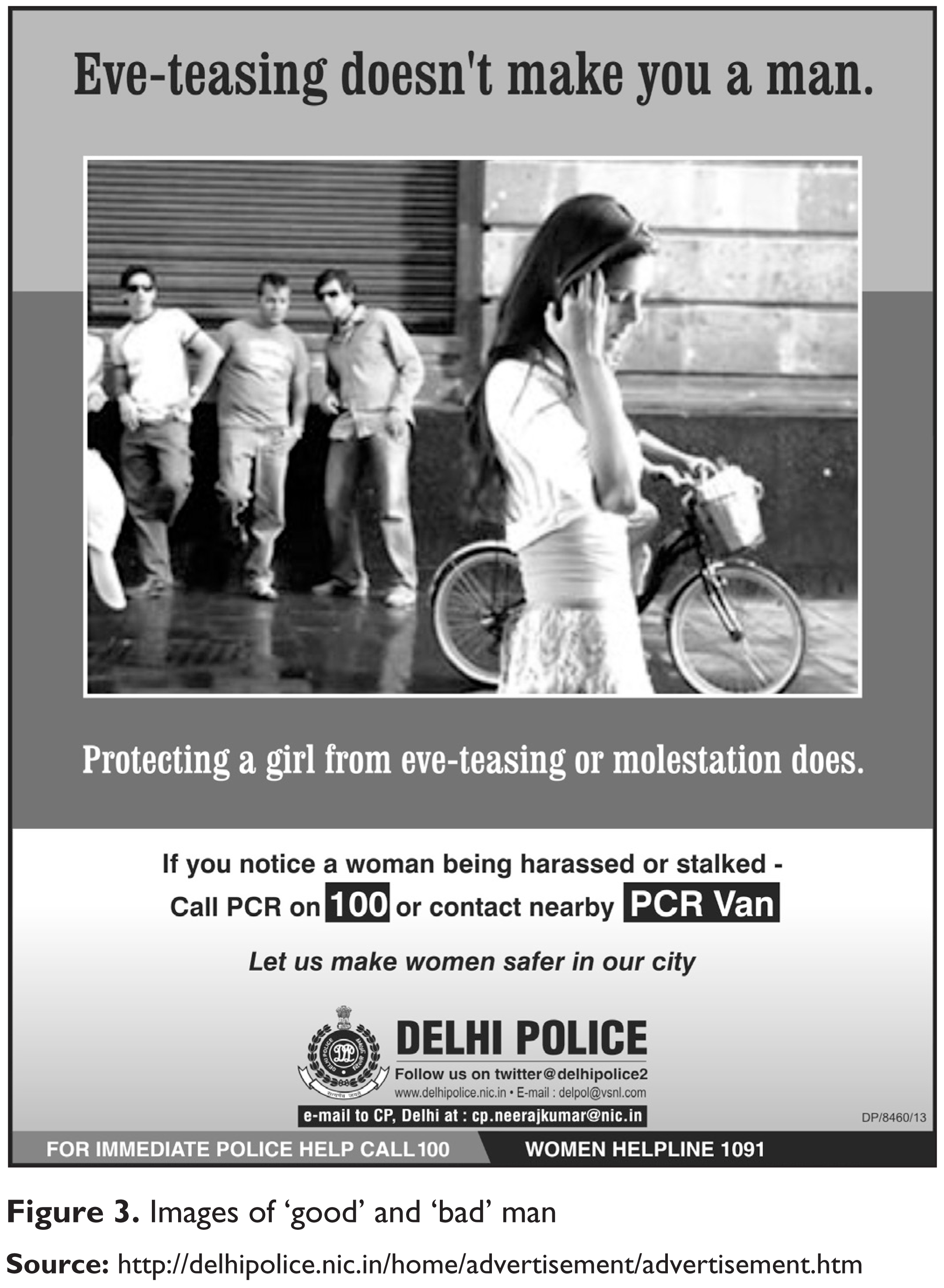
The next one that I discuss here carries an image that portrays three men looking at a woman on a street (Figure 3). The young woman, tending to her long hair while walking on the street looking downwards, is passing by a downed shutter by the road, leaning to which the three men are standing. The text that is put with the picture is this: ‘Eve-teasing doesn’t make you a man. Protecting a girl from eve-teasing or molestation does.’ We can see constructions of three images here. The first is the figure of the ‘bad’/non-‘man’ constructed through image and words: while the picture shows men standing in public space looking at a woman, the words indicate that they are ‘eve-teasing’ a girl. The second image is that of the victim: A feminine girl with long hair who does not look at the men, but walks past keeping her eyes low, bringing into question whether a woman who would not fall into this definition of ‘feminine’ women would still be seen as a ‘victim’. The third image, constructed through words in this case is that of a ‘good’ man, who would ‘protect’ or ‘rescue’ a girl from such a situation.
The one that we discuss next is even more revealing (Figure 4). It is an advertisement without any picture, and with a statement in bold letters which says that a ‘real man’ not only ‘does not harass women’ but also ‘harasses the men who harass’ women.
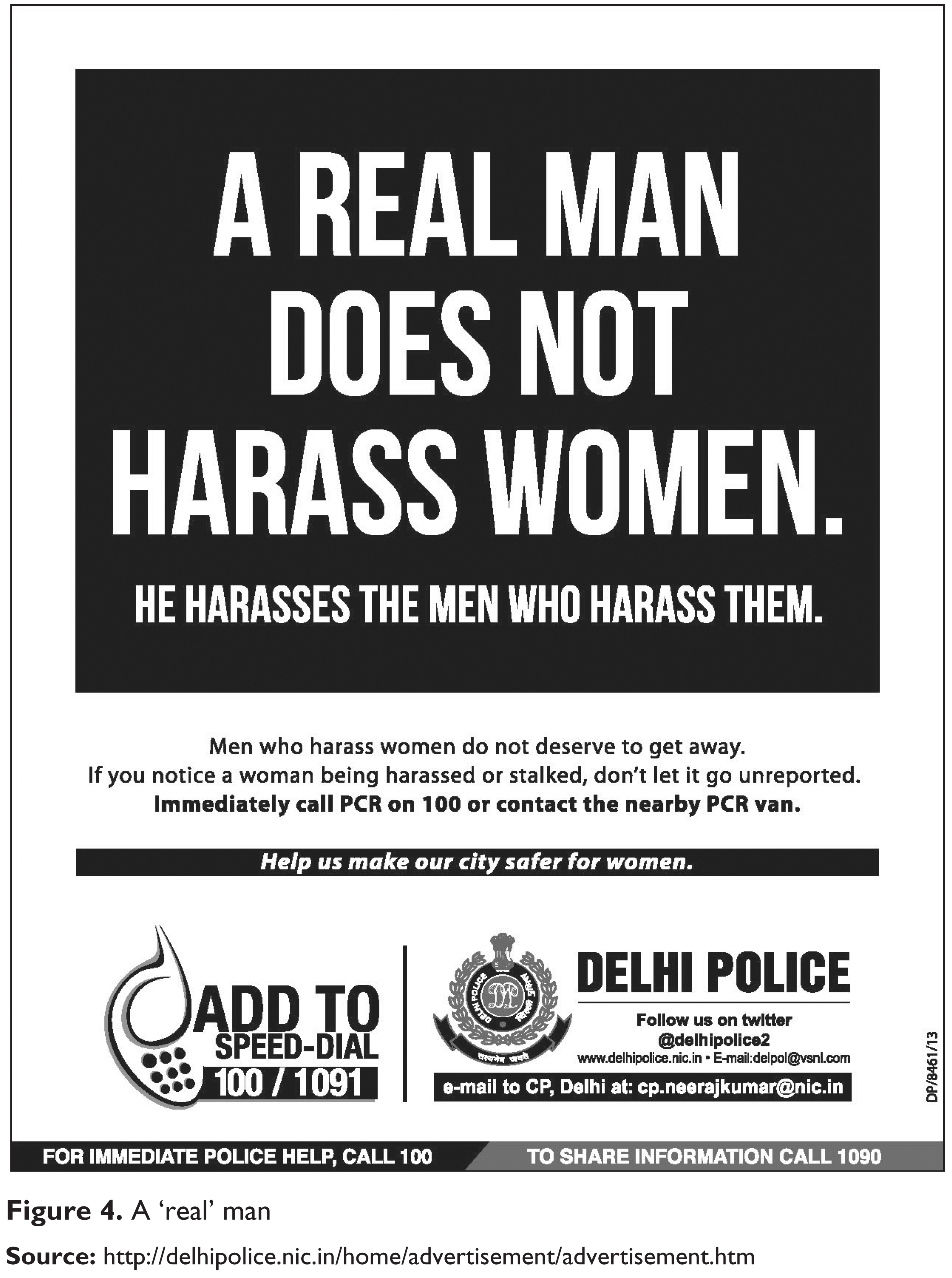
Thus, the image tells us the ideal form of masculinity within the official discourse of policing in Delhi is that of a protector-cum-harasser: the harasser of those who harass women. It gives out the image of an aggressive ‘protector’ man as ideal. The statement about ‘harassing the harasser’ puts an emphasis on conflicts between good and bad men for saving women, and pushes the question of women’s right against being ill-treated or sexually harassed to a back seat. It remains merely a question of good men saving powerless, passive women, who are portrayed in some ways as precious, but not as equals of men. Such a form of hegemonic masculinity would not or does not accept men in a role equal to that of women, but accepts one’s masculinity as real only when they are capable of protecting women from harassment. The statement in the advertisement about a real man going to the extent of ‘harass’ing the ‘harasser’ makes women an object of contest between two forms of masculinities, the deviant harasser masculinity and the hegemonic protector masculinity.
The dominance of the ideology of masculinist protection can be read clearly from another advertisement which specifically highlights the women’s helpline number 1091. This mention of 1091 is unlike the other advertisements discussed here. The rest of the advertisements only mention the police control room number 100, except in one case where the number 1091 is also mentioned along with 100, without specifying that it is a number dedicated to women’s safety. This advertisement (Figure 5) features a picture of popular Bollywood actor Farhan Akhtar covering a little less than half of the frame. He is not smiling, and looks very intensely towards the viewer. In the other half of the frame, the most prominent things are two sentences written in bold letters: ‘Make Delhi safer for women. Are you man enough to join me?’ followed by: ‘Don’t sit back and allow violence against women. Fight it, report it. Call Women’s Helpline No. 1091, written in sentence case.’ Under these words is placed an image of a woman police personnel about one-fifteenth in size of the image of the Bollywood actor. The woman is in full uniform, and looking over her shoulder towards the viewer with a smile on her face. She also seems to be holding a stick. At the same level as her picture, the Delhi Police logo is placed, and beneath that there is another message: Hazaron rakhwale, which would translate into English as ‘thousands of (male) protectors’. While the Delhi Police talks of increasing the number of women in the force to ensure better safety for women, it is ironical, and at the same time quite revealing, that in an advertisement specifically focusing on women’s safety, they had to use such sexist imagery. The relative placement and choice of posture and attitude of the male hero and the female cop in the frame is telling. While urging the audience to prove their ‘man’liness by fighting violence against women, the huge picture of Mr Akhtar facing the audience directly with an unsmiling stern look contrasts with the tiny smiling image of the female cop. At best, in an advertisement where an overpowering male figure is urging men to prove themselves, the female cop is reduced to a token.

While such advertisements attempt to portray pictures of ‘good’ and ‘bad’ men, and advance a general call to prove ‘man’hood, that is, the ‘good’ man image, and thus imply that one can choose and become a ‘good’ man, a recent statement of the then chief of Delhi Police B.S. Bassi 16 is quite ironical. Speaking at a conference on safety of women in the city, Mr Bassi commented: ‘I don’t think that in 500 years the mindset of men can be changed’, and hence suggested that self-defence training for girls is the only way out (The Hindu, 16 July 2015). His comments, while deviating from the optimistic call to every man to join the ‘good’ man brigade, at the same time affirm a fundamental rationale of police forces: the Hobbesian image of a conflict society based on brute force and in conditions of perpetual war.
Conclusions
Carole Pateman (1988) and Iris Marion Young (2005) have discussed that a model of an ideal man offering ‘protection’ to women is based on a hierarchical relation between men and women where women are protected, but only when they remain ‘women’, that is, when they follow the norms of an ideal feminine role as closely as possible. They may not be as chivalrous towards women who do not fit into their notion of femininity. In a force which works within the logics of such a ‘masculinist protection’, it is not surprising that police women who attempt to go beyond an emphasized feminine model face harassment and abuse, and thus are forced to enact a complicated gender role just to survive in the profession.
We observe that though the police force in Delhi attempts to make itself sensitive to gender crimes by incorporating more women into its ranks, the internal structure of male–female relations within the force is that of hegemonic masculinities, either of a brave protective man or of a powerful dominating man. The force emphasizes its ‘manly-ness’ as a guarantee against the harassment of women, and calls upon other men to join them in the effort. The attempt to make the institution gender-sensitive in such a manner does not really lead to breaking of gendered power hierarchies. It may talk of women’s ‘safety’, but does not talk of equal rights and dignity. It may have women in its ranks, but that presence does not really make a lot of difference to how the force operates.
This observation leads us to a larger question about the liberatory potential of the politics of presence. As there is no politics outside the contemporary field of power, we cannot totally refuse representational politics: in a scenario where women are systematically disadvantaged, increase in numbers of women as women in the institution of police would be a good first step. But such a contextual politics needs to be accompanied by a critical understanding of its regressive potential. Such politics of presence based on an idea of representation presumes a certain category marked by certain features/criteria as pre-existing or given, for whom representation is sought. Such presumptions tend to fix identities and roles, thus defeating the purpose of a politics seeking emancipation. Such politics to be meaningful thus needs to be accompanied by an active feminist practice against essentialization of women as a category. In the context of making a gender-sensitive police force, mere inclusion of women in the force in the absence of an active attempt to break binary sex-gender role-types thus does not appear to be an effective strategy for emancipatory politics.