







Abstract
India is in the throes of a massive demographic turn. People born and brought up after 1986 constitute the bulk of the population. Studies elsewhere show that generational replacement transforms societies and can play a key role in changing the political attitudes and behaviour of the electorate. Over the last few general elections the Indian National Congress has witnessed a steady decline in support, while the Bharatiya Janata Party has seen a surge in support. This article examines whether the decline of the Congress party is linked to a demographic shift that is taking place. The study demonstrates that generations as socio-historical space helps us nuance party-choice explanations.
Keywords
India is in the throes of a massive demographic turn. A simultaneous decline in birth rates and an increase in life expectancy will make India look very different 20 years from now. The broad contours of this change are already visible. Today, people born and brought up after 1986 constitute the bulk of the population, and over 40% of India’s population is under 20. Today’s youth will constitute an overwhelming majority of the population since newer cohorts are likely to live longer than previous generations.
Generational replacement transforms societies and can play a key role in changing the political attitudes and behaviour of the electorate, as studies from the United States (Andersen, 1979), the United Kingdom (Butler & Stoke, 1974) and Israel (Abramson, 1979) show. In India, we have witnessed a steady decline in support for the Indian National Congress, henceforth Congress, and a surge for the Bharatiya Janata Party (BJP) over the last few elections. Is this decline of the Congress linked to a demographic shift that is taking place?
While there are reasoned explanations for the decline of the Congress, there has probably been no systematic attempt to examine the impact of a generational turnover on the party system. This article asks two questions. First, do diverse age groups have typical political choices? Second, following from the first, if there are differences, are these a result of long-term generational divergence?
The article is organized into five sections. In the first section, I review the literature on political choice in India and studies on generational change and party choice elsewhere. Then I offer a framework to explain the relationship between party choice and age. The following section describes the empirical strategy and the data used to test the research hypotheses. The penultimate section presents the results from the data analysis and draws some tentative conclusions about the population characteristics of the sample regarding party choices. The final section summarizes and concludes.
Review of Literature
A combination of social structural and contextual factors are the dominant explanatory variables in the research on vote choice in India. A bulk of the contributions predominantly focus on social-structural factors, including caste (Verma, 2009; Yadav & Palshikar, 2009), gender (Deshpande, 2004, 2009), religion (Alam, 2009) and location (Falcao, 2009). At the same time, a wide variety of contextual factors have received attention, including economic circumstances (Suri, 2004, 2009), leadership (Chhibber & Ostermann, 2014; Shastri, 2009, 2019; Shastri & Syal 2014;); incumbency and government performance (Chhibber, 2009), governance (Kumar & Ranjan, 2009; Shankar & Sisodia, 2009); alliances (Kailash, 2009; Sridharan, 2004), electoral-systemic features (Palshikar, 2014) and campaign (Palshikar & Suri, 2014; Yadav, 2004). At the same time, there is much overlap between the different explanations.
Social-structural explanations ignore individual changes and, consequently, miss the link between social and individual change. As Alwin and Krosnick (1991) argue, social change and individual change are connected; while people change because of social changes, how people change has an impact on societal change. The neglect of age (individual change) as an influencing factor of vote choice studies of voting behaviour in India is not surprising.
Dismissing the significance of age, Yadav and Palshikar (2009, p. 39) make two points; first, age has not been a significant cleavage in Indian politics. Second, implicitly endorsing the ‘impressionable years hypothesis’, they argue that the age effect, if any, in terms of the surge of support new parties receive from younger cohorts fades away after a few elections. At the same time, they believe there is a generational effect for the BJP since it enjoys significant support from those under 25. A couple of questions follow. First, does the age effect dissipate? What if an enduring relationship exists between the younger cohorts and the new parties of their time? Before we push the age variable aside, we should examine these questions.
In age-related studies, one can identify at least four competing hypotheses (Niemi & Jennings, 1981). The ‘life-long persistence’ hypothesis argues that the impact of early socialization continues to inform the individual and endures throughout life. In contrast, the ‘life-long openness’ hypothesis does not see any stability in attitudes since individuals are open to receiving new ideas throughout their life. The ‘life-cycle’ hypothesis argues that while some attitudes endure, others are amenable to change given changes in the stages of life.
Finally, the ‘generational model’, like the life-cycle hypothesis, takes a middle position and leans towards the persistence model but does not argue that change will necessarily occur. Since different generations’ formative social and political experiences vary, different cohorts potentially have different attitudinal perspectives on issues and events. If this is the case, the replacement of older cohorts by younger groups impacts the nature and direction of political and social change. This model overcomes some of the limitations of the social-structural framework as it accounts for the relationship between individual and social change.
While there are differences between these models as to whether preferences and values remain stable over a lifetime, there is a general agreement about the importance of the early adulthood period in an individual’s life (Braungart & Braungart, 1986). A broad range of political and social values and attitudes crystallized in the period of the ‘coming of age’ influence political behaviour, including party and voting choice, for a long time to come (Converse, 1976; Franklin, 2004; Inglehart, 1989; Mannheim, 1952; Putnam, 2000). Furthermore, beyond the impressionable phase, attitudes and opinions are expected to change less incrementally (Alwin & Krosnick, 1991). Finally, the same happenings have different meanings for people since they are a product of different eras.
There has been considerable work on the impact of generational replacement in the context of the West. Studies have examined how generational change has impacted a variety of factors, including voting behaviour (Butler & Stoke, 1974; Goerres, 2008; Tilley, 2002), party loyalties and identification (Abramson 1976, 1979); economic policy choices, political attitudes, value preferences (Abramson & Inglehart, 1986; Dalton, 1987) and also voter turnout (Blais et al., 2004; Gallego, 2009; Strate et al., 1989; Wass, 2007). These contributions suggest that longitudinal analyses of survey data give the age variable more analytical purchase.
Analytical Framework
In this article, I use the concept of political generations to differentiate between people. The concept of political generations marks people in terms of age groups in historical-social time on the assumption that their shared experiences differentiate them from others. It differs from the popular notion of familial turnovers and succession in this respect. People in a generation exhibit similar characteristics as they have experienced comparable events and trends since they move through the same periods together. The time period allows them to witness the same political shifts, social changes and significant events. In response to their experiences, they are likely to develop and share similar values, beliefs, and choices. While there will be individual differences, a generational lens helps us capture the views and beliefs across a larger cross-section of the population.
The question of what shapes a generation then becomes essential. Since we are examining the relationship between age and party choice, it would be helpful to examine how parties and party systems influence voter choices. We should expect that those who have grown up during the same historical period will be affected by parties which are more visible during their formative years as young voters. Here visibility is not limited to success in government but also includes new parties that take a stand different from the frameworks offered by the dominant parties. Since the young voter has not made up their mind and is impressionable, they are likely to be partisan towards the leadership, assertions and agendas these parties articulate.
This study moves away from the dominant orientation in the literature, which focuses on the more ‘active and successful’ parties in terms of being in government, to include parties in the opposition as well. The literature assumes that political systems have fully competitive party systems from the beginning. However, what happens in dominant party systems with open and fair competition? Here a focus on winners is inadequate, as it leaves no space for explaining change whenever it happens. Since the nature of political competition differs in dominant party systems, we need to include opposition parties.
In the context of India, for instance, the first-mover advantage and political capital of the historical national movement gave the dominant party—the Congress, a tremendous advantage over the opposition. The Congress system (Kothari, 1964) was not a mechanical one-party dominance; the party had its foot in both camps. On the one hand, it was the ‘agent of criticism and change’ dissent and voice of the nation. On the other hand, the Congress was also the party of the government. Since there was a consensus on the role and goals, the opposition’s task was complicated.
Nevertheless, the opposition parties acted as ‘parties of pressure’ working on the factions within the Congress. The opposition was conscious of not merely their position but the ‘compulsions’ of their times. They believed they had a ‘corrective’ and not competitive role, and, therefore, their task was not to oppose in the traditional sense but to ‘cooperate with the ruling party in a critical spirit’. The ‘form and substance of politics’ (Kothari, 1961) in India is very different from the typical assumptions that the literature makes.
However, as political participation drew new groups and new social cleavages got politicized, the dominant party’s capacity to meet varied demands waned, opening up spaces for other ideas and parties (Sridharan, 2002, pp. 492–495). Besides making niche appeals, the opposition also attempted to chip away at the disenchanted. As is often the case, besides the anti-status quo critics, the young are more likely to be exhausted by the political ideas and policies offered by the dominant party. There is a consensus among observers that during the one-party dominant phase, the non-Congress parties were attracting young people (Kochanek, 1968; Weiner, 1967).
We can, therefore, assume that the young voter is likely to be attracted by new messages, political activities and lines taken by the opposition rather than the incumbent. When the dominant party system continues for an extended period, different anti-incumbent parties are likely to come up. These parties express their dissatisfaction with the existing order often in different ways, and consequently, their appeals vary. The different contexts and points of time in which new parties rise will coincide with different cohorts coming of age. As generations succeed one another, new generations with varying affinities of party replace older generations leading to political change and party system change.
Methodology, Data and Measures
To examine the influence of age in elections in India, I analyse a merged dataset from a series of National Election Studies (NES) surveys carried out after every general election since 1996. These were cross-national post-election surveys of Indian voters conducted by the Lokniti, Centre for the Study of Developing Societies (CSDS), Delhi, for general elections held between 1996 and 2019 after each election but before the votes were counted (Table 1).
Sample Size in National Election Studies 1996–2019.

Though the NES samples only those on the electoral rolls (registered voters), these surveys are representative cross-sections of the general population. The achieved national sample profile of the NES has almost always been close to that of the census figures. These surveys help us examine generations who came of age from when India gained independence until today.
My main dependent variable is the recall of vote choice in the general election. I use vote choice rather than party support since the NES is more likely to consistently measure vote choice rather than party support as it is an election survey. I am aware that vote choice is a provisional measure and not a stable disposition since it is dependent upon a host of other factors, including government performance, issues of the day, office to which elections are held as well as qualities of the candidate among other factors (Jenson, 1976). Furthermore, voters may not be attached or psychologically linked to a party when voting for one party (Seth, 1971).
I distinguish between five sets of political parties. While chronology is an element in the rise and fall of political parties, it may be an inadequate marker, as the role of leadership, individual political actors, their skills and resources need to be included (Kitschelt, 1988, pp. 196–197). Chhibber et al. (2014) found that ambitious leaders exit parties when their career advancement potential decreases, leading to a rise in the number of parties. In India, where parties are associated with a particular leader, while the party may be of recent vintage, the leadership could be from another era. It follows that any classification of parties will have to take into leadership besides the party’s age.
The first two are the Congress and the BJP. The two polity-wide parties are examined in separate categories as they have been the major actors from 1996 to 2019. The remaining political parties are divided into three categories. The ‘classical opposition parties’ form the third category. They include among themselves the oldest surviving and active parties in India. I include most parties that were active since the inauguration of competitive elections and formed the primary opposition to the Congress. These parties were at their peak in the centralization phase of the Congress and the subsequent anti-emergency agitation.
The classical opposition parties include the Communist Party of India (Marxist) (CPM), Communist Party of India (CPI), Revolutionary Socialist Party (India) (RSP) and others that comprise what is called the Left Front and the state-based parties like the Akali Dal (SAD), National Conference (JKN) and the Dravida Munnetra Kazhagam (DMK), among others. I also include parties like the Telugu Desam Party (TDP) and the Janata party family in this category since the party or its leadership were active or earned their spurs during Congress dominance. A characteristic feature of these is their well-defined programmatic critique of the Congress. They have been critical of the centrist development model and the strong-centre model of federalism, which privileged the centre.
In the fourth category of parties, we have ‘transformation parties’. Many of these parties are mobilizers and products of the ‘democratic upsurge’ (Yadav, 1996). These parties mainly formed between the mid-80s and the end of the century. I also include parties that emerged from the Congress, like the Nationalist Congress Party (NCP) and the All-India Trinamool Congress (AITC). While some parties have polity-wide ambitions like the Bahujan Samaj Party (BSP), there are state-based parties like the Marumalarchi Dravida Munnetra Kazhagam (MDMK), Pattali Makkal Katchi (PMK) and so on.
Many of these parties were formed by breakaway leaders who build parties around themselves after their ambitions were stymied. Unlike the classical opposition parties, the transformation parties do not have any common thread that binds them, and there is a definite step down in terms of programmatic reach, and their concerns are limited to distinctive groups.
The ‘post-Congress parties’ form the final category of political parties. They originated in this century and in many ways after the inauguration of the post-Congress polity. More than any other category, these new parties are likely to be linked to particular individuals. They share the feature of being tied to specific states, appealing to limited groups, and having no distinctive programmatic agenda with the transformation parties.
The primary independent variable is a generational group identification in four categories: the ‘Nehruvian’, ‘Emergency’, ‘Liberalization’, and the ‘Post-Congress’. The categorization is based on the assumption that the relevant variation is between the generations and not within. In this study, I use 15 years as a marker for socialization. The key differentiating factor is the political and socio-economic events during the formative years of each generational cohort (Table 2).
Mapping Political Generations in India.
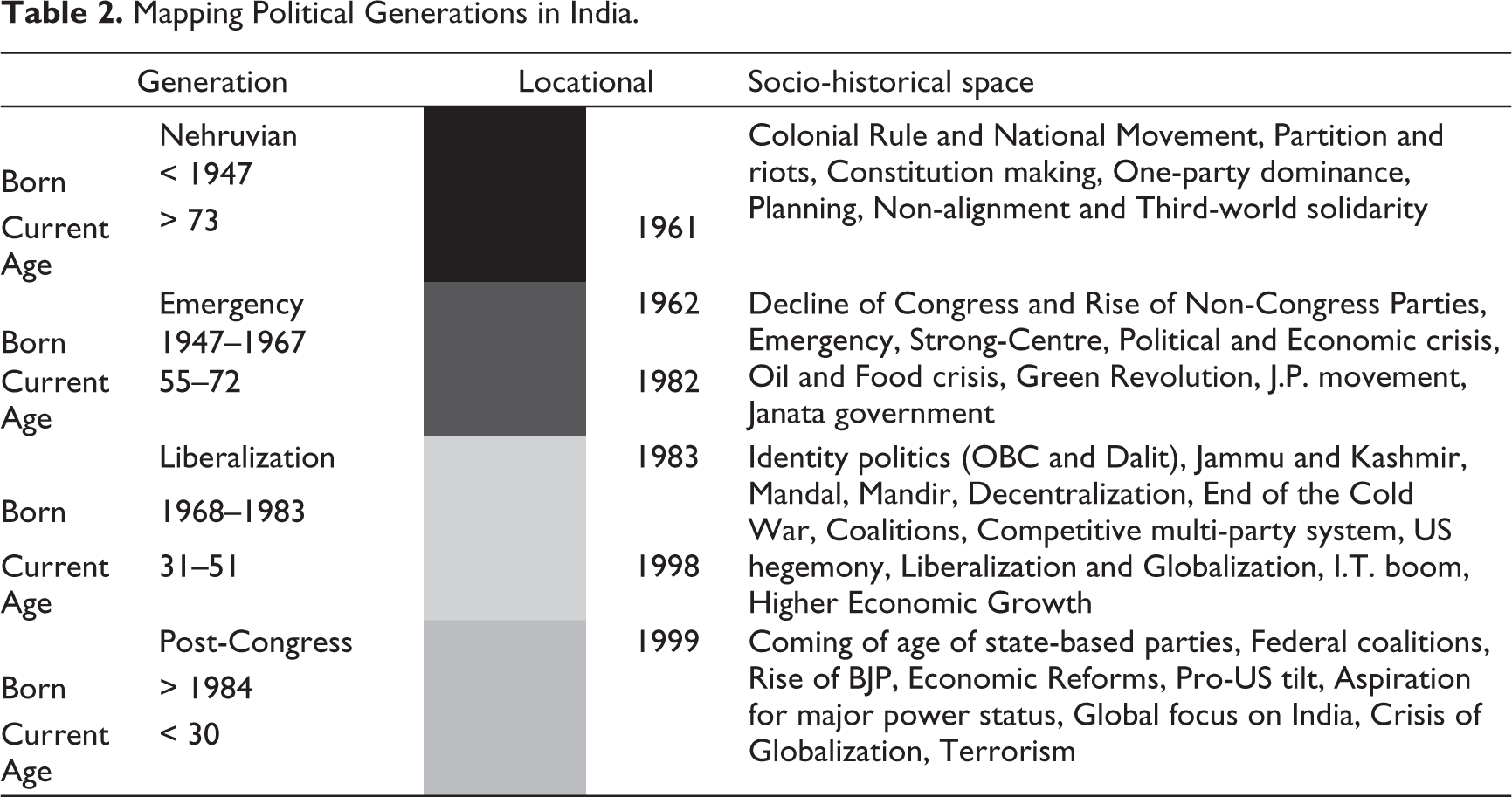
The first category is the ‘Nehruvian Generation’. They were born during colonial rule and would have turned 15 by 1961. This generation’s older members witnessed a series of significant events in India’s historical evolution. They would be the last of modern India’s link to the national movement. By the 2019 elections, the youngest of this generation would probably be around 73 years.
The Nehruvian Generation is the first generation of modern Indian politics. The goals and aspirations of the nationalist struggle would probably be their primary socialization values. The formative years of the younger members of this generation were exciting times for modern India. Nehru’s vision of a secular, socialist, democratic nation and his worldview probably inspired not only his generation but a generation of youth beyond his own (Tharoor, 2003). This vision was probably the official position until very recently. Today, it is this Nehruvian legacy that divides leaders and generations.
The second category, the ‘Emergency Generation’ born between 1947 and 1967, is a product of post-independence politics. Their formative years were a critical phase in Indian politics when the opposition to the Congress acquired and exercised power. This generation saw two contradictory pulls at work. On the one hand, this phase witnessed the pressures of rising aspirations due to societal and economic change initiated since independence. On the other hand, there was also a legitimacy crisis when the system could no longer live up to the standards it set for itself.
There are two distinct phases in this period. If the national movement stressed democracy and national unity, in the first phase of this period, the emphasis was on high principles of morality and ethics in public life and social justice. The theme of social justice and the questioning of upper-caste hegemony became an integral part of the political vocabulary. Non-Congress parties led movements explicitly targeting the youth and claimed to recover the essence of the freedom struggle and stop a further decline of the political system.
The latter half of this phase is characterized by what Palshikar (2015) calls four distinctive developments transforming democratic and competitive politics. First, the Congress took up the opposition challenge by embracing a communal fault line in the 1980s. Second, the BJP exploited the communal cleavage and wrested a space. Third, there was a shift to a new ‘middle ground’ characterized by majoritarian politics, which included religious, regional, and caste-based ideas of the majority. Fourth, the majority came to be identified with nationalism. This transformation in competitive politics becomes the base for the formative phase of the new generation subsequently.
The ‘Liberalization Generation’ was born after 1968 but before 1984, and their formative years coincided with the great Indian transformation of the 1990s. The period witnessed tremendous economic prosperity coinciding with a shift from a planned to a more open-market economy. At the international level, there was the collapse of the Soviet Union, the end of the Cold War, the rise of the United States, increased attention to so-called global terrorism and so on.
This liberalization generation was probably the first to have widespread access to education and health facilities. With market-led development, personal enrichment became the principal preoccupation. This generation was not only self-confident and outward looking but also impatient with the idealism of the old (Titus, 2015). India’s cultural and economic links with the West, especially with the United States, increased dramatically during this period. With many Indians living and working outside, Aseema Sinha (2007, pp. 46–47) believes that within this generation, there could be greater support for Western-style democratic institutions and ‘embrace of Western and pro-democratic ideas’.
The formative years of this generation were critical in another way. If the emergency period was the high tide of the classical opposition parties, this was the era of the BJP. It gradually moved from being an outlier to the main opposition party. The party’s Hindu nationalist agenda and dramatic Rath Yatra culminated with the destruction of the mosque in Ayodhya in 1992. This movement of the BJP parallels the evolution of a new ‘middle ground’ in Indian politics (Palshikar, 2004). One could argue that this new space is antithetical to the earlier dominant Nehruvian social-democratic liberal position.
Our final generational category is the ‘post-Congress Generation’, born after 1983 and voted for the first time in 2004. This generation witnessed the high point of liberalization and globalization. This was a period of high economic growth, and India was everywhere and attracting much global attention. The pro-US tilt continued and was strengthened in this period. In this phase, state-based political parties became prominent actors at the federal level. The BJP came to power at the centre, and its ascendance as a party of government also happened now.
Socio-economic indicators, locality, class, caste, and education, have been used to explain vote choice in India. It is often assumed that the collective experiences of people located in the same caste category are similar, and consequently, their vote choices are alike. Similarly, we are also told that party votes vary with location. For instance, in the popular understanding, the BJP is an urban party. Does location make a difference in vote choices?
Likewise, it is held that class and education also matter to vote choices. The differential experiences of the poor and the rich or the non-literate and those with greater educational opportunities will likely lead them to make different political choices. However, we must ask what happens when we control these socio-economic indicators with our generational variable. I expect that if the historical-space experiences of generations matter, then the choices of those in similar locales, caste and class groups will vary from generation to generation. In other words, class, caste, locality, and educational opportunities will not matter when we account for generational differences.
I also have three political variables that could influence vote choices. These include closeness to a party, determinants of party choice and party competition at the state level. Does proximity to a particular party matter when voting? I did mention earlier that Indians are not very forthcoming on the issue of closeness. Nevertheless, in comparative studies, party closeness is a widely used measure of partisanship. Related to partisanship is the question of what determines party choice. Does it matter when people exercise vote choices? In the context of this article, it may be useful to examine whether these factors vary according to generation. If historical-social space experiences matter, we should expect a certain degree of variation.
Finally, does the nature of party competition matter? For this purpose, I have five categories of states based on the state of competition. These categories include Congress vs BJP, Congress vs others, BJP vs others, others vs others and mixed/unclear competition. The others here include classical opposition, transformation and post-Congress parties. To conclude this section 2 , we believe that while many factors influence vote choices, generational differences may ask us to take a relook at what we have taken for granted.
Results and Discussion
Before we move forward, it may be helpful to see how historical-social time shapes generations. Since independence, India has undergone multiple social and economic changes, and this is nowhere more noticeable than in education levels. Literacy and education levels are considered important markers of development, and access to education has grown manifold since independence. We should expect older generations to have less education than newer generations (Figure 1).
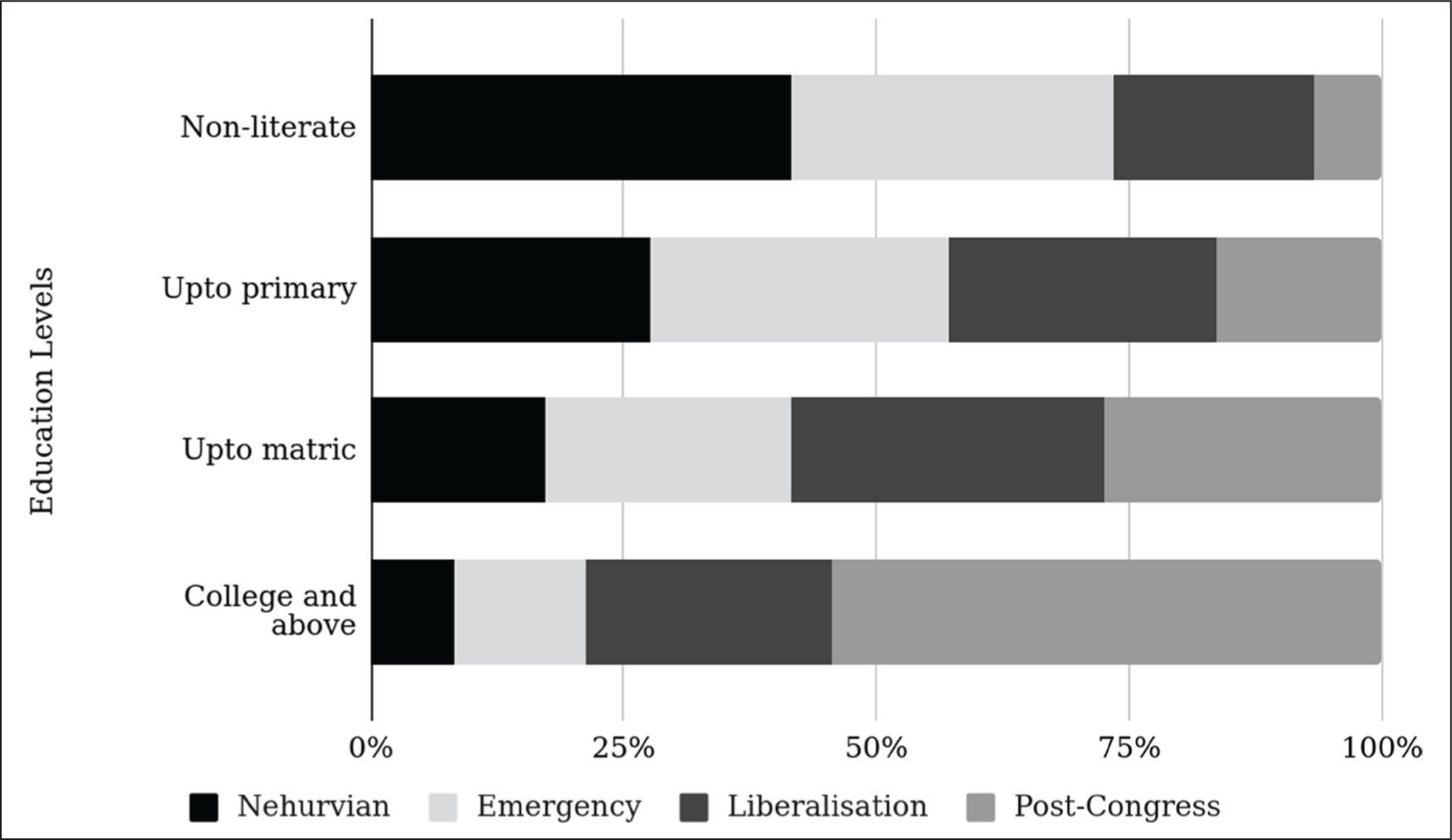
As expected, our generations stand apart from each other when it comes to education. The bulk of the Nehruvian and Emergency generations were non-literate compared to the Liberalization and post-Congress generations. The post-Congress generation’s educational attainment is much better than any previous generation, with a higher proportion of them being college-educated. In sharp contrast, one in two non-literates were from the Nehruvian generation. Access to educational life chances has varied across generations, and this variation underlines our point that generations can be a valuable unit for analysis.
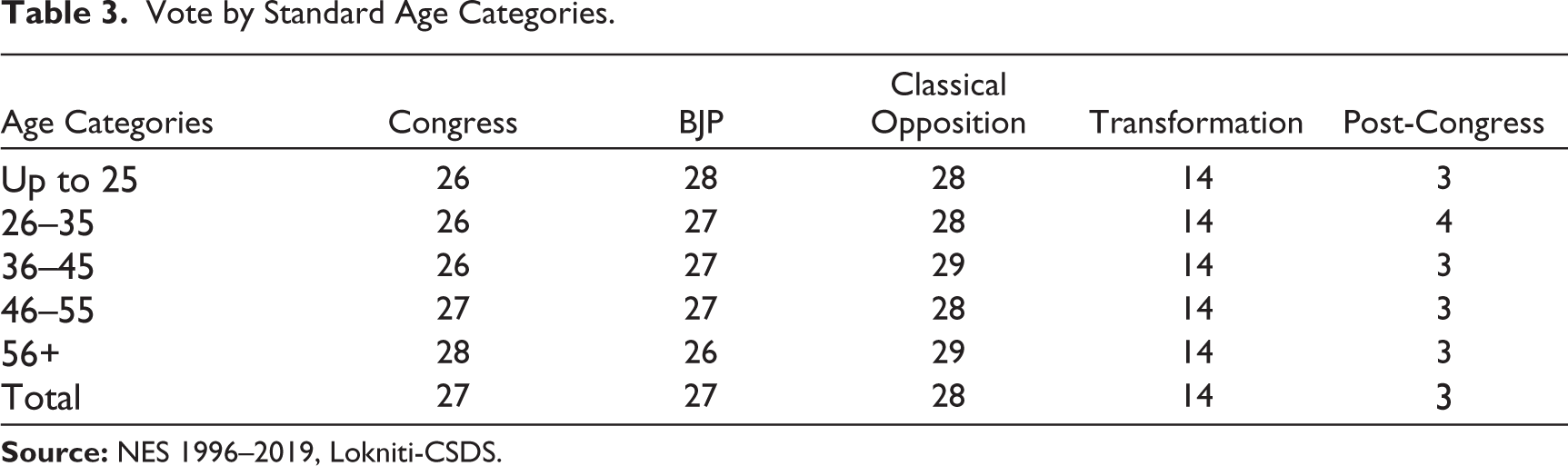
As noted earlier, analysis by age is not a widely used measure in examining voting patterns in India. One of the reasons for this could be that when voters are classified in standard age categories, it is difficult to discern any pattern in voting choices. The standard age categories (five-year or decadal age groups as in Table 3) may be useful for demographic or epidemiological studies but do not yield useful age-specific comparisons and conclusions when it comes to political choices.
Vote by Standard Age Categories.
Generations and Party Choice 1996–2014
The odds ratio is a useful analytical tool since they have useful statistical properties that help estimate differences in the voting behaviour of different generations and make comparisons across time (Heath & Yadav, 1999). In this study, we want to know the odds of a particular generation supporting a specific political party compared to the odds of support that party receives in the sample as a whole. This measure helps us distinguish between different generations and tells us whether a particular generation has a distinctive voting pattern.
A ratio of 1:1 indicates that the odds of a generation supporting the party are the same as it was overall. In contrast, an odds ratio above 1:1 would indicate that the generation in question supports the party strongly, and an odds ratio below 1:1 would indicate weaker support. The odds ratio, therefore, brings out both the peculiarities and patterns of support. Since odds ratios change with the overall support parties receive, they are also helpful for comparison. They allow us to not only compare between different groups but also between elections as well.
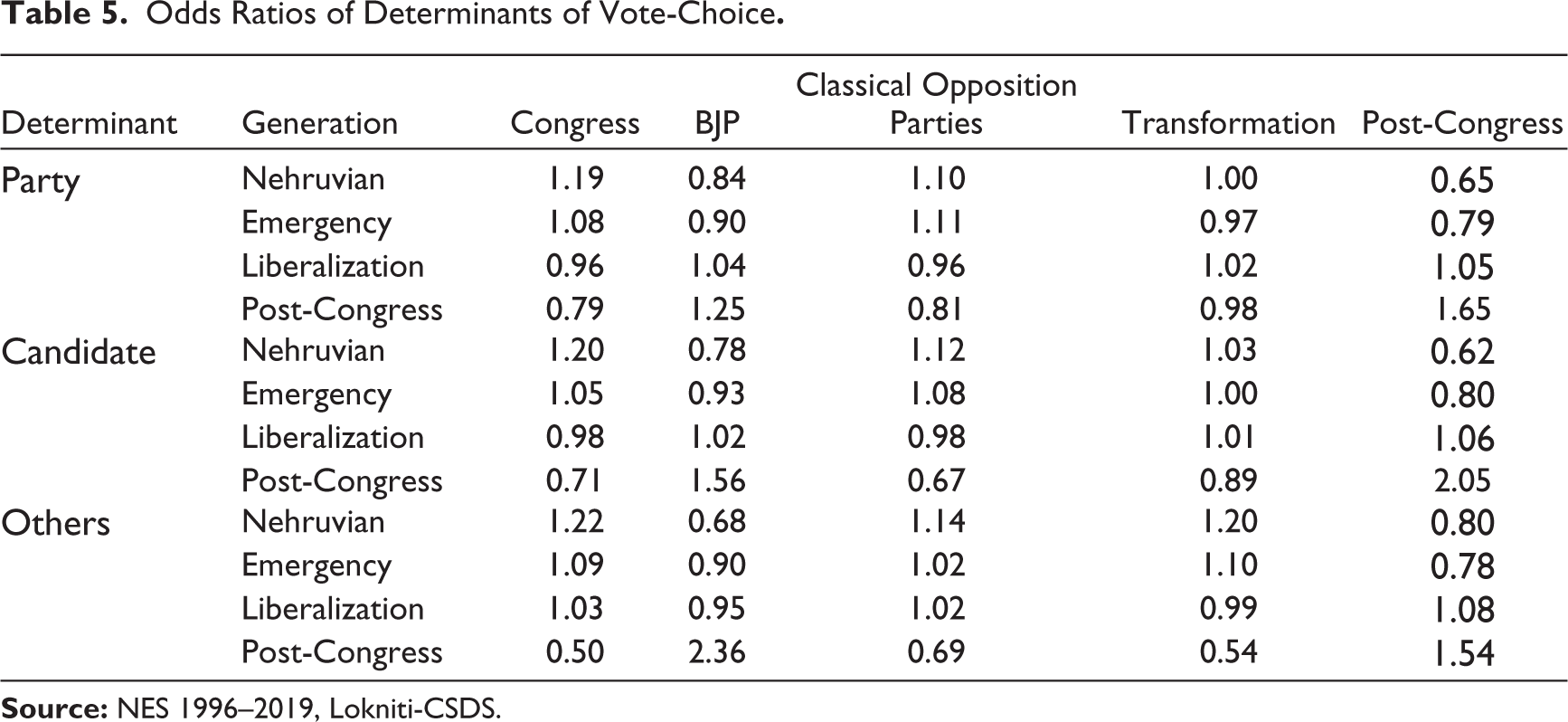
Our results show there is a definitive generational divide when it comes to party choices, especially between the Congress and the BJP. What the Nehruvian generation is to the Congress, the Liberalization and post-Congress generations are to the BJP. Since 1996, the Nehruvian generation has consistently stood with the Congress rather than with any other party family. The odds of the Nehruvian generation supporting the BJP have always been lower than the support it receives from the voters as a whole, including both the 2014 and 2019 elections when the party wiped the competition clean. The Liberalization and post-Congress generations have been with the BJP all through, and the odds of these generations supporting the Congress have always been lower than the support for the Congress in the surveys.
The Classical opposition parties are the main competitors to the Congress for the support of the Nehruvian generation. When the Congress slipped, these parties benefitted, which can be seen in both 2014 and 2019. Though the Emergency Generation throws up mixed results with Congress, the BJP, the Classical opposition and even the transformation parties benefiting from their support, the Classical opposition consistently received support from the Emergency Generation. Their support for the BJP was lower than what the BJP received from our sample in 2014 and 2019.
Unlike the other categories of parties, there is no discernible pattern of generational support for the set of transformational parties. The post-Congress set of parties were not surprisingly supported by the Liberalization and post-Congress generations. The Emergency generation was least likely of all generations to offer support to these parties.
We need to account for this generational variation to get an accurate picture of vote choices. For instance, when we examine the relationship between economic class and party choice, we are given to understand that as we move up the economic ladder, the vote for the Congress goes down while it increases for the BJP. However, when we control economic class with generations, we get a more nuanced picture of class voting. We see that the Nehruvian and Emergency generations across the economic class ladder prefer the Congress, regardless of whether they are poor or rich. However, the support the Congress gets from the Liberalization and the post-Congress generations, irrespective of class, is always lower than the support the Congress receives. The same division holds when we look at rural-urban voting patterns with the Liberalization and post-Congress generations supporting the BJP across generations.
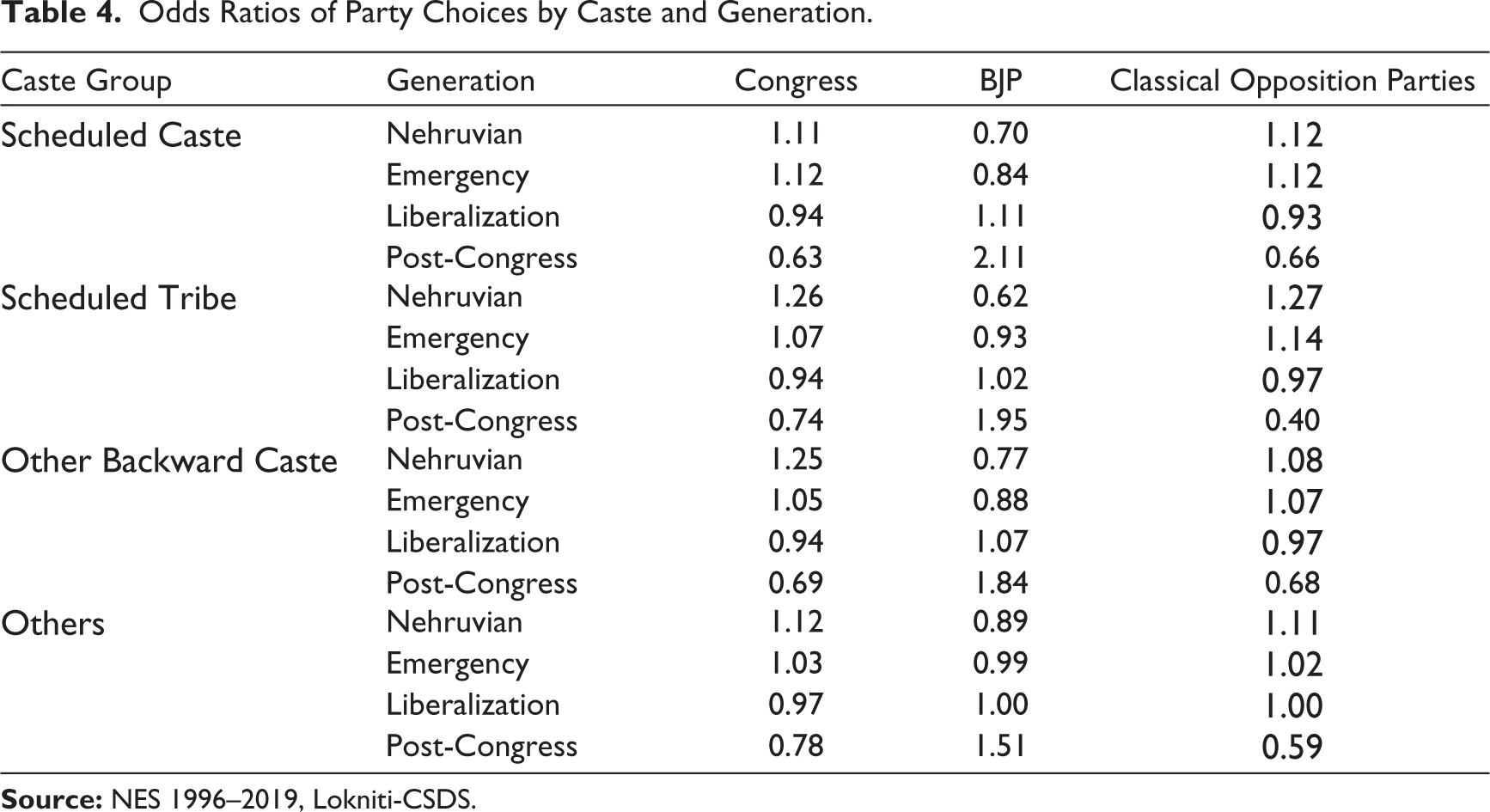
We get a similar picture when we examine the relationship between caste categories and vote choices. The Congress vote share goes up as we move from the so-called upper castes to the other groups like Scheduled Castes and Scheduled Tribes. However, when we use a generational lens, we see that the Liberalization and post-Congress generations across all caste categories are less likely to support the Congress. The BJP, it appears, receives its greatest support from the post-Congress generation compared to other generations within the caste categories.
This differentiation within caste categories as seen in Table 4 is significant. This, in a way, asks questions of the dominant assumption that views caste categories as monolithic and undifferentiated. Our generational analysis shows that the vote choice of the younger generations, Liberalization and post-Congress, is distinct from that of the older generations.
Odds Ratios of Party Choices by Caste and Generation.
Moving to our political variables, a generational difference is also visible when we examine party choice determinants, reinforcing the point that the newer generations prefer the BJP. Voters were asked what determined their vote for a particular party. Besides party and candidate, there was an open-ended option in the survey instrument which allowed the respondent to state any other reason. These other reasons included leadership, prime-ministerial candidates, competence, integrity, campaign, etc. Table 5 shows that the newer generation voters, especially the post-Congress generation, preferred the BJP, irrespective of the determinant.
Odds Ratios of Determinants of Vote-Choice.
Votes in Congress vs BJP States.
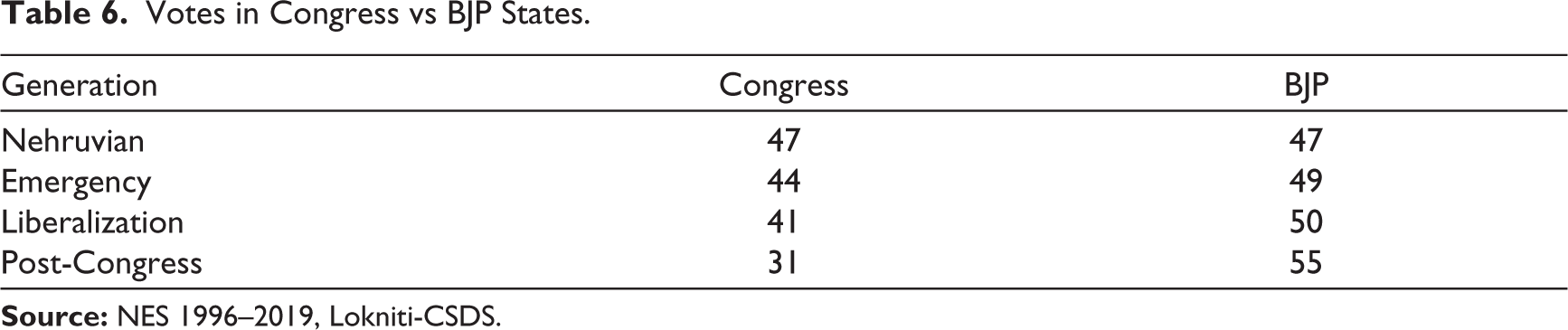
There was no definitive picture with our other two political variables, party closeness and party competition at the state level. However, it must be underlined that the generational divide between the older and newer generations comes out starkly when we focus on the states where the Congress is the main competitor to the BJP. In these states, as Table 6 shows, while the BJP has an advantage over the Congress, the BJP’s sway over the Congress increases as we move from the Nehruvian to the post-Congress generation.
Finally, to understand whether generations make a difference in voting choices, I ran a logit regression model with vote choice as the dependent variable and generations as the primary independent variable (Appendix B). The other explanatory variables in the model included locality, education, caste, class, media exposure, closeness to party, and vote determinant. The reference categories in the model included the post-Congress generation, other castes and other issues as vote determinants. Our model showed that the Nehruvian and Emergency generations are least likely to vote for the BJP, and the Congress is less likely to get votes from the Liberalization and post-Congress generations (Figures 2 and 3). For both our older generations, the post-Congress parties are their least possible preference. The Emergency generation prefers the Classical opposition parties more than other generations (Figure 4). As other studies have shown, the BJP is the preferred choice for those with higher educational achievements. Similarly, as we go up the economic ladder, the BJP is likely to benefit, while the Classical opposition and transformational parties are at a disadvantage (Figure 5). It is also not surprising that the picture of support for the post-Congress parties appears fuzzy except for the fact that party is a priority when for their voters (Figure 6).
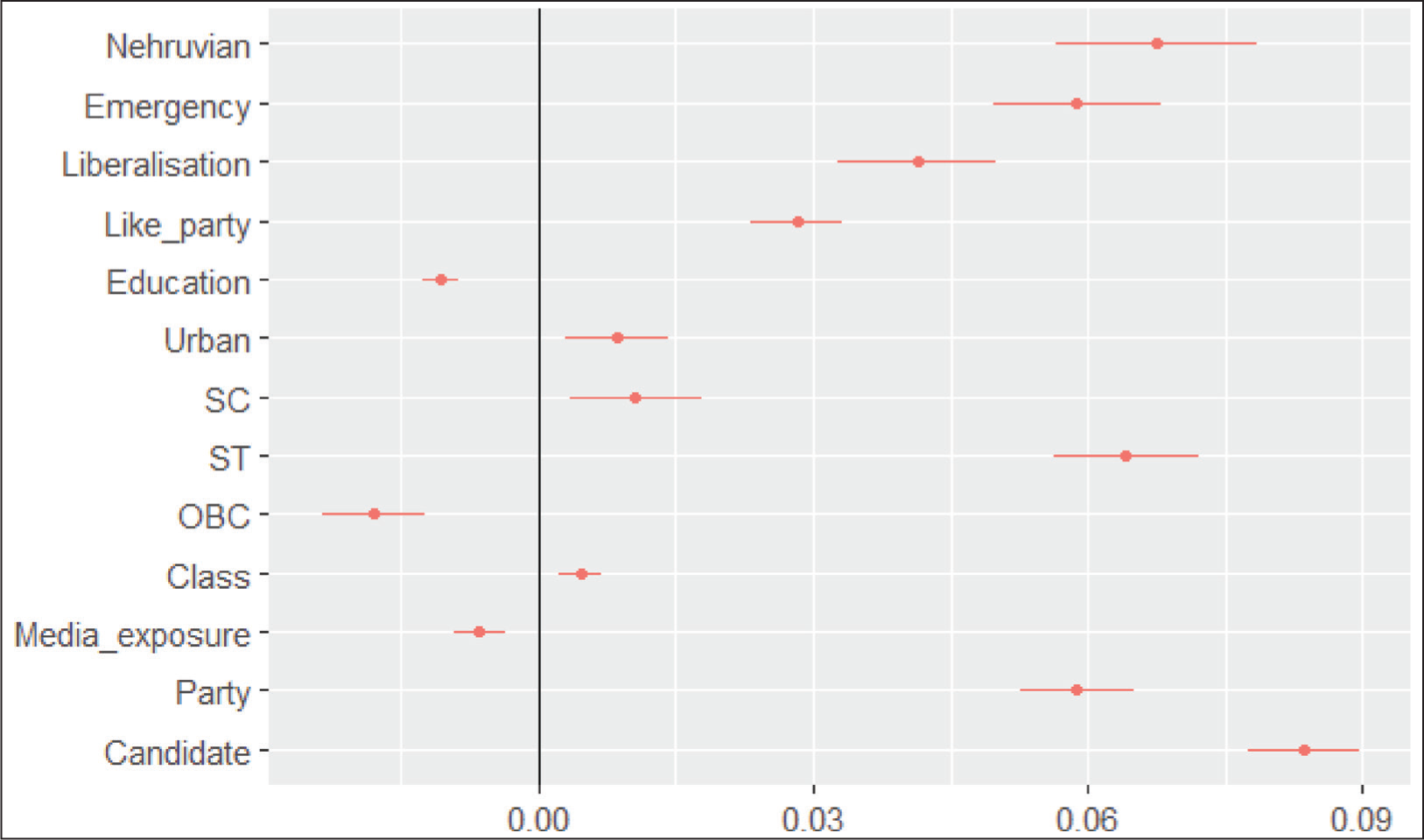
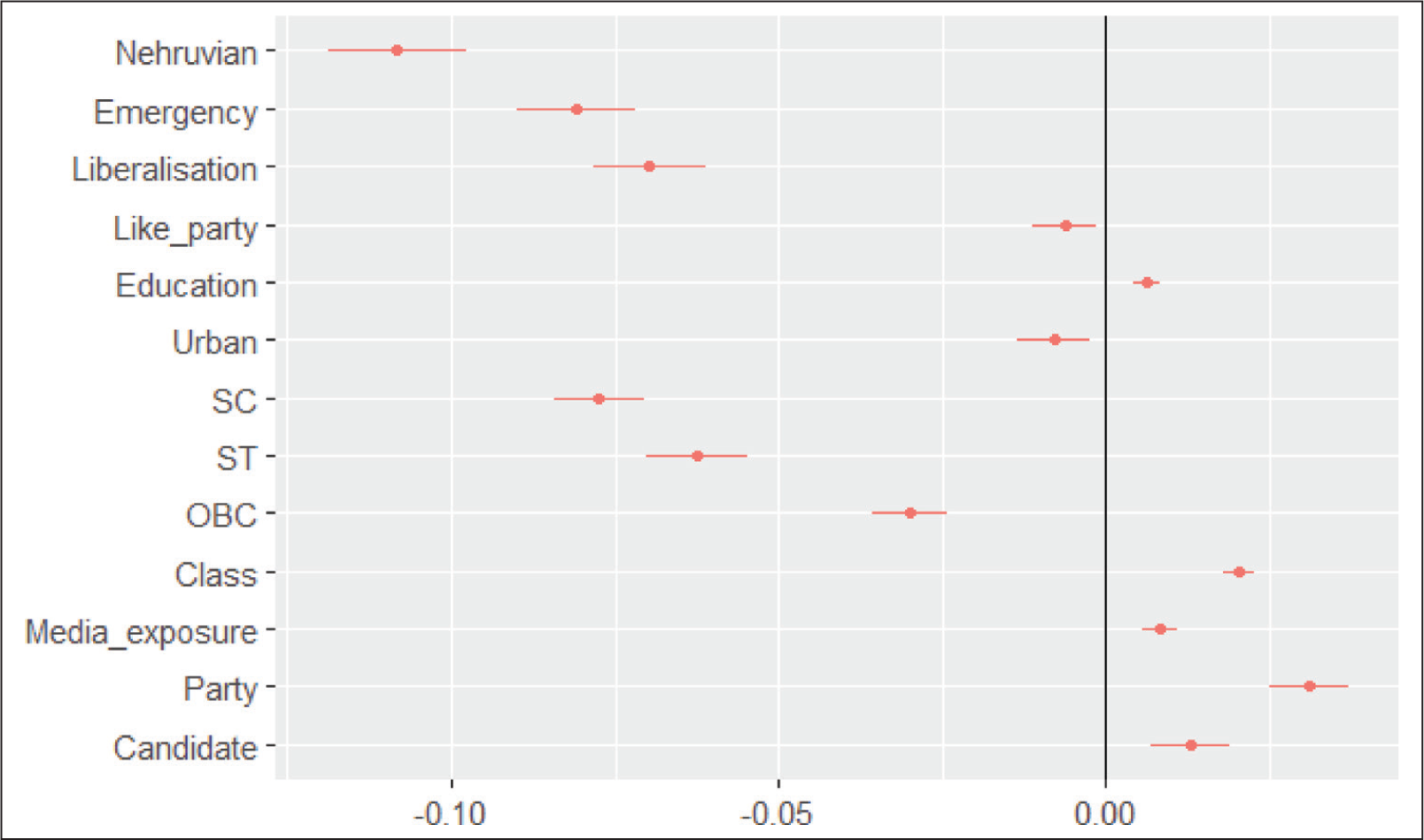
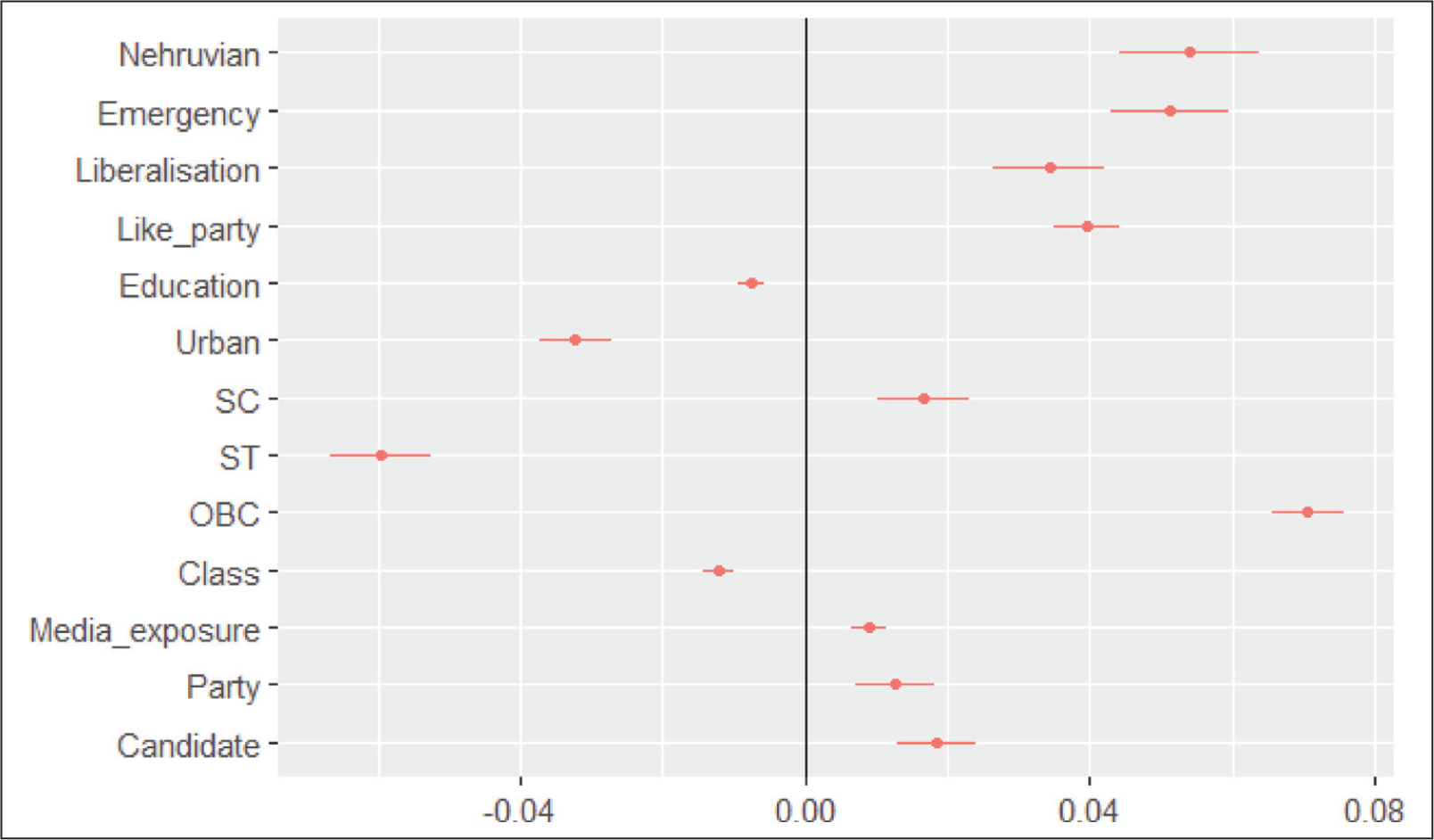
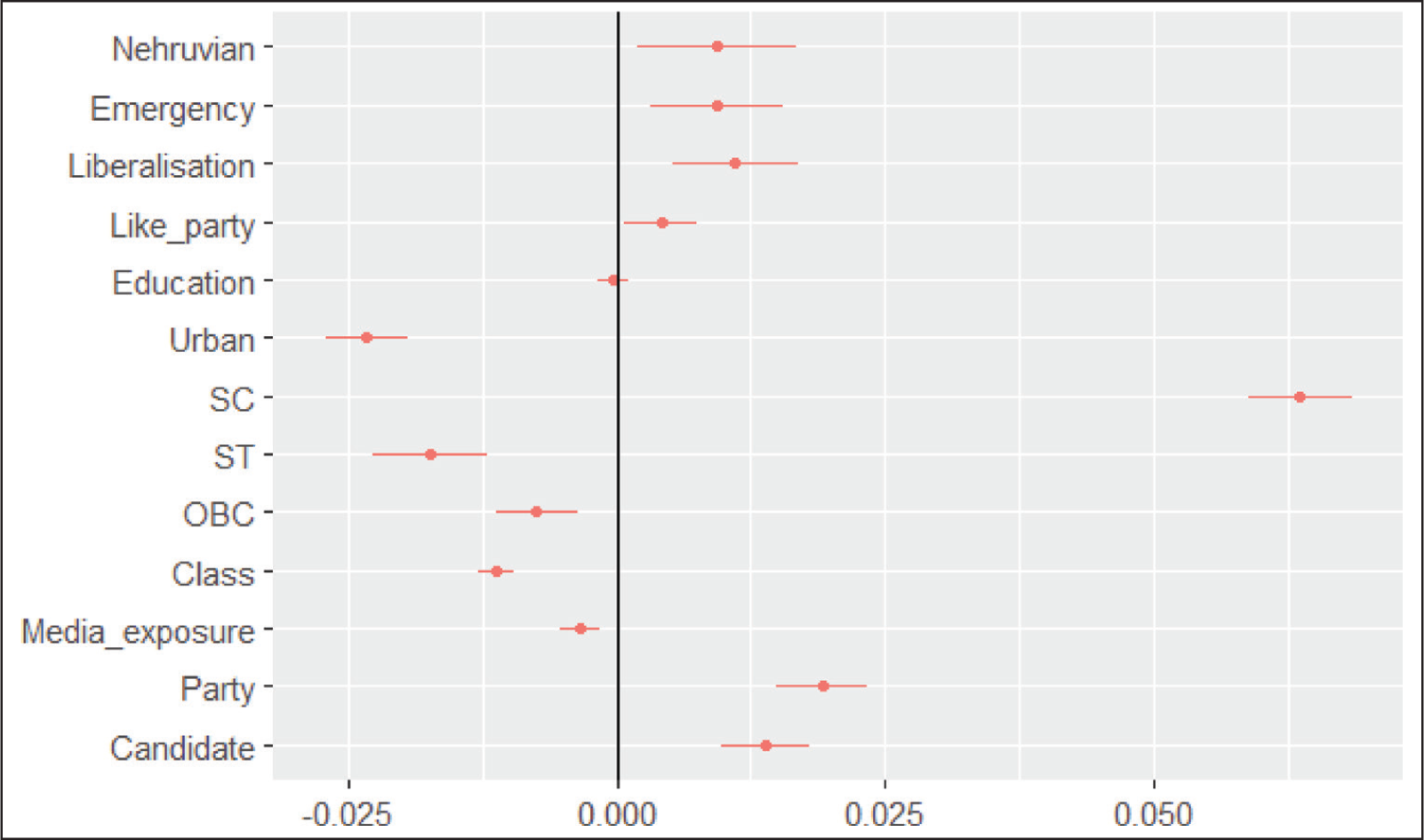

It follows that generations as socio-historical space helps us nuance party-choice explanations. As the generational turnover takes place and when the liberalization and post-Congress generation begin to occupy a greater space, the Congress and classical opposition parties are likely to be challenged.
Summary and Conclusion
During the past two decades, Indian politics has witnessed multiple transformations. Paralleling the political changes, there has also been a demographic transition. This article contributes to the study of the impact of generational change on party choices.
The Congress, the old dominant party, is bearing the brunt of the generational shift. While the rock-solid support of the Nehruvian generation for the Congress is remarkable, it also indicates a weakness of the party. The party’s support among the younger generations is much lower, and consequently, as generational shifts occur, the party is likely to be on less firm ground.
There is a definitive generational connection between political parties and the different periods in which they evolved. This study found that parties need not necessarily be in government to make a mark and capture the mind space. The Classical opposition parties and their role during the Nehruvian era and the emergency phase have given them an upper hand amongst the Emergency generation. However, like the Congress, their support from the newer generations is low.
For the BJP, its support among the Liberalization and Post-Congress generations should hold it good for many years, given the rise in life expectancy. However, there is an opposition space is waiting to be occupied. The question, however, is who will challenge the BJP and capture the mind space of the emerging generations.
Supplemental Material
Supplemental material for this article is available online.
Footnotes
Acknowledgements
I thank Rajeshwari Deshpande and Suhas Palshikar for their suggestions on an earlier version of the article and their patience and support throughout the process. I thank Himanshu Da and Jyoti Mishra for their help with the data analysis. The data used were made available by the CSDS Data Unit. Neither the Lokniti network nor the Data unit bears any responsibility for the analysis and interpretation presented here; I am responsible for any errors that remain.
Declaration of Conflicting Interests
The author declared no potential conflicts of interest with respect to the research, authorship and/or publication of this article.
Funding
The author received no financial support for the research, authorship and/or publication of this article.
Notes
References
Supplementary Material
Please find the following supplemental material available below.
For Open Access articles published under a Creative Commons License, all supplemental material carries the same license as the article it is associated with.
For non-Open Access articles published, all supplemental material carries a non-exclusive license, and permission requests for re-use of supplemental material or any part of supplemental material shall be sent directly to the copyright owner as specified in the copyright notice associated with the article.
