







Abstract
Abstract
The study took place in Southwest Nigeria and assessed the gender differentials on the challenges of land acquisition among male and female arable crop farmers. A multi-stage sampling technique was used to select 168 male arable crop farmers and 168 female arable crop farmers to make a total of 336 respondents. Analysis of the quantitative data was done using descriptive and inferential statistics, while content analysis was used to analyze the qualitative data. The results show that male and female arable crop farmers faced the challenges of high population of land users, inadequate credit facilities to acquire land, family dispute on land, poor soil fertility and high costs of rent in acquiring land, while female arable crop farmers faced the challenge of spouse restriction in acquiring land. There was a significant difference between male and female arable crop farmers’ challenges of land acquisition. It was concluded that male, as well as female, arable crop farmers in the study area face one challenge or the other in acquiring land for arable crop production, but female arable crop farmers face more challenges compared to their male counterparts. Gender-responsive policy formulation and implementation was recommended to ease access to land for male and female arable crop farmers.
Introduction
Land is an essential natural resource, a significant factor of production and a vital input in agricultural production, particularly for developing countries with large rural populations where most people earn a living through agriculture (Marie et al., 2014). Land accessibility for arable crop farmers is germane to sustainable food production, even though accessibility and control remain problems of land acquisition for arable crop production in Nigeria. In this regard, Aluko and Amidu (2006) posited that Nigeria should pay close attention to the issue of land accessibility. However, access to land and title ownership in Nigeria are determined by the state and characterised by several actors, including traditional/community leaders, the government, middlemen, families, lawyers and estate agents, among others (Udoekanem et al., 2014). The ownership structure of land in Nigeria is positively skewed in favour of males; male farmers typically own more land compared to their female counterparts (Adekola et al., 2013). This is despite the significant contribution of female farmers to agricultural production.
The availability of land to farmers for crop production involves a complex interaction of variables, including population size, stage of the nation’s development, technological level of the nation and land tenure system. The land tenure system put a significant hindrance on the amount of land available for all categories of farmers (Ojo & Afolabi, 2003). Even though the country of Nigeria has vast arable lands, there is still no equitable access to them by the majority of the rural dwellers. Lack of cooperation among farmers, financial constraints and cultural constraints are some of the factors influencing land acquisition among arable crop farmers (Adamu, 2014). Non-indigene farmers face tougher challenges, as land acquisition is often based on indigeneity. In the same vein, female farmers face more challenges in land acquisition; in contrast to their male counterparts, female farmers have limited access to and control over land (Britwum & Akorsu, 2016). In most African societies, female farmers gain land use rights from their husbands; this deprives them of independents rights to control the use of land (Cousins & Claassens, 2006). Male farmers have superiority and dominance in land acquisition, as identified by Onya et al. (2019); this is directly linked with the patriarchal nature of Nigerian society (Lawanson, 2010). Thus, this poses more challenges for female farmers to acquire land for agricultural production. There are various documented challenges of land acquisition in the literature; however, the gender-disaggregated empirical evidence on the challenges of land acquisition is scanty. Hence, this study intends to fill this gap by providing an in-depth empirical answer to the following research questions:
What are the socio-economic characteristics of male and female arable crop farmers in the study area? What are the gender challenges of land acquisition among farmers in the study area?
Objectives of the Study
The main objective of the study is to analyze the gender differentials in challenges of land acquisition among arable crop farmers in Southwest Nigeria.
The specific objectives are to:
identify the various challenges of land acquisition encountered by male and female arable crop farmers in the study area; and assess the gender differentials on the challenges in land acquisition among arable crop farmers.
In line with the above objectives, a null hypothesis, there is no significant difference between male and female arable crop farmers’ challenges in land acquisition, was tested.
Methodology
The Study Area
Southwest Nigeria was the study area. Republic of Benin borders the southwest geopolitical zone of Nigeria in the west, the Atlantic Ocean in the south, Kwara state in the north and Kogi, Edo and Delta states on the east. Southwest Nigeria comprises six states, namely Ekiti, Lagos, Ogun, Ondo, Osun and Oyo states. The dominant language spoken in this region is Yoruba. Southwest Nigeria represents a geographical area spreading between latitude 6°N and 4°S and longitude 4°W and 6°E. It has a land area of 114,271 km2, representing 12 per cent of the country’s landmass. Agriculture serves as a source of employment for the population of this area, with active involvement of male and female farmers in arable crop production.
Sampling Techniques
The selection of a sample size of 336 using a multi-stage purposive sampling technique took place. At the first stage, two states, Ekiti and Oyo, were purposively selected based on the preponderance of arable crop production. At the second stage, two Agricultural Development Programme (ADP) zones, known for high arable crop production, were purposively selected from each state to make four agricultural zones (Ekiti: Zone 1 and Zone 3; Oyo: Ibadan/Ibarapa and Saki Zones). At the third stage, the selection of the three Local Government Areas (LGAs), known for high arable crop production, from each agricultural zone, giving a total of 12 LGAs, were purposive. At the fourth stage, two communities in each LGA were selected by simple random sampling techniques, giving a total of 24 communities. At the last stage, seven male and seven female arable crop farmers were selected using snowball sampling techniques from each farming community, making a total of 336 respondents for the study.
Data Collection and Analysis
A validated, structured interview schedule was used to elicit quantitative information (on personal and socio-economic characteristics of farmers and challenges of land acquisition) from the respondents. Data collected were analyzed using descriptive statistics such as frequency counts, percentages, mean and standard deviation, while analysis of variance (ANOVA) was used to make inferential deductions. Focus group discussion (FGD) was used to collect qualitative data. Twelve focus group discussion sessions were conducted for the study, six from each state, six each for male and female arable crop farmers. Each FGD session comprised 8–10 participants. The FGD was used to unveil the hidden gender issues concerning the challenges of land acquisition. Qualitative data were analyzed using Atlas.ti.
Results and Discussion
Socio-Economic Characteristics of Arable Crop Farmers
Distribution of Respondents on Personal and Socio-economics Characteristics
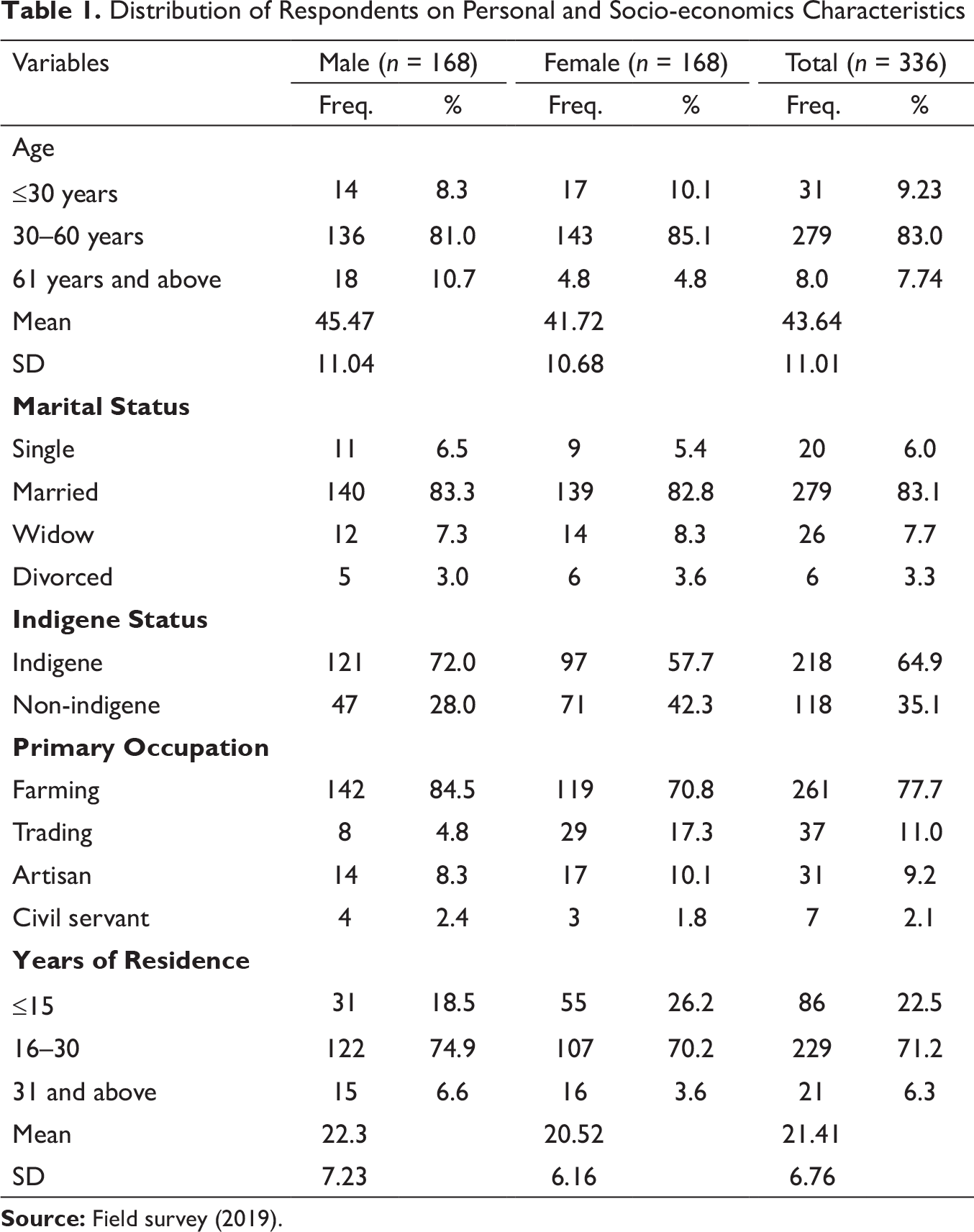
Rank Order of Statements on Challenges of Land Acquisition
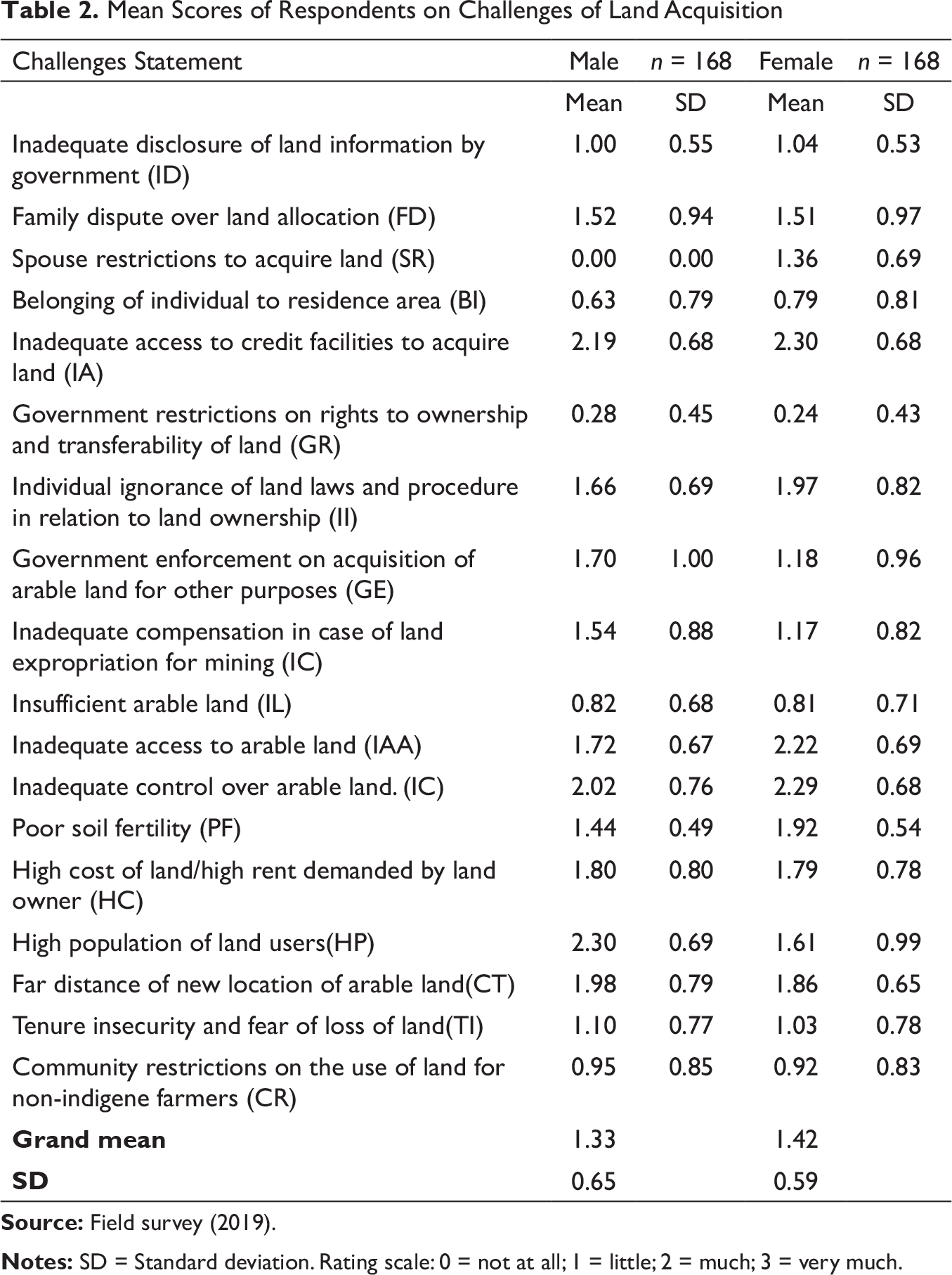
A list of 18 statements was made available to the arable crop farmers based on a 4-point Likert-type scale of 0 = not at all; 1 = little; 2 = much; and 3 = very much. Results in Table 2 show the mean scores for the respondents’ challenges of land acquisition. Male and female arable crop farmers had many challenges in accessing credit facilities to acquire land with mean scores of 2.19 and 2.30 and standard deviations of 0.68 and 0.68 for male and female arable crop farmers, respectively. The findings from the FGD that buttress it are:
We do not easily get access to loans for acquiring land, at times when we get one, we have the problem of getting a guarantor, even the lender think that females do not have the energy to work on the farm and repay the loan as at when due. (A Female Participant at Ayegbaju, Ekiti State)
Male arable crop farmers also had challenges with the government enforcement on the acquisition of arable land for other purposes (X = 1.70; σ = 1.00), inadequate access to land (X = 1.72; σ = 0.67), inadequate control over land (X = 2.02; σ = 0.76), high cost of land/high rent demanded by landowners (X = 1.80; σ = 0.80), high population of users (X = 2.30; σ = 0.69) and community restriction on the use of land for non-indigenes (X = 0.95; σ = 0.86).
However, female arable crop farmers had challenges with spouse restriction in accessing land (X = 1.36; σ = 0.69), inadequate access to land (X = 2.22; σ = 0.69), inadequate control over land (X = 2.29; σ = 0.68), poor soil fertility (X = 1.92; σ = 0.54), high cost of land/high rent demanded by landowner (X = 1.79; σ = 0.78), high population of land users (X = 1.61; σ = 0.99) and community restriction on the use of land for non-indigenes (X = 0.92; σ = 0.83). The following excerpt from the FGD also buttresses that females face the problem of spouse restriction in land acquisition:
My husband will not allow me to have my farm located far away from him, because of the herdsmen problem, their cattle destroy our crops, and as a woman (female) there is a limit to what we can do, our safety is important. (A Female Participant at Lanlate, Oyo state)
The following excerpt from the FGD reveals that male and female non-indigene arable crop farmers are faced with challenges on some community restrictions to the use of land:
The non-ˇindigene in this community are not allowed to cultivate permanent crop on the plot of land allocated to them through the community head; likewise, they are to bring rebate (Isakole) to the community head for the usage of land. (A Male participant at Ago Are, Oyo State)
The grand mean scores were 1.33 and 1.42, with standard deviations 0.65 and 0.59, for male and female arable crop farmers, respectively. About 60 per cent and 50 per cent of the mean scores of male and female arable crop farmers, respectively, were equal or greater than the respective grand mean scores; meanwhile, the remaining 40 per cent and 50 per cent mean scores of male and female arable crop farmers, respectively, were below the respective grand mean scores. It implies that the challenges of land acquisition among male arable crop farmers and female arable crop farmers in the study area were moderate. The findings from the FGD affirm the same:
The major barriers to land acquisition among the male arable crop farmers are: far distance of the new area of land to the residence of the willing farmers, increase population of land users, inadequate access to credit facilities required to acquire land, and family disputes over land allocation. Among the female arable crop farmers, the challenges include spouse restriction to acquire land, inadequate credit facilities to acquire land, family dispute, poor soil fertility, and high cost of the rent.Mean Scores of Respondents on Challenges of Land Acquisition
Gender Differential on Challenges of Land Acquisition
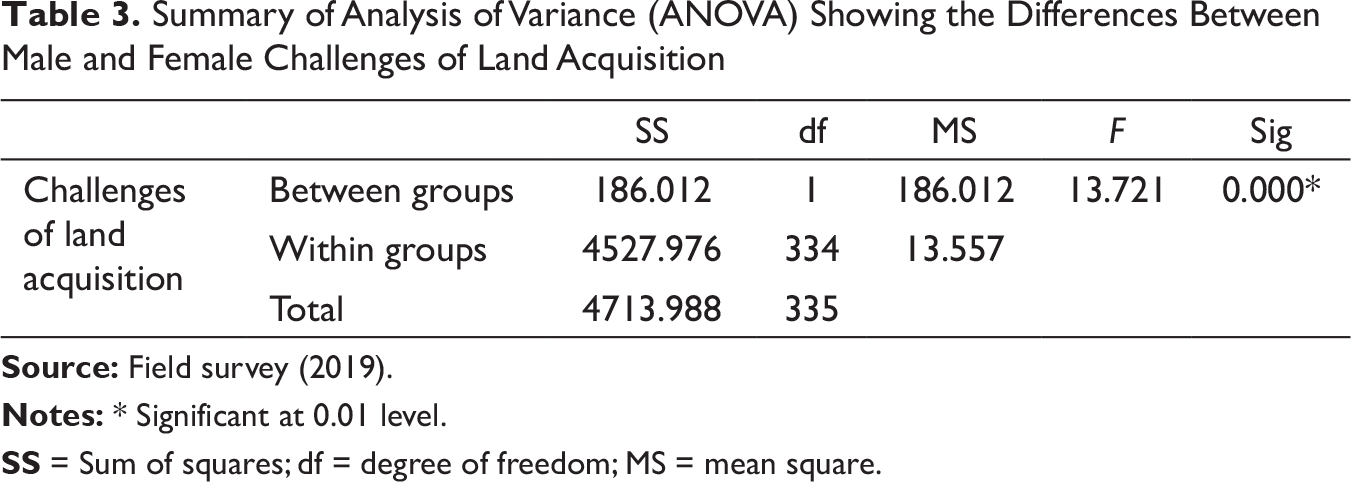
In order to assess the gender differentials on challenges of land acquisition among arable crop farmers in the study area, an analysis of variance test was carried out. Results in Table 3 show that, at p ≤ 0.01, there was a significant difference (F = 13.721) between male and female arable crop farmers’ challenges of land acquisition. It connotes that the challenges faced by male arable crop farmers significantly differ from those faced by female arable crop farmers in the acquisition of land for crop production. The difficulty might also be as a result of the gender discrimination associated with land acquisition in Nigeria, as reported by Adekola et al. (2013). The FGD report buttresses this point:
Some of us have the plots of our wives beside our own;; we cannot allow them to go far away from us for security reasons. (A Male participant at Ago-Are, Oyo State)
The challenges differ between male and female arable crop farmers, as shown in the mean of each challenge above.
For female farmers to have access to community land, she must provide a guarantor who is her husband, or belong to women association recognized in the community. It is important to be able to trace any female farmer to someone who will be responsible for her as a guarantor. (A Female participant at Ago Amodu, Oyo State)
Access to credit facilities is also a significant challenge facing male and female arable crop farmers in the study area. The results above show the mean for the challenges; the mean for males is lesser than that for females. The findings from the FGD also corroborate this:
To get loan/credit to purchase/rent land for arable crop production is difficult for us, whether you are a female or male farmer, even if we get where to borrow, we need guarantors. (A Male participant at Ifaki, Ekiti State)
Summary of Analysis of Variance (ANOVA) Showing the Differences Between Male and Female Challenges of Land Acquisition
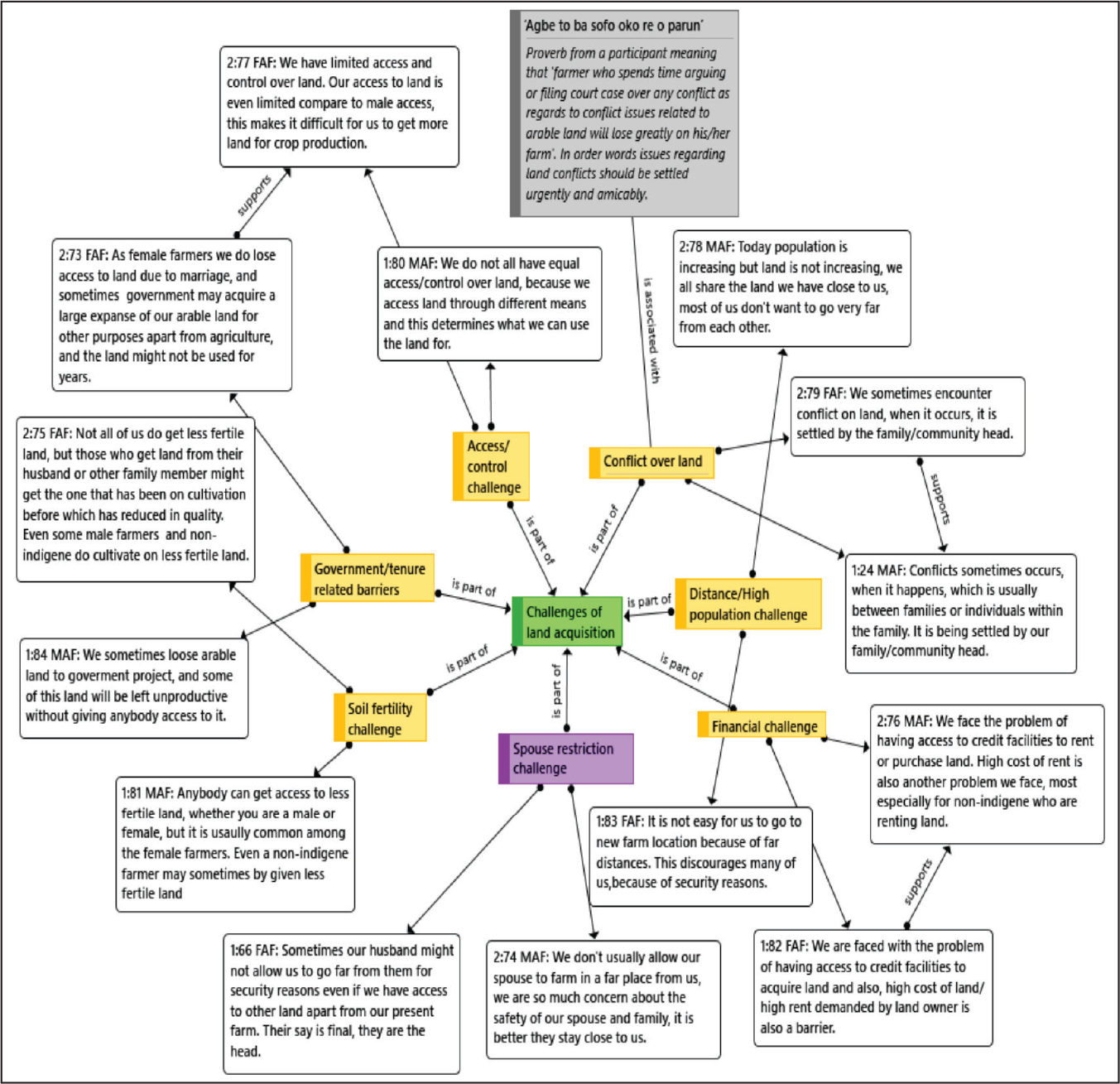
Results in Figure 1 reveals that the various challenges faced by male and female arable crop farmers in acquiring land might affect their agricultural production and thereby reduce their contributions to food security in Nigeria. However, female farmers do face gender-specific challenges, including spouse restriction; this hinders the production capacity of female arable crop farmers. Furthermore, female farmers encounter the problem of low soil fertility more than male farmers; most often, the less fertile lands are left for the females after the males occupy the fertile ones. Female farmers face more challenges in land acquisition than their male counterparts, despite their active participation in agriculture along the value chain; this might have been contributing significantly to the increase in food insecurity and rising poverty among the female farmers, the majority of who reside in rural communities in Nigeria. Land tenure policies should be gender-responsive to ease land acquisition by female farmers in Nigeria.
Conclusions
The findings from the study give a broad knowledge on the various challenges of land acquisition faced by male and female arable crop farmers. Male and female arable crop farmers face the challenges of family conflict over land, government- or tenure-related challenges, distance/high population of users, low soil fertility, inadequate access to and control over land and inadequate access to credit facilities required for acquiring land, while the spouse restriction challenge is peculiar to female farmers alone.
The study shows that farmers face challenges in acquiring land for crop production regardless of their sex. However, female farmers face more challenges than their male counterparts. The study concludes that there is a significant difference between male and female arable crop farmers’ challenges in land acquisition.
Recommendations
Based on the conclusions drawn from the findings, the following recommendations are made to ease access to land by male and female arable crop farmers:
There is a need for government agencies to formulate and implement appropriate gender-responsive policies that will ease access to land for both male and female arable crop farmers, with special attention to the females. Regular gender awareness programmes at the community level should be carried out to enhance gender acceptability and equal access to agricultural resources, including land.
Consequently, the challenges faced by male and female arable crop farmers in acquiring land for food production will be alleviated, and this will enhance food security in Nigeria.
Footnotes
Declaration of Conflicting Interests
The authors declared no potential conflicts of interest with respect to the research, authorship and/or publication of this article.
Funding
The authors acknowledge the financial support of Alexander von Humboldt Stiftung/Foundation, Germany and the material support of Friedensau Adventist University, Germany and Obafemi Awolowo University Ile Ife, Nigeria during the period of data analysis.