







Abstract
Among the greatest challenges of the 21st century is maintaining biodiversity and ecosystem services (ESs) to sustainably feed the projected 9–10 billion people of the world by 2050. Presently, incentives to preserve ESs in developing economies are limited, implying that there are no direct market mechanisms to signal the scarcity or degradation of a service until it fails. ESs are public goods with no direct owners. Hence, payment for ecosystem services (PES) is a voluntary transaction that aims at filling this gap by creating a new market for services, including carbon sequestration, biodiversity conservation, watershed protection and landscape values. Emerging PES has challenged the culture of natural resource depletion without consideration of sustainability. Sustainability is core of climate change vortex, and developing economies are worst hit. Food insecurity and failing agricultural systems will further endanger the fragile balance of life in the region. Until the right approaches to de-risking ecosystem sustainability emerge, the perpetrators of climate change will keep getting away with the harmful effects to our corporate existence. This treatise critically examined how ESs can foster sustainable food production given their holistic inter-relatedness to the subject of climate change mitigation, in the light of global development goals.
Keywords
Introduction
Ecosystem services (ESs) present benefits freely derived from the natural environment, without which life on earth would be non-existent. They constitute a mechanism for fulfilment and sustenance of human life through benefits derivable from the ecosystems and its bio-resources (Berg et al., 2013; Daily, 1997). They include profits derived from the ecosystem’s functioning such as goods (e.g., food) and services (e.g., waste assimilation) (Costanza et al., 1997). The Millennium Ecosystem Assessment (MEA, 2005) and Smith et al. (2013) categorised ESs into four broad and distinct categories, which include provisional, regulative, cultural and supporting services. While the first three categories have a direct impact on human well-being and health, the fourth has an indirect effect by way of supporting the previous three. MEA (2003) described provisional services as those providing food, fibre, fresh water, wood fuel and other essential resources.
Additionally, Mekonnen and Sintayehu (2018) identified climate regulation, pathogen suppression, water purification and regulation as regulatory services. Finally, supporting services include nutrient cycling, primary production and soil formation, while the cultural values include education, aesthetics and recreational facilities (Mekonnen & Sintayehu, 2018). The regulatory activities of the qualities of climate, soil, water and air are the overall components contributing to the ESs.
Ecosystem offers a myriad of functions that can provide an asset base of goods and services over time, in such a way that is like capital investments or assets development. Thus, adequately managed ecosystems will have a growing capital asset base over time. Goods and services from ecosystem functions keep us alive and provide raw materials for our development processes. By maintaining biodiversity, ecosystem produces products and services such as climate regulation, air filtration, watershed protection, water flow regulation, slope stabilisation, rainfall generation, microclimate cooling, poverty reduction, aesthetic value/enjoyment, sports and even spiritual fulfilment (Inter-American Institute for Cooperation on Agriculture [IICA], 2012).
ESs concept has become a dominant academic framework for discussing interactions between the economy, society and environment. In promoting conservation, the situation is fitted into the prevailing models and language of economics, services and values (Berg et al., 2013; Daily, 1997; ten Brink, 2011). In this way, the concept of ESs could be enriching; suggesting that destroying the environment runs counter to human interests. Reasonably, this has proved successful, especially with large-scale projects, which used the concept of ESs for ecosystem assessments (MEA, 2005; United Kingdom National Ecosystem Assessment [NEA], 2011). It has also proven useful in the debates about the economic value of the ecosystem (ten Brink, 2011). ESs concept is now used in many administrative documents and by different political bodies (including governments and international organisations). Such uses of the idea would provide a more in-depth insight into the whole essence of man’s dependence on nature (for anthropocentric and operative reasons). Eventually, these insights would cause behavioural changes that could result in positive environmental impacts as well as influencing the well-being of humans (who are an integral chunk of the global ecosystem) that have a dynamic interaction with other parts of the ecosystem.
On the flip side, humans can alter the ecosystem in whole or in part, thereby impacting on human activities and existence. Only sustainable ecosystems can support and sustain food production services over time. A sustainable ecosystem is one that supports itself and its surroundings. According to Falkenmark et al. (2007) and Pogodaeva et al. (2015), harmonising natural resources exploitation for socio-economic development and conservation can enforce sustainable development, which is critical to every human’s livelihood and well-being. In this article, we critically examined how ESs can be encouraged and fostered given their holistic inter-relatedness to the subject of climate change mitigation and sustainable food production systems in sub-Saharan Africa in the light of the global development goals. In doing so, we reviewed literature under six relevant subtitles.
Agricultural Intensification and Other Human Activities: Implications on Ecosystem Services
An increase in agricultural activities (food production systems), depends on the health and well-being of the soil, and this is most valid in regions where agricultural production is still primarily driven by inadequate technology and innovations. The interlinkage of food production systems, soil health and climate change are unique and non-down playable. Population expansion has resulted in drastic alterations of the ecosystem by humans, due to higher demands for food and changing consumption patterns; alongside land development for roads, buildings and other infrastructure to make life comfortable. According to Foley et al. (2005), cropland and pastures occupy approximately 40% of the earth’s surface area. This area is far more extensive compared to several decades ago. Since the origin of the planet, the landmass has not increased by an inch; paradoxical but true, yet it is continually being depleted by anthropogenic sequences. These processes have resulted in an unprecedented extinction of species, compromise of biodiversity, which sustains ESs and strengthens ecosystem resilience. Although it is hard to account for the actual monetary value of ESs correctly, environmental economists are increasingly attempting to demonstrate such benefits for different services (Russi et al., 2013).
Furthermore, MEA (2005) posits that 70% of the 1.1 billion people surviving on less than USD 1 per day depend directly on natural ecosystems. Of these people, rural dwellers specifically are underserved by government institutions, a situation that intensifies their dependence on nature for basic needs. For example, forest communities still depend on non-timber forest products for livelihood, howbeit this is mostly subsistence oriented, part-time and seasonal (Etowa et al., 2015).
Ecosystem Services, Climate Change Mitigation and Sustaining Food Production in Sub-Saharan Africa
The spiral of poverty, climate change and environmental degradation, which hamper ESs are intertwined. Sub-Sahara Africa, as conjectured by Blaikie (1988), is severely plagued by human poverty in a very fragile environment. Poverty forces people to make choices that create environmental degradation, while degraded environment on the converse accelerates the debt and are unable to sustain livelihoods. Delicate balance of humans and land area has forced dependants of the natural ecosystems into an inescapable quagmire of actions that will further exacerbate degradation of the environment at large. Thus, negative human interaction makes the already fragile environment less resilient and more prone to climate change effects. A degraded environment cannot produce wealth to match the efforts of the poor people that traverse it. Sub-Saharan Africa is therefore faced with a continued threat of food insecurity, desertification, drought, rural poverty, political instability and ineptitude, wars, civil strife and marginalisation of women folk (FAO, 2005). These problems arise from low performing governance, fiscal indiscipline, poor resource distribution and politically motivated greed, together with loss of moral right and lack of the will to do right concerning the economy and populace at large.
Ecosystem Services, Carbon Emissions Containment and Sustainable Climate Change Mitigation
The sustainable uses of ESs are nature-based approaches to climate change mitigation and adaptation. ESs reduce carbon emissions and greenhouse gases (GHG), and to conserve and expand carbon sinks in nature-based climate change mitigation. Nature-based climate adaptation includes the amelioration of climate change effects for the preservation of ESs to the benefits of humanity. It also aimed to reduce the impact of anticipated adverse effects of climate change such as more intense rainfall, more frequent floods as well as heatwaves and droughts. Forestry in particular as a form of ES helps in regulating the earth’s climate by removing carbon dioxide (CO2) from the atmosphere, forming the world largest terrestrial store of atmospheric carbon. Equally, with forests cleared, large amounts of carbon are released into the atmosphere. Therefore, ES that encourages the maintenance and protection of forests helps to sustainably contain carbon emissions through photosynthesis and its processes, by so doing mitigates climate change effects caused by carbon emission. These emissions contribute to the greenhouse phenomenon that increases the risk of catastrophic climate change effects (Forest Stewardship Council, 2012). However, the excessive use of fossil fuels, historical anthropogenic land use, including land cover alterations over time have led to increased greenhouse gas emission, particularly CO2. The increased atmospheric concentration of CO2 contributes to climate change and increases future environmental and economic losses.
Ecosystems capacity to influence the regulation of the concentration of carbon and greenhouse gases in the atmosphere depends on the climate. Climate is, therefore, an essential ES with many benefits for human societies (Carreño et al., 2012), and the mitigation of socio-economic damages associated with climate change (Castro, 2014; Chapin et al., 2002). Daba and Dejene (2018) surmise that terrestrial ecosystems, including forest, semi-natural and agricultural ecosystems, play an essential role in carbon cycling. By carbon sequestration and plant biomass formation, terrestrial ecosystems act as carbon sinks, litter and organic matter in the soil. Also, by releasing carbon from biological processes (e.g., respiration), they can act as carbon sources. Ecosystems regulate the global climate by storing carbon and greenhouse gases through carbon sequestration. Carbon sequestration is the binding of carbon either above-ground in vegetation or below-ground in soil complexes. Most literature sources find a positive relationship between biodiversity attributes and the effectiveness of carbon sequestration. After sequestration through photosynthesis, there is the transference of carbon to one of terrestrial pools, including above-ground biomass, dead wood, litter, roots (below-ground biomass) and soil (Daba and Dejene, 2018; National Academies of Sciences et al., 2018). Carbon sequestration decreases the concentration of gasses like CO2 in the air since plants absorb it during photosynthesis (Raupach, 2011). It is re-released during the decay of dead plants and animals and is taken up by soil complexes and delivered in and by natural vegetation like forests and peatland, grasslands and crops. Terrestrial ecosystems absorb atmospheric carbon during photosynthesis and return most of it by combustion or through the respiration of plants, animals and microorganisms (Robinson, 2007; Sánchez-Bayo, 2011). As trees and plants grow, for example, they remove CO2 from the atmosphere and effectively lock it away in their tissues (Schindler et al., 2010). Soil becomes a sink for carbon from these plants at some points in the ecosystem cycle. Therefore, the soil’s function in the ecosystem as carbon sequester is increasingly of contemporary interest.
Changes in soil carbon impact the earth’s climate system through emissions of CO2 and CH4 as well as the storage of carbon removed from the atmosphere during photosynthesis or climate regulation (Schlesinger & Bernhardt, 2013). According to Smith (2012), ecosystems influence climate through the exchange of greenhouse gases and by reflecting radiation and converting energy into different forms. Useful energy enters the ecosystems at the reduction of atmospheric CO2 to form organic carbon compounds during photosynthesis, a process driven by solar energy (Smith et al., 2013). Hence, there exists an interaction between energy and organic carbon in the ecosystem processes.
Moreover, afforestation and proper soil management can reduce excessive atmospheric carbon, while effective ecosystem management would control carbon emission (Vos et al., 2014). Carbon sequestration in plants and soils through reduced emissions from agriculture with improved agricultural practices can mitigate climate change effects (Whitmore et al., 2014). As a vital ES, climate regulation, is of foremost policy interest in many countries, given the current global climate change concerns. As a vast and active carbon sequester, forests store up excessive atmospheric carbon in biomass and forest soils. Hence, carbon sequestration is a very vital ES. Another essential ES is the elimination of greenhouse gases, a regulatory function that mitigates the intensity and potential impact of climate change.
What Are Strategic Boosters of Ecosystem Services for Sustainable Food Production?
As a leading multifunctional sector, agriculture provides benefits ranging from food and fibres, including benefits related to the sector’s sustainability and rural development (United Nations Conference on Environment and Development [UNCED], 1992). Agricultural production aims at food security at individual, households, community, national and international levels. Yet the food system has an ecological dimension of its functioning (World Bank, 2009). Continuous provision of ESs from the food production system, and the dependence of food outputs on the availability of ESs is an inevitable aspect of the sustainability of food production. Agriculture uses and changes the physical characteristics of air, soil, water and biodiversity, which are critical components of the ecosystem. Effective conservation of these vital attributes of the ecosystem would be considered a booster of ES that would ensure continued food production for generations to come.
There are measures aimed at supporting farmers in the adoption of sustainable agricultural practices in developing economies considered as strategic boosters of ESs and referred to as the Incentives for Ecosystem Services (IES) (FAO, 2020). An integrated IES includes improved agricultural productivity, soil and water conservation, forest conservation and protection of sensitive habitats, which would aim at an increased benefit to the environment, and improved long-term food security. IES enables the integration of private and public investment to boost sustainable food production while maintaining a robust ES delivery. This mix of investments include policy-driven investments given mandatory regulations (e.g., taxes, user charges), market-driven strategies that reduce production costs (e.g., water quality programmes) and voluntary investments, which yield social benefits (e.g., corporate social responsibility programmes) (FAO, 2020).
Who Pays for Ecosystem Services?
As an economic tool, payments for ecosystem services (PES) incentivises users of agricultural land and managers of coastal or marine resources, resulting in sustainable provision of ESs for societal benefit (FAO, 2011). The main element of six preconditions for a PES scheme (Kissinger et al., 2013; Landell-Mills & Porras, 2002) is when there exists a need to eliminate conflicts that stall the provision of ESs for equitable societal benefits. Hence, the goal of PES is to provide incentives to preserve ESs for continuous benefits to the society. PES is characterised by effectiveness in income generation and cash flow among suppliers, benefits delivery to buyers (e.g., payments) and promotion of practical tools for the preservation and control of ESs. As of 2002, over 300 PES schemes had been implemented around the world, and that revealed the complex interactions that exist between its ecological, economic and social dimensions (Landell-Mills & Porras, 2002).
PES is well applied in the sector because all activities in agriculture interact with the environmental, social and economic dimensions of sustainability (Kissinger et al., 2013; Wunder, 2007; Wunder & Alban, 2008). Moreover, PES provides financial incentives for alternative land uses in farm-level production. The payment should be economically comparable to the foregone alternative land-use (i.e., opportunity costs). This payment supports land-use or agronomic practices that can conserve or rejuvenate ecosystem processes. PES becomes a necessity with reasonably threatened ESs, when opportunity costs of land-use change remain considerable (Wunder, 2007; Wunder, 2008). Degraded pastures, marginal croplands, hillsides, residual forest patches are some resultant agro-ecosystems from the other circumstances. Such agro-ecosystems run short of their regulating capacity and therefore become inadequate in ESs, including insufficiency in regeneration of food, water and fibre. Disruption of agro-ecosystems equilibrium jeopardises ESs and mainly increases opportunity costs of alternative land use (Arneth et al., 2019; Ottaviani, 2011).
PES programs often are realised using donor funds or as part of government-subsidised compensation programs focused primarily on how to pay people for generating external benefits (Munoz-Pina et al., 2008; Page & Bellotti, 2015; Pagiola, 2008). Globally, governments are the predominant buyers of ESs in PES programs rather than direct beneficiaries (Pham et al., 2010; Shelley, 2011). Milder et al. (2010) opined that this trend might continue in the next era. PES programs are not sufficient for self-regulating markets for environmental services. Hence, the need to emphasis environmental protection rather than a market-oriented PES program (Muradian & Rival, 2012). By a simplified definition, PES is a voluntary transaction whereby a well-defined ES is bought by a minimum of one buyer from a minimum of one provider if and only if the ES provider continually secures the ES provision (Page & Bellotti, 2015; Wunder, 2007).
Conceptually, this definition stems from the Coase theorem as it internalises the positive externalities that ESs provide through bargaining solutions between those who provide the services and those who gain from it (Engel et al., 2008; Gómez-Baggethun et al., 2010), which is in the view of environmental economists (Gómez-Baggethun et al., 2010). Often enumerated in literature are the four kinds of ESs that may require payments. They include hydrological or watershed services, carbon sequestration, biodiversity protection and landscape beauty (George et al., 2012; Landell-Mills & Porras, 2002; Wunder, 2007). Certification of products is also sometimes included as a form of PES (Carroll & Jenkins, 2008; Food and Agriculture Organization (FAO, 2007). At the same time, a different school of thought sees it not as PES; as it fails to meet the criterion of guaranteed price premiums for the certified products (Sommerville et al., 2009). This categorisation differs from the more functionally oriented classification provided in the MEA (Ravnborg et al., 2007), which has become one of the most widely used classification systems (Fisher et al., 2009; Small et al., 2017). MEA differentiates ESs into four broad categories, namely provisioning services, which encompasses activities such as food, water, fuel and fibre—regulating services, which involves climate regulation, flood mitigation and control and disease regulation, as well as water purification. The supporting services include activities such as nutrient cycling and soil formation. At the same time, the social services include aesthetic, spiritual, educational and recreational facilities (Millennium Ecosystem Assessment, 2005). Aside from carbon sequestration, payments are made not only for the direct provision of the ESs but also for management or land-use practices expected to enhance or secure the service.
Since ES is a public good, the government pays for it, with little or no contribution from the private sector. However, government interventions and incentives have not entirely resulted in continued or improved provision of ESs because there are no clear-cut policy framework and institutions in place to address the challenges of ESs and payment for ES from the holistic perspectives (i.e., in terms of provisioning services, regulating services, supporting services, social services and recreational services).
Would Continuous Intensification of Ecosystem Services End Hunger in Developing Economies?
Goal 2 of MDG seeks sustainable solutions to end hunger in all its forms by 2030 and to achieve food security. The target aims at food security for all individuals in the globe for their healthy living through improved food access and the promotion of sustainable agriculture worldwide. Improved productivity and incomes of small-scale farmers through enabling equity in access to land, technology, markets, sustainable food production systems, improved agricultural practices and climate smart agriculture (production and cultivation of climate smart crops, i.e., drought and salinity tolerant, pests and diseases resistant crops, etc.) were some identified pathways to realising the goal. Also, more agricultural investments through multilateral cooperation boost production capacity in the food sector in developing economies. Although the undernourished population declined by 15% from 2000–2002 and 11% in 2014–2016, food access remained inadequate for over 790 million people (United Nations, 2018). If current trends continue, the zero hunger targets will be largely missed by 2030. Besides the issues of food availability, many countries were short of attaining the MDGs hunger target because natural and human-induced disasters or political instability have resulted in food insecurity affecting large swathes of the population. Analysis of Food Insecurity Experience Scale showed that food insecurity is most common in sub-Saharan Africa of 150 countries studied in 2014 and 2015 (United Nations, 2018). Presently, Africa is a net importer of food worth 30 billion dollars annually, whereas sub-Saharan Africa supposedly was a net exporter of food. Based on the facts mentioned earlier, Africa cannot end hunger in 2030 as in Goal 2 of MDG. Despite the 2013 renewed partnership agreement for a unified approach to end hunger by 2025 in Africa; the partnership’s commitment score to ending hunger by 2025 was 1.62 relative to a benchmark of 3.17 in 2017 (World Food Programme, 2017). This report corroborated the World Food Programme publication, which recognised that despite a prolonged decline, hunger in the world was on the rise due to the increased conflicts in Africa, worsened by climate shocks, drought and other factors that threaten to reduce the agricultural and livestock productivity of the African continent. Today over 155 million Africans are under threat of hunger in 55 countries, which has been exacerbated by COVID-19. Hence, innovative approaches and results-driven partnerships are a desideratum if Africa’s goal of ending hunger must be realised even in some years later than 2030.
With ESs continuously intensified, Africa can end hunger in 2050 as in Goal 2 of Sustainable Development Goals (SDG) and in generations to come. The adoption of the 2030 Agenda for Sustainable Development and its 17 SDGs aimed to strengthen Africa 2063 Agenda to end hunger through food security and sustainable agriculture. With the Malabo Declaration of Zero Hunger in 2014 and SDG 2, some African countries have made significant attempts to align policies to suit the goal. However, the goal of ending hunger in Africa is a whole is still farfetched, given the prevalence of low agricultural productivity, climate change, environmental degradation and high youth unemployment rate (FAO, 2018a; 2018b).
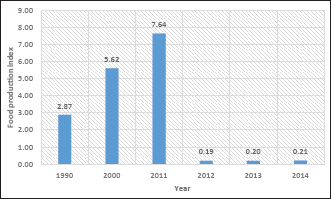
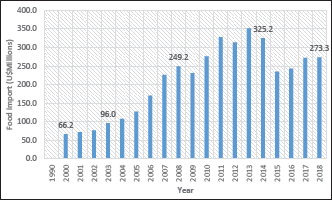
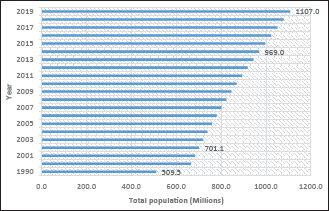
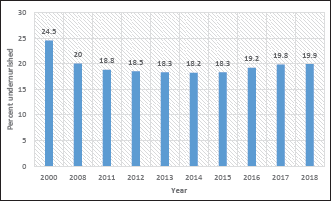
A study of the historical food growth curve in sub-Saharan Africa alongside food imports, population growth and prevalence of undernourishment indicates a need for a dramatic break in this vicious cycle of low productivity in agriculture and the capacity of the sector to meet domestic food supply. The FAO food production index dropped from 5.62 in 2000 to 0.21 in 2014 in SSA, for example (Figure 1), showing a significant decline in food production. Although the value of food imports grew substantially from US$66.2 million in 2000 to US$325.2 million in 2014 in SSA (Figure 2), the food supply gap did not witness commensurate decline. With the increased population of 31.3% between 2000 and 2014 (Figure 3), the prevalence of undernourishment fluctuated within a smaller range 24.5% in 2000 and 18.2% in 2014 (Figure 4). Therefore, the situation of hunger persists as 25% of people in sub-Saharan Africa are undernourished, amounting to a quarter of the world’s undernourished people (FAO, IFAD & WFP, 2014). Moreover, a yearly decline of 1% per capita fish production is anticipated between 2010 and 2030 despite estimated annual population growth of 2.3% in sub-Saharan Africa (World Bank, 2013). Hence, growth in fishery sector will not be adequate to meet protein demand of rapid population growth in sub-Saharan Africa (FAO, 2018a; 2018b). This is a significant concern as fish contributes an average 23% of animal protein intake relative to 17% world average (FAO, n.d.).
Among other factors, reduction in agricultural outputs in the sub-Saharan Africa can be linked to climatic variations, including rainfall extremes, flooding, temperature increases and drought. Kenya, for example, experienced 10%–16% drop in GDP due to reduced agricultural yields from incidence of flooding, while drought led to 41% decline in hydropower production, which accounted for reduced agricultural production (World Bank, 2004 in Serdeczny et al., 2017). Also, historical evidence shows that for a degree rise in temperature there was 2.66% drop in agricultural outputs (Dell et al., 2012). Yet, the African summer temperatures is estimated increase by around 1.5°C from its 1951–1980 baseline values until 2050 (Serdeczny et al., 2017). Worse still, the historical growth in agriculture has depended mostly on expansion of cultivated area (FAO, n.d.) which is increasingly impacted by unprecedented extreme weather conditions. Reports by IPCC (2013) reveal that the global climate is warming at an unprecedented rate. Hence, in future, the most vulnerable communities affected would be the poverty-stricken areas, which inadvertently depend heavily on fossil fuel exploration, and its attendant oil spill and gas flaring effects, as well as mineral mining, which has resulted in an impoverished environmental situation. Also, alluding to Capper (2012); in developing economies, and in sub-Saharan Africa (SSA) for example, about 90% of food production is rain-fed, agricultural sustainability is most vulnerable with a reduction in food supplies and higher food prices which spell starvation. Given that PES including investment in irrigation projects will increase agricultural production, income and food security (De Fraiture & Giordano, 2014; in Bjornlund et al., 2020), the World began to increase funding of such projects in since after the failures of 1980s and 1990s (World Bank, 2008 in Bjornlund et al., 2020). However, because the few large land owners often leave agriculture in the hands of the mass of poor households with limited use right on fragmented land holdings (Etowa & Nwiido, 2018), investment in capital intensive irrigation projects becomes challenging for funding agencies in Africa. Thus, calling for a more strategic approach to PES in addressing climate risk in sustainable food production.
Conclusion
The rural people in the developing countries are the key actors in the ESs. But their livelihood interests are greatly compromised when a blatant pursuit of profit is pursued by a minority of big economic players, at the cost of climate change or CO2 and CH4 gas emissions. The service of these unassuming poor should have legitimate rights over the PES, and very high stakes in the decision-making framework in the matter of finding ways to mitigate such casualties. In other words, these poor folks in the countryside deserve much higher dividend in the PES compensation package and be made key actor in the consultation process. Therefore, the private players, whose avarice for profit only perpetrated the mater to this pass, should have much lesser stakes in the deal.
In the face of current climate change challenges bedevilling global economies, viable ESs can contribute to household welfare and income through contracts for soil carbon sequestration, which is an important strategy to provide farmers with incentives, especially the resource-poor small landholders in developing countries and Africa. ESs will enable them to adopt management practices that increase and diversify benefits derivable from agricultural lands. Furthermore, the ESs strategy can also advance the global development goal reducing hunger and poverty, and empowering women, who account for most of the farming in the developing countries and Africa. Consequently, ending hunger is both a moral and an economic imperative, which with strategic and concerted efforts are a dream that is possible by 2050. Keeping up the momentum and redoubling current efforts in a coordinated, integrated and aligned approach to enhance food security and curb malnutrition are critical factors to the realisation of sustainable food production and poverty reduction.
Footnotes
Data Availability Statement
No primary sources of data.
Secondary source:
Declaration of Conflicting Interests
The authors declared no potential conflicts of interest with respect to the research, authorship and/or publication of this article.
Funding
The authors received no financial support for the research, authorship and/or publication of this article.
