







Abstract
The study compares the productivity under traditional and high-density apple plantation (HDP) techniques in Kashmir and look at the financial viability of the two in light of the HDP subsidy scheme of the government of J&K. The study also looks at factors behind adoption of high-density techniques as well as the farmers’ perception of the environmental and health impacts of fertilisers and pesticides used in the apple orchards. The study finds that the productivity of apple production, measured by the yield of apple output, is significantly higher under the high-density plantation system compared to the traditional apple cultivation methods. The efficiency of production is also higher under the high-density plantation techniques owing to better technology and more scientific use of inputs such as precision irrigation systems and proper application of fertilizers and pesticides. Results from the NPV and IRR analysis indicate that the high-density technique is financially viable in the long run even in the absence of any assistance from the government. However, it was found that there is low uptake of subsidy scheme because farmers find it difficult to produce revenue records in their own name. The main factors driving adoption of High-Density technology are presence of a progressive farmer in the village or neighbourhood. There is only limited awareness among the farmers about the harmful impacts of chemicals on environment and health. The awareness regarding long-term health implications such as cancer due to pesticide exposure is also very limited.
Introduction
Kashmir, the name evokes a multitude of imageries in one’s minds. Cradled in the lap of the mighty Himalayas, the valley is known for its beautiful meadows, gardens, lakes, its unique culture as well as its troubled history. But apart from all this, Kashmir is distinctly associated with the famous Kashmiri apple. Apples from Kashmir are sought after worldwide and are a symbol of Kashmir in the minds of Indians and foreigners alike.
This study is an attempt to understand the nature and working of the Apple Sector in Kashmir, with special focus on evaluating the impact of the high-density plantation techniques vis-à-vis the traditional cultivation techniques.
Apple Industry in Jammu and Kashmir
Jammu and Kashmir (J&K) is the largest producer of apples in India, accounting for over 80% of India’s apple production. India is currently the fifth largest producer of apple in the world, owing largely to the contribution of J&K.
Apple industry is the backbone of the Horticulture economy of Jammu and Kashmir. As per estimates for 2020–2021, 2.035 million or 20.35 lakh metric tonnes of apples were produced in J&K. The market size of the industry is estimated at more than ₹10,000 crores. It is also estimated that more than 3 million people depend on apple industry for their livelihood.
As per the last available figures for the year 2019–2020, area under apple cultivation in J&K is 164,854 ha or around 1.65 lakh ha.
Trends in Production in the Apple Sector in Jammu & Kashmir
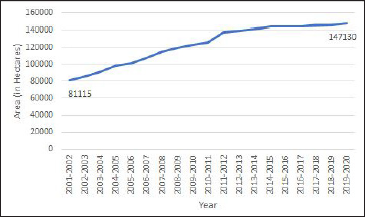
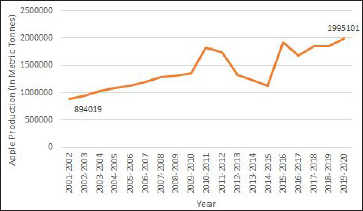
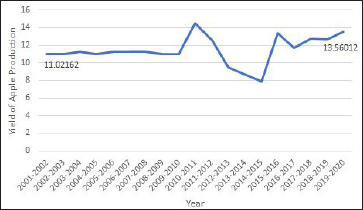
The area under apple cultivation has almost doubled, while the production of apple has more than doubled. However, the yield of apple cultivation has remained more or less stagnant over the past 20 years, with only a slight increase in the past few years. This is a major challenge and source of concern for the stakeholders involved in the apple industry in Kashmir (Figures 1–3).
Area Under Apple Cultivation in J&K (in Hectares).
Production of Apple in J&K (in Metric Tonnes).
Yield of Apple Production in J&K (Metric Tonnes per Hectare).
Challenges in the Apple Sector in Jammu & Kashmir
The yield in apple cultivation in J&K is only 11–12 metric tonnes per hectare (MT/ha), which is very low when compared with European countries such as Italy, where the yield is as high as 40–50 MT/ha. Further, the yield has been almost stagnant for the past two decades.
There are many reasons for the low and stagnant yield of apple in India
Use of old and outdated technology Lack of irrigation facilities Lack of institutional credit and limited mechanisation Poor marketing infrastructure Limited investment in cold storage and controlled atmospheric storage
High-density Plantation Technique
High-density plantation technique involves planting of fruit-bearing trees at a higher density, or close planting of trees using special techniques. The idea behind the technique is to achieve maximum productivity by getting greater output per unit area without sacrificing quality.
High-density plantation techniques were first introduced in Europe during the 1960s. and majority of the apple orchards in US, Europe, Australia and New Zealand use the high-density apple plantation (HDP) technique to achieve yields as a high as 40–50 MT/ha. To encourage widespread adoption of the technique, the Government of J&K has also introduced a high-density plantation scheme, under which farmers adopting the new technology are provided subsidy up to 50% as well as loans at concessional interest rates.
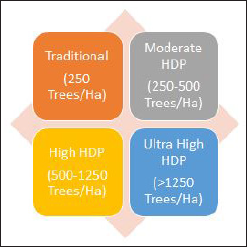
The traditional apple orchards have around 250 apple trees/ha. On the other hand, the high-density apple orchards can have anywhere from 1,000 to 3,000 apple trees/ha
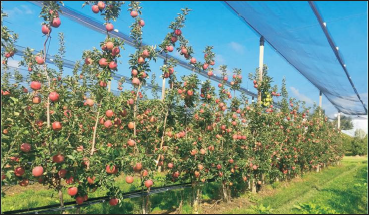
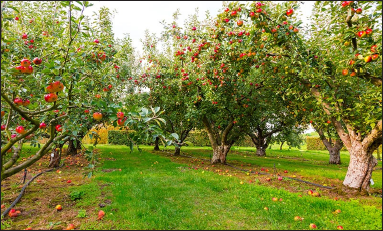
In the high-density apple orchard, the fruit bearing trees or stems are planted very close to each other, while in the traditional orchards, the trees are more spaced out. As a result, the tree density in a high-density orchard is significantly higher (Figures 4–6).
Comparison of Tree Density Under Traditional and High-density Apple Orchards.
High-density Apple Orchard, with Apple Plants Planted at Close Distance to Each Other.
Traditional Apple Orchard.
Advantages of High-density Plantation Technique
The HDP technique has many advantages over the traditional methods –
Production output of 7–8 years in the traditional method can be achieved through HDP techniques in 2 years only. The yield under HDP is almost five times as high as the traditional technique, around 60 MT/ha. There is a significantly higher percentage of Grade A or premium quality apple production under HDP. The HDP varieties are more resistant to insects and pests. HDP allows use of new technologies such as hail-nets to protect from natural phenomena, for example, hailstorm.
High-density Plantation Scheme of the Government
The Government of J&K launched a scheme called high-density plantation scheme in 2016 to encourage farmers to shift towards horticulture production as well as use of modern techniques and technologies for horticulture production (Hassan et al., 2020a).
Some components of the scheme were later modified and a modified high-density plantation scheme was launched in March 2021. The scheme is in line with the Government of India’s goal of ‘Doubling Farmers’ Income’.
The scheme has the overall objective of enhancing production and productivity of horticultural products as well as increasing the income and living standards of farmers.
Under the scheme, the government provides 50% of the project cost as subsidy. Further, the beneficiary has the option of availing 40% of the project cost as a loan from bank. There is a provision of capitalisation of interest for the first 3 years, which ensures that there is limited burden on the farmer in the initial years when the costs of establishment of the orchard are high and there are limited sales. The beneficiary has to contribute at least 10% of the total project cost. This ensures that the beneficiary has the right incentives to put in the required effort and hard work.
Research Questions
The basic aim of the study is to do a comparative analysis of the traditional and high-density plantation techniques in terms of the impact on apple production and yield for the farmers.
An attempt will be made to address the following research questions through this study –
Impact analysis of the high-density plantation techniques vis-à-vis traditional cultivation techniques
Has the adoption of high-density plantation technique resulted in better yields and productivity for apple cultivators in Kashmir? Financial viability of the high-density plantation technique Is the adoption of high-density plantation technique financially viable for the farmers? Is the subsidy or government assistance essential for financial viability of the HDP techniques or will the techniques be viable even when the government assistance is withdrawn? Factors responsible for adoption of high-density plantation techniques What are the factors which drive adoption of high-density plantation techniques by certain farmers? Environmental and health impact of the HDP techniques What is the farmers’ perception of the environmental impact of the use of chemical fertilisers and pesticides? What is the farmers’ perception about the adverse impact on the health of the farmers and workers?
Literature Review
Extensive research has been conducted on the apple sector in India and J&K specifically. However, there is limited research on the economic aspects of high-density plantation in the context of J&K. This is mainly because the technique is relatively new to the apple farmers in J&K and economic evaluation of the technique will require data over a longer period of time.
Wani et al. conducted an economic evaluation of HDP. They used an Economic Surplus Model based on data from experimental fields in SKUAST, Kashmir and found that productivity of apple production has increased by 53 MT/ha along with an increase in labour employment by 676 man-days after the adoption of high-density apple technology (Wani, Bhat & Baba, 2021).
Hassan et al. evaluated the performance of the high-density plantation scheme. Their study is based on primary data collection from apple farmers in the districts of Kulgam and Pulwama. They used statistical techniques to estimate the yield and break-even year of the different orchard densities. They also calculated net present value (NPV) and internal rate for these orchards. Their study found that yield has increased by two to five times as compared to traditional techniques. They found that the break-even period is 6 years without government support and this reduced to 4–5 years with government support. The authors advocate for broadening the scheme and making it more inclusive for the development of the sector (Hassan et al., 2020a).
The same authors also did a comparative analysis between high-density orchards in J&K and Italy and compare the yield, input costs and payback period of orchards in J&K and Italy. The authors find that the yield of orchards in J&K has increased substantially and the payback period for these orchards is around 5 years, which is similar to Italian orchards. The authors, however, find that 95% of the farmers chose lower density apple orchards as the initial investment cost is quite high. The authors recommend that the government should improve access to credit and establish Farmer Producer Organisations (Hassan et al., 2020b).
A study by Ranveer Singh, sponsored by the Directorate of Horticulture, Himachal Pradesh looks at the economics of high-density apple production in Himachal Pradesh. They found that while the initial investment cost of High-Density Apple production is high, the gestation period for the high-density variant is lower due to smaller harvest season. There is also increased cost on manure and fertilisers, but on the flip side, this is compensated by higher productivity and better and uniform quality of fruits which fetch a better price in the market.
A recent study by Wani et al. found that expected net returns from high-density orchards are 2.5 times higher than traditional orchards (Wani et al., 2021).
Apart from this, there have been several studies which have looked at the economics of high-density techniques and their yields and returns.
Cahn and Goedegebure looked at high-density apple cultivation in Netherlands by estimating yields and input costs and calculated NPV and payback periods. The authors found that long-term profitability of apples increased with tree density up to 5,000 trees/ha in Netherlands.
Similar results were observed in a study by Robinson et al. in New York State, USA, where they found that profitability increases with density up to 2,600 trees/ha followed by a slight decline (Robinson et al., 2007).
Thus, the literature suggests that there is a significant difference in yield and profitability between high-density and traditional methods of apple cultivation. The authors have arrived at these results using NPV and internal rate of return (IRR) analysis.
There are numerous studies on the impact of fertiliser and pesticide use on the environment and human health.
Killebrew and Wolff studied the impact of agricultural technologies and practices on various aspects of the ecosystem such as soil fertility, water, biodiversity, air and climate. They found that there are varied and severe environmental impact of intensive agricultural practices. Some of the adverse impacts they found include increase in soil salinity, nutrient deficiencies, leaching of chemicals in water bodies as well as adverse impact on natural biodiversity (Killebrew & Wolff, 2010).
Riyaz et al. conducted a review of the existing literature on the impact of pesticide use on farmers’ health in Kashmir Valley. The authors found that existing research points towards serious diseases among people of all age groups due to the use of chemical pesticides. There is evidence of pesticide residue in various rivers, streams and lakes of Kashmir. Kashmir Valley has also reported rising incidence of cancer among the population, which points to the adverse impact of pesticides on human health (Riyaz et al., 2020).
Jallow et al. also conducted another study in Kuwait about pesticide knowledge and safety practice among farm workers. The study found that farmers do not have adequate knowledge of pesticides and they often adopt risky behaviours when handling pesticides. The authors recommend that farmers should be provided proper training regarding pesticide safety and there should be strict enforcement of pesticide laws (Jallow et al., 2017).
Research Methodology
The study made use of various different tools and techniques for data collection as well as for analysing the data. The study makes use of both primary and secondary data for analysis. The Primary Survey also involves a mix of both quantitative and qualitative data.
However, various challenges came up during the course of data collection, which put some restrictions on the amount as well as the kind of data which could be collected.
Challenges Faced During Research Design and Data Collection
Recent introduction of the high-density plantation techniques leading to limited data: The technique is only in its infancy in Kashmir and there is only limited adoption of the HDP technique and even less farmers have availed the benefits of the subsidy. This heavily restricted the sample size that could be surveyed for this study.
High-density orchards still in early stage: Most of the high-density orchards have come up after 2018 and are either yet to start producing apples or are only in the initial 1 or 2 years of output production. As per the literature, the high-density orchards begin yielding sufficient output only after 2–3 years of planting. This reduces the availability of data on output and yield.
Militancy-prone region and security related concerns: Apple cultivation is prevalent mostly in South Kashmir, which is an area infested with militancy and terrorism. There are several security related concerns and this restricts the free movement and interaction. Thus, special care and adequate precautions have to be taken while conducting field surveys.
The scope of data collection and field surveys was limited by the above reasons.
The study was based on a primary survey of apple cultivators, carried out in Pulwama district in the Kashmir Division of the UT of Jammu and Kashmir. Pulwama district has the maximum uptake of high-density plantation techniques in the entire Kashmir Valley and thus this region was chosen for conducting the field survey.
The sample size for the survey was 100 farmers—50 using high-density plantation techniques and 50 using traditional techniques. Purposive sampling was used for data collection. This was mainly because of the constraint that there are only a few farmers using high-density plantation techniques. Random sampling was extremely difficult in this case. Moreover, security-related reasons prevented a proper random sampling and data was collected from farmers based on ease of access and keeping aspects of security in mind.
Survey Questionnaire
The survey questionnaire is a mix of quantitative and qualitative questions. The questionnaire was designed to capture data on the following broad parameters.
Quantitative Data
General information.
Resource ownership.
Cost related data, with focus on cost of fertilisers, pesticides, irrigation, training, pruning and labour costs.
Production data of each farmer in terms of number of boxes of apples produced.
Sales data, which were calculated using production data and using data on apple prices.
Qualitative Data
Factors driving the adoption of high-density plantation techniques.
Farmers’ response and feedback to the HDP subsidy scheme of the government and whether the farmers find it beneficial for them.
Information regarding perception of farmers on impact of fertilisers and pesticides on the environment.
Information regarding the health impact on farmers and workers involved in application of fertilisers and pesticides.
The field survey involved two main approaches:
Interview with individual farmers: Initial field survey involved visiting the orchards and fields of the farmers and using the survey questionnaire to record the responses of the farmers to the various questions. Survey camp method—mix of individual interview and focused group discussion method: Many farmers were brought together at one place and were asked questions on various aspects with the help of the survey questionnaire. The method involved individual interviews and focused group discussions.
Empirical Framework, Tools and Techniques Used for Analysis
Comparison of High-density Plantation and Traditional Techniques
The statistical techniques of hypothesis testing and regression analysis are used to compare the high-density and traditional techniques of apple cultivation.
Hypothesis Testing.
The data collected from the field survey were used to estimate the yield of apple production for each farmer. The hypothesis to be tested is –
H0: Yield under high-density plantation techniques = Yield under traditional techniques. HA: Yield under high-density plantation techniques ≠ Yield under traditional techniques
We use the standard t-test to test this hypothesis.
Apart from this, we use regression analysis to measure the efficiency of production under each technique and compare the two.
Regression Analysis—Stochastic Frontier Analysis
The two techniques for apple cultivation are based on completely different technologies. Thus, the difference in outputs or yields of apple under the two technologies cannot be simply compared by using a simple regression model, with the use of say, a dummy variable, to distinguish HDP and traditional farmers.
As a result, separate production functions must be estimated for the two production techniques.
We use a tool called stochastic Frontier analysis (SFA) to estimate production functions for apples under the two techniques. These production functions can be used to estimate the efficiency of production under the two techniques.
Further, we assume that the production function takes the standard Cobb–Douglas form and use the log formulation for the production function. We estimate the following stochastic Frontier regression model for both high-density and traditional orchards (Aigner et al., 1977).

Y1 = Value of apple output/apple sales (Rs.)
X1 = Cost of pesticides (Rs.)
X2 = Cost of fertiliser (Rs.)
X3 = Cost of manure (Rs.)
X4 = Cost of labour (Rs.)
X5 = Size of land holding (in kanal; 1 ha = 20 kanals)
vi = Stochastic error term
ui = Non-negative technical efficiency component
Each orchard produces physical output of apples in various grades depending on the quality, shape, size and colour of the apple. These apples sell for different prices in the market and fetch different returns. As a result, it is inappropriate to add the physical output of different grade apples. A more appropriate comparison is to add them in terms of their monetary value or sales. This is the reason for choosing the value of output and not the physical output as our dependent variable.
Similarly, we have taken our independent variables (except land) in terms of monetary cost as there are many different types of fertilisers used (urea, DAP, etc.) and adding their physical quantities and including them as an input variable is not appropriate.
This is in line with the approach taken by Wani et al. (2021).
Financial Viability of High-density Plantation Techniques
The financial viability of the high-density plantation is analysed through the tools of NPV, IRR and payback period.
A high-density plantation orchard takes 4–5 years to reach maturity and give peak yields. Due to the recency of adoption of the HDP technique among farmers in Kashmir as well as the recent launch of the subsidy scheme, it is difficult to analyse the financial feasibility of the technique in real world scenarios at present.
Thus, the financial feasibility analysis is done with the help of data from an experimental high-density plantation field in SKUAST-Kashmir. The data set includes time-series data of cost and returns from the field for a period of 11 years. Similar data are available from Experimental orchards based on traditional cultivation techniques. This enables financial comparison of the two techniques.
Since the experimental field did not avail any subsidy, the results from this analysis show the viability of the technique in the absence of any support from the government. If the technique is financially viable in the absence of any government support, extra assistance from the government will only make it more profitable for the farmer.
The tools of NPV, IRR and payback period are used to assess the financial viability of the high-density techniques.
Factors Driving Adoption of High-density Plantation Techniques
This was a crucial part of the study to understand the factors responsible for adoption of high-density plantation techniques. This is a broad question which made formulation of a specific quantitative and testable hypothesis difficult.
As a result, this research question was addressed through open ended questions and discussions with the farmers who had recently adopted HDP techniques to understand why they switched to the new technologies. Discussions were also held with farmers who continued to use the traditional methods of cultivation to understand why they were not switching.
Environmental and Health Impacts
The farmers were asked questions related to their perception of the environmental impact of use of fertilisers and pesticides in both traditional and HDP techniques as part of the survey.
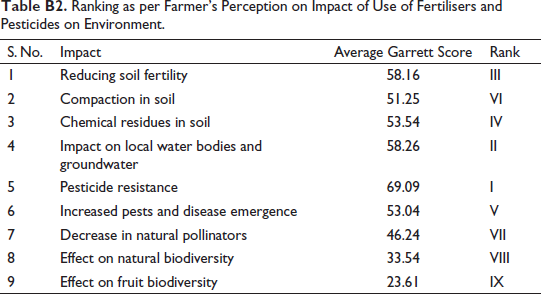
The farmers were asked to rank the impact of fertiliser and pesticide on various aspects of the environment and health. The ranks indicate the relative importance attached by farmers to these impacts.
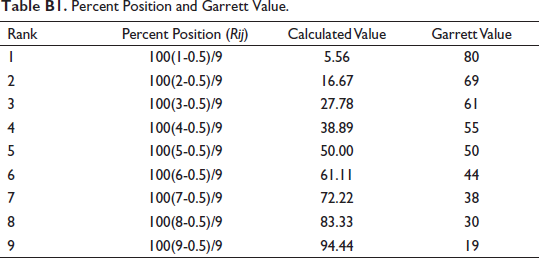
The individual ranks by farmers were aggregated using Garrett Ranking technique. This technique is useful in the awareness level of farmers regarding environmental and health impacts of technology and use of fertilisers and pesticides.
Research Findings and Analysis
Impact Analysis of the High-density Plantation Techniques vis-à-vis Traditional Cultivation Techniques
This section presents summary statistics, results from the hypothesis test for comparison of yields under high-density and traditional techniques as well as results on efficiency from the SFA.
Summary Statistics
Size of Landholdings. Most of the farmers are small and marginal farmers, with land holdings less than 1 ha. The average landholding under traditional orchards is more than those under high-density orchards. This is largely because high-density is a new technology and farmers are slow to adopt it. However, this is expected to increase in the future (Figure 7 and Table 1).
Average Landholding Size for Traditional and High-density Apple Farmers.
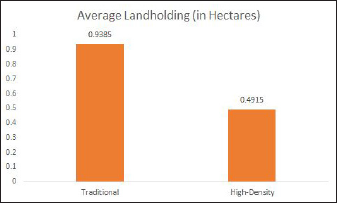
Average Landholding Size for Traditional and High-density Apple Farmers.

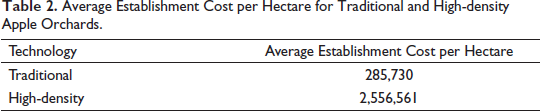
Cost of Establishment. The cost of establishment per hectare for high-density orchards is as high as nine times the cost for traditional apple orchards. This finding is in line with the existing literature on the subject (Figure 8 and Table 2).
Average Establishment Cost per Hectare for Traditional and High-density Apple Orchards.
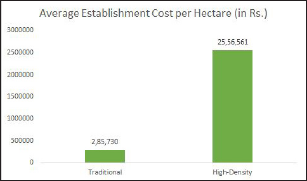
Average Establishment Cost per Hectare for Traditional and High-density Apple Orchards.
Yield. The average yield under high-density orchards is more than double the yield under traditional orchards (Figure 9 and Table 3).
Comparison of Average Yields Under Traditional and High-density Plantations.
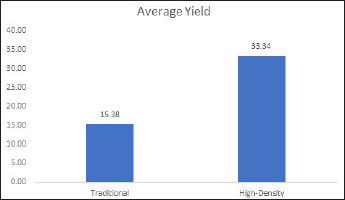
Comparison of Average Yields Under Traditional and High-density Plantations.

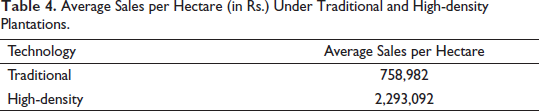
Apple Sales. Average apple sales per hectare is also higher for high-density farmers (Table 4).
Average Sales per Hectare (in Rs.) Under Traditional and High-density Plantations.
Results from Hypothesis Test
The hypothesis to be tested is as follows:
H0: Yield under high-density plantation techniques = Yield under traditional techniques HA: Yield under high-density plantation techniques ≠ Yield under traditional techniques
The results from the hypothesis test are shown in Table 5.
Hypothesis Test Results for Comparison of High-density and Traditional Apple Production Techniques.
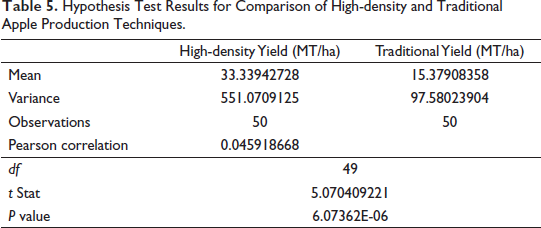
The p value is very close to zero, less than .001, and hence we reject the null hypothesis that there is no statistically significant difference between the average yields under high-density and traditional plantation techniques.
We can conclude that on average, the yield of apple production is higher under high-density plantation techniques compared to the traditional production techniques and this difference is statistically significant.
This result provides evidence that the high-density methods leads to greater productivity of apple production than the traditional methods.
Results from Stochastic Frontier Analysis
We estimate the following stochastic production Frontier for both high-density and traditional apple orchards –

Y1 = Value of apple output/apple sales (Rs.)
X1 = Cost of pesticides (Rs.)
X2 = Cost of fertiliser (Rs.)
X3 = Cost of manure (Rs.)
X4 = Cost of labour (Rs.)
X5 = Size of land holding (in kanal; 1 ha = 20 kanals)
vi = Stochastic error term
ui = Non-negative technical efficiency component
Results on efficiency of production are estimated using the regression results.
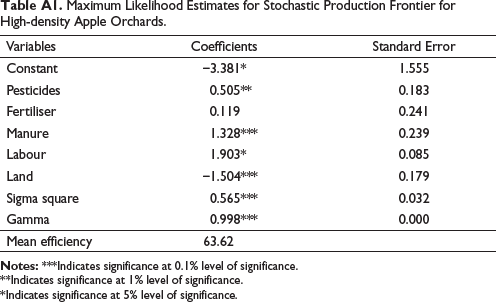
On average, the efficiency of production is higher under high-density plantation techniques, 63.62% is higher than the efficiency under traditional techniques, where it is 50.95% (Table 6).
Mean Efficiency of Production Under the Two Techniques.

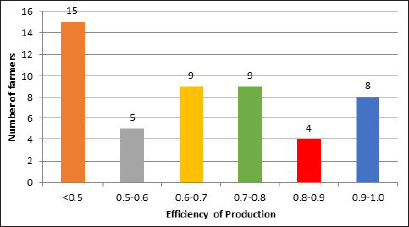
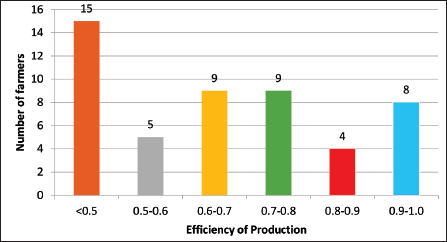
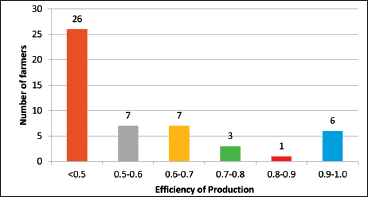
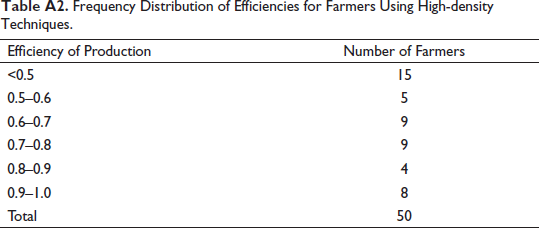
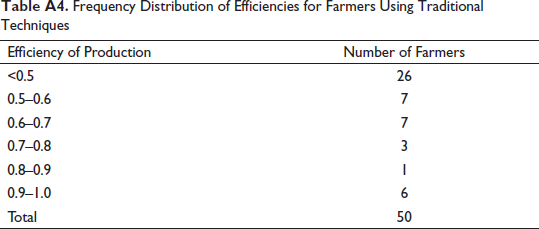
We can also compare the frequency distribution of efficiency calculated for each farmer using the regression results. Figures 10 and 11 show the frequency distribution of efficiencies for both high-density and traditional techniques.
Distribution of farmers as per Their Efficiency of Production Under High-density Techniques.
Distribution of Farmers as per Their Efficiency of Production Under Traditional Techniques.
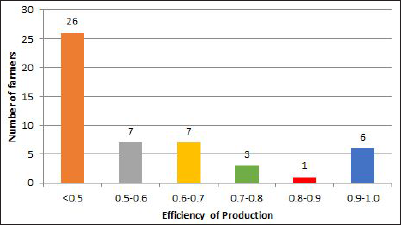
More than 50% of the farmers (26 out of 50) using traditional methods have an efficiency of less than 50%, while in the case of high-density, less than one-third of the farmers (15 out of 50) have efficiency less than 50%.
More farmers are able to reach higher levels of efficiency under high-density technology as compared to the farmers using traditional methods of production.
These results indicate that high-density techniques allow the farmers to reach greater efficiency of production. The technology allows more optimal use of the inputs and gives better returns to the farmers.
Financial Feasibility of the High-density Plantation Technique
The question sought to be answered here is whether the high-density plantation technique is financially viable or feasible in the long run or is it profitable for the farmers only due to the subsidy being offered by the government.
It is difficult to do a proper cost-benefit analysis of the HDP techniques as well as the subsidy scheme as both the techniques and the subsidy have been implemented only recently.
Such an analysis would require panel data, where a specific sample of farmers is tracked over a period of time and data regarding their productions and costs is recorded every year. Unfortunately, such an exercise is beyond the scope of the present study.
Therefore, we use an alternative data source for the purpose of assessing the financial viability of high-density apple orchards and comparing it with that of traditional orchards.
SKUAST-Kashmir maintains time series data on costs and returns for both traditional and high-density apple orchards based on study of experimental fields. This data is available in the form of a time-series over several years.
This data can be used to calculate the NPV, IRR and payback period for the two types of orchards and compare the two.
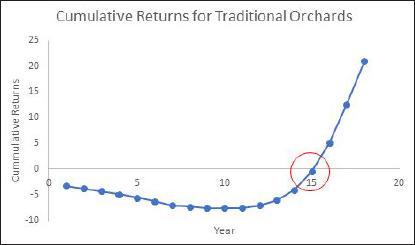
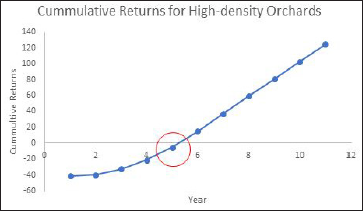
The calculations for NPV, IRR and payback period for traditional and high-density orchards are provided below.
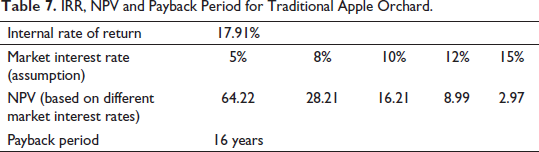
NPV for high-density orchards are higher in each case than the traditional orchard (Figures 12 and 13 and Tables 7 and 8).
Payback Period for Traditional Orchards.
Payback Period for High-density Orchards.
IRR, NPV and Payback Period for Traditional Apple Orchard.
IRR, NPV and Payback Period for High-density Apple Orchard.
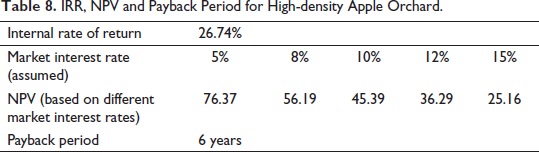
Similarly, payback period for high-density orchard is only 6 years while it is much higher, 16 years, in the case of a traditional apple orchard.
However, it is not strictly correct to compare NPV and payback period for the two investments as the size of the initial investment is not the same. There is a difference in scale in the two projects.
It is more appropriate to compare the two projects based on their internal rate of return. Even when comparing IRR, we can see that a high-density orchard has an IRR of 26.74% which is higher than the IRR of a traditional orchard at 17.91%.
Trends and Reasons for Adoption of High-density Plantation Techniques
Encouragement and mentorship by progressive farmers: Progressive farmers refer to enterprising farmers who lead the way for adoption of a new technology or new technique of production. The research revealed that the biggest driving force behind adoption of high-density plantation technology is the presence of a progressive farmer in the village or locality. Many progressive farmers were instrumental in encouraging their neighbours to adopt the HDP techniques and making them aware of the economic benefits from the new techniques.
High initial cost of setup leads to greater adoption of HDP technology by prosperous farmers: A major difference between the traditional and HD plantation is that HD plantation requires a high initial expenditure compared to the traditional orchards. As a result of this high initial investment cost, we see that HD plantations have been set up by relatively prosperous farmers, who had enough savings or capital at hand to be able to afford these high initial investment costs.
High-density plantations coming up on old/senile traditional orchards: Close to 90% of the HDP orchards have been set up on old or senile orchards and only about 10% of the HDP orchards are coming up on land under paddy cultivation. The farmers are reluctant to uproot their traditional orchards which were in high-output stage and plant HDP instead. This finding indicates that apple farmers are generally cautious and risk averse and do not wish to take the unnecessary risk even if there is a potential for significantly high returns.
Impact on Environment and Human Health
This section presents findings on the impact of fertiliser and pesticide use on environment and human health.
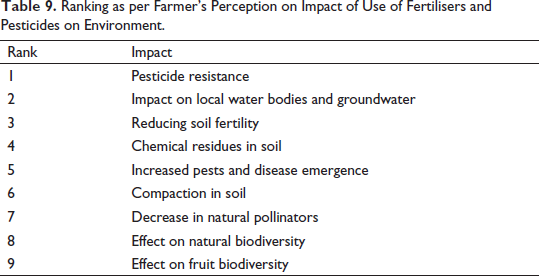
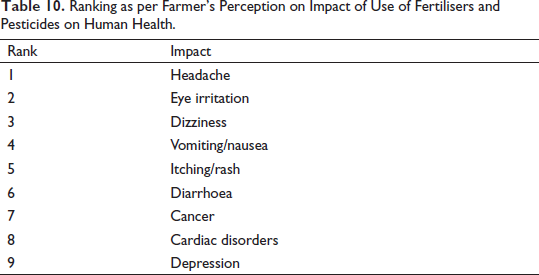
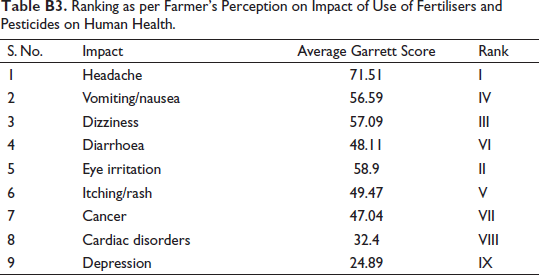
We use Garrett’s ranking technique to get a sense of what farmers feel about these impacts at an aggregate level. Tables 9 and 10 present the results from Garrett ranking.
Ranking as per Farmer’s Perception on Impact of Use of Fertilisers and Pesticides on Environment.
Ranking as per Farmer’s Perception on Impact of Use of Fertilisers and Pesticides on Human Health.
The farmers feel that pesticide resistance is the biggest or most important impact of pesticide use. The farmers also rank impact on local water bodies and groundwater quite high. However, the farmers are not very aware of the long-term adverse impact of chemical use on natural biodiversity, including the impact on fruit biodiversity.
The findings show that farmers are aware of mild impacts but less aware of more serious and long-term impacts of pesticides such as cancer and cardiac disorders. This finding is quite concerning as farmers lack awareness about serious ailments such as cancer and cardiac disorders. This might lead to casual behaviour on their part and they may not take adequate precautions to prevent such serious disorders.
Existing studies have shown a linkage between pesticide use and brain cancer in orchard farmers in Kashmir (Bhat et al., 2010).
Use of Protective Equipment During Application of Fertilisers and Pesticides
Very few farmers reported that they use protective equipment such as gloves, masks, eye goggles and face shields.
Most of the pesticide spraying work is done by labourers hired during the growing season of apple. These workers are completely vulnerable to diseases and health issues in the absence of any protective equipment.
There is an urgent need for government intervention to increase awareness about the harmful effects of pesticides as well as ensuring proper regulation and supervision related to use of protective equipment by workers.
Pest and Insect Profile in High-density Apple Orchards
High-density apple orchards are a new technique in the Kashmir valley and the field environments are completely different from traditional apple orchards. As a result, the challenges related to pests and insects that plague such cultivation techniques and orchards are also different. These need to be investigated thoroughly to ensure proper measures to deal with these challenges.
The present study was limited in its scope and did not undertake a detailed review of the issue of insects and pests. However, some results from existing literature are provided to give a sense of the issue. Future studies can build on the existing studies for a more in-depth understanding.
Khursheed et al. have looked at the issue of insects and pests prevalent in high-density apple orchards in Kashmir and have identified a comprehensive list of insect and mite pests in high-density apple orchards in Kashmir. However, they have also identified a list of natural predators associated with the pests which help keep them in check (Khursheed et al., 2021).
The authors find that pests have the potential to pose more threat to high-density orchards than traditional ones as high-density orchards require extremely careful handling and protecting. The extra cost in greater care is however compensated by the higher returns from high-density orchards. The authors recommend that there should be careful research on the choice of pesticides to be used to avoid harmful impact on the natural predators.
Apart from the science behind insect and pest management in high-density orchards, it is equally important that farmers should be aware of these issues and should be well versed with insect and pest management. Therefore, it is important to encourage the practice of integrated pest management (IPM) by giving apple farmers appropriate training and orientation programmes. This is where government in general and horticulture department in particular has a very crucial role to play.
A study on awareness regarding latest techniques in Pulwama district of Kashmir found that there was very low awareness about latest techniques such as HDP orchards and IPM. The study, however, found that training and awareness campaigns are highly effective, especially among the youth of Kashmir, who have an entrepreneurial mindset and are keen to take up the latest technologies and innovations. The authors of the study emphasise use of local dialects for effective training and information dissemination among the intended beneficiaries (Kumar, 2015).
Results and Policy Recommendations
The main findings from the research study are as follows:
Higher yield under high-density plantation technique: The productivity of apple production, measured by the yield of apple output, is significantly higher under the high-density plantation system vis-a-vis the traditional apple cultivation methods. More efficient production under high-density plantation technique: The efficiency of Production is also higher under the high-density plantation techniques owing to better technology and more scientific use of inputs such as precision irrigation systems and proper application of fertilisers and pesticides. High-density technique is financially viable: The high-density technique is financially viable in the long run and provide a higher internal rate of return when compared with the traditional techniques, even in the absence of any assistance from the government. Low uptake of subsidy scheme of the government: There is low uptake of the subsidy scheme of the government for setting up high-density plantations mainly because farmers find it difficult to produce revenue records in their own name, which is needed for availing subsidy. Many farmers do not avail bank loans either due to similar reasons. Reasons for adoption of high-density technology: The main factors driving adoption of high-density technology are presence of a progressive farmer in the village or neighbourhood, excess capital or savings by farmers to meet the high initial investment cost required as well as geographical and climatic factors. Most of the high-density orchards are coming up in plain areas and lands having old or senile traditional apple orchards and some on existing paddy fields. Farmers’ perception about environmental and health impacts of fertilisers and pesticides: The farmers are aware of harmful impacts of chemicals on environment and health, but there is only limited awareness. The awareness regarding long-term health implications such as cancer due to pesticide exposure is very limited. There is very low use of protective equipment by workers engaged in pesticide application, which puts their health at serious risk.
Policy Recommendations
High-density techniques have the potential to bring about a revolution in the Apple Farming Industry in Jammu and Kashmir. India is far behind global players in terms of productivity of apple cultivation mainly due to use of old techniques. There is an urgent need to encourage more farmers to shift to high-density technologies.
The following measures can help in removing some of the roadblocks to widespread adoption of high-density technology:
Handholding of farmers and greater support from the horticulture department: Awareness camps can be organised by the Department at the Tehsil, Block or Village levels where the apple farmers can be provided information regarding the new high-density techniques and the greater returns and economic benefits that they can earn. Officials of the horticulture department can utilise the influence they hold among apple farmers to encourage progressive farmers to share their experiences with high-density technology so that other farmers also realise the benefits in switching to the new technology. Digital technology can also be utilised in handholding farmers and help them in switching to HDP techniques. Telephone helplines or WhatsApp chat bots can be set up to help answer queries. The department should provide information at the click of a button and in the local language. Increasing the reach of the subsidy scheme: The study has revealed that the coverage of the subsidy scheme is limited and most of the farmers who have switched to high-density methods are doing it using their own capital. A major implication of such a trend will be that over the years, only relatively prosperous farmers will be able to adopt the modern high-density technology and the relatively less well-off farmers will remain stuck with the less productive traditional methods. This will widen the income inequalities present in the region and is not a desirable outcome. Therefore, the subsidy scheme of the government is crucial not from the financial viability point of view, but instead from an equity point of view, as it allows even poor farmers to switch to new techniques by reducing the financial burden on them due to the high initial investment cost. Enrolment camps can be used to encourage mass participation of Apple farmers. These camps can be organised at local places such as the Tehsil or Block Headquarter so that farmers have easy access to the officials. These camps can be combined with the Awareness camps and also provide information regarding weather advisories, pest and disease related advisories. They can be held in collaboration with the revenue department, which can hold simultaneous mutation or revenue camps for apple farmers. This will help apple farmers in getting their land records updated which they can use for their subsidy and loan applications. There is immense possibility for the District Administration and the District Collector to act as a changemaker and coordinate among various departments and provide multiple services at the same place and time. Digitisation of revenue records and providing proof of ownership of land to apple farmers: Jammu and Kashmir has been severely lagging in terms of digitisation of land records. Many revenue villages have missing records or maps which further complicates things and leads to a lot of disputes and litigations on land related matters. The J&K Government has recently started a major digitisation campaign called Aapki Zameen Aapki Nigrani for complete digitization of land and revenue records. The aim is to provide land passbooks to the landholders so that they have conclusive proof of land ownership and can use these passbooks as proof of land ownership for various purposes. Once all farmers have a conclusive digital proof of their land title in their name, they will be able to avail subsidy from the government as well as get easy access to bank loans by using their land as collateral. Stricter implementation of health safeguards in apple orchards: At present there is almost no supervision and regulation related to safety equipment required to be used when working in apple orchards, especially when applying pesticides. Certain officers of the horticulture department need to be specially empowered to conduct inspections of apple orchards and see if the safety guidelines are being implemented or not. There is uncertainty about the safety of some pesticides as well. For instance, many farmers reported using a pesticide called Chlorpyrifos. The pesticide is used widely in Apple Orchards in Kashmir but it has been banned in Europe in 2020 and the US in 2021. The pesticide is considered moderately hazardous to human health and can cause headache, eye-irritation, nausea, neurological disorders and other development disorders. Despite these harmful effects, Chlorpyrifos is the fourth most widely used pesticide in India and the pesticide’s residue in fruits and vegetables continue to be above the safety limits. This calls for a serious relook at the use of these pesticides. There is a need for careful examination of this issue by a panel of experts and scientists to regulate the use of such pesticides in the interest of safety of farmers and labourers working in the field.
Conclusion
Kashmiri Apple is a signature product of the Kashmir Valley. J&K produces over 80% of the total apple production of India. The apple farmers earn considerable returns and are relatively prosperous. Despite this, the apple sector in Kashmir is far away from its potential. The productivity of apple production is Kashmir is far behind the global standards. Apple is a sunrise sector.
High-density plantation techniques have emerged as a potential gamechanger for the apple industry of Kashmir. The technique has the potential to increase productivity and profitability for the apple farmers in Kashmir. The onus is on the government to increase the reach of the subsidy scheme so that even small and marginal farmers are able to benefit from the latest technologies.
At the same time, we must be mindful of the harmful effects on the environment and human health due to the excessive use of fertilisers and pesticides. Care must be taken to ensure that apple production is safe and environmentally sustainable.
It is time for an Apple Revolution in Kashmir, on the lines of the Green Revolution of the 1960s. The apple sector must play a key role towards achieving the goal of doubling farmers income laid down by the Hon’ble Prime Minister of India.
Limitations of the Study
Sample selection and possibility of selection bias: The sample of farmers to be surveyed was chosen through purposive sampling. The sample is not random and may not be representative of the entire population. Due to this the regression results and results of hypothesis testing may not be robust. There may be some element of selection bias since the survey involved mostly the early adopters of high-density techniques.
Data collected based on self-reporting by farmers: Most of the data related to costs, outputs and sales are based on self-reporting by the farmer. This is a major drawback as some farmers may underreport their output, sales and income. However, this will be the case in both traditional and high-density orchards so it is unlikely that this limitation will affect the overall results significantly.
Time series data on costs and returns based on experimental fields The data used for calculating NPV, IRR and payback period are based on data from experimental fields from SKUAST-Kashmir. These fields are maintained under ideal conditions with careful monitoring and application of inputs such as fertilisers, pesticides and irrigation in precise quantities. However, the comparison is based on similar conditions for both high-density and traditional orchards so that we end up comparing orchards under similar conditions. In relative terms, even in real world conditions, the comparative results about IRR being higher under high-density plantations are likely to be similar.
Limited availability of data: As mentioned before, there was limited availability of data as the high-density orchards take at least 2–3 years to start giving apple output. Most of the high-density orchards in Kashmir have been planted only recently in the past few years. Similarly, the subsidy scheme has only been implemented recently and enough data are not available to do a proper cost-benefit analysis of the scheme.
Despite these limitations, the present study is an attempt to provide some insights into the performance of high-density plantation techniques over the traditional methods.
Hopefully, some of the findings and observations from this study can be used to inform and drive policy decisions related to the apple sector in J&K.
Appendices
Appendix A. Regression Results for Stochastic Production Frontiers
The following are regression results for stochastic production Frontiers for high-density and traditional apple orchards (Figures A1 and A2 and Tables A1–A4).
High-density Apple Orchards
Distribution of Farmers as per Their Efficiency of Production Under High-density Techniques.
Distribution of Farmers as per Their Efficiency of Production Under Traditional Techniques.
Maximum Likelihood Estimates for Stochastic Production Frontier for High-density Apple Orchards.
**Indicates significance at 1% level of significance.
*Indicates significance at 5% level of significance.
Frequency Distribution of Efficiencies for Farmers Using High-density Techniques.
Traditional Apple Orchards
Maximum Likelihood Estimates for Stochastic Production Frontier for Traditional Apple Orchards.
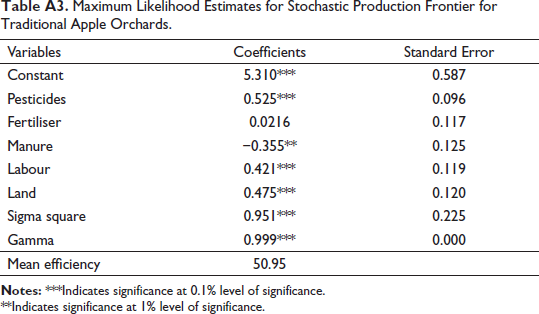
**Indicates significance at 1% level of significance.
Frequency Distribution of Efficiencies for Farmers Using Traditional Techniques
Appendix B: Results from Garrett Ranking Technique
Tables B1–B3 present the detailed results from the Garrett ranking technique.
Percent Position and Garrett Value.
Ranking as per Farmer’s Perception on Impact of Use of Fertilisers and Pesticides on Environment.
Ranking as per Farmer’s Perception on Impact of Use of Fertilisers and Pesticides on Human Health.
Footnotes
Declaration of Conflicting Interests
The author declared no potential conflicts of interest with respect to the research, authorship and/or publication of this article.
Funding
The author received no financial support for the research, authorship and/or publication of this article.
