







Abstract
This research article explores the socio-economic status and challenges faced by tribal women in the Khunti district of Jharkhand, a part of the Chota Nagpur region. Using a holistic lens, the study investigates various aspects, such as education, employment and access to resources, to understand the issues of tribal women in this region. The research methodology involves a combination of quantitative and qualitative approaches, including primary surveys as well as secondary data. Data collection techniques such as purposive sampling and structured questionnaires are employed to gather information from tribal women, community leaders and other stakeholders. For primary results, a sample of 350 tribal women is selected as the population of the study. The findings reveal several significant trends and patterns. Despite government initiatives aimed at promoting women’s empowerment and development, tribal women in Khunti continue to face multiple challenges, including limited access to education, low participation in the formal workforce and sociocultural barriers. Furthermore, the study highlights the intersectionality of gender with other axes of marginalisation, such as caste, class and ethnicity, which exacerbate the vulnerability of tribal women. Issues such as drought and lack of land ownership rights further compound their socio-economic disadvantages. The article concludes with recommendations for policy interventions and grassroots initiatives to address the systemic inequalities faced by tribal women in Khunti. At large, the research underscores the urgent need for a multidimensional approach to empower tribal women in Khunti and ensure their full participation in the socio-economic development of the region. By addressing the root causes of gender disparities and promoting gender-sensitive policies, stakeholders can contribute to building a more inclusive and equitable society for tribal women.
Introduction
The Chota Nagpur region, nestled in the eastern part of India, is known for its rich cultural heritage, abundant natural resources and vibrant tribal communities. Amidst its verdant landscapes and rugged terrains, the tribal population constitutes a larger section of this region. When most of these tribal populations lie in the category of vulnerable sections of society, in this scenario, the status of tribal women stands as a focal point for analysis and introspection. This analytical study aims to delve into the multifaceted realities faced by tribal women in the Chota Nagpur region, unravelling the challenges, opportunities and socio-economic dynamics that shape their lives. Tribal women, comprising a significant portion of the population in the Chota Nagpur region, navigate a complex web of sociocultural norms, economic constraints and systemic barriers. While deeply rooted in tradition and indigenous knowledge, these communities often fight with the consequences of modernity and its impact on gender dynamics. Against this backdrop, understanding the status of tribal women becomes imperative for academic discourse, policy formulation and grassroots interventions aimed at fostering gender equality and empowerment.
This analytical study adopts a multidimensional approach, drawing upon quantitative data, qualitative insights and participatory observations to paint a comprehensive picture of tribal women’s status in the Chota Nagpur region. It seeks to unravel the stories of their lives and experiences, exploring domains such as education, their day-to-day struggle, livelihood opportunities, sociocultural practices and access to justice. By delving into these domains, the study highlights the achievements and the persistent challenges faced by tribal women, shedding light on pathways for progress and inclusive development.
Further, this study is a call to action to acknowledge the agency, resilience and untapped potential of tribal women in the Chota Nagpur region. Through rigorous analysis and thoughtful reflection, this study seeks to amplify the voices of tribal women, advocating for their rights, dignity and well-being in pursuing a more equitable and inclusive society.
Women and Indian Society: An Overview
There is a saying, ‘The progress of any society can be measured by the progress of its women’. In Indian culture, women are considered to embody the essence of nature, endowed with the ability to create, nurture and transform. However, it is lamentable that while women are revered as life-giving goddesses, on the one hand, women, more often than not, are relegated to a secondary status in the patriarchal society. This tradition has deep historical roots and has evolved over time. Historically, women in ancient Indian society enjoyed significant rights. Women who composed Vedic hymns are known as Brahmavadini. Twenty such women scholars and sages—Brahmavadini—are well known. In brief, women were integral members of society, referred to as ‘Ardhangini’, and had equal access to education. Women could initiate divorce, though widow remarriage was restricted to specific circumstances. Practices like Sati were absent, and they actively participated in political life through ‘Samiti’. Women chose their partners in ‘Swayamvara’, and female infanticide was virtually unknown. Unmarried women had inheritance rights and were seen as companions, not subordinates. This era marked a time of respect and rights for women, which gradually diminished due to concerted efforts against them. While the situation is improving, women continue to excel in various fields, though much of their labour still needs to be recognised.
Key legislative reforms have sought to address these inequalities, including:
Hindu Widow Remarriage Act, 1856 Child Marriage Restraint Act, 1929 Hindu Marriage Act, 1955 Hindu Adoption and Maintenance Act, 1956 Immoral Traffic (Prevention) Act, 1956 Dowry Prohibition Act, 1961 Protection of Women from Domestic Violence Act, 2005
With the implementation of new laws and regulations, some changes were observed in women’s lives. In reality, the existence of women is seen everywhere—from childcare to healthcare, from social-cultural bonds to economic and political grounds. The contradiction lies in the fact that while in some cases, women can be seen excelling in every sphere of life, in others, their unrecognised labour towards society is overlooked under the guise of ‘a woman’s duty’. Therefore, this research also attempts to understand the status of women’s lives and the social-cultural status in the specific context of the Khunti district of Jharkhand in the Chota Nagpur region. To get a comprehensive understanding of all these factors, the research article will look into two different dimensions elaborately: (a) Land Issues, Ownership and Rights and (b) Livelihood and the Way of Life. However, before analysing the two factors, an overview of the Khunti region is necessary for demographical understanding.
Socio-economic Profile of the Study Area
Khunti is a drought-prone region, where the geographical location and economic conditions are not particularly conducive to development. As per the reports of downtoearth.org.in, ‘The Jharkhand government has finally declared 158 blocks in 17 districts of the state as drought-affected, where about 1.5 million farmers were impacted’. (12 January 2024). Similarly, a report of RuralVoice states:
The government had also declared 226 out of 260 blocks of the state as drought-hit in 2022 and decided to provide cash relief of Rs 3,500 to each affected farmer family. In Jharkhand, about 3.3 million farmers have suffered crop losses due to drought. The drought-affected districts are Chatra, Deoghar, Dhanbad, Dumka, Garhwa, Giridih, Godda, Gumla, Hazaribagh, Jamtara, Khunti, Koderma, Latehar, Lohardaga, Pakur, Palamu and Ranchi. (11 January 2024)
People here often struggle with livelihood issues. In this context, it can be speculated that women’s lifestyles are more affected by the aforementioned reasons.
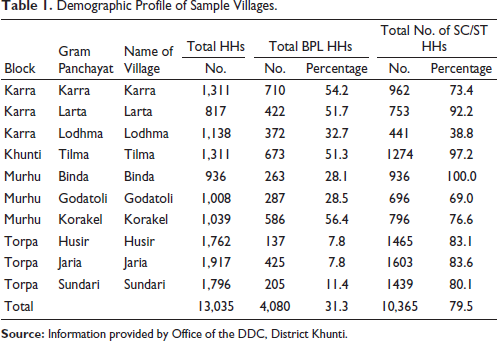
Therefore, to understand how the geographical conditions of the area create obstacles in the lives of women, how socio-economically, especially in the domain of land ownership, they are treated, and how they progress towards their development while facing these conditions, the research methodology adopted in the article includes mainly a primary survey. Subsequently, this article is based on the socio-economic conditions of 350 tribal women from Oraon, Munda, Kharia, Kharwar and Santhal tribal groups (N = 70) each through purposive random sampling in various blocks of the Khunti district. The 10 villages selected for the monitoring of the status of the women are given in Table 1. Further, only those women’s households that have participated in any or all of the programmes given in the list below have been chosen in the sample. The researcher has taken the support of district-level concerned officials for the data of the Gram Panchayats (GPs) and villages so that those GPs/villages could be selected where the maximum number of programmes of the Ministry of Rural Development (MoRD) were implemented. These programmes primarily include:
Mahatma Gandhi National Rural Employment Guarantee Scheme (MGNREGA), Deen Dayal Antyodaya Yojana-National Rural Livelihood Mission (Day-NRLM), Pradhan Mantri Awas Yojana (Gramin), National Social Assistance Programme (NSAP), Pradhan Mantri Krishi Sinchayee Yojana (PMKSY), Pradhan Mantri Gram Sadak Yojana (PMGSY), Digital India Land Records Modernisation Programme (DILRMP).
The research methodology includes both primary surveys and data from secondary sources. From the selected villages, a total number of 13,035 households reside in the villages, in which 31.3 per cent were BPL and 79.5 per cent were SC/ST (Table 1).
Demographic Profile of Sample Villages.
Educational Status
Literacy serves as an indicator of social development. Any group that is relatively more literate is also considered economically stronger. Therefore, the educational status of the respondents can be represented as shown in Table 2.
Educational Status.
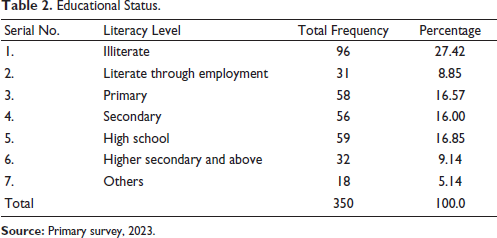
The figures in Table 2 clearly indicate that the majority of respondents (72.58 per cent) are literate. Additionally, it can be observed from the data that the number of respondents with education up to higher levels is higher among women under 30 years of age (87), indicating awareness towards education.
Further, tribal women, comprising a significant portion of the population in the Chota Nagpur region, navigate a complex web of sociocultural norms, economic constraints and systemic barriers. It is evident in their land ownership rights, paths of livelihood and way of life. Hence, the following sections of the article will peep into those factors.
Land Issues, Ownership and Rights
Importance of Land Ownership for Tribal Women in the Chota Nagpur Region
Land ownership is a crucial aspect of ensuring women’s rights as it lessens their dependency on other family members and makes them self-reliant. The Indian Constitution also offers protections to women through different laws as stated above, so they can develop while maintaining their distinctive customs. Especially in the case of Scheduled Tribes, to simplify these customaries, the Indian Government initiated the Panchayats Extension to Scheduled Areas (PESA) Act, 1996. For tribal women, possessing property signifies more than just financial stability; it also signifies social standing and independence. Although women have historically been heavily involved in agricultural and resource management in many tribal societies, their land rights are frequently unstable. Women are often denied direct ownership of property due to the patriarchal framework of inheritance and property rights, which makes them reliant on male family members to gain access to resources and land. Their capacity to make choices, obtain credit and engage fully in the economy is all weakened by this dependency. For tribal women in Chota Nagpur, land ownership is essential to ending this cycle of reliance. It gives them a material resource that they can use to their advantage in pursuit of business ventures, farming or borrowing money for revenue-producing endeavours. Thus, the following section will try to examine the status of land ownership of women in the study area.
Land Ownership Status
When discussing women’s rights, knowing what percentage of women own land becomes crucial. This section attempts to understand this fact more fundamentally. The responses are as shown in Table 3.
Land Ownership.
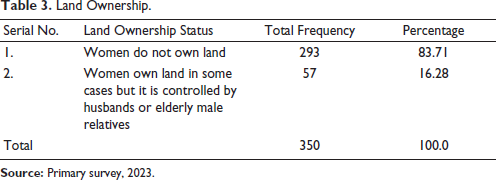
The figures show that nearly 83.71 per cent of women do not own land. Either it is under the control of their husbands or elderly male relatives, or 16.28 per cent own land acquired after their husband’s demise, being the oldest members of their households. This data indicates that most women lack economic security in terms of land ownership. It is due to the lack of education and awareness, due to which women themselves prefer men as the actual inheritors of the property and land. In the patriarchal system, the property rights of women, whether it is a single woman, a widow, a sister or a mother, are often overshadowed. The land and its rights automatically pass to men, reinforcing the systemic nature of this inequality.
Problems in Land Ownership
One of the major problems in land ownership among women is the prevalence of their customary laws. The key difference between customary laws and legal laws is that legal laws are created according to constitutional guidelines, ensuring equal treatment for all regardless of caste, class, race, creed or gender. In contrast, customary laws are shaped by the interests of the community and vary depending on the community’s structure, such as whether it is patriarchal or matriarchal. Though it is nearly two decades since the Panchayats (Extension to Scheduled Areas) Act, 1996 (PESA) was enacted under the Ministry of Panchayati Raj, Government of India, the proper implementation of it has not been done in the tribal areas till now. Vibrant examples of this are the tribal governance systems such as the Manki-Munda System among the Munda tribe of Jharkhand and the Parha system among the Oraon tribe in Jharkhand. According to these self-governance systems of the tribal people, they prefer to stick to their age-old practices, thus creating a gap in PESA and the customary laws. While in mainstream societies, sometimes it is very common for women to face all kinds of violence, physical and emotional, just to evict them from the land that they are waiting to own and hence the secondary status in land ownership makes them more vulnerable to oppression, humiliation and suffering. But in the case of the tribal women in Chota Nagpur, these cases are rare, and the land ownership goes to men by law due to customary practices and lack of education and awareness among women.
Measures for Effective Land Ownership
Laws concerning customary practices were rendered by the Jharkhand High Court in the year 2023; these rulings will have an especially large effect on the state’s tribal populations. These rulings are a reflection of the increasing acknowledgement of the rights of tribal people, particularly women, and the vital role that customary rules play in regulating these societies. They also highlight the difficulties brought about by these rules’ lack of codification, which forces judges to get involved in cases that may have been resolved through tribal customs.
The Oraon tribe’s customary rules underwent a dramatic change on 22 April 2023, when the Jharkhand High Court handed down a landmark ruling granting women of the tribe equal inheritance rights to paternal property. Women had previously been denied these rights. The case started as an appeal against rulings made by lower courts that restricted women’s inheritance rights. The court reversed earlier decisions because it could not find any convincing evidence of a tradition that prevented daughters from inheriting. This ruling emphasises how uncodified customary laws can be difficult to implement and how tribal societies are gradually coming to recognise gender equality. Hence, when we talk about the land rights of women, the following measures are of immense importance:
Codifying the customary laws of women and bridging the gap between customary laws and the PESA Act. Organising training camps, weekly meetings and awareness programmes in the tribal areas with the help of Gram Sabha. Ensuring community engagement and participation in the decision-making processes of Gram Sabha, especially the engagement of women. Initiating specialised programmes on land rights and inheritance of property of women. Creating financial independence for women through job creation and income-generation activities by using both physical and e-commerce systems so that they can become a helping hand instead of a burden. It will also lead them to understand and fight for their rights in case any injustice happens to them.
Hence, through these measures, the rights of women can be ensured, and the proper implementation of PESA plays a vital role in it. Further, in the following sections, the article will try to understand the livelihood choices of women and their patterns of living in the study area to get an overview of their way of life.
Livelihood and the Way of Life
Lifestyle
Table 4 illustrates the social and economic status of women and their livelihood paths.
Lifestyle.
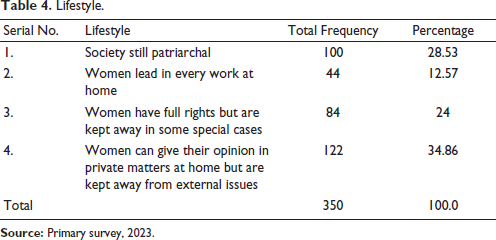
This data indicates that although the propagation of education has granted women some rights, there are still numerous obstacles hindering their development, and they need to make significant efforts to integrate into not only household chores but also broader societal issues.
Trends in Women’s Education
An educated society is the future of a powerful nation, and women’s contribution to it has always been considered integral. Most of the respondents, accounting for approximately 23 per cent, do not show interest in educating their daughters, believing that women are someone else’s property and, therefore, saving money for their marriage and future is more important. Some 17 per cent of respondents wish to provide education but face financial constraints. Awareness programmes can provide them with information about government policies. Many respondents, primarily involved in household work (13.71 per cent), are interested in skill development programmes for their daughters to enable them to start small businesses such as beauty parlours and tailoring shops. About 10 per cent of respondents are undecided about the type of education they want to provide, but they believe in educating their daughters to the best of their abilities. This demonstrates the various perspectives within society regarding women’s education and employment, highlighting the diverse challenges, whether economic or sociocultural, that women face. Hence, there is an urgent need for concerted efforts to address these concerns.
Economically Empowered Women
Economic empowerment is a fundamental basis of women’s empowerment. It not only enables women to fulfil their needs but is also essential for fulfilling their small desires. Therefore, it becomes extremely important to determine what percentage of women are economically engaged and capable of fulfilling their desires. A comparative analysis of these two tables can shed light on women’s desires and livelihood paths. Table 5 examines this.
Women’s Desires and Livelihood Paths: Comparative Analysis.
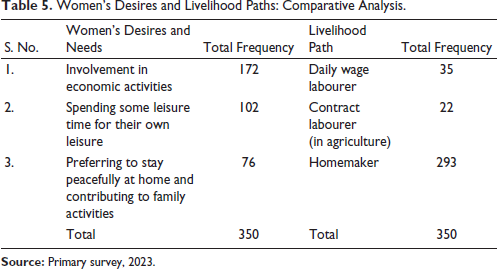
Table 5 highlights a very important fact and draws attention to the fact that 49 per cent (172) of women want to be involved in economic activities, but only 16 per cent, consisting of daily wage labourers (35) and contract labourers (22), are engaged in any work. The rest, 84 per cent of women, are homemakers. Even if we look at the level of work, it is evident that most women are engaged in labour-intensive work instead of higher-paying jobs, which they do out of necessity rather than for economic prosperity or to fulfil their small desires or needs. Further, in a person’s life, their desires and needs are very important. This becomes even more noteworthy when it comes to women because, in Indian society, most women strive for the fulfilment of men’s desires. However, in this effort, women often leave behind their own desires and needs. Table 5 also indicates that approximately three-fourths of women, which is the majority, want to be economically empowered. They desire to take some time out from their busy family lives to spend on themselves, for which it is very important to be economically empowered. This fact indicates that women are interested in economic activities as well, but they lack real resources and opportunities, which can only be achieved by strengthening education levels and exploring better livelihood options for them. Only a few women (21.71 per cent), in general, have internalised that family activities are their responsibilities and must be fulfilled. In their daily lives, the issue of prioritising activities of their interest does not arise, which is why they tend to focus more on homemaking tasks rather than being involved in any economic activities that they view as an obligation.
Awareness of Government Schemes
From Table 5, it is clear that the lives of these women can be improved through better facilities for education and livelihood. Table 6 also aims to confirm whether these women are aware of any government schemes and, if so, which schemes they know about.
Awareness of Government Schemes.
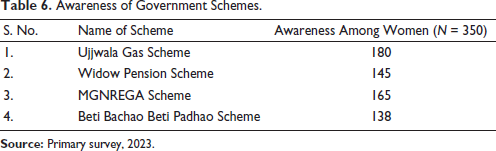
This fact confirms that though some women know about some specific schemes, such as Ujjwala Gas Scheme, Widow Pension Scheme, MGNREGA Scheme and Beti Bachao Beti Padhao Scheme, however, their awareness about livelihood-related schemes is not high, and many women have no knowledge about any scheme. This fact emphasises the need for organising group weekly or monthly camps by various government or non-government agencies to educate women about these schemes.
The Self-help Groups (SHGs) and Women Entrepreneurship
The Deen Dayal Antyodaya Yojana-National Rural Livelihood Mission (DAY-NRLM) programme was implemented in the district for developing micro-level entrepreneurship among women, and a total of 3,026 households were targeted in four villages under the programme. Out of them, only 2,731 households were mobilised into SHGs. As per the data provided under this category, the details are shown in Table 7.
Status Under Deen Dayal Antyodaya Yojana.
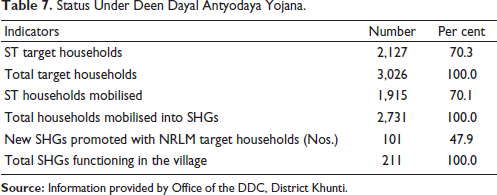
These covered 377 households that belonged to SC categories, 1,915 households belonged to ST categories and the rest, 439 households, were from other caste categories. Some households were listed under the BPL category. A total of 211 SHGs were formed in all villages, but it was surprising that 110 pre-NRLM SHGs were brought under NRLM after revival and training while such SHGs existed in the villages. As reported, all blocks were declared as intensive in the year 2016, but the programme actively started in 2019 due to a lack of staff under the scheme. The data show that after 2019, there has been a growth in the implementation of the scheme. All these SHGs are run by females in small groups of 8–10 women, and the process of admitting more women to these SHGs is through a chain method, where the women already involved in the SHGs admitted to inform and inspire the local neighbouring women to join their group or make a separate group orally. This process gives us hope for an economically empowered society in the near future.
Sources of Drinking Water
Fresh water has become a constraint in most areas that are dry, and there is a severe scarcity of water, knowing the sources of drinking water becomes crucial for those relying on it for their daily lives. Table 8 has been prepared to understand whether people are using fresh water sources or facing difficulties in accessing drinking water.
Sources of Drinking Water.
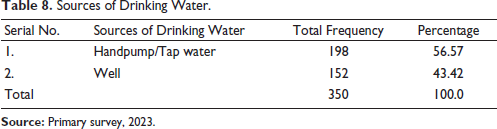
Table 8 indicates that current issues related to water sources have decreased. All have access to drinking water, whether from public or community sources. 56.57 per cent of respondents have handpumps/tap water and use them for water, while the remaining 43.42 per cent use wells.
Water Fetching Person for Home
Table 9 attempts to understand whether it is mostly women and children who go far to fetch water for the household or if men are equally responsible. The responses are shown in Table 9.
Water Fetching Person for Home.
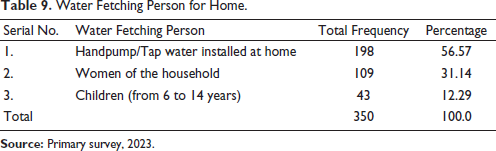
Table 9 clearly shows that the number of women and children fetching water for the home is higher than that of men. While 56.57 per cent have handpumps/tap water at home, eliminating the need for someone to fetch water from afar, 31.14 per cent of women and 12.29 per cent of children go outside to fetch water. As reported by the respondents, the approximate distance they cover to fetch water either from wells or ponds is between 500 m and 1 km. Though the time or distance covered by them is not too high, it is still a matter of consideration to facilitate drinking water in each household for everyone. This indicates that despite efforts to address the water issue, it remains largely unresolved, affecting women’s lives the most.
Daily Life Issues
Table 10 is created to showcase the major problems faced by women in their daily lives.
Daily Life Issues.
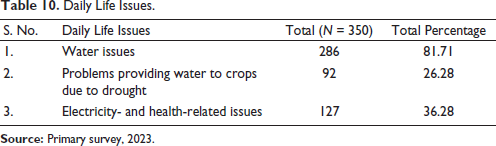
Table 10 indicates that water remains the biggest daily life issue for women, with approximately 81 per cent of them considering water and associated drought problems as major hindrances to agricultural production, impacting not only men but also women who are integral to agriculture. Presented below illustrates how water problems persist for residents of this region and how they strive to find solutions despite the challenges. Furthermore, this image also highlights the continuous role of women in sustaining society, not only by enduring hardships but also by actively contributing to their family’s financial well-being even in adverse circumstances.
Decision-making Process of Women
Involvement in the decision-making process is crucial concerning the status of women in any society. This can be in terms of economic, political and sociocultural aspects. The status of land ownership plays an important role in understanding the economic status of women in a society. Previously, it has already been seen that the majority of women do not own land. This puts a question on the decision-making process of the women in the study area regarding land ownership rights, the role of women in land sale and purchase and their freedom in the decision-making process. The case was observed acutely during the survey, and it has been observed that the woman has the right to own land and is highly motivated to make decisions, yet due to the lack of education and improper knowledge of governmental procedures, she finds it difficult to involve in these processes. Hence, activities like land sale and purchase, monetary transactions or taking the benefits of governmental schemes are looked after by the male section of society. Most of these decisions are taken at community level like at traditional Panch meetings. The examples are mainly found while applying for any government schemes or benefits, where they prefer to do it in groups. Thus, it can be argued that though women are empowered to make their decisions on land-related issues, due to a lack of socio-infrastructural knowledge, they prefer to avoid such decisions.
Similarly, when it comes to sociocultural decisions, the article has already discussed the non-material cultural elements in the above sections. However, in the case of material culture, such as the selection of clothes, it has been witnessed that although approximately three-fourths of respondents have the right to wear both traditional and modern clothes at home, the percentage of those whose households adhere strictly to the traditional attire is also significant (35.43 per cent). Another prevalent trend is where modern attire is permissible indoors, but traditional attire is favoured outside, and the count of such households is considerable (22.57 per cent). This fact indicates that despite globalisation, in some cases, people have become lax, but society remains quite conservative concerning women. It may take even more time for attitudes to relax further in women’s matters.
Conclusion: Towards a Gender-inclusive Future
As we draw upon the insights gleaned from the analysis of data presented in the preceding tables, we embark on a reflective journey into the nuanced landscape of women’s empowerment in contemporary India. With each statistic and trend, a mosaic of challenges and opportunities unfolds, revealing the intricate interplay of sociocultural norms, policy frameworks and individual agency in shaping the lived experiences of women across the nation. At the heart of this discourse lies the imperative of fostering gender equality and empowerment as fundamental pillars of societal progress and sustainable development. In a nation as diverse and dynamic as India, where traditions intertwine with modernity and innovation, the quest for gender justice transcends mere policy prescriptions. It requires a holistic and inclusive approach that acknowledges the complex realities of women’s lives. The analysis of women’s participation in government schemes offers valuable insights into the efficacy of existing policies and the challenges encountered in their implementation. While the data indicate a relatively high level of awareness among women regarding various schemes, the discrepancy between awareness and participation underscores the need for targeted interventions to enhance accessibility and inclusivity.
One of the striking findings is the disparity in participation rates across different schemes, with certain programmes exhibiting lower levels of engagement among women. This disparity may be attributed to a myriad of factors, including structural barriers, cultural norms and socio-economic constraints that hinder women’s ability to avail themselves of the benefits offered by these initiatives. To address this gap, policymakers must adopt a multi-pronged approach that combines outreach efforts with measures to address underlying barriers, such as lack of information, financial constraints and social stigma. By engaging local communities, empowering grassroots organisations and mainstreaming gender perspectives into policy design and implementation, governments can ensure that women are not only aware of their rights but also empowered to exercise them effectively. There is an urgent need for holistic interventions that address both the root causes and the downstream effects of water scarcity, including investments in infrastructure, technology and capacity-building initiatives. Moreover, efforts to enhance women’s access to healthcare services and sanitation facilities are essential for promoting their overall well-being and mitigating the burden of water-related diseases. The understanding of women’s decision-making underscores the importance of promoting gender-sensitive education, media representation and public discourse that celebrates diversity and challenges restrictive gender norms. By empowering women to make informed choices and assert their agency in all spheres of life, society can foster an environment that values individual autonomy and collective empowerment.
In conclusion, the journey towards gender equality and women’s empowerment in India is both a moral imperative and a strategic imperative for sustainable development and inclusive growth. It requires a concerted effort from all stakeholders—governments, civil society, the private sector and individuals—to dismantle structural barriers and challenge discriminatory norms.
At its core, gender equality is not merely a women’s issue; it is a societal issue that demands collective action and transformative change. By mainstreaming gender perspectives into policy formulation, investing in women’s education and economic empowerment, and fostering a culture of gender equality and respect, India can unleash the full potential of its human capital and accelerate progress towards the Sustainable Development Goals.
All these questions and their analysis compel us to further contemplate the fact that while the status of women in this society is relatively balanced when it comes to social rights, the definition of empowerment is still underdeveloped, and this conception can only be fully realised when women are economically empowered. When we talk about ‘empowerment’, it refers to gaining control over one’s own life and participating in decision-making, the impact of which extends to the home, society, government and international policies. Women are the backbone of society. They are the ones who contribute to building the fabric of society. As mothers, they create homes, and as working women, they strengthen families economically. In a larger perspective, it is crucial to ascertain how economically empowered women are in society, and the reality of economic status determines their capability to fulfil their aspirations and the level of freedom they enjoy in society. Undoubtedly, empowerment comes from economic independence, and therefore, women’s participation in work is one of the most important indicators of their development. Hence, this research emphasises the need to empower women with more skills development training, which can help them in immediate livelihood earning and economic empowerment. Society, government and non-governmental organisations should develop new initiatives to train them, only then will we progress towards a strong India and an advanced India.
Footnotes
Declaration of Conflicting Interests
The author declared no potential conflicts of interest with respect to the research, authorship and/or publication of this article.
Funding
The author received no financial support for the research, authorship and/or publication of this article.
