







Abstract
Law is firmly established as an integral and independent component of most business and economics degree courses. The objective of this article is to examine the contents and teaching methods generally employed in the law courses required for degrees in business and economics. As a rule, both the contents and the teaching methods are adopted from degree courses for law students. However, to date there has been little discussion as to whether teaching procedures that have been developed for law students are also suitable for business and economics students. The article shows what problems can arise if course contents and teaching methods are adopted without reflection and without adapting them to the needs of the target group. This overview is then taken as a basis for a proposal as to how the content of law courses can be taught in a practice-oriented way, adapting and further developing the curricula that have proved suitable for law students to the needs of students of business and economics. The use of presentations of the legal life cycle of business organizations and discussions of management case studies on legal problems as didactic models are introduced, and practical teaching issues are discussed. The aim is to raise students’ awareness of the legal problems that are important in running a company and to teach them skills that they can later use to deal with problems in their daily work.
Introduction: Teaching and Learning Law in Business Administration Degree Courses
Neither in law nor in business administration or economics much attention is paid to how law is taught to and learned by business administration and economics students. This is regretful, since the number of students of business administration and economics who study law as a required subject within their degree courses is greater than the number of students taking law as their main subject. Although business administration and economics students usually take only a few law courses, they are required for most business administration and economics degrees. Quite apart from course content, the large number of students involved alone is ample evidence of the importance of law studies in business administration and economics. 2 Despite these high numbers of students, there is only very little literature on the contents of law courses for business administration and economics students and how they are taught. 3 If this were so, one would expect the quality of the teaching and learning of law for business administration and economics students to improve.
The Shortcomings of the Status Quo
Many of the few existing publications on teaching law to business and economics students draw attention to the low student ratings of these courses. 4 This has to do with the fact that the course contents and the teaching methods employed are mainly oriented towards the degree courses for students studying law as their main subject and are not adjusted to meet the needs of different target groups. 5 This problem is intensified by the fact that law courses for business and economics students are usually designed and taught by legal scientists who know little about business administration studies and economics. In those cases in which lecturers have practical experience, it is usually in providing legal consultations and not in business. Therefore, in what follows, I present a brief outline of the weaknesses of law classes for business administration and economics students (see Figure 1), taking the selection of the course content and how they are taught as an example.
Course Contents
The contents of courses on law for business and economics students should meet the requirements that business and economics students will have to fulfil in their careers after graduation (see Figure 2). However, as revealed by the contents of widely used textbooks, in practice, courses do not in fact satisfy this requirement. Although the law textbooks are written for business and economics students and claim to orient the form and content of the material towards the needs of their target group, they usually bear more resemblance to abridged law textbooks (‘Law Books’). 6 Moreover, law lecturers for business and economics students tend to teach mainly those aspects that were important in their own degree courses for lawyers and with which they are most familiar (‘Law School Light’). 7 Hardly any attempts have been made to link the contents of textbooks with the tasks with which graduates will be faced after their graduation, for example, with the theory of management and economics. 8

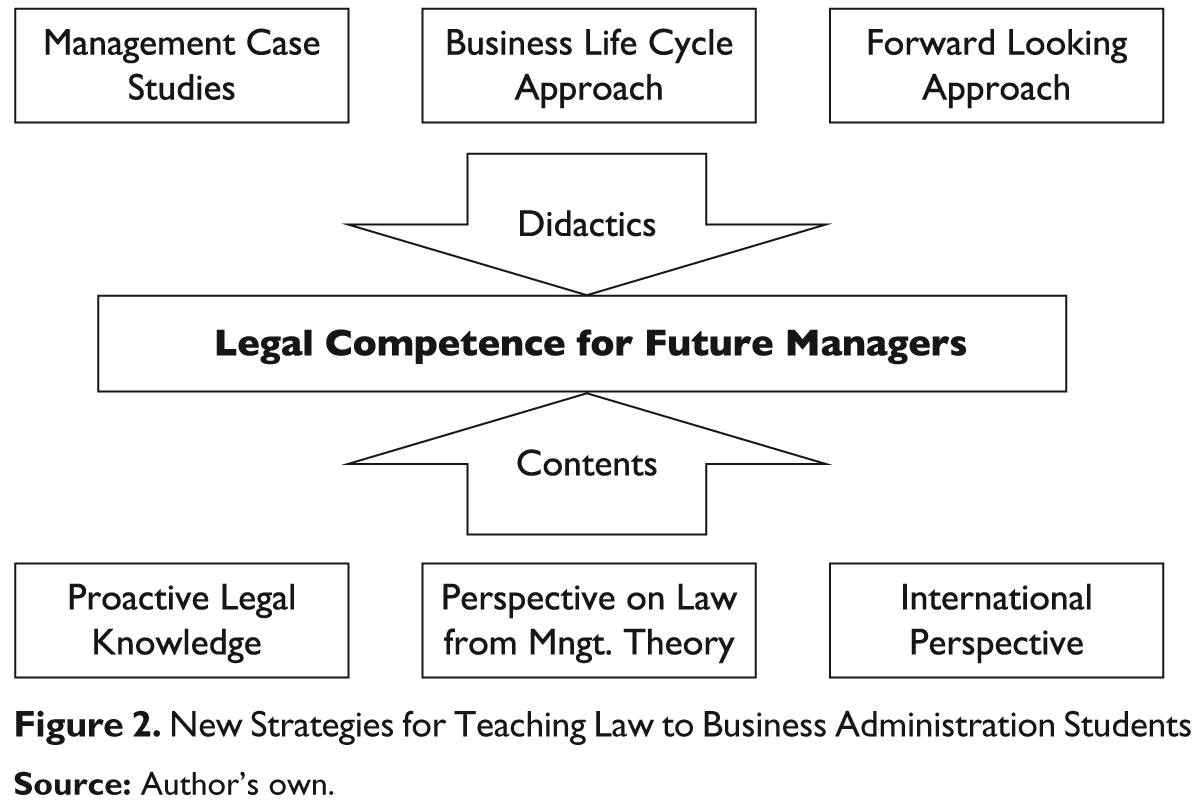
Due to the assumption that compulsory law courses taught as a part of business administration and economics degree courses should convey as comprehensive an understanding as possible of our legal system, as a rule they are structured in such a way that they familiarize students with a broad spectrum of contents. A basic, systematic knowledge of the legal system is indispensable also for business and economics students, since it helps them to communicate effectively with lawyers. 9 However, it is problematic if the content of law courses for business and economics students is too much compressed because too little time is allotted to them. To counteract this problem, the teaching material on law should be very carefully selected and the choice should be guided by didactic principles. It may be necessary to accept that the material selected will not follow the structure of a law exactly. If it is necessary in order to ensure that teaching material is suitable from a didactic point of view, the complexity of the legal problem covered can be reduced. This is an acceptable approach, since business and economics students do not, like law students, need to be able to apply laws, but must above all learn to understand the importance of legal regulations for business activities and the economy. 10
The material taught in law classes for business and economics students is also generally drawn exclusively from the national legal system (‘National Perspective’). 11 In view of the pronounced international involvement of many companies, this orientation towards the nation states is too narrow. 12 An international course on business administration must also provide its students with a basic knowledge of the legal systems of other countries that are important for the national economy. This is important, not least because the managers of the future will be even more affected by the globalization of the labour markets than lawyers. 13 Moreover, universities have long since begun to teach students of other nationalities besides that of their home country. The number of foreign students studying abroad has shown a constant rise over the past few years. 14 The teaching of law to business and economics students should thus also take into account the growing international orientation of the main subject in business degree programmes.
Methods of Teaching and Learning
Like the content of the teaching material, the methods employed to convey it to the students is also oriented towards those of degree courses for law students (‘Traditional Legal Cases’). Insufficient attention has been paid to the fact that a different didactic approach is required for business and economics students than for law students. 15 Lecturers usually draw on didactic methods that are familiar to them from their own studies as students of law. For instance, where law is only a mandatory course in a degree programme, it makes little sense to teach students how to solve legal issues mainly by employing the form and style of an expert legal opinion (‘Backwards Looking Approach’). It is certainly useful for businessmen to have a basic knowledge of legal doctrine, since it enables them to understand the decision-oriented arguments on which legal opinions are based. However, applying law in the classical case method is not a particularly suitable way of teaching the dimensions of law that come into play in the practice of business, and it should, therefore, be complemented by other more fitting methods. 16 Since most law lecturers are not familiar with the modes of thinking in business administration studies and economics, it is difficult for them to prepare the teaching material in a way that meets the needs of this target group. 17 If unsuitable methods are used to teach material that is foreign to this target group, students may fail to develop an interest in it, since they are as yet unable to grasp how important it will be for their work once they have graduated. The less relevance the legal material they are presented with has for business studies and economics, the more this will be the case. Where motivation is low, students frequently simply learn the material by heart in order to pass their exams. 18 Since the teaching material on law has not been sufficiently adjusted to the needs of business and economics students (‘Lacking Connection with Management Theory’), the students are not adequately prepared to take legal issues into account in their decision-making later on.
In contrast, it would be desirable for future businessmen to have developed a certain competence in legal matters or ‘legal astuteness’ during their legal studies.
19
In other words, they need to learn to take legal regulations suitably into account when formulating a competitive strategy and to employ the legal tools available to their company effectively to gain a competitive advantage. This management skill includes the following elements:
20
an ethical basic stance in their entrepreneurial activities that is in compliance with the spirit of the law; a proactive attitude with regard to legal regulations that permits them to perceive these regulations not only as restrictions, but also as opportunities; the ability to make management decisions in conjunction with legal advisers that are substantiated with regard to the legal concerns, despite adverse circumstances such as legal uncertainty and the acquisition of relevant legal knowledge that enables them to communicate efficiently with legal advisers and to exploit the legal tools available to their company to the full.
In the required law courses in business administration studies, the extent to which these skills can be acquired is limited. The objective of the courses is, thus, to help students to understand how important it is for their career to be competent in legal matters and to acquire the necessary basic knowledge.
Legal Skills as an Element of Leadership Qualities in Business
How Must a Law Course Tailored to the Learning Needs of Business and Economics Students be Designed?
For choice of material for law courses and their teaching to be suitable for business and economics students the following requirements should be fulfilled.
The teaching material should be selected and prepared in such a way that it can be integrated into business administration studies and economics. The importance of law should be explained from the viewpoint of these sciences. This would enable students to link the new material to the issues addressed in their main subjects. Students must be aware that an understanding of law is a necessary precondition for business activities which is important for a large part of the material that is learned in the course of business administration studies and economics. 21
Unlike degree courses for law students, the law courses for business administration and economics students should be oriented less towards solving cases by applying a law. The job profiles of business and economics graduates do not as rule require them to be able to approach legal issues from this perspective. Explaining legal regulations on the basis of legal precedents and practice in using these regulations to solve cases can lead students to overestimate the importance of litigation in solving conflicts in business. Contrary to the opinion implied by in the teaching of law, in business, only a fraction of all legal disputes are decided in court. Due to the high costs incurred, the tying up of company resources and the negative effects on the company’s image, from a business point of view, court proceedings are usually the least advantageous way to settle a conflict. 22 So as to avoid legal disputes from the start (‘Proactive Legal Knowledge’), students must above all learn to assess the legal permissibility of their actions. 23 In order to develop this skill, they need interdisciplinary case studies (see below) that are clearly related to the material of their business courses. Unlike legal case studies, in this case, the students are asked to assume not the role of a judge or lawyer, but that of a manager confronted with legal issues in the course of their business activities and decision-making. 24 These case studies can also, for example, replace the use of legal cases to be solved and multiple-choice tests in examinations. This would appear to be advisable, so as to encourage students to concern themselves with legal issues on an ongoing basis. 25
Comparative Law and the Economic Analysis of Law
In order to do justice to the international orientation of business administration studies, law courses for business and economics students must also take into account the findings of comparative law (‘International Perspective’). This enables students to recognize how similar requirements that economies place on their legal systems can be handled with the aid of different legal institutions and procedures. 26 Due to the limited time available in compulsory law courses for business and economics students, it is not possible to carry out a comprehensive comparison of legal systems, and it must, therefore, be done by comparing central areas of law by way of example. Thus, for example, in the context of company law, attention can be drawn to the fact that there are some structural characteristics of the corporation that exist in most legal systems in a similar way. These characteristics (legal personality, limited liability, transferable shares, centralized management under a board structure and shared ownership by contributors of capital) can serve as a guide for understanding the legal systems of other countries. 27 When a contract law has been discussed, attention can, for example, be drawn to the International Institute for the Unification of Private Law (UNIDROIT) Principles of International Commercial Contracts, which are increasingly being used for cross-border contracts and particularly in international arbitration proceedings. 28
To forge links between the contents of the legal studies and economic theory, law courses for business and economics students should also take into account the results of economic analyses of law. 29 Since in this approach legal regulations are usually discussed on the basis of efficiency criteria with generalized validity, it helps students to gain an understanding of legal systems that goes beyond individual national legal systems. 30 While legal scientists have sometimes considered economic analyses of law to be abstractly theoretical, naively functionalistic or radically market-oriented, today this is no longer considered to be an accurate assessment, at least in English-speaking countries. 31 Care should nonetheless be taken to ensure that students are provided with a comprehensive view of the importance of law for society. This also includes other dimensions of law such as, for example, the issue of ‘justice’, which can be addressed in connection with business and company ethics.
Target Groups and Practice-oriented Designs for Law Courses in Business Administration Studies
In the following sections, I shall make some suggestions as to how material on law can be taught in business administration and economics degree courses in a way that is both practice-oriented and oriented towards the target group. For reasons of space, it is neither possible to present a fully elaborated course design in this article nor to cover business administration and economics degree courses. I shall, therefore, only give some examples of how the content and mode of presentation can be altered to create a new orientation for teaching and learning in compulsory law courses in business administration degree courses.
Law as Part of Management Theory
The importance of law should be explained from the viewpoint of the theory of business administration (‘Perspective on Law from Management Theory’). In what follows, I give a brief outline of how law and management theories can be intermeshed. Management theory provides numerous ways in which the relevance of law for business activities can be taught to the students. 32 Models from the field of strategic management, which is accorded an important place in the teaching of business administration, are most suitable for this purpose. Roughly speaking, strategic management is concerned with the question as to what strategies enterprises should employ to gain a competitive advantage and sustain it in the long term. 33 A central concept in this approach is that of the value chain, 34 according to which, enterprises gain a competitive edge over others by coordinating different strategically relevant activities in a way that is advantageous to them. The value adding process consists of nine generic activities—five primary activities (internal logistics, production, external logistics, marketing, and sales and service) and four support activities (company infrastructure, human resource management, technology development and procurement). 35 In order to develop a competitive advantage, the prevailing legal conditions governing the competitive field must be included in the competition strategy (‘Forward Looking Approach’). 36 With the aid of this concept, which is familiar to the students from their major subject, the importance of law for business activities can be rendered clear in a way that reflects actual practice.
Figure 3 shows which legal institutions are important for each of the generic activities which make up the value chain. If teaching law with the aid of models from the field of management theory is to be successful, then it should be used in conjunction with the innovative teaching models described below.

The Legal Life Cycle of an Enterprise as a Concept for Teaching and Learning
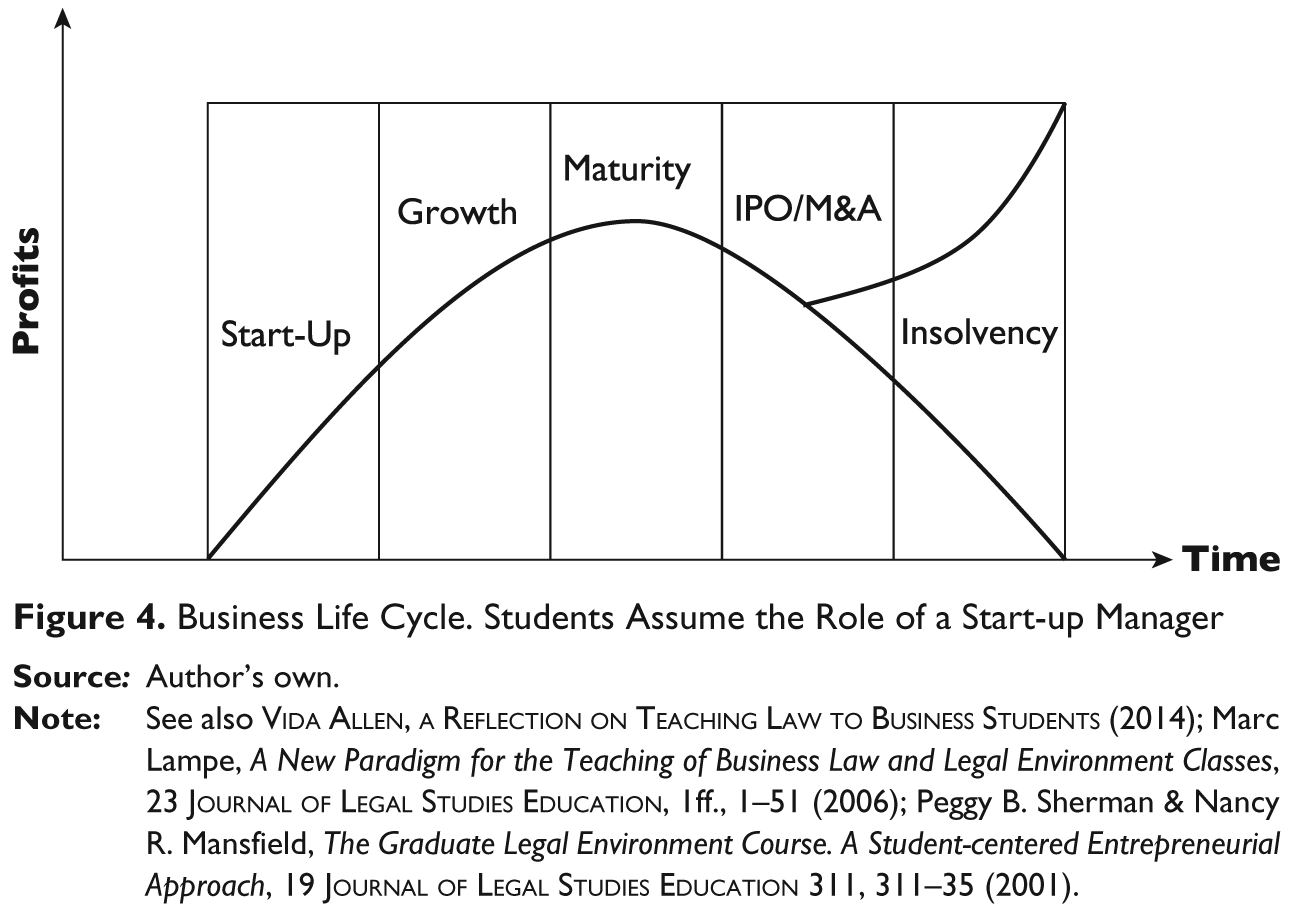
The goal is to enable future businessmen to take relevant prevailing legal provisions into account in their decision-making. The traditional approach of structuring law courses and seminars for business and economics students on the basis of fields of law and developing a lawyer’s approach to them frequently falls short of achieving this goal. 37 What is needed is a didactic approach that is tailored to the needs of the business and economics students. One design that fulfils this requirement is that of teaching law in connection with the life cycle of an enterprise (‘Business Life Cycle Approach’, also see Figure 4). 38
With this approach, the material on law can be linked to that on the students‘ major subject and the teaching methods and media (e.g., drawing up a business plan, start-up workshops, planning games, case studies) can be employed. 39 In this way, students learn that legal science is not something that is totally separate from business administration studies and that legal regulations play a constitutive role in the shaping of many areas of a business. They can then grasp the importance of what they are learning for their future careers. 40 This approach to teaching law to business and economics students also has a motivating effect, since students see more sense in playing the role of someone setting up a business in a case study than that of a lawyer or judge. Such a procedure can also help to awaken a sustained interest in legal issues, with the result that students also grapple with legal aspects of business administration outside of their compulsory law courses. 41 This model and procedure can serve as an orientation for teaching large sections of the law required for business administration degrees. It can be used for lectures and further exploration in seminars and small group work, also for term papers. The approach should be implemented by presenting the content of compulsory law courses in the form of the business life cycle. 42 The choice of material is highly dependent on the target group, the degree course in question and case-specific factors. Examples of how this model can be used are shown in Table 1.
These examples show the wide range of topics that can be addressed using this approach. In order to be able to implement rigorous, activating and motivating learning processes in the four hours usually allocated to this course per week, the material should be selected according to didactic criteria. Thus, for example, for each phase of the enterprise life cycle, only aspects of some of the central areas of commercial law such as company law, tax law, intellectual property law and labour law that are centrally important in each phase of the enterprise life cycle should be presented. 43 Other factors such as the speci-fic focus of the degree course, personal preferences and skills of the lecturer and aspects related to the institution where the course is being held also play a role in the selection of the material and the teaching methods employed.
Content of a Law Course for Business Administration Students Based on the Life Cycle of an Enterprise

Management Case Studies on Legal Problems in Enterprises
The use of case studies to teach business was made popular by the Harvard Business School (‘Management Case Studies’). 44 Today, they are used in business courses the world over and thus most students are familiar with this method. 45 In these cases, the students are asked to imagine themselves in situations experienced by decision-makers in which they practise applying the theories presented to them in lectures. 46 Most case studies are structured according to the same pattern. Following a brief introduction, students are given a general overview of the enterprise in question and the industry in which it operates. Then a problem description is given in narrative form on which the students are required to base their solution. 47 Originally, business case studies involved only management issues. However, in the last few years, more and more cases have been published that have been specially designed for teaching law to business and economics students. 48 These case studies are suitable for supplementing lectures on commercial law with student-centred learning exercises and thus for promoting the development of a practice-oriented understanding of commercial law.
Case studies can also be put to other uses besides that of an addition to the main course material on law; they can serve to restructure the entire design of these courses on law. 49 The didactic model of the legal life cycle of an enterprise presented here can be used for this purpose and supplemented with case studies to increase practice orientation. A brief example of how the two teaching approaches can be combined is presented below. At the beginning of the course or of the associated seminar, it is advisable to divide the students into working groups in which they will continue to work together until the end of the course or seminar. Each group is assigned a business formation case as a task; alternatively, students can develop their own business idea. The students act as managers for this start-up venture for the duration of the course. According to the teaching model of the legal life cycle of an enterprise, the legal issues that arise in each phase of the enterprise’s life (formation, regular business activities, closing of the enterprise) are discussed. The instructors give the students questions on the legal issues addressed in each lecture.
For example, in the business formation phase, the students are expected to discuss what legal form would be suitable for their business concept and what the articles of association should contain. When it comes to the regular business activities, the discussion could focus on what legal issues arise in connection with the funding of the enterprise, the recruitment of new staff and the protection of the enterprise‘s intellectual property. Towards the end of the seminar or course, the discussion would shift to the legal issues involved in closing down an enterprise, for example, in winding it up in the case of bankruptcy, in selling out or when launching it on the stock market.
In the small groups, the students work on the questions, applying legal methods and materials such as the texts of laws, court judgements, commentaries, etc. The solutions they propose are elaborated in oral presentations or short essays and can be presented to the other students. 50 A game-like competitive situation can be created. The groups with the best results are rewarded, for instance, by their business’s being particularly successful. In the next phase of their group work, they can then, for example, address the issues involved with launching it on the stock market, and not those associated with insolvency. 51
The teaching approach described above can help students to keep up a sustained interest in the legal issues addressed, since throughout the course or seminar they can come to identify more and more with the businesses they have ‘founded’ and realize that the legal issues that they have discussed will also be important in their future careers. This didactic approach entails more work for lecturers and/or requires more personnel than the conventional models. In addition to the lectures, the students also require support for their work on the case study questions. 52 Since only a few case studies on commercial law are available in other languages but English, 53 the lecturers must either create their teaching material themselves or translate material from English-speaking countries and adjust it to fit the home countries’ law.
Practical Teaching and Learning Issues
In the preceding sections, I presented material and methods that can be used to redesign the approach to teaching law in compulsory law courses for business and economics students in terms of both content and methods. The objective was not to abandon the teaching approaches that have proved successful in the legal sciences, but to adjust them to the needs of business and economics students. To what extent lecturers will be able to integrate these proposals in their courses will depend on the extent to which the time needed to implement them remains within acceptable limits and how far the institutional conditions permit. 54 Furthermore, their implementation requires some reflection. Linking the material on law to the theories of business administration (‘Perspective on Law from Management Theory’) requires a knowledge of law, business administration and economics that cuts across disciplines and is quite difficult to achieve. 55 Without prior knowledge of business administration and economics, this task is difficult. For lecturers without prior knowledge of business administration and economics, it is further complicated by the fact that there is very little non-English literature on these issues. If lecturers fall back on the English-language literature, students are confronted with a considerable linguistic challenge. The content also needs to be adjusted to fit the home countries’ legal system. The implementation of the above models, therefore, creates a substantial amount of extra work for lecturers. 56 This must not, of course, be understood as an argument against reforming the teaching of law to business and economics students. 57 If the teaching material is not modified to cater for the needs of the target group, it is difficult for students to get a grasp of the legal science material that is outside of their discipline. It remains to be hoped that in future, suitable teaching materials will be developed in other languages but English and thus reduce the amount of translation required of lecturers.
As a rule, law courses for business and economics students consist of about four hours per week in which the students are to be taught the most important aspects of law. In principle, this is sufficient time to present the material that is most important for the study of business administration. Since the students usually take these courses at the beginning of their studies, care should be taken not to overtax them by using advanced business administration and economics theories. 58 The material on law should, therefore, only be explained in the context of those theories and concepts with which the students are already familiar at this stage from their main subjects. Complex mathematical models such as those employed in some areas of the economic analysis of law should be avoided as far as possible.
The implementation of the two innovative models presented here (‘Business Life Cycle Approach’ and ‘Management Case Studies’) may be hampered by the fact that the basic conditions of study do not frequently support the teaching of law to business and economics students. 59 In courses with a manageable number of participants, case studies and small group work can be relatively easily interwoven with the theoretical part of the lecture to introduce a stimulating alternation between theoretical presentation and topic-related active participation of the students. 60 It is more difficult to implement these new models in courses with a large number of participants where it is not possible to use didactic concepts and teaching methods to solve the problems arising from having too many participants. 61 In their implementation of the management case studies and their treatment of the business life cycle in such cases, lecturers are forced to fall back on the procedures conventionally employed with courses of this size, such as distributing sheets of problems to be solved that the students can fill out on their own and check themselves using answer sheets prepared by the lecturer. From a didactic point of view, it would be better to limit the groups to a manageable size. 62 However, if this is not possible, it is advisable to divide the course into two parts, one with lectures and one conducted in seminar form. This requires additional staff and space. In the lectures, the instructor(s) can start by presenting the material on law in conjunction with the business administration and economic theories. This can then be followed by the management case studies and the legal life cycle of the enterprise in the seminars (with the support of tutors). With this procedure, the lecturers begin by introducing the students systematically to the new legal material. The students then work on this material on their own, in relation to a business problem. With such an approach, the question as to the best choice of legal form for a start-up venture would not be asked until after the introductory lecture on company law and a discussion of the characteristics of the corporation (legal personality, limited liability, transferable shares, centralized management under a board structure and shared ownership by contributors of capital) have taken place (see earlier).
Future Prospects
Law courses for business and economics students frequently fail to adapt their material and methods to the needs of the target group. In this article I have, therefore, put forward some suggestions as to how this situation could be improved. Taking into account research in management theory, the economic analysis of law and comparative law, it is possible to help students to develop a holistic understanding of business law. Efforts must be made to revise law courses for business and economics students if we are to produce entrepreneurial-minded management personnel with a grounding in law. To this end, law courses for business and economics students should be seen as an independent, interdisciplinary domain of research and teaching in which the legal problems and issues that are important for company management can also be examined with the methods of business administration and economics. With this approach, course content and teaching materials and methods must be developed which are suitable for teaching students competence in dealing with legal issues as an integral part of their managerial skills.
Footnotes
Acknowledgements
This is a revised and translated version of an article also published in German in the Zeitschrift für Didaktik der Rechtswissenschaft. I would like to thank Dr Denis Basak, Professor Dr Victoria Büsch, Professor Dr h.c. mult. Peter Eichhorn, Professor Dr Florian Faust, Professor Dr Karl Riesenhuber and Professor Dr Stefan Voigt for their valuable comments and suggestions. I am responsible for any remaining shortcomings.