







Abstract
From 2014 to 2019, a national, longitudinal study followed a group of self-selected law students enrolled at four of the six Aotearoa New Zealand law schools. This paper presents study participants’ self-reported post-law school reflections and experiences. These provide insight as to how participants’ time at law school served them after graduation. Reported data include participants’ work experiences, future career plans and reflections on their law school experience. The data is unique in that it captures the postgraduation experiences and reflections of a cohort which includes not only those who are employed in the legal profession but also those who are not. Key findings are largely positive self-reported post-law school outcomes for Aotearoa New Zealand law graduates, but that Aotearoa New Zealand law schools have work to do review and/or improve the delivery of the learning and teaching experiences leading to those outcomes. The reported data give law teachers, law schools and universities new information to consider and use in course and programme development and reviews. It will also be of interest to prospective and current law students and their families, employers of law graduates and the legal profession.
Introduction
From 2014 to 2019, the authors conducted a national, longitudinal study following a group of self-selected law students enrolled at four of the six Aotearoa New Zealand law schools (the Universities of Auckland, Canterbury, Waikato and Victoria University of Wellington). That study captured the student view of their law school learning and teaching experiences. 1 This paper presents study participants’ self-reported post-law school reflections and experiences. These provide some insight as to how participants’ time at law school served them after graduation. Reported data include participants’ work experiences, future career plans and reflections on their law school experience. The data is unique in that it captures the postgraduation experiences and reflections of a cohort, which includes not only those who are employed in the legal profession but also those who are not. 2 The reported data give law teachers, law schools and universities new information to consider and use in course and programme development and reviews. It will also be of interest to prospective and current law students and their families, employers of law graduates and the legal profession.
The second section provides the context to legal education in Aotearoa New Zealand. The third section summarizes the longitudinal study and participants’ self-reported teaching and learning experiences. The fourth section reports participants’ post-law school reflections and experiences. Key findings are largely positive self-reported post-law school outcomes for Aotearoa New Zealand law graduates but that Aotearoa New Zealand law schools have work to do review and/or improve the delivery of the learning and teaching experiences leading to those outcomes. The fifth section discusses the results. The sixth section concludes.
The Context to Aotearoa, New Zealand Legal Education
Aotearoa New Zealand law schools face competing demands affecting the teaching and learning experiences they provide to their students. 3 Demands include policies and procedures of the universities within which law schools sit, government tertiary education strategies and funding mechanisms, and New Zealand Council of Legal Education (NZCLE) regulations. Other relevant factors are the prior learning and teaching and experiences of students, student feedback captured through university processes, the wider economic environment as it affects student enrolments and the financial position of universities, higher education and legal education research, and the swift shift to online/hybrid teaching and learning during the COVID-19 pandemic. Law schools’ responses to these demands provide a significant part of the context to legal education in Aotearoa New Zealand.
The internal and external demands on law schools affect the learning and teaching experiences of law students. At the most basic level, the physical and technological environment available to students is affected by the competing demands of other units in the universities in which law schools sit and the financial position of those universities. The financial position of universities is affected by government funding, research funding, community demographics and the wider economic environment. University policies also determine law schools’ funding allocation, expected financial return and performance measures relating to student recruitment, retention and success.
Many university policies are driven by government funding mechanisms and Tertiary Education Strategy. Student performance against key measures is now linked to funding. 4 And lest it be thought that learning and teaching are the primary focus, other performance measures, and funding is tied to university and law school research performance. 5
The 2020 Tertiary Education Strategy sets out the long-term direction for Aotearoa New Zealand universities. 6 Listed actions for universities include ‘ensur[ing] every learner|ākonga gains sound foundation skills, including language, literacy and numeracy’ and have ‘ongoing opportunities to develop key capabilities and qualities, including communication, problem-solving, critical thinking and interpersonal skills’. Inclusive actions include ‘meaningfully incorporate[ing] te reo Māori and tikanga Māori into the everyday life of the place of learning’. Future learning and work actions include ‘[c]ollaborat[ing] with industries and employers to ensure that learners|ākonga have the skills, knowledge and pathways to succeed in work’ and ‘that teaching and learning meets learner|ākonga needs and delivers skills relevant for the workplace.’ 7 A related action is ‘[p]roviding for lifelong learning options that are flexible, adaptable and timely so that people can upskill and retrain throughout their lives.’
Aotearoa New Zealand universities publicize the knowledge, skills and attributes of their graduates, many of which reflect those specified in the Tertiary Education Strategy. The University of Canterbury, for example, specifies four graduate attributes: employable, innovative and enterprising (including analytical, critical thinking and problem-solving in diverse contexts and digital literacy), bicultural confidence and confidence, globally aware and community engagement. 8 Law schools must respond to these profiles and/or attributes in their programmes and degree outcomes.
The work-readiness theme in the Government’s Tertiary Education Strategy and in university graduate profiles or attributes is echoed in higher education literature. 9 Much of the recent Australasian legal education research highlights the teaching or assessing of practical and/or work-ready skills. 10 A related theme is equipping graduates to manage the current and future role of technology in the workforce, 11 where law schools must grapple with dramatic predictions that this will cause significant disruption to and/or the demise of the legal profession as we know it. 12
The teaching and learning experiences provided by Aotearoa New Zealand law schools are further regulated by the NZCLE. The NZCLE sets the qualification and educational requirements for admission as a barrister and solicitor. 13 All Aotearoa New Zealand law schools offer a NZCLE approved Bachelor of Laws degree, which requires the equivalent of four years of full-time study. Completion of an approved law degree is a requirement for admission as a barrister and solicitor, 14 and admission is a pre-requisite for the issue of a practising certificate by the New Zealand Law Society (NZLS). 15 Only holders of a current practising certificate may provide legal services as a lawyer. 16
NZCLE approved degrees have a series of prescribed courses: The Legal System, Law of Contracts, Law of Torts, Criminal Law, Public Law and Property Law (or Land Law, and Equity and the Law of Succession). 17 Legal reasoning and the judicial process and an introduction of statutory interpretation are covered in The Legal System, but otherwise NZCLE course prescriptions are brief and content focused. For example, the prescription for the Law of Contracts is ‘[t]he general principles of the law of contract and agency’. 18 Each course must have a final examination that is worth a minimum of 50% of the total course assessment, prepared by a university teacher and approved by a NZCLE appointed moderator. 19 Examination scripts must be marked by a university teacher and assessed by a NZCLE appointed teacher from another university. 20 Law schools must report pass rates and grades awarded to the NZCLE.
Law students complete the NZCLE compulsory courses across their first years of study with the result that these courses can attract large (200 plus) enrolments. The balance of an approved law degree is made up of optional courses approved by the universities in which law schools sit. Some optional courses are doctrine focused others address policy/societal issues or provide opportunities for the development of professional legal skills and/or work-integrated learning. The content, assessment and moderation of these courses are regulated by law school and/or university policies and processes. Numbers of enrolments in these courses vary from just a few to several hundred.
The NZCLE’s focus on content or doctrine in its prescribed courses is because candidates for admission as a barrister and solicitor must also pass the Professional Legal Studies Course (PLSC). 21 The PLSC is skills focused and intended to ‘bridge the gap between the academic study of law and its practice’. 22 Completion of the PLSC requires the equivalent of 13 weeks of full-time study. 23 Prescribed content includes interviewing, advising, fact investigation and analysis, writing, drafting, mediation, negotiation, advocacy, problem-solving, practical legal research and analysis, and office and personal management. 24
Aotearoa New Zealand law schools, thus, face significant internal and external requirements in terms of the framework of their teaching and learning programmes. They also face practical constraints (for example, staff/student ratios and university funding allocations) affecting how they achieve those outcomes. To the extent that law schools have a choice in terms of the learning experiences provided to students, the higher education literature is clear that student retention and success are linked to student engagement, with the concept of engagement used as ‘a metaphor for quality learning and teaching’. 25 The literature advocates that law schools foster student engagement by encouraging the building of positive and constructive relationships between students and between students and teachers, and the participation by students in deep or active learning activities. 26 A sobering reality is that empirical research on law student well-being from New Zealand and elsewhere reports that the law school experience is a likely source of psychological distress for many students. 27 Further, the ongoing COVID-19 pandemic has resulted in a swift shift to online and/or hybrid learning, 28 and the impact of this on students’ teaching and learning experiences and mental well-being is still to be assessed.
The higher education literature also recognizes that students’ engagement, retention and success are shaped by factors outside of law schools’ control such as students’ experiences prior to enrolling in tertiary study and events occurring in their lives whilst they are studying. 29 The engagement of different groups within a cohort may be affected to a greater or lesser degree by such factors. 30 In Aotearoa New Zealand, there is important research into the success of Māori students in tertiary education. 31 There are also two current initiatives underway exploring possibilities for improving legal education in New Zealand to better respond to the needs of Māori and Pasifika students, alongside improving the understanding of all LLB students of Māori law. 32 Whether or not law schools develop their own initiatives to respond to the needs of differing cohorts of students, they must also comply with wider university policies in this area, with such policies, in turn, frequently driven by government priorities.
Other external factors, such as the current economic environment and population demographics, have a positive or negative effect on student numbers and the financial position of universities and so have a trickle-down effect on law schools. Law schools are also affected by public perceptions of the utility of a legal career. For example, across the time that we collected the data reported in the fourth section, the #Me Too movement exposed practices and cultures of concern in parts of the Aotearoa New Zealand legal profession. 33
Longitudinal Study
Methodology
In the first half of the 2014 academic year, all students enrolled in 100-level law papers at the Universities of Auckland, Canterbury and Waikato were invited to participate in the longitudinal study and to complete the first of a series of online and anonymous surveys. An independent consultant allocated a digital identifier to every student who consented to participate in the study, and these were used to issue invitations to complete a second survey in the third quarter of 2014 and subsequent surveys in the third or fourth quarters in each of 2015–2019. In 2017, students from Victoria University of Wellington who began their law studies in 2014 were invited to join the study. The students who consented to participating were also assigned a digital identifier and sent invitations to complete the 2017–2019 surveys.
The first of the 2014 surveys collected demographic data and participants’ expectations of their law studies. The second asked questions to allow a comparison between participants’ initial expectations and actual experiences. Subsequent surveys across 2015–2019 collected data on participants’ learning and teaching experiences, future career plans, experiences outside of law school and well-being. Participants in the 2017 and 2018 surveys who identified as being in their final year of study were invited to provide a non-university address to an independent consultant, and this was used to invite them to participate in the 2018 and/or 2019 surveys. Those who responded provided detail on their post-law school reflections and experiences, and these data are reported in the fourth section.
The study began with 785 participants and this number decreased over time as is typical in longitudinal studies. Some participants have responded to every survey whilst others were more selective. A total of 146 graduate responses were collected and are reported below.
The longitudinal study took place in accordance with protocols approved by the University of Canterbury’s Educational Research Human Ethics Committee.
The law school experience
Several broad themes emerged from participants’ self-reported learning and experiences at law schools. Across the participating law schools (and likely affected by the available physical environment and staff–student ratios), face-to-face large classes or lectures were the primary teaching mode. Across their first three years at law school, participants reported a decreasing (although still high) attendance at face-to-face classes 34 during which they most frequently experienced a passive learning experience in the form of a traditional lecture where they listened to what their teacher had to say and took notes. 35 Participants reported decreasing lecture attendance in their later years at law school when they would have been enrolled in optional courses, but a greater frequency of the availability of active learning activities in those courses, although many chose not to participate in the offered activities. 36
Participants reported consistently that they spent approximately half the amount of time on self-study that the participating law schools would expect from their students. 37 Further analysis revealed that participants’ study approaches did not change across their second–fourth years at law school. 38
Participants reported limited contact with their teachers, with approximately half reporting in each of 2017, 2018 and 2019 that they thought between 0% and 20% of their teachers knew them. 39
Participants also reported decreasing frequency of interactions with other students outside of class for study-related purposes across time. For example, 56% of respondents reported in 2019 that they never or rarely had study-related contact with other students, compared to 40% in 2018 and 30% in 2017. 40
In their fifth year of study (when they would likely have been completing mainly optional courses), participants reported that they were most frequently required to complete individual assessments (individual essays/assignments, open-book tests/examinations and individual take-home tests). 41
Finally, across time, a significant minority of participants reported that their studies were affected by external events such as home and family issues, work issues, health issues, etc., although these factors did not appear to prevent participants from continuing with and completing their law degree. 42
Taken in the round, students’ reported experiences suggest that the law school learning experience can be a solitary one for many. This is likely to have been exacerbated by the shift to online learning during COVID-19 lockdowns. There is an apparent divergence between participants’ reported learning and teaching experiences and the ‘ideal’ reported in higher education literature insofar as this is affected by law school policy and practices (for example, students having positive and constructive relationships with teachers and participating in ‘deep’ or active learning activities). We suspect this divergence may have increased with the recent shift to online learning. As available data are sparse, it is not clear whether the reported law school experience is consistent with teaching and learning experiences in other disciplines or across the university sector. Nonetheless, participants’ reported experiences are not inconsistent with the last iteration of data from Aotearoa New Zealand university students in the Australasian Survey of Student Engagement. 43
We emphasize that data reported in the fourth section are of graduates who have attained the skills and attributes specified by law schools and the universities within which they sit, and that in many instances this has been confirmed by NZCLE external moderation processes. Study participants reported having acquired a variety of legal skills and attributes whilst at law school 44 and achieving grades mostly in the ‘A’ and ‘B’ range. 45 The little empirical work that has been carried out in Aotearoa New Zealand reports that legal employers are generally satisfied with law graduates’ work-readiness with two exceptions—graduates’ writing skills and a lack of understanding and appreciation of ‘real-world’ problems. 46 A study reporting the views of junior lawyers reports that almost all agreed that law school had given them ‘a good grounding in legal theory and analytical skills’, and just under half agreed that law school ‘prepared … [them] well for practising law’. 47 Perhaps the best that can be said is that although the available evidence supports the view that graduates have achieved specified legal education outcomes, there is room for improvement in the process by which they came to achieve those outcomes.
Study limitations
We acknowledge several limitations to the data presented in the fourth section. E-mail invitations to participate in surveys were initially tied to participants’ university e-mail addresses meaning that invitations only reached those who were continuing their studies at the university at which they were enrolled in 2014. Additionally, it was only those participants who provided a non-university e-mail address in their final year of study that received an invitation to complete the 2018 and 2019 surveys as graduates.
The responses reported are the self-reported experiences of a self-selected cohort. The extent to which they intentionally or unintentionally provided inaccurate information is unknown. The extent to which participants’ responses differ from graduates at the participating universities who chose not to participate in the study (the non-response bias) is also unknown.
By the time data were collected from graduates in the 2018 and 2019 surveys, numbers from some participating law schools were too small to generate statistically robust results so responses have not been analysed according to the law school that participants attended. 48 For the same reason, analysis of participants’ responses by ethnicity was not undertaken. By the time of the 2018 and 2019 data collection, numbers of self-identified ethnicities other than Pākehā New Zealand European were very small. 49
Results
Demographics
Data were collected from graduates in their first-year post-law school in 2018 and 2019. As the NZ LLB degree is a four-year degree, the first of the students in the longitudinal study to have graduated did so at the end of 2017, and data were collected from them in the third quarter of 2018. Many in the study reported that they were completing an LLB in conjunction with another degree, which generally takes between five and five and a half years of full-time study. Data were collected from these students in their first-year post-law school in September and October of 2019. In 2019, 29 graduates in their second-year post-law school provided further data on their post-law school experiences.
First-year Graduates 2018 and 2019.

Overall, data were collected from 117 graduates in their first-year post-law school in 2018 and 2019. A summary of participants is included in Tables 1 and 2. Tables 1 and 2 also detail the gender split of graduates. Thirty-six per cent of first-year graduates were male and 63% were female. The greater proportion of female graduates is consistent with the proportion of female participants in the longitudinal study across time, 50 but is slightly higher than actual enrolments reported by two of the participating law schools when the longitudinal study began in 2014. 51 An analysis of responses by gender was undertaken, and a key finding is that there were few significant differences in the experiences and reflections of male and female graduates.
Second-year Graduates 2019.

Career destinations
The first question asked of first-year graduates in 2018 and 2019 was whether they had completed or were intending to complete the PLSC. As noted above, this requires a time commitment of the equivalent of 13 weeks of full-time study. 52 Completion also incurs a significant cost as course fees are in the region of $5,500–$5,800. 53 Table 3 shows that 90% of first-year graduates had or were intending to complete this qualification.
First-year Graduates 2018 and 2019: Completion or Intended Completion of PLSC.

First-year graduates were asked whether they were currently employed at the time of data collection in 2018 and 2019. Seventy-one per cent of the 44 first-year graduates responding to the 2018 survey (n = 31) reported that they were. Of these, 81% were working full time and 19% were working part-time. Only 2 of the 13 first-year graduates who were not employed reported that they were actively looking for work, with one of these completing the PLSC at the time of the data collection. Of the 11 others, 4 were completing another undergraduate degree or qualification, 2 were engaged in postgraduate study, 2 were completing the PLSC, 1 was waiting for graduation, 1 was a ‘full time mum’ and 1 was about to give birth.
As Table 4 shows, 85% (n = 61) of the 72 first-year graduates responding to the 2019 survey reported that they were currently employed, with 95% working full-time and 7% working part-time.
Ninety-seven per cent of the 29 second-year graduates responding to the 2019 survey (n = 28) reported that they were employed.
First-year Graduates 2018 and 2019: Employment Rates.

Graduates were also asked the nature of their employer and given three options from which to select: a law firm, a government department or ‘other’.
Overall, as Table 5 shows, just under 49% (n = 45) of first-year graduates in 2018 and 2019 reported that they were employed by a law firm (n = 16 in 2018 and n = 29 in 2019). Those who specified their area of practice were working largely in domestic private law (litigation, conveyancing, corporate/commercial, banking and finance, estates and wills, and employment). One was employed as a criminal prosecutor, and two were engaged in criminal defence work.
First-year Graduates 2018 and 2019: Employment Destinations.

Just over 20% of first-year graduates reported that they were employed in a government department (n = 5 in 2018 and n = 15 in 2019). Much of the government work in which graduates were engaged appeared to have some legal focus, for example, working in a court registry office (n = 3), as a judges’ clerk (n = 3), providing policy advice (n = 1), and working in Treaty of Waitangi settlements between the Crown and the Māori iwi (indigenous communities) (n = 1).
The remaining first-year graduates (just under 30%) selected the ‘other’ category and were employed across several sectors. Reported roles of a professional nature included advocacy, auditing, financial analysis, health sector union advocacy and project assurance/management. Non-professional roles included working in retail, customer service, general factory work, hospitality, ski patrolling, playing cricket and cleaning. We surmise that those working as ski patrollers and playing cricket had likely chosen to do so, leaving only a small number who reported that they were engaged in unskilled work.
Slightly more male first-year graduates reported being employed by a law firm (57% of 2018 male first-year graduates compared to 50% of female graduates, and 59% of 2019 male participants compared to 41% of female participants). First-year female graduates were more likely to select the ‘other’ option in 2018 and 2019 (36% of female graduates selected this option in 2018 compared to 14% of male graduates, and 32% of female first-year graduates in 2019 compared to 18% of male graduates).
Of the 28 second-year graduates from whom data were collected in 2019, 97% (n = 28) reported that they were employed. Of the 28 who answered the employment destination question, 48% (n = 14) reported that they were employed by a law firm, 28% (n = 8) by a government department with 21% (n = 6) selecting the ‘other’ option. Twenty-eight of the second-year graduates specified the nature of their employment. A majority were engaged in legal work, with most working as a solicitor. Non-legal roles included creating websites, report writing, data analysis, ‘everything that makes a business work’, auditing and customer service.
Graduates who reported that they were employed at the time of the data collections were then asked to report the extent to which they used their law degree in their employment. As Table 6 shows, approximately 85% of first-year graduates reported using their law degree in their employment.
First-year Graduates 2018 and 2019: Frequency of Use of Law Degree in Employment.

Of the 28 second-year employed graduates who responded to the 2019 survey, 82% reported using their law degree in their employment.
Workplace experiences
The 2019 survey asked employed graduates a series of open-ended questions about their work experiences. No significant differences were identified on a gender analysis. Responses were also analysed according to whether the responder was in their first or second year out of law school. Again, no significant differences were identified. As these data were not collected from first-year graduates in 2018, the data presented below are a summary of responses from first- and second-year graduates in the 2019 survey.
The first question asked graduates what they found most fulfilling about their job. Eighty-one responded, and some indicated more than one fulfilling aspect of their work. The most frequently given response was helping people or clients (n = 17). Others noted they enjoyed solving problems in a real-world context, that they had challenging/interesting and/or a variety of work. Some referenced friendly and/or supportive colleagues or learning new skills. Being paid was the most fulfilling aspect of their work for three of the cohort. Examples of specific comments are listed below, and these also give a flavour of the type of work in which graduates were engaged:
It has a focus on New Zealand’s biodiversity in urban areas. I really enjoy learning about what people have done and are planning on doing to increase this, and seeing their passion come to life in a way that’s good for the environment and society. Report to the Ministers for the approval of investment proposals. I am directly contributing to the community and a better, wider Auckland. Liaison with judiciary and lawyers and police prosecutors. Working with iwi and hapu
54
in an area of passion. I’m the boss and I do exactly what I want.
The second qualitative question asked employed graduates what they found most stressful about their work. Seventy-eight responded. Although some graduates had identified helping others as the most fulfilling aspect of their work, the real-life impact of their advice was highlighted as a source of stress by some responses to this question. One described this as ‘[t]he pressure of having someone’s freedom in your hands’. Others referenced the high expectations of their employers and pressure to perform. Some noted their fear of making a mistake or appearing to lack knowledge. However, the most frequently occurring response given by first- and second-year graduates was workload or time management. Examples of responses in this category included:
Time pressure, getting everything done without sacrificing quality. Having multiple tasks to do simultaneously. Timesheets! The feeling that the clock is ticking and you are taking too long to do something.
The third open-ended question asked graduates how they felt about their work/life balance (such as their hours of work, remuneration and access to flexible working arrangements). Seventy-eight responded but not all commented on all suggested aspects of work/life balance. Positive comments (‘great’, ‘really good’, ‘well balanced’, ‘pretty good’ and ‘can’t complain’) about work/life balance exceeded the negative.
55
Just two graduates described their work–life balance as ‘poor’, and a further two acknowledged the ‘shock’ of full-time work with one noting:
At the moment the work life balance is hard because you are tired after work and in the weekends are still getting used to working full time. It is quite an adjustment from uni w[h]ere you have a lot of flexibility in your day! I haven’t had to work late yet, always gone between 5–5.30 pm.
Just under a quarter were dissatisfied with their pay, with two indicating that they were working below minimum wage when their hours of work were factored in. 56 A number made comments about their hours of work with some indicating that their working hours were too long, with another noting they did not get enough time off. One noted that she worked a lot of extra hours but was happy to do so, another commented that the work hours were strict, and another that work hours were not fixed. Two commented that that the working hours of those working in the law were longer than in non-law jobs. On the other hand, four graduates were happy with their hours of work.
Comments acknowledging the availability of flexible working arrangements were equally balanced with those reporting their absence. Of those reporting an absence, one commented that flexible working arrangements were not available to junior staff, and another noted that ‘[f]lexible working arrangements are not really a thing for graduates’. Two reported working from home.
The final open-ended questions asked graduates to describe their workplace culture, which was defined for participants as the way employees interact with each other and with management. Eighty-three responded, with a majority describing their workplace culture in very positive terms (for example, ‘amazing’, ‘awesome’, ‘friendly’, ‘collegial’, ‘inclusive’, ‘encouraging’, ‘social’, ‘welcoming’, ‘positive’, ‘supportive’, ‘culturally diverse’ and ‘professional’). 57 A minority (n = 7) highlighted positive and negative aspects, such as ‘pretty good, not a rigid hierarchy, some cliques, strong preference for strong networkers’. An even smaller minority (n = 5) described their workplace culture in negative terms, such as ‘awful’, ‘snarky and elitist’, ‘competitive’, ‘difficult’ and ‘very hierarchical’.
Future plans
As the study cohort were not necessarily admitted as a barrister and solicitor or engaged in legal work, we asked an open-ended qualitative question in 2018 and 2019 to gauge their thoughts about the future: ‘Where do you see yourself three years from now?’ One hundred and eight first-year graduates responded to this question (n = 35 in 2018 and n = 63 in 2019). Seventy-four per cent (n = 80) responded by specifying the type of work they saw themselves doing three years out. Of this group, 84% (n = 67) specified they intended to be engaged in law-related work. Of these 67, 81% (n = 54) referenced working in legal practice, for a law firm or as a lawyer. 58 Intended non-legal careers included playing cricket, working as a HR adviser, working for a FMCG organization, training for the police, flying planes and project management. A number indicated they intended to be working for a government department but did not specify the nature of their intended role.
A number of those who did not specify the type of work they saw themselves doing three years out gave responses indicating they intended to be employed. Answers in this category included ‘better paying job’, ‘promoted’, ‘maybe a different job’, ‘same job moving up’ and a ‘job I am passionate about’. A small number were unsure, with others indicating they intended to be travelling. Just one indicated an intention to have children, and two were clear that they would not be working in a law-related area.
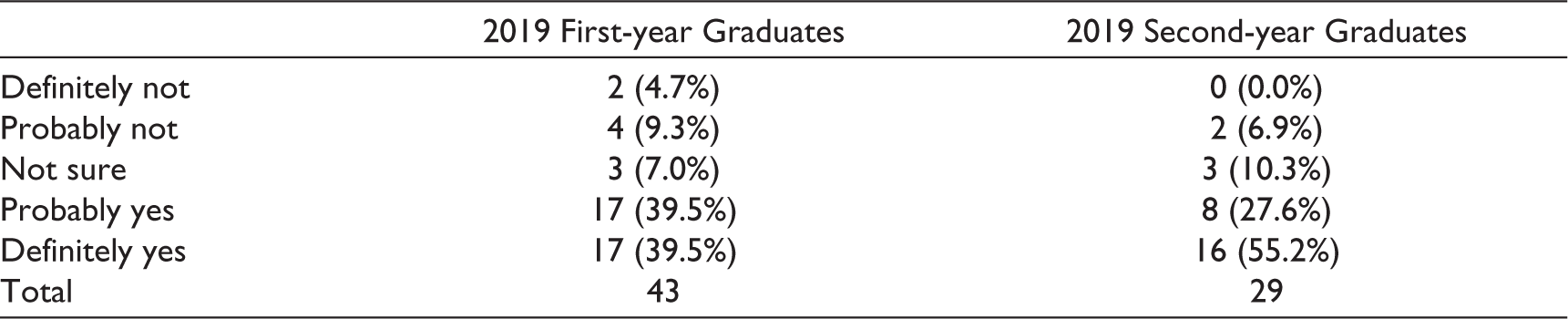
If they had their time over, would graduates still choose to study law? We asked this question in the 2019 survey. Ninety-four answered this question (n = 65 first-year graduates and n = 29 second-year graduates). We have included second-year graduates’ responses as these data had not been collected in the 2018 survey. Graduates were asked to select one of five responses ranging from ‘definitely not’ to ‘definitely yes’ on a Likert-style scale. As Table 7 shows, a majority (79% of first-year graduates and 83% of second-year graduates) would ‘probably’ or ‘definitely’ choose to study law again.
2019 First and Second-year Graduates: Would You Choose to Study Law if you Could Go Back in Time?
Reflections on the law school experience
In this final section, we report first-year graduates’ responses to a series of qualitative questions asking them to look back and reflect on their time at law school. This data were collected from first-year graduates in the 2018 and 2019 surveys.
Law school culture
The first of the questions asked graduates to describe the culture at the law school they attended, with ‘culture’ defined as ‘how students interact with each other and staff.’ Ninety-nine responded (n = 38 in 2019 and n = 61 in 2019). Some described more than one aspect of law school culture.
Approximately 40% described the culture of their law school in positive terms such as ‘good’, ‘collegial’, ‘excellent’, ‘friendly’ and ‘supportive’. However, just over a quarter described their law school culture in negative terms, with 15 graduates identifying the ‘hierarchical’ or ‘cliquey’ nature of relationships between students as a concern. One memorable description of law school culture was ‘Microcosmic, Elitist, Classist, an Echo Chamber’.
Just under a third of graduates identified positive and negative aspects of law school culture. Of these, a sizeable minority (approximately 40%) identified the ‘cliquey’ nature of relationships between law students as a negative but at the same time noting they had had a circle of good friends. One noted: ‘It’s a mixed bag. Some people are really great and others can be disrespectful and ruin it for everyone else.’ Another commented ‘Competitive, a bit ruthless, but alright if you had your own close knit group.’
Only nine responses addressed interactions or relationships with law school staff. Four described friendly and approachable staff, two made negative comments, one described staff–student interactions as ‘patchy’, another wished for greater interaction, and one acknowledged that there was interaction between staff and students.
Improving the student experience
The second of the questions asked students to look back and comment on what their law school could have done to improve their student experience. One hundred first-year graduates responded (n = 43 in 2018 and n = 57 in 2019). Some offered more than one suggestion.
Eight graduates indicated the student experience was good as it is, and four ‘did not know’ what their law school could have done to improve their student experience.
Suggestions were clustered around several themes. The theme attracting the greatest number of suggestions was teaching, with smaller classes (particularly earlier in the degree) the most frequently made request. Others requested diversification in assessment tasks, with several requests for more group projects. Others requested more detailed (and faster) feedback on assessment tasks. Several noted that some classes were not engaging and suggested changed teaching styles and/or ‘better lecturers’. A number requested lecture recordings or more online classes. In a related theme, some requested greater academic assistance, with a number keen for one-on-one assistance. Equality of access to academic assistance was also desired.
Another theme focused on staff/student or student/student relationships. A number wanted increased staff/student engagement, whilst others requested equality of treatment of students (for example, not just rewarding the top students and ignoring the rest), more supportive and/or approachable teachers, and for teachers to consider ‘students as people’ and to ‘listen to what students have to say’. Most comments focusing on student/student relationships suggested that law schools sponsor more events where students could get to know each other, particularly at first year. Other comments focused on a desire for a more inclusive student environment.
Providing better careers information was a further theme, including requests for information about non-traditional legal careers, more networking events involving the legal profession and more information on the transition from university to the workforce. A number also requested more information about the degree and/or pathways within the degree.
A final theme centred on a need for law schools to offer more practical experiences, assessments and opportunities to learn practical skills.
Workplace readiness
The final question in this category asked graduates what more their law school could have done to better prepare them for the workforce. Ninety-nine first-year graduates responded (n = 40 in 2018 and n = 59 in 2019). Some provided more than one suggestion. The most frequently occurring suggestion by a large margin was for a greater emphasis on practical legal skills and assessments. Specific suggestions of what this might entail included drafting contracts, learning to summarize the law so it is ‘client friendly’, writing letters and preparing court documents, office management skills, learning how to put submissions together, interpreting contracts, mooting, interviewing, mediation, negotiation, writing legal advice letters and memos to supervising partners, looking at sale and purchase agreements and giving more emphasis to how each subject relates to real-life practice.
In a related theme, a number suggested that law schools provide some form of work-integrated learning opportunity for students. Suggestions included ‘compulsory workplace papers where we get a short internship at a law firm’, the setting up of ‘formal internship programme/arrangements with all law firms in New Zealand/and being ‘actively involved in making sure all final year students have had some sort of job experience.’
Others suggested a greater interaction with the profession, such as through networking events, but with a focus on students securing employment
Three participants reported that they were satisfied with the balance between academic and practical skills at their law school.
Others wanted more careers assistance or guidance with a number suggesting law schools should place more emphasis on the availability of legal jobs outside of the ‘big firms’ or legal profession.
A small number reported that they were well prepared or that it was not the role of law schools to teach students how to work as a lawyer.
Discussion
Several themes emerge from graduates’ reported post-law school experiences. The first is the apparently low involuntary unemployment rate reported by first-year graduates in the 2018 survey. This is a finding that will be welcomed by universities, law schools and law students and their families, particularly given that reported labour shortages at the time of writing in mid-2022 were not present at the time of the data collection. 59
In a related theme, graduates’ reported and intended PLSC completion rates suggest that almost all (90%) intend to preserve the option of a career where admission as a barrister and solicitor is a requirement. The NZLS reported somewhat equivocally in 2019 that ‘it appears that about 57% of New Zealand law graduates [in 2017] … [were] admitted as barristers and solicitors,’ 60 but provided no source for this statistic. The indicative admission or intended admission rate of graduates in this study as evidenced by actual or intended PLSC completion rates appears to be much higher even though not all were immediately engaged (or intending to engage) in legal practice.
In a further trend, first-year graduates’ reported employment destinations revealed that just under half were working in law firm and largely engaged in the practise of domestic, private law. A number of those working for government departments and in other areas were also engaged in legal-related work (for example, judges’ clerks and court registrars). Overall, 85% reported using their law degree in their employment, a frequency of use suggesting that the skills and knowledge gained in the completion of a law degree are useful across a variety of sectors. 61 Comparable data is limited. The NZLS reported in 2019 that ‘about 40%’ of admitted lawyers do not enter legal practice ‘(at least promptly)’. 62 The reported employment rate of the first-year graduates in law firms (and where admission as a barrister and solicitor and the holding of a practising certificate is a requirement) in this study is somewhat higher. Not all law-related jobs (academia being an example) require admission as a barrister and solicitor and the holding of a current practising certificate and graduates’ responses suggest that a number were engaged in jobs of this nature. Overall, the majority of employed graduates were working in a law firm or in a law-related area.
Reported workplace experiences provide evidence that employed graduates were engaged in work in which they could identify at least one aspect that they found fulfilling. A majority also reported a satisfactory work/life balance, a finding mirrored in Pemberton’s study of junior lawyers where just under 75% reported themselves satisfied with their work/life balance. 63 A minority were dissatisfied with their hours of work and pay. Graduates’ comments on pay are mirrored in Pemberton’s report where just over three-quarters of junior lawyers reported themselves satisfied with their pay. 64 We note that the recent establishment of the Aotearoa Legal Workers’ Union may be assisting junior lawyers with these concerns. 65
Almost all graduates reported a positive workplace culture, a further finding that will be welcomed by law schools, and law students and their families. Reported rates of positive workplace culture were slightly higher than those reported in Pemberton’s study of junior lawyers where 80% were satisfied with the culture of their workplace. 66 Although responses were not analysed according to workplace destination, we note that even if the few who reported a negative workplace culture were employed in law firms or a particular type of law firm (for example, a large law firm), the sample size (n = 5) was too small from which to draw reliable conclusions. Given that just under half of all graduates reported they were working in a law firm, descriptions of workplace culture also provide reassurance that a career in the legal profession does not necessarily expose participants to the difficulties revealed in recent NZLS and other investigations. 67
The most frequently reported workplace stress was work and/or time management. This appears to be more than a passing concern associated with transition to the workforce as it was also the most frequently reported workplace stress of second-year graduates. However, the large sample size of the graduates reporting this difficulty makes it unlikely that it is associated only with legal practice or with employment in a particular type of law firm. This trend is a little surprising given that whilst at law school many students must manage their time to complete a variety of law school set assessment deadlines and hold down a part-time job. Possibly this reported difficulty is a part of transition to the ‘shock’ of full-time work, and we note that some graduates requested a greater focus by law schools on the transition from university to the workforce and on exposing students to the reality of the workforce through internships and other practical work-based experiences. Interestingly, time management was not a difficulty highlighted in a recent study capturing the views of law employers of law graduates. 68
The 2018 and 2019 data collections occurred within a relatively short time (approximately 10–11 months) after most of the first-year graduates completed their law studies. A large majority responded to the question asking where they saw themselves three years out by indicating that they saw themselves working. Of those who specified their intended employment, another large majority (84%) indicated their intention to be working in a law-related field, with most intending to be working as a lawyer or for a law firm, 69 an indication that most intend to persist with a legal career at least in the short term. There is limited data on retention rates in the legal profession where admission as a barrister and solicitor and the holding of a practising certificate is a requirement. The NZLS suggested in 2019 that retention rates in the legal profession differ according to gender with ‘male lawyers tend[ing] to stay in practice for a long time and the proportion of women in practice from those admitted declin[ing] more rapidly than for men after 20 years.’ 70 An intended ‘female flight’ was not evident in female graduates’ responses. In any event, it does not follow those who leave legal practice are necessarily also abandoning legal work. As Sir Kenneth Keith commented in 2017, ‘many of those qualifying and of those in practice move into other employment in the public and private sectors’ 71 and this other work may be law-related. Notably, a higher proportion of male graduates in this study (although still fewer in number than female graduates) reported that they were employed in legal practice. We can only speculate whether this is due to the employment decisions of law firms, female graduates prioritizing ‘other’ careers or some combination of these and other factors.
In a related trend, and again reflecting Pemberton’s finding in relation to junior lawyers, 72 most graduates would choose to study law again if they could go back in time.
Overall, graduates’ reported positive workplace experiences exceeded those that were negative. A majority were engaged in fulfilling law-related work in a positive workplace environment that provided them with a satisfactory work/life balance. This is a welcome finding for law schools and their students. Given that to a large degree, the framework of legal education in Aotearoa New Zealand is determined by NZCLE regulation, and university requirements (in turn affected by government policies and strategies), the graduate voice provides additional evidence for law schools and other stakeholders that law graduates are employable and equipped with skills and knowledge that are relevant to the workplace. The graduate voice on workplace experiences is largely consistent with other empirical data reported by the NZLS, Pemberton and others.
However, it is also important to acknowledge what graduates think law schools could do to better prepare them for the workplace. Although comments focusing on the inadequacy of the skills/knowledge graduates gained at law school are notably absent, a large proportion reported difficulties with time management and requested a greater focus by law schools on the teaching of practical skills. Many of the specific suggestions of practical skills related to legal practice or law-related employment (for example, drafting and interpreting contracts).
Work-readiness, at least in terms of generic skills and/or knowledge, is a consistent theme in requirements that law schools must meet, such as university graduate attributes relating to employability. Equipping learners with generic skills (for example, communication, critical thinking and problem- solving) is also an action for all universities in the current Tertiary Education Strategy. The requested focus by many on legal practical skills goes beyond this and edges into content that the NZCLE designates for the PLSC, even though it was the case that many of the graduates had completed or were intending to complete, the PLSC. We note that law employers of law graduates have not reported a general deficiency of practical skills in recent graduates. 73
The participating law schools already offer optional courses involving the teaching of practical skills or providing exposure to the realities of the workforce. Examples are courses in clinical legal education, transition to the workforce, work placement, negotiation, mediation and dispute resolution. A wholesale shift of focus to practical skills would significantly alter the focus of the degree and is likely to be constrained by the available physical environment, staff/student ratios and existing academic staff expertize. Realistically, such a shift would likely require a renegotiation of the place of law schools within universities and so is not something over which individual law schools have control. There are also associated pedagogical risks. James, for example, identifies these as ‘loss of theoretical rigour’, ‘loss of curricula breadth’, an ‘over-emphasis on extrinsic motivation’ (identified in the well-being literature as contributing to psychological distress) and ‘favouring the social and political status quo’. 74 Hood notes that a shift of this kind would be fundamental and should be preceded by a broader conversation about the future of law degrees in New Zealand, including whether it is time to develop a separate law degree (or a specialization within a law degree) for those who are interested in the law but have no intention of going into practice. 75
We emphasize that there are steps law schools can take to respond to the graduate voice without a wholesale shift to a practical focus. 76 Law schools could, as some graduates requested, provide greater information on transitioning to the workforce and offer at least one course, possibly in the nature of a capstone course, that all students have the option to take. We note that the Faculty of Law at the University of Canterbury has trialled a capstone course. Enrolments have not been high which makes the course manageable in terms of resources, but not universal enough to meet the concerns expressed by many graduates. Law schools can publicize the availability of internship or work-based course options. Teachers can tweak a portion of their content and assessment so that it reflects to a greater degree the practical reality of the workplace. As one graduate noted, this might be as simple as setting an assignment requiring the writing of a memo to a law partner/director rather than a theory focused essay. Law schools can identify and map the teaching and assessing of practical skills across the degree and make this available to students. Law schools (and university careers staff) can provide more information on a range of career options and more opportunities to engage with those already working in these areas. These and similar actions would not only respond to the graduate voice but may also further increase the work-readiness of law graduates.
What does not make for comfortable reading for law schools is the contrast between graduates’ largely positive descriptions of their workplace culture and the mixed and frequently negative descriptions of law school culture. A minority of graduates described the culture at their law school in positive terms. The negative descriptions are not inconsistent with participants’ reported learning and teaching experiences as students. For example, there were few references to staff/student interaction in the descriptions of law school culture even though ‘culture’ was defined in a way that prompted graduates to reflect on this. This is perhaps not surprising given that many students reported limited interactions with their teachers and that most of their teachers did not know them. Students’ descriptions of their teaching and learning highlighted the solitary and passive nature of those experiences. Students also highlighted the individual focus on assessments, a factor likely to encourage a competitive environment. Students’ reported experiences suggest that law schools do not frequently provide opportunities for student interaction with their peers in or outside of class. This student voice is not inconsistent with graduates’ reflections on law school culture, insofar as these relate to the way that students interact with each other. Reflections suggest that many did not feel comfortable initiating contact with others outside their immediate friend circle (if they had one).
These descriptions of law school culture are at odds with the ‘ideal’ of positive student engagement which advocates that law schools facilitate the building of positive and constructive relationships between staff and students, and between students. Many suggestions for improvement of the law school experience touched on this, such as smaller class sizes, diversity of assessment tasks (including more group projects) and more law school sponsored student events. These are all requests to which law schools can respond. Even though universities determine staff/student ratios, law schools do have control over how they deploy staff. The COVID-related disruption caused by the shift to recorded/live streamed lectures, and online teaching provides opportunities for the reassessment of the utility of long-standing teaching modes. For example, if large face-to-face lectures are predominantly passive learning experiences (as participants reported whilst students), reducing the number of face-to-face lectures and the redeployment of some teaching staff to small group teaching (assuming the available physical environment allows for this) might create opportunities for the building of relationships between staff and students, and among students, as well as opportunities for provision of greater active learning opportunities. The design of active/deep learning activities with a practical focus for use in small face-to-face classes may also go some way to assuage the graduate voice requesting a greater focus on practical legal skills.
Conclusion
This article focused on the reported experiences and reflections of a group of longitudinal study participants who had completed their law degree. Their reflections looking back on their time at law school were largely consistent with the information gathered from students while they were studying. Many highlighted a culture of fractured relationships in the student body and a desire for a greater focus by their teachers on practical skills. These reflections are even more telling because many graduates were looking back with the benefit of experience in the workforce which provided them with a basis for comparing and contextualizing their law school experience.
Graduates’ reported post-law experiences were more positive, and a key finding is that for many a law degree is a pathway to fulfilling work in a positive workplace environment. Reported employment rates were high, a majority of graduates were engaged in legal practice or law-related work, and most intended to remain in or secure some form of legal-related employment in the future. Most also reported that they would choose to study law again if they had their time over.
Overall, findings show largely positive self-reported outcomes for Aotearoa New Zealand law graduates but also reveal a clear message from graduates that Aotearoa New Zealand law schools have work to do to review and/or improve the delivery of learning and teaching experiences that lead to those outcomes.
The reported data were collected from graduates in 2018 and 2019 and predate the changes to legal (and all) tertiary education and legal workplaces wrought by the COVID-19 pandemic. Nevertheless, it provides a useful point-in-time reference of the reflections and reported post-law school experiences of a cohort of law graduates including those working in the legal profession and those working beyond it. It, thus, provides new and interesting data for the six New Zealand law schools and their staff, the universities within which they sit, the New Zealand Council for Legal Education, employers of law graduates and current and prospective law students and their families.
Footnotes
Declaration of Conflicting Interests
The authors declared no potential conflicts of interest with respect to the research, authorship and/or publication of this article.
Funding
The authors disclosed receipt of the following financial support for the research, authorship, and/or publication of this article: The authors received financial support for the research for this article from Ako Aotearoa.