







Abstract
Street Law refers to legal literacy programmes which aims to educate and empower the community about the law, legal processes and their rights and responsibilities through interactive methodologies. Through this programme, the students are able to deliver various topics on legal rights and responsibilities emphasizing the knowledge, skills and value of the learners and empowering them at the same time. Established in 1972 at Georgetown University, the programme has grown globally. Universiti Malaya and Universitas Indonesia have had a collaboration on the Street Law programme since 2017, focusing on urban children and women. This programme emphasizes experiential learning, enabling students to navigate cross-border legal frameworks, cultures and languages while addressing marginalized communities’ needs. Interactive teaching methods, such as role-play and puppet shows, have been instrumental. This article examines the programme’s implementation, activities, benefits, challenges and its role in enhancing legal education and community service over almost 10 years.
Introduction
The legal clinic programme plays a fundamental role in legal education, especially in the effort to equip students with essential practical skills. The students are given the opportunity not only to study legal theory in an academic context but also to implement it directly into society. One example of the implementation of this programme is Street Law. Street Law is part of a legal clinic that focuses on legal education and protection for marginalized groups. The programme has been implemented at various universities, including Universiti Malaya 3 and Universitas Indonesia. 4
Universiti Malaya and Universitas Indonesia have been collaborating in what is called a cross-border Street Law since 2017. The cross-borders Street Law has given the students another level of experiential learning as they have to also study another country’s law and legal framework, culture and language. The implementation of a legal clinic which focuses on outreach and education for marginalized groups is certainly not easy. Various challenges arise, both in terms of technical implementation and in efforts to achieve a significant impact within the communities served.
This article intends to examine the implementation of Street Law as part of the legal clinic programme, highlighting the collaboration between Universitas Indonesia and Universiti Malaya. It also explores how both universities develop Street Law programmes that not only enhance law students’ learning experiences but also address challenges in ensuring their long-term sustainability.
Method
The article employs a mixed-method approach, combining doctrinal analysis with qualitative insights drawn from the authors’ experiences as lecturers and supervisors of the Street Law programme at Universitas Indonesia and Universiti Malaya. It also examines the strategic steps taken by both countries to enhance collaboration, including adaptations to address differences in their legal and social frameworks.
Clinical Legal Education and Street Law
‘Clinical legal education’ (CLE) is a specialized pedagogical approach to law education that is a distinct kind of approach to teaching and learning the law for students by a hands-on experiential approach. 5 CLE not only provides a platform for law students to learn and experience on how to apply the law in a practical way, but it can also assist the students to acquire skills which is crucial for an advocate. 6 These skills include problem-solving, negotiation, mediation, public speaking and research skills.
Street Law is a global movement that began in the United States in the 1970s by a group of students at Georgetown University. 7 Street Law uses interactive and learner-centred methodology in delivering the lessons to the community. 8 Based on our experience conducting Street Law programmes in our respective universities, it benefited not only the students but also the community. On top of enhancing legal literacy, the community also feels motivated and encouraged after learning about rights and obligations. They feel empowered after attending the Street Law programme.
The primary objective of Street Law programmes remains consistent: to empower individuals, particularly those from underserved communities, with practical knowledge of law and legal rights. This aligns with global calls for greater access to justice and the reduction of legal illiteracy. Articles from this period emphasize that Street Law initiatives often target young people, marginalized groups and other vulnerable populations, promoting legal empowerment as a means to enhance democratic participation and protect human rights. 9 The focus on social justice through legal education has expanded beyond criminal law to include areas such as family law, housing rights and consumer protection.
The recent key trend is the integration of innovative teaching methods in Street Law programmes. Traditional classroom-based approaches have been supplemented by interactive activities like role-plays, simulations and moot court exercises. These experiential methods have been proven effective in helping participants internalize legal concepts. De Klerk argues that interactive pedagogical strategies not only make legal principles more accessible but also engage participants in a way that promotes deeper learning. 10
Moreover, digital technology has become a central tool in delivering Street Law content, particularly during the COVID-19 pandemic. 11 With restrictions on physical gatherings, many programmes had to be shifted to virtual platforms, using online simulations and video conferencing tools to conduct legal education sessions. 12 Studies have found that while the shift to digital platforms initially posed challenges, especially in regions with limited access to technology, it also led to a broader reach. Programmes that were once limited to specific geographical locations could now engage participants from across cities, regions or even countries. 13 Based on our experience, most community members accessed the online Street Law sessions using smartphones, which were the most commonly available digital devices in their households. In many cases, a single device was shared among multiple family members, limiting the duration and frequency of access. Despite these constraints, the use of mobile phones allowed participants to engage with the programme in a flexible and convenient manner. Messaging platforms such as WhatsApp and Telegram were particularly effective due to their widespread use, low data consumption and ease of navigation. These platforms enabled both synchronous and asynchronous communication, allowing students to deliver legal content, provide follow-ups and respond to community queries even outside formal teaching sessions. This approach helped to maintain engagement and continuity despite the digital divide.
Recent researchers demonstrate positive outcomes from Street Law initiatives, particularly in terms of participants’ legal knowledge and confidence. 14 Surveys conducted after programme interventions show an increase in participants’ awareness of their rights and their willingness to engage with legal systems when necessary. 15 Many studies focus on the long-term impact of Street Law, demonstrating how legal empowerment can contribute to greater social mobility and reduce the vulnerability of marginalized groups to exploitation and abuse. 16
In CLE, Street Law programmes also benefit law students who act as instructors and/or educators. 17 These programmes provide law students with opportunities to develop practical skills, such as public speaking, client counselling and legal research. Street Law offers them a chance to interact with real-world legal issues in a controlled environment, thus supplementing the theoretical knowledge gained in classrooms.
While Street Law programmes have received praise for their societal impact, the literature also identifies challenges. 18 One recurring criticism is the inconsistency in programme design and delivery across different jurisdictions. 19 In some cases, programmes lack a standardized curriculum, which can lead to disparities in the quality of education delivered. 20 Critics argue for greater collaboration between Street Law initiatives and legal professionals or government bodies to ensure that the content is up-to-date and legally accurate. 21
Another challenge has been the sustainability of Street Law programmes, particularly those reliant on volunteer law students or funding from non-profit organizations. 22 The reliance on temporary personnel or external grants can lead to gaps in service or programme cessation when resources dry up. 23 Several studies call for more institutional support, particularly from law schools and bar associations, to make these programmes more permanent fixtures in legal education. 24
One emerging trend in Street Law during this period is the increased focus on legal education for digital rights and online safety. 25 As societies become more digitalized, there is a growing need for them to understand the legal aspects of cybersecurity, data privacy and digital expression. 26 The Street Law programmes are increasingly incorporating these topics into their curricula to ensure that communities are aware of their rights and responsibilities in the digital world. 27
Another future direction for Street Law is the potential for greater partnerships with non-legal sectors. 28 For instance, some programmes are collaborating with healthcare professionals, educators and social workers to provide holistic education that addresses not only legal but also social and economic barriers to justice. This interdisciplinary approach is being seen as a way to enhance the effectiveness of Street Law programmes by addressing the multifaceted challenges that vulnerable populations face. 29
Street Law has continuing relevance in empowering marginalized communities through legal education. As the movement adapts to technological changes and societal shifts, Street Law programmes have expanded their reach and impact. However, to ensure long-term success, challenges related to standardization, sustainability and interdisciplinary collaboration must be addressed. Overall, Street Law remains a powerful tool in promoting access to justice and civic participation.
The above discussions are the basis of the article. The article aims to examine how the Street Law Clinic is implemented in both the Faculty of Law, Universiti Malaya and Universitas Indonesia. It explores the activities conducted, the expected benefits, as well as the challenges and obstacles encountered, drawing from years of experience in the cross-border Street Law exchange programme between Universitas Indonesia and Universiti Malaya.
The study employs an observational methodology, based on the experiences of the supervisors of the Cross-border Street Law Programme between the two universities, which spans over about 10 years of continuous activities.
The article consists of seven parts. Part 1 introduces Clinical Legal Education and Street Law, including recent developments. Part 2 discusses Clinical Legal Education and Street Law at Universitas Indonesia, followed by an examination of the same at Universiti Malaya in Part 3. Part 4 focuses on the Cross-border Street Law collaboration between the two universities. Part 5 explores the opportunities and benefits of the programme, while Part 6 addresses the challenges and obstacles faced. Finally, in Part 7, the article concludes with key findings and insights.
Clinical Legal Education and Street Law in Universitas Indonesia
The Street Law Clinic is a practical legal education programme that is designed to enable students to teach law to the community, with a particular emphasis on vulnerable groups such as prisoners, school children and marginalized communities. The objective of this clinic is to present the fundamental rights and legal concepts in a manner that is readily comprehensible to the general public. The primary objective of this programme is to improve legal literacy at the grassroots level and offer educational benefits to the community. Additionally, it aims to train students in the ability to effectively communicate complex legal concepts by simplifying them.
Introduction to Street Law Clinic Course as a Part of Legal Clinic’s Programme in FH Universitas Indonesia
Fakultas Hukum, Universitas Indonesia and Faculty of Law, Universiti Malaya have collaborated in The Street Law Exchange Program since 2015. The exchange programme saw both universities assigning students to work together in conducting Street Law in both Malaysia and Indonesia. The programme gives the opportunity to students of both countries not only to learn the law of the other country but also to share and gain experience from both university’s clinical legal aid programmes. To be eligible for the programme, Universitas Indonesia’s students are required to sign up for a legal clinic course. The students will be divided into five groups. Each group will have to do a presentation on the activities which they would like to conduct in Jakarta.
Street Law Clinic Course is one of the compulsory legal practice courses that can be taken by the students to complete the required minimum of 10 credits of legal practice courses to graduate from Fakultas Hukum. On the other hand, Faculty of Law, Universiti Malaya students who participate in the cross-border programme are members of the Community Outreach Programme (COP), which is a voluntary programme. COP specializes in Street Law activities and is constantly doing teaching sessions to marginalized communities, while the Street Law Clinic students from Universitas Indonesia are graded for the Street Law Clinic course. Aside from the structural difference, both entities are focused on reaching out to marginalized communities that are not touched by law literation.
The Law Clinic, on the other hand, is a programme where students learn through direct experience in the community, by handling real cases and meeting with real clients and the community, accompanied by law clinic lecturers. The legal clinic is an implementation of CLE, which is also experiential learning where there are components of concrete experience, reflection, learning from experience and conducting experiments after going through improvements. One of the law clinics is the Street Law Clinic, with its main objective being a legal counselling programme for marginalized communities.
CLE and Street Law Universiti Malaya
Introduction to CLE in Faculty of Law Universiti Malaya
The CLE was first introduced formally at the Faculty of Law, Universiti Malaya through the Street Law programme. Street Law in Malaysia initially started as a programme aimed at teaching law students but quickly broadened its reach to educate the general public, promoting legal awareness and improving access to legal knowledge. This expanded initiative became popularly known as ‘Community Legal Education’ (CLE). 30 The push for Street Law gained traction in Malaysia after 2000, particularly when the Malaysian Bar was encouraged at the 13th Malaysian Law Conference in 2005 to actively support CLE. 31 In June 2006, the inaugural CLE conference took place at the International Islamic University Malaysia, marking a significant milestone that heightened awareness and academic discussions on Street Law in the country. 32
Community Outreach Programme (COP)
The concept of Street Law and Community Legal Education at the Faculty of Law, Universiti Malaya, emerged through the involvement of both students and academic staff. It began when four students participated in a CLE workshop in Manila, the Philippines, during the 2006–2007 academic year. 33 They brought back an innovative idea that laid the foundation for a faculty-led initiative to teach law to marginalized communities, with law students themselves serving as the main educators. This initiative was named CLE, representing ‘Community Legal Education’. By the following academic year, the project was fully operational, with the founding members trained in unconventional Street Law teaching methods. 34 This led to a ripple effect, as more students joined and a team of educators formed, supported by faculty professors and lecturers who served as advisers. The project operates on a voluntary, non-profit basis.
Universiti Malaya’s CLE project began training its own student educators, developing teaching materials and commenced its outreach by teaching a group of juvenile offenders at a state correctional facility, Kajang Prison, in the same year. 35 The project gained national recognition and was officially launched as a university project at the International Juvenile Justice Conference held at the Faculty of Law, Universiti Malaya, on 16 March 2008, by a representative from the Ministry of Women, Family and Community Development. 36 At this point, the project was renamed COP to avoid confusion, as the faculty introduced an academic course in CLE that year. 37 The second- and third-year undergraduates became the first group of students enrolled in this academic course, with many also actively participating in the COP programme. 38 Universiti Malaya was the first university to incorporate CLE into its curriculum, introducing the CLE (LXEB 3322) course in 2009. 39 This course utilized the CLE and Street Law methods, with students assessed through community teaching, clinic participation, administrative tasks and reflective writing. Its core focus was on using interactive teaching methods for legal education within the community. 40 However, due to challenges, particularly a lack of human resources, the course was eventually discontinued but continues as a voluntary student activity.
COP has been conducting Street Law activities using interactive teaching methodologies, in collaboration with various institutions that support vulnerable and marginalized communities, with a primary focus on children. Marginalized groups in this context refer to individuals or communities who face social exclusion and limited access to basic rights and opportunities due to factors such as poverty, legal status, disability, homelessness or lack of education. This includes migrant workers, stateless individuals and undocumented persons who are often excluded from formal support systems. In this context, COP engages with children and youth from these backgrounds to promote legal awareness, empowerment and access to justice through community-based legal education. These include Sekolah Integrasi Kajang in Kajang Prison and Sekolah Henry Gurney in Perak, which provide formal education to young offenders and juveniles within prison institutions. 41 Established through a partnership between the Ministry of Education and the Malaysian Prisons Department, these schools serve inmates aged 15–21, offering academic instruction, co-curricular involvement and character development. 42 COP also collaborates with Pusat Aktiviti Kanak-Kanak Chow Kit (PAKK) and KL Krash Pad, both managed by Yayasan Chow Kit (YCK), a non-profit organization founded on 19 January 2011. 43 YCK operates two drop-in centres and a safe home in partnership with the Ministry of Women, Family and Community Development, providing structured support for children aged 7–12 and youth aged 13–21. 44 Guided by five core pillars such education, psychosocial, sports and health, spirituality and recreation. 45 YCK offers various programmes such as art, sports, psychosocial services and educational support. 46 In addition to PAKK and KL Krash Pad, COP engages with similar activity centres under the Social Welfare Department at Pusat Aktiviti Kanak-Kanak PPR Lembah Subang and PPR Lembah Pantai. COP also works with Sekolah Bimbingan Jalinan Kasih, which provides formal education to stateless, undocumented and homeless children in Kuala Lumpur. 47 Other partners include Kechara Soup Kitchen, which supports the homeless and urban poor through food, medical aid and rehabilitation 48 ; Sekolah Tunas Bakti, a rehabilitative school for juvenile offenders under the Social Welfare Department of Malaysia, Taman Seri Puteri Batu Gajah, Taman Seri Puteri is a place of refuge institution for the care and rehabilitation of children, established or designated under Section 55 (place of refuge) of the Child Act 2001; Drug Free Malaysia, which focuses on drug prevention and youth rehabilitation 49 and Monsters Among Us, a youth-led NGO committed to combating human trafficking and child sexual abuse through education and advocacy. 50 These collaborations strengthen COP’s mission by integrating legal education with the lived realities of the communities it serves.
The topics delivered are varied. Wide range and to list some: rights and obligations under the constitution, criminal law, environmental law, child law and consumer rights.
COP further expands the horizon by collaborating with international universities. The international activities and collaborations, inter alia, Universiti Malaya–Universitas Pasundan Cross-Border Project: Migrant worker Street Law Clinic, Universiti Malaya–Universitas Indonesia Cross-border Activity: Street Law with street kids/Institution for Women, BABSEACLE workshop in Chiang Mai, International CLE Workshop, Chiang Mai, International Pro bono Conferences (Bali and Malaysia) and Global Alliance Justice Education Conference, Universitas Pasundan Bandung. 51
Cross-border Street Law Universitas Indonesia and Universiti Malaya
The close friendship between these two institutions began when a friendly visit by delegates of the Faculty of Law, Universiti Malaya to Fakultas Hukum Universitas Indonesia (FHUI) on 8 December 2015. Among the items discussed was the collaboration of the Street Law programme with FHUI. Both parties were committed, and the planning began. From the discussions and follow-up discussions thereafter, the following was agreed: The above agreement continued until today. This shows the consistency in both institutional support and commitment.
Fifteen students from FHUI would come to Universiti Malaya in March 2016 for the Cross-border Street Law Universitas Indonesia and Universiti Malaya activities and 15 COP students would then go to FHUI thereafter.
Another session of the cross-border would be in October 2016.
Food, accommodation and transportation would be provided by the hosting institution.
At Universiti Malaya, participating students are typically from the first to third years of the undergraduate law programme (Bachelor of Laws, LLB), and involvement in the COP is voluntary. While participation in COP is not a formal prerequisite for joining the exchange, most students selected have prior experience. In contrast, at Universitas Indonesia, the Street Law Clinic is a credit-bearing elective, and students must complete this course as a prerequisite to participate. The exchange programme takes place during semester breaks (March and October) and typically lasts 1–2 weeks in each country, involving around 30 students per year in total. Upon returning, students share their experiences through reflective journals, presentations to faculty and by applying their insights in subsequent teaching trips.
As this article’s main focus is to discuss Cross-border Street Law Universitas Indonesia and Universiti Malaya, further detailed discussion on this collaboration are given below.
Cross-border Street Law Universitas Indonesia and Universiti Malaya
Cross-border Street Law as a Community Service for Legal Education Programme
As a collaborative initiative between the Fakultas Hukum, Universitas Indonesia and the Faculty of Law, Universiti Malaya, the Street Law programme provides a critical platform for students to engage with marginalized communities through practical legal education. This collaboration not only fortifies the academic partnerships between the two institutions but also enhances the educational experience of students by offering them cross-border exposure to a variety of social contexts and legal systems.
The programme addresses a diverse array of subjects that are essential for marginalized communities, including the broader concept of human rights, consumer rights and protection and the right to education. Students acquire vital skills in advocacy, communication and problem-solving by collaborating with these communities, in addition to providing essential legal education. This experiential learning approach enables students to implement the legal knowledge they have acquired in the class to real-world situations, thereby bridging the gap between theory and practice.
Additionally, the programme’s cross-border component provides students with the opportunity to consider international perspectives on legal matters. This comparative legal approach enhances their comprehension of both domestic and international legal frameworks by introducing them to the various legal systems that address the rights of marginalized groups. The interaction with legal professionals and diverse communities in both Indonesia and Malaysia provides students with a more comprehensive understanding of the practical application of law, thereby preparing them for future careers as socially conscious legal professionals. Moreover, both students from Universitas Indonesia and Universiti Malaya are given the opportunity to build camaraderie through activities such as cultural night (Malam Budaya) and visits to cities and historical sites in both Malaysia and Indonesia.
One of the most notable attributes of the programme is the emphasis on vulnerable populations, particularly women and children. Students are afforded the opportunity to engage with genuine legal challenges which these communities encounter, done through the legal literacy and advocacy programme conducted to the marginalized communities such as Pondok Bambu, a women’s prison in Indonesia, located in East Jakarta; Rumah Belajar Matalangi (a small learning centre located within the Ciracas vegetable garden area) initiated by the Student Executive Board of the FHUI (BEM FH UI) to providing a space for school-aged children of workers in the garden to receive a proper education and also an outreach for Rohingya Refugee’s children in 2022. Meanwhile, a similar programme is also conducted in Malaysia, with outreach efforts in various communities such as Pusat Aktiviti Yayasan Chow Kit, a non-governmental organization based in Kuala Lumpur that provides a safe space for marginalized and at-risk children; Pusat Aktiviti Kanak-Kanak and KL Krashpad, as children’s activity centres that are designed to provide support and development, such as educational activities, skills development and social support, for underprivileged or at-risk children.
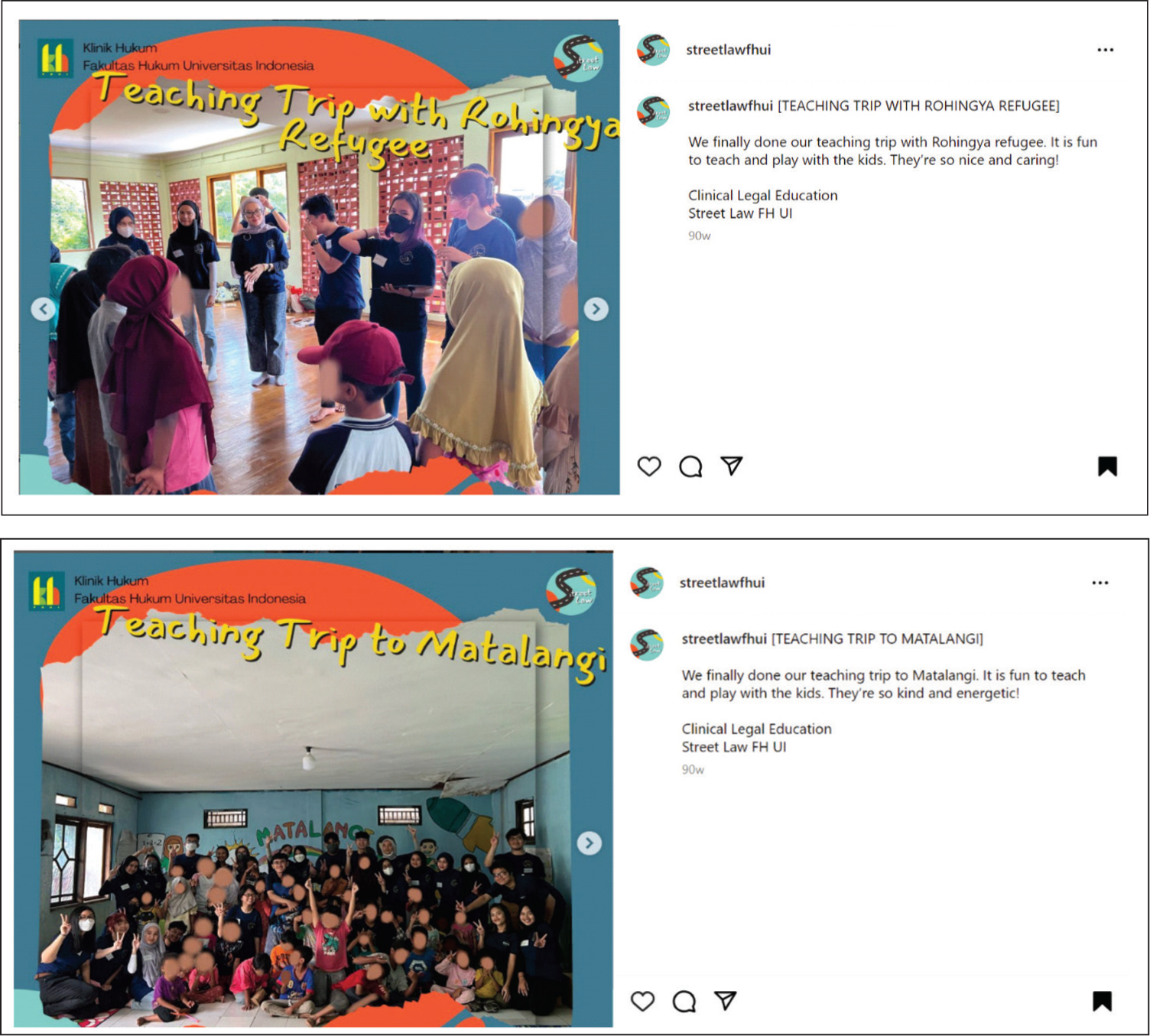
Before doing outreach, the students must go through a series of important stages, including attending workshops and seminars, learning about interactive teaching approaches, creating a lesson plan and eventually carrying out Street Law activities in the assigned places. In order to achieve the main objective in the implementation of the Street Law Clinic programme, several interactive methods that are commonly used in Street Law Clinic activities are as follows. The programme employs diverse, interactive methods designed to boost engagement and practical learning. These include:
Collaborative techniques: Brainstorming, small group discussions, ranking, opinion polls and peer teaching. Simulation exercises: Role-plays, case studies, debates, moots and hypothetical problems. Creative activities: Games, visual aids, puppetry, songs, folk stories and other creative formats.
These techniques collectively encourage critical thinking, collaboration and hands-on learning.
The cross-border Street Law programme was tested during the COVID-19 pandemic, requiring both institutions to innovate and adopt technology-based legal literacy methods. The shift from physical to online activities challenged students to be creative in engaging communities. Despite obstacles, the programme continued virtually using Zoom, WhatsApp, Telegram and TikTok. Choosing the right platform for each audience was crucial. For instance, WhatsApp and Telegram facilitated interaction with children at Pusat Aktiviti Kanak-Kanak, YCK, while TikTok videos enhanced engagement. Zoom proved effective for webinars with schools and university students. This adaptation demonstrated the programme’s resilience and flexibility, ensuring its impact despite limitations.
Opportunities and Benefits of Cross-border Street Law
The Street Law Clinic programme provides multiple advantages for students, lecturers and both the Universitas Indonesia and Universiti Malaya, while delivering essential services to the community.
Credited Course for Universitas Indonesia and Extra-curriculum for Universiti Malaya
At Universitas Indonesia, Street Law is a credited course that offers students a modern, experiential learning approach. At Universiti Malaya, although it is not credit-bearing, the programme still engages students in real-life legal scenarios, helping them develop essential skills such as communication, advocacy and legal reasoning—skills crucial for their future legal careers.
Unlike traditional lecture-based teaching, Street Law emphasizes participatory learning, which has been shown through psychological research to improve memory retention and understanding. Students learn legal concepts more effectively when they are actively involved, rather than passively receiving information. 52
Enhancing Legal Skills and Interpersonal Skills
Many alumni of the legal clinic programme report significant professional benefits resulting from their participation. They frequently note that the clinic equipped them with practical skills and hands-on experience that traditional classroom settings often lack, effectively preparing them for the demands of legal practice. Through direct engagement with real cases, students not only develop technical competencies but also strengthen their integrity in handling legal matters and creativity in problem-solving.
The clinic fosters a deep understanding of professional ethics and the practical application of law, enhancing graduates’ adaptability and effectiveness in the workplace. Alumni consistently credit the legal clinic as a critical factor in their career development, having provided meaningful exposure to the realities of the legal profession.
One former student, Puan Adria Ikhsan, S.H., a 2014 participant of the Civil Law Clinic, Faculty of Law, Universitas Indonesia, remarked
53
:
The legal clinic is the most practical course, as it directly deals with real cases in the field. Being selected to participate was a personal blessing, given the competitive selection process. The clinic introduced me to the professional world, particularly in advocacy and litigation consultancy. This experience was invaluable in shaping and strengthening my career path. Thank you, Legal Clinic!
Similarly, Andreas Marbun, S.H., a 2015 participant in the Anti-Corruption Clinic, Faculty of Law Universitas Indonesia, shared 54 : ‘The clinic is truly great… it’s not just about classroom learning, but real field knowledge. This course is definitely unforgettable’.
Such testimonials underscore the transformative impact of CLE at the Faculty of Law, Universitas Indonesia, making it one of the most memorable and professionally relevant components of the students’ academic journey.
Enriches Experiential Learning
The implementation of the Street Law programme benefits both Universitas Indonesia and Universiti Malaya by enriching their legal education curricula and offering a more holistic learning experience. By adopting CLE methods, similar to those used in Street Law, both institutions strengthen their academic offerings while preparing students to better meet the practical demands of legal practice.
Importantly, the programme also promotes social responsibility among students by encouraging active participation in community service. By addressing real societal issues, the curriculum allows students to bridge the gap between legal theory and practice. As reflected in a student S’s journal entry
55
:
When I volunteered, I learned the importance of self-discipline and committing to causes I care about. Combining passion with action has helped me grow creatively and professionally. Volunteering taught me to approach situations with a beginner’s mindset, embrace new experiences, and stay present. Through this program, I gained confidence, clarity, and discovered my spark in spreading legal awareness through hands-on learning.
The Street Law programme provides considerable benefits to faculty members. Educators are not merely instructors but facilitators who navigate students through interactive learning experiences and offer essential feedback. Peer and instructor and/or educator assessments continuously evaluate students’ advancement in this approach, creating a more dynamic and interesting educational atmosphere. Faculty members can augment their teaching by observing the application of legal ideas in real-world scenarios, complementing the classroom experience with practical examples from the Street Law programme.
Access to Legal Literacy for the Community
The Street Law Clinic plays a vital role in supporting underprivileged and underserved communities by promoting legal literacy among groups with limited access to legal knowledge or services—such as high school students, incarcerated individuals and marginalized populations. The clinic offers accessible education on basic legal rights, human rights and democratic values, helping individuals better understand and navigate the justice system.
Law students contribute by providing legal assistance and guidance on everyday issues, helping bridge the gap between communities and the legal system. In doing so, the programme fosters a more informed, empowered public and strengthens the connection between law and society.
The impact of the Street Law Clinic is multifaceted. It enhances students’ practical skills and social awareness, enriches faculty engagement, elevates the academic reputation of institutions like Universitas Indonesia and Universiti Malaya and serves as a valuable legal resource for the public. As a model of experiential and community-focused legal education, Street Law stands out as a transformative approach that benefits both learners and society at large.
Challenges and Obstacles
The cross-border street law programmes provide substantial advantages for both students and the community; however, their execution is not without obstacles. Street Law Clinic, like numerous experiential learning initiatives, encounters numerous challenges that may undermine its overall efficacy and influence. These obstacles are the result of the inherent complexities of engaging with marginalized communities, logistical difficulties and a scarcity of resources. It is imperative to comprehend and resolve these challenges to improve the programme’s quality and guarantee that it continues to achieve its educational and social justice objectives.
Financial and Infrastructure
A primary challenge for both institutions is the scarcity of resources, both financial and infrastructural. Street Law initiatives frequently necessitate financial backing to facilitate activities including legal outreach, advocacy and the distribution of instructional resources. Insufficient financial support makes maintaining these vital activities challenging. The lack of facilities, including classrooms and technological access, can impede the programme’s effective implementation, particularly in efforts to engage broader or rural areas.
Cultural and communication
A key challenge faced by both students and faculty members involves balancing the temporal and logistical demands of Street Law outreach with existing academic commitments. Coordinating community-based activities alongside coursework can be overwhelming, often leading to scheduling conflicts and reduced participation. Engaging with underprivileged communities also presents unique difficulties, particularly in navigating cultural and communication barriers. Delivering legal information in a clear and accessible manner to diverse audiences requires careful planning and sensitivity. Although English is the medium of instruction at the university level, outreach sessions are typically conducted in Bahasa Malaysia or Bahasa Indonesia, with adaptations made for local dialects and varying levels of comprehension. Cultural nuances and differing communication styles initially posed difficulties for student facilitators. Additionally, while Bahasa Malaysia and Bahasa Indonesia share common linguistic roots, some terms carry different meanings across the two languages. For instance, baja means ‘fertilizer’ in Malaysia but ‘bomb’ in Indonesia, and percuma means ‘free of charge’ in Malaysia but ‘useless’ or ‘in vain’ in Indonesia. Such differences necessitate vigilance and clarification during community engagements to avoid misunderstandings.
Technology Usage
The COVID-19 pandemic disrupted face-to-face activities, significantly impacting the Street Law Clinic programme, which traditionally relied on in-person engagement. However, the clinic adapted by shifting to online platforms such as Zoom for meetings and consultations, WhatsApp and Telegram for communication and conducted webinars and social media campaigns such as Instagram, Facebook and TikTok to deliver legal education and reach wider audiences.
This digital transition allowed the programme to maintain its outreach and continue providing legal support to underserved communities despite pandemic-related restrictions.
Assessments
At Universitas Indonesia, where Street Law is offered as a formal course, there is a continuous need for critical evaluation and curriculum refinement. Given its engagement with real legal issues, the programme is regularly assessed by educators and peers to ensure its relevance and effectiveness. The evolving legal landscape and the diverse needs of the community require constant updates to both teaching methods and content. Addressing these challenges demands adaptability, sustained commitment and support from the university and external partners to ensure the programme’s ongoing success.
Lessons Learnt and Moving Forward
Based on the experiences and observations from coordinating the cross-border Street Law programme and also training the students involved in this programme, the following are some of the lessons that we learnt:
Institutional Support and Leadership Commitment
The leadership and administration of both Universitas Indonesia and Universiti Malaya demonstrate unwavering support for the Street Law programme, recognizing its value in providing experiential learning opportunities and community service. Universitas Indonesia and Universiti Malaya leadership consistently support the Street Law programme, recognizing its impact on experiential learning and community service. Despite leadership changes, their commitment to CLE ensures continuity, securing essential resources, funding and guidance. This steadfast support sustains the programme’s long-term success. This institutional backing ensures that the programme receives the necessary resources, funding and guidance, even as leadership or faculty members change over time. It is this continuity in support that allows the programme to weather challenges and remain sustainable in the long term.
Shared Commitment to Legal Education and Social Justice
Both Universitas Indonesia and Universiti Malaya are deeply committed to the mission of providing legal education that extends beyond the classroom and serves real societal needs. This shared dedication to social justice and community empowerment creates a strong foundation for the programme. By working together, both institutions actively promote the idea that law students should not only learn legal theory but also apply their knowledge to help marginalized communities, such as migrant workers, vulnerable children and women. This common purpose strengthens the partnership, ensuring that it endures over time.
Collaborative Planning and Problem-solving
The programme’s sustainability relies on the willingness of both institutions to engage in collaborative planning and problem-solving. Whether it is designing curriculum materials, coordinating field activities or addressing logistical challenges, Universitas Indonesia and Universiti Malaya work closely to ensure the programme’s smooth operation. This collaboration fosters an environment where ideas, best practices and resources are freely exchanged, leading to more innovative and effective approaches to Street Law education.
Cultural Exchange and Mutual Learning
The programme serves as a platform for cultural exchange, allowing students and faculty from Universitas Indonesia and Universiti Malaya to interact, learn from each other and develop a deeper understanding of diverse legal systems and societal challenges. This exposure to different perspectives enhances the learning experience for all participants, creating a more inclusive and holistic approach to legal education. The mutual respect and appreciation for each institution’s unique contributions cultivate a sense of unity, which is essential for maintaining the programme’s momentum.
Adaptability and Resilience
Operating a cross-border programme involves navigating various challenges, including language differences, legal system disparities and logistical complexities. The spirit of togetherness ensures that Universitas Indonesia and Universiti Malaya approach these challenges with a mindset of adaptability and resilience. By working together, both institutions can quickly address and resolve issues, whether it is adapting teaching methods, translating materials or adjusting to changing legal requirements. This adaptability ensures the programme remains relevant and effective in meeting the needs of the communities it serves.
Strengthening Student Relationships and Networks
One of the key outcomes of the programme is the creation of strong bonds between students from Universitas Indonesia and Universiti Malaya. These relationships, built through joint activities, workshops and street law clinics, foster a sense of camaraderie and shared responsibility. This network of students acts as ambassadors of the programme, promoting its values and ensuring its continuity through their dedication and passion, even after they graduate. Some of them even attended each other’s graduation and go on holiday together.
Long-term Vision and Shared Goals
The cross-border Street Law programme is sustained by a long-term vision that both Universitas Indonesia and Universiti Malaya share. This vision goes beyond immediate outcomes and focuses on the broader impact of creating legally empowered communities and producing socially responsible lawyers. This forward-thinking approach ensures that the collaboration is not merely a short-term project but a sustainable initiative that continues to evolve and adapt, meeting the changing needs of society. Although there is no formal system to track alumni, informal observations suggest that past participants remain in contact and continue to collaborate. Some have chosen careers in legal education or public interest law. In the future, the programme aims to create a digital alumni network and carry out long-term studies on their career paths and involvement in community work.
Shared Cultural Values and Understanding
The cultural similarities between Malaysia and Indonesia, such as language roots, societal values and certain aspects of legal traditions, provide a common ground for participants from both universities. These shared elements facilitate smoother communication, mutual respect and a sense of camaraderie, which are essential in fostering effective collaboration. This commonality helps in creating a more inclusive environment where both students and faculty can work together seamlessly to address the legal needs of migrant communities.
Learning from Differences
The strength of the cross-border Street Law programme also lies in the differences between Malaysian and Indonesian cultures, legal systems and societal norms. These distinctions offer rich opportunities for comparative learning and professional development. Malaysia’s legal system is rooted in the common law tradition, introduced during British colonial rule, and continues to shape its legal structure today. This system places strong emphasis on judicial precedent, where decisions by higher courts are binding on lower courts, and legal reasoning is often drawn from case law in addition to statutes. Moreover, Malaysia incorporates elements of Islamic law in specific areas, particularly in matters of matrimonial, family and inheritance law for Muslims. 56
In contrast, Indonesia operates under a civil law system influenced by Dutch colonial heritage. This system prioritizes codified legislation and regulations as the main sources of law, with less reliance on judicial decisions. Indonesian judges are generally expected to apply written law to cases rather than draw from precedent. Legal education in Indonesia focuses more on doctrinal analysis of codes and statutes than on case interpretation. Legislative authority plays a central role, especially in administrative and criminal law. 57
These foundational legal differences significantly influence not only the interpretation and application of law but also how legal education is structured and delivered in both countries. They also shape the strategies used in legal outreach, such as Street Law, which must be carefully adapted to fit the respective legal and cultural contexts.
At the same time, these differences provide a unique opportunity for students and faculty to engage in meaningful comparative legal analysis, enriching their understanding of how diverse legal frameworks function in practice. Exposure to different systems and methods strengthens students’ legal reasoning, enhances cross-cultural communication and prepares them to operate effectively in increasingly global and multicultural legal environments.
Developing Cross-cultural Competency
By engaging in the Street Law programme, participants from Universitas Indonesia and Universiti Malaya developed essential cross-cultural competencies that are increasingly important in today’s globalized world. They learn to appreciate different communication styles, approaches to problem-solving and ways of interacting with communities. This experience cultivates adaptability, empathy and cultural sensitivity, which are crucial qualities for legal professionals working in diverse contexts, especially when dealing with vulnerable target groups.
Enhancing Legal Education Through Cultural Exchange
The interplay of cultural similarities and differences enriches the educational experience by introducing varied teaching methods, perspectives and legal practices. For instance, role-playing exercises, case studies and interactive teaching techniques might be adapted differently by each institution, providing students with a more comprehensive understanding of legal concepts. This cross-cultural exchange enables them to view legal issues through multiple lenses, making them more effective in addressing the real-world challenges faced by vulnerable communities.
Strengthening Community Impact
The cultural insights gained from both Malaysian and Indonesian contexts allow the programme to tailor its approach to meet the specific needs of the communities it serves. Understanding the nuances of how cultural beliefs and practices influence legal awareness and behaviours enables the Street Law programme to be delivered to the targeted group in both countries. This culturally sensitive approach ensures that the legal information provided is accessible, relatable and effectively addresses the concerns of the target community.
Conclusion
The cross-border Street Law programmes between Universitas Indonesia and Universiti Malaya demonstrate the profound impact of CLE in fostering legal literacy, social awareness and professional skills among law students while empowering marginalized communities. Through the use of experiential learning techniques, the programme successfully bridges the gap between theoretical legal education and practical application, equipping students with essential skills such as advocacy, communication and problem-solving. This initiative not only enhances the quality of legal education but also instils a sense of social responsibility and cultural competence in future legal professionals.
The collaboration between both universities is sustained by a strong spirit of togetherness, shared commitment and mutual respect for cultural similarities and differences. This partnership has proven to be adaptable and resilient, effectively navigating challenges such as language barriers, legal system disparities and logistical complexities, especially during unprecedented times like the COVID-19 pandemic. By leveraging innovative teaching methods and digital platforms, the programme has continued to make significant contributions to legal education and community outreach, ensuring that it remains relevant and impactful.
The lessons learnt from this cross-border initiative underscore the importance of institutional support, collaborative planning and the development of cross-cultural competencies in sustaining such programmes. By fostering a long-term vision focused on social justice and community empowerment, the Street Law programme serves as a model for other legal education institutions, demonstrating how experiential learning can be harnessed to create a more inclusive and socially responsive legal profession.
In conclusion, the Street Law programme has successfully achieved its dual objectives of enhancing legal literacy among marginalized communities and developing competent, culturally aware law students. As it continues to evolve and adapt, this programme stands as a testament to the transformative power of CLE in promoting access to justice, civic participation and the cultivation of socially conscious lawyers prepared to address the complexities of an increasingly interconnected world.
Footnotes
Declaration of Conflicting Interests
The authors declared no potential conflicts of interest with respect to the research, authorship and/or publication of this article.
Funding
The authors received no financial support for the research, authorship and/or publication of this article.