







Abstract
This article evaluates the effectiveness of the bilingual Chinese–Portuguese Bachelor of Law programme at the University of Macau, designed to address the unique demands of Macau’s legal system. As a former Portuguese colony and current Chinese Special Administrative Region, Macau’s legal framework, enshrined in its Basic Law, requires proficiency in both Chinese and Portuguese. The five-year programme integrates bilingual legal education with intensive language training, including an optional year abroad in Portugal for immersive Portuguese study. Analysing a decade of data (2014–2024) from 333 students, the study reveals that 48.77 per cent of students who studied in Portugal achieved B2 proficiency, compared to 20.83 per cent of those who remained in Macau. The COVID-19 pandemic disrupted international mobility, sharply reducing proficiency gains in affected cohorts. Despite challenges, the programme graduated 99 bilingual students, with flexibility allowing transfers to a Chinese-only track if language benchmarks are unmet. The authors argue that the programme’s success—combining rigorous legal training with strategic linguistic immersion—provides a model for bilingual legal education.
Introduction
The need for proficient bilingual lawyers has become a matter of vital importance in an increasingly globalized legal landscape, particularly in jurisdictions with bilingual legal systems. Macau, as a Special Administrative Region (SAR) of the People’s Republic of China (PRC), presents a unique case study in bilingual legal education, given its simultaneous employment of Chinese and Portuguese in its laws. Historically administered by Portugal until its handover to China in 1999, Macau continues to operate under a legal system that uses Chinese and Portuguese as mandated by its Basic Law.
Recognizing the complexities of training lawyers within this dual-language legal system, the Faculty of Law at the University of Macau introduced a bilingual Bachelor of Law programme in 2014. This programme, conducted in Chinese and Portuguese, aims to equip students with the linguistic and legal proficiency necessary to navigate Macau’s bilingual legal environment. A distinctive feature of this programme is the opportunity for students to spend a year in Portugal, immersing themselves in the language and culture and addressing the linguistic challenges faced by students whose mother language is Chinese.
This article evaluates the extent to which this novel programme has succeeded in educating students who are proficient in legal Chinese and Portuguese. In particular, the article focuses on the outcomes of language acquisition by comparing the performance of students who studied Portuguese abroad with those who remained in Macau for their language studies. The results demonstrate that the current structure of the programme has successfully yielded a significant number of graduates who not only completed their law degrees but also achieved a high level of bilingual proficiency, indicating that the programme can serve as a model that can be emulated by other law courses aiming for similar outcomes.
This article proceeds as follows. The first section discusses the challenges of bilingual legal teaching. The second section explains the historical and legal foundations of Macau as a bilingual legal system. The third section details the structure and implementation of the bilingual Bachelor of Law programme at the University of Macau, particularly in regard to Portuguese language education. The fourth section presents data on student outcomes, including enrolment, graduation rates and language proficiency achievements, comparing students who spent a period of time in Portugal during the programme with those who remained in Macau. Finally, the fifth section summarizes the programme’s overall performance and offers suggestions for improving bilingual legal education in Macau and other jurisdictions.
Challenges and Approaches in Bilingual Legal Education
The study of law in two languages presents considerable challenges, as it involves not only mastering a foreign language but also understanding the specialized legal terminology and concepts within that language. Learning a foreign language for legal purposes is particularly demanding because legal discourse often differs from everyday language, even within one’s native tongue. This complexity is compounded in legal education, where the precise meaning of terms and expressions is critical for legal interpretation and application. 2 Furthermore, learning a foreign language requires a deep understanding of the culture that underpins it, including its values, ethical framework and historical context. 3
Of course, knowing two or more languages is highly advantageous, especially in the legal field. In today’s globalized world, mastering more than one legal language offers lawyers a strong competitive position. Scholars such as Nicolás Etcheverry Estrázulas and Sofía Cairo have identified the manifold benefits of bilingual legal education, noting that it not only expands students’ world views but also increases their professional opportunities and earning potential. Law firms and public institutions alike increasingly seek lawyers with bilingual or multilingual capabilities, making language mastery a distinct asset in contemporary legal practice. 4
The challenges are particularly acute in legal systems where the relevant languages are linguistically distant, such as Chinese and Portuguese. In such cases, mastery of legal vocabulary in both languages is indispensable—an achievement that cannot be replicated by non-specialist translators. 5 Comparative legal education literature highlights that in jurisdictions where multiple official languages co-exist, the ability to navigate legal issues in both is a significant professional advantage. This recognition has prompted institutions in countries such as Belgium, Canada and France to develop bilingual law programmes. 6
Bilingual education can take several forms. It may involve the use of two languages at the university or faculty level, or it may reflect the administrative languages of the institution. In the context of bilingual languages of instruction, Xabier Arzoz identifies three principal models of bilingual legal education:
7
Double Monolingual Education: Students choose one language as their medium of instruction, attending all coursework in that language. For example, the University of the Basque Country offers this model at the undergraduate level, though not at the postgraduate level.
8
Partial Bilingual Exposure: Students are required to complete a specified number of courses in each language, with offerings determined by factors such as staff expertise and institutional policy.
9
Integrated Bilingualism: Institutions offer a balanced number of courses in both languages, allowing students to select their preferred medium.
10
For instance, at the University of Fribourg, Switzerland, students must complete at least 25 per cent of their courses in their non-primary language.
11
The University of Macau’s Bachelor of Law programme exemplifies this approach: while students may choose the majority language of instruction, at least 40 per cent of their coursework must be completed in Portuguese.
The advantages of bilingual legal education are clear 12 —particularly in a globalized legal market where multilingual ability is increasingly valued—but the design and implementation of such programmes face unique challenges. One of the most significant hurdles is the availability of qualified instructors who are proficient in both languages and capable of teaching legal concepts in a bilingual context. 13 In many cases, legal educators may be experts in their particular fields but lack the linguistic skills necessary to teach in a second language. This gap is an impediment to institutions recruiting or training faculty who can effectively bridge linguistic and legal divides.
Another challenge lies with students’ preparedness for bilingual programmes. If a jurisdiction does not require entrance examinations to assess language proficiency, students will enrol with varying levels of linguistic ability, which creates a wide variance in their capacity to engage with course materials. This disparity can impair the academic progress of less-prepared students while placing additional strain on faculty tasked with addressing such gaps. Institutions must, therefore, carefully design language training to ensure that all students can meet a baseline level of competence to succeed in bilingual legal education.
Developing a bilingual curriculum also entails significant logistical and pedagogical challenges. One key issue is the availability of legal textbooks and teaching materials in both languages, 14 and assessing student performance in two languages adds another layer of complexity. Institutions must develop standardized methods for evaluating legal knowledge and language proficiency in both languages to ensure that students can meet rigorous academic and professional standards regardless of their linguistic background. This process requires careful alignment of assessment criteria and the development of tools that can accurately measure students’ legal and linguistic competencies.
Macau as a Bilingual Legal System
Macau, an SAR of the PRC, presents a unique legal and linguistic landscape due to its history as a former Portuguese colony and its current status as a bilingual jurisdiction. From 1557 until its handover to China in 1999, Macau was under Portuguese administration. Initially, Portuguese law was applied alongside the legal codes of the Ming and Qing dynasties. 15 This dual legal system governed relations between the Portuguese and Chinese populations. For example, disputes between Portuguese settlers and Chinese Christians were adjudicated under Portuguese law, whereas traditional Chinese law applied to disputes among the local Chinese population. However, the coexistence of these legal systems led to practical difficulties, particularly in resolving disputes between Portuguese and non-Christian Chinese residents, which the dual legal framework failed to adequately accommodate. 16
In 1849, the dual legal system was abolished, and Portuguese law became the governing legal framework, supplemented by a handful of bodies of laws solely applicable to Chinese residents. 17 This legal system remained in place through the remainder of the Portuguese administration. In 1987, the Sino-Portuguese Joint Declaration formalized the terms of Macau’s return to China. After the Joint Declaration, a comprehensive effort to translate legal texts from Portuguese into Chinese was undertaken, reflecting the region’s future as a bilingual legal system under sovereign Chinese rule. 18
The Basic Law of Macau, which took effect upon the region’s handover to China on 20 December 1999, enshrined the principle of legal continuity and guaranteed the long-term influence of law in place prior to the handover. To this end, Article 8 of the Basic Law stipulates that all laws, decrees, administrative regulations and other normative acts previously in force in Macau would remain applicable after the handover, subject to amendments by the Macau legislature. This provision is intended to ensure that the Portuguese legal tradition remains part of the Macau legal system after its return to China.
Article 9 of the Basic Law further codifies Macau’s bilingual legal framework by establishing Chinese and Portuguese as the region’s official languages. In addition to the Chinese language, Portuguese may be used by the executive authorities, the legislature and the judiciary of the Macau SAR. This bilingualism is not merely symbolic, 19 as proficiency in Portuguese is essential for understanding many of Macau’s foundational legal texts, which are firmly rooted in Portuguese law. This situation has led to an ongoing debate over whether and to what extent proficiency in Portuguese is necessary for a comprehensive understanding of Macau’s legal system. 20
Legal education in Macau has evolved to reflect these bilingual demands. The first law degree programme in Macau was introduced in 1989 at the University of East Asia (later renamed the University of Macau). 21 This programme, offered in Portuguese, was initially an evening course designed to meet the needs of the working population. In 1996, the Faculty of Law at the University of Macau introduced a Bachelor of Law programme in Chinese, also as an evening course and expanded the offering to a daytime programme in 2000. 22 The Chinese-language law degree quickly became the dominant form of legal education in Macau, aligning with the linguistic demographics of the region, where roughly 90 per cent of the population is Chinese and over 95 per cent of residents do not speak Portuguese. 23 Even during the colonial period, Portuguese was not widely spoken or taught in schools, and its use was largely confined to the legal, governmental and ecclesiastical spheres. 24
The implementation of the Chinese-language law programme addressed the needs of most of Macau’s population and made legal education more accessible to local residents. However, given Macau’s status as a bilingual legal system, a number of voices within the Macau legal community have emphasized the importance of training bilingual lawyers capable of navigating both Chinese and Portuguese legal frameworks. 25 This need has not diminished because Macau’s legal system, despite increasingly accommodating Chinese-language legal education, still retains many key legal texts and principles rooted in Portuguese law.
Thus, the Faculty of Law at the University of Macau has sought to address these challenges by developing a comprehensive bilingual legal education programme. The establishment of a bilingual Bachelor of Law degree, conducted in Chinese and Portuguese, was intended to produce graduates proficient in both languages and capable of operating effectively within Macau’s unique legal environment. In this sense, it was created to leverage the existing capabilities of legal teaching in Portuguese and Chinese that were already present among the law faculty.
A Bilingual Bachelor of Law: A Bachelor of Law Conducted in Chinese and Portuguese
The bilingual Bachelor of Law programme at the University of Macau is a five-year academic course that addresses the region’s unique bilingual legal context. The curriculum follows a traditional legal education model, balancing theoretical instruction with practical application while following the traditional plans of law degrees in the Portuguese-speaking world and Macau.
In the first year, students must take foundational courses, namely Introduction to Law, Legal History, Constitutional Law, Macau Basic Law and Public International Law. Concurrently, students begin intensive language training, with a curriculum aimed at developing both oral and written proficiency. The language component comprises four sequential courses: Oral Comprehension and Production Skills I (6 hours per week), Written Comprehension and Production Skills I (6 hours per week), followed by Oral Comprehension and Production Skills II and Written Comprehension and Production Skills II (each 6 hours per week). This integrated approach ensures that students develop the linguistic capabilities necessary for advanced legal study bilingually. 26 This language learning is then complemented in the second year, where students focus solely on language learning either in Macau or a partner University in Portugal.
During their third, fourth and fifth years, students continue their studies with a mix of law courses offered in both languages. This flexible structure enables them to deepen their expertise in either Chinese or Portuguese law, depending on their interests and linguistic abilities. Students who attend the bilingual Bachelor of Law do not attend separate classes, but instead they join classes from either the Bachelor of Law in Chinese and the Bachelor of Law in Portuguese programmes. 27 Pursuant to the programme’s requirements, students whose primary instructional language is Chinese must complete no less than 40 per cent of core law courses in Portuguese, while those with Portuguese as their principal medium must satisfy an equivalent proportion of core requirements in Chinese. 28
This arrangement is possible at the University of Macau because the Faculty of Law already ran two parallel bachelor programmes in Portuguese and Chinese, which covered the same subjects and had similar programme outlines. This pre-existing set-up allowed the faculty to circumvent many of the difficulties generally associated with creating a bilingual programme. Importantly, the faculty members teaching these courses in Portuguese include native Portuguese speakers and Chinese professors fluent in Portuguese, and the courses in Chinese are taught by native Chinese speakers, ensuring high-quality legal instruction in both languages.
A distinctive feature of the programme is the requirement for students to attain a minimum A2 level in Portuguese, as measured by a recognized proficiency exam, such as CAPLE or CELPE-Bras, by the end of their first year. Those who meet this requirement are offered the opportunity to study in Portugal during their second year. This period of linguistic immersion is considered essential for students to develop the language skills necessary to engage fully with Portuguese legal texts and principles. Typically, students study at partner universities in Portugal, where they are embedded in the language and the culture. By the end of the second year, students must achieve a B2 level in Portuguese to continue in the bilingual programme. Those who fail to meet this requirement must transfer to the Chinese-only Bachelor of Law programme.
The bilingual programme is characterized by the flexibility it offers students who cannot meet the Portuguese language proficiency requirements. As noted above, students who fail to achieve the minimum B2 level by the end of the second year of studies are required to transfer to the Chinese-only Bachelor of Law programme. This ‘escape valve’ ensures that language difficulties do not prevent students from completing their legal studies. This policy provides extra motivation for students to enrol in the bilingual programme, as they are reassured that their legal education will not be interrupted even if they encounter challenges in acquiring Portuguese proficiency.
The University of Macau has also supported students in their year abroad by offering a financial allowance of approximately 70,000 MOP (approximately USD 8,700). If a student fails to reach B2 proficiency after their year abroad, they must refund the allowance, a policy intended to ensure that students take the language requirement seriously. Some students, therefore, opt to remain in Macau. For students who opt not to travel abroad, the University of Macau’s Faculty of Arts and Humanities offers Portuguese language courses to provide local students with continued language training.
Outcomes: Graduation Rates and the Importance of Studying Abroad
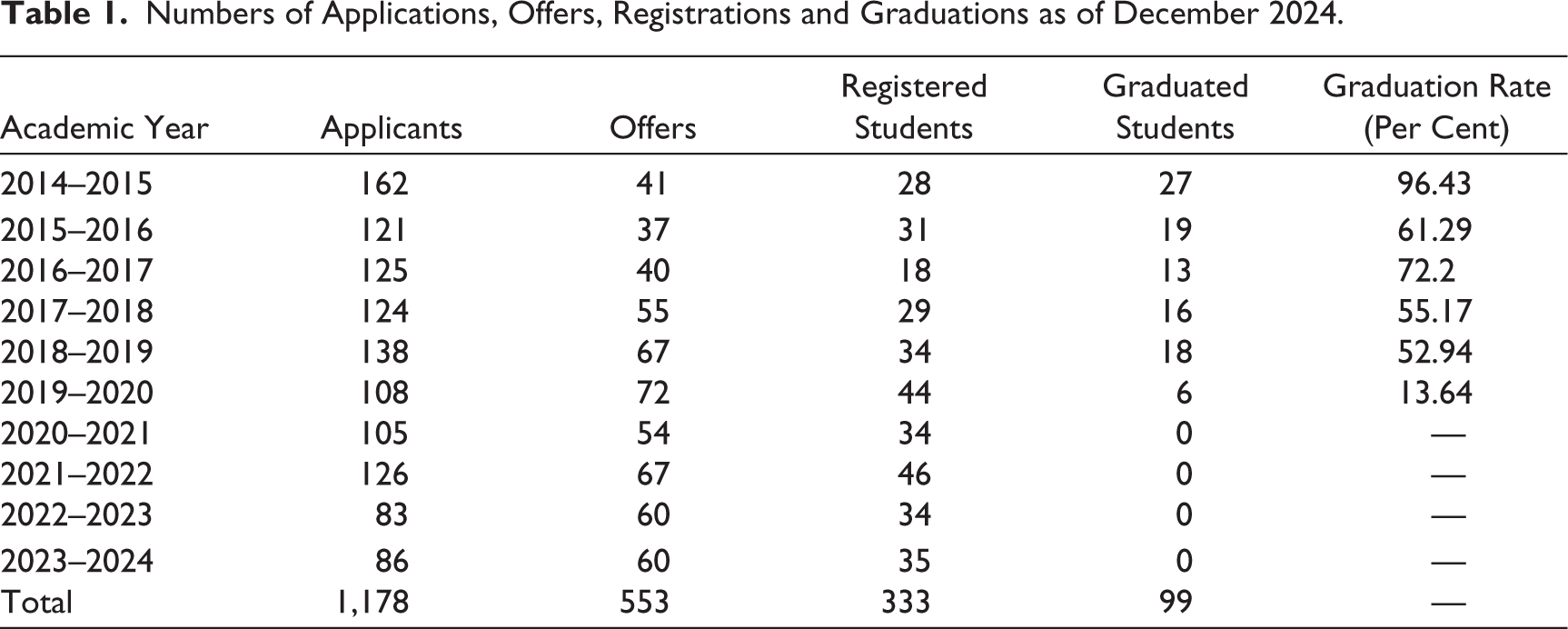
Since its establishment in 2014–2015, a total of 333 students have registered for the bilingual Bachelor of Law programme at the University of Macau. To date, 99 students from the bilingual bachelor’s programme have successfully graduated, demonstrating the programme’s ability to train legal professionals in both Chinese and Portuguese. Furthermore, 67 students, having been deemed not to have achieved sufficient bilingual proficiency, transferred to the Bachelor of Law in Chinese and graduated from that programme instead.
The figures in Table 1 reveal significant variations in graduation rates across cohorts. The highest graduation rate was recorded in the programme’s inaugural year (2014–2015), with 96.43 per cent of registered students graduating. This exceptional outcome can be attributed to the use of a more lenient definition of bilingual proficiency during the programme’s initial implementation. In contrast, the lowest graduation rate occurred in the 2019–2020 academic year, with only 13.64 per cent of registered students completing the programme. 29 A likely reason for this decline is the restrictions imposed during the COVID-19 pandemic, which prevented students from participating in the critical study-abroad component in Portugal, a cornerstone of the programme’s language acquisition strategy.
Numbers of Applications, Offers, Registrations and Graduations as of December 2024.
The programme’s structure, therefore, allows for an analysis of the specific factors influencing student outcomes, particularly the role of studying abroad in Portugal. As mentioned, as part of the bilingual Bachelor of Law programme, students are encouraged to spend a year abroad in Portugal to immerse themselves in the Portuguese language and culture. The data reflect that this opportunity appears critical for achieving language proficiency. 30
Data on Students Who Went Abroad and Language Proficiency Outcomes as of December 2024. 30
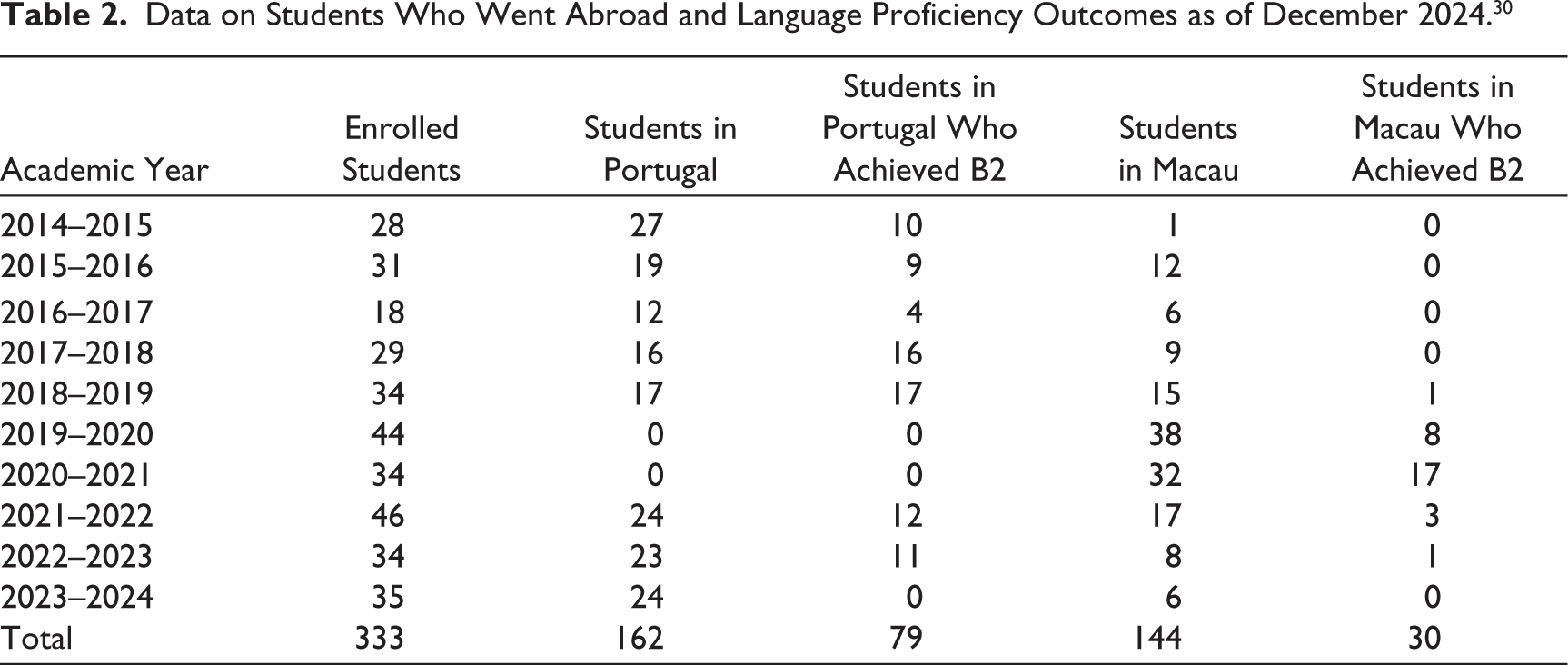
The data in Table 2 highlight the substantial advantage of studying abroad for language acquisition. Students who participated in the Portugal immersion programme were significantly more likely to achieve the B2 level of Portuguese proficiency—a benchmark for fluency—compared to those who remained in Macau. 31 As shown in Table 3, approximately 48.77 per cent of students who studied in Portugal achieved B2 proficiency, whereas only 20.83 per cent of students who studied Portuguese locally in Macau did so. 32 33
Breakdown of Students Who Obtained a B2 Qualification as of December 2024.
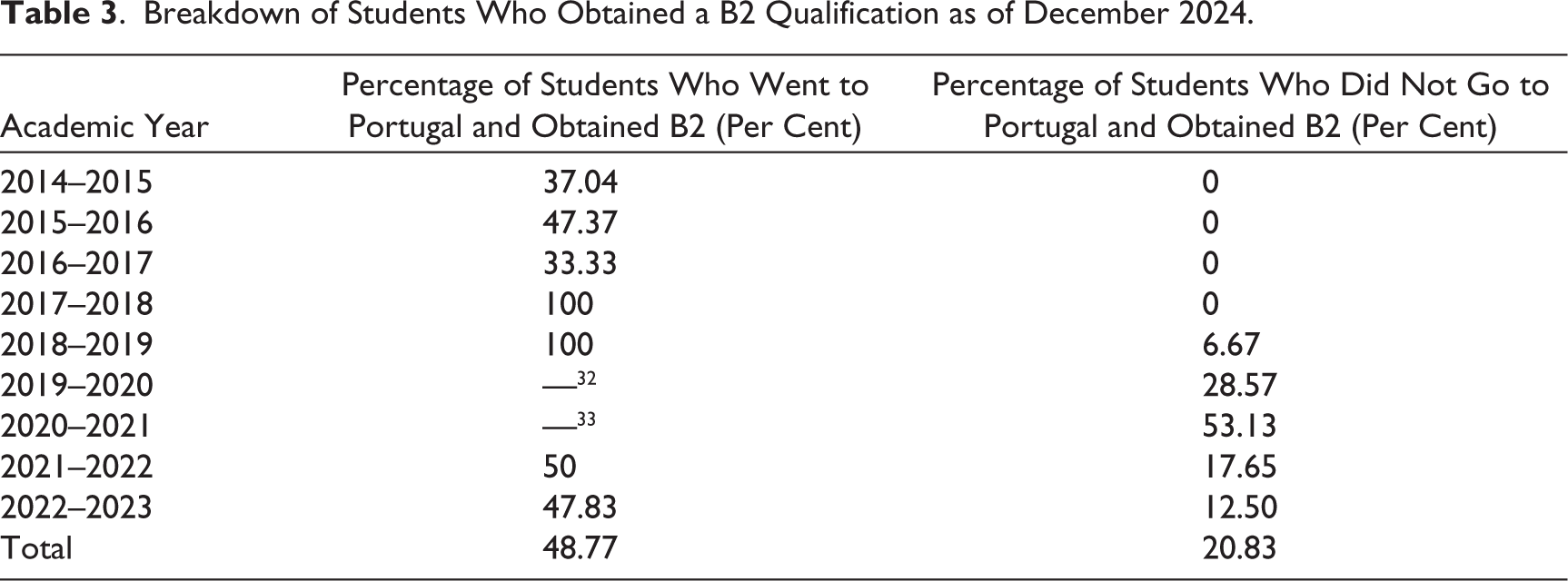
The immersion experience in Portugal appears, therefore, very important for students to develop the advanced language skills required to engage with Portuguese legal texts and principles. While the local Portuguese language programmes in Macau offer an alternative for students unable or unwilling to study abroad, their success rates are generally lower. However, notable exceptions exist. For example, in the 2020–2021 cohort—a year heavily impacted by the COVID-19 pandemic and travel restrictions— 53.13 per cent of students who remained in Macau achieved B2 proficiency. 34 The data demonstrate that local programmes can be effective when accompanied by strong institutional support.
Conclusion
Reflecting on the experience of establishing the bilingual Bachelor of Law programme, three principal insights emerge. First, from the perspective of university and faculty management, law schools that already offer programmes in multiple languages may find that developing a bilingual programme leveraging existing resources can be an attractive option for students and a cost-effective option to expand a law school’s offering. By building on current infrastructure and academic expertise, institutions can introduce an additional bilingual programme with minimal incremental costs, enhancing their academic offerings and appealing to a broader cohort of prospective students.
Second, implementing language proficiency requirements that are external to the university—such as mandating students to pass an official language examination—proves to be an effective means of ensuring that graduates possess the linguistic skills demanded by the legal market. However, it is important to incorporate provisions that allow students who do not initially meet these requirements to continue benefiting from the programme. Such flexibility can support student progression while maintaining overall programme standards.
Third, while international immersion experiences are generally advantageous, the timing of such experiences within the programme’s curriculum is crucial. The programme’s experience indicates that students who participate in immersion abroad at the very beginning, particularly those with limited or negligible prior knowledge of Portuguese, may not fully capitalize on the benefits of an immersive environment. This observation is particularly relevant in the context of this programme, where many students commence their studies with minimal exposure to Portuguese, limiting the immediate effectiveness of early immersion.
The bilingual Bachelor of Law programme offered by the Faculty of Law at the University of Macau has, over its first decade, demonstrated its relevance and success. Established to address the need for bilingual lawyers in Macau’s unique legal system—where Chinese is the dominant language of the population, but Portuguese is vital for legal practice—this programme bridges the gap between the region’s linguistic demographics and its legal heritage. Rooted in the principle of continuity enshrined in the Basic Law, Macau’s legal framework has retained its Portuguese origins while adapting to the realities of a predominantly Chinese-speaking population. The bilingual programme responds to this challenge by training students to navigate legal systems in both languages, thereby preparing them for the complexities of Macau’s legal environment.
The programme’s structure, which includes an optional year of Portuguese immersion abroad, addresses one of the key barriers to bilingual legal education: the lack of a natural Portuguese-speaking environment in Macau. By embedding students in Portuguese culture and language, the programme facilitates the acquisition of advanced language skills that local instruction alone cannot fully accomplish. After a decade of implementation and five graduation cohorts entering the workforce, the programme has proven that it can meet its ambitious goals and has demonstrated that effective bilingual legal education is possible, even in jurisdictions where one of the legal languages is not widely spoken by the population.
While the programme has achieved notable success, challenges remain. Some graduates display varying levels of Portuguese proficiency, highlighting the need for continual refinement of teaching methods. Further adapting instruction to student needs and incorporating novel technological approaches may help overcome these obstacles. 35 The foundation, however, is well-established and the programme offers a model for other jurisdictions seeking to develop bilingual or multilingual legal education, regardless of whether they operate within bilingual systems. 36
Scholars have highlighted the role of universities, particularly the University of Macau, in creating a localized bilingual legal culture. 37 This programme embodies that vision by preparing students to engage with Macau’s unique legal system while fostering a deeper understanding of its Portuguese legal heritage. By equipping graduates with both linguistic and legal competence, the bilingual Bachelor of Law programme offers a pathway for adapting Macau’s legal system to the region’s evolving needs, bridging its historical background with its present-day realities.
Footnotes
Acknowledgements
The authors thank the General Office of the Faculty of Law, University of Macau, for its kind assistance in obtaining the data used in this study.
Declaration of Conflicting Interests
The authors declared no potential conflicts of interest with respect to the research, authorship and/or publication of this article.
Funding
The authors received no financial support for the research, authorship and/or publication of this article.