






Abstract
Prior research on workplace spirituality has mostly looked at the antecedents and consequences of the construct. The purpose of the present research is to investigate the mediating effect of employee commitment, employee engagement and work motivation in the relationship between workplace spirituality and organizational performance in Indian context. Using standardized self-report measures and structural equation modelling (SEM), present research finds that two facets of organizational commitment (namely, affective and normative), employee engagement and work motivation partially mediate the relationship. Implications of these findings for academic theory as well as HR managers are discussed.
Keywords
Introduction
There is an emergent interest in workplace spirituality among academicians and HR professionals (Giacalone & Jurkiewicz, 2003). Spirituality at workplace is increasingly being lauded as a probable solution to many HR challenges. Over the past two decades, conceptual and empirical research on the concept and utility of workplace spirituality have increased and expanded significantly (Houghton, Neck, & Krishnakumar, 2016).
Among the many outcomes, workplace spirituality is shown to benefit at three levels: societal, organizational and individual (Moore & Casper, 2006). At societal level, it strengthens and consolidates trust and faith in the power of goodness (Miller, 2001). Workplace spirituality calls for augmenting profit maximization with fulfilment of moral obligation, social service, philanthropic activities and corporate social responsibility.
At individual level, spirituality at workplace results into greater physical, psychological, mental and spiritual health of the employees (Krahnke, Giacalone, & Jurkiewicz, 2003). Greater personal growth, higher self-confidence and enhanced sense of self-worth are common outcomes of workplace spirituality (Krahnke et al., 2003). Fry, Hannah, Noel and Walumbwa (2011) reported positive relationship between spiritual leadership and productivity in military units. Additionally, James, Miles & Mullins (2011) attributed greater performance to employees having inherent spiritual attributes. Other researchers who advocated greater performance with workplace spirituality include Javanmard (2012), Pandey, Gupta and Arora (2009), Maleki et al. (2012), Garg (2017) and Malik and Naeem (2011). It allows realization of their full potential and complete self at work.
At organizational level, firm that practices spirituality experiences greater profitability and productivity in the long run. Lloyd (1990) reported that the firms soaked in spirituality at workplace perform 86 per cent higher than firms with little or no workplace spirituality. It also serves the role of catalyst in change management, and therefore easy transformation helps organizations in mastering market opportunities in a better way. Spiritual organizations achieved greater efficiencies and rate of return than their competitors (Jurkiewicz & Giacalone, 2004).
Workplace spirituality shapes employees and organizations’ performance at multiple levels (Moore & Casper, 2006). Many firms are ready to walk extra mile to institutionalize spirituality at workplace so that they can engage hearts and minds of employees (Pfeffer, 2010). In the opinion of Giacalone and Jurkiewicz (2003), the systematic study of workplace spirituality focuses on a fundamental question: “Is spirituality significantly related to various aspects of organizational behaviour and performance, and if so, how?” The present study is an endeavour to answer the “how” part of the question raised. Specifically, the present article looks at the mediating effect of organizational commitment, work motivation and employee engagement in relationship between workplace spirituality and organizational performance.
This article is broadly divided into four parts. In the first part of the article, various definitions of workplace spirituality along with divergent views of researchers are discussed. In the second part, six constructs of Indian spiritualism, already delineated in the literature, are described. Here, the author proposes one additional construct of workplace spirituality: kritagayata (gratefulness). Thirdly, with the help of structured questionnaire and random sampling, a model using all relevant variables of the study is proposed and tested with the help of structural equation modelling (SEM). The mediating effect of intervening variables is explored using revised model. And lastly, practical implications of study and propositions for further research are discussed.
Literature Review
Defining Workplace Spirituality
There is little consensus among research scholars for an acceptable definition of workplace spirituality (Kinjerski & Skrypnek, 2004). Workplace spirituality has been approached through diverse conceptions such as value and belief system, as a developmental line, as a way to get in touch with inner self, as a means of self-realization and as inner experience (Garg, 2017). Zohar and Marshall (2000) argue that workplace spirituality is best evaluated in terms of hyper or super intelligence, which is characterized by quickness of understanding, sound thought, good judgements and effective response to stimuli. One of the most revered Indian epics, Shrimad Bhagvad Gita (Chapter 2, verse 50), also shares similar views by stating Yogah Karmasu Kaushalam (excellence in action is yoga). Workplace spirituality helps to establish connection with the true self (Dehler & Welsh, 2003; George, Sorenson, & Bums, 2004). According to Emmons (2000), spirituality paves the path for experiencing higher state of self-realization. A person moves beyond physical and material world in his pursuit of self-actualization. Spirituality is a special capability that connects one with its complete self, with others and with complete universe (Mitroff & Denton, 1999a).
Covey (2009) elaborated spirituality as:
The word spiritual has its roots in spirit, for which dictionaries provide many definitions, most of which are nonreligious in nature, such as “disposition of mind or outlook” or “a mental disposition characterized by firmness or assertiveness.” Thesauruses likewise put forward many synonyms for spirit including disposition, courage, determination, vigor, will, moral fiber, heart, enthusiasm, inner self, fortitude, and strength. Combine the dictionary definitions with these synonyms, and that is what I am referring to here when speaking of young people’s spirits, or spiritual needs.
Giacolone and Jurkiewics (2003) provide the following definition:
Aspects of the workplace, either in the individual, the group, or the organization, that promotes individual feelings of satisfaction through transcendence. To elaborate, that the process of work facilitates employees sense of being connected to a non-physical force beyond them that provide feelings of completeness and joy.
Krishnakumar and Neck (2002) defined spirituality as perennial search for the purpose and meaning of the life. Other authors provide different connotation to workplace spirituality: inner experiences (Dillard, 1982), attitude of openness and care (Milliman, Czaplewski, & Ferguson, 2003), morality (Kohlberg & Ryncarz, 1990), workplace integration and connectedness (Ingersoll, 2003), respect, humility and courage (Heaton, Schmidt-Wilk, & Travis, 2004), common purpose (Kinjerski & Skrypnek, 2004), inclusiveness and interconnectedness (Marques, Dhiman, & King, 2007), inner consciousness (Guillory, 2000), feelings that energizes action (Dehler & Welsh, 1994), faith (Fowler, 1981), sacred force that implies life (Nash & Mclennan, 2001), compassion (McCormick, 1994) and so on. Karakas (2010) reported 70 different definitions of workplace spirituality in his meta-analysis study. There is no consensus over definition of workplace spirituality (Kinjerski & Skrypnek, 2004), but there is an emergent agreement on the fact that the spirituality is a multidimensional paradigm that aspires one to search something meaningful and purposeful in life (Dehler & Welsh, 2003; George et al., 2004; Tepper, 2003).
Researchers are searching avenues to practice spiritual values at workplace (George et al., 2004; Milliman et al., 2003). As constructs of workplace spirituality are culture specific, present research gauged workplace spirituality through Indian ethos. Present work references six core components of workplace spirituality in Indian settings: swadharma (means duty of an individual), lokasangraha (binding people for the welfare of the society), authenticity, sense of community, karma capital and kritagayata. These measures of workplace spirituality are chosen after synthesis of modern empirical researches and ancient Indian epics such as Ramayana, Shrimad Bhagvad Gita, Upanishads, etc. These constructs provide initial references to measure workplace spirituality, and future researches could incorporate other important constructs to help measure workplace spirituality.
Constructs of Indian Spiritualism
Workplace spirituality has been practiced in India from ages. Indian kings used to have a spiritual teacher (Rajpurohit) in their courts for practicing morality and spirituality with work. Pandey, Gupta and Kumar (2016) explored Indian spiritual climate using four constructs: swadharma, lokasangraha, authenticity and sense of community. Garg (2017) introduced karma capital, another vital and indispensable paradigm to the existing literature. Based on ancient spiritual literature, the present article proposes additional fundamental constructs of spirituality: kritagayata.
Swadharma
The word swadharma (means duty of an individual) appears several times in Shrimad Bhagavad Gita (Agarwal, 1997; Bhawuk, 2011; Sebastian, 2003). It is acting in accordance with one’s skills and talents, and also according to one’s own nature (swabhava). The word “swadharma” is the combination of two terms: swa and dharma (“swa” means self and “dharma” means to uphold). In modern literature, two constructs capture the essence of swadharma (Pandey et al., 2009): meaningful work and meditative work. Meditative work means state of being totally engrossed in work, losing sense of self and thus becoming one with the work (McCormick, 1994). Meditative work includes behavioural aspect of self that satisfies higher level needs and aspirations of the employees (Pandey et al., 2016). Meaningfulness refers to work done for life and not only for bread and butter. These constructs establish the importance of work profile of an employee.
Lokasangraha
The word “lokasangraha” comprises of two terms: loka (world) and sangraha (coming together). It means binding people for the welfare of the society (Sebastian, 2003; Sharma, 1999). The great Indian epic Shrimad Bhagavad Gita (Chapter 3, verse 14) has referred to lokasangraha as a model of universal consciousness that connects all human beings. It binds people together, encourages them to work for the welfare of the society and leads them to the self-realization. It includes welfare of all (Chakraborty, 2006), well-being of society as whole and humanity (Sharma, 1999) and concern for social and natural environment (Pandey et al., 2009). Every individual has his/her own duty to be performed and contribute to the maintenance of the world order.
Authenticity
Authenticity is operationally referred to synchronization of employees’ actions and behaviours with their core and internalized cultural values and beliefs (Pandey et al., 2016). Authenticity is being true and honest to self, and to others too (Garg, 2017). An employee may operationalize authenticity at workplace by being genuine, open and helpful to colleagues. It ensures an official environment that lacks office politics, favouritism, exploitation, harassment and discrimination.
Sense of Community
It has been defined as interconnectedness and interdependence among employees (Jurkiewicz & Giacalone, 2004). Employee values those workplaces where they feel and experience a sense of belongingness and affiliation (Pfeffer & Veiga, 1999). According to Naylor, Willimon, & Osterberg (1996), sense of community could be developed through shared vision, common values, empowerment, responsibility sharing, growth and development, feedback and friendship.
Karma Capital
Karma theory is the essence of Indian spiritual values. It advocates 100 per cent efforts without expectation of fruits of the action (Shrimad Bhagvad Gita, 2.47). Karma (action) should be free from any impression of pleasure–sorrow, profit–loss and win–loss (Shrimad Bhagvad Gita, 2.38). Good actions are reciprocated through blissful and desired results (Brihadaranyaka Upanishad, 4.4.5). Fearless action, dedicated workforce, and ethical and moral behaviour at workplace are natural resultants of internalizing teachings of karma theory.
Kritagayata
Kritagayata is being grateful for whatever one possesses. Indian spiritualism represents pinnacle of gratefulness. Hindu tradition honours every living and non-living aspect of life. On the one hand, fire, water, sun, Earth, rain, river, mountain, etc., are worshipped for their contribution to humanity, and on other hand, animals such as lion, cow, snake, etc., are treated akin to God. Gratitude towards God, nature and fellow humans forms basis of Indian spiritualism. One must be thankful for whatever one possesses (Shrimad Bhagvad Gita, 18.2). Indian renowned spiritual guru Sri Sri Ravi Shankar stated that being grateful is a heavenly virtue, and it fills a person with deep contentment and satisfaction. No scientific exploration in the domain of Indian spiritualism is complete without including kritagayata. Thus, the present article considers six constructs of workplace spirituality.
Workplace Spirituality and Organizational Performance
Researchers argued that workplace spirituality could be utilized to improve organizational performance (Ashmos & Duchon, 2000; Fry, Vitucci & Cedillo, 2005; Garcia-Zamor & Jean-Claude, 2003; Giacalone & Jurkiewicz, 2003). The last decade of the twentieth century witnessed several empirical research projects that concluded positive association between workplace spirituality and organizational performance (Biberman & Whitty, 1997; Bierly, Kessler, & Christensen, 2000; Burack, 1999; Delbecq, 1999; Mitroff & Denton, 1999a; Korac-Kakabadse, Kouzmin, & Kakabadse, 2002; Kriger & Hanson, 1999; Mitroff & Denton, 1999b; Neck & Milliman, 1994; Thompson, 2000). Additional explorations highlighted that the organizations with voluntary spirituality programmes reported higher profits and success (Dehler & Welsh, 1994; Konz & Ryan, 1999; Mitroff & Denton, 1999a; Turner, 1999). Other researches demonstrated linkage of spirituality at work with productivity and profitability (Ashmos & Duchon, 2000; Fry, Vitucci & Cedillo, 2005; Garcia-Zamor & Jean-Claude, 2003; Giacalone, Jurkiewicz, & Fry, 2005; Giacalone & Jurkiewicz, 2003).
Although the domain of workplace spirituality is increasingly recognized as a significant area of inquiry, studies exploring intersection of workplace spirituality and organizational performance has not been systematically consolidated (Karakas, 2010). There exists a lot of confusion regarding the role of workplace spirituality in ensuring organizational performance (Giacalone & Jurkiewicz, 2003). Researchers such as Giacalone, Jurkiewicz and Fry (2005) encouraged scholars to empirically and rigorously highlight the positive effects of workplace spirituality on organizational performance to prevent the marginalization of spirituality at work research. Basic aim of such an encouragement was to make the area of workplace spirituality research more legitimate and mainstream to organizational studies.
Workplace Spirituality and Organizational Commitment
Organizational commitment is a psychological state of being highly associated with an organization. It has positive impact on various employee-level outcomes such as attitudes and behaviours at workplace, attrition, attendance and adherence to timeliness, organizational citizenship behaviours (Allen & Meyer, 2000; Meyer & Herscovitch, 2001). Allen and Meyer’s (1991) model of organizational commitment has three components: affective commitment (emotional attachment of employees with the organization), continuance commitment (cost of leaving firm is much higher than benefits associated with the firm) and normative commitment (internalization of organizational norms and values through socialization). Relationship of workplace spirituality and organizational commitment has been investigated by numerous scholars. Greater levels of workplace spirituality results into normatively and affectively committed workforce (Giacalone & Jurkiewicz, 2003). Workplace spirituality ensures that employee brings entire self (physical, mental, emotional and spiritual) to the workplace, and thus organizational commitment develops (Gavin & Mason, 2004). Spiritual organizational values and meaningful work profile improves self-esteem, happiness, health and personal growth of the employees. As a result, employee assumes work as a mission rather than as a “job.” It makes employees affectively and normatively attached to their organizations, and also more dedicated to improve organizational performance (Gavin & Mason, 2004). Various authors, namely Kim and Mauborgne (1998), Karasek and Theorell (1990), Brown and Leigh (1996), Gouldner (1960), Settoon, Bennett and Liden (1996), Eisenberger, Armeli, Rexwinkel, Lynch and Rhoades (2001), Bromet, Dew and Parkinson (1990), Jurkiewicz and Giacalone (2004), Adams et al. (2003), Burroughs and Eby (1998), and many more, support positive association between workplace spirituality and organizational commitment. Additionally, other researchers (Angle & Perry, 1981; Aselage & Eisenberger, 2003; Bakiev, 2011; Eisenberger et al., 2001; Şahin, 2010) concluded positive relationship between organizational commitment and performance paradigms. The present study hypothesized that the organizational commitment provides one of the paths through which workplace spirituality affects organizational performance.
Workplace Spirituality and Employee Engagement
Employee engagement level is decreasing (Bates, 2004; Richman, 2006), and such situation is referred as “engagement gap” (Johnson, 2004; Kowalski, 2003). HR professional relies on workplace spirituality for solving serious problem of engagement gap (Pfeffer, 2010). Employee engagement is associated with human spirit at work (May, Gilson, & Harter, 2004), and workplace spirituality helps in experiencing complete self at work (Krishnakumar & Neck, 2002). Highly engaged employees require work profile that utilizes all aspects (cognitive, physical, emotional, social and psychological) of an individual personality (Garg, 2014). And spiritual workplace induces complete involvement of the employees at the workplace (Milliman et al., 2003). Indian spiritual values are strong advocatory of complete devotion and commitment at workplace. No organization can rise without devotion and engagement of its employees (Sri Sri Ravi Shankar, 2008). Spirituality develops mutual faith and trust among employees and employers, and it produces appropriate environment wherein employee’s readiness to take higher responsibility increases. Kena Upanishad says Bhutesu bhute suvicitiyadhirah which means “one must look beyond individual differences to experience undivided and one supreme consciousness.” The teaching is important for modern organization wherein employees are expected to ignore their demographical and cultural differences to work collectively towards organizational goal. Shrimad Bhagvad Gita (Chapter 3, verse 9) suggested that everyone should work collectively without self-interest towards greater goal of the society. These theoretical inferences establish linkage between spiritual workplace and employee engagement. Other scholars (Albrecht, 2012; Andrew & Sofian, 2012; Markos & Sridevi, 2010; Mehta & Mehta, 2013; Shamila, 2013; Siddiqui, 2015; Truss, Shantz, Soane, Alfes, & Delbrige, 2013) observe positive relationship between employee engagement and various performance parameters. It is hypothesized that the job engagement intervenes the relationship of workplace spirituality and organizational performance.
Workplace Spirituality and Work Motivation
According to Ran (2009), motivation may be referred to “as the process that accounts for an individual’s intensity, direction, and persistence of effort toward attaining a goal.” It refers to “the reasons underlying behavior” (Guay, 2010). Elliot and Zahn (2008) described work motivation as strength and course of behaviour. In certain instances, motivation explains and predicts the behaviour of a particular employee’s work performance (Irons & Buskist, 2008). Researchers are looking at workplace spirituality to act as another source of work motivation. Clemmons and Fields (2011) reported significant influence of workplace spirituality on work motivation of soldiers. Indian epics are full of inference that combines workplace spirituality with work motivation. Shrimad Bhagvad Gita is an epitome of the epics that highlights important of spirituality for work motivation. God Krishna motivated Arjuna (the warrior) to fulfil his official duty (to fight in a war) through spiritual discourses. Modern researchers (say Albrecht, 2012) have also concluded association between spirituality and work motivation. Taking clues from the available literature, therefore, the hypothesis is that work motivation mediates the relationship between spirituality at work and organizational performance
In sum, the aforementioned referred studies clearly highlight the potential importance of workplace spirituality for modern-day organizations. But empirical studies on how spirituality at work impacts organizational performance has received limited attention (Giacalone & Jurkiewicz, 2003). This study is an attempt to fill this research gap by exploring the relationship between workplace spirituality and organizational performance in a sample of Indian employees. The specific research proposition is: three facets of organizational commitment (affective, continuance and normative), employee engagement and work motivation mediate the relationship between workplace spirituality and organizational performance (please see Figure 1 for the proposed model).
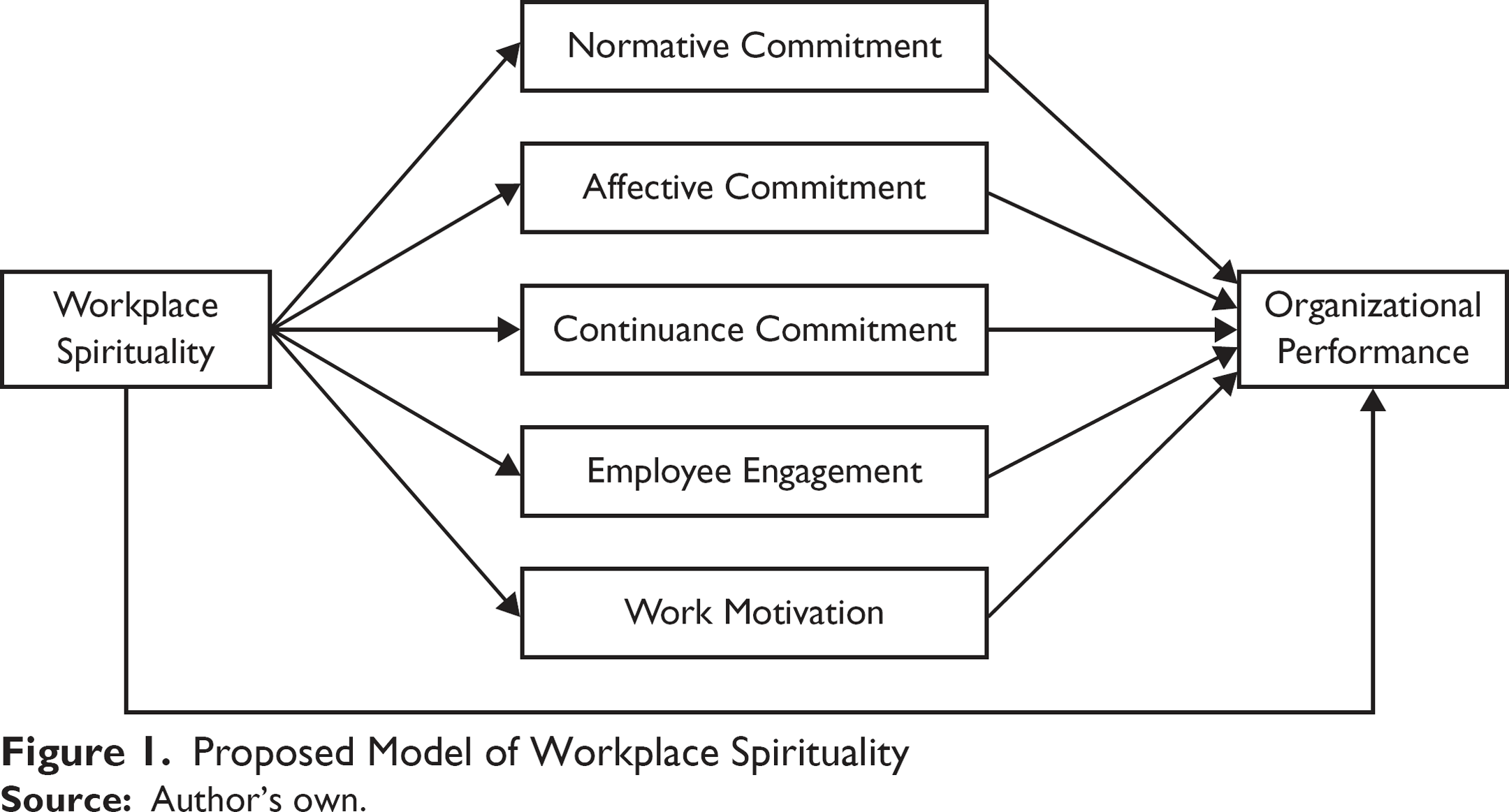
Research Framework
Research Setting
The research setting for the present study is manufacturing and service companies located in National Capital Region (NCR), India. The study is based upon an exploratory-cum-descriptive research design (Shamra, Karim, & Jain, 2015).
Participants and Procedure
A sample of 418 respondents was sampled with the help of random sampling. Probable respondents were surveyed with the help of online survey. The industries surveyed include banking, insurance, textile, BPO, KPO, petroleum, consultancy, cold drink, rice, shoe and broker situated in NCR. Of the 418 respondents, 240 were men and 178 were women. Mean age of the respondents was 41.8 years. The majority of participants (62%) were graduates and the rest were either diploma holders (27%) or postgraduates (11%).
Questionnaire
Workplace Spirituality
Workplace spirituality was accessed using scale developed by Pandey et al. (2009). This scale is based on four constructs of spirituality: swadharma (e.g., my job helps me to understand my life’s purpose, working here makes my life meaningful), authenticity (e.g., peoples’ actions here are aligned with their words, and people here own up to mistakes with others in the group), lokasangraha (e.g., people here perform their duties as if they contribute to the (community/society at large/humankind in general), sense of community (when stuck with a problem, people here feel free to ask for (advice from colleagues/advice from a superior/help from their colleagues/help from a superior). Karma capital (four statements) was added based on the work of Garg (2017). The present article included additional dimension of Indian spirituality, that is, kritagayata (three statements) (see Appendix for the complete scale). All questions were answered on a 5-point Likert scale, ranging from 1 (strongly disagree) to 5 (strongly agree). Mean value of independent variable was 3.21 and reliability (Cronbach’s alpha) is good (overall = 0.82, swadharma = 0.84, authenticity = 0.87, lokasangraha = 0.79, sense of community = 0.91, karma capital = 0.76 and kritagayata = 0.88).
Organizational Commitment
Organizational commitment was accessed with the help of questionnaire used by Rego and Souto (2004). The scale measured affective, normative and continuance facet of organizational commitment using 14 statements. Reliability of scale was acceptable (affective = 0.80, continuance = 0.071 and normative = 0.76). Statements such as “I feel like part of the family at my organization” (affective commitment); “If I got another offer for a better job elsewhere, I would not feel it was right to leave my organization” (normative commitment); “I believe that I have just a few options to consider leaving this organization” (continuance commitment) are used.
Employee Engagement
Employee engagement was explored with the help of scale used by Garg and Sharma (2015) that comprised of 72 statements. The main constructs of employee engagement were work environment (14 statements), relationship with immediate seniors and co-workers (14 statements), policies and work procedures of the company (6 statements), work-life balance (6 statements), compensation programme (4 statements), leadership and direction (11 statements), job security and career development (7 statements) and workplace well-being (10 statements). Mean value of the variable was 3.85 and reliability of the scale was 0.71. Statements included “I am able to maintain a balance between official and household responsibilities simultaneously,” “I enjoy company of my coworkers.” 5-point Likert scale ranging from 1 (strongly disagree) to 5 (strongly agree) was used.
Work Motivation
Work motivation was measured using 10-statements scale developed by Shouksmith (1989). Ten items were assessed on a 7-point scale (1 = strongly disagree, 7 = strongly agree), and included items such as “my job is secure?” and “job is exciting and challenging.” Reliability (alpha) for this scale in this sample was 0.94.
Organizational Performance
Organizational performance was accessed with the help of scale developed by Singh (2004). Items included “quality of products or services,” “development of new products or services.” Perceived organizational performance was accessed on a 5-point Likert scale, ranging from 1 (strongly disagree) to 5 (strongly agree).
Results
Table 1 gives the means, SDs and the correlations of all variables in the study. SEM was used to test the fit of the proposed model.
Mean, Standard Deviation and Correlation among Variables

Cronbach’s alpha is in parentheses, * p < 0.001, ** p < 0.05, *** p < 0.01.
Measurement Model
Workplace spirituality (latent variable) was modelled with swadharma, lokasangraha, sense of community, authenticity, karma capital and kritagayata as manifest variables. The latent organizational performance and work motivation were modelled with their respective subscales as a manifest variable. Employee engagement was modelled with work environment, leadership and direction, relationship with immediate seniors and co-workers, compensation programme, job security and career development, policies and work procedures of the company, work-life balance and workplace well-being. Error terms were suitably added with every variable of the study. Model fit was not good, chi-square value (df = 322, N = 432) = 684 p < 0.001, χ2/df = 2.12, RMR = 0.17, CFI = 0.84, RMSEA = 0.13. Model required improvement for good model fit. Loading of two manifest variables (relationship with immediate seniors and co-workers, and leadership and direction) was not significant and were removed from the model. Resultant model showed better model indices, but still some improvement were required. Next round of improvement in the model was done with the help of modification indices. Resultant model showed good model fit, chi-square value (df = 298, N = 432) = 402 p < 0.001, χ2/df = 1.34, RMR = 0.08, CFI = 0.97, RMSEA = 0.07 (see Figure 2).

Mediation Analysis (See Table 2)
Direct, Indirect and Total Effect of Workplace Spirituality on Organizational Performance

To investigate mediation effect of five variables (affective commitment, normative commitment, continuance commitment, work motivation and employee engagement), regression values of direct, indirect and total effects were calculated using improved model. Improvement in model was achieved after removing two variables (relationship with immediate seniors and co-workers, and leadership and direction) from the study. Baron and Kenny’s (1986) technique has been used to examine mediation. According to their technique, mediation exists if (a) independent variable (WS) relates to dependent variable (OP), (b) mediating variable relates to dependent variable, (c) independent variable relates to mediator, (d) relation between independent variable and dependent variable reduces (partial mediation) or remains no longer significant (full mediation) when mediator is controlled. Total effect refers to sum of direct effect and indirect effect (Baron & Kenny, 1986).
Workplace spirituality exerted significant direct effect on affective commitment (direct β = 0.36, p < 0.01), continuance commitment (direct β = 0.42, p < 0.01), employee engagement (direct β = 0.38, p < 0.01) and on work motivation (direct β = 0.49, p < 0.05). However, workplace spirituality reported no significant effect on normative commitment (direct β = 0.67, p < 0.15). Thus, hypothesized mediation effect of normative commitment in relationship of workplace spirituality and organizational commitment was ruled out (refer to the second condition of Baron and Kenny’s [1986] method). Further all hypothesized mediating variables exerted significant direct effect on dependent variable (organizational commitment). Direct relationships of affective commitment and organizational performance (direct β = 0.66, p < 0.05), of continuance commitment and organizational performance (direct β = 0.53, p < 0.05), of employee engagement and organizational performance (direct β = 0.61, p < 0.05) and of work motivation and organizational performance (direct β = 0.60, p < 0.01) were concluded significant. This satisfies the third condition of Baron and Kenny’s (1986) method.
Further, workplace spirituality did exert statistical significant indirect effect on organizational performance (indirect β = 0.52, p < 0.05) after being mediated by affective commitment (first condition satisfied). Now direct effect of workplace spirituality on organizational performance was found significant even when mediator (affective commitment) was controlled (direct β = 0.40, p < 0.05). Since value of regression coefficient reduces here, thus partial mediation is confirmed (refer to the fourth condition of Baron and Kenny’s [1986] method). Indirect effect explained 56.5 per cent of total effect of independent variable on dependent variable being mediated by affective commitment (total β = 0.92, p < 0.05). Workplace spirituality exerted significant direct (direct β = 0.42, p < 0.01) and indirect (indirect β = 0.44, p < 0.05) effect on continuance commitment. The calculated indirect effect resulted in 51.1 per cent of the total effect of spirituality on performance being mediated by continuance commitment (total β = 0.86, p < 0.05). Additionally, predictor variable exerted significant indirect effects on criteria variable (indirect β = 0.40 p < 0.01), resulting in 51.2 per cent of the total effect of workplace spirituality on organizational performance being mediated by employee engagement (total β = 0.78, p < 0.05). Identically, work motivation also reported partial mediation in relationship of workplace spirituality (indirect β = 0.49, p < 0.05 and total β = 0.89, p < 0.001). Indirect effect explained 55 per cent of the total effect of workplace spirituality on organizational performance being mediated by work motivation.
Discussion and Conclusion
A number of successful organizations have started to reap benefits of associating spirituality with workplace. Multinational organizations such as the World Bank (Laabs, 1995), AT&T, Hewlett–Packard, DuPont, Ford Motor company (Burack, 1999), Apple computers (Cavanagh, 1999) have institutionalized special programmes to add spiritual flavour to the overburdened and boring life of its employees. AT&T sends its middle managers to three-day spiritual-cum-self-development programmes. Trainee reported better self-understanding and renewed positive relationship with colleagues (Cavanagh, 1999). Hewlett–Packard implements workplace spirituality through a company philosophy that emphasizes the values of trust and mutual respect, which in turn are believed to contribute to cooperation and sharing a sense of purpose (Burack, 1999). World’s largest search engine Google has started Google’s school of personal growth. Microsoft has an online prayer service. Kris Kalra, CEO of BioGenex acknowledged that he relied on Shrimad Bhagvad Gita to steer his business out of trouble. Mediation classes have become a permanent feature of many organization’s daily routine, namely Apple, Google, Yahoo, IBM, etc.
Although workplace spirituality has been concluded to have strong influence over organizational performance, but researchers are not unanimous about exact mechanism through which impact of spirituality transcends to organizational performance. The present study makes a comprehensive effort by exploring as many as five different intervening variables for probable mediating effect. Mediator or intervening variable defines the path through which independent variable makes an impact on dependent variable. The present study is one of the pioneer studies that tried to explore intervening variable in the domain of workplace spirituality studies. The study is based on Indian conceptualization of workplace spirituality as the constructs of the studies are taken from Indian epics and from empirical studies conducted in Indian settings. This article has also enriched the literature by suggesting incorporation of one more indispensable and important construct of Indian spiritualism. The new construct, kritagayata, will help in better understanding of workplace spirituality in Indian settings. Results were consistent with initial proposition of the study. The article concludes that the two facets of organizational commitment (affective and normative), employee engagement and work motivation show partial mediation effect. As mentioned in the discussion section, only the relationship of continuance commitment presented a result different to what was hypothesized. In a nutshell, the results suggest that employees denote higher affective and normative commitment, engagement and work motivation, when their spiritual needs are satisfied at workplace, which leads to higher level of organizational performance.
The findings of the study have a number of practical implications. It is suggested that employer should try to institutionalize spiritual values and techniques in organizational vision, mission, and policies and practice, so that true potential of spiritualism could be accrued. However, spirituality should not be regarded as common and universal solution for all organizational challenges of employee commitment and engagement (Saks, 2009). Implementation of spirituality at workplace must not be used as a manipulative attempt to improve performance of the employees. Firms must endeavour to develop a holistic spiritual organizational climate so that true potential of workplace spirituality could be channelized in appropriate direction of organizational effectiveness (Garg, 2017).
Although this research provides an empirical model of workplace spirituality and organizational performance in the Indian context, the article has certain limitations too. Firstly, dependent (organizational performance), mediators (organizational commitment, employee engagement and work motivation) and independent variables (workplace spirituality) were collected from the same source and at the same time. This may lead to risk of common method error. Future study may resort to double source method or longitudinal approach to deal with common method error. Secondly, a larger sample size would have made the study more worthwhile. Thirdly, the mediators included in this study are also relatively highly correlated. This is to be expected given the nature of mediators, but such high correlation presents challenges for disentangling the unique contributions of each of these mediators in relationship between workplace spirituality and organizational performance; also multicollinearity between the predictor variables might affect the model fit (Grewal, Cote, & Baumgartner, 2004). And lastly, the present work used cross-sectional approach. No researcher can confidently claim causal relations based on cross-sectional studies. Thus, results of present studies could be confirmed through any longitudinal exploration. Future researchers may further explore workplace spirituality by conceptualizing and measuring workplace, using both qualitative and quantitative approach. Researchers could explore integration of apparently different topics such as spirituality and employee-level outcomes (attitude, organizational commitment, engagement, etc.), which has the potential to enrich our knowledge and understanding of both. Other variables such as trust, positive emotions, organizational role stress and perceived organizational support can be investigated for probable mediating effect. Further, other variables such as individual characteristics, gender, experiences and leader behaviours could also be explored for possible moderating effect. This re-synthesis could lead to new and exciting researches for the benefit individuals and organizations. Further, the methodology adapted in the study could be replicated in other cultures, but with different dimensions of spirituality.
Footnotes
Acknowledgements
The author is extremely grateful to Dr Ritu Tripathi (IIM-Banglore) for her useful suggestions to improve the quality of the article.