







Abstract
The purpose of this article was to investigate the impact of career-related support in work and non-work domains on the aspirations of women for progression in career. Using multistage sampling technique, the data were collected from 438 female employees working in private sector banks and insurance companies in Punjab, a state in north India. AMOS-based structural equation modelling was performed, and the results revealed that family/spousal support in non-work domain and supervisory and organisational support in work domain significantly predicted the career aspirations of working women, whereas the impact of collegial support was not observed. Supervisor support was found to be the most significant source of support followed by family/spousal support and then organisational support.
The present study is a pioneer work, which has empirically examined the role of various forms of contextual supports in work and non-work domains in determining the desired aspirations of working women in India. The study proposes that collective efforts on the part of women themselves, their families, supervisors, colleagues and organisations are required to enhance working women’s propensity to aspire and realise their aspirations for advancement in career.
Keywords
Introduction
Despite the improved sex ratio and increased educational opportunities, the participation of Indian women in the workforce has not only remained low, but it rather has been declining persistently over the years. With only 27 per cent female participation in the workforce against 96 per cent for males, India is among the countries that have an abysmally low female workforce participation rate recorded globally (SCOPE-ILO, 2018). The demographic characteristics, lower educational attainments, marriage, lack of employment opportunities and stable household income are some of the reasons cited in various national and international surveys for the skewed ratio of male to female participation in the Indian workforce (Das et al., 2015; Sorsa et al., 2015).
However, what complicates the situation is the fact that there exists a narrow pipeline for women’s career growth, which is evidenced by the presence of visibly smaller number of women in the leadership and managerial roles across Indian organisations. According to Catalyst (2018), women only hold 15 per cent of the board seats across 158 largest Indian companies. More recently, the concern has even shifted from dearth of women on upper echelons to the gradual decline of women from all levels in the organisation. According to the NDTV Business India Report (2014), out of 27 per cent of women entering the workforce, 14.91 per cent reach the middle level and only 9.3 per cent make it up to the top level. Nearly half of the women who enter the workforce quit their jobs before they even reach the middle level because of various work- and non-work-related issues (Catalyst, 2018). Admittedly, women’s persistence in the workforce is subject to a number of constraints, which impede their career growth to the extent that they prefer to opt out. One such constraint that the existing research has time and again emphasised is the lack of career-related support available to women at their home and workplace.
India being predominately a patriarchal society has, since ages, testified women’s subordination to men, dictated women’s social roles and acknowledged women’s primary role as homemakers (Batra & Reio, 2016). Women in India are so blatantly believed to be meant only for homemaking and taking care of their children and the elderly that their career-related aspirations are considered secondary, and their professional success is considered as a reflection of their familial and social relations (Powell & Mainiero, 1992). Family commitments and the pressure to balance work and family act as the biggest hindrances to the aspirations of working women to advance in their career (Desai, 1996; Rosser, 2004). Hence, unsurprisingly, it is considered socially acceptable and sometimes even expected of Indian women to quit their jobs for assuming domestic responsibilities full-time (Pande & Moore, 2015). As such, it becomes imperative that women juggling with the conflicting demands of multiple roles are extended support emanating from various social institutions, preferably family and workplace. In fact, women who succeeded in their career acknowledged the support received from their family, especially their spouses as the biggest motivational drive (Datta & Agarwal, 2017; Nath, 2000). However, the availability of social support to women is subject to several sociocultural dynamics that might impact the propensity of women to harness support in the non-work domain. The social norms governing gender roles, especially in developing countries like India, severely impact the thinking of women with regard to their work and workforce participation, bringing to light the lack of support available to working women. Nonetheless, the lack of support in the non-work domain is a dominant factor that leads to low career satisfaction and advancement for working women.
Across literature, organisation as a context has been observed as shaping the impetus for women-based access to career resources, development of expertise, proficiency, career development and predicting their career satisfaction (Lent & Brown, 2006; Sturges et al., 2002). There is sufficient theoretical evidence of the workplace support from organisation, colleagues and supervisor bearing a hard imprint on the shaping of the desired aspirations of women for advancement in career at the workplace (Eisenberger et al., 1986; O’Neil & Bilimoria, 2005). However, research in Indian context predominantly enlists the non-existence of the organisational support as a major barrier in the consistent realisation of career aspirations of working women.
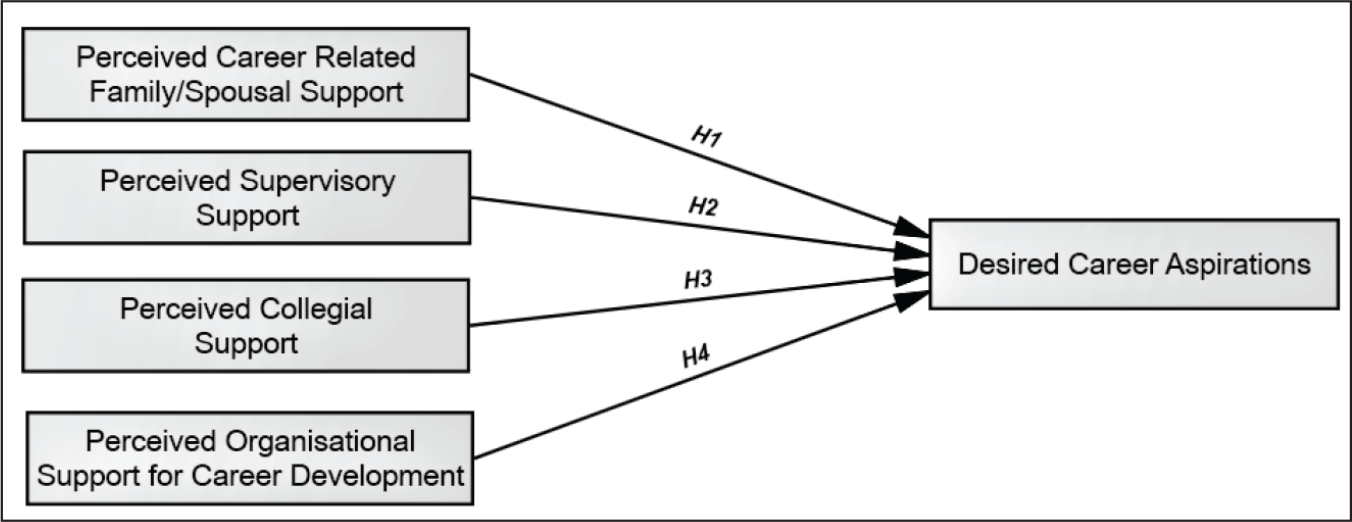
Research in the Indian context has focused on organisational, personal and social barriers, including gender stereotyping, gender discrimination at workplace, family responsibilities and work–family conflicts as limiting women’s career aspirations (Buddhapriya, 2009; Kaushik et al., 2014; Valk & Srinivasan, 2011). Also, though the existing research has documented individual-specific factors and contextual influences having a plausible impact on career development of women, the role of various contextual support elements as the determinants of career aspirations has received little attention in academic research, particularly in India. Moreover, the family/spousal support in the Indian context has mostly been investigated in terms of whether the family/husband helps in the domestic chores and allocation of domestic responsibilities with the balance tilted disproportionately on the women (Ramu, 1987). Only a few studies in India have touched the issue of career-related familial and spousal support available to women, that too, qualitatively (Chawla & Sharma, 2016). Hence, there is a need to examine what Indian women think about the adequacy of contextual support available to them in work and non-work domains and how their perceptions of availability or lack of support from different sources affect their aspirations of furthering their career. This points towards a huge gap in the related literature, which requires a closer look in the present scenario wherein Indian professional women are in a transitional phase of creating their own work identities. The study, therefore, proposes that women who perceive availability of adequate support from significant people around them at work and home would aspire to progress in career, whereas women who do not perceive career-related support are de-incentivised from aspiring to higher positions in the organisations (see Figure 1).
In the next section, the review of the relevant literature and the theoretical development of the hypotheses of the study are presented. Following this, the methodology used for data collection is outlined and the results are described. Finally, a discussion on the findings, practical implications, limitations of the study and conclusion are presented.
Theoretical Background and Hypotheses Development
Desired Career Aspirations
Career is thought of as an evolving sequence of professional roles that an individual assumes across time and service within an occupation (Arthur et al., 1989; Mavin, 2001). Aspirations represent future-oriented goals, which motivate an individual to invest resources in terms of time, effort and money to realise such goals (Sherwood, 1989). Concomitantly, the term ‘career aspirations’ is referred to as an individual’s strong desire for relatively higher accomplishments within a selected career field (Super, 1980). Haller and Miller (1971) perceived career aspirations as an individual’s internal dispositions in terms of attitude and intentions towards career, wherein attitude represents an individual’s desires to attain career-related goals, and intentions represent the aspirant’s behaviour towards realising those goals. The desired component of aspirations, therefore, signifies individual’s attitude towards progression in career, which is reflected in his/her longing for a higher position in the organisation. Tharenou and Tarry (1998) described desired career aspirations as a subjective measure of individual’s ambition to achieve a position of greater responsibility and influence at the workplace.
Several theories on women’s career development, evolving around psychological, social and behavioural investigations, emphasise separate set of factors explaining women’s vocational behaviour. While psychological theories emphasise the role of women’s internal dispositions in terms of their beliefs and attitudes influencing their career behaviour, the social and behavioural theories are based on the premise that the external contextual forces determine the course of women’s career development (Mavin, 2001; Osipow, 1973). Yet, from a social cognitive perspective, an individual’s career development is viewed as determined by the interplay of person-specific factors and environmental factors representing contextual supports and barriers (Lent et al., 1994). Though, a considerable amount of research has emphasised on women’s personal agency as determining career aspirations of women, few empirical studies have been carried out to investigate the impact of contextual support factors on career aspirations of women.
Contextual Support
In the context of social cognitive career theory (Lent et al., 1994), contextual support is referred to as the influences beyond an individual’s control, which reinforce or restrict the formation and pursuit of individual’s interest, career goals and actions to attain those goals. Nonetheless, working women’s sense of social learning cannot escape the clutches of the social construction and the social contexts that envelop the working and the life of the women in particular. The support contexts are interpreted as involving working women’s perception of the existence of support from significant individuals around her, that is, from the supervisor in terms of mentoring assistance, from co-workers in terms of networking as well as the vital emotional and incremental support from spouse and family. Walsh and Heppner (2006) found contextual support factors as not only affecting the formulation of their career goals but also the extent to which such goals are pursued and attained. Litzky and Greenhaus (2007) suggested that individual’s aspirations to a large extent depend upon the availability or lack of support at both work and non-work domains. The support system is believed to fulfil the conflicting demands of women’s multiple roles, thereby reducing work-life stress and work–family conflicts (Michel et al., 2010).
According to Brough and Pears (2004), the contextual support is bifurcated into work- and non-work-related support. Work related support stems from organisation, like formal organisational support mechanism for career development and support from supervisor and colleagues (Voydanoff, 2002). Since employees perceive supervisor’s attitude towards their well-being as an indicator of organisational support, supervisor’s support is also viewed as perceived organisational support (POS) (Eisenberger et al., 1986). Existing studies reveal that support in the work domain is positively associated with various work-related outcomes, like job satisfaction and occupational success (Allen et al., 2016; Friedman & Greenhaus, 2000). Support in the non-work domain represents instrumental and emotional support from family, spouse or partner at home, which helps an individual perform better in the work domain (Wayne et al., 2006). Further, support at home also enables an individual to devote more time in work-related activities (Friedman & Greenhaus, 2000). Silva et al. (2012) observed the tremendous impact of personal and non-personal support from spouse, parents, relations, friends and other social actors on the purpose and existence of women’s philosophy towards work, life, career and their family responsibilities. Considering the role of support in both the work- and non-work domains, the present study examines the impact of perceived family/spouse support from non-work domain and supervisor, colleagues and organisational support from work-domain in determining the desires of women to achieve higher positions in organisations.
Perceived Career-Related Family/Spousal Support
One of the vastly explored factors in women’s career development has been the support available from family in general, and the spouse in particular (Friedman & Greenhaus, 2000). There is a strong evidence that supportive family relationships positively impact women’s career and life choices across all phases of career (O’Neil & Bilimoria, 2005). Support from family, especially spouse, has been identified as a critical factor that has been observed to lead to women’s career satisfaction and career advancement, especially in the post-marriage and post-motherhood stages of women’s lives (Janning, 2006). However, in the Indian context, the diminishing or non-sustainable contextual support from husbands is observed as a key determinant of women’s exit behaviour.
According to Heikkinen et al. (2014), while the personal support from family/husband represents a personal dimension in terms of hands-on assistance in home chores and child rearing, the professional support characterises instrumental support to women in making their career choices, assisting in their work-related issues, providing them resources valuable in work context and psychologically supporting them by believing in their career ambitions and understanding their work dilemmas and challenges. Grether and Wiesse (2016) found both the personal and professional support available from family/husband as equally impacting women’s personal as well as professional lives.
Thus, the career-related contextual support in the non-work domain is related to understanding the work-related issues of women, indicating that the partner and/or significant other are/is supportive of women’s career-related decisions, and thus they willingly extend them emotional and instrumental support in the form of career-related assistance, applauds and affirmations (Ezzedeen & Ritchey, 2008; Friedman & Greenhaus, 2000). Thus, the spouse/family being more considerate about problems and appreciative of the accomplishments create a sense of being understood in a broader life context. According to Litzky and Greenhaus (2007), supportive family and spouse in the non-work domain feed their aspirations to advance to higher positions. Chawla and Sharma (2016) also empirically established that support extended by the family and spouse strengthens women’s psychological well-being. It is observed across past research that women who perceive support from their spouse are more engaged in their career and are more enthusiastic about their development in the work domain (Parasuraman et al., 1996; Wayne et al., 2006).
The career-related emotional support helps create space for aspiring women to work without being questioned for not addressing the demands of home and family (Ezzedeen & Ritchey, 2008) and strengthening their career identity (Datta & Agarwal, 2017), whereas lack of support, especially from spouse, hinders the career development of women (Ahmed & Carrim, 2016; Gershuny et al., 2005). Buddhapriya (2009) also stated that inadequate support at home make women vulnerable to stress and burnout due to role overload eventually affecting their career ambitions. As is discussed earlier, the support from family, especially spouse, is highly critical in determining the career aspirations of women, and so it is important to investigate whether this relationship holds true or not for Indian working women. Thus, the hypothesis is
Perceived Supervisor Support
Rhoades and Eisenberger (2002) described perceived supervisor support as employees’ perception that supervisor is empathetic towards their personal and work-related needs and well-being. Supervisory support can be in the form of concern, trust (emotional support), information exchange and career guidance (informational support), exchange of resources and providing challenging tasks at work (instrumental support), constructive performance feedback and acknowledging skill (appraisal support) and sponsorships, which enhances employees’ capabilities and henceforth facilitates their career progression and professional satisfaction (Greenhaus et al., 1990; Salas-Lopes et al., 2011; Van der Heijden et al., 2010; Wickramasinghe & Jayaweera, 2010).
Contextual support in the form of direct support from the supervisor at workplace is of paramount importance to an employee’s career aspirations and career development, especially women employees (O’Neil & Bilimoria, 2005; Pyke, 2013; Wickramasinghe & Jayaweera, 2010). Datta and Agarwal (2017) revealed the salient role of support from the immediate supervisor on the career aspirations and success of working women in India. Supervisors as mentors share job-related information, provide challenging opportunities and guidance through their expertise, which help women aspiring to higher positions in the organisation fulfil their aspirations (Litzky & Greenhaus, 2007; Salas-Lopez et al., 2011; Wentling, 1996). Evidence exists that the supportive relationship with the supervisor develops faith and feeling of satisfaction, reduces workplace conflicts and stress, and promotes well-being (Caesens et al., 2019; Friedman & Greenhaus, 2000). The earlier discussion highlights the importance of supervisory support in determining the career aspirations of women, which is used as a ground to set the following hypothesis.
Perceived Collegial Support
Co-worker support has been referred to as perception of employees about the concern and work-related assistance available from colleagues at the workplace (Ladd & Henry, 2000; Susskind et al., 2003). The existing studies on women’s careers have attested the substantial role of strong professional integration with colleagues at the workplace in shaping women’s career aspirations (Pyke, 2013), their career development and career success (Datta & Agarwal, 2017; Harris et al., 2009). Close colleagues provide informational support in the form of sharing work-related information (Zhou & George, 2001), constructive feedback and instrumental support in the form of helping and suggesting solutions to the work-related problems, which is crucial for the development of women’s career (Van der Heijden et al., 2010). Existing research indicates that in general, employees who perceive high co-worker support are more attentive at work (Shanock & Eisenberger, 2006), report enhanced well-being (Bergbom & Kinnunen, 2014), increased job satisfaction and less employee turnover (Morrison, 2004).
While ample evidence exists that cordial social integrations at workplace leads to several positive career outcomes such as salary and career satisfaction (Wolff & Moser, 2009), hierarchical promotions (Michael & Yukl, 1993) and career success (Forret & Dougherty, 2004; Nierenberg, 2002), some researchers have also suggested that women are at a disadvantage so far as leveraging the social connections for advancement is concerned (Bierema, 2005; Burt, 1997). Forret and Dougherty (2004) suggested that the stereotyping threats and gender bias at workplace limit the propensity of the women to network effectively with colleagues that ultimately leads to unsatisfactory experiences across working women in the context of realisation of their career aspirations. Schein (2007) also reported the biased attitude and behaviour of male colleagues being the biggest hindrance in women’s upward mobility in the organisation. The literature reviewed earlier discloses that the access to collegial support is determined by the nature and depth of relationship women develop with their colleagues, which further helps them in the formulation of their aspirations for progression in career. Thus, the following hypothesis is set to test the given relationship in the Indian context.
Perceived Organisational Support
According to Eisenberg et al. (1986), organisational support has its roots in employee’s perceptions that the organisations value their contribution and care about their well-being. Across the existing studies, organisational support has been emphasised in nurturing, harnessing, developing and sustaining the organisational human capital, their career aspirations, as well as the enactment and realisation of employee’s career goals (Allen et al., 2016). The support from an organisation is widely believed to be vital in shaping the environment in which an individual’s dreams and aspirations are put to test (Blake-Beard, 2015).
Since women experience lack of mentorship at the workplace and are excluded from the informal social networks (Davies-Netzley, 1998), they have to rely on the formal organisational encouragement in the form of training and development opportunities to help them progress in career (Lyness & Thompson, 2000; Tharenou, 2001). Nonetheless, women receiving development opportunities and career encouragement tend to be motivated for vertical career progression (Hoobler et al., 2011). On the other hand, women perceiving biasness in organisational policies are less satisfied in their jobs and hence are less engaged in their career (Burke et al., 2008). Ismail et al. (2014) observed that individual’s perceptions of career development support available at workplace impact the effectiveness of development programme as favourable perception influence their participation in such programmes and ultimately their career-related satisfaction. Thus, the extent to which individuals observe that the organisational development activities can enhance their career progression will influence their participation in such activities and ultimately impact their career-related satisfaction. Yet, the literature in the Indian context is predominantly silent about the role of organisational support towards the consistent realisation of career aspirations for women.
Jung and Takeuchi (2017) viewed that in recent decades, though the responsibility of career management has shifted to the individual, the role of organisations is important in supporting them to realise their aspirations. As it has already been reported that in India, participation of women in the workforce is very less as compared to men, and thus workplaces are primarily male dominated. Further, career development opportunities and programmes of organisations are not designed specifically from women’s perspective. Women, therefore, might have differing perceptions about these programmes in terms of their usefulness for them and thus might affect their career aspirations.
Research Methodology
Sample and Sampling Procedure
The remarkable growth of banking and insurance companies in India has created a wide array of opportunities for women. In the banking sector, women constitute 27 per cent of the total workforce of scheduled commercial banks, representing 26.5 per cent at the entry level, 10.87 per cent belonging to the officers’ cadre and 2.6 per cent belonging to the executive cadre (Khandelwal, 2010). The maximum growth has been recorded in private sector banks, wherein the proportion of women officers has increased substantially from 6.2 per cent in 1996 to 21.21 per cent in 2018 (Bezbaruah, 2016; RBI, 2017). In the insurance sector also, women represent 27.5 per cent of the total life insurance agency workforce, of which 52.8 per cent represent the private insurance agency workforce (IRDAI Annual Report, 2018–2019). There has been an increase of 11 per cent in women agents in private life insurance in 2019 as against the previous year.
However, despite the remarkable contribution of the financial sector in gender diversity, there is evidence of concurrent existence of shrinking pipeline of women’s career growth in the financial sector, indicating a smaller number of women reaching up to the top positions that necessitates the need to study aspirations of women working in the financial sector for their advancement in career. Second, the existing research also suggests that women’s vocational behaviour is different in traditional and non-traditional career trajectories (Chatterjee & McCarrey, 1989). Since the financial sector in India is still considered as male bastion, the sector provides a sound background to study the career aspirations of working women for their advancement in career
Multistage Systematic Sampling technique was employed to select the sample. At the primary stage, top 10 private sector banks were selected on the basis of India’s top banks’ ranking (Dun & Bradstreet, 2016), and top 10 private insurance companies were selected on the basis of Insurance Regulatory Development Authority (IRDA’s) 2015 ranking of insurance companies (IRDAI Annual Report, 2015–2016). Further, top five branches (in terms of maximum number of women employed therein) of each of the selected banks were chosen from four major cities (Amritsar, Jalandhar, Ludhiana and Patiala), which had the maximum number of functioning offices of scheduled commercial banks as of 31 March 2017 (RBI, 2017). In case the number of branches of any of the selected banks was less than five, all branches of the bank were included in the sample. Similar criterion was followed for selecting top five branches of each of the private insurance companies in the selected four cities of Punjab. Since all the private insurance companies had less than five branches in each of the four cities, all branches were included in the sample. Another filter used for selection of sample was that the respondents needed to have at least 3 years of work experience, which was based on the assumption that it might be difficult for new entrants/less experienced women employees to reflect upon their aspirations for achieving higher level positions. The questionnaire designed for the purpose of the study was distributed personally to collect the information from the respondents.
The final sample consisted of 438 female employees with ages ranging from 26 to 42 years (mean age 32.9 years; SD = 3.689), 64.6 per cent of them were married and 82 per cent resided in urban and semi-urban areas. As far as qualification of respondents was concerned, 51.6 per cent were postgraduates, 44.3 per cent graduates and 4.1 per cent had a professional degree. Work experience of the respondents ranged between 3
Measures
Standardised and pre-validated scales were used to measure the variables of interest. All scales were measured on a 7-point Likert scale, ranging from 1 (strongly disagree) to 7 (strongly agree).
Desired Career Aspirations
The adapted version (Litzky & Greenhaus, 2007) of the desired career aspiration scale originally developed by Tharenou and Terry (1998) was used to measure participants’ aspirations for progression within their chosen career. The sample items included ‘I would like to move into a high position within the organisation’, and the Cronbach’s alpha for the scale was 0.93.
Perceived Career Related Family/Spousal Support
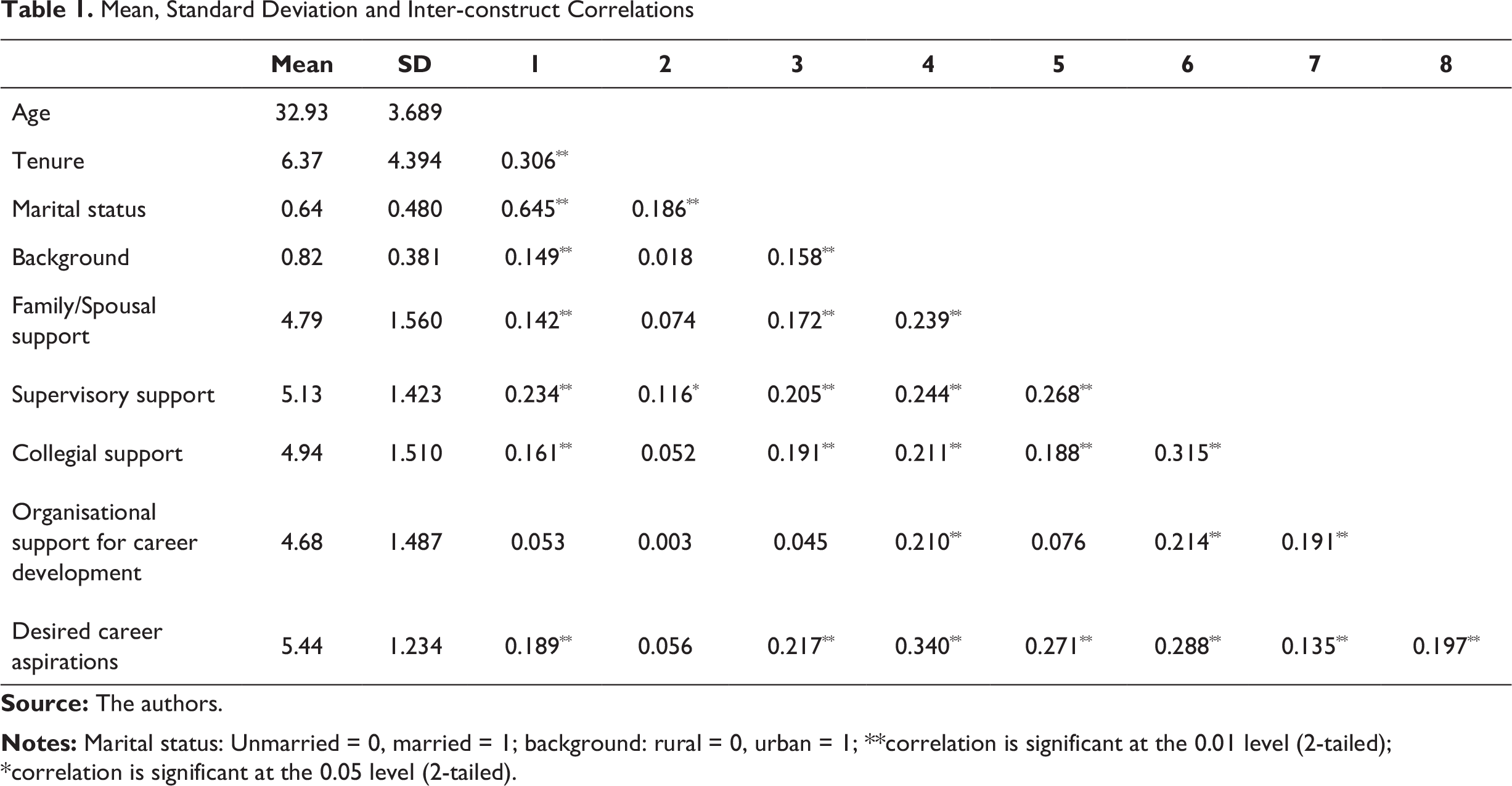
Mean, Standard Deviation and Inter-construct Correlations
Perceived Supervisory Support
Supervisory support scale (Greenhaus et al., 1990) was used to measure the participants’ perception of the support available from her supervisor. The sample item included ‘My supervisor keeps me informed about different career opportunities for me in the organisation’, and the Cronbach alpha for the scale was 0.92.
Perceived Collegial Support
The adapted version of the co-worker support scale (Ma, 2010), originally developed by Ladd and Henry (2000), was used for assessing respondent’s perception about co-worker support available at the workplace. The sample item included ‘My co-workers are willing to assist me to perform better’, and Cronbach alpha for the scale was 0.90.
Perceived Organisational Support for Career Development
POS scale, designed by Kraimer et al. (2011), was used to assess women’s perceptions of organisational support available for the development of their career. The sample item included ‘My organisation has programmes and policies that help employees to reach higher managerial levels’, and Cronbach alpha for the scale was 0.88.
Control Variables
Age, tenure, residential background and marital status of the respondents were statistically controlled. While age and tenure (work experience in years) represented continuous variables, residential background and marital status were measured as categorical variables and hence were coded as: marital status (unmarried = 0; married = 1) and residential background (rural = 0; urban = 1).
Analysis
Descriptive Statistics and Correlations
Table 1 summarises mean, standard deviation and inter-correlations among the observed variables. Results indicate the presence of significant correlations among most of the variables. Age (r =
Testing Common Method Bias
To empirically ensure that the research outcomes are not contaminated by the method biases, Harman’s single factor test (Harman, 1967) was employed, which involved conducting factor analysis on all measured variables in SPSS (Chang et al., 2010). The analysis was constrained to obtain single factor without factor rotation. Results of the test indicated that the single common factor explained only 27.44 per cent of the variance, which did not cross the suggested benchmark of 50 per cent (Podsakoff et al., 2012). Hence, the single factor did not account for the substantial amount of variance, thus an evidence that method bias was not the concern in responses and the subsequent results.
Model Testing
A two-step approach, as suggested by Anderson and Gerbing (1988), was adopted to test the hypothetical model, wherein the measurement model was first tested for model fit and construct validity before testing the structural relationships between the dependent and independent variables in structural equation modelling. Thus, a measurement model of all the variables was constructed, wherein all the latent constructs were allowed to covary, and then confirmatory factor analysis was executed. Model fit of the measurement model was evaluated on the basis of recommended parameters of practical fit indices like comparative fit index (Bentler & Bonett, 1980) and incremental fit index (Bentler & Bonett, 1980) values more than 0.90, and root mean square error of approximation (Steiger, 1990) less than 0.08 was considered good fit. The results (χ2 = 765.54; df = 584; p < 0.01) GFI: 0.910; AGFI: 0.898; NFI: 0.927, CFI: 0.982, IFI: 0.982; TLI: 0.980; RMSEA: 0.027; CMIN/df 1.311) indicated that the model appropriately fit the data.
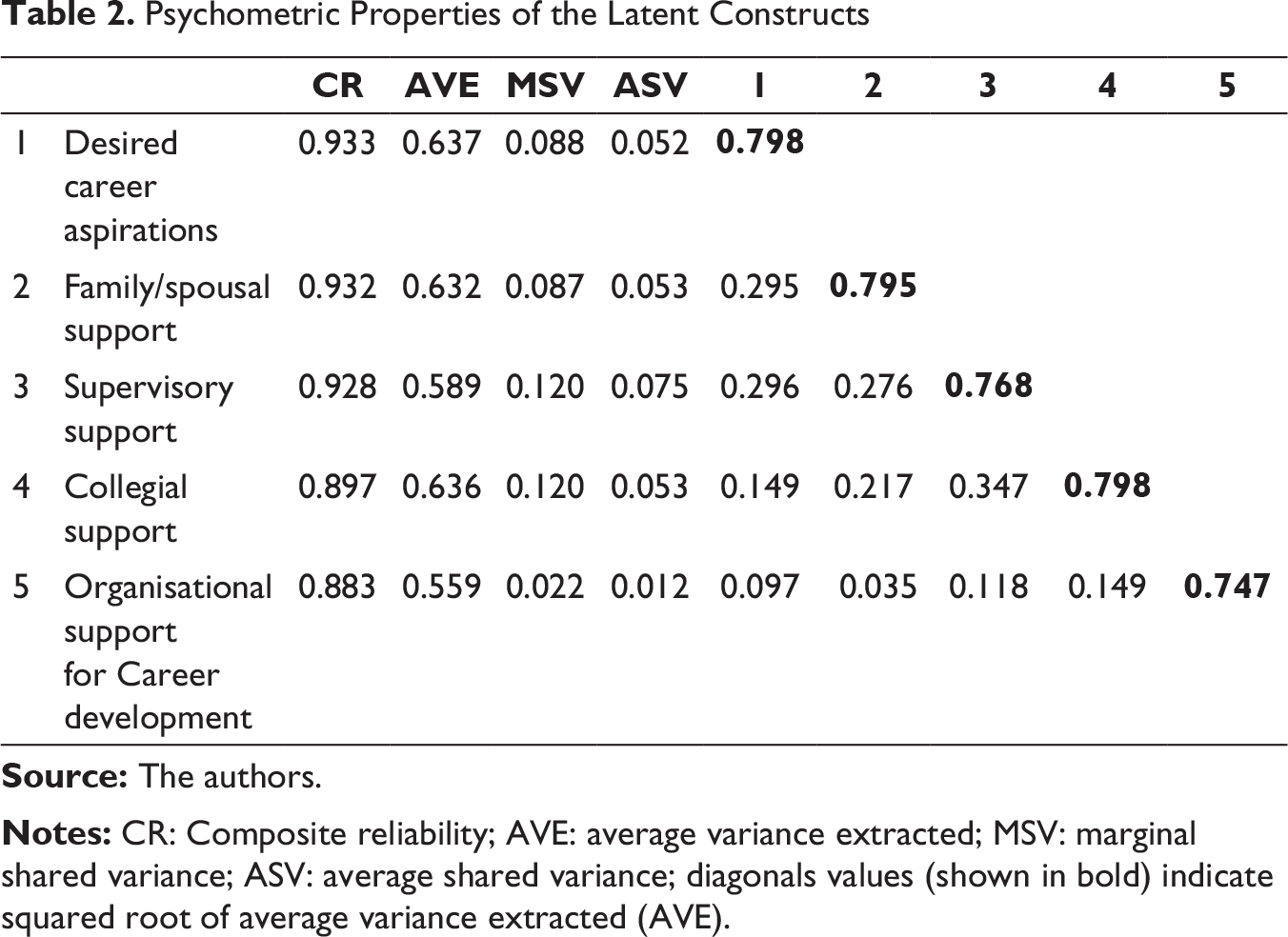
Convergent validity as a measure of convergence of the measuring items (indicators) to form the assumed theoretical constructs was assessed from average variance extracted (AVE) and composite reliability (CR). All factor loadings found to be significant and more than 0.7, composite reliability of all latent constructs more than 0.8 and AVE more than 0.5 indicated satisfactory convergent reliability (Fornell & Larcker, 1981). Further, discriminant validity as a measure of distinctiveness of the theoretically distinct constructs was evaluated by comparing the square root of the AVE with the correlations of each observed construct as recommended by Hair et al. (2014). As shown in Table 2, the square root of AVE (diagonal values presented in bold) is more than the squared correlation between the constructs, thus indicating discriminant validity. Cronbach alpha as a measure of internal consistency for all measures was found to be between 0.88 and 0.93, indicating that the measures were internally coherent.
Structural Equation Modelling
The validated measurement model was further transitioned to structural model to test the postulated hypothesis. AMOS-based structural equation modelling was performed with maximum likelihood approach. The results presented in Table 3 revealed the incidence of significant path diagram fit across the selected variables. The structural model fit indices adequately corresponded to the recommended parameters, suggesting an acceptable fit of data (χ2 = 765.54; df = 584; p < 0.01) GFI: 0.910; AGFI: 0.898; NFI: 0.927, CFI: 0.982, IFI: 0.982; TLI: 0.980; RMSEA: 0.027; CMIN/df 1.311).
Psychometric Properties of the Latent Constructs
Results of Structural Equation Modelling
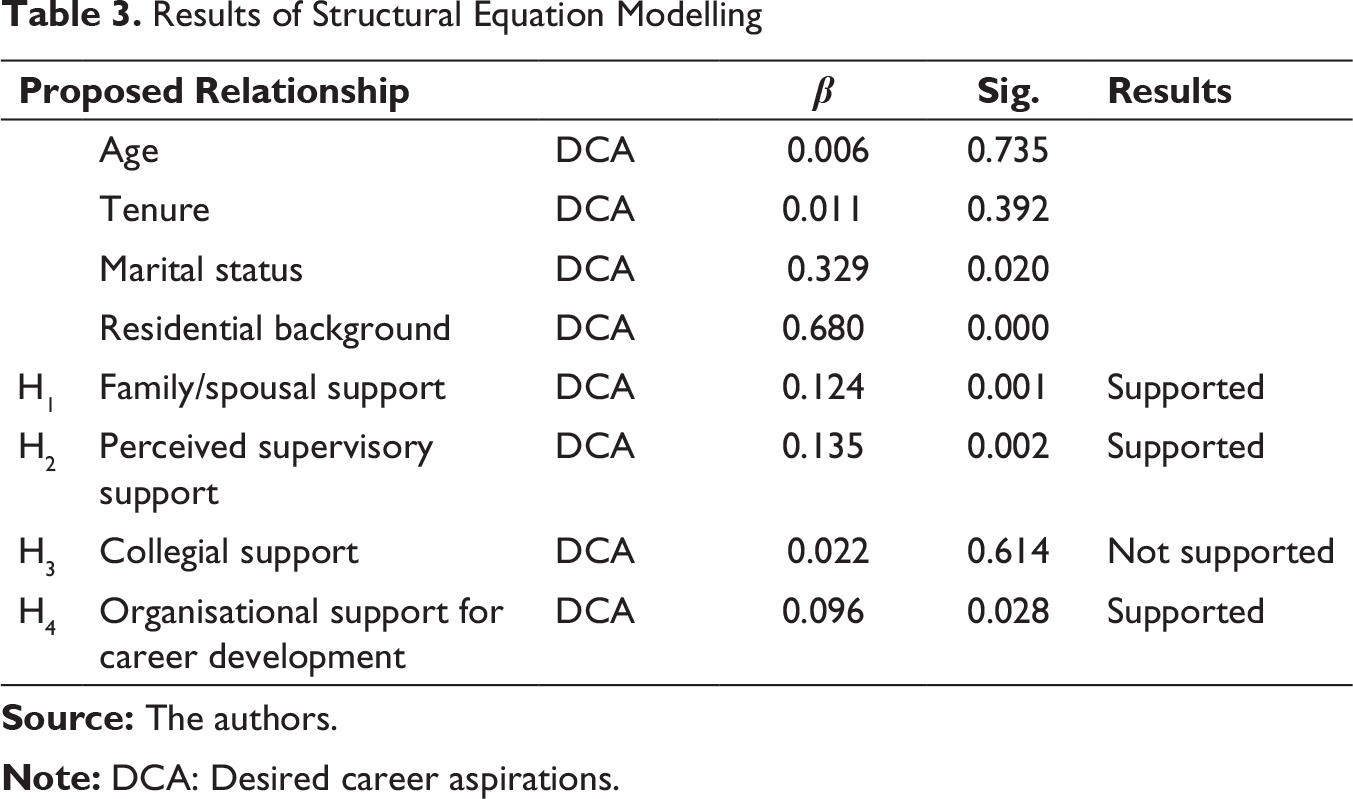
Hypothesis H1 that predicted positive impact of family/spousal support on women’s desired career aspirations was supported (β = 0.177, p < 0.001). The positive beta coefficient suggested that women who perceive greater family/spousal support at non-work domain tend to have higher aspirations for career progression. H2 that theorised positive relationship between perceived supervisory support and desired career aspirations was also supported (β = 0.176, p < 0.001), suggesting that perceptions of availability of informational and emotional support from supervisors determine women’s aspirations to achieve higher positions in the organisation. The co-worker support was, however, not found to significantly influence the desired career aspirations of women (β = 0.009, p > 0.05), thus H3 was not supported. Finally, H4 that assumed positive relationship of POS for career development was supported empirically (β = 0.096, p < 0.05), endorsing that working women have higher aspirations if they perceive that organisational programmes and policies are supportive of their career advancement.
Discussion
Results of the current study confirmed that the perception of Indian women’s familial/spousal support positively impacts their aspirations to advance to higher positions in an organisation. These findings suggest that career-related support in the non-work domain serves as a motivational nudge as women perceive they are able to discuss their work-related problems with their family or husband. A possible explanation could be the fact that when women believe that their family/spouse take time to listen to their work-related issues and suggest them a solution, they would feel that the family/spouse understand the value of work in their life and are concerned about their career growth. Moreover, support from family/spouse is crucial as women feel emotionally bolstered by the family/spouse’s interest and concern for their career goals. Another possible explanation could be that since women are generally not a part of the male networks at the workplace, discussing work-related issues with the husband or a male member of the family provide them with a trusted male perspective. Such advice or solution offered to them gives them the confidence to deal with the challenges at work, which, in turn, motivates them to pursue their career goals with more zeal. Similar findings were reported by Chawla and Sharma (2016), Ahmed and Carrim (2016), Silva et al. (2012) and Gordon and Whelan-Berry (2004), who also found that women who received encouragement from the family and spouse were more likely to experience a progressive career.
Further, women respondents in the present study reported that they leveraged moderate level (mean = 4.97 on a 7-point Likert scale) of career-related support from their family or spouse. The results coincide with the findings of Valk and Srinivasan (2011), Schomer (2010) and Bezbaruah (2016) that urban middle-class families aspiring to a higher standard of living support their daughters and daughters-in-law(s) in domestic and child-rearing responsibilities, giving them more time to concentrate on their career. The findings are, however, contrary to the existing research in the Indian context, emphasising the lack of spousal/family support available to working women (Rajadhyaksha & Smita, 2004; Ramu, 1987). The difference in the findings is due to the fact that most of the related research in the Indian context has focused only on studying the spouse’s hands-on assistance in performing domestic chores and childcare, which normally Indian husbands are not known to perform due to their ‘traditional roles’ ideology, resulting in women perceiving a lack of support. However, these studies did not take into account husbands supporting their wives by advising and guiding their actions in response to work-related problems. In the present study, this aspect of spousal support was also taken into consideration and was deemed instrumental, as it led to a considerable difference in the results. The finding also indicates a change in the mindset of Indian men regarding the employment of women and support they (women) need to build their careers. It also reflects upon the change in the mindset of women to advance in career rather than restricting themselves throughout life to the job they joined to begin with.
The finding regarding perceived supervisory support positively affecting career aspirations of women suggests that the constructive feedback, timely help and advice from the supervisor encourage women employees to engage in capacity development activities to enhance their career progression, whereas lack of supervisory support negatively impacts the same. Further, most participants agreed that working on difficult or complicated assignments, as assigned by their supervisors, helped them in developing new skills and capabilities for career advancement. This results in a raised level of confidence among women in handling difficult projects, which makes them feel that they are prepared to assume higher positions. Moreover, being a part of important assignments raises their visibility in the organisation, thereby enhancing their chances of being considered for promotions. Similar findings were reported by Datta and Agarwal (2017), Ismail and Ibrahim (2008), Litzky and Greenhaus (2007), Tharenou (2001), Tharenou and Conroy (1994) and Wentling (1996), who also established that encouragement from supervisors is critical for women’s career growth.
Contrary to the findings of Pyke (2013), Fritz and van Knippenberg (2017) and Turkmen (2018), support from colleagues was not found to significantly influence women’s aspirations for career progression. Though the women respondents reported a moderate level (mean = 4.94, SD = 1.51) of collegial support available to them, it has not emerged as a significant factor in predicting their career aspirations. It seems that support offered to women employees by their colleagues is customary and just has a cosmetic value. Due to professional jealousies and gender biases in a male-dominated workplace, it appears that, in actuality, the colleagues hold information and instrumental support, which can be critical for the career growth of a woman but pretend to offer significant instrumental support necessary for their career growth. Similarly, emotional support being offered by the colleagues also appears to be fake, having no influence on desired career aspirations.
The finding that organisational support significantly affects women employees’ aspirations for career advancement advocates that opportunities that are offered to learn skills, and career management policies and programmes that are organised/sponsored by the organisations, are perceived by women as relevant and effective element for building their careers. It suggests that if organisations have effective career management policies in place and women are provided opportunities to attend training and development programmes relevant to their career growth, they will be encouraged to participate in these programmes as well as pursue their career further. This would also inspire them to garner additional support if required and work hard to achieve their desired goal. Also, the availability of career development opportunities in organisations builds women’ faith in their own potential, thereby motivating them to aspire for the upper echelons in the organisation (Burke et al., 2008; Hoobler et al., 2011).
Practical Implications
In most part of the literature concerning women’s career development, the lagging career progression of women has been ascribed to several women-specific factors such as women getting off the ramp due to their overt prioritisation on family, low levels of confidence or failure to attain work–life balance. However, the impact of social support challenges that women have to slog through have been by and large ignored. In this context, the current study suggests interventions not only required on the part of women as individuals but also on the part of the family, organisations and the government to provide conducive environment that would foster women to aspire and achieve high in career.
If we look at the demographic variables, age and tenure were found to have no influence on the career aspirations of women. The β value (0.68) of residential background reveals that the desired career aspirations of women living in urban area are significantly different from women living in rural areas. It implies that women in urban areas are at an advantage as compared to women residing in rural areas in terms of favourable change in the attitude of men and women and urban society at large about career of women and better infrastructural support. The negative β value (−0.329) discloses that desired career aspirations of married women are lower than unmarried women, which highlights that marriage is a limiting factor for women in India as far as their career is concerned. Marriage has a multilevel effect as it restricts the entry of women in the workforce, making many women leave their jobs, and those who continue after marriage stick to their existing jobs with low or no aspirations to grow further. These two observations suggest that the Indian society needs to bridge the gap between urban and rural societies and also need to educate the citizens for a change in their attitude towards marriage and should redefine their roles so that an increasing number of women, if they wish, could pursue their careers.
The finding that women perceiving higher family/spousal, supervisor and organisational support have higher aspirations to grow in their careers has implications for the society, government, organisations, families, individuals and researchers. Supervisor support has been perceived to be the most significant support (β = 0.135), which suggests that organisations should appoint and/or train supervisors who understand both men and women in terms of their competencies as well as contextual factors and should support women in an unbiased manner for their career growth. The supervisors, therefore, should be trained to provide professional advice, constructive feedback and mentoring. The second important source of support has been observed to be family and spouse (β = 0.124), which indicates the need for an accelerated and sustainable change in the attitude of the society, families and spouses towards the career of women to further encourage and facilitate them to grow to the level of their potential. The third biggest source of support has been found to be organisational support (β = 0.096), which highlight the need to strengthen the organisation-sponsored support in the form of effective career development programmes to develop functional and managerial skills and opportunities to grow in their careers. Career counselling for women employees can be initiated to make them aware of the career opportunities available within and outside the organisation. Organisations should adopt policies that enable women to balance their work and families. The collegial support has not been found to influence the career aspirations of women that hints at the need for objective, transparent and merit-based human resource management practices to be followed by the organisations to provide a level playing field for each and every employee and thus averting professional jealousies and gender biases. The organisations should encourage women to build long-term healthy relationships with peers that add value to their professional life. Women should be taught the importance of seeking help and advice when in need and to help others too. The organisations can devise formal programmes, requiring women to be a part of group projects, so that they create their social networks. Networking to ensure professional or social interactions at the workplace can help women relieve the psychological job stress and assist them in getting access to valuable information relating to career opportunities and organisational resources. Though the supportive relationships with colleagues provide emotional assistance to women employees, the career-related assistance from male colleagues should be encouraged to assist them move up the organisational hierarchy. The organisation therefore should encourage the employees, especially male employees, to extend support to women colleagues to help them advance in their career. Last but not the least, the government should provide career counselling and recruitment services exclusively for women and should also make provisions for terms and conditions of employment, which facilitate women in balancing their family and workplace responsibilities.
Limitations and Scope for Future Research
The study, however, suffers from certain limitations. First, the respondents of the study are selected from private sector banks and insurance companies from Punjab only. A more diverse sample is therefore recommended to upraise the generalisability of the results. Second, the present research used a cross-sectional survey design, which measured the phenomenon as and when it occurred. A longitudinal research design is therefore recommended in the future to assess the temporal impact of the contextual influences on career aspirations of working women. Most importantly, the current study researched women’s aspirations as an end in itself; future research can investigate the role of contextual support in enabling career-aspirant women to enact upon their aspirations. This would help in elaborating the relative effectiveness of various contextual influences in transforming women’s desire for progression in career through realising their aspirations.
Conclusions
The paucity of women at top ranks of management in Indian organisations has always remained a matter of intense debate. Studies seeking to identify the reasons for the same have primarily focused on factors such as lower level of participation of women in the workforce at the entry level, higher level of women turnover after marriage and attaining motherhood, structural constraints to women’s career growth, gender biases at the workplace and, lately, lack of career aspirations among women. Most of the literature produced, which has focused on factors responsible for lower participation of women in the workforce, are opinion and conjecture based, and very less empirical research covering diverse issues associated with aspirations of women in India has been carried out. The present study contributes to the existing literature by empirically examining the role of various contextual supports in work and non-work domains, that is, family and spouse, supervisor, colleagues and organisational support.
Amidst increased urbanisation and economic pressure on Indian families in the ever-increasing inflationary economy requiring both men and women to work, the attitude of Indian families has changed towards the idealised role of women, particularly in the urban setting. Most of the Indian families have started accepting women working outside and either wilfully or by necessity preparing themselves to extend their support to the working women. The findings are particularly relevant in the Indian context where hiring domestic help in Indian families is a usual phenomenon and parents, and in-laws still manage to stay with the working couples to take care of the grandchildren (Buddhapriya, 2009; Valk & Srinivasan, 2011). Hence, instead of seeking support in childcare and domestic chores, contemporary working women expect their family/spouse to extend career-related support by discussing and understanding their work-related complexities.
At the same time, women cannot be expected to aspire for progression in their career until they are not supported at the organisational level too. The study suggests that formal organisational support in the form of sponsored programmes and direct support from the supervisor are more important than the co-workers’ support in enabling women to aspire for progression in career. Thus, formal policies and programmes are essential to make them realise their potential to pursue their professional dreams.
In retrospect, the research outcomes pose crucial implications for organisations, families, spouses and society around which women’s career is shaped and developed. The findings strongly assert that even though contemporary women are cognitively strong, the role of contextual influences cannot be overlooked in determining their career aspirations. Admittedly, the collective efforts on interpersonal and organisational front are required to move the dial by providing a conducive environment, wherein women could visualise a better future in their career.
