







Abstract
Drawing on the experience of four South Asian economies (Bangladesh, India, Pakistan, Sri Lanka), this article argues that properly designed labour market institutions and regulations play a pivotal role in engendering desirable economic and social dividends. The alternative is a Hobbesian world of an unregulated labour market, which is likely to produce poor wages and working conditions. Policymakers in the region should acknowledge common challenges pertaining to low utilisation of the skills and talents of young people, entrenched gender disparities, high, and in many cases rising, informality, significant incidence of working poverty and vulnerability. They should focus on designing complementary interventions to tackle such shared challenges rather than being fixated on the narrowly conceived notion of deregulating labour markets.
Keywords
Introduction
The notion that labour markets should be free of regulatory restraints is shaped by the intellectual ethos of a perfectly competitive labour market. A crucial assumption of this framework is that both employers and workers enjoy equal bargaining power. As a result, a great deal of self-selection will take place: workers will abandon poor wages and working conditions and seek better alternatives. Thus, in a perfectly competitive market ‘good’ employers will drive out ‘bad’ employers. A happy equilibrium will prevail in which both employers and workers engender and sustain mutually beneficial outcomes.
In real life a perfectly competitive labour market is unlikely to prevail. Monopoly imperfections in the product market and monopsony power exercised by enterprises can easily render the optimism of a happy equilibrium obsolete. Yet, this well-known concern has not deterred influential international organisations in the past to discourage the use of labour regulations in developing countries. A good example is the World Bank (1990). In a landmark publication (World Bank, 1990, p. 63), it noted that regulations ‘…intended to raise welfare and reduce exploitation…reduce labour demand…and labour incomes…’. Over time, this ‘let markets rule’ view has given way to a more nuanced position. Thus, in a subsequent publication, the World Bank (1995, p. 86) noted that the ‘…denial of workers’ rights is not necessary to achieve growth of incomes’. By 2013, the World Bank argued that jobs are central to economic welfare and the main goal of labour regulations is to strike the right balance between protecting workers’ rights and promoting jobs.
It is this middle view that guides the rest of the discussion in this article. It commences with an evidence-based evaluation of competing perspectives on labour regulations. This sets the global context against which multiple facets of labour regulations are discussed in four South Asian countries: Bangladesh, India, Pakistan and Sri Lanka. Of course, there are more than four countries in South Asia, but the ones selected here provide a solid representation of regional diversity. Three of the countries (Bangladesh, India and Pakistan) are the among top ten most populous nations in the world.
The article notes that there are three main ways in which labour regulations can be enacted: (1) compliance with core international labour standards (ILS) as agreed by all member states of the International Labour Organization (ILO) in the 1998 Declaration on the Fundamental Principles and Rights at Work 1 ; (2) minimum wage legislation and (3) employment protection legislation (EPL), including severance pay. Once these alternative ways of assessing labour regulations are considered, the picture becomes complex. It is no longer possible to adopt a binary divide between minimally regulated and highly regulated labour markets. Some countries might be highly regulated in some respects (such as minimum wage legislation), but not in others (such as EPL).
The article then proceeds to examine, albeit in a succinct fashion, the correspondence between labour regulations, growth and labour market performance. This macro-exercise is complemented by a firm-level view of the importance of labour regulations in affecting the conduct of business. A concluding section weaves together the multiple strands of the discussion in this article to argue that that a deregulated labour market is likely to produce a Hobbesian world of poor wages and working conditions.
The Debate on Labour Regulations: A Review of State-of-the-Art Global Evidence
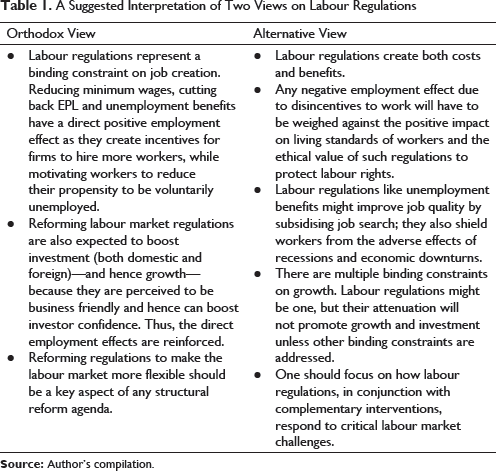
A Suggested Interpretation of Two Views on Labour Regulations
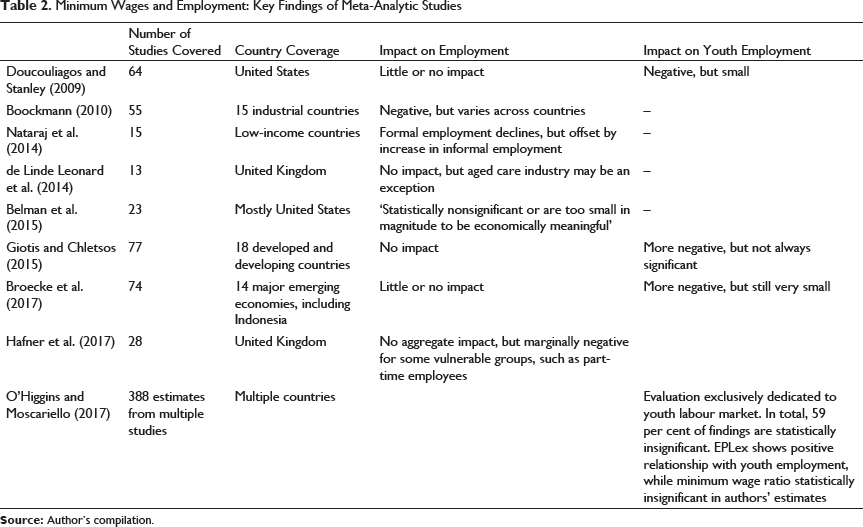
Minimum Wages and Employment: Key Findings of Meta-Analytic Studies
The veracity of these views depends on sifting through the available evidence. Hence, this section explores the labour regulations-employment nexus using global evidence.
Minimum Wages and Labour Market Outcomes
There is a large literature on the minimum wage-employment linkage as this is one of the most thoroughly studied topics in labour economics primarily led by research in the United States. Belman and Wolfson (2014), for example point out that there has, by now, been 15 years of research on minimum wage in the United States. The same authors, in a widely cited contribution, note that ‘more than 600 scholarly and policy papers that mention the minimum wage have been published since 2,000’ 2 . It thus seems reasonable to pay particular attention to minimum wage policy and its ramifications for the labour market.
A quantitative way to establish the evidence is to implement a meta-analytic approach to the available studies that pertain to estimates of the impact of minimum wages on employment. This approach has often been employed in countries, typically the United States, where a large number of studies exist. It has also been used to pool together studies across a number of countries. A summary is offered in Table 2. A key feature of Table 2 is that a great deal of the estimates, culled from hundreds of studies from the United States, as well as other developed and emerging economies are statistically insignificant and small in magnitude.
It is also worth pointing out that many empirical investigations in this field suffer from a ‘negative reporting bias’, that is, there is a tendency to report negative results (minimum wages reduce employment). Broecke et al. (2017), for example, point out that, 70 per cent of the estimates that were reviewed suffered from publication bias.
Beyond meta-analytic studies enumerated in Table 2, others have assessed the evidence using multiple techniques and methods. In a thorough review of the latest evidence, Dube (2019) points out the following:
…the most up to date body of research from US, UK and other developed countries points to a very muted effect of minimum wages on employment, while significantly increasing the earnings of low paid workers. Importantly, this was found to be the case even for the most recent ambitious policies.
Such conclusions resonate with the findings of a landmark World Development Report 2013 on the global labour market, which pointed out that ‘…most estimates of the impacts of (labour regulations) on employment levels tend to be insignificant or modest’ (World Bank, 2012, p. 261). Even if there is a modest and negative impact of minimum wages on employment, this can be offset by the fact that minimum wages can alleviate the incidence of low pay and thus reduce working poverty. As Belman and Wolfson (2014) note: ‘…there is almost universal agreement that the minimum wage boosts earnings’.
EPL and Labour Market Outcomes
What about the EPL-employment nexus? A meta-analysis (881 estimates on the effect of EPL on unemployment from 75 studies) makes the following claim. 2 ‘Once’, claims the study, ‘…we control for publication selection bias, we cannot reject the hypothesis that the average effect of EPL on unemployment is zero’.
The author notes, however, that one can detect a ‘small’ adverse effect on female unemployment. The findings are also influenced by how EPL is measured. Survey-based, author-driven estimates of EPL seem to display statistically stronger results relative to OECD’s EPL.
One can highlight an in-depth study of European data on whether EPL reform can improve labour market outcomes
3
. The study notes the following:
…Our results show that deregulating the use of temporary contract increased temporary employment risks of youths but did not reduce…unemployment risks. In contrast, we find some evidence that decreasing the protection of permanent jobs was successful in decreasing risks of inequality/insecurity (in terms of temporary employment).
The implication for South Asian countries is that policymakers should not uncritically remove restraints on temporary employment. Merely seeking to increase temporary employment opportunities for South Asians through outsourcing overlooks the problems of poor wages and insecure working conditions that temporary workers might face.
Labour Regulations, Growth and Labour Market Performance Indicators: Overview of South Asia
The discussion of the previous section has set the global context in which the experience of the selected South Asian countries can be reviewed from the perspective of the regulations-economic performance nexus. As noted, labour regulations manifest themselves in three main ways: (1) compliance with core ILS as agreed by all member states of the ILO; (2) minimum wages and (3) EPL, including severance pay.
A brief overview is offered for the three dimensions of labour regulations noted above. Consider the case of compliance with core ILS. All member countries of the ILO have agreed to eight core ILS or conventions cutting across freedom of association, forced labour, discrimination and child labour. In other words, member states who ratify all these conventions agree
to freedom of association (and hence workers are free to be members of trade unions of their choice and engage in collective bargaining),
not to use forced labour,
not to practice any form of discrimination in employment and wage setting mechanisms and
avoid the use of child labour.
Ratification of Core ILS, Selected Asian Countries 4
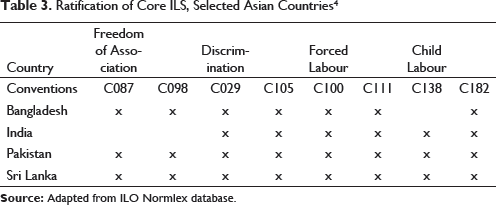
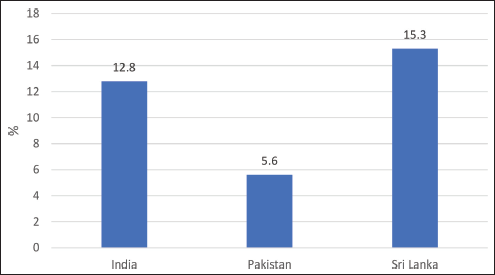
From the perspective of Table 3, it might be tempting to suggest that Pakistan and Sri Lanka have highly regulated labour markets because they have ratified all the core ILO conventions, while India has a more flexible labour market because it has ratified five out of the eight conventions. Yet, in practice, this is not the case. Ratification of international conventions does not necessarily mean compliance and enforcement at the local level. For example, Pakistan has a much lower incidence of trade union density relative to India (Figure 1).
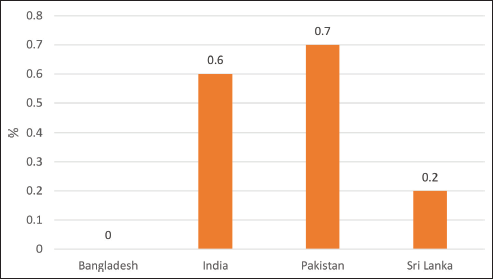
Figure 2 revisits the issue of labour regulations from the perspective of the minimum wage (measured as per cent of value added). As can be seen, Pakistan has the highest relative minimum wage among the four South Asian countries reviewed here followed by India. Bangladesh apparently has no mandated minimum wage. Sri Lanka has the lowest relative minimum wage.
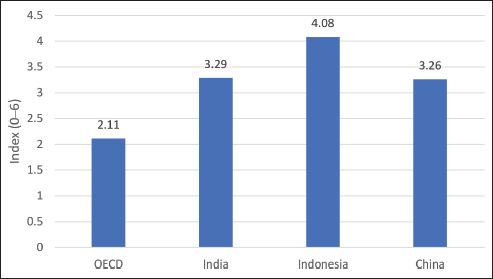
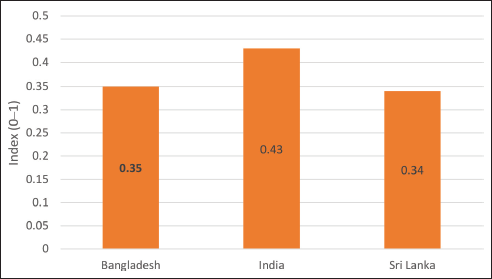
The discussion now shifts to labour regulations as judged through the prism of EPL, including severance pay. The OECD and ILO publish an overall index of EPL. In the case of OECD, the EPL ranges between 0 (least restrictive legislation) and 6 (most restrictive). In the case of the ILO’s version of EPL—known as EPLex—the generic index ranges between 0 (least restrictive) and 1 (most restrictive). Both OECD and ILO construct their overall index by drawing on regulatory limits on fixed term contracts, procedural limits on working hours, constraints on individual and collective dismissals, redundancy rules and costs and arbitration procedures. Hence, the higher the incidence of such regulations, the greater the value of EPL.
The OECD focuses mostly on advanced economies that are members of the OECD, but there is some information on non-OECD economies, including India. This is shown in Figure 3, which compares India with other large Asian economies (China, Indonesia). As can be seen, India has a higher EPL relative to OECD, but it is very similar to China and lower than Indonesia.
ILO publishes its EPLex and related legal information on various regulatory instruments on 116 countries, but Pakistan is not included. The aggregate value of EPLex (0–1) is shown in Figure 4 for Bangladesh, India and Sri Lanka. It appears that India has the most restrictive EPL relative to Bangladesh and Sri Lanka both of which have very similar values.
A key aspect of EPL is that it might lead to high firing costs in the form of mandated severance pay. Overly generous severance pay can impose a heavy burden on firms for mitigating labour market risks of lay-offs and job losses. It is not fair to expect that firms should bear sole responsibility for handling such risks. It also deters them from hiring new workers.
A standard way of resolving this issue is to use unemployment insurance (UI) for dealing with the risk of lay-offs and job losses. The cost of UI is then shared between the government, employers and workers. The South Asian countries under review do not have UI schemes but a number of ASEAN economies do 5 .
There are critics of UI. The typical concern is that UI benefits create disincentives to work. Countries that operate UI systems typically try to design them in a way that seeks to reduce the disincentive effects (tighter eligibility criteria, reduced benefits, shorter duration) while increasing reliance on active labour market policies. The ASEAN countries that operate UI systems are evolving in that direction. Hence, South Asia can learn from their experiences as much as it can learn from the more established UI schemes in the OECD 6 .
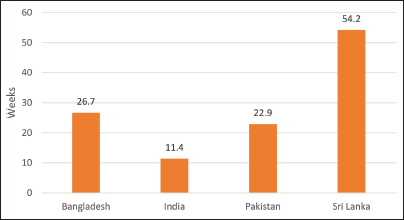
What is the extent and scope of severance pay in the countries under review? Figure 5 provides pertinent information. As can be seen, severance pay is very low in India, but rather high in Sri Lanka. Once again, this demonstrates that there is no simple way to ascertain that country X has a more regulated labour market than Y. For example, Sri Lanka has rather low minimum wages, but very generous severance pay relative to regional norms. On the other hand, India has very low severance pay but a high value of EPL.
Having set the context by reviewing salient aspects of labour regulations in four economies in South Asia, one has now reached an appropriate juncture to reflect on the regulations-performance nexus. This in turn begs the question: Are onerous labour regulations associated with weaker growth and relatively poor labour market performance? From the perspective of the orthodox view laid out in Table 1, the answer appears to be a resounding ‘yes’. Thus, a more regulated labour market is likely to be associated with lower labour force participation rate (LFPR), lower employment, higher unemployment and a greater risk of exclusion of young people. Growth in labour productivity is also likely to be stymied as firms seek to deploy excessive and wasteful capital inputs to avoid high hiring and firing costs. Growth, which is driven by both factor accumulation and factor productivity, could thus be impaired.
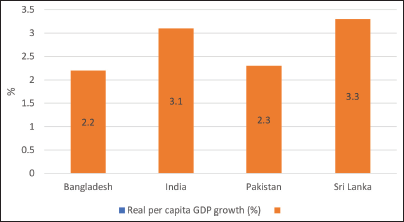
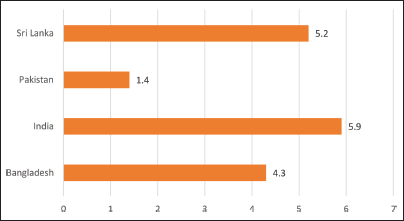
The evidence is far more ambivalent, at least at the macro-level. Per capita GDP growth in both India and Sri Lanka have been the fastest over a period of 70 years, while it has been much slower in Bangladesh over an equivalent period despite a lightly regulated labour market (Figure 6). This is also complemented by Figure 7, which shows that labour productivity has grown significantly faster in India and Sri Lanka than Bangladesh in the 2010–2019 period. Yet, Bangladesh has a lower level of EPL than India and the same level of EPL relative to Sri Lanka. Pakistan is a laggard in this respect. One could argue that its much higher level of minimum wage might have played a role in its poor productivity performance. On the other hand, there are multiple determinants of labour productivity. Labour regulations represent one plausible factor but not the only possible one.
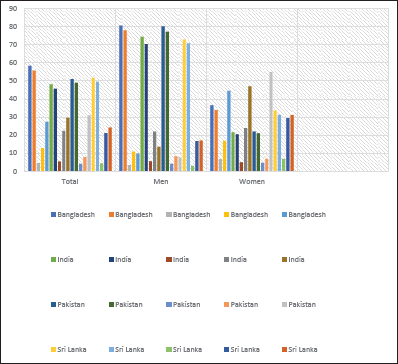
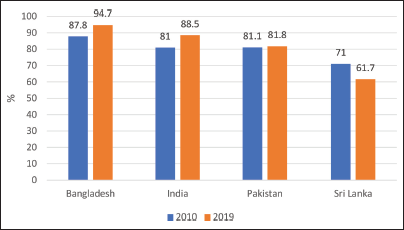
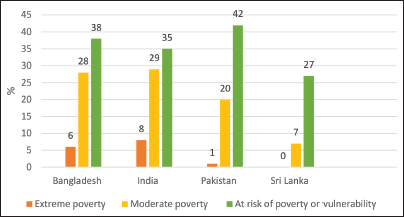
More detailed depiction of labour market indicators also does not provide any clear support for the orthodox view. In some respects, lightly regulated (by some measure) Bangladesh does well (relatively high employment rate and LFPR) but lags behind some of its South Asian neighbours relative to the youth underutilisation rate, the incidence of informality (Figure 9) and the incidence of working poverty (Figure 10). These indicators that are embedded in the Sustainable Development Goals (SDGs).
The stylised evidence suggests that the incidence of informality is quite high, especially in Bangladesh, India and Pakistan. It has in fact risen in recent years in Bangladesh and India, while remaining roughly stable at high levels in Pakistan. Only in Sri Lanka does one see evidence of a perceptible decline in informality.
The stylised evidence also suggests that, while extreme poverty among the working population is modest in all the South Asian countries under review (negligible in Pakistan and non-existent in Sri Lanka), the use of a higher international poverty line translates to a significant degree of ‘moderate’ poverty among workers in Bangladesh, India and Pakistan. The proportion of workers that are vulnerable to poverty ranges from 27 per cent (Sri Lanka) to 42 per cent (Pakistan).
What has to be emphasised is that in all the South Asian countries there are deeply entrenched gender disparities. In Figure 8, women fare rather badly across the entire spectrum of key labour market indicators. This is particularly striking in the case of disparities in terms of LFPR.
In sum, regardless of the nature and scope of labour regulations, all the South Asian countries face some common challenges. They include high underutilisation of the skills and talents of young men and women, significant poverty and vulnerability among the working population, deeply entrenched gender disparities. Responding to these challenges will require a holistic framework of complementary interventions rather than a narrowly conceived one of deregulating the labour market.
The admittedly cursory review of growth and labour market indicators suggest that the regulations-performance nexus is not clear cut. This is to be expected as growth and labour market performance are shaped by a complex interplay of factors. Most importantly, measured indicators of labour regulations remain virtually constant over long periods of time. For example, between 2010 and 2019, the value of EPLex did not change in Bangladesh, India and Sri Lanka. Yet, other variables changed, whether it is income or employment both along quantitative and qualitative dimensions. Hence, it is difficult to explain changes in economic outcomes by linking them to explanatory factors that remain virtually unchanged over long periods of time.
Firm-Level Perceptions and Labour Market Regulations: Evidence from South Asia
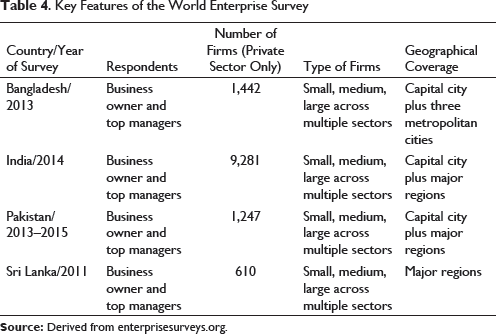
So far, the discussion has been pitched at a macro-level. This should be complemented by firm-level analysis. The World Bank’s enterprise surveys offer a good overview of firm-level perceptions on the role of labour regulations in affecting the business environment. These surveys ask private sector firms to identify the top 10 obstacles to private sector firms as experienced by them in their business operations. Labour regulations are listed as part of the top 10 obstacles. Others pertain to access to infrastructure (electricity and transport), access to finance, lack of an educated workforce, access to land (as a proxy for physical space to build factory sites), tax administration and tax rates. Hence, it would be useful to establish the extent to which private sector firms in the four South Asian economies regard labour regulations as part of the top 10 obstacles to the business environment.
. Key Features of the World Enterprise Survey
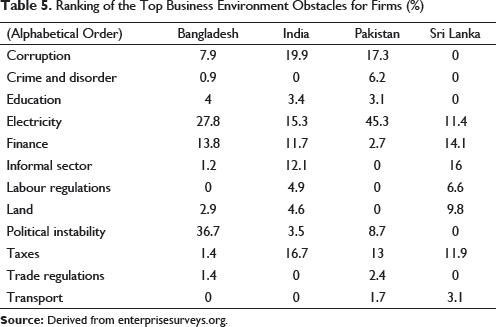
Ranking of the Top Business Environment Obstacles for Firms (%)
Despite these caveats and limitations and their dated nature, the World Bank’s enterprise surveys are widely consulted and cited sources to delineate the perceptions of firms on the nature of the business environment in a wide range of countries. By now, the World Bank has collated survey data on more than 141,000 firms in 171 countries. This is an impressive compendium.
What strikes one is that labour regulations are not even considered a binding constraint by private sector firms in Bangladesh and Pakistan. In India and Sri Lanka, labour regulations are seen as a binding constraint by less than 10 per cent of firms. There are more pressing concerns, such as corruption in India, and access to infrastructure and finance in both India and Sri Lanka.
The key normative message of Table 5 is that simply deregulating the labour market represents a partial agenda in India and Sri Lanka, given that there are multiple binding constraints on firms that impede their capacity to be a source of job and wealth creation. It appears that deregulating the labour market is even irrelevant in Bangladesh and Pakistan, given that onerous labour regulations are not considered as among the top 10 obstacles that impede firms to reach their full potential.
Concluding Remarks
The article has assembled various facets of labour regulations in four South Asian economies (Bangladesh, India, Pakistan and Sri Lanka). The pattern that emerges is complex. For example, India emerges as a highly regulated labour market in terms of an overall index of EPL. Yet, in some respects, it suggests a less regulated labour market. It has the least number of ratifications of the core ILO conventions. Its trade union membership is significant but also significantly less than Sri Lanka. It has the lowest degree of severance pay, while Sri Lanka has the highest. The minimum wage in India is a little lower than in Pakistan.
The article has also highlighted the fact that measured indicators of labour regulations barely change over time. Hence, it becomes difficult to press them into service to explain changes in key economic variables, most notably growth and labour market performance that are supposed to be shaped by labour regulations.
A cursory review of the macro-evidence has suggested that South Asian countries that are deemed to be endowed with highly regulated labour markets, such as India, have grown significantly faster than a seemingly less regulated labour market, such as Bangladesh, over a period of 70 years. At the same time Bangladesh does not perform consistently better than its regional peers across a broad spectrum of labour market indicators.
A review of the international evidence, based on many empirical studies, suggest that the concern over such key elements of labour regulations as the minimum wage, are overblown. Furthermore, a review of firm-level evidence in the South Asian countries suggests that labour regulations are by no means considered a binding constraint by the majority of firms in India and Sri Lanka. Employers in Bangladesh and Pakistan do not consider labour regulations as a binding constraint at all.
In sum, the professional consensus has shifted in favour of the view that properly designed labour market institutions and regulations, far from being impediments to growth and job creation, play a pivotal role in engendering desirable economic and social dividends. The alternative is a Hobbesian world of an unregulated labour market which is likely to produce poor wages and working conditions. It is this intellectual foundation on which any discussion of labour regulations in South Asia should be built. Policymakers in the region should acknowledge common challenges pertaining to low utilisation of the skills and talents of young people, entrenched gender disparities, high, and in many cases rising, informality, significant incidence of working poverty and vulnerability. They should focus on designing complementary interventions to tackle such shared challenges rather than being fixated on the narrowly conceived notion of deregulating labour markets.
Footnotes
Declaration of Conflicting Interests
Funding
The author received no financial support for the research, authorship, and/or publication of this article.