






Abstract


Many African Americans and Hispanic Americans avoid milk and dairy products because they believe they are lactose intolerant. In fact, research shows that currently nearly 20% of African Americans and 10% of Hispanic Americans consider themselves to be lactose intolerant. Yet lactose intolerance continues to be one of the most misunderstood, mislabeled, and misdiagnosed diet-related conditions.
There is an emerging body of evidence that links milk and other dairy products to a reduced risk of heart disease, hypertension, obesity, and type 2 diabetes—diseases that affect African Americans and Hispanic Americans at disproportionate rates. For example, as an important contributor of calcium, potassium, and magnesium to the diet, African Americans and Hispanic Americans who avoid dairy foods may increase their risk of type 2 diabetes and hypertension. In fact, the National Medical Association (NMA), which represents African American health care providers, and the National Hispanic Medical Association, representing Hispanic health care providers, recommend in their joint 2013 consensus statement on lactose intolerance that African Americans and Hispanic Americans consume 3 to 4 servings of low-fat dairy every day.
Diabetes educators often serve as health and wellness gatekeepers for minorities with diabetes and have the opportunity to educate African Americans and Hispanic Americans about the dietary importance of dairy foods and their nutrients, even if they are lactose intolerant. Therefore, it is imperative that educators become familiar with lactose intolerance and management strategies that can help African Americans and Hispanic Americans with lactose intolerance enjoy the recommended servings of milk and milk products every day.
Diabetes educators often serve as health and wellness gatekeepers for minorities with diabetes and have the opportunity to educate African Americans and Hispanic Americans about the dietary importance of dairy foods and their nutrients, even if they are lactose intolerant.

What Is Lactose Intolerance?
Lactose is a naturally occurring sugar found in yogurt and other milk products. During digestion, an intestinal enzyme called lactase breaks down lactose into 2 smaller sugars, glucose and galactose, which are more easily digested.
Lactose intolerance is a condition in which people have digestive symptoms—such as bloating, diarrhea, and gas—after eating or drinking milk or milk products. Lactase deficiency and lactose malabsorption may lead to lactose intolerance.
In people who have a lactase deficiency, the small intestine produces low levels of lactase and cannot digest much lactose. Lactase deficiency may in turn cause lactose malabsorption—also known as lactose maldigestion. In lactose malabsorption, undigested lactose passes to the colon. Left undigested, lactose is fermented by “healthy” bacteria in the intestinal tract. This fermentation produces uncomfortable symptoms such as gas, abdominal pain, or bloating.
Not all people with lactase deficiency and lactose malabsorption have digestive symptoms. It’s a matter of degree of sensitivity to lactose. Some people may experience gastrointestinal disturbances every time they eat foods with lactose, while others may only experience this disturbance if they consume a large amount of lactose on an empty stomach. For example, an individual with lactose malabsorption may consume 12 g of lactose—the amount of lactose in 1 cup of milk—without symptoms but be intolerant to 24 g, which is the amount in 2 cups of milk. Lactose malabsorption does not necessarily lead to lactose intolerance or mean that dairy foods need to be avoided.

Minorities and Dairy Avoidance
Unfortunately, when minorities avoid milk and milk products due to perceived or actual lactose intolerance, they are more susceptible to type 2 diabetes and cardiovascular disease—conditions where nutrients found in dairy foods such as calcium, potassium, and magnesium may play a preventative role.
For example, dietary approaches to stop hypertension in the DASH study found a diet rich in low-fat dairy; high in calcium, potassium, and magnesium; and rich in fruits and vegetables significantly lowered blood pressure. Hypertension, a major risk factor for cardiovascular disease, is highest in African Americans compared to any other ethnic group in the United States. Notably, the DASH diet was twice as effective in lowering blood pressure among African Americans.
Mexican Americans, the largest Hispanic subgroup, are almost twice as likely to have diagnosed diabetes compared to whites, and more than 10% of all Hispanics have diabetes. Consuming low-fat dairy such as yogurt, milk, and cheese has been associated with a reduced risk of type 2 diabetes.
Unfortunately, many minorities miss out on these benefits. According to the NMA consensus statement, African Americans, on average, consume only 1.2 servings of dairy foods per day, with 26% consuming less than 1 serving per day. Hispanic Americans don’t fare any better, consuming on average 1.5 servings of dairy foods per day.
Moving Beyond Belly Aches
Many people who say they have trouble digesting milk have actually never been diagnosed as lactose intolerant by a health professional. Gas, bloating, or abdominal discomfort are common gastrointestinal disturbances in many disease states and conditions, therefore it is important to identify the true source of discomfort.
Unfortunately, when minorities avoid milk and milk products due to perceived or actual lactose intolerance, they are more susceptible to type 2 diabetes and cardiovascular disease – conditions where nutrients found in dairy foods such as calcium, potassium and magnesium, may play a preventative role.
The NMA and NHMA jointly recommend that if lactose intolerance is suspected, patients should be referred to their health care provider for a standardized and objective test, such as the hydrogen breath test, used to measure the amount of hydrogen in a person’s breath. Normally, only a small amount of hydrogen is detectable in the breath when a person eats or drinks and digests lactose. However, undigested lactose produces high levels of hydrogen.
If lactose intolerance is confirmed, patients should be encouraged to keep dairy foods in the diet. See the DAIRY strategies in the following paragraphs to help patients get the recommended 3 to 4 servings of dairy every day.
Whether lactose malabsorption is present or not, given the low dairy intake among African Americans and Hispanic Americans, health care providers are encouraged to work with patients to achieve recommended daily servings for all individuals, which can help improve daily nutrient intakes.
Strategies for Diabetes Educators to Help Minorities Meet Dairy Needs
According to the United States Census Bureau, by 2060 African Americans and Hispanic Americans will constitute nearly 15% and 31% of the population, respectively. As these demographics continue to evolve, the prevalence of lactose intolerance is also expected to increase. This will have profound health consequences on a group already at risk.

Drink milk and eat cheese and yogurt with meals, keeping in mind that up to a cup of milk (12 g of lactose) may be well tolerated.
Diabetes educators play an important role in helping to educate African Americans and Hispanic Americans on the critical role 3 servings of dairy foods, such as milk, yogurt, and cheese, can play in helping them meet the recommendations for calcium, potassium, magnesium, and other key nutrients. Educators can use these DAIRY strategies for confirmed lactose-intolerant patients:
Drink milk and eat cheese and yogurt with meals, keeping in mind that up to a cup of milk (12 g of lactose) may be well tolerated.
Aged cheeses such as Swiss or cheddar are low lactose and may be better tolerated. Queso fresco, fresh Mexican cheese with virtually no lactose, is a culturally specific cheese that may be well tolerated.
Introduce dairy slowly. Start with small amounts of dairy foods and individualize treatment.
Reduce it. Consider lactose-reduced dairy products, such as lactose-free milk and lactose-free cottage cheese.
Yogurt is semi-solid, contains live and active cultures, and has less lactose per serving than milk, all of which may make it easier to digest for those with lactose intolerance.
Tips for Working with Patients

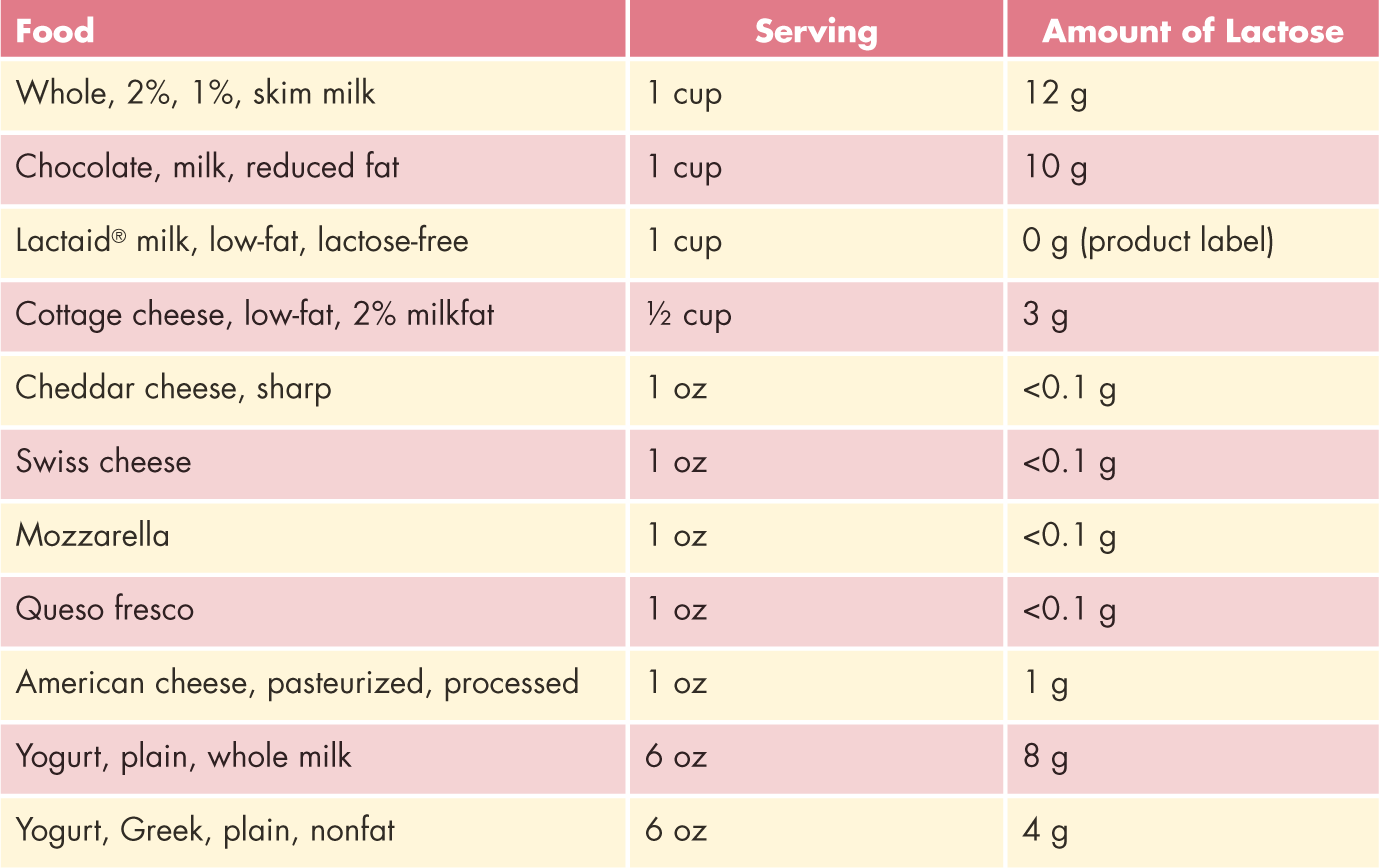
Lactose Content of Common Dairy Foods
Adapted from: U.S. Department of Agriculture, Agricultural Research Service. 2013. USDA National Nutrient Database for Standard Reference, Release 26. Nutrient Data Laboratory. Available at: http://www.ars.usda.gov/ba/bhnrc/ndl. Accessed July 17, 2014.
Summary
Many African Americans and Hispanic Americans with lactose intolerance avoid dairy foods and consume inadequate amounts of calcium, magnesium, potassium, and other essential nutrients found in dairy foods—putting them at increased risk for heart disease, hypertension, obesity, and type 2 diabetes. Research indicates that not all people with lactose malabsorption have digestive symptoms and many can consume 12 g of lactose—the amount in 1 cup of milk, without symptoms. Diabetes educators must educate African Americans and Hispanic Americans about the importance of dairy foods and their nutrients, even if they are lactose intolerant. ■
Footnotes
Constance Brown-Riggs, MSEd, RD, CDE, CDN, is Nutrition Advisor of Dannon’s One Yogurt Everyday Initiative and Owner of CBR Nutrition Enterprises, Massapequa, NY.