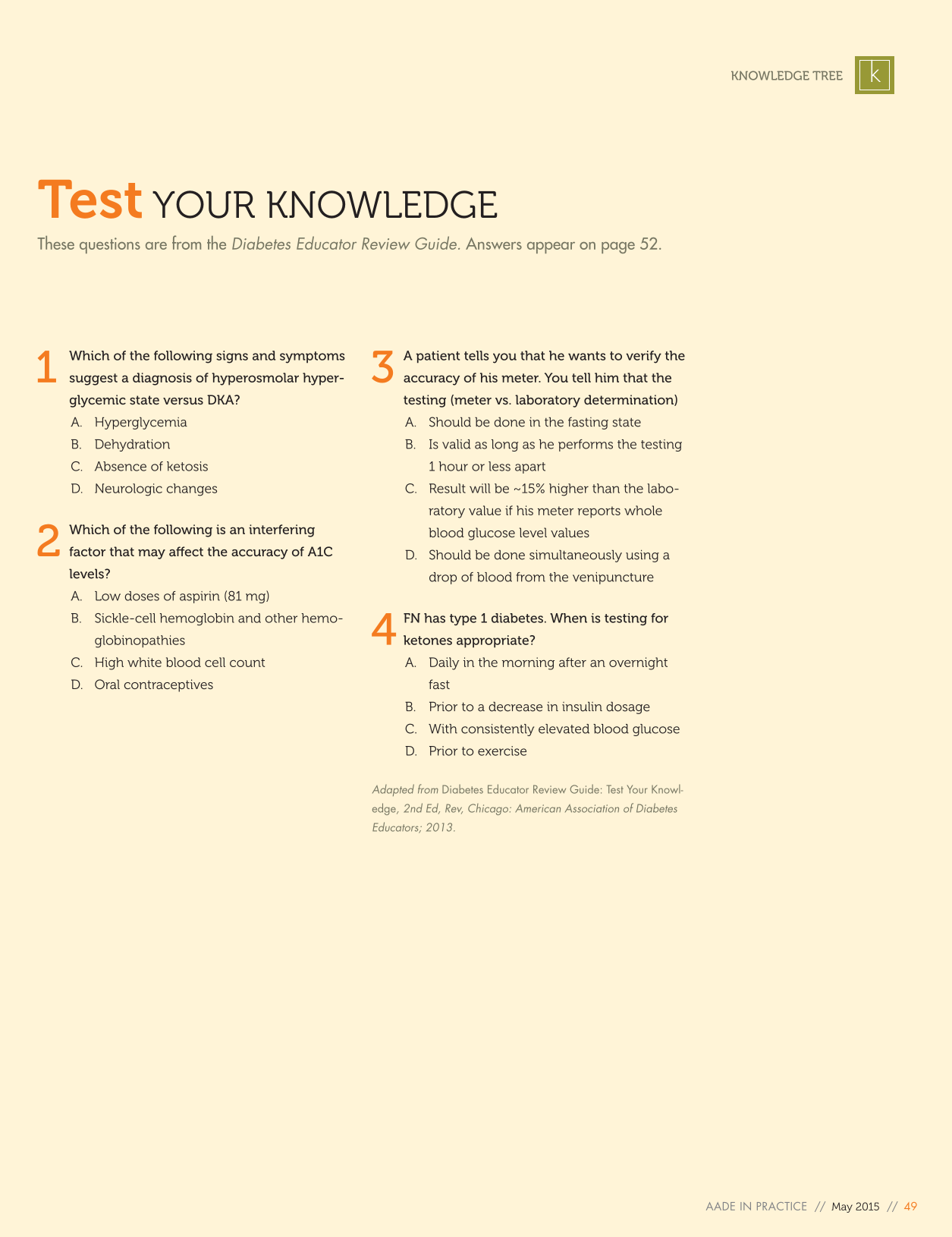
These questions are from the Diabetes Educator Review Guide. Answers appear on page 52.
Which of the following signs and symptoms suggest a diagnosis of hyperosmolar hyperglycemic state versus DKA?
Hyperglycemia
Dehydration
Absence of ketosis
Neurologic changes
Which of the following is an interfering factor that may affect the accuracy of A1C levels?
Low doses of aspirin (81 mg)
Sickle-cell hemoglobin and other hemoglobinopathies
High white blood cell count
Oral contraceptives
A patient tells you that he wants to verify the accuracy of his meter. You tell him that the testing (meter vs. laboratory determination)
Should be done in the fasting state
Is valid as long as he performs the testing 1 hour or less apart
Result will be ~15% higher than the laboratory value if his meter reports whole blood glucose level values
Should be done simultaneously using a drop of blood from the venipuncture
FN has type 1 diabetes. When is testing for ketones appropriate?
Daily in the morning after an overnight fast
Prior to a decrease in insulin dosage
With consistently elevated blood glucose
Prior to exercise
Adapted from Diabetes Educator Review Guide: Test Your Knowledge, 2nd Ed, Rev, Chicago: American Association of Diabetes Educators; 2013.
Test Your Knowledge Answers
The questions are from the Diabetes Educator Review Guide and appear on page 49.
C: Individuals with type 2 diabetes are generally ketone resistant. Individuals in DKA are also dehydrated (B) and hyperglycemic (A). Neurological changes (lethargy and mild confusion) are less common in DKA (D).
B: Since A1C is based on normal hemoglobin, hemoglobinopathies can affect the test in 3 ways: (1) altering the normal process of glycation from HbA to A1C; (2) causing an abnormal peak on chromatograph, making the estimation or A1C unreliable; (3) making the red blood cells more prone to hemolysis, thereby decreasing the time for glycosylation to occur and thereby producing a falsely low A1C. There is lack of evidence to support interference of low-dose aspirin usage with A1C result. Ingesting large doses of aspirin may, however, impact A1C result (A). White blood cell count is not related to hemoglobin A1C, which is a measure of the amount of glucose attached to the hemoglobin in the red blood cells (C). Oral contraceptives do not affect the accuracy of A1C result (D).
A: When verifying the accuracy of a meter, the blood glucose meter results should be compared against a laboratory value, not another meter. Only fasting values can be compared since post-meal values will differ between the capillary blood (as measured on the meter) and the venous blood (as measured in the lab). When comparing a meter result with a lab result, the 2 tests must be done at the same time. Measuring blood glucose at home either before or after the venipuncture allows too much time between the readings for a valid comparison (B). The meter result would be ~15% LOWER than the laboratory result if the meter reports whole blood glucose values (C). Comparing meter readings to lab values involves a fingertip or alternate site puncture AND a venipuncture. Applying a drop of blood from the venipuncture needle is not acceptable, as the meter strips will give false readings if venous blood is used (D).
C: Ketone testing is appropriate during illness, when blood glucose levels are consistently elevated, and during weight loss and pregnancy. It does not need to be done daily (A), prior to a decrease in insulin dose (B), or prior to exercise unless glucoses are elevated, making this choice incorrect (D).
Adapted from Diabetes Educator Review Guide: Test Your Knowledge, 2nd Ed, Rev, Chicago: American Association of Diabetes Educators; 2013.