






Abstract


Being admitted to a hospital to deliver a baby can be overwhelming for any woman. It can be particularly challenging for a woman with diabetes who uses an insulin pump to manage her diabetes, especially if she’s not permitted to continue its use during her hospitalization. Having to disconnect an insulin pump can create unnecessary added anxiety as people who use an insulin pump to self-manage their diabetes may be emotionally attached to the device.
NYU Winthrop Hospital is a 600-bed, major teaching insulin pump–friendly hospital. At NYU Winthrop Hospital, clinical staff members act as a team to partner with patients and each other to foster a safe and collaborative environment for patients who are capable of self-managing their insulin pumps in the hospital.
Glucose Control During Pregnancy, Labor, and Delivery
The variability of glucose metabolism during pregnancy, labor, delivery, and the postpartum period can be both emotionally and physically demanding for a woman with diabetes. It is known that good blood glucose control during pregnancy and labor and delivery can reduce the risks of maternal and fetal morbidity and mortality. According to the American Diabetes Association (ADA), some of the risks of poor blood glucose control during pregnancy include spontaneous abortion, fetal anomalies, macrosomia, and neonatal hypoglycemia.
The ADA Standards of Medical Care in Diabetes 2017 recommended goals for fasting blood glucose levels during pregnancy should be no greater than 95 mg/dl with 1-hour postprandial readings no greater than 140 mg/dl. It is recommended by the American College of Obstetricians and Gynecology and the American College of Endocrinology that the goal for blood glucose levels during labor and delivery be maintained between 70 and 110 mg/dl.
Benefits of Using an Insulin Pump
Many people with diabetes who require insulin prefer the use of an insulin pump over multiple daily injections (MDI) as it is often a more convenient and effective way to control blood glucose levels. Insulin pumps are often used by women with diabetes both before and throughout the perinatal period to help achieve and maintain optimal blood glucose control. The use of an insulin pump during this period allows for the flexibility needed during a time when blood glucose levels fluctuate since the insulin pump rates can be adjusted as needed. According to a 2013 article in Diabetes & Metabolic Syndrome: Clinical Research and Reviews, a study comparing pregnancy outcomes in women taking MDI to women using insulin pumps showed that A1C levels were reduced further in women using insulin pumps than in those taking MDI. The study also demonstrated that there was less hypoglycemia and higher APGAR scores in the newborn when an insulin pump was used.
The variability of glucose metabolism during pregnancy, labor, delivery, and the post-partum period can be both emotionally and physically demanding for a woman with diabetes.
Arrival on the Labor and Delivery Unit
During pregnancy, a woman with diabetes will likely be apprehensive about what to expect regarding not only the birth of her baby but her diabetes management as well. When a woman arrives on the labor and delivery unit to prepare to deliver her baby, her anxiety level may be rather high.
Using a team approach, the diabetes nurse clinician as a certified diabetes educator, collaborates with patients and clinical staff members while providing diabetes education and support to both.
NYU Winthrop Hospital staff members alert the diabetes nurse clinician (DNC) when a patient with diabetes using an insulin pump is admitted to the hospital. Using a team approach, the DNC, as a certified diabetes educator, collaborates with patients and clinical staff members while providing diabetes education and support to both. Another role of the DNC is to act as a liaison between the patient, unit staff members, endocrine hospital staff members, and outpatient health care providers. This is especially important on the labor and delivery unit.
Not surprisingly, the DNC learned that providing educational and emotional support to an anxious and distracted woman about to deliver a baby can be especially challenging. Addressing the unique needs of a woman who uses an insulin pump to manage her blood glucose levels requires time in an environment with minimal distractions. This proved to be impossible while competing with numerous other clinical staff members caring for a soon-to-be mother.
In the throes of this experience, it became clear that arrival on the unit was not an ideal time to educate a patient about the intricacies of self-managing blood glucose levels with an insulin pump during labor, delivery, and the postpartum period. It was then, while one patient was giving birth to a baby, that an idea was also born.
The “What to Expect Visit” Is Born
It was determined that it may be more beneficial to the patient, the DNC, and the other clinical team members if the DNC met with the patient before the estimated due date of the baby’s delivery. This would provide the DNC with the time needed to assess the unique and complex diabetes management needs and desires of the patient while educating the patient regarding what she may experience during labor and delivery and throughout her hospital stay.
An email was sent to local obstetrical physician practices requesting referrals to the DNC for a free antepartum visit for women who manage diabetes with an insulin pump and plan to deliver their baby at NYU Winthrop Hospital. The email explained that the purpose of the visit was to provide an overview of expectations concerning use of the patient’s insulin pump during labor and delivery and the need to remind the patient to bring insulin pump supplies to the hospital. Additionally, the email pointed out how anticipating admission of these high-risk patients serves to enhance staff coordination of both intrapartum and postpartum diabetes management. The DNC also attended an obstetric department meeting where a description of the visit and contact information were provided.
NYU Winthrop Hospital obstetric clinical staff received education regarding the What to Expect Visit as well as, including:
an overview of how insulin pumps deliver insulin
the benefits of patients safely self-managing their insulin pumps during their hospital stay
patient responsibilities in collaborating with staff when using an insulin pump
the importance of having the patient sign NYU Winthrop Hospital’s insulin pump collaborative agreement, which outlines how the patient is expected to collaborate with the nurse when self-managing an insulin pump while in the hospital
contraindications to continuing the use of an insulin pump in the hospital
discipline-specific clinical staff responsibilities when caring for a patient who uses an insulin pump as per NYU Winthrop Hospital’s insulin pump policies
insulin pump management specific to types of delivery, stages of labor, and postpartum period
insulin pump documentation guidelines.
Professionals in the NYU Winthrop endocrine practice and the Diabetes Education Center were also educated about the What to Expect Visit. The endocrine team was asked to send the DNC a list of pregnant patients who were planning to deliver their baby at NYU Winthrop Hospital. The list includes the patient’s brand type of insulin pump; whether the patient has gestational, type 1, or type 2 diabetes; and the patient’s estimated due date as well as the names of the endocrinologist and nurse practitioner caring for the patient.
The What to Expect Visit in Practice
The What to Expect Visit is primarily designed to provide the patient with an overview of what she, as a person with diabetes who uses an insulin pump, can expect during her hospital stay specific to the perinatal period. The focus is on the insulin pump use and diabetes management in the labor and delivery environment. The clinical staff’s expectations of her as she continues to self-manage her diabetes using her insulin pump are also discussed.
The What to Expect Visit is primarily designed to provide the patient with an overview of what she, as a person with diabetes who uses an insulin pump, can expect during her hospital stay specific to the perinatal period.
After being alerted by the patient’s obstetrician or diabetes care provider that an insulin pump patient is due to deliver her baby at NYU Winthrop, the DNC contacts the patient to set up an appointment to meet several weeks before the estimated delivery due date. The patient is encouraged to bring a partner and/or family member to the meeting. She is told that the objective of the meeting is to develop a collaborative plan with her and her partner for the safe use of her insulin pump and for overall blood glucose management while in the hospital.

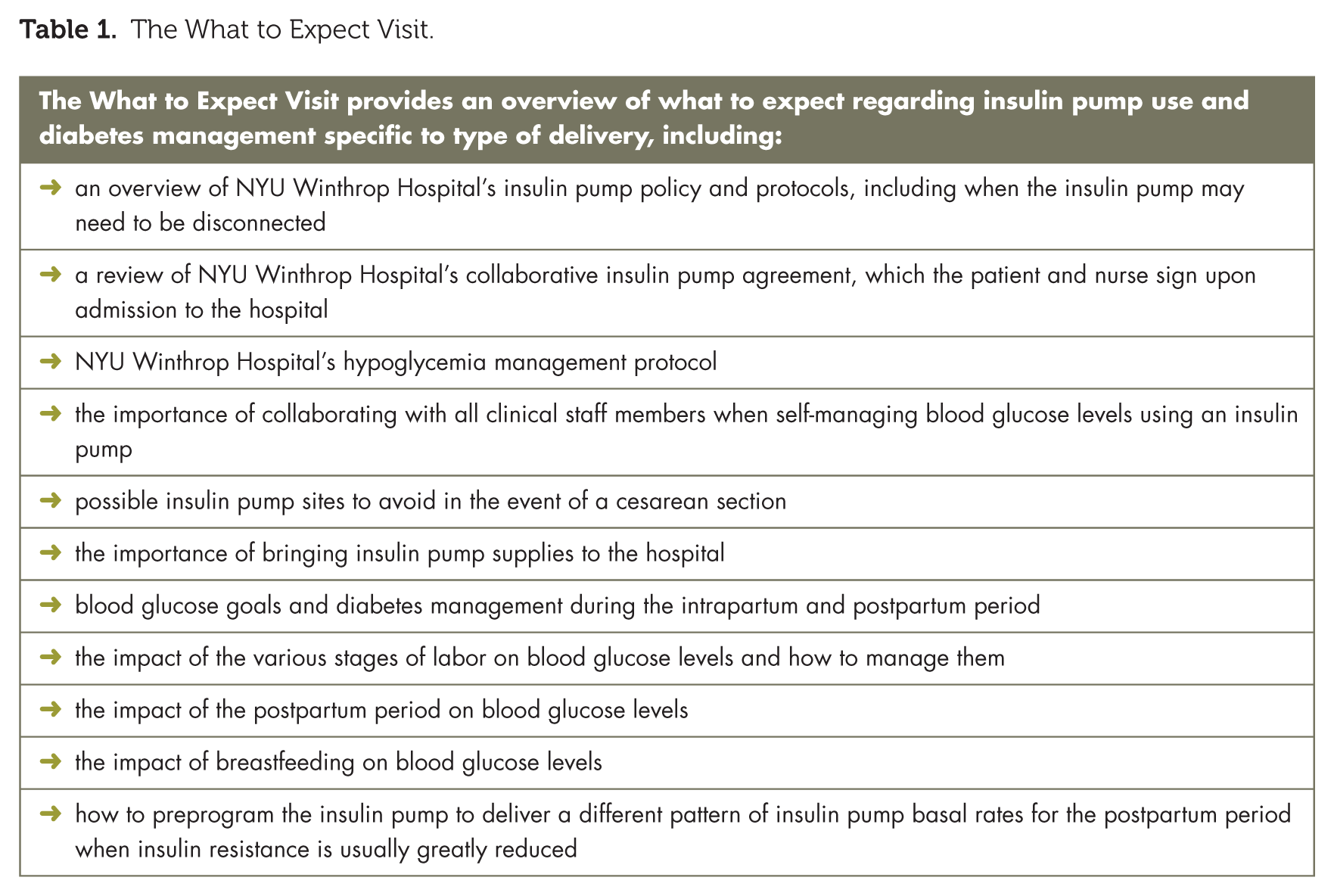
During the visit, the DNC assesses the patient’s blood glucose control before and during pregnancy. The patient’s ability and desire to safely operate her insulin pump in the hospital is also assessed. Education is provided based on the patient’s needs and desires. Table 1 provides an overview of the usual content of the visit.
The What to Expect Visit.
Patients and their partners and/or family members often have many questions answered during the meeting. A tour of the labor and delivery unit is offered if the patient has not had the opportunity to see the unit prior to the meeting.
After the Visit
The DNC provides the patient with contact information and encourages her to communicate any questions or concerns related to her diabetes management. The DNC also encourages the patient to provide updates regarding the expected delivery date of her baby.
The insulin pump diabetes management plan is discussed with the patient’s outpatient diabetes provider, the hospital endocrine staff, and labor and delivery clinical staff members. The DNC collaborates with the endocrine team to devise a plan for intrapartum and postpartum diabetes management based on the patient’s type of diabetes and type of delivery planned. Glucose control, insulin requirements during pregnancy, and other individual patient needs and concerns are also considered.
The DNC reviews the plan with the labor and delivery staff as well. The labor and delivery staff provides the DNC with information regarding any obstetrical complications or additional issues that may need to be considered regarding the diabetes management plan. As the expected delivery date approaches, communication continues as needed.
The Patient Experience
Many patients using insulin pumps during their hospital stay have expressed appreciation for the individualized, collaborative care they have received at NYU Winthrop Hospital before, during, and after their hospital stay. They report that they are pleased with having had the opportunity to meet with the DNC and often state they were less anxious knowing they would have the opportunity to continue to self-manage their insulin pump with the support of the clinical staff during their hospital stay.

After several years and many lessons learned, the What to Expect Visit has been successful in contributing to the coordination of care in a welcoming, collaborative environment.
Six weeks after one patient delivered her baby, she sent an email to the DNC stating how she was impressed with the care she received during her hospital stay and proud to be a member of the Winthrop family. During an interview described in the 2012 NYU Winthrop Annual Report, the patient explained, “It was impressive how continuous and expert the care was. Every nurse from shift to shift knew what was going on, and that was so comforting.”
Several patients have contacted the DNC when they are planning to return to NYU Winthrop to deliver subsequent babies.
Lessons Learned by the DNC
After some babies were unexpectedly delivered prior to the What to Expect Visit, the DNC realized that the visits needed to be arranged earlier in the pregnancy. Women have also had complications during pregnancy that required a visit to the hospital before the visit took place. When this occurs, if possible, the DNC meets with the patient during that hospitalization.
The DNC also learned that not all women wish to remain on their insulin pump during their hospitalization. At the end of a meeting with one patient and her husband, the patient wanted to know why she had to remain on her pump. She was relieved to learn that she did not have to remain on her insulin pump or self-manage her diabetes, and we would develop an alternative plan in collaboration with her outpatient diabetes care team.
Conclusion
After several years and many lessons learned, the What to Expect Visit has been successful in contributing to the coordination of care in a welcoming, collaborative environment. Furthermore, it has been instrumental in reducing anxiety for all, especially the women who wished to manage their diabetes using an insulin pump during what should be an incredible life experience. NYU Winthrop Hospital is very proud to be a baby-friendly and insulin pump–friendly hospital. ■
Footnotes
Jane Wendel, MS, RN, BC-ADM, CDE, is with the Diabetes and Obesity Institute, NYU Winthrop Hospital, in Mineola, NY.