







Abstract
Social contract theories serve a twofold purpose: by addressing acute crises, they elaborate solutions to long-standing social paradoxes. The article reinterprets the stakes of the Covid pandemic from this perspective. Firstly, the long-lasting structural paradoxes of late modernity are linked to the acute crisis of the pandemic with the help of critical theories of late modernity. It is argued that the pandemic provides opportunity for revaluating those social contracts, which are based on universalist principles of justice. Secondly, two paradigmatic historical examples (Hobbes, Rawls) are overviewed in a meta-theoretical fashion, so that the dimensions of revaluation could be highlighted. Thirdly, the foundations of a post-pandemic social contract are outlined. As the pandemic is inseparable from the structural paradoxes caused by unconstrained systems based on universal principles of justice, the post-pandemic social contract aims at preventing the system paradoxes by revaluating their universal principles in a ‘trial of particularity’ (Derrida, Levinas).
The pandemic is a crisis, both in a pragmatic and an existentialist sense. Not only does it challenge specific ‘social systems’, 1 such as healthcare or the economy, but it also raises questions about the foundations of late modern existence. As the boundaries of freedom, the basis of (global) justice and the sustainability of our (technologically mediated) relation to nature become blurred, the modern lifeworld loses its taken-for-granted modality. A rupture is born on the phenomenological horizon of collective identity, which requires new narratives granting new certainties. While such narratives could originate from many sources, there is a specific genre, which has been used since the beginning of modernity, as a distinguished ‘language game’ in times of crises: social contract theories. These elaborate solutions to long-standing social paradoxes while addressing acute crises at the same time. Despite their limitations, social contract theories have a unique feature: they are capable of grounding new, convincing normative horizons in a widely accessible manner while relying on the model of autonomous actors sharing universal rationality. In this sense, social contract theories promise to integrate actors of divergent cultural and structural backgrounds while handling both persistent paradoxes and acute challenges.
The broader stake of the pandemic can be revealed from this perspective: it plays the role of a catalyst. By intensifying long-lasting paradoxes of modernization, the pandemic facilitates collective reflection: those challenges, which have burdened late modernity for a long time both on the level of freedom (e.g. the fragmentation of the collective lifeworld due to individualization), justice (e.g. the increasing global and local inequality) and sustainability (e.g. the exploitation of humans and natural resources for the sake of perpetual growth), suddenly became a multi-dimensional imminent crisis requiring collective countermeasures. In this sense, the pandemic is a ‘tipping point in the Anthropocene’ (Horn, 2021): it reveals those individual discrepancies and structural conflicts which already existed on a latent level (Beck, 1992). It implies reflection on the foundations of modernity by raising the question: are the interrelated tendencies of functional differentiation, the expansion of capitalism, industrialization, bureaucratization, scientific discovery and globalization, sustainable in their original form, as ‘unconstrained’ social systems justified by universalist principles of justice?
These questions provide opportunity for rephrasing the social contract: to elaborate its theoretically valid and generally convincing new version, the social contract needs to be embedded in the context of a concrete, universally experienced problem; include a diagnosis of times (as a non-trivial explanation to that problem); provide a utopic horizon (as a collective solution to that type of problem). In what follows, an attempt is made to outline the basis of a social contract fitting the constraints of the post-pandemic late modern constellation. Firstly, the social constituents of the pandemic are linked to the long-lasting structural paradoxes of late modernity. Secondly, the steps of elaborating a social contract theory are reconstructed based on a meta-theoretical analysis of historical examples (Hobbes, Rawls). Finally, the foundations of a post-pandemic social contract are outlined based on moral theories operating outside the scope of justice (Levinas, Derrida).
From the crisis of a pandemic to the paradoxes of late modernity
To understand a pandemic emerging in the contemporary world, firstly an appropriate ontology is needed – one which moves beyond differentiations such as object-subject or nature-culture (Latour, 2020). As the pandemic is equally constituted of biological (i.e. the virus) and social (i.e. the networks of contamination) components, any explanation reduced to either of them remains one-sided (Delanty, 2021). When it comes to the specificities of Covid-19, the difficulties of detectability (i.e. pre-symptomatic contamination, lack of typical symptoms, asymptomatic cases as super-spreaders) combined with the fast pace of infection and mutation are to be mentioned. In the environment of the global structures of late modernity, these biological specificities prove to be particularly adaptive. A global challenge is born testing the sustainability of late modern social systems.
Since the classics of social theory, modernization has been described as adaptive functional differentiation (Durkheim, 1997). Such a process includes the interrelated tendencies of ‘disembedding’ (i.e. the decontextualization of interactions) and the increased extension and density of social ties. Mechanisms of integration change in an evolutionary manner: those forms of action coordination are stabilized, which successfully integrate the increasingly complex social systems (Luhmann, 1995). The gradual replacement of communities (based on personal acquaintance) by systems (based on the ability to use symbolically generalized mediums) or the replacement of bureaucratic organizations (based on a stable formal order) by networks (based on the ability of rapid expansion and shrinking) equally express such dynamics of adaptive modernization. As larger and larger masses are integrated into coordinated social units, individual actors become irreplaceable, while their local contexts are erased.
Late modern societies are particularly sensitive to the potential hindrances of large scale, disembedded integration. In contemporary ‘liquid society’ (Bauman, 2000), stable social boundaries are sacrificed for the sake of virtually unlimited network flexibility and connectivity (Castells, 1996). Contemporary social networks are optimized according to the principles of efficiency: any nodes or ties are replaceable, therefore high fluctuation is not simply a possibility but a key feature. The legal frames, the technological infrastructure, the channels of information are equally designed to support an accelerating pace of network-formation (Rosa, 2010). These networks are not limited anymore by the boundaries of nation-states: they encompass an inherently global ‘world society’ (Luhmann, 1997).
The undetectable, infectious and quickly mutating Covid-19 virus thrives in this constellation. On the one hand, the fast-paced, liquid, global networks provide an optimal platform for infection. On the other hand, the basic countermeasures relying on the suspension of social ties are incompatible with the logic of network society: neither the complete shutdown of networking is an option nor the drastic decrease of the density of interactions. In the network society, any specific mechanisms require the establishing of functionally differentiated new ties. This leads to a paradox: the potential countermeasures, which could prevent the spreading of the virus (i.e. decreasing the pace and extent of networking) are inconsistent with the very logic of countermeasures (i.e. the establishing of new networks). The network society cannot transcend its own foundations: once network integration becomes predominant, any new challenges are handled according to its logic (i.e. a functionally differentiated restructuring of networks). This creates a paradox in case of those challenges which are interrelated with the logic of network integration: any attempted solutions will reproduce the problem itself.
Unsurprisingly, most countries did not experiment extensively with a general shutdown of interactions. Instead, they attempted to outpace the virus. Global networks of vaccine development were established to find an ‘actant’ capable of countering the virus on the biological level, without the need for limiting the core integration logic of network society. Even if these efforts proved to be successful in a technological sense (several effective vaccines were developed within less than a year), they imply social paradoxes of their own. Taking into consideration that the population is global, and the networks of vaccine development and distribution are embedded in the structures of global capitalism and nation-states, such a process is undermined by at least two challenges: vaccine-nationalism 2 and vaccine-profiteering. 3 These two phenomena express how the existing social systems undermine the fight against the pandemic on a general level (Azmanova, 2021).
Beside these global challenges, nation-states also struggle with internal paradoxes as the expert institutions attempting to manage the pandemic clash with intensified populist voices (Brubaker, 2021). In a biopolitical setting, phenomena such as the pandemic imply the involvement of hegemonic expert discourses (Foucault, 1997): causal explanations are elaborated, which rely on reductionist ontologies. 4 These disciplinary explanations are not capable of establishing an unambiguous interpretation. Since expert knowledge has lost its previously unquestionable authority in the risk society (Beck, 1992), experts rely on a reflexive institutional logic (Giddens, 1991). However, without inclusive and deliberative public spheres, the disciplinary voices are overshadowed by the many forms of ‘post-truth discourses’ including esoteric or conspiracy theories (van der Linden and Löfstedt, 2021) spreading in the anti-public sphere of the information society (Davis, 2021). As the reflexive platforms mediating between expert and lay participants become sparser, consensual and scientifically validated interpretations of the pandemic are missing.
The pandemic seems to imply potentially unresolvable challenges for nation-states being embedded in the networks of global capitalism. It may still occur, despite the increasing global ignorance, that the states can neither restrict the global logic of network integration nor use it to outpace the virus. In this sense, the pandemic represents a turning point: it is not simply an external, unmanageable crisis, but rather the expression of the functional limitation of late modern social systems (Stratton, 2021). Accordingly, the pandemic is a unique historical moment: as its paradoxes become potentially perceptible for wide masses, the chance for renegotiating the tacit social contract that grounds modern systems becomes a realistic possibility. As there is a realistic chance that the pandemic cannot be defeated by further system expansion, the intensification of networking or accumulation may prove to be ultimately meaningless. Such experiences equally hold the potential of the immersion in the crisis (i.e. related crisis to the economic, social and political systems) or the reformulation of collective identity that is the birth of a ‘new cosmopolitan imagination’ (Chernilo, 2021). This latter possibility is the key to renewing those basic principles which ground social existence – in other words, to a new social contract.
Taming universal freedom: Social contracts in early and classic modernity
Social contract theories balance between the realm of the particular and the universal. On the one hand, they are inseparable from concrete historical challenges. On the other hand, they rely on general anthropological claims. Due to this dual nature, social contract theories operate both as language games contributing to political debates and abstract inquiries reflecting on the horizon of social existence. To elaborate a post-pandemic social contract capable of addressing the paradoxes of late modernity, a reliable methodological grounding is needed. For this purpose, this section summarizes two of the most influential historical examples of a meta-theoretical perspective. Hobbes’ theory was born in a liminal constellation between pre-modernity and early modernity; Rawls’ theory represents the liminal constellation between classical and late modernity. In both cases the questions are raised: What are the latent diagnoses of times justifying the need for a new social contract? What are the anthropological presuppositions? What are the actual steps of a social contract? What are the expected outcomes and unintended consequences? By answering these meta-theoretical questions, a methodological guideline may be reconstructed orienting a post-pandemic social contract.
According to the common approach, the historical background of the Leviathan is the ‘engagement controversy’ related to the aftermath of the execution of Charles I. After this event Hobbes’ originally royalist position was placed in a completely new setting, which motivated him to expand the question of authority to a secular social context (Burgess, 1990). While the turmoil of the civil war played a catalytic role, Hobbes was concerned with deeper structural paradoxes of early modernity: the power struggle between the church and the king. The related philosophical debates were at the centre of attention in Hobbes’ times, because they had implications for the grounding of social order in general (Sommerville, 1992). The stake of these debates was both political and existential: by questioning the hierarchy of worldly and religious authority, the scope of freedom was discussed. As the church was not universally accepted anymore as a self-evident, divine limitation of worldly freedom, the boundaries of human agency also had to be re-defined in a secular manner (Riley, 1982). The Leviathan is a contribution to these complex debates: directly, it reflected on the crisis of the civil war, but indirectly, it addressed the structural paradoxes of power in the liminal phase of early modernity.
To find a new foundation of social existence, Hobbes grounded his analysis on a renewed anthropological basis: a model of human existence free from any metaphysical or theological presuppositions. In accordance with new empiricist trends (e.g. Bacon) he viewed humans as sensing and processing beings, not characterised by any inherent substantive values, but rather motivated by desires and fears (Bunce, 2003). Such actors are unbound by universal constraints (of divine or metaphysical origins); instead they act according to principles born in the individual processes of sensing and desiring. To solve the authority paradoxes of early modernity, a social order was envisaged based on these anthropological premises. As a generally accepted substantive value did not exist anymore, authority could be based on the formal level of human capacities. Although actors vary according to the content of their views and preferences, they share a universal interest: the rational desire of preserving their own life. Even if this universal ‘life instinct’ is not moral per se, it may serve as the basis of any further moral convictions or sentiments (Branstetter, 2017).
The challenge of early modernity is to establish a system of morality that can overcome the social contingencies resulting in the acute crisis of the civil war and the long-lasting conflict between worldly and church authorities. Such a system can be built on the minimalistic version of human rationality aiming at preserving personal life. Actors are willing and motivated to accept authority only if it satisfies their desire for survival. In this sense, the agreement presupposes a phenomenological element: actors are motivated to make the social contract if being exposed to life threatening experiences. Those attempts of making a social contract are the most successful which appear as the most effective countermeasures of widely experienced life threats. In this sense, unlike ‘civil contracts’ being based on voluntary agreement, the social contract is based on existential necessity (Venezia, 2015). Actors are motivated to give up their unlimited freedom characterizing the ‘state of nature’ not because of pure conviction but rather because they are exposed to the life-threatening war of all against all. In this sense, making the social contract is not a deliberate choice, rather a desperate attempt of establishing security. The early modern social contract resembles a ‘peace treaty’: it aims at ending a sometimes latent (i.e. the conflict between church and king), sometimes manifest (i.e. civil war) fight originating from the paradoxes of early modern power structures. It follows the logic of truce: security is established by the mutual giving up of the actors’ unlimited liberty characterizing the state of nature. The Leviathan being born in such a peace treaty has absolute power as long as it maintains peace, but loses its authority the moment it fails to prevent violence (Hobbes, 1997: 82).
From this perspective, the original social contract involves a deal: in exchange for security, personal liberty is transferred to the state. As in any other deal, this one is maintained only insofar as the parties remain interested (Ward, 1993). From the moment the sense of security does not justify the lack of liberty, the contract is weakened. This could happen both because the sense of danger disappears or because the state seems to be ineffective. Modernity is characterized by a constant balancing between the security and liberty functions of the state, which led to the forming of islands of relative autonomy: the market (as a free space of production and exchange); the public sphere (as a free space of debates); science and technology (as a free space of discovering and controlling nature); and the arts (as a free space of aesthetic self-expression and judgement). Within the boundaries of these functionally specialized institutional systems, the actors are allowed to exercise a conditionally ‘unconstrained’ freedom.
In the capitalist market no moral obligations bind the transactions, therefore even extreme forms of cruelty are possible (such as complete exploitation or slavery; Graeber, 2011). In the public sphere anyone is obliged to endure the consequences of free speech, even if it means the hurting of one’s feelings, therefore even extreme forms of insults may emerge (e.g. Davis, 2021). In the modern scientific-industrial complex nature is free to be exploited, therefore its destruction is an imminent threat (e.g. Cassegård, 2020). In the realm of aesthetic reflectivity deconstructionism prevails, therefore cultural traditions are relativized or dismantled (e.g. Lash, 1999). It is common in these various spaces that they are enabled by the state (in this sense their boundaries are set by the laws), but also they grant relative freedom for the actors involved (in this sense there is an unconstrained horizon within the boundaries of each institutional system). 5 Accordingly, the modern social contract does not create an unchangeable Leviathan, it rather enables a dynamic constellation where liberty and security constantly compete. Consequently, the unlimited freedom of the state of nature continues to exist in a contained form: it is allowed within the boundaries of social systems, not as a general feature.
Modern existence is embedded in this structural framework: it is characterized by a functionally differentiated version of unconstrained liberty, that is the freedom of the markets, scientific discovery or bureaucracy. 6 Such a framework resulted not only in emancipatory consequences, such as social mobility, the technological domination of nature or democratization. As is indicated by various criticisms, the functionally differentiated spaces of unconstrained freedom also produced paradoxes of their own (Adorno and Horkheimer, 2002). Among these paradoxes, probably the most persistent ones are related to material inequalities: despite being at the centre of criticism since the early phase of capitalism, wealth and income inequalities represented a fundamental challenge throughout classic modernity. Rawls’ contract theory can be read from this perspective, as an attempt at resolving the paradox of material inequalities within the structural framework of classic modernity.
Unlike Hobbes, who can be viewed as a ‘public intellectual’ of his times, Rawls intentionally distanced himself from such a role. Probably this explains why the majority of the – otherwise vast – literature on the birth of A Theory of Justice barely discusses the socio-political background of the work (e.g. Freeman, 2009; Galisanka, 2019). Yet, similarly to Hobbes’ case, an acute crisis and the underlying long-lasting paradoxes can be reconstructed in the background of Rawls’ ideas. The former is represented by the Vietnam War, which dominated the US political debates of the late 1960s. Rawls’ position was clear on this matter: he viewed the war to be unjust (Pogge, 2007: 19). While these concrete events preoccupied his mind during the writing of his social contract theory, their interpretation was related to deeper structural paradoxes. Rawls was convinced that one of the major flaws of modern political systems is the compatibility of political liberties with a high level of wealth-inequality (Rawls, 1999: 198). This inequality has fundamental consequences, as the economic advantage can be transformed into political influence. In the US such distortions have had a particularly high impact, which has resulted in political decisions incompatible with both international justice and the liberal social contract – as is exemplified by the unjustifiable Vietnam War (Pogge, 2007: 19). Rawls considered this problem a fundamental paradox of classic modernity: in his later works he returned to it extensively (Rawls, 1995: 289).
When it comes to his anthropological presuppositions, one of the most important influences is Kant: the actors are considered to have autonomy, which is used in a rational manner for the purpose of making moral decisions. The other is utilitarianism: actors are not only morally autonomous but also ‘psychologically egoistic’, which means that they try to realize goals promising happiness (McConnell, 1978). A less explicit but similarly important source is Wittgenstein: Rawls understood morality as inseparable from a ‘form of life’. This means that the moral language games do not only express abstract principles but also play a constitutive role in organizing institutions (Galisanka, 2019: 115). This final clause is particularly important, because the everyday discussion of the principles of justice (i.e. certain moral language games) is inseparable from the functioning of social institutions (representing a specific ‘form of life’). The whole point of elaborating a social contract is to affect the actors oscillating between moral responsibility and egoism: from the perspective of the social contract, these two positions could be harmonized simultaneously on the institutional level and the level of everyday life.
Rawls offers a moral language game for a society burdened with the crisis of war and the long-lasting conflicts related to wealth inequalities. According to his view, only a new social contract has the potential of overcoming these difficulties. Such a new agreement is not only usable in a legal setting; it is also meant to be used in everyday life. Actors are invited to reflect on moral decisions from the perspective of the ‘veil of ignorance’ and the consequent principles of ‘negative freedom’ (everyone is entitled to freedom limited only by others’ freedom) and ‘difference’ (only those social and economic inequalities are legitimate which benefit the actors in the least advantageous positions). If these principles are applied in private life and the public sphere, the otherwise unconstrained logic of the market can be limited, without completely suspending it. In sum, Rawls’ solution to a specific, distributive paradox of modernity is the elaboration of language games justifying market limitations. These new boundaries refine the space of modern liberty: by introducing morally grounded limitations in a previously moral-free – thus unconstrained – zone, they save what is salvageable from the otherwise paradoxical economic sphere.
After overviewing two of the most influential theories of social contracts, some general conclusions may be drawn. Hobbes introduced how social contracts may help to resolve the fundamental paradox of modernity revolving around the boundaries of secular liberty. To establish a sustainable social order, individual liberty must be firstly given up in its totality, so that it can be cultivated in specific areas. From his perspective, the boundaries of liberty are shaped by the perpetual struggle between the Leviathan (limiting freedom in order to secure peace) and the individuals (maximizing freedom without risking the resurgence of the state of nature). These struggles produced functionally differentiated systems of unconstrained liberty (e.g. the market), where specific rules enable the pursuing of personal interest in a manner free from moral limitations. However, the unconstrained liberty creates paradoxes even within such well-defined spaces, and Rawls seeks a solution to these challenges. He tackles a specific paradox: the inequalities originating from the unconstrained economic freedom undermining the hard-won political liberties. To overcome the paradoxes, a social contract is elaborated, which not only provides principles for limiting economic freedom but also a new modus operandi. Instead of solely establishing new institutions controlling individual freedoms, the contract also functions as a critical praxis applicable in the private and public spheres alike. These general conclusions are used in the next section, while returning to the paradoxes of late modernity catalysed by the pandemic.
The basis of a post-pandemic social contract: From universal justice to face and hospitability
Even if Rawls successfully addressed a specific paradox of classic modernity, he did not engage with the critical social theories of his times. Consequently, he did not take into consideration those paradoxes of modernity which have complemented the inequality of wealth distribution for a long time (e.g. anomie, alienation, loss of meaning). In the first section, several structural and phenomenological paradoxes were mentioned, which are intensified by the pandemic: the ones related to global capitalism, network integration, acceleration, liquid structures, individualization. Being symptoms of a widely experienced late modern crisis (catalysed by the pandemic), they justify the need for a new social contract. While Hobbes’ and Rawls’ theories highlight the key constituents of modern social contracts promising to tame freedom, their conclusions need to be adjusted to the current constellation. Adjustments are required both on the level of appropriate anthropological model (how can late modern actors be described?); the principles of the contract (how can the functionally differentiated systems be morally criticized?); and its modus operandi (how can a new social contract be applied to late modern networks?).
While Hobbes relied on actors sharing the intention of peace and the consequent basic rationality, Rawls presupposed autonomous actors balancing between morality and self-interest. Even if these actors experienced the crises and hardships of their own time, neither Hobbes nor Rawls doubted that they were still autonomous subjects capable of deliberate decisions, such as a contractual commitment. The same cannot be said about late modern actors. Various forms of social suffering including older and newer ones – such as anomie, alienation, loss of meaning, dehumanization, discrimination, exclusion, denigration or precariousness – exemplify the late modern distortions of subjectivity (Wilkinson, 2005). As the late modern subjects grow into the specific pattern of social distortions, their agency also adjusts to these constraints. Being exposed to perpetual conflicts, they do not evidently desire peace (Rumford 2001); being excluded from social mobility, their moral values are uncertain (Inglehart and Norris 2017); having limited autonomy, they incorporate helplessness (Standing, 2011); being exposed to addictive technologies, they are not in control of their consumption (Jenner, 2020). In the eyes of such ‘damaged subjectivities’, the previously self-evident common denominators are not given: peace is not a particularly desirable goal, if it results in a meaningless existence; universal liberty is not respected, if one’s negative freedom is paired with the lack of positive freedom; the pursuing of self-interest is futile, if it implies uncontrollable addictions (Sik, 2021).
The pandemic further traumatized these already damaged subjectivities: the latently defeatist horizon of late modernity as a non-continuable (depressive, anxious or addictive) project was complemented with an explicitly apocalyptic prospect. Accordingly, the anthropological preconditions of social contracts need to be modified: while the Hobbesian and Rawlsian actors were seeking means to tame unconstrained individual liberty, late modern individuals are disillusioned about the possibility of liberty itself, while being convinced by the pandemic about the breakdown of modernity (Stratton, 2021). Therefore, a new social contract cannot simply aim at taming freedom; it needs to address the possibility of freedom itself. The phenomenological horizon of freedom must be restored by showing that its self-destructive consequences are not inevitable, but manageable. In the eyes of the late modern damaged subjectivities, neither the establishing of new institutions granting security and regulated freedom (such as the Leviathan), nor the moral language games critically supervising the existing institutions (such as the principles of justice as fairness), are sufficient. Disillusioned late modern subjectivities seek social praxes offering not merely peace or a space for freedom, but also the promise of reconstituting these horizons on a phenomenological level.
Being embedded in paradoxical late modern structures, the actors cannot rely either on stable organizations (which are made impossible in ‘disorganized capitalism’; Lash and Urry, 1987), or critical language games (which are made obsolete by the diminishing space of deliberative public spheres; Lash, 2002). Instead, they must adjust to the only available logic of integration: that is, the creation of temporary networks. New networks have emancipatory potential if the ties distorted by the unintended consequences of unconstrained systems are reconfigured. The horizon of freedom may be restored if the paradoxes of unconstrained freedom are addressed in a comprehensive manner. For this purpose, the very concept of unconstrained universal freedom, grounding the operation of systems, needs to be revaluated. An alternative moral basis is needed, which enables the critical reflection on the universalistic principles related to liberty, autonomy or self-interest. These concepts are so deeply rooted in the phenomenological horizon of modernity, that highlighting alternatives requires the movement beyond the tradition itself. This means the deconstruction of those universalistic principles, which ground the modern understanding of subjectivity and intersubjectivity. Levinas’ phenomenological analysis of the ‘face’ and Derrida’s investigations on ‘hospitality’ provide some conceptual tools for such a step.
What connects these moral analyses is the introduction of ‘impossible moralities’. According to Levinas, in every intersubjective situation, there is a chance of relating to the other through an absolute ethical lens. If the face of the other is revealed, the subject is confronted with a moral decision: they either view the other as an entity giving sense to the world and themselves on their own terms, or as a freely interpretable object. While in the latter case an ontological perspective overwrites the ethical (implying the ‘murdering’ of the other by misrecognizing them), in the former case the boundaries between the other and the self dissolve. The other is recognized as ontologically indistinguishable from the self: the ‘I’ and the ‘You’ become interchangeable. Through this experience, an absolute responsibility is born: the world ceases to appear as a freely consumable or controllable environment; rather it is reinterpreted from the perspective of sharing (Levinas, 1969: 197). The life-giving elements and the meanings do not belong anymore to the individual self: the world is not inhabited alone, but intersubjectively. While the experience of absolute responsibility is necessary for the emergence of any concepts of justice, certainly it is not capable of explaining morality on its own. The appearance of the ‘others’ eliminates the perspective of the singular face: an absolute ethical commitment is impossible towards several faces. Hence the universalist concept of justice and legality is born as a moral compromise (Hughes 1998). These are supposed to operate morality not as a particular intersubjective feature but as a universal interpersonal tie, so the absolute responsibility is reduced (Simmons, 1999). In this sense, absolute responsibility is an impossible phenomenon: it exists in unique constellations (such as the parent-child relationship or intimacy), but it is usually replaced with a limited version in everyday sociability.
Derrida elaborates a similar line of thought while differentiating between the conditional and unconditional forms of ‘hospitability’ (Derrida, 2000: 77). In the former case, concrete social norms regulate which foreigners are entitled to be guests: the host provides the gift of the shelter only to the deserving ones. The benefit of such precaution is the expected security, which comes at great cost: only those may enter who are already invited. Everyone else, including the ones having the potential of transforming the self (e.g. ‘messiahs’), are sent away. The unconditional hospitability is not without risks (Derrida, 1998: 70). It implies the acceptance of the painful possibility of being changed by the other (Kearney and Fitzpatrick, 2021). In such moral decisions, the integrity of the self is at stake: if only the worthy ones are allowed to enter, the self isolates itself from potentially transformative impacts – including the ones keeping them alive. If the self remains open to others, it risks losing itself, while maintaining the ability to change – that is a precondition of being alive. Even if unconditional hospitability – similarly to absolute responsibility – is impossible as a universal principle, it still helps to understand the broader phenomenological context of becoming a subject. During their formation, individuals inevitably open: they turn to the other with unconditional hospitability in order to let themselves be transformed by the foreign (Rivera, 2021). However, this openness gradually gives way to conditional hospitability, so that the boundaries of the newly found self can be protected – even at the cost of closing itself off in the prison of unchangeablility (that is, a living-dead condition).
The significance of the experience of the face and hospitability is that they reveal the broader phenomenological context of morality. From their perspective, the concepts justifying social systems (e.g. ‘autonomous subject’ or ‘universal justice’) are reinterpretable as reduced forms of morality. From Levinas’ perspective, ‘universal justice’ is the consequence of the inevitable limitation of the absolute responsibility, which originally connects the self to the other; the ‘free individuals’ – realizing their self-interest, while interpreting and acquiring the world – exist only if the other is not recognized as interchangeable with the self (that is ‘murdered’). From Derrida’s perspective, the self depends on the transformative potential of unconditional hospitability (otherwise it becomes a living-dead), which is threatened by the normative differentiation between worthy and unworthy others. These alternative sources of the subject and morality enable the critical revaluation of basic principles related to liberty, autonomy or self-interest. In this sense, they provide sources for revaluating the unconstrained concept of liberty, in order to save what is salvageable from the social systems built around it.
The ‘trial of particularity’ as principle and praxis
A social contract for the subjects damaged by the paradoxical structures of late modernity – and the related trauma of the pandemic – aims at reconfiguring the functionally differentiated networks of unconstrained freedom from the perspective of notions such as the face or hospitability. Instead of approving systems – such as the global market or the scientific-industrial complex – as legitimate spheres of unconstrained freedom, these networks are revalued from the perspective of absolute responsibility and hospitability. A social contract for post-pandemic late modernity could be envisaged as a continuation of the conceptual history started by Hobbes and continued by Rawls. In the former case, unconstrained individual freedom is contained in specific areas (e.g. the capitalist market), so that the paradoxes of the state of nature could be avoided. In the latter case, the contained yet unconstrained economic freedom is further limited by the principle of fairness, so that the paradox of wealth disproportion could be countered. In the case of a post-pandemic social contract, this model is expanded by taming the systems based on universalistic justice with a ‘trial of particularity’. 7
The paradoxes of late modernity are not restricted to the economic field (or its tamed version based on the principle of fairness). The unintended consequences of social systems based on unconstrained liberty constitute a diverse pattern including economic, environmental, political and technological crises. Therefore, the subjects damaged by these crises (while losing the horizon of freedom itself) can agree only on a contract, which does not pick a single system paradox, but addresses their common core. This means focusing on the self-destructive potential of any sort of unconstrained system. 8
A meta-theoretical comparison of an early, classic and late modern social contract.
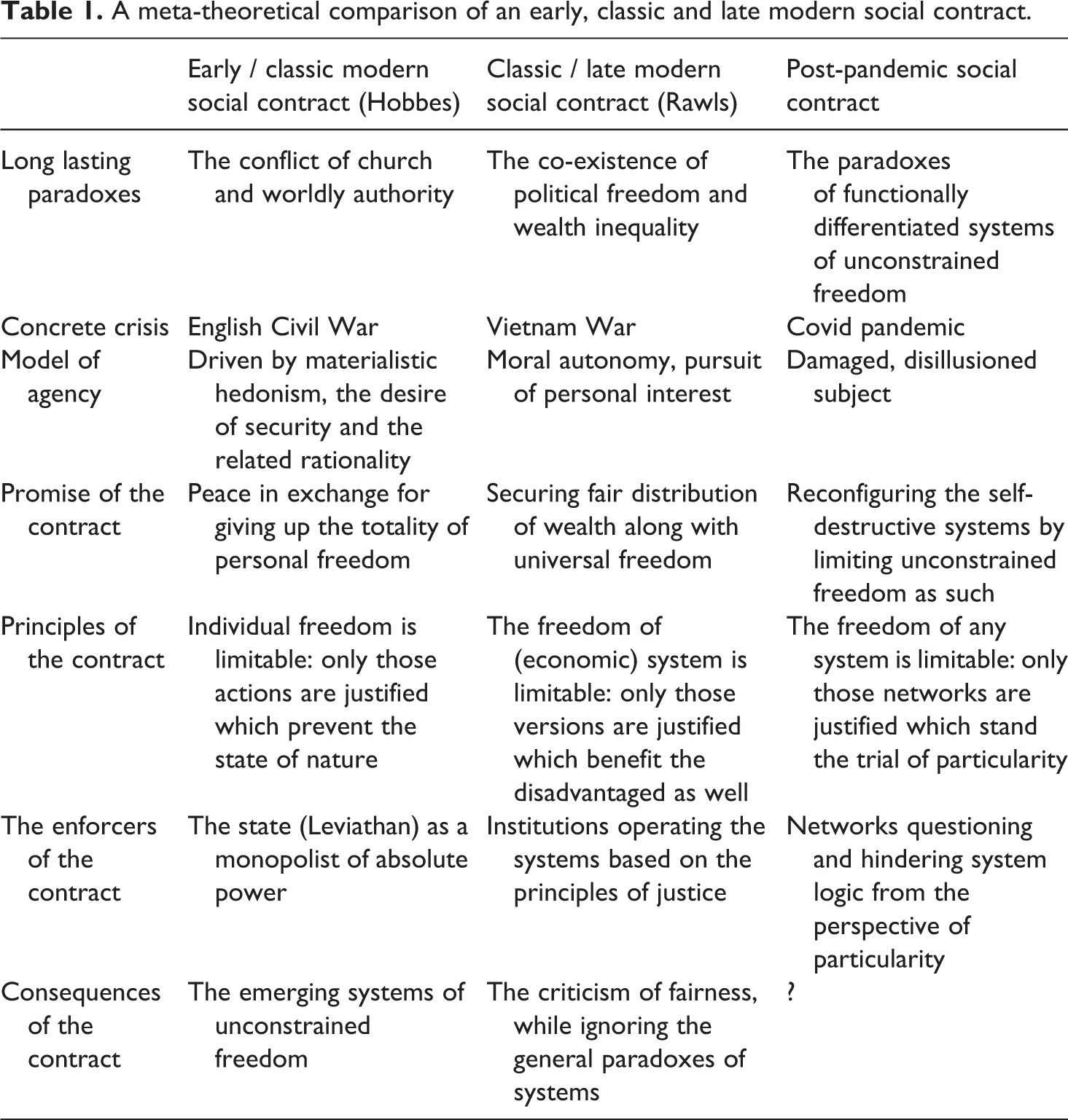
From the perspective of late modern damaged subjects, any system having unconstrained liberty threatens it with inevitable distortions. To prevent the actualizing of these potentials, the very logic enabling such spaces needs to be reconfigured. System justification is based on the universalistic principle of justice and the autonomous-egoistic subjectivity: social systems are legitimate because they allow the actors to pursue their individual goals within their specific spaces, while also pursuing commonly accepted constructs of general interest (e.g. free market as a means of producing the most value; free science as a means of dominating nature). To block the self-destructive unintended consequences of unconstrained systems, the institutions and praxes exclusively based on the universalistic principle of justice and the autonomous-egoistic subjectivity need to be tested by a trial of particularism.
In case of every business contract, the question may be raised: even if it is in accordance with the legal frames and the difference principle, would it be signed with someone who is perceived as a face? Is the contract not just legally adequate and fair in general, but also suitable for guests, friends or relatives? In case of every technological intervention affecting nature, the question may be raised: even if it is in accordance with the regulations, and based on the most accurate scientific knowledge, would it be applied on individual beings in emotional attachment? Is the technology not just safe from a universalistic perspective but also suitable for the environment cultivated by the subject, and for the sentient beings raised by the subject? If the answer to any of these questions is no, it means that the specific network fails the trial of particularism: even if it is justifiable by universal principles, the actors would not rely on it in their own personal network.
The reasons behind such evaluations are not generalizable by definition: they are based on moral sentiments close to hospitability or absolute responsibility. However, they do not have to be generalizable to be applicable: the purpose of the trial of particularity is to create a recurring pattern of obstacles within the social systems. The non-universal but widely practised reflection on the limitation of otherwise unconstrained systems, and the attempts of reconfiguring universally justifiable but particularly unacceptable ties, are already effective in slowing down or blocking the emergence of self-destructive unintended consequences. While these paradoxical consequences are often compatible with the universalistic social contracts, if recognized as being incompatible with the particularistic morality of the face or hospitability, their impact may be reduced. Even if it is not applied in a universalist fashion, but only in local settings, the trial of particularity could successfully address not just specific paradoxes of late modernity (such as inequality) but the general threat of recurring self-destructive potentials caused by the unconstrained systems.
Obviously, the goal of such a social contract is not the replacement of universal principles of justice with particularistic principles of responsibility – it needs no emphasizing that classic modern social contracts provide unmatched security for individual freedom. Its goal is neither the elimination of networks of global enterprises or industrial-technological infrastructures: this is neither feasible without potentially cataclysmic consequences, nor desirable (taking into consideration the lost benefits). Instead, the goal of such a social contract is to create obstacles within the networks in a random yet reliable way, so that these obstacles could become inherent boundaries of the otherwise unconstrained liberty. On a practical level, the particularity trial slows down the functionally optimized systems while buying valuable time to perceive their unintended risks. On a substantive level, it complements the principles of previous modern social contracts with a new layer: social networks could be critically evaluated from the perspective of the risk of the state of nature (Hobbes), the freedom of the individual and the fairness of differences (Rawls), and also the trial of particularity.
Of course the trial of particularity represents only the first step in the elaboration of a social contract reacting to the challenges of a post-pandemic world, while also addressing the paradoxes of late modernity. Those ‘enforcers’ also need to be described, which are responsible for applying the principles of particularity in various social contexts. While in the case of Hobbes the enforcer was the Leviathan, in the case of Rawls it is the institutional system built around the universal principles of justice; in the case of a post-pandemic contract, there are no easily identifiable enforcers. Due to the general tendency of disorganizing, liquification and acceleration, the social institutions dissolve, so they cannot be considered as trivial candidates of enforcing the trial of particularity. Instead, in a constellation lacking a stable, functionally differentiated structure, only the dynamically evolving networks themselves hold such potential. The trial of particularity relies on a naïve and lay perspective, unbounded by any system-based authority or knowledge. Accordingly, within a given network, anyone is entitled to initiate the trial of particularity, except for the representatives of the universalistic systems.
It is important to note that such a position is not to be institutionalized: it works only if not representing a decontextualized, automatized logic but remains an occasional, contextually embedded possibility. The initiators of the trial of particularity are inevitably ‘trouble-makers’ within their own networks: they sacrifice functional perfection for the sake of liveability. Even if the trial of particularity is a disruptive element, that does not mean it is dysfunctional as well. It has the specific functionality of opening spaces, which are independent from the universalistic logic of systems. Such a mechanism has a cost, when it comes to efficiency, but it has a benefit when it comes to sustainability. The space opened by the disruptive trial of particularity holds the potential of new networks to emerge, free from the blindspots of systems (i.e. the exclusivity of universal justice). The substantive criteria of such networks are undefined: because they resist the very logic of being based on universalistic principles, they can only be experienced by the actors within each network. All things considered, the most likely enforcers of the trial of particularity can be imagined as hybrid (human and institutional) ties, which are capable of mediating between the locally embedded actors and the universalistic, technologically operating systems. 9
If the principles of particularity are applied, a social contract may be enforced which could reconfigure the system dynamics being indirectly responsible for phenomena such as the Covid pandemic, and also the long-lasting paradoxes of late modernity. In other words, the post-pandemic contract enables a horizon of ‘restoration’ (for damaged subjectivities) and emancipation (for the disillusioned ones). Late modern management of the pandemic is full of paradoxes due to the incapability of finding an alternative to the universalistic system logic. The crises related to the unhindered network expansion are unresolvable by creating new ties; the dead-ends of vaccine-nationalism and vaccine-profiteering are unmanageable by relying on the existing institutional logic of nation-states and global enterprises; the collective identity crisis is not treatable by reifying biopolitical discourses and a public sphere hosted by the narratively reduced information society. Instead of these attempts, the particularity trial provides an alternative: if network expansion is limited by the criteria of inhabitability, then the networks enabling the pandemic may diminish; if strictly nationalist or profit-based countermeasures are limited by the logic of hospitability, the excluding and reifying relation to the global suffering may be replaced by solidarity; if the one-directional, mediatized, hierarchical expert discourses are replaced by undistorted face to face communication, then meaningful collective identities may emerge.
On a more practical level, the trial of particularity also might have relevance for the Covid countermeasures reconfiguring everyday life. In the extraordinary setting of the pandemic, the boundaries of normalcy are contested all around the world: not only the usual discursive frameworks and routines became inadequate, but also the principles of establishing new praxes. The questions concerning the extent of lockdown, contact tracing, mask or vaccine mandates represent some of those challenges, which catch the actors off-guard. The global answers ranged from extreme state rigour (represented by countries such as China; Yang, 2022) to the extreme reluctance to undertake state interventions (exemplified by countries such as Brazil; Dunn and Laterzo, 2021). While the former strategy involved a system-based sacrifice of individuals for the universal justice of ‘public interest’, the latter threatened collective demise caused by the lack of system level intervention. The trial of particularity could help to navigate between these two extremities by providing a critical basis for revaluating state interventions relying on universalist principles of justice.
The main targets of the trial are the biopolitical expert systems: the logic of particularity does not deny the importance of these institutions, rather it aims at differentiating between their paradoxical and sustainable forms. Instead of blindly following the universalistic principles of medical expertise and administrative power (leading to biopolitical suffering; Caduff, 2020) in each affected network, the question may be asked: would the applied lockdown, tracing or mask-wearing principles be applied on others perceived as a face? There is no universally justifiable answer to such questions: only the locally embedded members of various networks are entitled to provide responses.
It needs to be emphasized that not just any private affections or local customs represent a normative basis for criticizing the universalistic principles. Only those which are based on the ‘impossible moralities’ of the face or hospitability. In other words, the ones which refer to an ethical perspective transcending the formalized, universalistic accounts of justice (and the institutional mechanisms based on them), while representing ‘existential feelings’ (Ratcliff, 2012). By referring to those forms of biopolitically induced sufferance, which do not simply deprive the subjects from their abstract ‘human dignity’, but rather eliminate the possibility of existing as a face or perceiving the other as a face, a normative basis is established. In those cases, where the unconstrained application of universalistic biopolitical principles prevents the surfacing of the face, an exception is due. 10 Obviously, each exception weakens the functionality of the biopolitical complex – this is the cost of applying the trial of particularity. However, to maintain the general legitimacy of the medical principles, a chance is needed to create exceptions: even if it results in partial dysfunctionality, only in this way can the dehumanizing consequences of unconstrained biopolitics be hindered.
Beside normatively orienting the countermeasures of the pandemic, the proposed post-pandemic social contract has broader consequences as well. The forthcoming crises related to the paradoxes of the functionally differentiated systems of unconstrained freedom are likely to imply similar challenges. As the negative externalities of global capitalism manifest in the form of droughts, floods or extreme temperatures, the everyday economic praxes including production, exchange and consumption will require revaluation. As the negative consequences of information society result in overwhelmed and disoriented subjects and the consequent extreme polarization of political communities, the technologies and institutions of intersubjectivity will need to be reconfigured. Even if the trial of particularity does not imply any final answer to these challenges, it might succeed in providing tools for disrupting the unconstrained expansion of paradox systems and buying time for experimenting with corrective mechanisms. This way, it has the potential of not only saving what is salvageable from the structures of late modernity but, more importantly, of restoring the phenomenological horizon of freedom, which is desired by the increasing masses of late modern damaged and disillusioned subjects.
Footnotes
Declaration of Conflicting Interests
The author(s) declared no potential conflicts of interest with respect to the research, authorship, and/or publication of this article.
Funding
The author(s) disclosed receipt of the following financial support for the research, authorship, and/or publication of this article: Hungarian Academy of Sciences – Bolyai János Kutatói Ösztöndíj; Hungarian Research Fund – K134428.