







Abstract
Background:
Although many clinical trials are conducted on rotator cuff tears, a significant number of patient-enrolled studies remain unpublished, resulting in potential gaps in the sharing of scientific knowledge.
Purpose:
To analyze the publication rate and discontinuation percentage of registered trials involving rotator cuff pathology.
Study Design:
Cross-sectional study.
Methods:
A search for clinical trials was conducted in 4 different registries in a retrospective cohort study. Nontherapeutic studies, trials based on rehabilitation or anesthesia, or studies that had not completed recruitment and analysis before 2022 were excluded. The studies were classified according to their topic of interest, status in the registry, and funding. The sample size and study methods were also documented.
The existence of an indexed publication in PubMed and Embase was verified, along with the final sample size included and the type of study. The corresponding authors of unpublished studies were contacted to explore the fate of the research project. The reasons for trial discontinuation were registered.
Results:
Of the 152 included trials, 60 (39.47%) were not published in an indexed journal and 36 (23.68%) were discontinued. Studies of biological treatments presented a greater risk of discontinuation than trials on other topics (38.18% vs 15.46%; P = .03). One-third of published trials (27.17%) presented major inconsistencies concerning the original registry data.
Conclusion:
Approximately 40% of the trials on rotator cuff tears were not published. Research on biological therapies showed a higher rate of discontinuation.
Research involving human participants is based on altruism and trust. Patients participating in a clinical trial expect to contribute to advancing medical knowledge for a given condition. 7 However, many scientific projects in which patients are enrolled will never be published. 2 This results in publication bias, where study results are selectively published on the basis of their outcome or significance. 18 In 2005, the International Committee of Medical Journal Editors (ICMJE) implemented a policy requiring clinical trials to be registered in a public database before publication. 6 This policy responded to the need for all available evidence to inform health care decisions, not just the published evidence. The Declaration of Helsinki 24 states that every clinical trial must be registered in a publicly accessible database before the first participant is recruited. In accordance with the guidelines of the ICMJE, commonly accepted registries are defined as electronically searchable databases that are freely accessible to the public, open to all registrants, and managed by a nonprofit organization. The Declaration of Helsinki also advises researchers, sponsors, or editors to publish experimental results regardless of whether the therapies eventually prove harmful, as these results on toxicity or harm are of significant relevance. In brief, making informed decisions on any topic is difficult if there are suspicions of publication bias and selective reporting.
Research in the field of rotator cuff surgery has increased over the last 2 decades.10,11 Tendon augmentation, suture fixation, and biological treatments represent the current frontiers in rotator cuff research projects. 22 However, like any other field of medicine, it is not free from publication bias or selective reporting bias. A systematic review of 347 randomized controlled trials, across disciplines such as surgery, oncology, cardiovascular, or neurology research, found that >30% of trials were discontinued and 20% never made results publicly available (either in journals or trial registries). 19 Selective outcome reporting and failure to publish registered clinical trials are well-recognized threats to the integrity of medical research, including orthopaedic surgery. 4 Although the volume of rotator cuff–related clinical trials and systematic reviews has increased substantially, 21 it remains unclear how many registered studies ultimately reach publication and whether published reports remain faithful to their prespecified protocols. The present study aimed to analyze the publication status of rotator cuff trials listed in different registries. It also aimed to explore the discontinuation of registered projects involving shoulder surgery.
Methods
A retrospective cohort study was conducted to evaluate the outcomes of rotator cuff tear trials. Four different registries were examined to identify trials related to rotator cuff tear pathologies: ClinicalTrials.gov (CTG), European Union Clinical Trials Register, Australian New Zealand Clinical Trials Registry, and WHO International Clinical Trials Portal (WHOICTR). Up to 20 primary registries from various countries or continents are included in the WHOICTR portal. The included registries are electronic, publicly searchable databases that are open to all registrants and managed by a nonprofit organization. A flow diagram mapping the number of records identified, included, and excluded and the reasons for exclusion is shown in Figure 1. We used the STROBE (The Strengthening the Reporting of Observational Studies in Epidemiology) reporting guideline 23 to draft and edit the paper.

Flow diagram mapping the number of records identified, included, excluded, and the reasons for exclusions.
Search Strategy
A general search was conducted using the term “rotator cuff” in the “condition/disease” box for CTG or in the general search box for the other registries. This search strategy ensured that relevant studies on rotator cuff tears were not overlooked. The precise search used for each record is provided in the APPENDIX section and was performed in September 2023.
Selection Criteria
Registered trials were eligible for analysis when the following criteria were met: (1) therapeutic trials registered on the specified website portals, (2) trials investigating surgical or invasive treatments for rotator cuff tears (partial or complete), and (3) completed studies or those anticipated to be completed before the end of 2022 in the original registry. On the basis of similar previous studies,1,17 the deadline was selected to allow authors at least 24 months from study completion or recruitment finalization to manuscript publication. We excluded ongoing or “not yet recruiting” studies at the time of the search. Active studies anticipated to be completed before the end of 2022 were not excluded, as updates in registry status are not mandatory. Studies focused on different aspects of rotator cuff tears, such as rehabilitation/physical therapy, pain control, subacromial pain/syndrome, anesthesia techniques (nerve blocks or postoperative management), diagnostic imaging tests, shoulder arthroplasty/degenerative tears, or rheumatoid studies were also excluded. Additionally, duplicated records across different registries were excluded.
Data Extraction
Two reviewers (J.M. and A.V.F.) analyzed the eligible studies. The included records were categorized based on the following study purposes: (1) biological augmentation or stimulation procedures (platelet-rich plasma [PRP] injections, mesenchymal cells, or bone marrow stimulation); (2) surgical augmentation techniques (patches, scaffolds, and subacromial balloons); (3) characteristics and configuration of anchors for tendon suture (double-row suture techniques and suture anchor osteointegration); or (4) other (concomitant procedures such as biceps procedures or acromioclavicular procedures, and comparison of mini-open vs arthroscopic repair). The type of funding (public, industry, or no funding), trial design, sample size, year of trial initiation, and primary outcome were recorded. The trial status was also noted from the original website registry, categorizing the studies as “completed,”“active,”“prematurely stopped,”“withdrawn,” or “unknown status,” when available. The trials were categorized as “unknown status” when a trial passed its completion date and its status was not verified in >2 years. Trials with the status “prematurely stopped” or “terminated,”“withdrawn,”“unknown,” or “suspended” were considered “discontinued,” as adapted from previous studies. 16 The reasons for discontinuation were registered.
Publication Analysis and Study Results
Two individuals (J.M. and A.V.F.) reviewed the included studies to find subsequent publications that matched the trial registration. The searches were conducted in the PubMed and Embase databases using keywords from the trial registry and the names of the principal investigators. The search was performed in March 2025 to provide investigators with a minimum of 24 months between trial completion and study publication. Disagreements between reviewers were resolved by consensus. The criteria for considering the trial publications were based on previous studies1,4 and are listed in Table 1.
Definition of Publication Outcome for Registered Trials

The consistency between the study methodology reported in the registry and that of the final article was evaluated. We defined significant discrepancies using a modified version of the criteria previously reported by Chan et al, 3 as follows: (1) a prespecified primary outcome in the original registry was substituted for another outcome in the final publication, or (2) the trial did not ultimately achieve 90% of the target sample size. 1 Finally, the trial's corresponding authors were contacted by email when no publication match was found with the previous search. The present study protocol received institutional review board approval (2024/5091) and was registered in the Research on Research Registry (https://ror-hub.org/study/4686/).
Statistical Analysis
We used descriptive statistics for reporting study characteristics and the incidence of publication. A chi-square test was used to analyze the influence of the topic on the chances of publication, as well as the topic's impact on the final status of the trial. A t test for independent samples was used to explore the relationships between qualitative variables and quantitative data, such as sample size. Statistical significance was defined as a difference such that P was <.05.
Results
Description of Registered Trials
A total of 152 study registries were included in the analysis. Of these, 55 studies (36.2%) were categorized as biological stimulation therapies for rotator cuff, followed by 42 studies (27.6%) related to surgical augmentation techniques and 25 trials (16.4%) exploring rotator suture techniques and anchor characteristics. Biceps procedures and other therapeutic studies (such as nonoperative therapy and distal clavicle procedures) were represented by 30 registered studies (19.7%). Table 2 summarizes the procedures allocated to the different topics. Regarding the study design, 69.7% of the studies were randomized controlled trials, followed by prospective nonrandomized trials (17.8%), retrospective studies (7.2%), and safety/early-phase studies (5.3%). Most of the studies were sponsored by public institutions (n = 113; 74.3%), whereas 37 trials (24.3%) were industry-funded trials. Funding information was not available for 2 cases. The categorization of the trial status in the registry is shown in Table 3.
Influence of Trial Characteristics on Publication Chances a
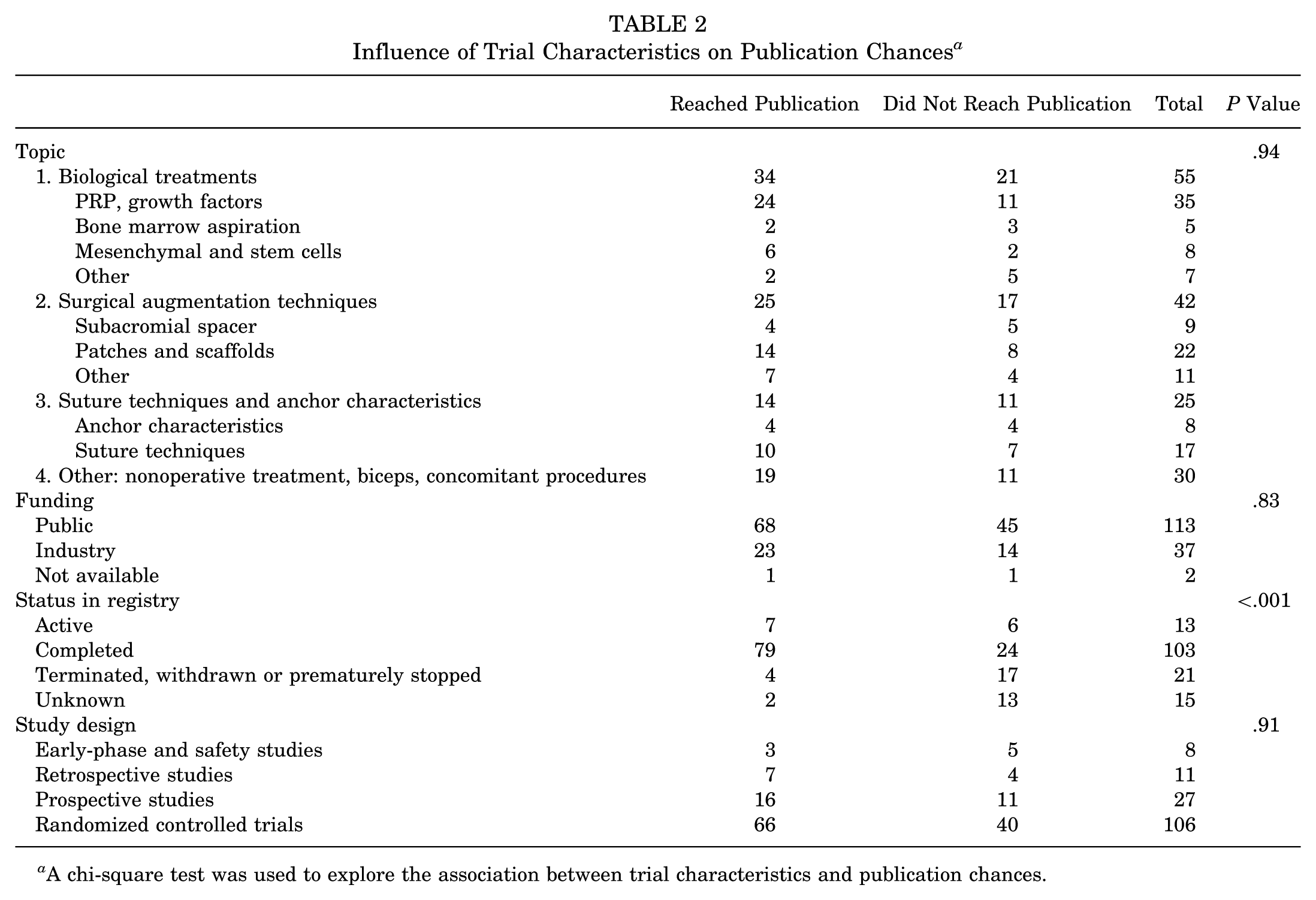
A chi-square test was used to explore the association between trial characteristics and publication chances.
Categorization of Trial Topic Concerning Final Status of the Trial a
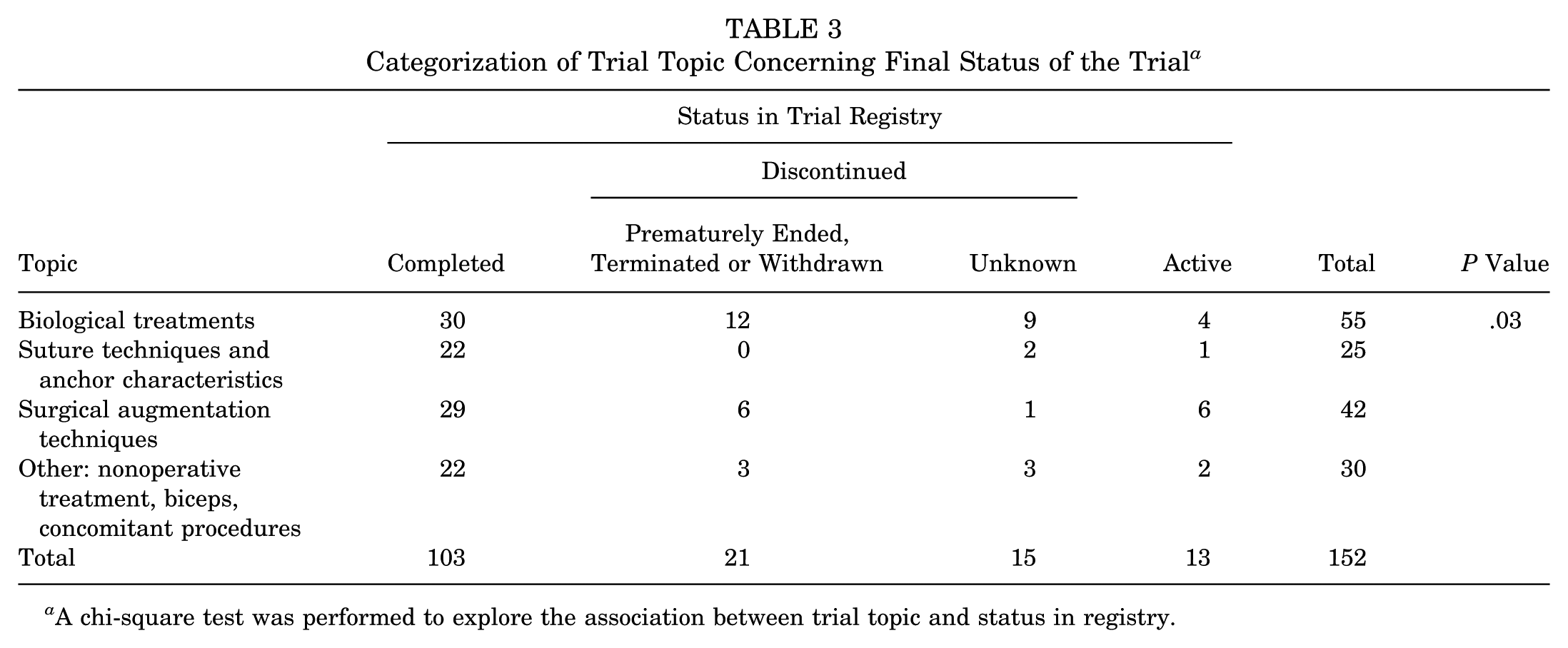
A chi-square test was performed to explore the association between trial topic and status in registry.
Publication Rate and Trial Status in the Registry
The overall publication rate for rotator cuff studies recorded in the registries was 60.5% (92/152). The trial topic, study design, or type of funding did not correlate with the likelihood of publication (P > .05). The trial status in the registry was significantly correlated with the likelihood of publication (P < .001) (Table 2).
A total of 36 studies (23.7%) were discontinued. Trials focused on biological therapies were significantly more likely to be discontinued (prematurely stopped, terminated, withdrawn, or unknown status) than trials on other topics (38.2% vs 15.5%; P = .03) (Figure 2).
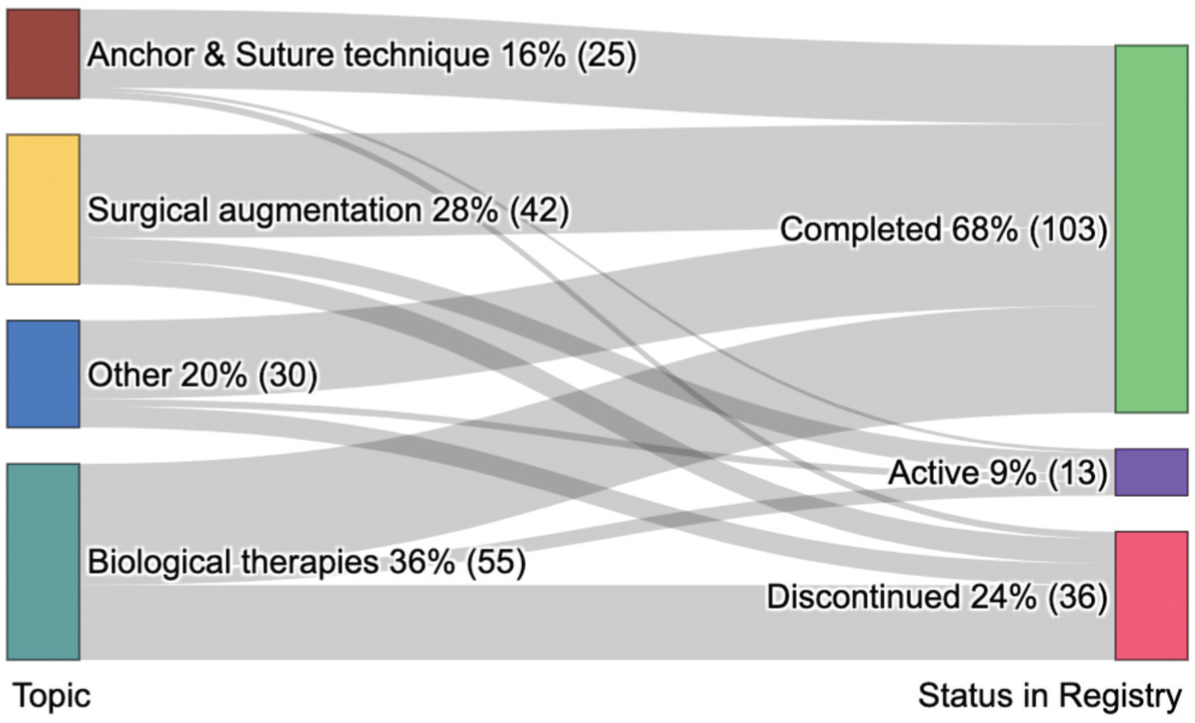
Sankey-flow diagram illustrating the status of clinical trials in registries by topic.
The reasons for trial discontinuation were not specified in the majority of cases (22/36 studies). Recruitment-related challenges were reported in 5 studies, and logistical issues were identified in 2 studies. Additional reasons for discontinuation included COVID-19–related disruptions, changes in the funding agency's priorities (without safety concerns or regulatory involvement), personal reasons, withdrawal of funding, failure of multicenter coordination, discontinuation of the research concept at the study stage, and changes in research personnel.
Finally, the unpublished project's principal investigator and project leader were contacted directly via email to further explore the publication possibilities and the reasons for nonpublication. Unfortunately, only 4 of 60 investigators contacted provided feedback on the trial status. Investigators cited several different reasons for nonpublication, including (1) technical issues, (2) ongoing study with delayed completion due to low participant recruitment, (3) changes in research focus, and (4) a manuscript of the project that was reportedly in preparation at the time of the inquiry.
Consistency Between Trial Registration and Publication
Among the published projects, 25 trials (27.2%) showed significant inconsistencies with the original registry regarding sample size or primary outcome selection. Eighteen trials did not achieve 90% of the target sample size, whereas 8 published trials substituted the original primary outcome. One publication presented both inconsistencies.
Discussion
Publication bias is a scientific and ethical problem that leads to the overestimation of new therapies. 20 Our study revealed that almost 40% of the registered trials were not published in peer-reviewed journals indexed in the PubMed or Embase databases. Furthermore, trials focused on rotator cuff biological therapies had a greater risk of being discontinued (withdrawn or prematurely stopped). The findings presented in this paper challenge the currently published benefits of new treatments for rotator cuff tears.
The number of systematic reviews and meta-analyses on the rotator cuff has substantially increased over the past decade. 9 A basic PubMed search for rotator cuff with the “Systematic Review” filter returned >900 articles when this article was submitted. Since 2020, >100 systematic reviews regarding rotator cuff tears have been published every year. Moreover, clinicians rely on the results of systematic reviews for clinical decisions, as these reviews synthesize the best evidence available, serving as a source of clinical guidelines. 5 Several meta-analyses have assessed the role of biological therapies in the management of rotator cuff pathology.25,26 The pooled analyses of randomized controlled trials indicate that PRP applied at the time of arthroscopic repair is associated with reduced retear rates and improved functional outcomes compared with control treatments. Our findings highlight the importance of accounting for trial discontinuation and nonpublication in meta-analytic syntheses to avoid potentially misleading recommendations. Moreover, the nonpublication of initiated trials may lead to overrepresentation of trials with positive results, favoring a given therapy in the medical literature. 18 This issue is illustrated by the example of the surgical augmentation technique using subacromial spacers, for which our study found that most registered projects have not been published. Among the 4 trials that have been published, 3 reported results favoring the intervention,13,15,21 whereas the remaining trial 14 was completed with a reduced sample size after an interim analysis based on futility criteria. The reasons for discontinuation or nonpublication of the remaining registered studies are unknown. Although early termination may occur for valid reasons, including unexpected findings or feasibility concerns, the absence of publicly available results limits the ability to fully contextualize the existing evidence. Accordingly, systematic reviews should consider trial discontinuation and incomplete dissemination to avoid potentially misleading conclusions.
The rate of discontinued trials (withdrawn, prematurely stopped, terminated, or with unknown status) for rotator cuff tear trials was 24%. This rate rose to 40% for biological rotator cuff therapies. However, 6 discontinued trials were published. This may explain why the topic of the trials is not related to publication rates, while the topic influences the discontinuation rate. This is the case for a trial exploring the benefits of a morphogenetic recombinant protein that was terminated for strategic reasons involving the funding company. However, the results were published and favor the use of the therapy, with less than half of the initially estimated sample size. 8 Whatever the reasons for discontinuation, prematurely ended trials present adverse consequences, as they may undermine patients’ trust in being enrolled in forthcoming trials for biological therapies in rotator cuff tears and could have a negative impact on researchers’ careers. 12
The present study has several limitations. First, the selected time interval from study completion or recruitment finalization to manuscript publication may have limited the opportunity for some studies to reach publication, particularly those requiring extended follow-up or complex analyses. Nevertheless, despite this relatively short observation window, the publication rate observed in our cohort was not among the lowest reported in the orthopaedic literature, suggesting that the chosen deadline did not substantially underestimate publication outcomes.2,15 Second, the response rate obtained from the principal investigators of projects that were not published was extremely low. Consequently, the reasons for nonpublication could not be explored. Unfortunately, this limitation aligns with similar publications. 16 Although the reasons provided by respondents are reported in the manuscript, these may not fully capture the broader factors contributing to nonpublication. Beyond investigator-reported explanations, structural and systemic challenges in the contemporary research and publishing environment may also influence the dissemination of scientific knowledge. Third, 2 databases were used to find potential publications for the registered projects. Additional database searches may have influenced the final publication rate results.
Conclusion
The rotator cuff trials had a moderate publication rate of 60%. However, trial discontinuation, particularly for biological therapies, was common and often occurred for unspecified reasons. Furthermore, a notable proportion of published trials (27.2%) showed inconsistencies with their original registry data, highlighting ongoing challenges in research transparency and trial completion.
Footnotes
Appendix1
Search strategy
Final revision submitted February 16, 2026; accepted March 6, 2026.
The authors declared that they have no conflicts of interest in the authorship and publication of this contribution. AOSSM checks author disclosures against the Open Payments Database (OPD). AOSSM has not conducted an independent investigation on the OPD and disclaims any liability or responsibility relating thereto.
Ethical approval for this study was obtained from Institut d’Investigació i Innovació Parc Taulí, (I3PT) (reference No. 2024/5091).
