







Abstract
Background:
Injectable orthobiologics such as platelet-rich plasma (PRP), mesenchymal stem cells (MSCs), and autologous protein solution (APS) have gained popularity as regenerative options for knee osteoarthritis (OA). Despite widespread clinical and public interest, evidence from randomized controlled trials (RCTs) remains heterogeneous, and public understanding may be shaped more by media representation than by data-driven evidence.
Purpose:
To synthesize the current evidence on injectable orthobiologics for knee OA and evaluate whether media portrayals align with the strength and quality of available clinical evidence.
Study Design:
Systematic review; Level of evidence, 1.
Methods:
A dual-pronged systematic review was performed on March 31, 2025, following Preferred Reporting Items for Systematic Reviews and Meta-Analyses guidelines. MEDLINE, Embase, and Web of Science were searched for RCTs comparing injectable orthobiologics (PRP, MSCs, APS) versus placebo (saline or sham) in knee OA. Study quality was assessed using the Cochrane Risk of Bias 2 tool. In parallel, the Factiva database was searched for English-language news articles reporting on injectable orthobiologics for knee OA. Extracted variables included biologic type, benefits and drawbacks discussed, and tone (favorable, neutral, or cautionary).
Results:
Of 869 articles, 14 RCTs met the inclusion criteria. Eight demonstrated significant improvements in pain and 10 in function following orthobiologic injections, although heterogeneity and risk of bias were frequent. The media review identified 124 relevant articles from 3482 potential articles: 79.0% highlighted therapeutic benefits, only 29.8% mentioned drawbacks, and 37.1% used the term stem cell without specifying the product. Mentions of commercial entities occurred in 35.5% of articles, with no corresponding disclosures. Overall, 66.1% of media articles were favorable in tone.
Conclusion:
Our review showed that while RCT evidence remains inconsistent, media portrayals of orthobiologics are predominantly positive, often lacking nuance or acknowledgment of uncertainty. This disconnect may encourage unrealistic expectations and premature adoption of these therapies.
Knee osteoarthritis (OA) is a prevalent degenerative joint condition that leads to chronic pain and loss of mobility, decreasing an individual's function and quality of life. 29
Recently, there has been growing interest in the use of regenerative medicine for knee OA, particularly orthobiologics, as potential alternatives for earlier intervention. Intra-articular injectable orthobiologics have been increasing in popularity, with various forms such as platelet-rich plasma (PRP), mesenchymal stem cells (MSCs), and autologous protein solution (APS) becoming increasingly available. 3 These injectable biologics are either autologous or allogenic and can be derived directly from a patient's whole blood, bone marrow, or adipose cells. 33 The biologics aim to leverage the body's own healing mechanisms by delivering growth factors, anti-inflammatory cytokines, or regenerative cells to the intra-articular environment. 15 While a growing number of studies have evaluated the efficacy of these therapies, the evidence remains heterogeneous. Guidelines remain cautious, recommending against the routine use of intra-articular orthobiologics for knee OA. 12 Inconsistencies in the guidelines and heterogeneity in study methodologies result in conflicting and confusing messages, worsened by ambiguous nomenclature and low-quality evidence. 33
Parallel to the increasing scientific interest, public interest, fueled in part by media coverage, has grown substantially. A study analyzing search engine trends identified growing interest in PRP for knee OA since 2009. 5 The media often serve as the first point of contact for patients seeking alternative therapies and may influence perceptions, treatment expectations, and decision-making.
However, the accuracy, tone, and framing of media coverage may not always align with the scientific evidence, potentially leading to misinformation or overestimation of benefit. Language choices, anecdotal framing, and commercial influences can distort perceptions, contributing to misinformation and unrealistic expectations. 26 This potentially inaccurate reflection of the academic literature might also lead to misleading or incorrect interpretations of available evidence and even misallocation of health care resources by affecting demand.2,31
While reviews regarding the use of orthobiologics for knee OA have been published, no prior review has simultaneously analyzed the literature and its portrayal in the news media, to our knowledge. Assessing for any exaggerated benefits or misalignments in recommendations between clinical evidence and public messaging may influence behavior, resource utilization, and patient-clinician interactions.
Therefore, the aims of this study are to synthesize the current body of evidence on the use of injectable orthobiologics for knee OA and assess the portrayal of these therapies in the media. We hypothesized that these therapies are portrayed positively without nuance in the media.
Methods
Systematic Review
The contents of this review were synthesized with reference to the Preferred Reporting Items for Systematic Reviews and Meta-Analyses guidelines. 24 The protocol for this combined review of the academic literature and news media was not prospectively registered due to the exploratory nature of its dual-review design.
Medline, Embase, and Web of Science electronic databases were searched systematically on March 31, 2025. Keywords and terms used were synonymous with knee osteoarthritis; orthobiologics, including platelet-rich plasma; mesenchymal stem cells; and autologous protein solution. The search was limited to articles written in English. The search strategy can be found in the Appendix.
Study Selection
Eligible studies were randomized controlled trials (RCTs) evaluating intra-articular injection of orthobiologics versus placebo (saline or sham). Studies were excluded if they were non-RCTs or included other intra-articular knee injection therapies such as viscosupplementation or corticosteroids to isolate the efficacy of orthobiologics alone. Orthobiologics included in the review included PRP, MSCs, APS, stromal vascular fraction (SVF), and amniotic suspension allograft (ASA).
The inclusion of an article was evaluated by an independent pair of authors (E.Z.J.X. and R.T.W.L.), with any disagreements resolved by consensus with a senior author (B.W.L.T.).
Data Extraction
Data extraction was performed to extract study characteristics (orthobiologic used, sample size, follow-up duration), as well as postintervention outcomes by both authors (E.Z.J.X. and R.T.W.L.).
Risk of Bias
The risk of bias in randomized trials was assessed with the Risk of Bias 2 (RoB 2; the Cochrane Collaboration) tool. 30 The RoB 2 tool is a specialized tool structured into fixed sets of domains of bias, ultimately categorizing studies into various levels of risk of bias: low, moderate, serious, and critical. It provides a structured and comprehensive approach to assessing interventions through signaling questions to determine overall risk. 30 Risk was evaluated by an independent pair of authors, with any disagreements resolved by consensus with a senior author (B.W.L.T.).
Media Review
A review of the news media was also completed. With no established media review guidelines, the methodology for this review was devised with reference to a similar previous study. 8 The Factiva (Dow Jones & Company) database was searched on March 31, 2025, for relevant news media articles. Search terms synonymous with knee OA; orthobiologics, including PRP; mesenchymal stem cells, and autologous protein solution, were used. The search strategy can be found in the appendix. Articles were included if they were written in English and discussed the use of injectable orthobiologics for knee osteoarthritis. They were excluded if the use of orthobiologics was for augmentation of soft tissue repair or reconstruction and if the articles were press releases, financial statements, patent announcements, or stock market reports. All articles were reviewed by an independent blinded pair of authors (E.Z.J.X. and R.T.W.L.), with any disagreements resolved by consensus with a senior author (B.T.W.L.).
Information extracted included the year of publishing, the benefits and drawbacks discussed of orthobiologics, and any other relevant information. The articles were also classified on the basis of article type, as well as the overall tone of the article. The tone of the article was classified into 3 categories: favorable, neutral, and cautionary. Two independent authors (E.Z.J.X. and R.T.W.L.) assessed the tone of each included article, with any disagreements resolved by consensus with a senior author (B.T.W.L.). These characteristics were summarized using descriptive statistics. Categorical variables (eg, orthobiologic type mentioned, benefits and drawbacks discussed, and article tone) were reported as frequencies and percentages and presented in summary tables. Temporal trends in media coverage were presented by plotting the number of included articles per year.
Results
Randomized Controlled Trials
A systematic search of the literature produced 1039 references, with 869 remaining after removal of duplicates. A total of 48 full-text articles underwent review, of which 14 were subsequently included* (Figure 1). A summary of the studies is displayed in Table 1.

Preferred Reporting Items for Systematic Reviews and Meta-Analyses flow diagram of included studies.
Summary of Included Studies a
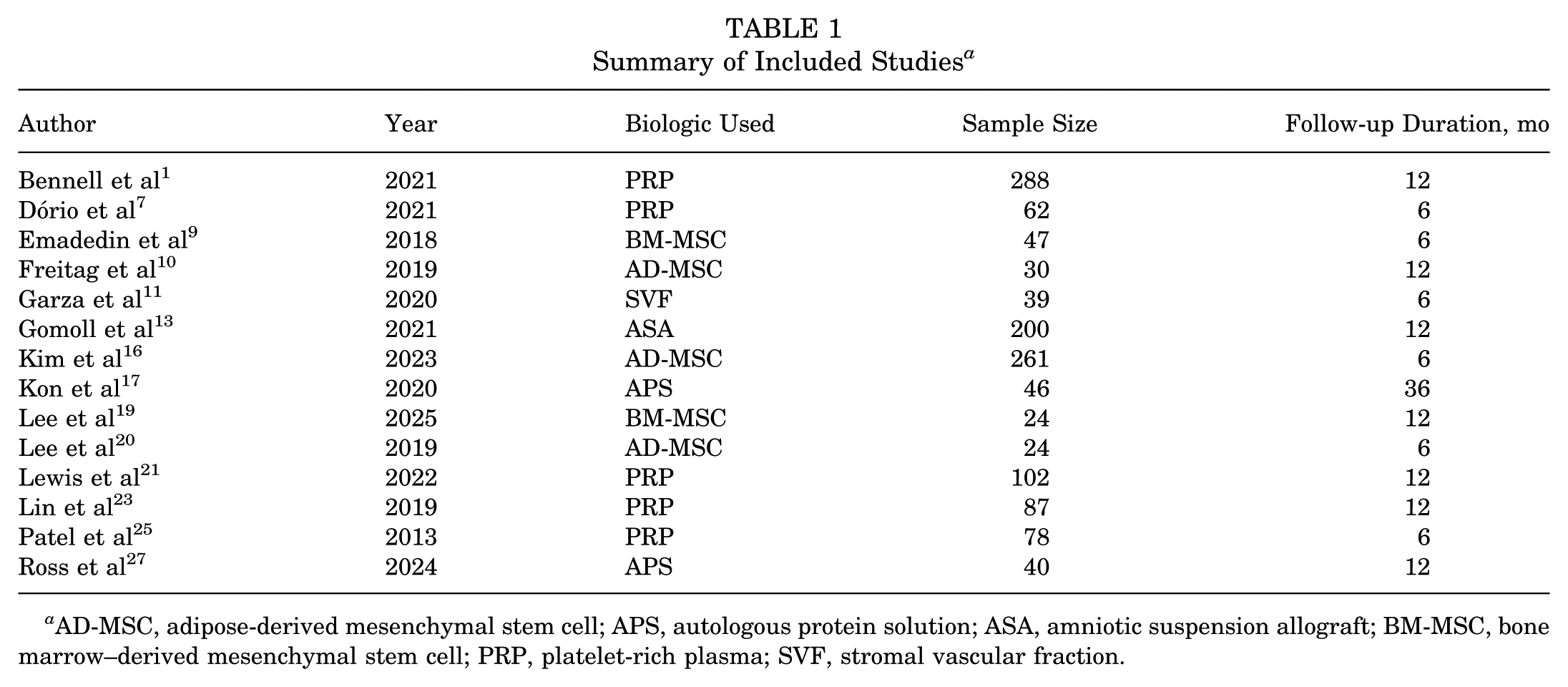
AD-MSC, adipose-derived mesenchymal stem cell; APS, autologous protein solution; ASA, amniotic suspension allograft; BM-MSC, bone marrow–derived mesenchymal stem cell; PRP, platelet-rich plasma; SVF, stromal vascular fraction.
Of the 14 included trials, 5 were about PRP,1,7,21,23,25 3 on adipose-derived mesenchymal stem cells,10,16,20 2 on bone marrow–derived mesenchymal stem cells,9,19 2 on APS,17,27 1 on ASA, 13 and 1 on SVF. 11
The main benefits reported in the trials were pain and function improvement. Eight of the trials reported significant improvement in pain, and 10 reported significant improvement in function in the group receiving orthobiologics (Table 2).
Benefits Reported in Included Studies

The main adverse effects of the orthobiologics reported were pain (10 studies), stiffness (4 studies), swelling (9 studies), and harvest site injury (2 studies) (Table 3). One study reported additional adverse effects from PRP: syncope, dizziness, headache, nausea, gastritis, sweating, and tachycardia.
Adverse Effects Reported in Included Studies

Risk of Bias
The risk of assessment of randomized studies is shown in Figure 2.

Risk of Bias 2 assessment of included randomized controlled trials.
Media Publications
A search of the media news database produced 3482 results initially. A total of 152 full-text articles underwent review, of which 124 were subsequently included (Figure 3). Media publication categories are displayed in Table 4.

Preferred Reporting Items for Systematic Reviews and Meta-Analyses flow diagram of included news media articles.
Media Publications by Categories a

The sum of proportions adds up to more than 100% as some articles discussed more than 1 aspect. AD-MSC, adipose-derived mesenchymal stem cell; APS, autologous protein solution; BM-MSC, bone marrow–derived mesenchymal stem cell; PRP, platelet-rich plasma.
Of the included media publications, 35.5% included a specific product name, company, or health care facility (hospital or private clinic), 79.0% talked about the benefits of injectable orthobiologics, and 29.8% raised potential drawbacks of such therapies.
The most discussed orthobiologic was PRP, with 60.5% of media publications including PRP. Of the media publications, 37.1% did not specify the orthobiologic and used the term stem cell generically without referring to MSCs, SVF, and so on.
The benefits brought up in the media publications were pain relief, improvement in function, and delaying or serving as an alternative to joint replacement. The drawbacks brought up included those of cost, lack of high-quality evidence, and exaggeration of benefits. Benefits and drawbacks discussed in media publications, as well as categories of the orthobiologics used, are summarized in Tables 5 and 6.
Aspects Discussed in Media Publications, Summarised a

The sum of proportions adds up to more than 100% as some articles discussed more than 1 aspect.
Aspects Discussed in Media Publications a

The sum of proportions adds up to more than 100% as some articles discussed more than 1 aspect. TKR, total knee replacement.
Of the media publications, 66.1% (n = 82) had a favorable tone toward injectable orthobiologics, while 18.5% (n = 23) had a neutral tone and 15.3% (n = 19) had a cautionary tone.
The increase in the number of media articles published annually is portrayed in Figure 4. The year with the highest number of media publications regarding injectable orthobiologics was 2018, followed by 2019 and 2022.
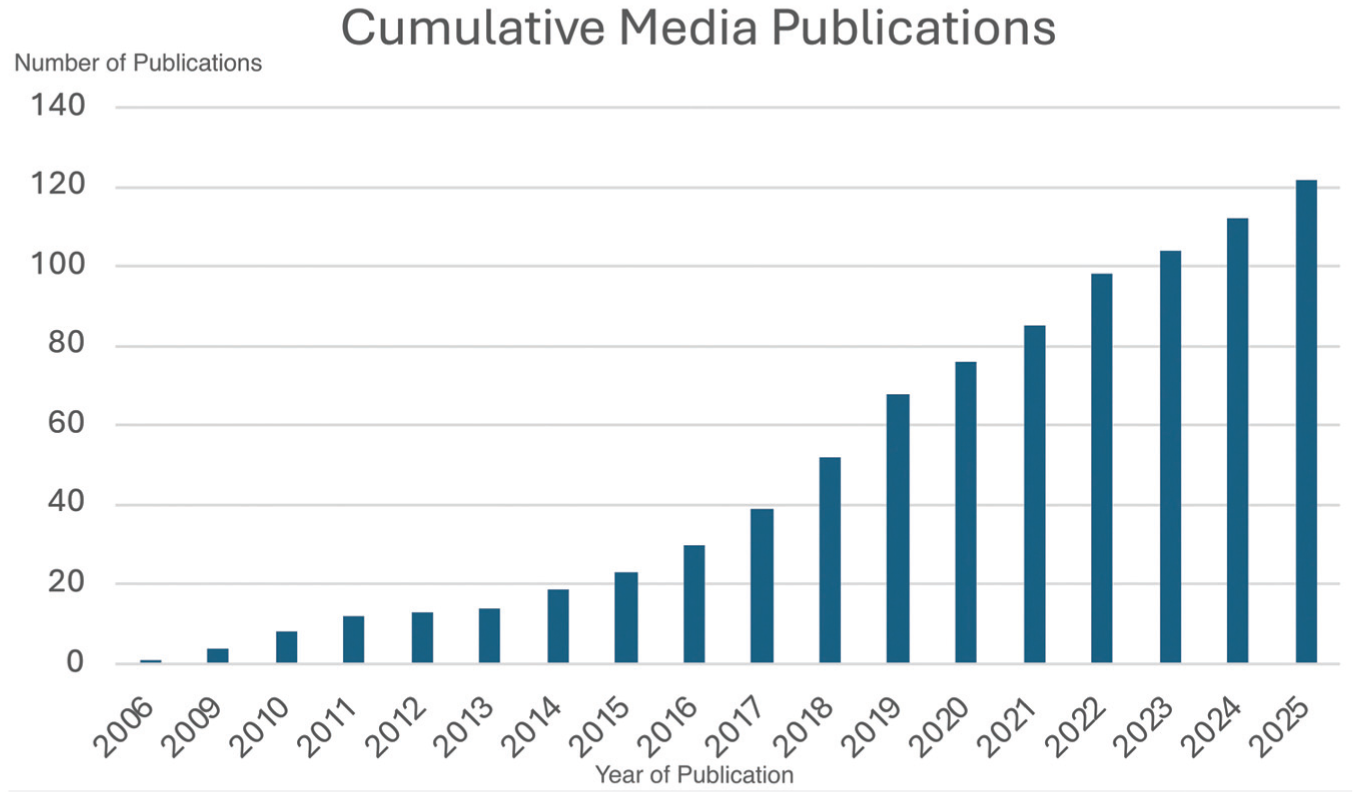
Cumulative media publications.
Discussion
The major findings of our review demonstrate that the literature suggests a potential symptomatic benefit of injectable orthobiologics, but with substantial heterogeneity and variable study quality, while media portrayals were predominantly optimistic and often lacked balance.
This dual-pronged review provides a comparative analysis of the academic literature and media portrayal of injectable orthobiologics for knee OA. Based on the type of injectable orthobiologics discussed and studied, there is a markedly greater interest in PRP in both the scientific community and in the media sphere. However, there are noticeable differences between the results discussed and reported in academic literature and the media portrayal of injectable orthobiologics.
The evidence remains limited by heterogeneity in trial design, outcome measures, and risk of bias, as echoed by prior meta-analyses, which have reported variable results and statistical fragility.4,6,14,18
In contrast, media portrayal of injectable orthobiologics was largely optimistic and positive. Articles highlighting the potential benefits of orthobiologics often lacked nuance and balance, with only 29.8% of media publications including the drawbacks of the therapies. In total, 37.1% of articles referred to orthobiologics vaguely as “stem cells,” without specifying their source or the type of biologic used. Articles also talked about how professional athletes were already using therapies such as PRP. These raise concerns about the potential oversimplification and sensationalism common in media publications. A prior study analyzing health news stories in the United States stated a high proportion of news stories failed to adequately address costs, harms, benefits, the quality of the evidence, as well as the existence of other options when covering health care products and procedures, raising potential concerns regarding the quality of health information disseminated. 28 Although the study was conducted a significant number of years ago, predating social media's explosion, we believe the same issues still hold true today.
In addition, 35.5% of media publications had specific names of products, clinics, or companies involved, with no article mentioning any commercial disclosure, raising concerns for commercial bias or promotional intent, especially when specific clinics are promoted.
It is worth noting that this might not be exclusive to media publications, as a study found that most exaggeration in health-related science news was already present in academic press releases, possibly due to the increasing culture of competition and press releases. 32 The issue with exaggeration is multifactorial, and more must be done to better understand the origin of such claims.
These findings reveal a significant gap between evidence and public discourse. Media coverage may lead to patient misconceptions, inflated expectations, and the demand for unproven or premature interventions. Given the rising popularity of orthobiologics and the direct-to-consumer marketing often associated with them, clinicians must be prepared to counsel patients using evidence-based recommendations and a critical appraisal of available therapies. We recommend that professional bodies consider issuing clearer public-facing guidance or position statements to help contextualize emerging therapies and mitigate hype-driven utilization.
However, it is also important to acknowledge that the continued use and promotion of orthobiologics, despite heterogeneous findings in the literature, may reflect the unmet needs among patients with knee OA. Individuals may experience inadequate relief with nonsurgical treatment, yet may not be immediate candidates for surgical intervention. In such therapeutic gray zones, clinicians and patients may seek alternative options, even in the absence of definitive evidence. Within this context, the media's predominantly optimistic tone—often emphasizing innovation, celebrity endorsements, or anecdotal success—may not solely reflect commercial interests or misinformation. It may also represent a response to genuine public interest and demand for novel interventions. These narratives may fill a void left by inconsistent scientific guidance and limited regulatory clarity alongside limited high-quality evidence. Recognizing this dynamic highlights the broader tension between the ideals of evidence-based medicine and the realities of clinical practice, where patient demand and physician practices and pragmatism converge. Addressing this gap will require not only rigorous clinical research but also proactive and transparent communication from both the scientific community and health care providers.
The strengths of this review include a double-pronged approach to assess both academic literature and media publications. We were able to assess for trends in messaging and information relayed to the public. It highlights the imperative for more rigorous, high-quality RCTs to define the therapeutic value of orthobiologics and for improved public-facing communication.
Following recent developments in our world and the rise in misinformation, there is an increasing need for information conveyed to be accurate and truthful, whether in academic literature or the news media. Media publications greatly influence public thinking and perception, and it is crucial that the information the public receives from media outlets accurately portrays the material. 22 Health care specialists also have a responsibility to provide a balanced picture of what they are consulted on and should strive to be as transparent as possible. New advances should be celebrated and discussed, but the potential drawbacks and adverse effects should be shared as well.
However, this review also has limitations. There is currently no established protocol for news media literature reviews, and we have referenced previously published articles for our methodology. However, this limits reproducibility. The search is highly unlikely to have been comprehensive due to the limited search on a single database and restriction to a single language, as well as the variable and broad definitions with reference to the various types of orthobiologics. In addition, we elected to limit the RCTs included to only those of biologics against saline placebo or sham injections, as compared to including comparisons against viscosupplementation and corticosteroid injections. This is because we wanted to assess whether these biologics could be considered a viable therapy for knee OA, rather than evaluate whether they were superior to existing therapies. Additionally, tone assessment, although independently conducted, may carry inherent subjectivity.
Conclusion
Our review showed that while RCT evidence remains inconsistent, media portrayals of orthobiologics are predominantly positive, often lacking nuance or acknowledgment of uncertainty. This disconnect may encourage unrealistic expectations and premature adoption of these therapies.
Our findings underscore the need for balanced, evidence-based communication to align public perception with scientific reality, ensuring responsible clinical translation of orthobiologic interventions.
