Abstract
Background:
Grit (perseverance for long-term goals despite obstacles1) has been associated with athletic success. Childhood sport participation may promote higher grit in adulthood2. Athletic identity also influences sport performance. Given the physical and psychosocial challenges following injury, this study aimed to determine whether sport specialization level is associated with grit and athletic identity among adolescents with and without musculoskeletal (MSK) injuries.
Hypothesis:
We hypothesized that higher sport specialization levels would be associated with higher grit and athletic identity, after adjusting for recent MSK injury.
Methods:
We conducted a cross-sectional study of adolescents who completed the Short Grit Scale (Grit-S), Wisconsin Sport Specialization Questionnaire (WISSQ), Jayanthi Specialization Scale, and Athletic Identity Measurement Scale (AIMS). We compared demographic, sport specialization, grit, and athletic identity variables between those with an injury (sport-related injury sustained within one month) and those without (no injury in the past six months) using independent t-tests and chi-square analyses. We then constructed two multivariable linear regression models to evaluate the association between injury status and sport specialization level with grit and athletic identity ratings, adjusting for the effect of age and sex.
Results:
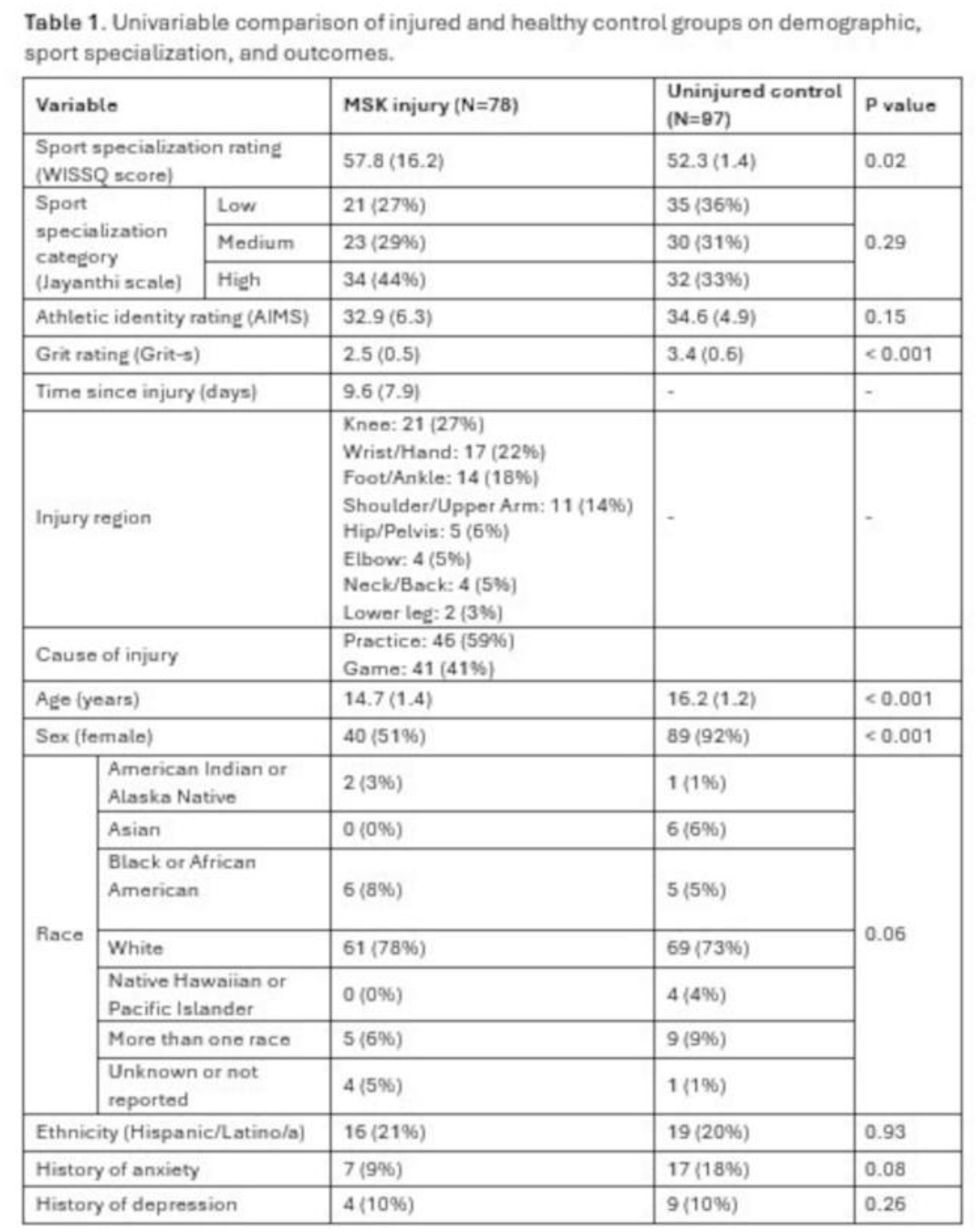
A total of 175 adolescents were evaluated: 78 with acute MSK injury (mean age = 14.7 ± 1.4 years) and 97 uninjured (mean age = 16.2 ± 1.2 years). The MSK injury group was significantly younger and had a higher proportion of females (p < 0.001). The injured group also reported higher sport specialization via the WISSQ than the uninjured group, but the groups did not significantly differ using the Jayanthi scale (Table 1). Univariable evaluation also identified that the MSK injury group reported significantly lower grit than the uninjured group, but non-significantly different athletic identity ratings (Table 1). Results from the multivariable regression models indicated that MSK injury and older age were significantly associated with lower grit, after adjusting for covariates (Table 2). Additionally, higher WISSQ sport specialization was significantly associated with higher athletic identify, after adjusting for injury status, sex, and age (Table 2).
Conclusion:
Adolescents with acute MSK injuries demonstrated significantly lower grit but similar athletic identity relative to uninjured peers. Reduced grit may reflect inconsistent training, suboptimal load management, or adherence to safety practices, potentially increasing injury risk. Greater specialization, as measured by WISSQ, was associated with both MSK injury and higher athletic identity. These findings support the need for targeted counseling of highly specialized youth athletes and suggest the WISSQ may be a valuable screening tool.