Abstract
Background:
Female athletes are more likely to suffer a concussion compared to their male counterparts.(1) Past work has suggested sex differences exist in various concussion outcomes, but findings remain variable.(2) Even less is known about the effect of oral contraceptive pills (OCP) on concussion outcomes in females. Limited evidence suggests that OCPs may act as a protective factor following concussion due to their hormone regulation properties.(3) Our study aimed to evaluate the interaction between recent concussion and OCP use among adolescents on a variety of patient reported mental health and quality of life outcomes.
Hypothesis:
Both concussion status and OCP use would be associated with impaired mental health and quality of life outcomes.
Methods:
Adolescent female participants were enrolled into one of two groups: concussion or control. Participants were then grouped by self-reported OCP use on The Low Energy Availability in Females Questionnaire (LEAF-Q). Participants also reported anxiety and depressive symptoms via the Hospital Anxiety and Depression Scale (HADS) and mobility and fatigue domains via the Patient-Reported Outcomes Measurement Information System Global Pediatric 25 (PROMIS-25). A series of 2x2 ANOVAs assessed main effects and interactions of concussion (concussion/control group) and OCP use (yes/no) on four measures: anxiety symptoms, depressive symptoms, mobility, and fatigue.
Results:
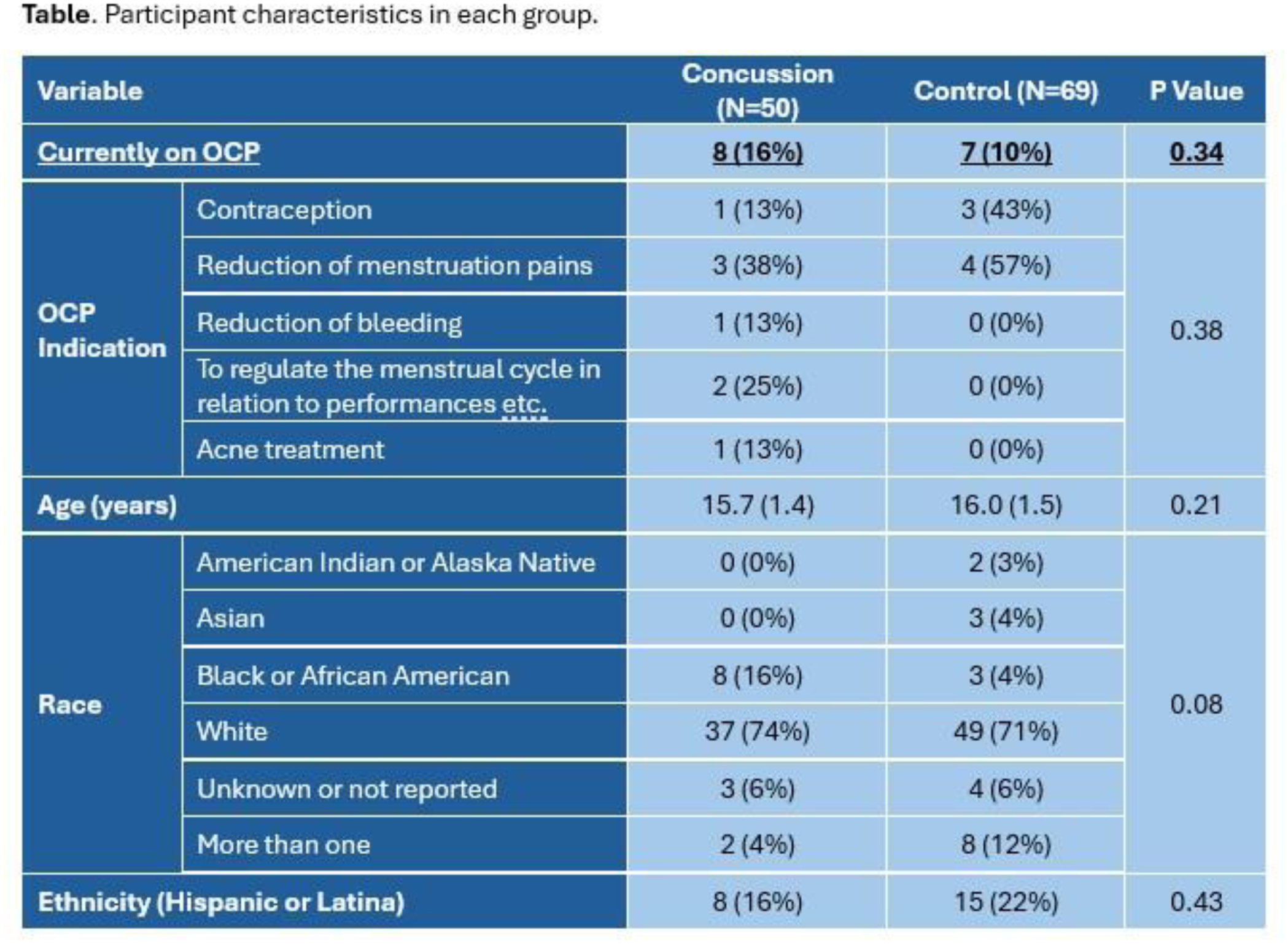
We enrolled 119 adolescent female participants: N=50 with recent concussion (13.1±4.6 days post-concussion, Table) and N=69 uninjured controls (Table). OCP use did not differ significantly between groups (Table). We identified significant main effects of concussion status on depressive symptoms (Figure 1B), mobility (Figure 1C), and fatigue (Figure 1D), where the concussion group reported significantly worse ratings than the control group, independent of OCP use. In addition, we identified a significant main effect of OCP use on mobility (Figure 1C), where those on OCPs reported more severe mobility impairments, independent of concussion status. There were no significant interactions identified, nor were there any significant effects for anxiety severity.
Conclusion:
We did not observe any direct interaction between concussion and OCP use on mental health outcomes among adolescent female athletes. However, we did show that concussion participants are more likely to experience depressive symptoms, mobility impairments, and fatigue compared to controls. These findings support the need for clinicians to address mental health and quality of life during concussion evaluations, regardless of OCP use. Future work should explore the associations between concussion and OCPs across a broader range of outcomes.